

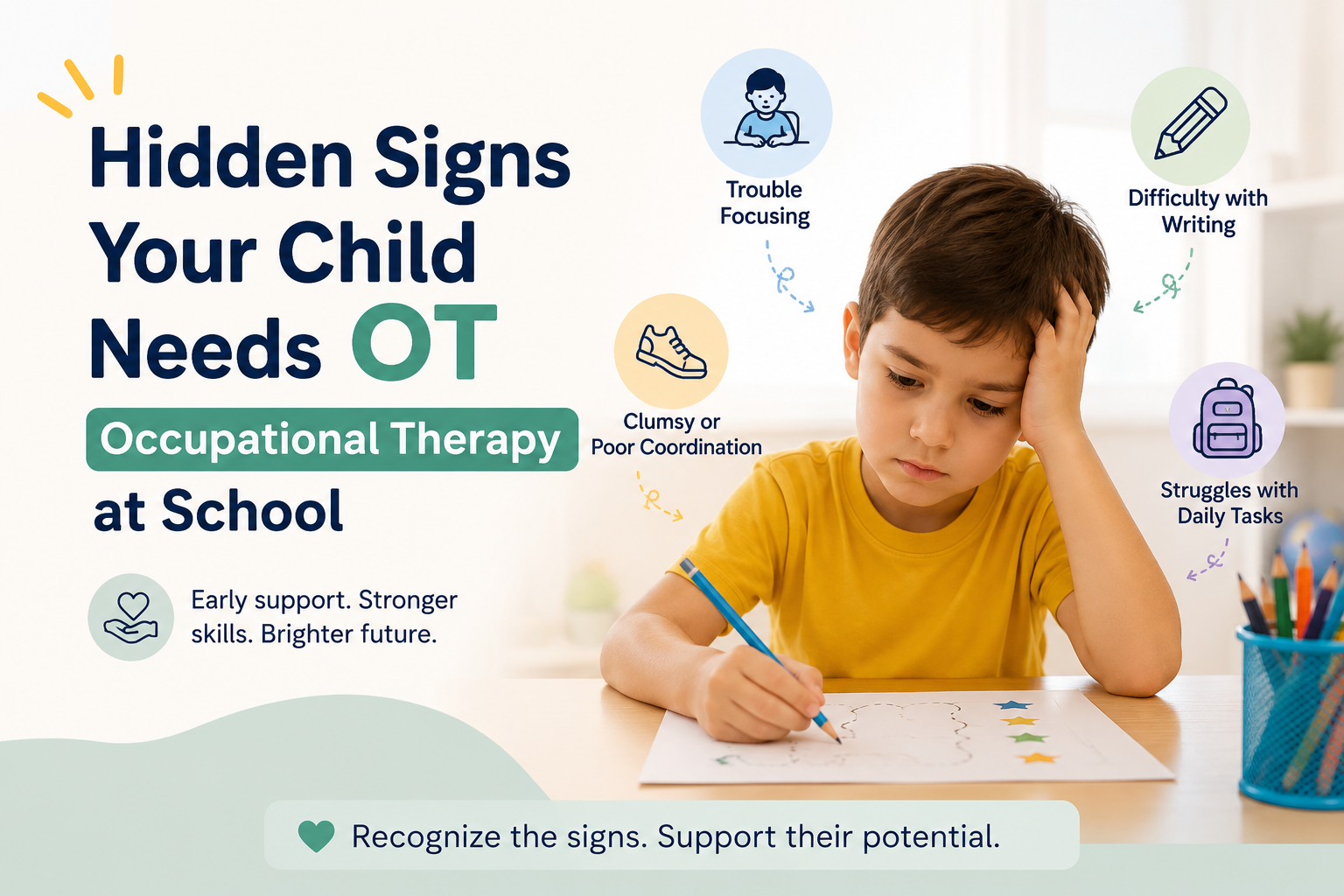
Hidden Signs Your Child Needs OT Occupational Therapy at School: 2026 Complete Parent Guide 💛
🏫 Is your child struggling in school but nobody can explain why? These hidden signs mean your child needs OT occupational therapy — and most parents miss every single one. Discover the complete 2026 checklist now. 💛👇

- 🌟 What Are the Hidden Signs a Child Needs OT Occupational Therapy at School?
- 📊 School OT Occupational Therapy — Key Statistics 2025–2026
- 🧠 What Does OT Occupational Therapy at School Actually Do?
- 🚨 The Complete Guide to Hidden Signs Your Child Needs OT Occupational Therapy at School
- Category 1: Hidden Classroom Signs 📚
- 1.1 The Pencil Problem — Far More Than Handwriting
- 1.2 The Scissors Signal
- 1.3 The Desk Avoidance Pattern
- Category 2: Hidden Sensory Signs 🌀
- 2.1 The Noise-Sensitive Child
- 2.2 The Touch-Avoidant or Touch-Seeking Child
- 2.3 The Movement-Seeker or Movement-Avoider
- Category 3: Hidden Daily Living Signs at School 🍽️
- Category 4: Hidden Postural and Gross Motor Signs 🤸
- Category 5: Hidden Emotional and Regulatory Signs 🌈
- 📋 The Complete Hidden Signs Checklist — OT Occupational Therapy Referral Guide
- Fine Motor Domain
- Sensory Domain
- Gross Motor and Postural Domain
- Daily Living and Self-Care Domain
- Emotional Regulation Domain
- ⚖️ Your Legal Rights — How to Request an OT Occupational Therapy School Evaluation
- 📝 What OT Occupational Therapy Goals Look Like in an IEP — 2026 Examples
- Fine Motor Goal Example
- Handwriting Goal Example
- Sensory Regulation Goal Example
- Self-Care Goal Example
- 💬 A Parent’s Experience — The Signs Were There All Along
- 💡 What You Must Not Miss About OT Occupational Therapy at School
- 1. OT Is Not Just for Children with a Diagnosis
- 2. The Difference Between Medical OT and School OT
- 3. The “Smart but Struggling” Child
- 4. Girls Are Identified Later Than Boys
- ❓ FAQs — OT Occupational Therapy at School 2026
- Q1: What are the signs a child needs OT occupational therapy at school?
- Q2: Can I request a school OT occupational therapy evaluation for my child?
- Q3: Does my child need an IEP to receive school OT occupational therapy?
- Q4: Is poor handwriting enough reason to request school OT?
- Q5: What does a school OT occupational therapy evaluation include?
- Q6: How long does it take to get school OT occupational therapy after requesting?
- Q7: What is the difference between school OT and private OT occupational therapy?
- Q8: What are the hidden signs a child needs OT that teachers miss?
- Q9: Can children with ADHD benefit from school OT occupational therapy?
- Q10: How do I know if my child’s school OT occupational therapy is working?
- 🔗 Essential Resources
🌟 What Are the Hidden Signs a Child Needs OT Occupational Therapy at School?
OT occupational therapy at school addresses far more than handwriting — and most parents only request it after years of visible struggle that could have been identified much earlier.
The direct answer: a child may need school-based OT occupational therapy when they show persistent difficulty with fine motor tasks, sensory regulation, daily living skills, or classroom participation — even after standard accommodations have been tried. These signs are often hidden in plain sight, misread as behaviour problems, laziness, or developmental delay.
This guide reveals every hidden sign — including the ones most teachers and even some doctors miss — along with the complete framework for how school-based OT occupational therapy works, how to request an evaluation, what the law requires, and what a strong IEP OT goal looks like.
📊 School OT Occupational Therapy — Key Statistics 2025–2026
| Statistic | Data | Source |
|---|---|---|
| ADHD prevalence in school-aged children | ADHD affects about 1 in 10 school-aged children — a behaviour disorder that may be helped by OT occupational therapy; recognised under IDEA | URMC Rochester — School OT Guide |
| OT in schools — systematic review outcome | A systematic review of 18 articles highlighted the effectiveness of the occupational therapist within the school environment and the importance of an interdisciplinary team to cover special needs students within the school | MDPI Children / PMC Systematic Review, 2023 |
| OT services eligibility under IDEA | Under IDEA, students with special needs between the ages of three and 22 may be eligible to receive OT occupational therapy as a provision of the child’s IEP | Woods Mall Law Group, April 2025 |
| OT without IEP — IDEA provision | Children may receive OT services in school even if they don’t have an IEP — IDEA Part B provides funds for early intervening services for children who have not yet been identified as needing special education but who need additional support | OT Potential — OT in Schools Guide, March 2026 |
| Legal mandate for school OT | An occupational therapist is a trained health professional who uses purposeful, goal-directed activities to enable a child with a disability to benefit from their IEP; federal law mandates that OT in school be educationally relevant | Colorado Department of Education |
| Referral trigger for school OT | A referral to an OT for appraisal will be made when a student is not able to participate in the educational curriculum at the expected level of ability, and previous modifications and accommodations have not been effective | Woods Mall Law Group |
| Parent rights under IDEA evaluation | Parents are entitled to: request an evaluation; receive notification of a planned evaluation; access planning and evaluation materials; and be involved in all meetings regarding their child’s placement and services | OT Potential, March 2026 |
| Starting OT early — evidence | OT at school is especially helpful when therapy is started early in the child’s life and when OTs work closely with teachers | URMC Rochester |
Read our guide on OT at home exercises here.
🧠 What Does OT Occupational Therapy at School Actually Do?
Before identifying the hidden signs, it is important to understand what school-based OT occupational therapy actually addresses — because most parents associate OT only with handwriting or fine motor skills.
An occupational therapist is a trained health professional who uses purposeful, goal-directed activities and task analysis to enable a child with a disability to benefit from their IEP. Federal law mandates that OT occupational therapy in the school system be educationally relevant.
The Full Scope of School-Based OT Occupational Therapy
| Domain | What School OT Occupational Therapy Addresses | Examples |
|---|---|---|
| Fine motor skills | Hand strength, pencil grip, cutting, manipulation | Handwriting, scissors use, fastening buttons |
| Visual-motor integration | Eye-hand coordination, copying from the board | Writing, drawing, copying text |
| Sensory processing | Regulation of sensory input in the classroom | Noise sensitivity, movement seeking, touch aversion |
| Gross motor skills | Coordination, balance, physical education participation | Catching, climbing, gym class participation |
| Self-care / ADLs | Dressing, eating, hygiene at school | Opening lunch boxes, managing clothing |
| Posture and seating | Upright sitting, core stability for desk work | Slouching, falling off chairs, fatigue |
| Executive function | Organisation, task initiation, planning | Starting tasks, managing materials, transitions |
| Emotional regulation | Sensory-based self-regulation strategies | Meltdowns, shutdown, emotional outbursts |
| Social participation | Sensory and motor aspects of peer interaction | Playground participation, group work |
| Assistive technology | Recommending and training on adaptive tools | Pencil grips, slant boards, AAC devices |
This comprehensive scope means that many children who genuinely need OT occupational therapy are missed — because their need shows up in a domain that parents and teachers do not associate with occupational therapy.
🚨 The Complete Guide to Hidden Signs Your Child Needs OT Occupational Therapy at School
Category 1: Hidden Classroom Signs 📚
1.1 The Pencil Problem — Far More Than Handwriting
Poor handwriting is only the visible tip of a much larger iceberg. But here is what most parents miss: handwriting is just one reason a child may be referred for OT occupational therapy. Those skills needed for functional written communication — such as posture, fine motor skills, visual perceptual and visual-motor skills — should be tested and interventions provided if deficits are noted.
Hidden signs in this area:
- ✅ Your child holds their pencil very tightly — white knuckles when writing; complains their hand hurts after short writing tasks
- ✅ Letters that are the wrong size — mixing very large and very small letters inconsistently
- ✅ Not crossing the midline — your child rotates their whole body or switches hands rather than reaching across the centre of their body
- ✅ Pressing so hard they tear through the paper — or so lightly the writing is nearly invisible
- ✅ Fatiguing after writing one or two sentences — needing to stop, shake their hand, or rest
- ✅ Can tell you the answer verbally but cannot write it — a significant discrepancy between spoken and written expression
1.2 The Scissors Signal
Difficulty with scissors is a classic OT occupational therapy indicator — but parents often miss it because they attribute it to age.
- ✅ Cannot open and close scissors with one hand independently after age 4
- ✅ Holds scissors awkwardly — thumb not in the top hole, multiple fingers in the bottom
- ✅ Rotates the paper rather than rotating the scissors when cutting curves
- ✅ Cannot cut along a straight line at age 5, or curved line by age 6
1.3 The Desk Avoidance Pattern
This is one of the most misread classroom signs. A child who consistently avoids desk-based work — who suddenly needs to sharpen their pencil, use the bathroom, or complain about feeling unwell every time a writing task begins — may not be lazy or manipulative. They may be avoiding a task that is genuinely painful or frustrating because of an underlying fine motor, visual-motor, or sensory processing issue.
What it looks like in class:
- Pencils “falling” repeatedly
- Excessive erasing that erases through the paper
- Fidgeting, chair tipping, or getting up frequently during written work specifically
- Producing very little written work despite having verbal answers
Category 2: Hidden Sensory Signs 🌀
These are the signs that teachers most commonly misinterpret as behaviour problems. But for a child with sensory processing differences, these are neurological responses — not choices.
2.1 The Noise-Sensitive Child
- ✅ Covers their ears in the classroom, hallway, or lunch room — even when noise levels seem ordinary to others
- ✅ Becomes distressed or dysregulated after assemblies, PE, or transitions — environments with unpredictable sound
- ✅ Cannot filter background noise — cannot listen to the teacher when other students are moving or talking
- ✅ Has meltdowns specifically on specific days — music day, fire drill day, assembly day
2.2 The Touch-Avoidant or Touch-Seeking Child
- ✅ Refuses to participate in art activities involving glue, finger painting, clay, or wet materials
- ✅ Becomes distressed when accidentally touched by a peer — seeming overreaction to light contact
- ✅ OR conversely — constantly touching peers, objects, walls; crashing into furniture; seeking deep pressure
- ✅ Refuses to go barefoot for PE or water activities — even when all other children are participating
2.3 The Movement-Seeker or Movement-Avoider
- ✅ Cannot sit in their chair for more than a few minutes without wiggling, sliding out, or falling off — this is dysregulation, not naughtiness
- ✅ Constantly spinning, rocking, or bouncing — the child is seeking vestibular input because their sensory system is dysregulated
- ✅ OR — refuses to use the climbing frame, is fearful of heights, cries during PE activities involving movement — vestibular hypersensitivity
- ✅ Runs rather than walks everywhere — at all times, in all settings
Category 3: Hidden Daily Living Signs at School 🍽️
These are the signs most likely to cause social difficulties and be misread as behaviour or attitude problems.
3.1 The Lunchbox Struggle
- ✅ Cannot open their own lunchbox, thermos, or food packaging — relies on staff or peers for every meal
- ✅ Spills frequently — not occasionally (as all children do) but consistently, in ways that suggest difficulty with grip, force modulation, or bilateral coordination
- ✅ Eats with their hands past the age when peers use utensils — not preference, but inability to manage cutlery reliably
- ✅ Refuses school food that peers eat — this can indicate oral sensory processing differences
3.2 The Dressing Difficulty
- ✅ PE lessons cause extreme stress — taking too long to change, becoming distressed about the process
- ✅ Cannot manage their own shoes independently by age 7–8
3.3 The Bathroom Issue
- ✅ Refuses to use school bathrooms — sometimes due to sensory aversion (noise of hand dryers, smell, fluorescent lights)
- ✅ Frequently wets or soils themselves at school beyond the age when accidents are typical
Category 4: Hidden Postural and Gross Motor Signs 🤸
4.1 The Posture Problem
Poor core strength and postural stability affect everything from handwriting to attention — because a child who is spending energy holding themselves upright has less cognitive resource for learning.
- ✅ Slumps dramatically over their desk — head almost on the table by mid-morning
- ✅ Leans on walls, peers, or furniture constantly — using external support because internal postural stability is insufficient
- ✅ Cannot sit “criss-cross applesauce” (cross-legged on the floor) for circle time without collapsing
- ✅ Fatigues during whole-class activities — needs to lie down or rest in ways that peers do not
4.2 The PE and Playground Gaps
- ✅ Cannot catch or throw a ball reliably by age 6–7
- ✅ Avoids the climbing frame, swings, or slides — refusing playground equipment that peers use freely
- ✅ Falls frequently — trips over nothing, bumps into furniture, misjudges distances
- ✅ Cannot ride a bike, skip, or hop on one foot at age-expected milestones
Category 5: Hidden Emotional and Regulatory Signs 🌈
This is the category most likely to result in a child being referred for behavioural support rather than OT occupational therapy — because the presentation looks like a behaviour problem when it is actually a sensory-regulatory one.
- ✅ Has meltdowns specifically at sensory-rich transitions — between lessons, after lunch, after assemblies — not randomly
- ✅ Shuts down or becomes withdrawn after sensory overload — goes quiet, stops responding, refuses to participate
- ✅ Cannot tolerate change to routine — any change in the classroom timetable triggers significant distress
- ✅ Emotional outbursts when asked to stop an activity — transition difficulties that are disproportionate to the situation
- ✅ Consistent “worst days” that correlate with specific school activities — always worse on music day, always worse after PE
📋 The Complete Hidden Signs Checklist — OT Occupational Therapy Referral Guide
Use this checklist at your child’s next parent-teacher conference or to self-refer for an OT evaluation.

Fine Motor Domain
- [ ] Pencil grip that is awkward, tight, or inconsistent after age 6
- [ ] Handwriting that is significantly below peers — illegibility, inconsistent size, poor spacing
- [ ] Fatiguing during writing after one to two sentences
- [ ] Cannot use scissors independently to cut along a line by age 6
- [ ] Cannot use cutlery reliably at school mealtimes
Sensory Domain
- [ ] Covers ears consistently in environments where others are comfortable
- [ ] Cannot tolerate art materials, textures, or messy play
- [ ] Constantly moving — rocking, spinning, bouncing — or significantly movement-avoidant
- [ ] Distress that is consistently triggered by specific sensory environments
Gross Motor and Postural Domain
- [ ] Cannot sit upright for class without significant slumping
- [ ] Falls or trips significantly more than peers
- [ ] Cannot catch, throw, skip, or hop at age-expected levels
- [ ] Avoids playground equipment peers use freely
Daily Living and Self-Care Domain
- [ ] Cannot open own lunch packaging independently
- [ ] Spills frequently — beyond typical child clumsiness
- [ ] Cannot manage own dressing independently for PE
Emotional Regulation Domain
- [ ] Meltdowns or shutdowns that consistently follow sensory-rich activities
- [ ] Extreme resistance to transitions between activities
- [ ] Emotional dysregulation that is disproportionate to apparent triggers
If your child shows 3 or more signs in any one category, request an OT occupational therapy evaluation immediately.
⚖️ Your Legal Rights — How to Request an OT Occupational Therapy School Evaluation
This is the section that’s the most actionable part of this entire guide.
Parents are entitled to: request an evaluation; receive notification of a planned evaluation; access planning and evaluation materials; and be involved in all meetings regarding their child’s placement and services.
Step-by-Step: Requesting a School OT Evaluation
Step 1: Put it in writing
Send a written request to the school principal AND the special education coordinator. Email provides a timestamped record. Use this language:
“I am writing to formally request a comprehensive occupational therapy evaluation for [Child’s Name], [grade], [date of birth]. I have observed the following concerns that I believe are affecting their educational performance: [list specific signs from the checklist above]. I understand that under IDEA, the school has 60 days from this request to complete the evaluation and hold an eligibility meeting. I look forward to your written response.”
Step 2: Follow up in 15 days
If you have not received a written response acknowledging the request within 15 days, follow up in writing again referencing your original request date.
Step 3: Attend the evaluation meeting
You have the right to be present at every meeting about your child’s evaluation and placement. Bring your completed checklist and any private evaluations you have obtained.
Step 4: Request an IEE if you disagree
If parents obtain an outside evaluation at their own expense, the results must be considered by the public agency if they meet agency criteria under FAPE. If you disagree with the school’s evaluation, you have the right to request an Independent Educational Evaluation (IEE) at the school district’s expense.
📝 What OT Occupational Therapy Goals Look Like in an IEP — 2026 Examples
If your IEP team determines that your child needs OT occupational therapy to access their education, together you’ll develop goals to help your child build skills and measure progress.
Here are real-format IEP OT occupational therapy goals from 2026:
Fine Motor Goal Example
“By [date], during classroom fine-motor activities, the student will cut out a circle along a bold, pre-drawn line, maintaining appropriate scissor grasp and using the helper hand to stabilise the paper, with no more than verbal cues, achieving 80% accuracy in 4 out of 5 trials, as measured by work samples and OT data collection.”
Handwriting Goal Example
“By [date], during structured play or project-based learning, the student will write labels, signs, or messages using consistent letter formation and spacing, with no more than verbal cues, in 4 out of 5 opportunities, as measured by OT data and work samples.”
Sensory Regulation Goal Example
“By [date], [Student] will independently use a sensory regulation strategy (such as a movement break, fidget tool, or calming technique) when experiencing dysregulation in the classroom, reducing the frequency of teacher-directed interventions from current baseline of [X] per day to [Y] per day, across 4 consecutive weeks, as measured by teacher observation logs.”
Self-Care Goal Example
“By [date], [Student] will independently manage all clothing fasteners required for PE class (zip, velcro, elastic waistband) with no more than verbal cues, in 4 of 5 opportunities, as measured by OT observation during school transitions.”
💬 A Parent’s Experience — The Signs Were There All Along
“My son Ishaan was in second grade before anyone mentioned OT occupational therapy. For two years, his teachers had said he was ‘just a slow writer’ and ‘a bit clumsy.’ What they were seeing — and not identifying — was that he couldn’t open his lunchbox without help, fell off his chair almost daily, covered his ears at assembly and cried, and came home from school so exhausted he could barely speak.
When we finally requested an OT evaluation — after reading about sensory processing — the school OT assessed him and identified significant sensory processing difficulties and low core stability. He qualified for school-based OT occupational therapy immediately. In one school year, the chair-falling stopped, he started managing his own lunch, and his handwriting improved enough to move to a mainstream class.
The signs were there from the beginning. Nobody connected them. Now I tell every parent: if your child seems to be working twice as hard as everyone else just to get through the school day — that is a sign. Request the OT evaluation.” — Kavitha R., mother of a child with sensory processing disorder, Chennai, India
💡 What You Must Not Miss About OT Occupational Therapy at School
1. OT Is Not Just for Children with a Diagnosis
Children may receive OT occupational therapy services in school even if they don’t have an IEP. IDEA Part B provides funds for early intervening services for children who have not yet been identified as needing special education but who need additional academic and behavioural support.
This means a parent who notices the signs in this checklist can request an OT evaluation — without any prior diagnosis, without an IEP, and without waiting for a formal referral from the teacher.
2. The Difference Between Medical OT and School OT
OT services are not intended to satisfy the medical needs of a student and therefore may not meet the total therapy needs of the student.
School OT focuses exclusively on educational participation — what the child needs to access the curriculum. Medical or clinic-based OT addresses the child’s broader developmental needs. Both are valuable. They serve different purposes and ideally work together. A child may need both — school OT for educational goals and private OT for broader developmental goals.
3. The “Smart but Struggling” Child
Some of the children who most urgently need OT occupational therapy at school are the ones with high intelligence — because their intelligence compensates for the underlying difficulty, masking it from teachers for years. A gifted child who is struggling academically despite evident intelligence, especially one who is exhausted at the end of the school day and avoids written work, may be managing an unidentified fine motor, sensory, or postural challenge through sheer effort.
4. Girls Are Identified Later Than Boys
Research consistently shows that girls with sensory processing differences and related OT needs are identified significantly later than boys — partly because girls tend to compensate more effectively, internalise their distress rather than externalise it, and receive less teacher referral for behavioural reasons. If your daughter is quiet, compliant, and struggling — look more carefully at the fine motor, sensory, and regulatory signs in this guide.
❓ FAQs — OT Occupational Therapy at School 2026
Q1: What are the signs a child needs OT occupational therapy at school?
Key signs include: persistent difficulty with handwriting or fine motor tasks despite instruction; inability to use scissors age-appropriately; sensory responses that interfere with classroom participation (covering ears, refusing textures, constant movement); inability to manage self-care tasks at school (lunchbox, clothing); poor posture or frequent falling; and meltdowns or shutdowns consistently following sensory-rich school activities. Any three or more signs in one category warrants a formal OT evaluation.
Q2: Can I request a school OT occupational therapy evaluation for my child?
Yes — absolutely. Parents are entitled to request an evaluation; receive notification of a planned evaluation; access planning and evaluation materials; and be involved in all meetings regarding their child’s placement and services. Put your request in writing to the school principal and special education coordinator, and reference IDEA in your letter. (Source: OT Potential, March 2026)
Q3: Does my child need an IEP to receive school OT occupational therapy?
Not necessarily. Children may receive OT occupational therapy services in school even if they don’t have an IEP — IDEA Part B provides funds for early intervening services for children who need additional academic and behavioural support but have not yet been identified as needing special education. However, for ongoing, formally documented OT services, an IEP is typically required. (Source: OT Potential)
Q4: Is poor handwriting enough reason to request school OT?
Not alone. Handwriting alone is not generally indicative of a need for OT occupational therapy services. Those skills needed for functional written communication — such as posture, fine motor skills, visual perceptual and visual-motor skills — should be tested. If poor handwriting is accompanied by postural difficulties, fine motor weakness, or visual-motor challenges, the combined picture strongly supports an OT evaluation. (Source: Children’s Specialised Hospital)
Q5: What does a school OT occupational therapy evaluation include?
A school OT evaluation includes: observation of the child in their classroom and other school environments; standardised assessments of fine motor, visual-motor, sensory processing, and daily living skills; interviews with teachers and parents; and a review of academic records and previous assessments. Assessment must be completed by a licensed OT, not a physical therapist or an Adaptive Physical Education teacher. (Source: Woods Mall Law Group)
Q6: How long does it take to get school OT occupational therapy after requesting?
Under IDEA, the school has 60 days from a written parental request to complete the evaluation and hold an eligibility meeting. After eligibility is determined, the IEP (including OT services) must be in place and services must begin promptly — typically within 30 days of the IEP being written.
Q7: What is the difference between school OT and private OT occupational therapy?
School OT occupational therapy is delivered at school, paid for by the district under IDEA, and focused exclusively on educational goals — what the child needs to access the curriculum. Private OT is broader in scope, addressing the child’s overall developmental needs across home, community, and school. Both are valuable. A child with significant needs may benefit from both simultaneously. OT services are not intended to satisfy the medical needs of a student and therefore may not meet the total therapy needs of the student. (Source: Colorado Department of Education)
Q8: What are the hidden signs a child needs OT that teachers miss?
The most commonly missed signs by teachers include: the meltdown that consistently follows sensory-rich activities (identified as behaviour rather than sensory dysregulation); the child who avoids desk work through distraction (identified as attention problem rather than fine motor difficulty); the child who slumps dramatically (identified as attitude); and the child who avoids messy art activities (identified as preference rather than tactile hypersensitivity). Each of these is a potential OT occupational therapy indicator.
Q9: Can children with ADHD benefit from school OT occupational therapy?
Yes. ADHD is an example of a behaviour disorder that may be helped by OT occupational therapy. If a child has ADHD, an OT may advise special educational programmes to help the child learn how to get organised and limit distractions at school. A 2026 randomised controlled trial also confirmed comprehensive positive effects of OT/ASI in children with ADHD across attention, executive function, and emotional regulation. (Source: URMC Rochester)
Q10: How do I know if my child’s school OT occupational therapy is working?
Progress in school OT is measured through goal attainment data collected by the occupational therapist and reported to parents at each progress report period. Look for: increased independence in the specific skills targeted by IEP goals; reduced frequency of meltdowns or dysregulation episodes; improved teacher reports of classroom participation; and the child’s own reports of finding school tasks easier. If progress data shows no improvement after two reporting periods, request an IEP review to discuss changes to the OT programme.
🔗 Essential Resources
- 🌐 AOTA — School-Based OT Occupational Therapy
- 🌐 OT Potential — OT in Schools Complete Guide
- 🌐 Undivided — IEP OT Occupational Therapy Goals, February 2026
- 🌐 URMC Rochester — School OT Parent Guide
- 🌐 IDEA — IDEA.ed.gov — Federal special education law text
- 🌐 PMC — School OT Systematic Review
This article is written for educational and informational purposes only. It does not constitute medical, therapeutic, or legal advice. For specific questions about your child’s right to OT occupational therapy at school, consult a qualified special education advocate or attorney in your state.


