

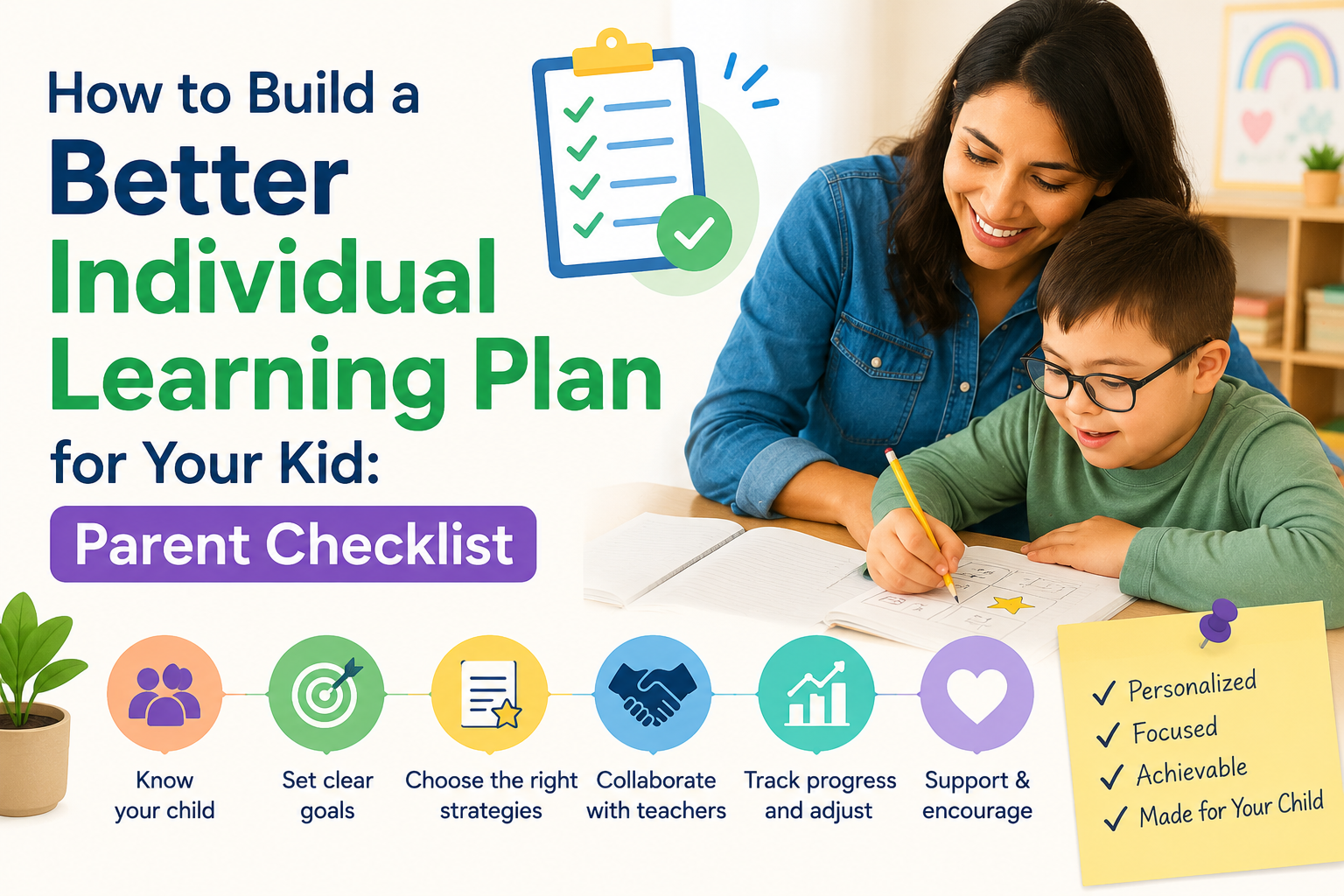
🌟 How to Build a Better Individual Learning Plan for Your Kid: 2026 Parent Checklist
An Individual Learning Plan built on your child’s genuine strengths — not a checklist of deficits — is one of the most powerful tools in special education. To build a better one, work collaboratively with your Student Support Group (SSG), shift from compliance-driven targets to strength-based goals, and make sure your child’s voice is genuinely present in the plan — not just on paper.
This guide shows you exactly how. 💛

- 📋 What Is an Individual Learning Plan — and What It Should Actually Do
- ⚠️ The Problem With Traditional Plans: Compliance vs. Capability
- 📊 The Numbers: What Research Shows About Strength-Based Planning
- 👥 Who Should Be in Your Student Support Group (SSG)?
- ✅ THE 10-STEP COLLABORATIVE CHECKLIST FOR A BETTER INDIVIDUAL LEARNING PLAN
- 🔄 Strength-Based Goals vs. Deficit-Based Goals — Side-by-Side Examples
- 🗣️ How to Include Your Child’s Voice in the Individual Learning Plan
- 🔍 What You Must Not Miss About This Topic
- 1. 🧩 The “Meaningful Progress” Standard Is Rarely Explained to Parents
- 2. 🤖 The AI-Generated Goal Problem Is Growing Fast
- 3. 💭 Masking Costs Are Rarely Named in Planning Conversations
- 4. 🔄 The Plan’s Language Is Often Written About the Child, Not With Them
- 💙 A Parent’s Story: When the Plan Finally Felt Right
- ❓ FAQs About Individual Learning Plans
- Q: What is an Individual Learning Plan?
- Q: What is the difference between an ILP, IEP, and EHCP?
- Q: What is a neurodiversity-affirming Individual Learning Plan?
- Q: How do I get my child’s voice included in their Individual Learning Plan?
- Q: Can I challenge goals in an Individual Learning Plan that I disagree with?
- Q: How often should an Individual Learning Plan be reviewed?
- 🔗 Trusted Resources for Families
- 💙 Final Thoughts: Your Child’s Plan Should Sound Like Your Child
📋 What Is an Individual Learning Plan — and What It Should Actually Do
An Individual Learning Plan (ILP) — sometimes called an Individualized Education Program (IEP) in the US, or an Education, Health and Care Plan (EHCP) in the UK — is a formal written document that describes a child’s current abilities, their learning goals for the year, and the supports and services they will receive to achieve those goals.
In its best form, an Individual Learning Plan is a living, collaborative map of how a specific child learns, what they are working toward, and how their school and family will support that journey together.
In practice, however, many plans look very different from that ideal. Traditionally, IEPs have led with a medical model or deficit-based model for most of our educational experience. (Source: The Neurodiversity Advocate — Neurodiversity-Affirming IEP)
This guide is about changing that — for your child, starting at your next meeting.
⚠️ The Problem With Traditional Plans: Compliance vs. Capability
Here is the honest truth that most parent guides do not say directly: many Individual Learning Plans are built around what a child cannot do, rather than what they can do and where they are genuinely headed.
Research from 2024 published in Intellectual and Developmental Disabilities (Burke et al., 2024) found that IEP goals for students with extensive support needs frequently lacked self-determination content, focusing instead on compliance and adult-directed behaviour. (Source: IEP Focus — Neurodiversity-Affirming Goal Bank, 2026)
In plain terms: many plans ask children to perform neurotypical behaviour — make eye contact, sit still, follow adult directions without questioning — rather than build genuine skills, self-knowledge, and capability.
This matters enormously because compliance-focused goals often teach masking — the suppression of natural neurological responses — rather than authentic development. And masking has a real cost.
Research by Ferrell and Dorsey (2024) emphasises that goals should foster student wellbeing rather than burnout. Goals focused on autonomy, self-advocacy, and self-determination are not only more affirming — they produce better long-term outcomes. (Source: IEP Focus, 2026)
A neurodiversity-affirming Individual Learning Plan does not lower expectations. It reframes which expectations genuinely serve your child. A neurodiversity-affirming IEP goal is a clear, measurable target for school.
It supports access, communication, learning, or independence. It does not ask a neurodivergent learner to mask, hide safe regulation behaviours, or copy neurotypical behaviour. (Source: Structural Learning — IEP Goal Bank 2026)
📊 The Numbers: What Research Shows About Strength-Based Planning
| Statistic | Figure | Source |
|---|---|---|
| US students ages 3–21 receiving IDEA special education services | 7.5 million (15% of all students) | NCES — Students With Disabilities |
| IEP goals lacking self-determination content for students with high support needs | Majority — majority compliance-focused | Burke et al., 2024 — Intellectual and Developmental Disabilities, via IEP Focus |
| Special education teachers who have used AI to write IEP goals (2024) | 57% | Center for Democracy and Technology, 2024 — via Structural Learning |
| AI-generated IEP goals used without modification (risking IDEA individualisation failure) | 31% of the time | Leroy et al., 2023 — via Structural Learning |
| Supreme Court standard for IEP adequacy (Endrew F. v. Douglas County, 2017) | Progress “appropriate to the child’s circumstances” — not minimal | Endrew F. v. Douglas County School District, 2017, via Structural Learning |
| US students with autism on IEPs | 12% of all IEP students | EdWeek — Special Ed Statistics |
| Student-voiced IEP goals associated with | Higher engagement, reduced anxiety, better goal follow-through | Everyday Speech — Neurodiversity-Affirming IEP Goals, 2026 |
💡 What this tells parents: The legal standard for an Individual Learning Plan is genuine, meaningful progress — not minimal compliance.
And the research increasingly confirms that strength-based, student-centred goals produce better outcomes, higher engagement, and lower burnout. You are legally and ethically entitled to push for this in your child’s plan.
👥 Who Should Be in Your Student Support Group (SSG)?
A Student Support Group (SSG) — the collaborative team responsible for building and reviewing your child’s Individual Learning Plan — is only as effective as the people in it and the culture they bring to the table.
The core SSG typically includes:
- 👨👩👧 Parents and caregivers — You know your child across all contexts. Your voice is not a courtesy at this meeting. It is essential.
- 🏫 Classroom teacher — Brings daily observation of your child in their primary learning environment
- 🎓 Special education coordinator or SENCO — Brings knowledge of legal requirements, available supports, and school systems
- 🗣️ Relevant specialist therapists — OT, SLP, psychologist, or behaviour specialist, depending on your child’s profile
- 👦 The student themselves — For any age where meaningful participation is possible (more on this below)
- 📋 IEP facilitator or advocate (where available) — A neutral party who can ensure the process is genuinely collaborative
What makes an SSG genuinely effective vs. one that goes through the motions:
| ✅ Genuinely Collaborative SSG | ❌ Compliance-Focused SSG |
|---|---|
| Parents receive draft documents at least 3 days before the meeting | Documents presented at the meeting for the first time |
| Parent and student concerns are documented and responded to | Parent input is noted but does not change the plan |
| Goals are built on assessment of strengths first | Goals begin with lists of deficits and difficulties |
| Student voice is genuinely sought and incorporated | Student is discussed but not present or consulted |
| Team members respectfully disagree and revise together | Plan is presented as finished for parent signature |
✅ THE 10-STEP COLLABORATIVE CHECKLIST FOR A BETTER INDIVIDUAL LEARNING PLAN
Use this checklist before, during, and after your SSG meeting.

📅 BEFORE THE MEETING
Step 1: Document your child’s strengths in writing
Before focusing on any challenge area, write a detailed picture of what your child does well, what they love, how they communicate best, and what environments help them thrive. This becomes your anchor for the entire planning conversation.
Ask yourself: What does my child know how to do that they could not do a year ago? What lights them up? What are they proud of?
Step 2: Request draft documents in advance
Ask the school to send you any draft goals, assessment summaries, or proposed accommodations at least three to five working days before the meeting. Reviewing in advance — rather than during — allows you to ask more thoughtful questions and prevents a rushed, one-sided process.
Step 3: Prepare your own goals list
Before the meeting, write three to five specific outcomes you hope to see your child achieve over the next twelve months.
Frame them positively and functionally: “I would like Mia to be able to ask for a break when she is overwhelmed, using her words or a card.” Not: “I want Mia to stop having meltdowns.”
Step 4: Request your child’s involvement
For children from as young as five or six, there are age-appropriate ways to involve them in their planning conversation.
Ask the school whether your child can briefly attend the beginning of the meeting, contribute through a “My Strengths and My Needs” worksheet, or share their own goals through a visual or verbal method they are comfortable with.
🏫 DURING THE MEETING
Step 5: Lead with a Strengths Profile
Request — or propose — that the meeting begins with a “Strengths Profile” rather than a list of challenges. A structured opening that names your child’s genuine assets sets the tone for the entire planning conversation.
When we approach the IEP process with a neurodiversity-affirming lens, we can honour them in their full humanity — getting curious, seeking to understand how the child engages in their world, how they communicate, how they think, and meeting them where they are at. (Source: The Neurodiversity Advocate, 2024)
Step 6: Challenge Deficit-Framed Goals
When a proposed goal is framed around eliminating or reducing a behaviour, ask this question: “What new skill or access tool would this goal help my child develop?”
A goal focused on reducing stimming, for example, should be challenged — it asks a child to suppress a self-regulatory behaviour. A reframed goal would instead focus on expanding the child’s range of regulation tools, giving them more options rather than taking one away.
Rather than pushing students to meet neurotypical standards, neurodiversity-affirming goals should emphasise self-advocacy, support multiple modes of communication, and build on student strengths rather than focusing only on areas of challenge. (Source: Everyday Speech, 2026)
Step 7: Verify Each Goal Meets These Four Standards
Before agreeing to any proposed goal in your child’s Individual Learning Plan, check it against this standard:
| Standard | What to Check |
|---|---|
| Specific | Does it name a clear, observable behaviour or skill? |
| Measurable | Can progress be tracked objectively? Does it include how and by whom? |
| Achievable | Is it ambitious but realistic within twelve months? |
| Meaningful | Will achieving this goal genuinely improve your child’s quality of life or access to learning? |
The fourth standard — meaningfulness — is the one most often skipped in traditional planning.
Ask directly: “If my child achieves this goal, what will be different for them in their daily life?” If the answer is unclear or sounds like compliance rather than capability, the goal needs revision.
Step 8: Confirm Accommodation and Support Details
Goals without adequate support are set-ups for failure. For each goal in the Individual Learning Plan, confirm:
- What specific support, accommodation, or resource is provided to help the child achieve it
- Who is responsible for delivering that support
- How frequently it will be delivered
- How the team will know if the support is working
📊 AFTER THE MEETING
Step 9: Document Everything and Keep Copies
Keep a personal copy of every version of your child’s Individual Learning Plan, including any draft versions that changed between meetings. Note the date of every conversation, email, and phone call about the plan. This record is invaluable if you need to escalate a concern, request a review, or advocate for a change.
Step 10: Schedule a Progress Review, Not Just an Annual Meeting
Annual reviews are the legal minimum — not the optimal frequency for a genuinely collaborative plan. Ask for a brief progress check-in at the mid-year point, even if it is a twenty-minute phone call. Regular, small check-ins catch problems before they become entrenched and demonstrate that the plan is genuinely alive rather than filed away.
🔄 Strength-Based Goals vs. Deficit-Based Goals — Side-by-Side Examples
This is where the approach becomes concrete. Here are direct comparisons showing exactly how the same need can be framed two very different ways.
| Need Area | ❌ Deficit-Based Goal | ✅ Strength-Based Alternative |
|---|---|---|
| Social interaction | “Will make eye contact with peers during conversation” | “Will demonstrate active listening in a way that feels comfortable — nodding, verbal cues, or preferred body position” |
| Regulation | “Will reduce meltdown frequency by 50%” | “Will identify and use two preferred regulation strategies when noticing signs of overload” |
| Communication | “Will reduce use of echolalia during class” | “Will use their preferred communication method to express needs and share ideas with peers and adults” |
| Writing | “Will write legibly within lines on lined paper” | “Will produce written work using their preferred method — typed, handwritten, or voice-recorded — to express their ideas effectively” |
| Organisation | “Will not lose homework more than once per week” | “Will use a preferred organisational system — visual, digital, or physical — to track and locate assignments independently” |
| Self-advocacy | (rarely included in deficit plans) | “Will identify at least two personal learning preferences and communicate them to a trusted adult when needed” |
The essence of a neurodiversity-affirming approach is valuing students for who they are and writing goals that help them grow without asking them to hide or change the parts of themselves that make them unique. At its core, a goal explains the skill a student is building and what success will look like. (Source: Live Out Loud — Neurodiversity-Affirming IEP Goals, 2025)
🗣️ How to Include Your Child’s Voice in the Individual Learning Plan
This is one of the most important, most research-supported, and most consistently skipped steps in the planning process. When students have a say in their learning journey, they are more likely to feel engaged and supported. By centering student voices, IEPs become more meaningful, realistic, and effective. (Source: Everyday Speech, 2026)
Age-appropriate ways to bring your child’s voice in:
| Age / Stage | Method |
|---|---|
| Young children (3–6) | Simple visual choice boards: “What helps you feel calm at school?” with picture options |
| Primary school (6–10) | “My Strengths and Wishes” worksheet completed at home with parent support |
| Upper primary (10–12) | Brief attendance at the start of the meeting to share one priority; or a letter/video message prepared in advance |
| Adolescents (12+) | Full or partial attendance; structured self-advocacy script; student-led elements of the meeting |
| Minimally verbal students | Communication device, picture exchange, eye-gaze, or caregiver interpretation of expressed preferences |
Questions to ask your child in preparation:
- “What is the easiest part of your school day?”
- “What is the hardest part?”
- “What helps you most when things get difficult?”
- “What is something you wish your teachers knew about you?”
- “What is something you want to get better at this year?”
Their answers — whatever form they take — belong in the Individual Learning Plan.
🔍 What You Must Not Miss About This Topic
Most parent guides about IEPs or Individual Learning Plans focus on legal rights, procedural compliance, or tool lists. Here is what is almost never addressed.
1. 🧩 The “Meaningful Progress” Standard Is Rarely Explained to Parents
Neurodiversity-affirming goals meet the Endrew F. v. Douglas County (2017) standard for progress appropriate to the child’s circumstances. (Source: Structural Learning, 2026)
Most parents are never told about the Endrew F. standard — a 2017 Supreme Court ruling confirming that an IEP must be reasonably calculated to produce meaningful progress, not just minimal advancement. Understanding this legal standard transforms your position at the meeting from grateful observer to informed advocate.
2. 🤖 The AI-Generated Goal Problem Is Growing Fast
A 2024 survey by the Center for Democracy and Technology found that 57% of special education teachers use AI to help write IEP goals, with AI-generated goals used without modification 31% of the time — meaning IDEA’s individualisation requirements may be unmet. (Source: Structural Learning, 2026)
If a goal in your child’s plan sounds generic, vague, or interchangeable with any other child’s plan, ask directly: was it drafted from a template or AI tool, and how was it personalised to your specific child?
3. 💭 Masking Costs Are Rarely Named in Planning Conversations
Compliance-focused goals that ask children to suppress natural behaviours — stimming, repetitive questions, movement needs, alternative communication — teach masking, not growth.
The mental health cost of sustained masking is well-documented in the research and in lived experience, yet it is almost never named directly in standard planning conversations. This guide names it, and gives parents language to raise it at the table.
4. 🔄 The Plan’s Language Is Often Written About the Child, Not With Them
A neurodiversity-affirming approach recognises that each learner is fully human, with a neurotype that is not a deficit to be corrected but a reality to be understood and supported. (Source: Structural Learning, 2026)
Yet most plans are written entirely in third person by professionals, describing the child without the child’s own language, metaphors, or preferences anywhere in the document. Advocating to have your child’s own words — however they are expressed — reflected somewhere in their plan is a small but meaningful shift.
💙 A Parent’s Story: When the Plan Finally Felt Right
Priya had attended five annual review meetings for her son Rajan, who is autistic. Each year, she left with a document that listed everything Rajan struggled with, a set of targets she did not fully understand, and a signature line she felt quietly pressured to sign before she had time to think.
“Every plan started with a page and a half about everything he could not do,” she says. “By the time we got to the goals, I felt defeated. And I am sure Rajan would have felt devastated if he had ever read it.”
Before the sixth meeting, Priya found a parent advocacy group that introduced her to neurodiversity-affirming planning. She prepared differently this time. She wrote a two-page Strengths Profile about Rajan — his encyclopaedic knowledge of train systems, his exceptional spatial memory, his dry wit, his deep loyalty to people he trusted. She emailed it to the school a week before the meeting with a request that it anchor the discussion.
She also prepared Rajan. They sat together and talked through what he wished his teachers knew. He told her three things in about seven minutes — things she had never thought to write down or bring to a meeting before.
“He said he needed five minutes of quiet before he could start any written task. He said music helped him think. And he said he wanted to learn how to ask for help without feeling embarrassed.”
Those three things became the foundation of his new goals. Real goals. Goals that, when she read them back to him, made him say: “Yeah. That is actually me.”
“That was the first time an IEP meeting felt like it was about him,” Priya reflects. “Not about the version of him that did not fit the system.”
❓ FAQs About Individual Learning Plans
Q: What is an Individual Learning Plan?
An Individual Learning Plan is a formal, written document created collaboratively by a student’s support team — including parents, teachers, and specialists — that describes the child’s current abilities, their learning goals for the year, and the specific supports and accommodations they will receive. It is designed to guide personalised, targeted educational support for children with additional learning needs.
Q: What is the difference between an ILP, IEP, and EHCP?
These terms refer to similar documents in different countries. In the United States, an Individualized Education Program (IEP) is the legal document mandated under IDEA for eligible students with disabilities. In England and Wales, an Education, Health and Care Plan (EHCP) serves a similar function. An Individual Learning Plan (ILP) is a broader term used across multiple countries and educational systems to describe any personalised educational planning document.
Q: What is a neurodiversity-affirming Individual Learning Plan?
A neurodiversity-affirming Individual Learning Plan is one that builds goals around a child’s genuine strengths, supports their authentic development, and avoids asking them to mask or suppress natural neurological behaviours. It prioritises self-advocacy, self-determination, and genuine capability over compliance with neurotypical expectations. Goals are specific, measurable, and — critically — meaningful in the child’s actual daily life.
Q: How do I get my child’s voice included in their Individual Learning Plan?
Ask the school how your child’s preferences, priorities, and self-identified needs are gathered and documented before the planning meeting. For young children, this might mean a simple visual choice board or a parent-facilitated “My Strengths” worksheet. For older children and teenagers, it may mean attending part of the meeting, preparing a statement in advance, or having their communication device present. Push for their actual words to appear somewhere in the document, in whatever form they are expressed.
Q: Can I challenge goals in an Individual Learning Plan that I disagree with?
Yes. Under IDEA in the US, parents are legal members of the IEP team, and the plan cannot be finalised without parental consent. You can request revisions to any goal that you believe is deficit-focused, unmeasurable, inappropriate for your child, or that asks your child to mask rather than develop genuine skills. If agreement cannot be reached, you have the legal right to dispute resolution through mediation or due process.
Q: How often should an Individual Learning Plan be reviewed?
Legally, under IDEA, an IEP must be reviewed at least annually. However, many families and schools choose to schedule shorter mid-year progress checks to ensure goals remain appropriate and that supports are actually being delivered. For children whose needs are changing rapidly, requesting a formal IEP review more frequently than annually is both allowed and often recommended.
🔗 Trusted Resources for Families
| Resource | What It Offers | Link |
|---|---|---|
| 🏛️ U.S. Department of Education — IDEA | Official federal special education law and parent rights | sites.ed.gov/idea |
| 👨👩👧 Center for Parent Information and Resources | Free, comprehensive parent IEP guidance | parentcenterhub.org |
| ⚖️ Wrightslaw — IEP Rights and Advocacy | Legal framework explained clearly for families | wrightslaw.com |
| 📖 Structural Learning — Neurodiversity-Affirming IEP Goals | Research-backed goal bank with affirming language | structural-learning.com |
| 🗣️ Everyday Speech — Neurodiversity-Affirming Goals | Free downloadable IEP goal bank | everydayspeech.com |
| 🧠 IEP Focus — Goal Bank 2026 | Comprehensive neurodiversity-affirming goal examples | iepfocus.com |
| 🏫 NCES — Special Education Statistics | Official US data on students with disabilities | nces.ed.gov |
💙 Final Thoughts: Your Child’s Plan Should Sound Like Your Child
The best Individual Learning Plan is one your child could read — or have read to them — and think: yes, that is me. That is what I am working on. That is what I am good at.
Not a list of things that are wrong with them. Not a set of targets designed to make them look more like everyone else. A real, honest, strength-first roadmap built around who they actually are and where they are genuinely headed.
You are the person in that room who knows them best. Use this checklist. Prepare your Strengths Profile. Bring their voice. Push back on goals that ask them to mask. Ask what meaningful progress looks like.
Because your child deserves a plan that sees them fully. 💛
📝 This article is for informational and educational purposes only and does not constitute legal advice. IEP laws, rights, and procedures vary by country, state, and local authority. Always consult your national or regional education authority and, where needed, an independent advocate or legal professional regarding your child’s specific rights and entitlements.


