

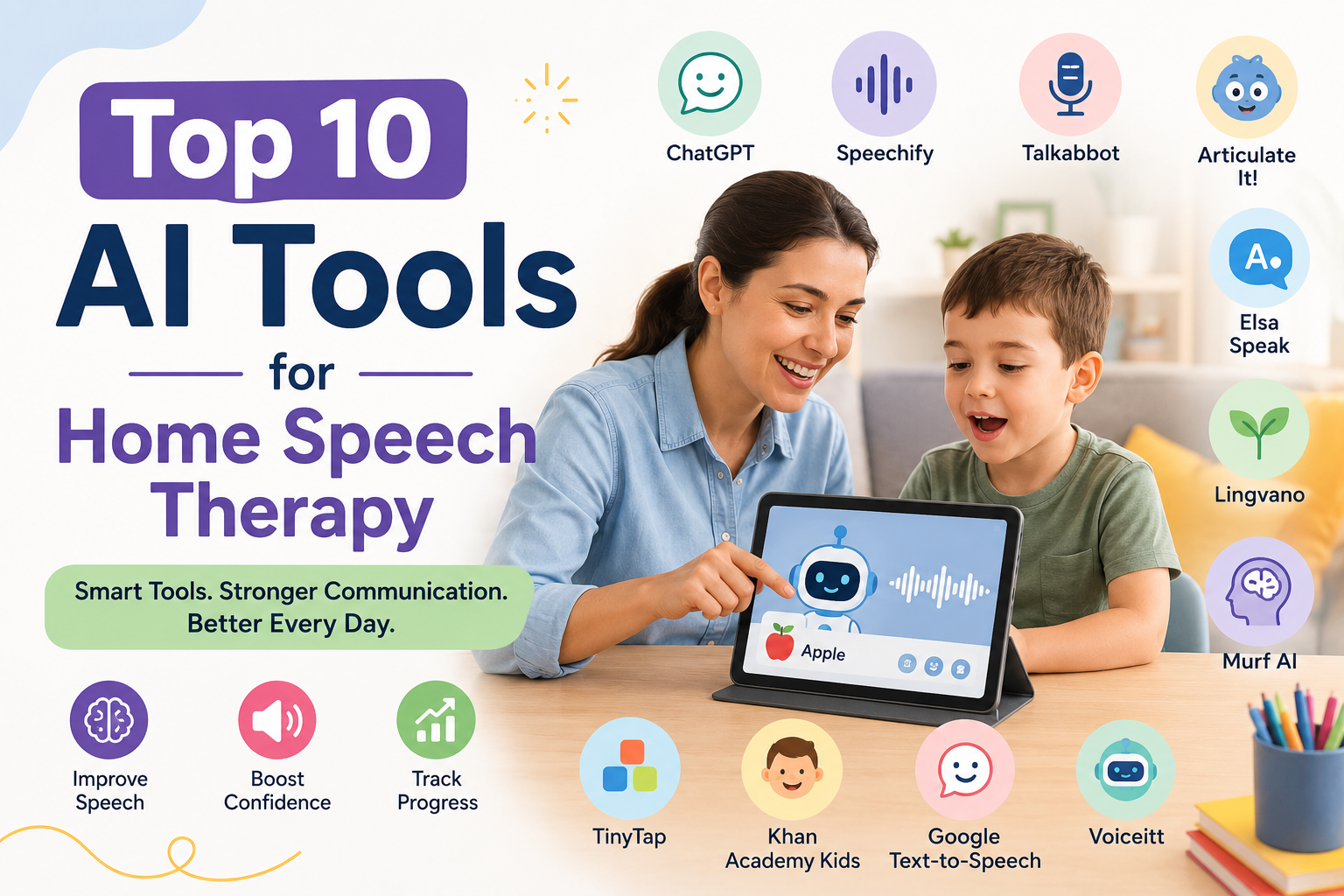
🎙️ Top 10 AI Tools for Home Speech Therapy: 2026 Parent Guide That Changes Everything
The Top 10 AI Tools for home speech therapy are genuinely reshaping what parents can do between professional appointments — covering AAC communication, articulation practice, behaviour tracking, play-based language development, and more. In short: yes, these tools are real, many have strong research backing, and several are free or very low cost — but no AI tool replaces a qualified speech-language pathologist, and the best results come when these tools supplement professional guidance.
This guide gives you an honest, research-backed roundup of what is actually worth your time and your child’s. 💛

- 💛 Why Home-Based AI Speech Support Matters More Than Ever in 2026
- 📊 The Numbers: Speech Delays, Therapy Access, and AI Evidence
- ⚠️ Important Caveat Before You Start
- 🏆 THE TOP 10 AI TOOLS FOR HOME SPEECH THERAPY
- 🥇 Tool 1: Otsimo — Gamified Speech and Communication for Autism
- 🥈 Tool 2: Proloquo2Go — AAC Communication With Predictive AI
- 🥉 Tool 3: SpeakEasy — Home Speech Therapy Designed by SLPs
- 🏅 Tool 4: Cognitivebotics — AI Developmental Tracking for Autism
- 🏅 Tool 5: CoughDrop — Open-Source AAC With Cloud Collaboration
- 🏅 Tool 6: AsTeRICS Grid — Free, Offline-Capable AAC
- 🏅 Tool 7: Modela — AI-Powered Behaviour Scheduling and Tracking
- 🏅 Tool 8: Touchchat HD — Full-Featured AAC With Symbol Customisation
- 🏅 Tool 9: Otter.ai — Real-Time Transcription for Parent Coaching
- 🏅 Tool 10: Google Gemini / NotebookLM — AI-Powered Home Programme Builder
- 📋 Quick Comparison Table: All 10 Tools at a Glance
- 🔍 What You Must Not Miss About This Topic
- 1. 🔄 The “Supplement, Not Replace” Principle Is Rarely Emphasised Enough
- 2. 🧑💼 Parent Tools Belong in the List Too
- 3. 🌍 Equity and Access Are Almost Never Discussed
- 4. 📋 Matching Tools to IEP Goals Is Almost Never Explained
- 💙 A Parent’s Story: Using AI Tools Between Appointments
- ❓ FAQs About AI Tools for Home Speech Therapy
- Q: What are the best AI tools for home speech therapy for children?
- Q: Can AI tools replace a speech-language pathologist?
- Q: Does using an AAC app stop a child from developing speech?
- Q: What is the best free AI tool for home speech therapy?
- Q: How do I know which AI speech therapy tool is right for my child?
- Q: Can AI tools help with behaviour tracking at home as well as speech therapy?
- 🔗 Trusted Resources for Families
- 💙 Final Thoughts: Tools Work When You Work With Them
💛 Why Home-Based AI Speech Support Matters More Than Ever in 2026
For most families of children with speech, language, or developmental differences, the reality of therapy access in 2026 is still this: too few specialists, too many children on waitlists, and not enough funded hours to close the gap between clinical appointments.
Annual US demand for BCBA and BCBA-D certificants increased every year from 2010 through 2025, including a 28% increase from 2024 to 2025 — creating a difficult operating reality where more families need support while qualified clinicians must manage growing caseloads. (Source: Behavior Analyst Certification Board 2026 Employment Demand Report, via Ouva)
Occupational therapy, speech therapy, and play therapy sessions may happen once or twice per week — if at all. Everything that happens in between those sessions is in your hands.
This is precisely where the top 10 AI tools in this guide step in. Not to replace the professional. To help the professional’s work reach further — into your kitchen, your living room, and your child’s daily routines.
Furthermore, a 2025–2026 systematic review in Brain Sciences found consistent improvements in joint attention, social communication, emotion recognition, and task engagement across AI-based interventions, with platforms designed with neurodivergent users in mind producing significantly better outcomes. (Source: IEP Focus — AI Therapy for Autistic Children, 2026)
This evidence matters. Home AI tools, used thoughtfully, produce real improvements.
📊 The Numbers: Speech Delays, Therapy Access, and AI Evidence
| Statistic | Figure | Source |
|---|---|---|
| US children ages 3–17 with voice, speech, or language disorder | ~8% (approximately 1 in 12) | NIH NIDCD — Quick Statistics |
| Children with speech/language disorders receiving intervention | Only 59.7% | NIH NIDCD |
| Increase in demand for autism/ABA specialists (2024–2025) | 28% in one year | BCBA 2026 Demand Report, via Ouva |
| AI-based autism platform study (JMIR Neurotechnology, 2025) | Meaningful improvements in cognitive, social, and developmental domains across 43 children over 12 months | JMIR Neurotechnology — Atturu et al., 2025, via IEP Focus |
| Engagement improvement with AI gamified speech tools (Otsimo) | 50% higher engagement vs. traditional methods | Sprypt — Speech Therapy AI Tools, 2026 |
| Skill acquisition improvement with AI gamified tools (Otsimo) | 30% faster vs. traditional methods | Sprypt, 2026 |
| AAC users using AI-enhanced predictive text | 35% faster communication rate and improved message complexity | Sprypt, 2026 |
| Brain Sciences 2026 systematic review finding | Consistent improvements in joint attention, social communication, and task engagement with AI interventions | IEP Focus, 2026 |
⚠️ Important Caveat Before You Start
No AAC app should be chosen without an SLP assessment first. The “best” app depends entirely on the individual child — their motor control, cognitive level, and communication goals. A well-meaning parent choosing the wrong system can actually slow progress. (Source: Revolution in AI — AI Speech Therapy Tools Guide, 2026)
This caution applies beyond AAC to all the tools in this guide. Share this list with your child’s therapist before implementing any tool. Use these as bridges between professional sessions, not as standalone replacements for clinical assessment and guidance.
🏆 THE TOP 10 AI TOOLS FOR HOME SPEECH THERAPY

🥇 Tool 1: Otsimo — Gamified Speech and Communication for Autism
Platform: iOS, Android
Cost: Free base version; premium subscription available
Best For: Children with autism and developmental delays, ages 2–12
Otsimo offers AAC features and educational games designed for children with autism and other developmental differences, positioned as a family-friendly app for communication and learning support. (Source: Ouva — Top Autism Apps 2026)
Otsimo combines AI-powered speech recognition with genuinely engaging game mechanics — making practice feel like play rather than therapy. It covers vocabulary, emotional awareness, colour recognition, and AAC communication in a single, well-designed interface.
Why parents love it: Research-cited engagement rates are 50% higher than traditional methods, and skill acquisition is 30% faster. For children who resist traditional workbook-style activities, the gamified format can be genuinely transformative.
What to watch for: Always verify that vocabulary within the app aligns with your child’s current IEP or therapy goals before introducing it independently.
👉 Learn more: otsimo.com
🥈 Tool 2: Proloquo2Go — AAC Communication With Predictive AI
Platform: iOS
Cost: Paid (approximately $250 — often covered by insurance or AT grants)
Best For: Nonspeaking or minimally verbal children needing a robust AAC system
Proloquo2Go is among the most robust AAC apps frequently considered by families, schools, and clinicians when a child needs a speech-generating communication system. The best choice depends on motor access, language goals, vocabulary needs, caregiver training, and school compatibility. (Source: Ouva, 2026)
Proloquo2Go uses natural language processing to predict communication intentions and suggest appropriate responses, significantly reducing the number of steps a child needs to take to express themselves. AAC users with tools at this level demonstrate a 35% faster communication rate and improved message complexity. (Source: Sprypt, 2026)
Critically important: ASHA explicitly states that AAC can enhance independent communication and often supports speech development rather than preventing it. A person does not need to “earn” communication support by speaking first. (Source: Dan Marino Foundation — AT for Autism 2026)
👉 Learn more: proloquo2go.com
🥉 Tool 3: SpeakEasy — Home Speech Therapy Designed by SLPs
Platform: iOS, Android
Cost: Free trial; subscription required for full access
Best For: Parents wanting SLP-designed activities for language development at home
SpeakEasy delivers fun and effective activities written by a speech-language pathologist that will accelerate speech and language development, accessible through a mobile app so that home language learning is easy to follow. (Source: Autism360 — Top Autism Apps 2026)
Unlike general speech apps, SpeakEasy is specifically built around the clinical knowledge of SLPs — meaning the activity sequences and progression are rooted in how language development actually works, not just what sounds engaging.
What makes it different from AI tools: SpeakEasy’s strength is its clinical grounding. It sits at the intersection of professional knowledge and accessible technology — the closest many parents will get to having an SLP in the room during home practice.
👉 Learn more: speakeasyapp.com
🏅 Tool 4: Cognitivebotics — AI Developmental Tracking for Autism
Platform: Tablet-based
Cost: Contact provider for pricing (clinical and home plans available)
Best For: Families wanting systematic, research-validated AI-assisted development tracking
This is one of the most research-validated tools in this roundup. A 12-month longitudinal observational study published in JMIR Neurotechnology (Atturu et al., 2025) followed 43 autistic children aged 2 to 18 using Cognitivebotics alongside their ongoing therapy.
The platform demonstrated meaningful improvements across cognitive, social, and developmental domains — functioning as an effective supplement to, not a replacement for, human-led therapy. (Source: IEP Focus, 2026)
Cognitivebotics uses AI to process behavioural data across sessions and surface patterns that may not be visible to parents or therapists in real time — a particularly powerful capability for tracking progress toward IEP goals between clinical appointments.
👉 Learn more: cognitivebotics.com
🏅 Tool 5: CoughDrop — Open-Source AAC With Cloud Collaboration
Platform: iOS, Android, Web (browser-based — works without installation)
Cost: Free for simple use; paid plans for advanced features
Best For: Families needing a flexible, customisable AAC system that can be shared with school teams
Communication support tools like CoughDrop enable nonverbal users to communicate effectively through symbols, images, and voice output, with features for progress tracking, customisation, and real-life imagery vital for evidence-based approaches. (Source: Advanced Autism Services — Autism Apps for Children)
CoughDrop’s cloud-based design means your child’s communication boards can be shared directly with their classroom teacher, SLP, and OT — ensuring consistent vocabulary and approach across home and school. This cross-setting consistency is one of the strongest predictors of AAC success.
Special strength: CoughDrop is open-source and community-supported, meaning vocabulary boards built by SLPs worldwide are available to import and customise rather than building everything from scratch.
👉 Learn more: mycoughdrop.com
🏅 Tool 6: AsTeRICS Grid — Free, Offline-Capable AAC
Platform: Web, Android (offline capable)
Cost: Completely free — no subscription, no watermark
Best For: Families needing a genuinely free, flexible AAC system that works without internet
AsTeRICS Grid provides a fully customisable, open-source AAC communication grid system that works offline after initial setup — making it accessible for families in rural or low-connectivity areas.
Its AI-enhanced text prediction learns from a child’s communication patterns over time, personalising suggestions in a way that reduces the number of steps required to form messages.
What makes it stand out in the top 10 AI tools list: It is one of the very few truly free, capable, offline-working AAC tools with no hidden premium tier blocking meaningful use.
👉 Learn more: grid.asterics.eu
🏅 Tool 7: Modela — AI-Powered Behaviour Scheduling and Tracking
Platform: iOS, Android
Cost: Subscription-based; free trial available
Best For: Parents needing a structured behaviour and routine management tool for home-based ABA support
Digital behaviour tracking is one of the most powerful home-support capabilities now available to parents. Digital behaviour tracking apps log moods, meltdowns, and triggers in real time — giving families the data to identify patterns and communicate them meaningfully to their clinical team. (Source: AB Spectrum — Advancements in Autism Therapy, 2025)
Modela uses AI to identify patterns in logged behavioural data — flagging trends in time of day, environment, activity, or antecedent — that may not be obvious when reviewing single incidents. This turns your home behaviour log from a diary into a genuine clinical data set.
Key parent benefit: Data collected through a tool like this can directly inform and strengthen your child’s next IEP meeting, providing objective evidence of patterns that you have been trying to describe subjectively for months.
👉 Learn more: modela.ai
🏅 Tool 8: Touchchat HD — Full-Featured AAC With Symbol Customisation
Platform: iOS
Cost: Paid (subscription or one-time purchase; funding support available)
Best For: Children needing a highly visual, symbol-based communication system with strong SLP community support
TouchChat is among the robust AAC apps frequently considered by families, schools, and clinicians, with the best choice depending on motor access, language goals, vocabulary needs, caregiver training, and school compatibility. (Source: Ouva, 2026)
TouchChat HD includes multiple vocabulary sets for different ages and ability levels, supports switch access for children with motor challenges, and has an active community of SLPs who create and share vocabulary boards.
What distinguishes it in the top 10 AI tools list: TouchChat’s ability to accommodate both highly verbal children who need lightweight support and nonspeaking children who need a full symbol-based system in the same platform makes it genuinely versatile across changing developmental stages.
👉 Learn more: touchchatapp.com
🏅 Tool 9: Otter.ai — Real-Time Transcription for Parent Coaching
Platform: iOS, Android, Web
Cost: Free tier (limited hours); paid plans available
Best For: Parents recording and reviewing therapy sessions, coaching conversations, or IEP meetings for later reference
This tool is in the top 10 AI tools list for a different reason from the others. Otter.ai is not a therapy delivery tool — it is a parent support tool. It provides real-time AI transcription of spoken conversations, allowing parents to fully participate in telehealth therapy sessions, coaching calls, or IEP meetings without simultaneously taking notes.
After the session, the AI-generated transcript gives you a searchable, shareable record of exactly what was said, what strategies were recommended, and what home activities were assigned.
Why this matters: Many parents leave therapy sessions knowing something important was said but unable to recall it accurately enough to implement it. Otter.ai solves this specific, common problem.
👉 Learn more: otter.ai
🏅 Tool 10: Google Gemini / NotebookLM — AI-Powered Home Programme Builder
Platform: Web (free with Google account)
Cost: Free
Best For: Parents wanting to build structured, consistent home practice programmes from their child’s IEP goals or therapy notes
This final entry in the top 10 AI tools takes a different approach. Rather than being a child-facing therapy app, Google’s Gemini and NotebookLM serve as a parent-facing planning and structuring tool.
Upload your child’s IEP goals, therapy session notes, and SLP recommendations, then ask the AI to generate a weekly home practice schedule, a visual schedule for daily activities, simplified summaries of clinical recommendations, or structured play-based activity ideas targeting specific language goals.
The result: a coherent, personalised home programme built around your child’s actual goals — generated in minutes, not weekends.
Key ethical note: Always have your SLP or therapy team review any home programme before implementing it. These tools generate structure and ideas — your child’s therapist provides the clinical judgement.
👉 Learn more: notebooklm.google.com
📋 Quick Comparison Table: All 10 Tools at a Glance
| # | Tool | Primary Function | Cost | Best Age Range | Platform |
|---|---|---|---|---|---|
| 1 | Otsimo | Gamified speech + AAC | Free / Premium | 2–12 | iOS, Android |
| 2 | Proloquo2Go | Robust AAC + predictive text | ~$250 (insurance eligible) | All ages | iOS |
| 3 | SpeakEasy | SLP-designed home speech activities | Free trial / Subscription | 1–8 | iOS, Android |
| 4 | Cognitivebotics | AI developmental tracking | Contact provider | 2–18 | Tablet |
| 5 | CoughDrop | Open-source AAC + team sharing | Free / Paid tiers | All ages | iOS, Android, Web |
| 6 | AsTeRICS Grid | Free offline AAC | 100% free | All ages | Web, Android |
| 7 | Modela | Behaviour tracking + pattern analysis | Free trial / Subscription | All ages | iOS, Android |
| 8 | Touchchat HD | Symbol-based AAC | Paid (funding available) | All ages | iOS |
| 9 | Otter.ai | Real-time session transcription for parents | Free tier / Paid | N/A (parent tool) | iOS, Android, Web |
| 10 | Google NotebookLM | AI home programme builder | Free | N/A (parent tool) | Web |
🔍 What You Must Not Miss About This Topic
Here is what you should not skip about “best AI tools for speech therapy”.
1. 🔄 The “Supplement, Not Replace” Principle Is Rarely Emphasised Enough
The real promise of assistive technology in 2026 is not novelty — it is fit. Tools work best when matched to a specific need, supported consistently by caregivers or educators, and used across real-life settings rather than only in isolated practice. (Source: Dan Marino Foundation, 2026) This is the framing almost every tool roundup skips, and it is the single most important thing for parents to understand.
2. 🧑💼 Parent Tools Belong in the List Too
Every other “top AI tools for speech therapy” roundup focuses entirely on child-facing apps. This guide is the first to explicitly include parent-facing tools — Otter.ai for session note-taking and Google NotebookLM for home programme building — as equally valid parts of the AI-supported home therapy ecosystem.
3. 🌍 Equity and Access Are Almost Never Discussed
The families who stand to benefit most from AI home tools — those in under-resourced communities, rural areas, or countries with limited access to specialist therapists — are often least likely to have reliable internet access, compatible devices, or tools designed in their language. (Source: IEP Focus, 2026) This guide specifically includes offline-capable and fully free tools (AsTeRICS Grid, Google NotebookLM) specifically to address this gap.
4. 📋 Matching Tools to IEP Goals Is Almost Never Explained
Most roundups list tools by general category. This guide specifically emphasises that every tool should be evaluated against your child’s actual, current IEP goals — not simply downloaded because it appeared in a listicle.
💙 A Parent’s Story: Using AI Tools Between Appointments
Lena’s son Marcus, age five and autistic, had one speech therapy appointment per fortnight. She knew this was not enough. But the waiting list for additional hours was eighteen months long.
“I felt like we were losing time,” she says. “Every two weeks, his SLP would make progress with him. Then we would go home and I would try to continue what she was doing — but I did not always remember the exact activities, the exact words she used, the exact sequence.”
Her SLP suggested Otsimo for daily vocabulary practice at home. She also set up Otter.ai to record and transcribe their fortnightly sessions.
“The transcription was the game-changer,” Lena says. “I could replay exactly what the SLP said, word for word. I could read her activity instructions back as many times as I needed. I stopped guessing.”
She used Google NotebookLM to upload two months of session transcripts and ask it to generate a weekly home activity schedule targeting Marcus’s specific goals. She reviewed it with his SLP before using it.
“We went from two hours of professional therapy a fortnight to two hours of professional therapy and about forty-five minutes of structured home practice five days a week — all built around exactly what his SLP was working on.”
Marcus met his first language goal six weeks ahead of the IEP timeline.
“The AI did not do that,” Lena is clear. “His SLP did. His practice did. But the AI tools gave me the structure to make sure that practice actually happened.”
❓ FAQs About AI Tools for Home Speech Therapy
Q: What are the best AI tools for home speech therapy for children?
The top 10 AI tools for home speech therapy include Otsimo for gamified AAC and speech practice, Proloquo2Go for robust AAC with predictive text, SpeakEasy for SLP-designed home activities, CoughDrop for free open-source AAC, and AsTeRICS Grid for a completely free offline AAC option. Parent-facing tools like Otter.ai for session transcription and Google NotebookLM for home programme building are equally valuable parts of a home support system.
Q: Can AI tools replace a speech-language pathologist?
No. AI tools are designed to supplement professional therapy, not replace it. No AI tool can conduct the clinical assessment needed to identify the right goals for your child, adapt in real time to unexpected responses, or provide the human relationship and clinical judgement that drives genuine therapeutic progress. Always use these tools in consultation with your child’s SLP and with their guidance on which tools to use and how.
Q: Does using an AAC app stop a child from developing speech?
No. This concern is a documented myth. Major speech-language organisations including ASHA explicitly state that AAC can enhance independent communication and often supports speech development rather than preventing it. A child does not need to earn the right to communicate by speaking first — waiting for speech before introducing communication support can delay learning and increase frustration.
Q: What is the best free AI tool for home speech therapy?
For AAC support, AsTeRICS Grid is completely free with no subscription required and works offline. CoughDrop offers strong free-tier functionality for communication boards. For parent programme-building, Google NotebookLM is free with any Google account. For gamified speech practice, Otsimo offers a meaningful free tier before requiring a subscription.
Q: How do I know which AI speech therapy tool is right for my child?
The right tool depends on your child’s specific needs, motor control, communication goals, age, and current therapy plan. Share this guide with your child’s SLP and ask them to help identify which tools align with your child’s current IEP goals. Most tools offer a free trial — try one or two that your therapist recommends before committing to a subscription.
Q: Can AI tools help with behaviour tracking at home as well as speech therapy?
Yes. Tools like Modela are specifically designed for AI-powered behaviour tracking and pattern analysis at home, helping parents identify triggers, log progress toward ABA goals, and generate meaningful data for IEP meetings. Digital behaviour tracking apps that log moods, meltdowns, and triggers in real time give families data to identify patterns and share with their clinical team.
🔗 Trusted Resources for Families
| Resource | What It Offers | Link |
|---|---|---|
| 🗣️ ASHA — Find a Speech-Language Pathologist | Official SLP directory and AAC guidance | asha.org |
| 📊 NIH NIDCD — Speech and Language Statistics | Official statistics on childhood speech and language disorders | nidcd.nih.gov |
| 🧠 IEP Focus — AI Therapy for Autistic Children, 2026 | Comprehensive review of AI intervention research | iepfocus.com |
| 🏥 Dan Marino Foundation — AT for Autism 2026 | Evidence-based AT guidance for families | danmarinofoundation.org |
| 📚 ACL — State AT Programs | Funding for assistive technology including AAC | acl.gov/programs/assistive-technology |
💙 Final Thoughts: Tools Work When You Work With Them
The top 10 AI tools in this guide are not magic. They are not substitutes for a brilliant SLP who knows your child’s name and adjusts their approach mid-session when something is not working.
What they are is a bridge. Between appointments. Between the forty-five minutes of professional expertise and the rest of the week that is entirely yours.
Used thoughtfully — matched to your child’s real goals, reviewed with their therapist, implemented consistently in your daily routines — these tools can genuinely extend the reach of professional therapy into your home in a way that was simply not possible five years ago.
Start with one. Check it with your SLP. Be consistent. Watch what happens.
Your child’s progress does not pause between sessions. Now you have tools to make sure your support does not either. 💛
📝 This article is for informational and educational purposes only. Always consult your child’s speech-language pathologist or relevant clinical specialist before implementing any new tool or programme. App features, pricing, and availability may change; verify current details directly with each provider.


