

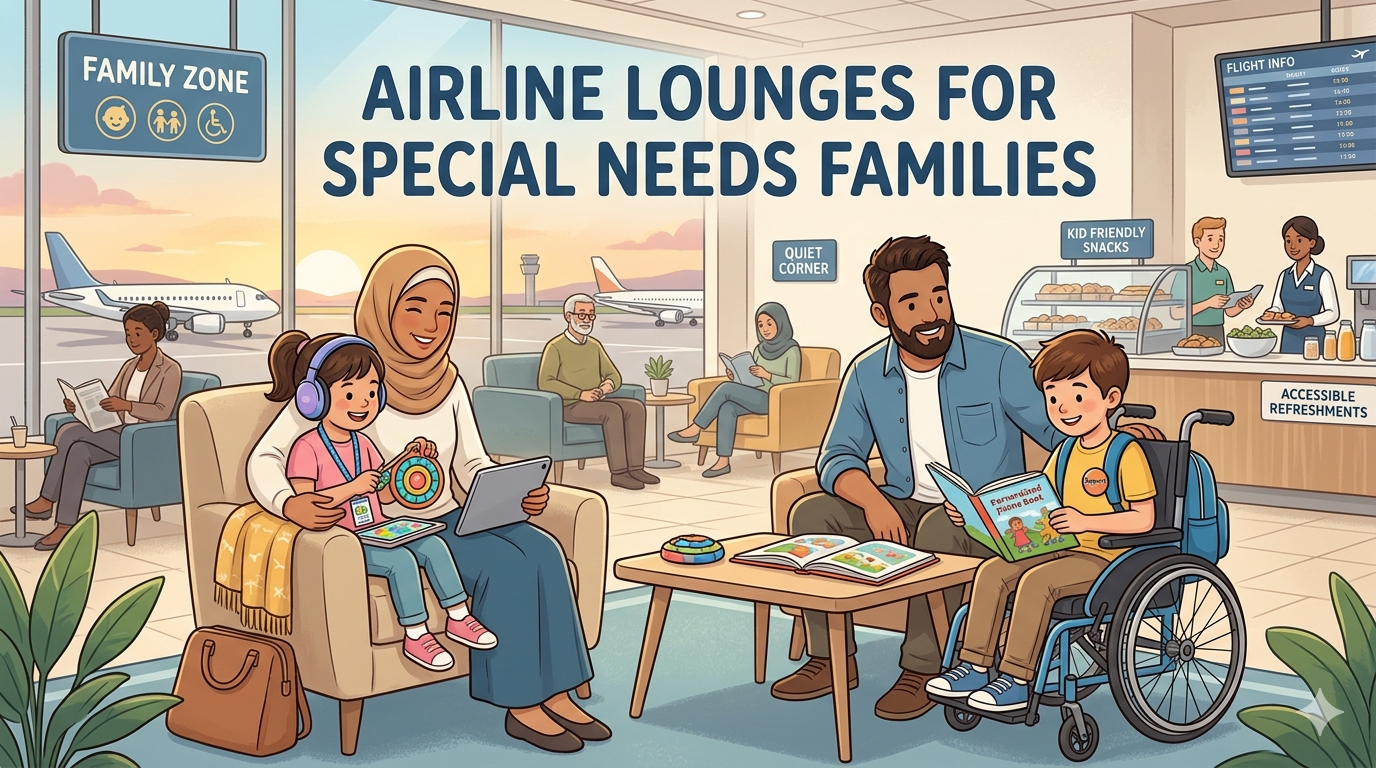
✈️ Access to Airline Lounges 2026: Stress-Free Airport Experience You Never Knew Was Possible
Did you know families with special needs children can get access to airline lounges — quiet, calm, sensory-friendly escapes — without a first-class ticket or elite status? 😱 Most families suffer through chaotic airport terminals when a lounge could change everything. Discover every way in, what to expect, and the disability rights that protect your family. This guide could transform how you travel forever.

- ✈️ What Is Access to Airline Lounges — and Why Does It Matter for Special Needs Families?
- 🛫 Why Airport Lounge Access Is a Game-Changer for Special Needs Families
- 🗺️ Every Way to Get Access to Airline Lounges in 2026
- 💳 Method 1: Premium Travel Credit Cards (Most Popular Route)
- 🌐 Method 2: Priority Pass Membership (Best for Frequent Flyers)
- 🎫 Method 3: Day Passes (Best for Occasional Travellers)
- 🏆 Method 4: Airline Elite Status
- ✈️ Method 5: Flying Business or First Class
- ⏱️ Method 6: Flight Delays and Irregular Operations
- 🎯 Method 7: Redeem Miles or Points for Lounge Access
- ♿ Disability Rights and Access to Airline Lounges: What You Must Know in 2026
- Your Legal Rights as a Disabled Passenger (US)
- The Airline Passengers with Disabilities Bill of Rights
- Requesting Lounge Access on Disability or Special Needs Grounds
- 🌍 Best Airport Lounges for Special Needs Families: What to Look For
- 💔 The Real Cost of NOT Having Lounge Access: A Special Needs Family Story
- 📋 Special Needs Airport Travel: The Pre-Flight Lounge Access Checklist
- 🛡️ Sensory-Friendly Strategies Inside the Lounge
- 📊 Air Travel and Disability: Key Statistics Every Family Should Know
- 🔍 What Special Needs Families Must Know About Lounge Access
- 🔗 Trusted Resources for Special Needs Families and Air Travel
- ❓ FAQs: Access to Airline Lounges
- Q: Can you get access to airline lounges without a first-class ticket?
- Q: What is the cheapest way to get access to airline lounges in 2026?
- Q: Can disabled passengers get free access to airline lounges?
- Q: How many guests can I bring to an airline lounge?
- Q: Are airline lounges accessible for wheelchair users?
- Q: Can I book a lounge day pass in advance for my special needs child?
- Q: Are children allowed in airline lounges?
- 💙 A Final Word — Because Your Family Deserves a Better Journey
✈️ What Is Access to Airline Lounges — and Why Does It Matter for Special Needs Families?
Access to airline lounges refers to the ability to enter a private, dedicated airport space offering quieter environments, comfortable seating, food, Wi-Fi, and essential facilities — away from the noise and crowds of a main terminal. For families with special needs children, lounge access is not a luxury. It is a genuine travel management tool.
Priority Pass membership enables you to access about 1,300 airport lounges in 650 airports across 148 countries. Amenities at participating lounges range from complimentary refreshments and free Wi-Fi to spa treatments, massage rooms, and sleeping areas. (Source: Going.com — Airport Lounge Access Guide, April 2026)
For a child with autism, ADHD, sensory processing disorder, anxiety, or any condition amplified by noise and unpredictability — a lounge can be the difference between a successful flight and a devastating family travel experience.
🛫 Why Airport Lounge Access Is a Game-Changer for Special Needs Families
Most special needs travel guides focus on what happens on the plane. Almost none address what happens in the terminal — where the real challenges often begin.
Consider a typical airport departure experience for a family with a sensory-sensitive child:
- 🔴 Crowded, loud check-in halls
- 🔴 Security queues with sudden loud announcements
- 🔴 Bright overhead lighting and commercial noise
- 🔴 Limited seating, often near busy walkways
- 🔴 Chaotic food courts with overwhelming smells and lines
- 🔴 Unpredictable delays with no quiet space to wait
- 🔴 Stressed parents trying to manage a child already dysregulated before boarding
Now contrast that with what access to airline lounges provides:
| Lounge Feature | Why It Matters for Special Needs Families |
|---|---|
| 🔇 Quieter, controlled environment | Reduces sensory overload before and during delays |
| 🛋️ Comfortable, spread-out seating | Children can move and decompress without disturbing others |
| 🍽️ Food and drinks available freely | Eliminates the stress of food queues and sensory-restricted diets |
| 📶 Reliable Wi-Fi | Keeps children engaged with familiar, calming devices |
| 🚽 Clean, accessible bathrooms | Available without queues and with changing facilities |
| 🏨 Private spaces or quiet zones | Ideal for meltdown recovery or pre-flight regulation |
| 💤 Less crowded waiting area | Reduces unpredictable social contact for anxious children |
| 👨👩👧 Family-friendly atmosphere | Less judgment, more space, more grace |
Airport lounges used to be a reliable refuge when connections fell apart. Increasingly, they’re full, restricted, or temporarily closed due to capacity. For disability-related or family travel needs, pre-booking through platforms or memberships improves your chances of getting in. (Source: Blind Travels — Airline Policy Changes, 2026)
The lesson is clear: advance planning is essential. And the earlier families learn how lounge access works, the better their travel experience will be.
🗺️ Every Way to Get Access to Airline Lounges in 2026
Here is every route to lounge access in 2026, with costs and what works best for families.
💳 Method 1: Premium Travel Credit Cards (Most Popular Route)
The most popular way to access airport lounges is through a credit card that includes lounge benefits. Many premium travel credit cards offer complimentary access to lounge networks worldwide. (Source: Airport Lounge List — How to Access Airport Lounges, 2026)
| Credit Card | Lounge Networks Included | Annual Fee (approx.) | Guest Policy |
|---|---|---|---|
| Amex Platinum Card | Centurion Lounges, Priority Pass, Delta Sky Club (on Delta flights), Plaza Premium | ~$695 | 2 free guests |
| Chase Sapphire Reserve | Priority Pass Select (unlimited visits) | ~$550 | 2 free guests at $35 each |
| Capital One Venture X | Priority Pass + Capital One Lounges | ~$395 | 2 free guests |
| Diners Club International | 1,000+ airport lounges worldwide | Varies | Varies |
(Source: Airport Lounge List, 2026 | NerdWallet — Airport Lounge Access, 2026)
For special needs families: The card’s guest policy matters enormously. A card that allows two free guests means a family of three (parent, child, and one additional adult) can all access the lounge together for the card’s annual fee alone.
🌐 Method 2: Priority Pass Membership (Best for Frequent Flyers)
Priority Pass is the world’s largest independent airport lounge network. You can join directly — without any airline loyalty or credit card requirement.
As of 2026, Priority Pass has three tiers. Standard is $99 per year plus $35 per visit. Standard Plus is $329 per year and includes 10 free visits before charging $35. Prestige is $469 per year and includes unlimited visits — guests still cost $35 each. (Source: Tictivity — Airport Lounge Access Guide, April 2026)
Best for families: Standard Plus or Prestige, depending on how often you travel. If you take 4+ return trips per year with a special needs child, the cost is easily justified by the stress reduction alone.
🎫 Method 3: Day Passes (Best for Occasional Travellers)
Many airport lounges sell single-visit day passes, letting you pay once to access the lounge without any membership or credit card requirement. Day passes are the best option if you fly infrequently but want lounge access for a special trip or long layover. (Source: Airport Lounge List, 2026)
Day pass costs vary by lounge and airport:
| Lounge Type | Typical Day Pass Cost | Booking Method |
|---|---|---|
| Priority Pass contract lounges | $35–$55 | Via Priority Pass app or loungeBuddy |
| The Club Lounges (US airports) | $40–$60 | Online or at the door |
| Plaza Premium | $35–$70 | Online pre-booking recommended |
| Centurion Lounges (Amex) | Not available for day passes | Card access only |
| Independent airport lounges | $27–$80 | Direct booking or LoungeBuddy app |
(Source: AirTravelGenius — Airport Lounge Access, April 2026 | Going.com)
Special needs tip: Pre-book wherever possible. Walk-in availability is not guaranteed — especially at major hub airports during peak travel periods. A pre-booked pass also removes one uncertainty from your travel day.
🏆 Method 4: Airline Elite Status
Earning elite status with a major airline’s frequent flyer programme provides complimentary lounge access — even in economy class on qualifying routes.
| Airline Alliance | Lounge Network | Status Required |
|---|---|---|
| Star Alliance | Star Alliance Gold Lounges (worldwide) | Gold status in member airline |
| Oneworld | Oneworld Sapphire / Emerald | Sapphire or Emerald status |
| SkyTeam | SkyTeam Elite Plus Lounges | Elite Plus status |
For families who travel regularly for medical appointments, therapy evaluations, specialist consultations, or family support — accumulated miles toward elite status is worth tracking carefully.
✈️ Method 5: Flying Business or First Class
The simplest route to access to airline lounges: book a business class or first class ticket. Both include automatic lounge access on most international routes.
This is increasingly realistic for special needs families because:
- Many airlines offer deep discounts on business class for passengers with disabilities or their carers
- Award redemptions using credit card or frequent flyer miles make business class more accessible than ever
- Some families travelling with a disabled child receive complimentary seating upgrades — always ask
⏱️ Method 6: Flight Delays and Irregular Operations
Some lounges offer complimentary access to passengers when flights are severely delayed or cancelled. While it’s not guaranteed, asking politely at the service desk or lounge entrance might get you through the door. The worst they can say is no. (Source: Far & Wide — 15 Ways to Get Into Airport Lounges, 2026)
For families with special needs children facing a long delay, asking directly — and mentioning your child’s disability needs — is always worth attempting. Many lounge staff will exercise discretion, particularly when a visibly distressed child is present.
🎯 Method 7: Redeem Miles or Points for Lounge Access
If there are leftover miles in your frequent flyer account, you might be able to use them for lounge entry. Airlines like United, Delta, and British Airways occasionally let travelers trade miles for a pass. (Source: Far & Wide, 2026) Check your account and airline redemption options before assuming you cannot afford entry.
♿ Disability Rights and Access to Airline Lounges: What You Must Know in 2026
For special needs families, it is one of the most important.
Your Legal Rights as a Disabled Passenger (US)
The Air Carrier Access Act (49 U.S.C. § 41705) prohibits discrimination on the basis of disability in air travel. (Source: US Department of Transportation — ACAA) While the ACAA primarily governs onboard and gate experiences, its protections establish a clear framework: airlines and their associated facilities must not discriminate against passengers with disabilities.
Additionally, in 2026, forty years after the Air Carrier Access Act was passed in 1986, compliance with the Act and related federal rules have largely been ignored by the airline industry. Airlines have filed lawsuits challenging new wheelchair safety rules that became effective January 16, 2025. (Source: National Center — Airlines and Disability, February 2026)
This ongoing battle makes it even more critical that families know and assert their rights proactively.
The Airline Passengers with Disabilities Bill of Rights
The Airline Passengers with Disabilities Bill of Rights describes the fundamental rights of air travelers with disabilities under the Air Carrier Access Act and its implementing regulation, 14 CFR Part 382. (Source: US Department of Transportation) Key rights include:
- The right to be treated with dignity and respect
- The right to receive information and assistance needed to fly safely and with dignity
- The right to accessible airport facilities and ground transportation
- The right to travel with assistive devices without charge
Requesting Lounge Access on Disability or Special Needs Grounds
While no law specifically mandates free lounge access for passengers with disabilities in the US, families can and should:
- ✅ Contact the airline directly before travel — explain your child’s disability and ask about any lounge access accommodations or sensory-quiet spaces
- ✅ Request a Special Service Request (SSR) code — these communicate your needs throughout the booking and check-in system
- ✅ Ask about dedicated quiet or family areas — many major hub airports now have sensory rooms or quiet spaces that function similarly to lounge environments
- ✅ Speak to the airline’s disability assistance desk on arrival — they can sometimes facilitate lounge access for families in genuine distress
The guidance promotes appropriate interaction between passengers and operators by involving active listening, attentively addressing specific needs, and encouraging open communication, allowing passengers to express concerns or preferences related to their disability freely. (Source: IATA — Air Travel Accessibility Fact Sheet)
🌍 Best Airport Lounges for Special Needs Families: What to Look For
Not all airline lounges are equally suitable for families with special needs children.

Here is what to look for when choosing:
🎯 The Special Needs Lounge Checklist
- ✅ Quiet zones or separate seating areas — away from televisions and busy bars
- ✅ Natural light — softer and less overwhelming than harsh fluorescents
- ✅ Accessible bathrooms with changing facilities
- ✅ Hot food available — children with restricted diets need options beyond cold snacks
- ✅ Space to move — not cramped rows of seating but areas where a child can move safely
- ✅ Wi-Fi speed sufficient for streaming — a regulated child is a manageable child on a travel day
- ✅ Friendly, trained staff — essential for sensory-sensitive environments
- ✅ Proximity to the gate — critical for families who may need to board early
Highly Regarded Lounges for Family Comfort
| Lounge | Airport | Known For | Access Method |
|---|---|---|---|
| Cathay Pacific The Pier (First Class) | Hong Kong HKG | Exceptional quiet zones, dining rooms, showers | First Class ticket or Oneworld Emerald |
| Qantas First Lounge | Sydney SYD | Dedicated quiet spaces, excellent food | Business/First or Oneworld Emerald |
| Centurion Lounge JFK | New York JFK | Family-friendly, Amex access | Amex Platinum card |
| Singapore Airlines Private Room | Singapore Changi | Serene, spacious environment | First Class only |
| Plaza Premium Lounge (multiple) | Various global airports | Widely accessible, family-friendly | Priority Pass, day pass |
| The Club (US airports) | Various US airports | Accessible, day pass available | Priority Pass, day pass |
(Source: Tictivity — Airport Lounge Guide, 2026)
💔 The Real Cost of NOT Having Lounge Access: A Special Needs Family Story
Most people think of lounges as a status symbol. For special needs families, they are a survival strategy.
Meet Anika. She is a single mother of an 8-year-old son, Noah, who has autism and severe noise sensitivity. For years, she avoided flying entirely — the terminal experience was too overwhelming for Noah, and she had no coping strategy beyond hoping for the best.
Then, during a medical trip to a specialist in another city, a gate agent noticed Noah in full meltdown — covering his ears, rocking, becoming inconsolable — and quietly asked if Anika knew about the lounge access her travel card included.
She didn’t. No one had ever told her.
That flight, they waited in the lounge: soft lighting, a quiet corner, familiar snacks from the buffet, and Noah with his headphones watching his favourite show. He boarded the plane calm and regulated.
“It sounds small,” Anika says. “But it completely changed how I think about travel. We’ve been on six flights since then. Noah has handled all of them.”
Noah’s experience is not exceptional. It is achievable for every family — once they have access to the right information.
📋 Special Needs Airport Travel: The Pre-Flight Lounge Access Checklist
Use this checklist before every trip:
| Action | When to Do It | Importance |
|---|---|---|
| ✅ Check if your credit card includes lounge access | When booking trip | Critical |
| ✅ Register your Priority Pass or lounge membership | 2+ weeks before travel | High |
| ✅ Search the specific airport for participating lounges | 1 week before | High |
| ✅ Pre-book a day pass if needed | 3–7 days before | Recommended |
| ✅ Request SSR disability code with airline | At booking | Critical |
| ✅ Request airport wheelchair/assistance (if needed) | At booking | Critical |
| ✅ Bring your child’s diagnosis documentation | Day of travel | Recommended |
| ✅ Pack lounge-friendly sensory tools | Day of travel | High |
| ✅ Arrive with sufficient time for lounge use | Day of travel | High |
| ✅ Locate the lounge on the terminal map before arrival | Day before | Recommended |
🛡️ Sensory-Friendly Strategies Inside the Lounge
Having access to airline lounges is step one. Using the lounge strategically for your child’s sensory needs is step two.
Once You Are Inside: Making the Most of Lounge Access
- 🎧 Bring noise-cancelling headphones — even quiet lounges can have background noise
- 🌡️ Choose seating away from the kitchen or bar area — these areas have noise and smell spikes
- 🪟 Find a seat near natural light — soft daylight is easier for most children than overhead artificial lighting
- 🍽️ Take food slowly — allow your child to explore the buffet at their pace without the pressure of a queue
- 📱 Use the lounge Wi-Fi for familiar media — pre-downloaded videos and games are good; familiar lounge-based viewing is even better
- ⏰ Build buffer time — aim to arrive at the lounge 90+ minutes before boarding so you are not rushing out just when your child has settled
- 💬 Speak to lounge staff — a quiet word explaining your child’s needs almost always results in extra consideration
📊 Air Travel and Disability: Key Statistics Every Family Should Know
| Statistic | Figure | Source |
|---|---|---|
| Americans who use a wheelchair | ~5.5 million | CBS News / DOT, 2025 |
| Wheelchairs damaged, delayed, or lost per 100 domestic flights | 1 in 100 | CBS News / DOT, 2025 |
| Airport lounges accessible via Priority Pass globally | 1,300 in 148 countries | Going.com, April 2026 |
| DOT Final Rule protecting disabled flyers — effective date | January 16, 2025 | US DOT Final Rule |
| Priority Pass Standard membership annual cost | $99 + $35/visit | Tictivity, April 2026 |
| Priority Pass Prestige annual cost | $469 (unlimited visits) | Tictivity, April 2026 |
| Typical lounge day pass cost | $35–$80 | Airport Lounge List, 2026 |
| ACAA — year passed | 1986 (40 years ago in 2026) | National Center, 2026 |
🔍 What Special Needs Families Must Know About Lounge Access
Here is what HopeForSpecial families actually need:
🔸 The sensory environment of a lounge matters more than its prestige.
A high-end lounge with dim lighting, separated seating zones, and a quiet area may be far more beneficial for a sensory-sensitive child than a crowded top-tier lounge with multiple televisions and a busy bar.
🔸 Guest policy is critical for families.
A credit card that provides free lounge access for the cardholder only — but charges $35 per guest — could cost more than a day pass for a family of four. Always check the guest policy before choosing your access method.
🔸 Priority Pass coverage in the US has shrunk.
Priority Pass has dense coverage in Europe, the UK and Asia, but its US presence has thinned over the past few years as airlines have pulled their domestic lounges from the network. Always check the specific airport on the Priority Pass site before relying on it. (Source: Tictivity, April 2026) For families flying domestically in the US, verify lounge availability specifically before assuming Priority Pass will work.
🔸 Early boarding and lounge access complement each other.
Many airlines offer early boarding for passengers with disabilities and special needs. Pairing early boarding with lounge access creates the optimal travel experience: regulatory pre-boarding time in the lounge, followed by calm, first-on-the-aircraft boarding.
🔸 Disability documentation is not legally required for lounge access — but may help.
Having a letter from your child’s paediatrician, a copy of their diagnosis, or an NDIS/ESA documentation letter available gives you a practical tool if you need to explain your child’s needs to lounge staff.
🔸 Lounge crowding is a growing problem.
Lounges are crowded, Priority Pass is diluted, and back-up plans matter. Airport lounges used to be a reliable refuge. Increasingly, they’re full, restricted, or temporarily closed due to capacity. (Source: Blind Travels, 2026) For special needs families, this makes pre-booking and early arrival even more important.
🔗 Trusted Resources for Special Needs Families and Air Travel
- 🌐 US Department of Transportation — Passengers with Disabilities — Your complete legal rights as a disabled air traveller
- 🌐 DOT — Airline Passengers with Disabilities Bill of Rights — Print this and carry it with you
- 🌐 IATA — Air Travel Accessibility — Global airline accessibility initiatives and guidance
- 🌐 Priority Pass — Find a Lounge — Search lounges by airport before your trip
- 🌐 LoungeBuddy App — Buy day passes and search available lounges in real time
- 🌐 NerdWallet — Best Cards for Lounge Access — Compare credit cards for lounge access benefits
- 🌐 DOT Final Rule — Disability Air Travel Protections, 2025 — New 2025 protections for wheelchair users
❓ FAQs: Access to Airline Lounges
Q: Can you get access to airline lounges without a first-class ticket?
Absolutely. Economy passengers can access lounges via programs like Priority Pass or DragonPass, airline lounge memberships, certain credit cards, or by purchasing a one-time entry pass. (Source: AirTravelGenius, April 2026) For special needs families, a Priority Pass membership or a day pass booked in advance is often the most practical and affordable solution.
Q: What is the cheapest way to get access to airline lounges in 2026?
Priority Pass Standard at $99 per year plus $35 per visit is the entry-level option. For infrequent travelers, lounge day passes starting from $27–$35 are the cheapest route to access without any annual commitment. (Source: Tictivity, 2026) For families flying 3+ times per year, a credit card with bundled lounge access typically delivers the best overall value.
Q: Can disabled passengers get free access to airline lounges?
There is no universal policy mandating free lounge access for disabled passengers in the US. However, the Air Carrier Access Act requires that airlines treat disabled passengers with dignity and provide appropriate assistance. The ACAA prohibits discrimination on the basis of disability in air travel. (Source: DOT — About the ACAA) Families should contact their airline before travel to ask about any disability accommodation programmes that may include lounge access.
Q: How many guests can I bring to an airline lounge?
Guest policies vary significantly. Most premium credit cards allow 2 free guests per visit. Priority Pass Prestige charges $35 per additional guest. Airline elite status guest policies vary by airline and status tier. Always check your specific lounge access method’s guest policy before travel — for families, this detail is critical.
Q: Are airline lounges accessible for wheelchair users?
Major lounges at hub airports are required to be accessible under disability law. However, quality varies. In 2026, compliance with the Air Carrier Access Act has largely been ignored by the airline industry, with poor communication and lack of staff training being ongoing problems. (Source: National Center, February 2026) Always call ahead to confirm wheelchair access and accessible bathroom facilities at specific lounges.
Q: Can I book a lounge day pass in advance for my special needs child?
Yes — and for special needs families, advance booking is strongly recommended. Some lounges, like The Club or Plaza Premium, let you book online in advance to guarantee space. Day passes are the best option if you fly infrequently but want lounge access for a special trip or long layover. (Source: Airport Lounge List, 2026) Use the LoungeBuddy app or the Priority Pass lounge finder to check availability and book ahead.
Q: Are children allowed in airline lounges?
Yes — the vast majority of lounges permit children. Most Priority Pass, Plaza Premium, and independent lounges welcome families. Some premium-brand lounges (such as certain Centurion Lounge locations) may have quieter areas better suited to adults, but they do not exclude children. Always check the specific lounge’s policy if you are unsure.
💙 A Final Word — Because Your Family Deserves a Better Journey
Access to airline lounges is not about status or luxury. For families navigating travel with a child who has autism, ADHD, sensory processing disorder, anxiety, mobility needs, or any other special need — it is about having a fighting chance at a successful, regulated, dignified travel experience.
You deserve to arrive at your gate with a child who is calm, not overwhelmed. You deserve a comfortable space to wait, not an endless battle against noise, crowds, and chaos. And you deserve to know that these spaces exist, they are accessible, and they are within reach for your family — right now, at a price that works for your situation.
The airline industry is dedicated to enhancing air travel accessibility, ensuring a safe, reliable, and dignified journey is accessible to everyone. (Source: IATA — Air Travel Accessibility) Hold them to that commitment. Ask for what you need. Book the lounge pass. Apply for the card. Advocate clearly.
And the next time you walk through those lounge doors with your child — into the quieter, calmer, kinder side of air travel — know that you earned it. 💙✈️
📌 To learn more about your rights as a disabled air traveller, visit the US Department of Transportation — Passengers with Disabilities page and download your Airline Passengers with Disabilities Bill of Rights.


