

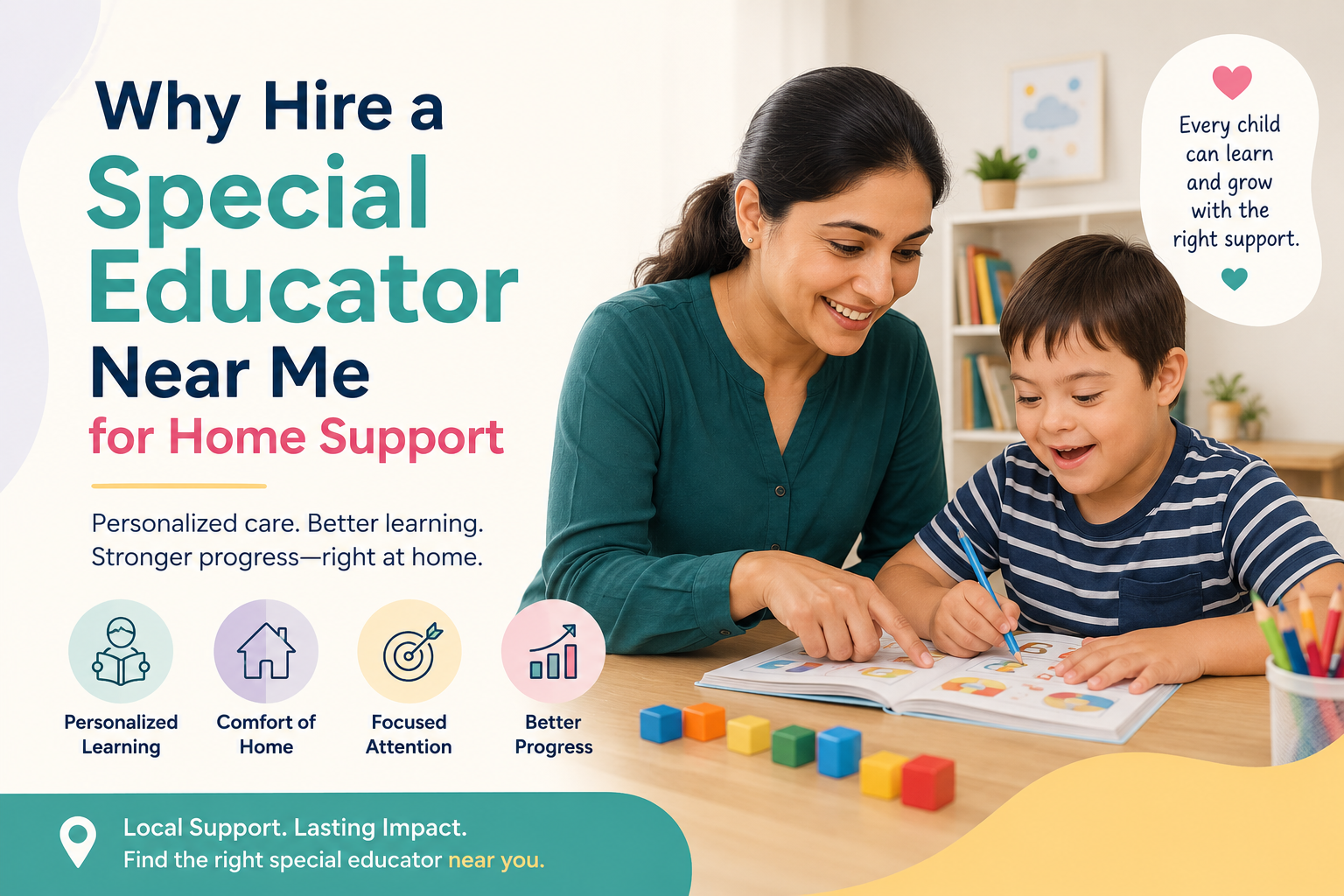
🏫 Why Hire a Special Educator Near Me for Home Support? 2026 Parent Comparison Guide
When searching “Special Educator Near Me”, you are likely asking one real question underneath it all: is what my child receives at school actually enough — or is there a gap I am responsible for filling? The honest answer is: it depends on your child’s specific needs, your school’s actual resources, and how well the IEP is being implemented — and this guide helps you evaluate all three.
No pressure. No agenda. Just a clear, research-backed framework to help you decide. 💛

- 👩🏫 What a Private Special Educator Near Me Actually Does
- ⚠️ The Honest Reality of Public School IEP Support in 2026
- 📊 The Numbers: IEP Gaps, Tutoring Evidence, and Funding Reality
- ✅ When School Resources Are Sufficient — and When They Are Not
- 🚨 THE 8 SIGNS YOU MAY NEED A PRIVATE SPECIAL EDUCATOR NEAR YOU
- 💰 What a Home-Based Remedial Tutor Actually Costs vs. What It Delivers
- 🔍 How to Evaluate Any Special Educator Near Me Before Hiring
- 🔍 What You Should Not Miss About This Topic
- 1. ⚖️ The Legal Framework for When Schools Must Provide More
- 2. 📊 The Real Difference Between “Meeting Goals” and “Closing Gaps”
- 3. 🤝 The “Aligned With School” vs. “Parallel but Separate” Problem
- 4. 💰 Funding for Private Support Is More Available Than Most Parents Know
- 💙 A Parent’s Story: The Question That Changed Everything
- ❓ FAQs About Hiring a Private Special Educator Near Me
- Q: What is the difference between a private special educator and a regular tutor?
- Q: Can the school be required to pay for private special education tutoring?
- Q: How do I find a qualified special educator near me?
- Q: How often should my child see a private special educator?
- Q: Is online special education tutoring as effective as in-person?
- Q: What should I do if the school says my child’s IEP is sufficient but I disagree?
- 🔗 Trusted Resources for Families
- 💙 Final Thoughts: Appropriate Is Not the Same as Enough
👩🏫 What a Private Special Educator Near Me Actually Does
A private special educator near me — also called a home-based special education tutor, remedial educator, or learning support specialist — is a qualified professional who delivers personalised educational support to your child outside of school hours, typically in your home or in a community setting.
This is categorically different from a general academic tutor. A general tutor helps a typically developing child review school content.
A private special educator brings specific training in learning differences, neurodevelopmental conditions, and adaptive instructional strategies — and can work in direct alignment with your child’s IEP goals, school-based therapies, and home needs simultaneously.
What a private special educator near you typically does:
- Delivers one-to-one, highly individualised instruction aligned to your child’s specific learning profile
- Bridges gaps between what the IEP provides and what your child actually needs to consolidate learning
- Uses evidence-based methods matched to your child’s diagnosis — whether that is Orton-Gillingham for dyslexia, structured literacy for reading difficulties, or Applied Behaviour Analysis principles for autism
- Provides a level of individualisation and pace flexibility that is almost impossible to deliver within the constraints of a classroom or small pull-out group
- Communicates regularly with school teams to ensure home and school support are genuinely aligned, not working against each other
⚠️ The Honest Reality of Public School IEP Support in 2026
This is the conversation most educators will not initiate with you — and that you deserve to have honestly.
Public school IEPs are legally required to provide a “free appropriate public education” (FAPE) — appropriate being the key word. Appropriate does not mean optimal. It does not mean maximally intensive. It does not mean identical to what a private provider working one-to-one with your child could deliver.
Special education teachers frequently have proficiency in adapting curriculum and managing behaviour; yet they may not have adequate time or resources to oversee all pupils on their caseloads.
Conversely, general education teachers are required to apply adjustments but may feel inadequately prepared or uneducated on a student’s particular learning requirements. This disconnection may lead to a discrepancy between IEP objectives and classroom methodologies, ultimately affecting student outcomes. (Source: American Journal of Development Studies — IEP Implementation Systematic Review, 2026)
Furthermore, funding research paints a clear picture of the scale of the gap. A state-level IEP adequacy study in Maryland found that the state would need to invest approximately $75.4 million per year in supplemental interventions to ensure each student with a disability makes adequate progress.
The researchers explicitly recommended supplemental interventions beyond special education — confirming that supplemental private support is not a luxury choice but an evidence-based recommendation at the policy level. (Source: Maryland IEP Adequacy Study — Maryland Public Schools)
This does not mean your child’s school is failing them. It means the system has structural constraints that are not always visible to parents — and that understanding those constraints is the first step toward making a genuinely informed decision about private support.
📊 The Numbers: IEP Gaps, Tutoring Evidence, and Funding Reality
| Statistic | Figure | Source |
|---|---|---|
| US public school students receiving special education (2018–19) | 14.1% — up from 10.1% in 1981 | NCES, 2020, via arXiv — Returns to Special Education Study |
| Effect of tutoring on student achievement (meta-analysis, 0.29 SD) | Significant, substantively positive impact across wide range of programmes | Nickow et al. 2023, via Accelerate Research Report |
| Impact of high-dosage, 1:1 or 1:2 tutoring vs. group tutoring | Significantly higher effect sizes for small-ratio tutoring | Accelerate Research Report, 2024 |
| Documented IEP implementation gap (goals vs. classroom practice) | Systematic disconnection confirmed in 2026 peer-reviewed research | AJDS — IEP Implementation SLR, 2026 |
| Annual investment needed (Maryland) to close special ed gap per state | ~$75.4 million/year in supplemental intervention | Maryland IEP Adequacy Study, 2019 |
| US students with disabilities below basic reading (4th grade) | 74% | Undivided — Reading Goals in the IEP, citing NAEP 2022 |
| US students with disabilities below basic reading (8th grade) | 70% | Undivided — Reading Goals in the IEP, citing NAEP 2022 |
| Students qualifying for special education based on academic performance | Eligible for IEP — “appropriate” progress legally required, not optimal | Endrew F. v. Douglas County School District, 2017 |
💡 What this data means for your decision: The research is not ambiguous. One-to-one or very small-ratio tutoring has a documented, measurable positive impact. IEP implementation gaps are not anecdotal — they are peer-reviewed findings.
And the scale of underachievement among students with disabilities in core academic areas suggests that school resources alone are, for many children, not sufficient to fully close learning gaps.
✅ When School Resources Are Sufficient — and When They Are Not
This is the heart of the decision. Here is an honest framework.
🟢 School Resources Are Likely Sufficient When:
- Your child is meeting their IEP goals consistently at each annual review
- Progress reports show measurable, meaningful advancement — not just participation
- Your child’s classroom teacher is knowledgeable about their specific needs and consistently implements accommodations
- Your child is emotionally regulated and engaged at school, and bringing work home feels manageable
- Your child is accessing the general education curriculum at an appropriate level with current supports
- You feel genuinely informed and involved in the IEP process
- There is no significant gap between your child’s potential and their current academic performance
🔴 School Resources May Not Be Sufficient When:
- Goals are being “met” on paper but you see no meaningful change in your child’s functional skills at home
- Your child is struggling significantly with reading, writing, or maths despite having an IEP
- Accommodations are inconsistently applied because different teachers interpret them differently
- Your child’s classroom teacher openly acknowledges they do not have enough time to fully implement all accommodations
- Your child comes home emotionally depleted, anxious, or resistant to any academic work
- You regularly need to provide significant academic support at home just to help your child complete assignments
- A specialist evaluation has identified a specific gap (dyslexia, dyscalculia, working memory challenges) that the school’s general provision is not specifically addressing
The key principle: the IEP provides the minimum legal standard. A private special educator near you provides what your individual child actually needs — which may or may not be more than that minimum.
🚨 THE 8 SIGNS YOU MAY NEED A PRIVATE SPECIAL EDUCATOR NEAR YOU
Look honestly at each of these. If you can tick three or more, a private special educator near you is worth serious consideration.

| # | Sign | What It Typically Indicates |
|---|---|---|
| 1 | IEP goals have not meaningfully changed in 2+ years | Goals may be set below your child’s actual potential, or implementation is insufficient |
| 2 | Reading level gap is growing, not shrinking, despite IEP support | School intervention may not be intensive or specific enough |
| 3 | Your child’s anxiety or avoidance of schoolwork is increasing | Emotional cost of the current learning environment is unsustainable |
| 4 | You regularly spend 1–2+ hours per night trying to help with homework | Your child is not consolidating learning during the school day |
| 5 | A recent private assessment identified a specific need the school has not addressed | Gap between diagnosis and school response requires additional targeted intervention |
| 6 | Your child’s classroom teacher has 10+ students with IEPs on their caseload | Structural constraints make genuine 1:1 implementation extremely difficult |
| 7 | You have requested IEP revisions and been told “this is what we can provide” | The school has reached its resource ceiling; supplemental support is the realistic path forward |
| 8 | Your child tells you they feel “stupid” or “behind” compared to peers | Emotional wellbeing is deteriorating — a sign the current support is not working well enough |
💰 What a Home-Based Remedial Tutor Actually Costs vs. What It Delivers
This is the question most parents wrestle with — and the honest answer is more nuanced than a simple hourly rate.
📋 Typical Cost Range (US, 2026)
| Type of Provider | Typical Hourly Rate | Session Frequency | Monthly Investment |
|---|---|---|---|
| General academic tutor | $25–$60/hour | 1–2x/week | $100–$480/month |
| Private special education tutor | $60–$120/hour | 1–2x/week | $240–$960/month |
| Certified special education specialist | $100–$200+/hour | 1–2x/week | $400–$1,600+/month |
| Online/telehealth special educator | $50–$90/hour | 2–3x/week | $400–$1,080/month |
Important context: These costs should be weighed against the documented impact of high-dosage, small-ratio tutoring.
Tutoring has a significant and substantively positive impact on student achievement across a wide range of programmes, on the order of 0.29 standard deviations — with higher effect sizes for well-designed programmes with small ratios. (Source: Accelerate Research Report — Efficiency and Cost Effectiveness, 2024)
How to reduce the cost:
- Ask your school whether any funding for supplemental private support is available — some districts provide this through their IDEA obligations when they cannot fully deliver services
- Check whether your state’s AT programme or vocational rehabilitation services include educational support funding
- Use tax-advantaged accounts (in the US, some states allow 529 accounts to cover special needs tutoring costs)
- Consider telehealth options, which consistently come in at lower rates than in-person provision
🔍 How to Evaluate Any Special Educator Near Me Before Hiring
Finding a special educator near me is step one. Evaluating them thoroughly before committing is step two. Here is what to look for.
✅ Credentials to Verify
| Credential | What It Means |
|---|---|
| Special Education degree or Masters | Formal academic training in special education methodologies |
| Orton-Gillingham certification | Specialist training in structured literacy for dyslexia |
| BCBA or BCaBA | Board Certified Behaviour Analyst — for children with autism and ABA-based support needs |
| Wilson Reading System certification | Evidence-based reading intervention training |
| Teaching licence with special education endorsement | State-authorised to teach children with disabilities |
❓ Questions to Ask Before Hiring
- “What specific qualifications do you hold in special education?”
- “Have you worked with children who have [your child’s specific diagnosis]?”
- “How do you align your sessions with a child’s existing IEP?”
- “How do you communicate with the school team?”
- “How do you measure and report progress?”
- “Can you provide references from families of children with similar needs?”
🚩 Red Flags to Watch For
- Cannot name specific special education methodologies they use
- Has no experience with your child’s specific diagnosis
- Offers no progress measurement or reporting system
- Unwilling to communicate with the school team
- Has no verifiable qualifications beyond general tutoring experience
🔍 What You Should Not Miss About This Topic
Most articles about private special education tutoring are either promotional (from tutoring companies) or extremely generic. Here is what is genuinely missing from almost all of them.
1. ⚖️ The Legal Framework for When Schools Must Provide More
IEPs must be aligned with state learning standards and the school’s curriculum to ensure students can engage with and progress in the general education curriculum. (Source: UFT — IEPs, 2025) What most parents do not know is that the 2017 Supreme Court ruling in Endrew F. v. Douglas County established that an IEP must be reasonably calculated to enable a child to make meaningful progress — not just minimal advancement.
If your child is not making meaningful progress, this legal standard is the foundation for requesting additional services within the public system before investing in private support.
2. 📊 The Real Difference Between “Meeting Goals” and “Closing Gaps”
A child can meet every goal in their IEP and still be falling further behind grade-level peers — because goals can be set below grade level, making “meeting” them technically correct but practically insufficient. This gap between IEP goal attainment and genuine learning gap closure is almost never explained in parent-facing content, yet it is one of the clearest signals that private supplemental support may be needed.
3. 🤝 The “Aligned With School” vs. “Parallel but Separate” Problem
Many families hire a private special educator without telling the school — leading to two entirely separate intervention tracks that may use different methods, different vocabulary, and even conflicting approaches. The most effective arrangement always involves the private educator actively communicating with the school team, reviewing the IEP, and building home sessions that reinforce rather than contradict school-based instruction.
4. 💰 Funding for Private Support Is More Available Than Most Parents Know
Many parents assume private educational support must be paid entirely out of pocket. However, IDEA’s IEP process can require schools to fund or reimburse for private services when the public school has failed to deliver a free appropriate public education. Independent Educational Evaluations (IEEs) obtained at school expense can strengthen this case. This is a legal pathway most parents never hear about.
💙 A Parent’s Story: The Question That Changed Everything
Sandra’s daughter Nadia had been on an IEP since second grade. Now in fifth grade, Nadia was technically meeting her goals at every annual review. The reports said so. The signatures confirmed it.
But Nadia was coming home in tears three nights a week. She could not read her science textbook independently. Her writing was a full two years behind her classmates. She had started saying she was “the dumbest kid in the class.”
“Every meeting, they told me she was making progress,” Sandra recalls. “And technically, she was. But I could see what was actually happening. The gap between her and her classmates was getting bigger, not smaller. The goals were set too low.”
After researching her legal options, Sandra learned about the Endrew F. standard and brought it to her next IEP meeting. She also found a certified special educator who had experience with Nadia’s specific profile — dyslexia and working memory challenges — through the International Dyslexia Association’s directory.
“The private tutor spent the first three sessions just assessing Nadia properly,” Sandra says. “She identified specific phonological processing gaps the school had never explicitly targeted. She used Orton-Gillingham. She communicated with Nadia’s classroom teacher. It was the first time I felt like both sides were actually talking to each other.”
Within four months, Nadia’s reading level advanced by ten months on a standardised measure.
“I did not replace the school,” Sandra is clear. “I filled the gap the school genuinely could not fill with the resources they had. Those are different things — and understanding the difference helped me stop feeling angry at the school and start focusing on what Nadia actually needed.”
❓ FAQs About Hiring a Private Special Educator Near Me
Q: What is the difference between a private special educator and a regular tutor?
A private special educator has specific qualifications and training in special education methodologies — such as structured literacy, applied behaviour analysis, or adaptive curriculum design — and works specifically with children who have learning differences, disabilities, or developmental conditions. A general tutor typically provides academic content support for typically developing students without specialist training in disability or neurodivergent learning profiles.
Q: Can the school be required to pay for private special education tutoring?
Under IDEA, if a public school fails to provide a free appropriate public education (FAPE), parents may be entitled to seek compensatory services, which can include reimbursement for private special education services. This typically requires demonstrating that the school failed to adequately implement the IEP. Consulting a special education advocate or attorney is recommended if you believe this applies to your situation.
Q: How do I find a qualified special educator near me?
Start with credential-verified directories. The International Dyslexia Association (IDA) maintains a directory of trained, IDA-certified literacy specialists. The Council for Exceptional Children (CEC) provides professional resources and member directories. The Learning Disabilities Association of America (LDA) also offers referrals. Always verify qualifications independently and request references from families of children with similar needs.
Q: How often should my child see a private special educator?
Research on tutoring intensity consistently shows that higher-frequency, smaller-ratio sessions produce better outcomes. Most specialists recommend at least two sessions per week to maintain momentum and consolidate learning between sessions. However, the right frequency depends on your child’s specific goals, current skill level, and how much the school provides — your private educator should assess this and make a specific recommendation based on your child’s profile.
Q: Is online special education tutoring as effective as in-person?
Research on telehealth special education services shows positive outcomes across multiple studies for many types of intervention, particularly for language and literacy support. In-person sessions retain advantages for children who need physical materials, who have significant attention challenges, or who benefit from the tactile, embodied aspects of in-person instruction. Discuss your child’s specific needs with any prospective provider before choosing the format.
Q: What should I do if the school says my child’s IEP is sufficient but I disagree?
You have the legal right to request an Independent Educational Evaluation (IEE) at public expense if you disagree with the school’s evaluation. You can also request an IEP review meeting at any time — not just at annual reviews. If disagreements persist, IDEA provides access to mediation and due process. Consider consulting a special education advocate before escalating to formal dispute resolution, as many concerns can be resolved collaboratively.
🔗 Trusted Resources for Families
| Resource | What It Offers | Link |
|---|---|---|
| 📚 International Dyslexia Association — Find a Provider | Verified directory of trained literacy specialists | dyslexiaida.org/provider-locator |
| 🏛️ Council for Exceptional Children (CEC) | Professional body for special educators | cec.sped.org |
| 📋 LDA — Learning Disabilities Association of America | Family resources and specialist referrals | ldaamerica.org |
| ⚖️ Wrightslaw — Special Education Legal Guide | Parent-accessible legal framework for IEP rights | wrightslaw.com |
| 🏥 Center for Parent Information and Resources | Free IEP guidance and advocacy support | parentcenterhub.org |
| 📊 Undivided — IEP Reading Goals Evidence | Research-backed parent resource on literacy gaps | undivided.io |
| 📖 Maryland IEP Adequacy Study | Full state-level research on special education funding gaps | marylandpublicschools.org |
💙 Final Thoughts: Appropriate Is Not the Same as Enough
Searching for a special educator near me is an act of love. It is you saying: what my child receives is not adding up to what I know they are capable of, and I am not willing to wait and see.
That instinct is worth trusting.
The public school system is working within real constraints. Most educators are doing genuinely good work within those constraints. But “appropriate” — the legal standard — is not the same as “optimal.” The gap between the two is where many children with special needs quietly fall further behind, year by year, despite technically meeting their IEP goals.
A private special educator near you will not fix everything. But used wisely — in genuine alignment with the school team, targeting the specific gaps a classroom cannot address — they can meaningfully change the trajectory of your child’s learning.
That is a decision worth making carefully, with real information. And now you have it. 💛
📝 This article is for informational and educational purposes only and does not constitute legal advice. Always consult a qualified special education advocate or attorney regarding your specific IEP rights and legal options.


