

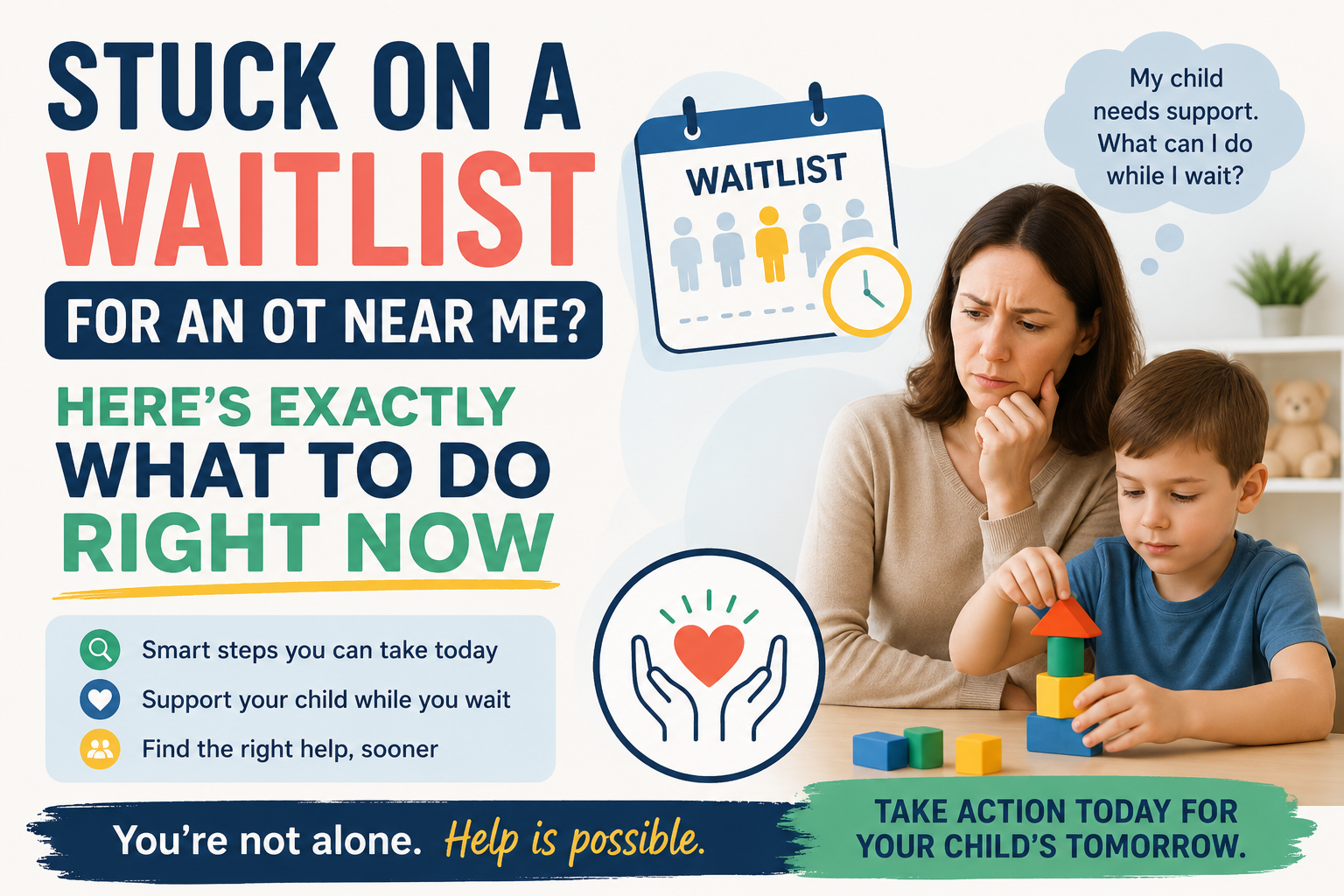
🧩 Stuck on a Waitlist for an OT Near Me? Here’s Exactly What to Do Right Now
Searching for an OT near me and stuck on a months-long waitlist? You don’t have to lose precious developmental time. Discover 20+ proven strategies to support your child starting today — no OT appointment needed.

- 🧩 Why Finding an OT Near Me Is So Hard — and What to Do While You Wait
- 📊 The OT Waitlist Crisis: Why It’s So Hard to Find an OT Near Me
- 🛑 What NOT to Do While Waiting for an OT Near Me
- ✅ The 20-Point Action Plan: What to Do Right Now While Waiting for an OT Near Me
- 🔷 STEP 1: Get on Multiple Waitlists Simultaneously
- 🔷 STEP 2: Request School-Based OT Immediately
- 🔷 STEP 3: Request an OT Assessment Before the Wait for Therapy Sessions
- 🔷 STEP 4: Implement a Home Sensory Diet
- 🔷 STEP 5: Access Telehealth OT Services
- 🔷 STEP 6: Build Fine Motor Skills at Home
- 🔷 STEP 7: Work on Self-Care and Daily Living Skills
- 🔷 STEP 8: Use Structured Free Resources From OT Professional Organisations
- 🔷 STEP 9: Find a Parent-Guided Home Programme (OT Coach / Parent Coaching)
- 🔷 STEP 10: Request School Accommodations Now — Without Waiting for OT
- 🔷 STEP 11: Consider an OT Consultation Group or Workshop
- 🔷 STEP 12: Document Everything for the OT Appointment When It Comes
- 💔 A Story That Every Family on a Waitlist Will Recognise
- 🌟 What You Must Not Skip About “OT Waitlist”
- 🔗 Key Resources for Families Waiting for an OT Near Me
- ❓ FAQs: OT Waitlists and What to Do While Waiting
- Q: How long is the waitlist for an OT near me?
- Q: Can a school provide OT if I’m on a private OT waitlist?
- Q: What can I do at home while waiting for occupational therapy?
- Q: Are telehealth OT services as effective as in-person?
- Q: How do I request school-based OT for my child?
- Q: Can I implement a sensory diet without an OT assessment?
- 💙 A Final Word — Because Your Child’s Development Cannot Wait for a Waiting List
🧩 Why Finding an OT Near Me Is So Hard — and What to Do While You Wait
Searching for an OT near me — an occupational therapist for your child with special needs — and hitting a 6, 12, or even 18-month waitlist is one of the most frustrating experiences in special needs parenting. But waiting does not have to mean doing nothing.
Research shows that parent-implemented sensory, fine motor, and daily living strategies at home can produce meaningful developmental gains — even without formal OT sessions. This guide tells you exactly what to do while you wait.
📊 The OT Waitlist Crisis: Why It’s So Hard to Find an OT Near Me
The shortage of paediatric occupational therapists is a documented, worsening crisis in the US, UK, Australia, and beyond. Understanding its scale helps parents advocate more effectively — and feel less alone in their frustration.
| Statistic | Figure | Source |
|---|---|---|
| US occupational therapists (all settings) | ~140,000 | BLS — OT Occupational Outlook 2025 |
| Projected OT job growth (2023–2033) | +12% (much faster than average) | BLS — OT Outlook |
| Median OT annual salary | ~$96,370 | BLS, 2024 |
| Children qualifying for school-based OT (US) | 7.3 million children receive IDEA services | NCES Fast Facts |
| Average paediatric OT waitlist (UK) | 18–52 weeks | Royal College of Occupational Therapists |
| Average paediatric OT waitlist (US, private) | 3–12 months in most metro areas | AOTA — OT Workforce |
| Children with developmental challenges in US | 1 in 6 children | CDC — Developmental Disabilities |
The demand for paediatric occupational therapy has increased dramatically — driven by rising autism diagnoses, better identification of sensory processing differences, and ADHD recognition. Meanwhile, supply has not kept pace. The result: every parent searching for an OT near me is competing for the same limited appointments.
🛑 What NOT to Do While Waiting for an OT Near Me
Before covering what to do, it is important to name what not to do — because several common parental responses to waitlist anxiety actually waste time.
- ❌ Wait passively. The developmental window does not pause. Home strategies during this period matter.
- ❌ Try to replicate professional OT sessions from YouTube alone. Without a professional assessment, you do not know which specific areas to address. Generic activities can waste time or cause frustration.
- ❌ Join every waitlist in your area simultaneously without tracking them. Keep organised records of every waitlist you join — clinic name, date added, contact name, and waitlist position if known.
- ❌ Assume school OT and private OT are interchangeable. They serve different purposes. Pursue both simultaneously.
- ❌ Stop advocating once you are on a waitlist. Call monthly. Circumstances change. Cancellations open spots.
✅ The 20-Point Action Plan: What to Do Right Now While Waiting for an OT Near Me

🔷 STEP 1: Get on Multiple Waitlists Simultaneously
This is the most impactful immediate action. Do not join one waitlist and wait. Join every relevant waitlist in your area simultaneously.
Where to find OTs for your waitlist applications:
| Resource | What It Provides | Link |
|---|---|---|
| AOTA Find an OT | US directory of licensed OTs | aota.org/consumer/who-are-ots/find-ot |
| Psychology Today OT Directory | US searchable OT database | psychologytoday.com |
| RCOT Find an OT (UK) | UK OT directory | rcot.co.uk |
| OT Australia | Australian OT directory | otaus.com.au |
| Zocdoc | US online booking; shows real availability | zocdoc.com |
| Headway (UK) | Brain and developmental therapy referrals | headway.org.uk |
Waitlist strategy:
- Call clinics rather than just emailing — you are more memorable as a voice
- Ask specifically: “Do you have a cancellation list? How often do cancellations occur?”
- Call every clinic you are on monthly — consistency signals priority
- Ask if they have any recently reduced waitlists due to new staff
🔷 STEP 2: Request School-Based OT Immediately
Many parents searching for an OT near me are unaware that their child may already be entitled to school-based occupational therapy — funded by the school district — if their child’s motor, sensory, or daily living challenges affect their ability to access education.
Under IDEA (Individuals with Disabilities Education Act), occupational therapy is listed as a related service that schools must provide when a child requires it to benefit from special education. (Source: IDEA — Related Services) This is not optional for schools. If your child qualifies, they are legally entitled to school-based OT — regardless of private OT waitlists.
How to request school-based OT:
- Write a formal letter to your child’s school principal or special education director requesting an evaluation for OT services
- The school must respond within 60 days (in most states)
- The evaluation is free to families
Key resource: Wrightslaw — OT in Schools — Free template letters for requesting school evaluations
🔷 STEP 3: Request an OT Assessment Before the Wait for Therapy Sessions
Many families are on a waitlist for both assessment AND therapy. Separate these where possible. An assessment alone — which identifies your child’s specific OT needs — can be conducted more quickly than ongoing therapy.
With an assessment report in hand, you can:
- Begin targeted home strategies for your child’s specific profile
- Access recommendations from another source while waiting for therapy
- Jump ahead on therapy waitlists (assessments often have shorter waits than therapy slots)
🔷 STEP 4: Implement a Home Sensory Diet
A sensory diet is a personalised programme of sensory activities that helps regulate a child’s sensory processing system throughout the day. It is one of the most evidence-supported OT interventions — and it can be partially implemented at home by parents with the right guidance.
The concept of the sensory diet was developed by OT Dr. Patricia Wilbarger. Sensory integration therapy and sensory diets are among the most commonly recommended OT interventions for children with sensory processing differences. (Source: AOTA — Sensory Integration in OT)
General sensory diet activities by sensory system:
| Sensory System | Low-Cost Home Activities | When to Use |
|---|---|---|
| Proprioception (body awareness) | Wheelbarrow walking, jumping, pushing heavy laundry basket, carrying books | Before demanding tasks; when dysregulated |
| Vestibular (movement/balance) | Swinging, rocking chair, rolling on the floor, balance board | Morning routine; transition support |
| Tactile (touch) | Play-dough, sand or rice bins, textured surfaces, hand massage | Before fine motor tasks; calming |
| Oral | Chewy foods, straw drinking, blowing bubbles, chewing gum | During focused tasks; for oral seekers |
| Visual | Reducing clutter, dimming lights, providing visual timers | Before and during concentration tasks |
| Auditory | Noise-cancelling headphones, white noise, preferred music | Crowded or noisy environments |
Important: Without a formal OT assessment, you do not know your child’s specific sensory profile. Use a general approach, observe responses carefully, and prioritise safety. A telehealth OT consultation (see below) can help create a more targeted sensory diet.
🔷 STEP 5: Access Telehealth OT Services
Telehealth OT has grown significantly since 2020 and is now a well-established service option. Many families searching for an OT near me do not realise they can access OT services online — from a therapist anywhere in their state or country.
Telehealth OT services can provide:
- Formal developmental assessment
- Sensory diet creation specific to your child
- Fine motor activity programmes
- Parent coaching and education
- School accommodation recommendation letters
Where to find telehealth OT:
| Service | Type | Link |
|---|---|---|
| AOTA OT Telehealth | Directory with telehealth filter | aota.org |
| BetterHelp / TherapyDen | Online therapy directories | therapyden.com |
| Therapy Brands (TheraPlatform) | Telehealth OT platform | theraplatform.com |
| Panda Health (UK) | Online OT services | panda.health |
| Kids Therapy Zone | Online paediatric OT | kidstherapyzone.com |
🔷 STEP 6: Build Fine Motor Skills at Home
Fine motor development is one of the most commonly addressed areas by paediatric OTs — and one of the areas most amenable to targeted home practice.
Evidence-based fine motor activities by age:
| Age Group | Activity | Target Skill |
|---|---|---|
| 2–4 years | Playdough squeezing, tearing paper, large bead threading | Hand strength, bilateral coordination |
| 4–6 years | Cutting with scissors, dot-to-dot drawing, peeling stickers | Precision, tool use, hand dominance |
| 6–8 years | Colouring within lines, origami (simple), building with small Lego | Pencil control, hand stability |
| 8–12 years | Knitting/sewing basics, typing, coin sorting | Bilateral integration, dexterity |
| 12+ years | Cooking tasks, using tools, detailed crafts | Independence, complex bilateral tasks |
(Source: AOTA — Fine Motor Development | CDC Milestone Guidelines)
The key principle: Short, frequent practice sessions (5–10 minutes daily) produce more developmental gain than occasional long sessions. Embed fine motor activities into daily routines rather than treating them as separate exercises.
🔷 STEP 7: Work on Self-Care and Daily Living Skills
Activities of daily living (ADLs) — dressing, feeding, grooming, hygiene — are core OT target areas. Working on these at home during the OT waitlist period produces genuine developmental gains AND creates meaningful opportunities for practice in real-world context.
ADL skill-building strategies:
| Skill | Strategy | Tools That Help |
|---|---|---|
| Dressing | Practice with large-button clothing first; use visual sequence guides | Button boards; velcro shoes; dressing sequence cards |
| Feeding | Weighted cutlery; adaptive plates with high edges; finger food progression | Dycem mats; adapted spoons; novaform handles |
| Tooth brushing | Electric toothbrush; visual timer for duration; preferred flavour toothpaste | Two-minute timer; toothbrushing social stories |
| Hair brushing | Detangling spray; small sectioned brushing; sensory preparation | Tangle Teezer; desensitisation programme |
| Shoe fastening | Velcro first; elastic laces; lace fastening boards | Lock Laces; lacing activities |
🔷 STEP 8: Use Structured Free Resources From OT Professional Organisations
The American and British occupational therapy professional bodies offer extensive free parent resources that provide guided activity programmes while waiting for an OT near me.
| Resource | What It Provides | Link |
|---|---|---|
| AOTA — OT Practice Resources | Free parent handouts and activity guides | aota.org |
| RCOT — Helping Children | UK OT parent guidance | rcot.co.uk |
| Understood.org — OT Guides | Dyslexia, ADHD, fine motor — parent friendly | understood.org |
| CDC — Learn the Signs Act Early | Developmental milestone resources | cdc.gov/actearly |
| Pediatric Occupational Therapy — Pinterest Community | Practitioner-created activity ideas | pinterest.com/search/pins/?q=pediatric%20OT |
🔷 STEP 9: Find a Parent-Guided Home Programme (OT Coach / Parent Coaching)
Several organisations offer structured parent coaching programmes — where an OT trains and coaches the parent to implement a targeted programme at home, rather than working directly with the child. This model dramatically reduces waitlist dependency because the parent becomes the primary implementer.
Parent coaching / home programme models:
- DIR/Floortime parent coaching — ICDL.com — parent-led developmental relationship approach
- TEACCH structured teaching — teacch.com — includes parent training components
These are not substitutes for OT — but they extend the therapeutic reach of professional input between and before sessions.
🔷 STEP 10: Request School Accommodations Now — Without Waiting for OT
Your child does not need a formal OT assessment to receive accommodations at school. Under Section 504 of the Rehabilitation Act, schools must provide reasonable accommodations for students with disabilities — and many of these are OT-aligned.
OT-aligned school accommodations you can request now:
| Accommodation | What It Addresses | How to Request |
|---|---|---|
| Pencil grips and slant boards | Fine motor difficulty in handwriting | Written request to teacher or SENCO |
| Keyboarding instead of handwriting | Fine motor fatigue; dysgraphia | 504 Plan or IEP request |
| Adaptive scissors | Fine motor difficulties in art/cutting | Written request |
| Movement breaks | Sensory regulation; attention | 504 Plan or informal agreement |
| Sensory tools at desk (fidget, cushion) | Sensory seeking; attention regulation | Written request to teacher |
| Preferential seating away from distraction | Sensory sensitivity; auditory processing | Written request |
Key resource: PACER Centre — Accommodations Guide — Free guide to requesting school accommodations
🔷 STEP 11: Consider an OT Consultation Group or Workshop
Many OTs offer parent workshops and group consultations at a fraction of the cost of individual sessions. These provide:
- Direct OT guidance tailored to a range of needs
- Peer support from other parents in the same situation
- Q&A with a licensed OT about your specific child
- Activity demonstrations you can replicate at home
Search for:
- “OT parent workshop near me”
- “Sensory processing parent group”
- “Occupational therapy parent training”
These workshops are often advertised through NICU follow-up programmes, autism advocacy organisations, and children’s hospital community outreach teams.
🔷 STEP 12: Document Everything for the OT Appointment When It Comes
One of the most valuable things you can do while waiting for an OT near me is prepare. When the appointment finally arrives, you want to use every minute effectively.
The OT Appointment Preparation Checklist:
- ✅ A detailed developmental history: when milestones were reached, any regressions
- ✅ Video footage of specific challenges — short clips of the exact difficulties you want to address
- ✅ Previous assessment reports (speech, psychology, paediatric)
- ✅ School reports noting relevant observations
- ✅ Your own observation log — a dated record of specific challenges and any home strategies you have tried and their results
- ✅ A prioritised list of your top three concerns to address in the first session
💔 A Story That Every Family on a Waitlist Will Recognise
Meet Sophia. She is the mother of 5-year-old Leo, who has sensory processing disorder and difficulty with fine motor tasks. In March 2024, Sophia was told the wait for an OT near her was 14 months.
She cried. Then she got to work.
She contacted her son’s school and formally requested a school-based OT evaluation under IDEA. She was added to two telehealth OT waitlists. She attended a parent sensory workshop through their local hospital. She set up a sensory corner at home with a swing and tactile bins. She implemented a daily fine motor activity programme.
By the time Leo’s private OT appointment arrived, eight months later, he had made measurable progress in handwriting, self-dressing, and sensory tolerance.
“The OT told me he was presenting significantly better than she expected for his age and diagnosis,” Sophia says. “She asked what we had been doing. I told her: everything.”
Leo did not lose eight months of developmental opportunity. His mother made sure of it.
🌟 What You Must Not Skip About “OT Waitlist”
🔸 The school OT entitlement is the most underused resource available.
Most families searching for an OT near me are completely unaware that school-based OT is a legal entitlement under IDEA if their child’s motor or sensory difficulties affect their ability to access education. This costs families nothing and bypasses private waitlists entirely.
🔸 Telehealth OT is now widely available and professionally equivalent for many assessment and coaching needs.
The equivalent of finding an OT near you — in terms of assessment quality and parent coaching — is available online from licensed OTs in most states and countries. Distance is no longer the barrier it once was.
🔸 Documenting home observations has direct clinical value.
The observation diary you keep during the waitlist period — noting specific challenges, responses to strategies, and developmental changes — becomes the most valuable clinical input at your first OT appointment. Your observations carry real diagnostic weight.
🔸 Peer parent communities often have more practical OT activity knowledge than general internet searches.
Facebook groups for parents of children with autism, SPD, and similar conditions frequently have experienced parent members who share OT programme activities they have been given. Search for groups specific to your child’s diagnosis and region.
🔸 Ask if the OT offers a “parent consultation only” format.
Some OTs on long therapy waitlists have shorter waiting times for a single parent consultation session — where they advise parents on a home programme without taking on the child as a regular client. This is an underused option that many clinics offer informally.
🔗 Key Resources for Families Waiting for an OT Near Me
| Resource | What It Provides |
|---|---|
| 🌐 AOTA — Find an OT | US OT directory; telehealth filter available |
| 🌐 Wrightslaw — School OT Rights | Free guides to accessing OT through schools under IDEA |
| 🌐 PACER Centre — Accommodations | Free parent training and accommodation guidance |
| 🌐 IDEA — Related Services | Legal text confirming OT as a school-based entitlement |
| 🌐 Understood.org | Fine motor, sensory, and OT-aligned parent resources |
| 🌐 CDC — Developmental Milestones | Milestone tracking to guide home focus areas |
| 🌐 RCOT — Children and Young People | UK OT guidance for families |
| 🌐 AOTA — Sensory Integration | Professional guidance on sensory integration approaches |
❓ FAQs: OT Waitlists and What to Do While Waiting
Q: How long is the waitlist for an OT near me?
Waitlists for paediatric occupational therapy vary significantly by location. In the UK, typical waiting times are 18–52 weeks through NHS services. In the US, private practice waitlists range from 3–12 months in most metropolitan areas. School-based OT evaluation timelines are regulated — in the US, schools must complete evaluations within 60 days of a written request under IDEA. (Source: IDEA — Evaluation Timelines)
Q: Can a school provide OT if I’m on a private OT waitlist?
Yes — and this is the most important thing for families to know. Under IDEA, occupational therapy is listed as a related service that schools must provide when a child requires it to benefit from special education. (Source: IDEA) Write to your school requesting a formal educational evaluation for OT services. This is free, legally protected, and bypasses private waitlists entirely.
Q: What can I do at home while waiting for occupational therapy?
The most effective home strategies while waiting for an OT near me include: implementing a general sensory diet with proprioceptive and vestibular activities, practising fine motor skills for 5–10 minutes daily through play-based activities, working on self-care skills (dressing, feeding, grooming) with adaptive strategies, accessing telehealth OT for remote assessment and coaching, requesting school accommodations, and attending parent OT workshops.
Q: Are telehealth OT services as effective as in-person?
For parent coaching, developmental assessment, sensory diet creation, and home programme development, telehealth OT is widely considered clinically effective. Some direct hands-on interventions (such as certain sensory integration techniques) require in-person delivery. The AOTA supports telehealth OT as a legitimate service delivery model. (Source: AOTA — Telehealth in OT Practice)
Q: How do I request school-based OT for my child?
Write a formal letter to your child’s school principal or special education director requesting a comprehensive educational evaluation to determine eligibility for occupational therapy as a related service under IDEA. The evaluation is free. The school must respond within 60 days in most US states. Wrightslaw provides free template letters at wrightslaw.com. In the UK, contact your SENCO and request OT as part of an Education, Health, and Care Plan assessment.
Q: Can I implement a sensory diet without an OT assessment?
General sensory activities — proprioceptive input through heavy work, vestibular input through movement, tactile exploration through play — are generally safe to implement at home without a formal assessment. However, a specific, personalised sensory diet should be created by a licensed OT based on your child’s specific sensory profile. A telehealth OT consultation is the safest way to get a personalised sensory diet while waiting for in-person OT.
💙 A Final Word — Because Your Child’s Development Cannot Wait for a Waiting List
The waitlist is real. The frustration is real. The grief of watching your child struggle while a clock ticks down to an appointment months away is one of the most painful experiences in special needs parenting.
But the waiting list is not the only thing that is real.
Your observation of your child is real clinical data. Your implementation of a home sensory programme is real therapeutic input. Your request letter to the school is a real legal action. Your telehealth OT consultation is a real professional assessment.
None of these require the in-person appointment you are waiting for. All of them are available to you right now, today, while that appointment is still months away.
The families who arrive at their first OT appointment with eight months of documented observations, implemented home strategies, and school accommodations already in place — those families give their children a head start that no waitlist can take away.
You are your child’s first and most powerful therapist. The OT near you is coming. In the meantime, you have more tools than you know. 💙🧩


