

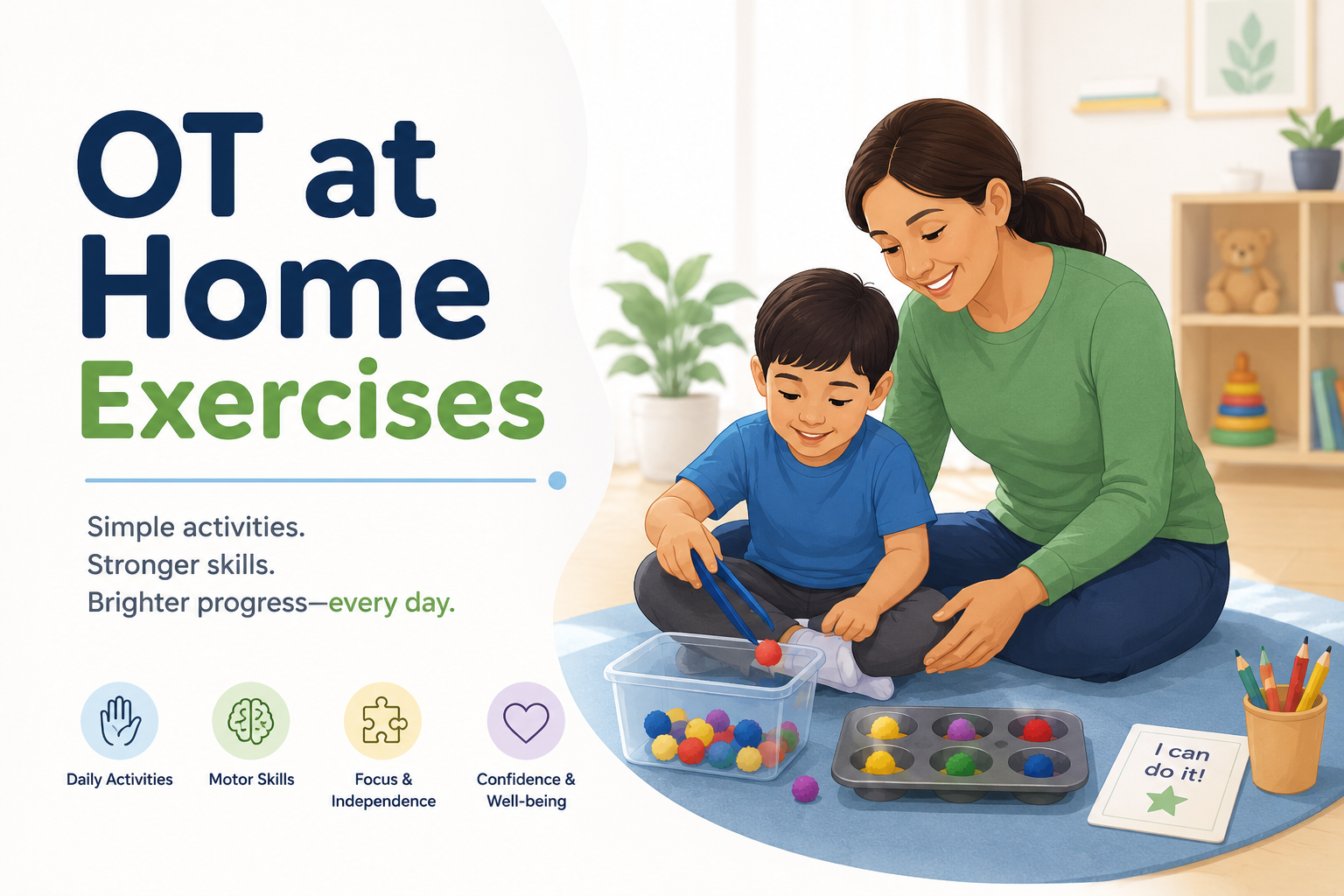
OT at Home Exercises 2026: Complete Parent’s Guide for Special Needs Children 💛
🏠 Want to do occupational therapy at home but don’t know where to start? Research shows 30 OT sessions deliver real gains — now replicate that daily. This 2026 complete exercise guide for special needs families shows you exactly how. 💛👇

- 🌟 What Is OT at Home and Can It Really Help Your Child?
- 📊 The Research Case for OT at Home — Key Statistics
- 🧠 Understanding Why OT at Home Matters So Much
- 🏠 How to Set Up OT at Home Successfully
- 💪 Complete OT at Home Exercise Guide — By Domain
- Domain 1: Sensory Processing Exercises 🌀
- 1.1 Proprioceptive Input Exercises (Deep Pressure and Heavy Work)
- 1.2 Tactile Desensitisation Exercises
- 1.3 Vestibular Input Exercises (Movement and Balance)
- Domain 2: Fine Motor OT at Home Exercises ✏️
- Domain 3: Gross Motor OT at Home Exercises 🏃
- Domain 4: Daily Living Skills OT at Home 🍽️
- Domain 5: Emotional Regulation OT at Home 🌈
- Domain 6: OT at Home for Specific Conditions 🎯
- 📋 Weekly OT at Home Schedule Template
- 💬 A Parent’s Experience — OT at Home in Real Life
- 💡 What You Must Not Miss About OT at Home
- 1. Sensory Diet vs Sensory Menu — The Critical Distinction
- 2. Co-Regulation Comes Before Self-Regulation
- 3. Sensory Regression Is Normal and Informative
- ❓ FAQs — OT at Home Exercises 2026
- Q1: What does OT at home mean?
- Q2: Can parents do OT at home without a therapist?
- Q3: How much time should I spend doing OT at home?
- Q4: What OT at home exercises are best for autism?
- Q5: What OT at home activities help with ADHD?
- Q6: How do I know if my child needs OT?
- Q7: Is sensory play the same as OT at home?
- Q8: How do I make OT at home fun for my child?
- Q9: What household items can I use for OT at home?
- Q10: Where can I learn more about OT at home for my child?
- 🔗 Essential Resources for OT at Home
🌟 What Is OT at Home and Can It Really Help Your Child?
OT at home — occupational therapy exercises done by parents at home between professional sessions — is one of the most powerful things a family can do to accelerate their special needs child’s development.
Research confirms that children who received 30 sessions of occupational therapy using sensory integration scored significantly higher on Goal Attainment Scales (p=0.003, d=1.2) and showed significantly better caregiver assistance in self-care (p=0.008) and socialisation (p=0.04) than control groups. Consistent OT practice at home compounds these clinic gains daily — making parents the most important therapists in their child’s life.
This guide gives you a practical, evidence-based framework for doing OT at home — with specific exercises for sensory processing, fine motor skills, gross motor development, daily living skills, and emotional regulation. Every exercise is designed to be implemented by parents without specialist equipment, using materials readily available in most homes.
📊 The Research Case for OT at Home — Key Statistics
| Statistic | Data | Source |
|---|---|---|
| OT sensory integration outcomes — autism RCT | Children who received 30 sessions of OT/SI scored significantly higher on Goal Attainment Scales (p=0.003, d=1.2) and significantly better on caregiver assistance in self-care (p=0.008) and socialisation (p=0.04) than usual care controls | NCBI / PMC — Autism RCT |
| OT/ASI for ADHD — 2026 RCT | OT using Ayres Sensory Integration® showed comprehensive positive effects in children with ADHD across sensorimotor functions, attention, executive functions, emotional regulation, and participation | AJOT — RCT, January 2026 |
| Sensory processing differences prevalence | Sensory processing differences affect children across the developmental continuum, transcending specific diagnostic criteria and significantly influencing participation in diverse occupational environments | AOTA / AJOT, 2025 |
| SIT for ASD + intellectual disability (2026) | Over an 8-week intervention period with once-weekly sensory integration therapy, improvements were observed in communication, social skills, and activities of daily living among children with ASD and co-occurring intellectual disability | MDPI Children, April 2026 |
| OT technology use in ASD children | OT interventions using new technologies in children with ASD showed beneficial effects in academic skills, activities of daily living, and acquisition of social skills including interaction and collaboration with peers | NCBI / PMC — ASD OT Scoping Review |
| Family involvement in OT outcomes | Sensory processing differences significantly influence participation in diverse occupational environments — family routines and home environments are primary occupational contexts for autistic children | Frontiers in Psychology / PMC |
🧠 Understanding Why OT at Home Matters So Much
Most special needs children receive OT once or twice per week — 45 to 60 minutes per session. That is approximately 90–120 minutes of professional therapy each week. Out of 10,080 waking minutes in a week, the clinic provides less than 1.2%.
The remaining 98.8% happens at home. And that is where the parent steps in.
When a parent learns the principles behind their child’s occupational therapy goals and consistently weaves those exercises into daily routines — bath time, mealtimes, transitions, play — the developmental gains accelerate dramatically. OT at home does not replace the therapist. It amplifies the therapist’s work.
The AOTA (American Occupational Therapy Association) actively supports coaching parents in home programming because research consistently shows that family-centred practice — where parents are active participants rather than passive observers — produces better outcomes for children than clinic-only treatment.
🏠 How to Set Up OT at Home Successfully
Before diving into specific exercises, the setup matters enormously.
Creating Your Home Sensory Environment
| Home Area | OT Purpose | What to Add |
|---|---|---|
| Living room | Gross motor and sensory regulation | A small trampoline, a yoga mat, floor cushions |
| Bedroom | Calming and proprioceptive input | A weighted blanket, a quiet corner with a tent |
| Bathroom | Tactile desensitisation | Varied textures in bath toys, different soap textures, sponges |
| Kitchen | Fine motor and daily living | Age-appropriate utensils, pouring activities, food preparation tasks |
| Backyard / outdoor | Vestibular and proprioceptive input | Swings, climbing equipment, sandbox |
The Daily OT at Home Routine — The 5-Minute Rule
OT at home does not require long, formal sessions. In fact, frequent short bursts of targeted activity are more effective for most special needs children than one long daily session.
The 5-minute rule: embed one targeted OT activity into five existing daily routines. Morning dressing, breakfast, car ride, after-school transition, and bedtime each become a tiny OT session.
This approach is called embedding — and it is one of the most researched and supported practices in paediatric occupational therapy.
💪 Complete OT at Home Exercise Guide — By Domain

Domain 1: Sensory Processing Exercises 🌀
Sensory processing is the foundation of OT for most special needs children. These exercises address the sensory systems — tactile, proprioceptive, vestibular, auditory, and visual — that many children with autism, ADHD, SPD, and related conditions process differently.
1.1 Proprioceptive Input Exercises (Deep Pressure and Heavy Work)
Proprioceptive input — information from muscles and joints about body position — is one of the most calming and organising sensory inputs for dysregulated children.
Exercises:
- Wall push-ups — Child presses both hands flat against the wall and pushes as hard as they can for 10 seconds. Repeat 5–10 times. Simple, powerful, takes 2 minutes.
- Wheelbarrow walking — Hold the child’s ankles while they walk on their hands across the floor. Start with short distances and build up.
- Heavy work carry — Give the child a backpack with a small amount of weight (books, water bottles) and ask them to carry it for a short walk. Provides sustained proprioceptive input.
- Bear hugs — Firm, sustained hugs from behind, counting to 10. Many children find this deeply calming. Always get the child’s permission first.
- Jumping on a trampoline — 5–10 minutes on a small indoor trampoline provides significant proprioceptive and vestibular input simultaneously.
- Resistive activities — Play-Doh kneading, squeezing stress balls, rolling dough, hammering pegs — all provide excellent proprioceptive input for hands and arms.
1.2 Tactile Desensitisation Exercises
Many special needs children are hypersensitive to tactile input — they find certain textures overwhelming. Gradual, systematic exposure to different textures through play is one of the core techniques of OT at home.
The Tactile Ladder — Start Here:
| Sensitivity Level | Texture Type | OT at Home Exercise |
|---|---|---|
| Lowest challenge | Dry, smooth textures | Running fingers through dry rice, sand, or dried beans |
| Medium challenge | Varied textures | Play-Doh, kinetic sand, shaving cream on a table |
| Higher challenge | Wet or sticky textures | Finger painting, slime, pudding play, wet sand |
| Highest challenge | Messy, unpredictable | Cloud dough, water beads, mud play |
Always work from lowest challenge upward. Never force. Watch for signs of stress and honour the child’s signals.
Specific exercises:
- Texture bins — A large plastic bin filled with dry rice or dried pasta. Hide small toys inside for the child to find using their hands only.
- Lotion massage — During bedtime routine, apply lotion to the child’s hands and feet using firm, consistent pressure. Always work toward the heart (hands to wrist to arm). Firm pressure is more organising than light touch.
- Finger painting — Messy tactile play that normalises hand exposure to unfamiliar textures. Use edible paints for younger children.
1.3 Vestibular Input Exercises (Movement and Balance)
The vestibular system — located in the inner ear — processes movement and balance. Children who seek movement constantly (spinning, swinging, running) or who are fearful of movement need vestibular-targeted OT at home activities.
For movement-seeking children:
- Swinging on a garden swing — linear swinging is calming; rotary spinning is alerting
- Somersaults and rolling on a mat
- Rocking in a rocking chair or hammock swing
- Spinning in an office chair — always monitor duration; some children become over-aroused
For movement-avoidant children (gravitation insecurity):
- Ground-level activities first — roll like a log along a mat
- Slowly progress to sitting on a therapy ball with feet on the floor
- Standing on a wobble board with the parent holding hands
- Walking on varied surfaces — grass, sand, a thin foam mat
Domain 2: Fine Motor OT at Home Exercises ✏️
Fine motor skills — the small muscle movements of the hands and fingers — underpin writing, dressing, eating, and many daily living tasks. These exercises are among the most commonly practised OT at home activities.
2.1 Hand Strength and Dexterity
- Play-Doh and putty work — Rolling into balls, snakes, and flat shapes. Hiding beads or small toys in putty for the child to dig out with their fingers.
- Tong and tweezers games — Picking up small objects (pom-poms, cotton balls, small cubes) with kitchen tongs or child-safe tweezers and sorting them into cups.
- Peeling stickers — Peeling stickers off a backing sheet and placing them on paper. Excellent for pincer grip development.
- Hole punching — Using a single-hole punch to make patterns in paper. Requires significant hand strength and bilateral coordination.
- Spray bottles — Filling a small spray bottle with water and using it to water plants or paint outdoor surfaces. Strengthens the intrinsic muscles of the hand.
- Squeeze and pop — Popping bubble wrap requires controlled hand strength and is often deeply satisfying.
2.2 Pincer Grip Development
The pincer grip — thumb and index finger coordination — is essential for writing, eating, and dressing.
| Exercise | How to Do It | Developmental Level |
|---|---|---|
| Cheerio threading | Thread round cereal onto a pipe cleaner | Beginner |
| Coin insertion | Post coins through a slot cut in a plastic lid | Intermediate |
| Button board | Button and unbutton buttons on a fabric board | Intermediate |
| Bead threading | Thread beads onto a lace | Intermediate |
| Lacing cards | Lace through pre-cut holes in cardboard | Advanced |
| Origami | Simple folds — paper boats, fortune tellers | Advanced |
2.3 Pre-Writing and Handwriting Support
- Tracing activities — Trace shapes, letters, and numbers on textured surfaces — sandpaper tracing boards are excellent
- Drawing in sand or shaving cream — Using fingers to draw shapes provides simultaneous tactile and motor input
- Vertical surface drawing — Taping paper to the wall and drawing while standing engages the shoulder muscles appropriately for writing posture
- Gravity letter formation — Place paper on the floor and have the child write while on all fours — weight through the wrists improves proprioceptive feedback for pen control
Domain 3: Gross Motor OT at Home Exercises 🏃
Gross motor skills — large muscle movements involving the whole body — are the foundation that fine motor skills build upon. Many special needs children have delays in coordination, balance, and bilateral integration.
3.1 Core Strength Exercises
- Superman holds — Lying face down, the child lifts arms and legs off the floor and holds for 5 seconds. Builds the core and back extension strength needed for upright sitting posture.
- Bridge pose — Lying on their back, the child pushes their hips up toward the ceiling and holds. Excellent for core and hip strength.
- Animal walks — Bear walks (all fours, knees off the ground), crab walks (all fours, tummy up), and inchworm walks (walk hands out from standing, then feet to hands) are all excellent OT at home whole-body exercises.
- Balance beam walking — A strip of masking tape on the floor serves as a balance beam. Walk heel-to-toe without stepping off the line.
3.2 Bilateral Coordination
Bilateral coordination — using both sides of the body together in a coordinated way — underlies catching, clapping, climbing, and cutting with scissors.
- Clapping games — Simple rhythmic clapping patterns that require both hands to coordinate
- Ball rolling — Rolling a ball back and forth while seated, using both hands together to send and receive
- Jumping jacks — A classic bilateral coordination exercise; start with arms only, then legs only, then combine
- Cutting with scissors — Start with playdough strips, then thick card, then standard paper — always with proper scissor grip
Domain 4: Daily Living Skills OT at Home 🍽️
Daily living skills — also called Activities of Daily Living (ADLs) — are the core goal of occupational therapy. OT at home is most impactful when it targets the specific ADLs your child struggles with.
4.1 Dressing Skills Progression
| ADL Skill | OT at Home Approach |
|---|---|
| Putting on socks | Practice with loose, seamless socks; use a mirror so the child can see what they are doing |
| Fastening buttons | Start with large buttons on a dressing board; progress to child’s own clothing |
| Zipping | Use a zip pull attached to a keyring for easier grip; practice with a jacket laid flat on the floor first |
| Shoe tying | Use the two-colour lace method; practice on a lacing board before actual shoes |
| Putting on a shirt | “Facedown on the floor” method — shirt laid face down, child leans forward through the neck hole; eliminates over-the-head confusion |
4.2 Eating and Mealtime OT at Home
- Utensil practice — Introduce a fork with a thick, adaptive handle before a standard fork; use a spork (combined spoon-fork) as a transitional utensil
- Pouring activities — Pouring from a small jug into cups; excellent for bilateral coordination and controlled movement
- Food preparation tasks — Tearing lettuce, spreading butter on toast, peeling bananas — age-appropriate food preparation builds hand function and confidence
- Resistive eating — Chewing crunchy foods (carrots, apples, pretzels) provides oral proprioceptive input that helps regulate the sensory system
4.3 Hygiene Skills OT at Home
- Handwashing sequence — Post a visual step-by-step handwashing chart at the sink; point to each step before the child does it
- Tooth brushing — Use a vibrating toothbrush for children who are hypersensitive in the mouth; desensitisation through chew tubes before toothbrushing helps
- Hair washing — Preparing children before water touches their head (counting down, warning them), using a visor to keep water from the face, and providing heavy proprioceptive input (bear hug) immediately afterward
Domain 5: Emotional Regulation OT at Home 🌈
OT using Ayres Sensory Integration showed comprehensive positive effects across sensorimotor functions, attention, executive functions, and emotional regulation in children with ADHD. Emotional regulation — the ability to manage and modulate emotional responses — is deeply connected to sensory processing, and OT at home can directly support it.
5.1 Creating a Sensory Calm-Down Kit
Assemble a personalised calm-down kit for your child — a small bag or box containing items that provide specific sensory input their nervous system finds regulating:
| Item Type | Examples | Sensory Input Provided |
|---|---|---|
| Proprioceptive | Stress ball, resistive putty, fidget ring | Joint and muscle feedback — calming |
| Oral sensory | Chewy tube, crunchy snack, sports water bottle | Oral proprioception — organising |
| Visual | Glitter calm-down bottle, lava lamp image | Slow visual tracking — calming |
| Tactile | Smooth stone, soft fabric swatch, velvet patch | Predictable touch input — calming |
| Auditory | Noise-cancelling headphones, preferred music playlist | Auditory filtering — reducing overwhelm |
5.2 The Zones of Regulation at Home
The Zones of Regulation — a framework developed by occupational therapist Leah Kuypers — divides emotional states into four colour zones (Blue = low energy, Green = ready to learn, Yellow = heightened, Red = out of control) and teaches children to identify their zone and apply strategies to return to Green.
OT at home implementation:
- Post a Zones of Regulation chart at child’s eye level
- Ask “What zone are you in?” at transitions and challenging moments
- Practice zone-specific strategies together: jumping for Blue, deep breathing for Yellow, squeeze the stress ball for Red
Domain 6: OT at Home for Specific Conditions 🎯
For Children with Autism
Over an 8-week intervention period with once-weekly sensory integration therapy, improvements were observed in communication, social skills, and activities of daily living among children with ASD and co-occurring intellectual disability.
Priority OT at home exercises for autism:
- Sensory bins (tactile normalisation)
- Heavy work and proprioceptive activities (regulation before learning)
- Fine motor activities that embed communication opportunities
- Routine-based ADL practice with visual supports
For Children with ADHD
Priority OT at home exercises for ADHD:
- Jumping and bouncing before seated tasks (alerting and organising)
- Fidget tools during required seated activities
- Movement breaks every 20 minutes during homework
- Proprioceptive activities before transitions (bear hugs, wall push-ups)
- Writing on vertical surfaces to improve posture and focus
For Children with Down Syndrome
Priority OT at home exercises for Down Syndrome:
- Oral motor exercises (blowing through straws, blowing bubbles)
- Fine motor activities targeting pincer grip
- Core strengthening through ball play and floor activities
- Dressing practice with adaptive tools
For Children with Cerebral Palsy
Priority OT at home exercises for CP:
- Range of motion activities through play
- Bilateral activities for children with hemiplegia — two-hand activities
- Adapted gripping tools for fine motor access
- Positioning for optimal function during activities
📋 Weekly OT at Home Schedule Template
Use this as a starting point and adapt it to your child’s specific IEP goals and your family’s routine.
| Time | Activity | OT Domain | Duration |
|---|---|---|---|
| Morning — before school | Wall push-ups + heavy backpack carry | Proprioceptive / regulation | 5 minutes |
| Breakfast | Practice pouring milk; use fork independently | ADL / fine motor | During breakfast |
| Car ride / commute | Resistive squeeze toy or fidget; verbal naming game | Sensory regulation / communication | During travel |
| After school (transition) | 10 minutes trampoline or outdoor play | Vestibular / gross motor | 10 minutes |
| Homework | Fidget tool available; movement break at 20 minutes | Sensory regulation / fine motor | During homework |
| Bath time | Varied texture sponges; lotion massage after | Tactile desensitisation | During bath |
| Bedtime routine | Deep pressure massage; firm weighted blanket | Proprioceptive / calming | 10 minutes |
💬 A Parent’s Experience — OT at Home in Real Life
“My son Arjun has autism and ADHD. He receives OT once a week at his therapy centre. His OT, Dr. Nandini, taught me the heavy work activities and the calm-down kit approach in our parent training sessions. I started doing 10 minutes of proprioceptive activities with Arjun every morning before school — wall push-ups, his heavy backpack, and five minutes on his small trampoline.
Within three weeks, his transition to school was measurably better. His teacher contacted me to ask what we had changed. The meltdowns in the car dropped from almost daily to twice in a whole month. He still needs his weekly OT session — absolutely.
But what changed his daily life was the 10 minutes I do with him every morning. OT at home is not a replacement. It is the amplifier.” — Meena K., mother of a child with autism and ADHD, Bengaluru, India
💡 What You Must Not Miss About OT at Home
1. Sensory Diet vs Sensory Menu — The Critical Distinction
A sensory diet is not a food diet. It is a personalised schedule of sensory activities prescribed by an occupational therapist for a specific child. A sensory menu is the broader collection of activities from which parents can choose.
Most OT at home guides provide a sensory menu — a list of activities. What transforms this into a sensory diet is personalisation by your child’s OT — knowing which sensory systems need more input, which need less, and when activities should be scheduled in the day.
This is why OT at home works best when paired with professional guidance. Take this guide to your child’s OT and ask them to help you select which activities are most appropriate for your child’s specific profile.
2. Co-Regulation Comes Before Self-Regulation
Many parents focus on teaching self-regulation tools (calm-down kits, breathing exercises). But children — especially young or significantly affected special needs children — cannot self-regulate until they have first experienced co-regulation with a calm adult. Your own regulated nervous system is the most powerful OT tool you have.
Before any exercise or strategy, regulate yourself first. Take a breath. Slow your voice. Lower your body to your child’s level. Your nervous system leads theirs.
3. Sensory Regression Is Normal and Informative
Children will have days — sometimes weeks — when previously tolerated sensory experiences are overwhelming again. This is normal and does not mean OT at home has failed. Sensory systems are affected by sleep, illness, stress, and transitions. A regression is information — it often tells you that the child’s regulatory system is under additional load from another source.
❓ FAQs — OT at Home Exercises 2026
Q1: What does OT at home mean?
OT at home means doing occupational therapy exercises and activities at home, between professional therapy sessions, to reinforce and accelerate the goals being worked on in the clinic. It involves parents implementing sensory, fine motor, gross motor, and daily living skill activities as part of daily routines — embedding therapeutic input into bath time, mealtimes, play, and transitions.
Q2: Can parents do OT at home without a therapist?
Yes — with important caveats. General OT at home activities like sensory bins, proprioceptive exercises, and fine motor play are safe for most children. However, the best OT at home programme is designed in collaboration with your child’s occupational therapist, who can personalise activities to your child’s specific sensory profile, goals, and current developmental level.
Q3: How much time should I spend doing OT at home?
More is not always better. Research supports frequent, brief, embedded activities over long formal sessions. Aim for 5–10 minutes of targeted OT activity embedded into five or more daily routines. This adds up to 25–50 minutes of OT at home daily without requiring any formal “session.”
Q4: What OT at home exercises are best for autism?
Children in the OT/SI treatment group scored significantly higher on Goal Attainment Scales (p=0.003) and better on self-care (p=0.008) and socialisation (p=0.04) than control groups. The most impactful OT at home activities for autism include heavy work and proprioceptive activities (wall push-ups, weighted backpacks, trampolines), tactile desensitisation through texture play, and routine-based ADL practice with visual supports. (Source: PMC RCT)
Q5: What OT at home activities help with ADHD?
OT using Ayres Sensory Integration showed comprehensive positive effects in children with ADHD across sensorimotor functions, attention, executive functions, and emotional regulation. At home, the most effective activities include proprioceptive exercises before seated tasks, movement breaks every 20 minutes during homework, fidget tools during required concentration tasks, and jumping or bouncing to increase alertness. (Source: AJOT 2026)
Q6: How do I know if my child needs OT?
Signs that a child may benefit from OT include: difficulty with fine motor tasks (holding pencils, buttons, using utensils), unusual responses to sensory input (extreme sensitivity or seeking), difficulty with daily living skills (dressing, eating, hygiene), poor coordination or balance, difficulty sitting still or focusing, and emotional dysregulation that seems connected to sensory experiences. A paediatric occupational therapist can conduct a formal assessment.
Q7: Is sensory play the same as OT at home?
Sensory play is one component of OT at home — specifically targeting the tactile, vestibular, and proprioceptive systems. OT at home is broader — it also includes fine motor activities, daily living skill practice, gross motor development, visual-motor integration, emotional regulation strategies, and adaptive skill building. Sensory play is an excellent starting point but is not the complete picture.
Q8: How do I make OT at home fun for my child?
The most effective OT at home activities are embedded in play and disguised as fun. Treasure hunts in sensory bins, animal walks across the living room, trampoline challenges, cooking together, and arts and crafts all provide therapeutic input while feeling like play. Follow the child’s interests — a dinosaur-obsessed child will engage more with dinosaur figurines hidden in a sensory bin than with a generic texture bin.
Q9: What household items can I use for OT at home?
Virtually every household has the resources for OT at home. A box of dry rice for a sensory bin. Play-Doh (or homemade salt dough). Straws for blowing activities. Masking tape on the floor for a balance beam. A pillow between the child’s back and the wall for wall push-ups. Tongs or tweezers from the kitchen for fine motor games. Bubble wrap for squeezing and popping. A spray bottle for hand strength. A vibrating toothbrush. Scarves for tactile and vestibular play.
Q10: Where can I learn more about OT at home for my child?
The American Occupational Therapy Association (AOTA) at aota.org provides parent-facing resources and can help locate registered occupational therapists in your area. The Spiral Foundation specialises in sensory integration research. Your child’s OT should be your primary resource — ask them specifically for a home programme at your next session. In India, the Occupational Therapy Association of India (OTAI) at otai.in provides practitioner directories.
🔗 Essential Resources for OT at Home
- 🌐 American Occupational Therapy Association (AOTA) — Research, parent resources, therapist directory
- 🌐 AJOT — OT/ASI Research, January 2026 — ADHD RCT evidence
- 🌐 PMC — OT Sensory Integration RCT for Autism — Landmark randomised controlled trial
- 🌐 MDPI Children — SIT for ASD + Intellectual Disability, 2026 — Latest evidence
- 🌐 Understood.org — Occupational Therapy Overview — Parent-friendly OT explanation
- 🌐 The OT Toolbox — Free parent-facing OT activity ideas and resources
This article is written for educational and informational purposes only. It does not constitute medical or therapeutic advice. Always consult your child’s occupational therapist before starting a home programme — especially for children with complex medical needs or significant sensory profiles.


