
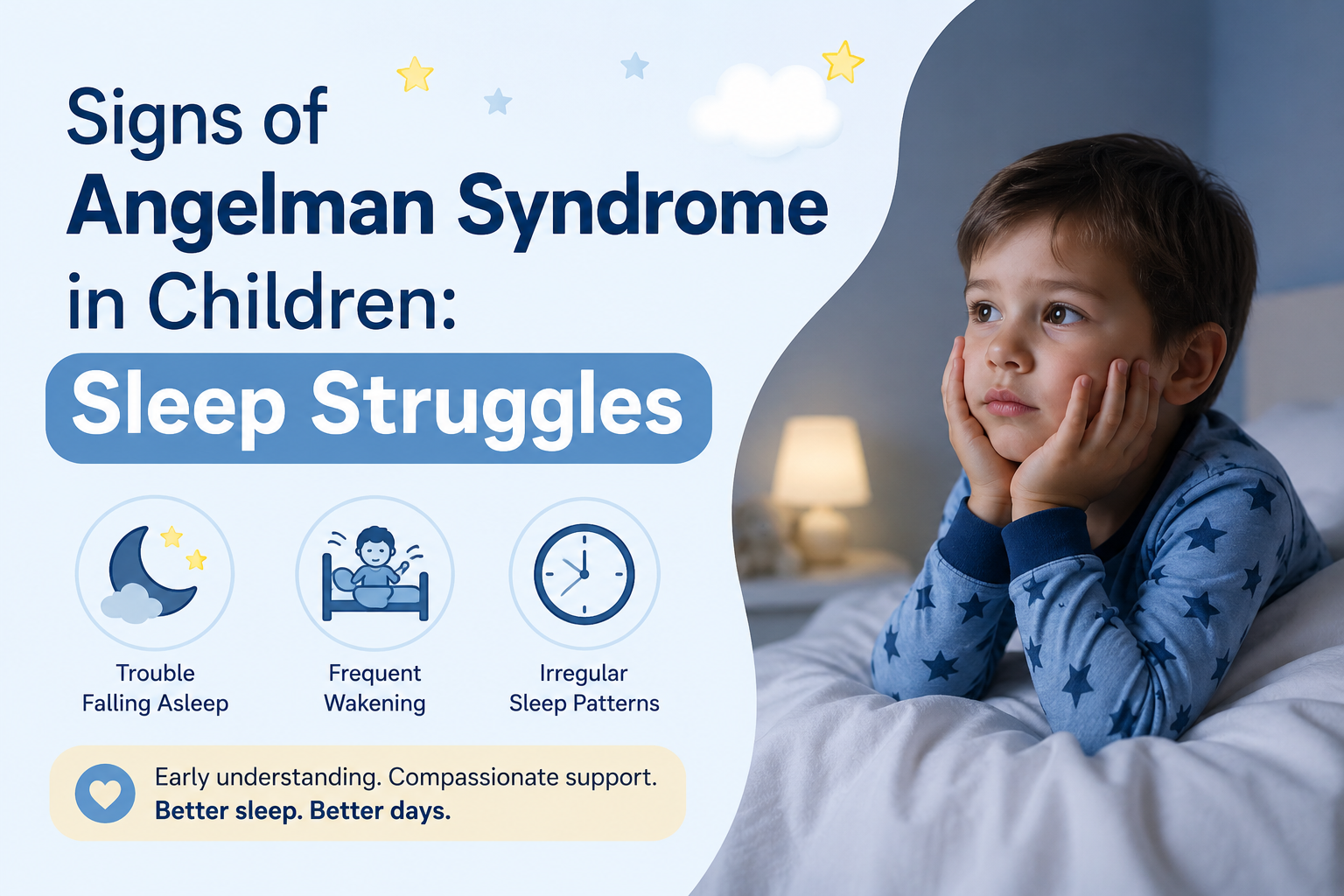
Signs of Angelman Syndrome in Children: Sleep Struggles Every Parent Must Know in 2026 💛
😴 Over 80% of children with Angelman Syndrome have severe sleep problems — some sleeping only 4–6 hours nightly. Discover the hidden signs, causes, and 2026 breakthrough treatments every parent needs to know. 💛👇

- 🌟 What Is Angelman Syndrome and Why Are the Sleep Signs So Important?
- 📊 Angelman Syndrome Statistics 2025–2026 — Key Data
- 🧬 What Causes Angelman Syndrome? The Genetics Made Simple
- 🚨 The Complete Signs of Angelman Syndrome in Children — Age by Age
- Signs in Infancy (0–6 Months) — Early But Easy to Miss
- Signs in Early Childhood (6–18 Months) — The First Red Flags
- Signs in Toddlerhood (18 Months–3 Years) — When Most Diagnoses Occur
- Complete Angelman Syndrome Signs Table
- 😴 Angelman Syndrome Sleep — The Deep Dive Every Family Needs
- How Severe Is the Sleep Problem in Angelman Syndrome?
- The Angelman Syndrome Sleep Profile — What Makes It Unique
- Why UBE3A Loss Disrupts Sleep — The Neuroscience
- 💬 A Parent’s Experience — The Night-Time Reality of Angelman Syndrome
- 🏥 Angelman Syndrome Sleep Treatment — The 2026 Complete Guide
- Tier 1: Sleep Hygiene Adaptations for AS
- Tier 2: Melatonin and Pharmacological Options
- Tier 3: The 2026 Breakthrough Therapies — Hope on the Horizon
- 🏫 Angelman Syndrome at School — What Teachers and Parents Need to Know
- 💡 What You Must Not Miss About Angelman Syndrome
- 1. The Happy Demeanour Can Mask Distress
- 2. Sleep Problems Worsen Seizure Control — Creating a Vicious Cycle
- 3. The Sibling and Parent Burden — Documented but Underacknowledged
- 4. Genotype Affects Sleep Profile
- ❓ FAQs — Angelman Syndrome and Sleep 2026
- Q1: What are the first signs of Angelman syndrome in a baby?
- Q2: How common are sleep problems in Angelman syndrome?
- Q3: How little sleep do children with Angelman syndrome need?
- Q4: Why does Angelman syndrome cause sleep problems?
- Q5: Is there a cure for Angelman syndrome?
- Q6: At what age is Angelman syndrome usually diagnosed?
- Q7: Does melatonin help Angelman syndrome sleep problems?
- Q8: What is the life expectancy of a child with Angelman syndrome?
- Q9: Can children with Angelman syndrome communicate?
- Q10: Where can I find support and the latest research on Angelman syndrome?
- 💛 Final Words: For the Family Who Is Awake at 3am
🌟 What Is Angelman Syndrome and Why Are the Sleep Signs So Important?
Angelman syndrome is a rare neurodevelopmental disorder — and its sleep problems are among the most severe, most disruptive, and most overlooked aspects of the condition.
To answer the question directly: Angelman syndrome is caused by the loss of maternal UBE3A gene expression on chromosome 15, resulting in severe developmental delay, absent or minimal speech, epilepsy, ataxia, and distinctive sleep disturbances that affect more than 80% of children with the condition.
Sleep problems in Angelman syndrome are not simply bad nights — they are a neurological signature of the condition that requires specific recognition and management.
For families raising a child with Angelman syndrome, the sleep struggle is often the most exhausting aspect of daily life — more exhausting, sometimes, than even the developmental and communication challenges. A child who sleeps only 4–6 hours per night, wakes frequently, and exhibits abnormal sleep-wake cycles does not just affect their own health. They reshape the entire family’s wellbeing.
This guide covers everything: the signs of Angelman syndrome in detail, the specific sleep profile that defines the condition, the science behind why AS causes such profound sleep disruption, and the 2026 state of treatment — including the gene therapy breakthroughs that are now entering Phase 3 trials.
📊 Angelman Syndrome Statistics 2025–2026 — Key Data
| Statistic | Data | Source |
|---|---|---|
| Prevalence of Angelman syndrome | Affecting at least 1 in every 15,000 people — approximately 500,000 individuals worldwide | American Brain Foundation |
| Age of first detection | AS is often first detected between 6 and 12 months of age when an infant shows delays in maturing — for example not yet crawling or babbling | American Brain Foundation |
| Sleep disturbance prevalence in AS | Sleep disturbances affect more than 80% of individuals with Angelman syndrome, including decreased sleep need, difficulty falling asleep, frequent night waking, and reversed sleep-wake cycles | The World Data — AS Statistics 2026 |
| Reduced total sleep duration (systematic review) | Systematic review findings demonstrated reduced total sleep duration (mean = 538 minutes), longer night-awakenings (mean = 67 minutes), and reduced sleep efficiency (78%) in AS compared with typically developing peers | Springer / Systematic Review, 2024 |
| Sleep medication prescribing in AS | Medication was highly prescribed historically and currently — 176 out of 266 participants (66.2%) in the systematic review were receiving medication for sleep | Springer Systematic Review, 2024 |
| Seizure prevalence in AS | Seizures affect 80–90% of individuals with AS, typically beginning before age 3 years and often proving difficult to control despite multiple medications | The World Data, 2026 |
| Microcephaly prevalence in AS | Microcephaly occurs in more than 80% of cases but is acquired rather than congenital — head size is typically normal at birth but fails to grow proportionally, becoming apparent by age 2 years | The World Data, 2026 |
| GTX-102 Phase 3 trial — ASPIRE | The Phase 3 ASPIRE trial fully enrolled 129 participants in July 2025, and results are expected in the second half of 2026; therapy received FDA Breakthrough Therapy Designation in June 2025 | StatPearls / NCBI, March 2026 |
| Typical AS diagnosis age range | Characteristic findings of AS are not usually apparent at birth; diagnosis is usually made between 1 and 4 years of age | NORD — Angelman Syndrome |
🧬 What Causes Angelman Syndrome? The Genetics Made Simple
Angelman syndrome is a rare neurodevelopmental disorder caused by loss of maternal UBE3A expression on chromosome 15q11.2–q13, resulting in severe developmental delay, absent or minimal speech, epilepsy, ataxia, sleep disturbance, and distinctive behavioural features including frequent laughter. (Source: StatPearls / NCBI, March 2026)
Let us break this down in plain language.
Every person inherits two copies of every gene — one from their mother and one from their father. In most parts of the body, both copies are active. But in the brain, there is a specific gene called UBE3A where only the maternal copy is switched on. The paternal copy is naturally silenced.
In Angelman syndrome, the maternal copy of UBE3A is missing or non-functional. This means the brain has no working UBE3A at all. This is the fundamental cause of the condition’s neurological effects — including the sleep disruption.
Four Genetic Mechanisms That Cause AS
| Mechanism | How It Works | Frequency |
|---|---|---|
| Maternal deletion (15q11-q13) | A section of chromosome 15 containing UBE3A is deleted | ~70% of cases |
| Paternal uniparental disomy (UPD) | Child inherits two copies of chromosome 15 from the father — no maternal copy | ~7% of cases |
| Imprinting defect | The maternal UBE3A is present but incorrectly “switched off” | ~3% of cases |
| UBE3A mutation | The maternal UBE3A is present but mutated — non-functional | ~11% of cases |
There are no signs of Angelman syndrome at birth. (Source: Boston Children’s Hospital) This is one of the most important points for families to understand. No newborn screening currently identifies AS at birth. The signs emerge gradually — and sleep problems are among the earliest to appear.
🚨 The Complete Signs of Angelman Syndrome in Children — Age by Age

Signs in Infancy (0–6 Months) — Early But Easy to Miss
Symptoms include trouble sucking or feeding and trouble going to sleep or staying asleep. (Source: American Brain Foundation)
- ✅ Feeding difficulties — poor sucking, difficulty swallowing, slow weight gain
- ✅ Hypotonia (low muscle tone) — the baby feels floppy or unusually limp when held
- ✅ Sleep difficulties begin early — longer than expected night waking, difficulty settling
- ✅ No obvious facial differences — most facial features reflect normal parental traits in infancy
Signs in Early Childhood (6–18 Months) — The First Red Flags
The first signs of Angelman syndrome are most often developmental delays — including lack of crawling or babbling between 6 and 12 months. (Source: Mayo Clinic / Mosaic Life Care)
- ✅ No crawling by 9–10 months when typically expected
- ✅ No babbling — the baby is notably quiet compared to same-age peers
- ✅ Hyperexcitability — easily excited, high-energy, difficult to calm
- ✅ Sleep problems worsening — shorter sleep periods, more frequent waking
Signs in Toddlerhood (18 Months–3 Years) — When Most Diagnoses Occur
This is the period when Angelman syndrome becomes most recognisable. Diagnosis is usually made between 1 and 4 years of age.
Characteristic Features:
- ✅ Absent or near-absent speech — a child this age who uses no words or only one to two words, yet appears to understand some language, is a significant red flag
- ✅ Seizures beginning — seizures may begin between the ages of 2 and 3 years old and may be the event that triggers referral for genetic testing
- ✅ Ataxic gait — wide-based walking, arms held up and out for balance
- ✅ Jerky movements of the arms and legs — a tremulous quality to movement
- ✅ Frequent, unprovoked laughter and smiling — the defining behavioural feature; often described as the “happy demeanour” of AS
- ✅ Hand-flapping — excited hand movements, especially during happy states
- ✅ Short attention span — moving rapidly from one activity to the next
- ✅ Fascination with water — many children with AS are particularly attracted to water, puddles, and swimming
Complete Angelman Syndrome Signs Table
| Feature | Prevalence | What It Looks Like |
|---|---|---|
| Severe developmental delay | 100% | Global delay across all milestones |
| Absent or minimal speech | 100% | Non-verbal or minimal verbal; receptive language better than expressive |
| Movement/balance difficulties (ataxia) | 100% | Wide-based gait, jerky movements, tremulousness |
| Frequent laughter/happy demeanour | ~100% | Smiling and laughing often, seemingly without a specific trigger |
| Sleep disturbance | >80% | Difficulty falling asleep, frequent waking, short sleep cycles |
| Seizures | 80–90% | Multiple types; begin before age 3; often intractable |
| Microcephaly (acquired) | >80% | Normal head at birth; slow head growth apparent by age 2 |
| Hyperactivity | >80% | Short attention span, constant movement, difficult to settle |
| Hypopigmentation | ~40% | Lighter skin, hair, and eye colour than biological family members |
| Crossed eyes (strabismus) | ~40% | Especially common in deletion subtype |
| Tongue thrusting | Common | Protruding tongue during eating and at rest |
| Fascination with water | Very common | Unusual attraction to water play |
| Hand-flapping | Very common | Excited, repetitive hand movements |
😴 Angelman Syndrome Sleep — The Deep Dive Every Family Needs
This is the section that most other Angelman syndrome guides cover superficially. For families living with AS, sleep is not a minor concern — it is the central challenge around which everything else is organised.
How Severe Is the Sleep Problem in Angelman Syndrome?
The data is striking. Sleep disturbances plague more than 80% of individuals with Angelman syndrome, with affected individuals requiring less sleep than expected, having difficulty falling and staying asleep, and exhibiting abnormal sleep-wake cycles that severely impact family quality of life.
Furthermore, the systematic review data puts specific numbers on what this means night to night: reduced total sleep duration (mean = 538 minutes — approximately 9 hours, compared to the 10–11 hours typical for young children), longer night-awakenings (mean = 67 minutes — over one hour awake in the middle of the night), and reduced sleep efficiency (78%, compared to >90% in typically developing children).
The Angelman Syndrome Sleep Profile — What Makes It Unique
| Sleep Feature | What It Looks Like | Why It Happens |
|---|---|---|
| Reduced sleep need | Child appears to need only 4–6 hours of sleep | UBE3A gene loss disrupts melatonin regulation and circadian rhythm neurologically |
| Difficulty falling asleep (sleep onset insomnia) | Takes hours to settle at bedtime | Hyperexcitability combined with circadian dysregulation |
| Frequent night waking | Wakes multiple times; often alert and happy; will play or vocalise | Fragmented sleep architecture due to neurological differences |
| Early morning waking | Fully awake at 3–4am, apparently refreshed and ready to engage | Shortened sleep cycles; reduced sleep need |
| Reversed sleep-wake cycles | Awake at night; sleepiest during the day | Circadian rhythm disruption from UBE3A loss in hypothalamus |
| Hypnagogic jerks | Startles as falling asleep; may wake immediately after | Normal in all people but exaggerated in AS due to motor hyperexcitability |
| Sleep-related seizures | Seizures that occur during sleep or at sleep-wake transitions | High seizure burden in AS; nocturnal seizures are common |
Why UBE3A Loss Disrupts Sleep — The Neuroscience
UBE3A is expressed in the neurons of the hypothalamus — the brain region that governs circadian rhythm, melatonin production, and the sleep-wake cycle. When maternal UBE3A expression is lost in Angelman syndrome, the hypothalamus cannot properly regulate these systems.
Additionally, the hyperexcitability that characterises Angelman syndrome — the readiness to become excited, laugh, and engage — is a feature of the nervous system that works against sleep onset. A child who is neurologically primed for excitement and engagement has a fundamentally different challenge settling into sleep than a neurotypical child.
Finally, the epilepsy that affects 80–90% of AS individuals directly interferes with sleep architecture. Seizure activity during sleep — even subclinical seizure activity detectable only on EEG — fragments sleep, prevents deep sleep phases, and contributes to the exhausting night-time profile that AS families describe.
💬 A Parent’s Experience — The Night-Time Reality of Angelman Syndrome
“Our daughter Siya was diagnosed with Angelman syndrome at 18 months. By the time she was two, we hadn’t had a full night’s sleep in almost a year. She would fall asleep at 11pm, wake at 2am completely happy and alert — laughing, vocalising, wanting to play — and then go back to sleep around 4am for another two hours. She was getting maybe 5 or 6 hours broken up across the night.
We tried everything. Blackout blinds. Routine. White noise. Sleep training — which was impossible because the problem wasn’t behaviour, it was neurology. Eventually her neurologist added melatonin to her evening medication. It helped somewhat — not dramatically.
We still have difficult nights. But we understand now that her sleep problem is not something we failed to fix. It is part of Angelman syndrome. It is in her genes. And knowing that has made a profound difference to how we cope with it.” — Priya R., mother of a child with Angelman syndrome, Mumbai, India
🏥 Angelman Syndrome Sleep Treatment — The 2026 Complete Guide
Management requires coordinated multidisciplinary care focusing on symptom control, particularly seizure management, sleep disturbances, gastrointestinal issues, and orthopedic complications.
Tier 1: Sleep Hygiene Adaptations for AS
These strategies are always implemented first — though families should know they are often insufficient alone for AS, whose sleep problems are neurologically driven.
- Consistent bedtime routine — same sequence every night; AS children respond well to predictability
- Dim lighting 1–2 hours before bed — begin the melatonin transition well before the desired sleep time
- Cool, quiet sleep environment — AS children are prone to hyperexcitability; minimise stimulating input
- Physical activity during the day — reduces hyperactivity at bedtime; helps with proprioceptive regulation
- Avoid screens 2 hours before bed — blue light suppresses melatonin in all children; particularly problematic for AS
Tier 2: Melatonin and Pharmacological Options
Medication was highly prescribed in AS — 66.2% of participants in the systematic review were receiving medication for sleep. The most commonly used medications include:
| Medication | How It Helps | Notes |
|---|---|---|
| Melatonin | Helps initiate sleep; low doses (0.5–3mg) at bedtime or immediate-release form | Most commonly used first-line; helps with sleep onset but less effective for night waking |
| Clonidine | Reduces hyperexcitability; promotes sleep onset and maintenance | Often used when melatonin alone is insufficient |
| Trazodone | Sedating antidepressant that can improve sleep maintenance | Used in older children and adolescents |
| Chloral hydrate | Historically used; increasingly replaced by safer alternatives | Short-term use only |
| Anticonvulsants | When nocturnal seizures are contributing to sleep disruption | Seizure control can significantly improve sleep quality in AS |
Always discuss medication choices with your child’s neurologist or developmental paediatrician — and monitor carefully, as AS children can have paradoxical reactions to some sedating medications.
Tier 3: The 2026 Breakthrough Therapies — Hope on the Horizon
This is where the science is genuinely, dramatically moving.
GTX-102 (Ultragenyx) — ASPIRE Trial: The Phase 3 ASPIRE trial fully enrolled 129 participants in July 2025, and results are expected in the second half of 2026. The therapy received FDA Breakthrough Therapy Designation in June 2025.
GTX-102 works by silencing the paternal copy of UBE3A (which is naturally silenced in the brain) — specifically, it blocks the RNA that normally keeps the paternal copy turned off. When the paternal copy of UBE3A becomes active, it compensates for the missing maternal copy. In principle, this could address the fundamental cause of AS — including the sleep disruption.
ION582 (Ionis) — REVEAL Study: The Phase 3 REVEAL study was initiated in early 2025. The therapy received FDA Breakthrough Therapy Designation in September 2025 and has not demonstrated lower extremity weakness seen in earlier trials of similar approaches.
Rugonersen (Oak Hill Bio): Phase 1 results demonstrated dose-dependent normalisation of electroencephalography patterns in 61 children. Normalisation of EEG patterns has direct implications for seizure burden — and therefore for sleep quality.
For families asking “Is there hope?” — the answer in 2026 is more clearly yes than at any point in the history of Angelman syndrome research. Phase 3 trials with breakthrough therapy designations. Over 100 children enrolled in studies. Results expected before the end of this year.
🏫 Angelman Syndrome at School — What Teachers and Parents Need to Know
School settings present particular challenges for children with Angelman syndrome — especially when sleep deprivation from the previous night compounds existing developmental challenges.
IEP Considerations for AS
Children with Angelman syndrome qualify for special education services under IDEA — typically under the category of “Multiple Disabilities” or “Other Health Impairment” depending on the specific presentation.
Essential IEP accommodations for AS:
| Area | Accommodation |
|---|---|
| Communication | AAC device — Proloquo2Go, TouchChat, or PECS system; signed instruction system |
| Academic participation | Modified curriculum; visual supports throughout; one-step instructions |
| Sensory management | Fidget tools; movement breaks; sensory room access |
| Seizure safety | Individual Health Plan (IHP) with seizure protocol; seizure alert bracelet; trained staff |
| Sleep-related fatigue | Flexible rest periods; reduced expectations during days after poor sleep nights; communication with parents about previous night |
| Motor support | Physical therapy for ataxia; adapted PE; appropriate seating supports |
| Behaviour | Positive behaviour support plan; note that laughter is not defiance — it is a symptom |
Communicating With School About Sleep
One of the most practical things parents can do is establish a daily sleep log communication with school staff. A simple morning text or note — “Siya had her worst night this week, up from 2–4am, be prepared for a harder day” — allows teachers to adjust expectations and provide additional support rather than attributing the difficult school day to unexplained behaviour.
💡 What You Must Not Miss About Angelman Syndrome
1. The Happy Demeanour Can Mask Distress
The characteristic happy demeanour and frequent laughter of Angelman syndrome — while genuine — can make it harder for caregivers and professionals to recognise when a child with AS is in pain, unwell, or significantly distressed. A child who is laughing and smiling may be having a seizure. A child who appears happy may have a gastrointestinal condition causing significant discomfort. The joyful presentation does not indicate absence of distress.
2. Sleep Problems Worsen Seizure Control — Creating a Vicious Cycle
This critical relationship is rarely discussed in parent-facing content: sleep deprivation lowers seizure threshold in children with epilepsy. In Angelman syndrome, where both seizures and sleep problems are near-universal, this creates a vicious cycle. Poor sleep increases seizure frequency. Increased seizures — particularly nocturnal ones — worsen sleep quality. Breaking this cycle often requires simultaneous attention to both problems rather than treating them sequentially.
3. The Sibling and Parent Burden — Documented but Underacknowledged
The systematic impact of AS sleep problems on the entire family — siblings whose own sleep and development is affected, parents experiencing the health consequences of years of sleep deprivation — is documented in research but rarely addressed in clinical care. Family support, respite services, and caregiver wellbeing should be explicit parts of the AS care plan.
4. Genotype Affects Sleep Profile
The genetic subtype of AS affects the severity of sleep problems. Children with the deletion subtype — the most common — typically have the most severe presentation across all features including sleep. Children with UPD or imprinting defects often have milder presentations. Knowing your child’s specific genetic subtype helps predict and prepare for their likely sleep profile.
❓ FAQs — Angelman Syndrome and Sleep 2026
Q1: What are the first signs of Angelman syndrome in a baby?
The first signs of Angelman syndrome are most often developmental delays — including lack of crawling or babbling between 6 and 12 months. Additionally, early sleep difficulties — trouble settling, frequent waking — often begin before the classic AS features are recognisable. Feeding difficulties and hypotonia may also be early indicators. There are no signs of Angelman syndrome at birth. (Source: Boston Children’s Hospital)
Q2: How common are sleep problems in Angelman syndrome?
Sleep disturbances affect more than 80% of individuals with Angelman syndrome, including decreased sleep need, difficulty falling asleep, frequent night waking, and reversed sleep-wake cycles that severely impact family quality of life. (Source: The World Data, 2026)
Q3: How little sleep do children with Angelman syndrome need?
Individuals with AS often require only 4–6 hours of sleep — far less than the 10–11 hours typical for young children. The systematic review found a mean total sleep duration of approximately 538 minutes (about 9 hours) — still significantly less than typically developing peers, with longer night awakenings and reduced sleep efficiency. (Source: Springer Systematic Review)
Q4: Why does Angelman syndrome cause sleep problems?
Sleep problems in AS are neurological in origin. UBE3A loss affects the hypothalamus — the brain region governing circadian rhythm and melatonin production — directly disrupting the sleep-wake cycle. The hyperexcitability characteristic of AS works against sleep onset. Additionally, nocturnal seizures (common in AS) directly fragment sleep architecture, further reducing sleep quality.
Q5: Is there a cure for Angelman syndrome?
Although no disease-modifying therapies are currently approved, several investigational approaches including gene-based therapies targeting UBE3A expression are advancing in clinical trials. The most advanced is GTX-102, whose Phase 3 ASPIRE trial has results expected in the second half of 2026, and which received FDA Breakthrough Therapy Designation in June 2025. (Source: StatPearls / NCBI, March 2026)
Q6: At what age is Angelman syndrome usually diagnosed?
The characteristic findings of Angelman syndrome are not usually apparent at birth, and diagnosis is usually made between 1 and 4 years of age. Delayed diagnosis is common due to phenotypic variability — particularly milder presentations in UPD and imprinting subtypes. Parents who notice early developmental delays and sleep disruption should request genetic evaluation promptly. (Source: NORD)
Q7: Does melatonin help Angelman syndrome sleep problems?
Melatonin is the most commonly used first-line treatment for AS-related sleep difficulties. It primarily helps with sleep onset — difficulty falling asleep. It is less effective for the frequent night waking and early morning waking that characterise AS sleep. Medication overall was prescribed for 66.2% of participants in the AS systematic review — reflecting how consistently medical management is required for this condition’s sleep problems. (Source: Springer)
Q8: What is the life expectancy of a child with Angelman syndrome?
People with Angelman syndrome tend to live close to a typical life span. AS does not significantly shorten life expectancy in most cases. However, the condition requires lifelong support — and the quality of that support significantly affects quality of life. Adults with AS continue to need full-time care and continue to experience the hallmark features of the condition. (Source: Mayo Clinic)
Q9: Can children with Angelman syndrome communicate?
Although those with the syndrome may be unable to speak, many gradually learn to communicate through other means such as gesturing. AAC (Augmentative and Alternative Communication) devices — including tablet-based systems like Proloquo2Go — are increasingly used and can significantly expand a child’s ability to express needs and communicate. Receptive language is typically better than expressive language in AS. (Source: NORD)
Q10: Where can I find support and the latest research on Angelman syndrome?
The Foundation for Angelman Syndrome Therapeutics (FAST) at cureangelman.org is the leading advocacy organisation focused on finding a cure, with detailed information on clinical trials. The Angelman Syndrome Foundation at angelman.org offers family support, community resources, and educational guides. The Global Angelman Syndrome Registry at angelmanregistry.info allows families to contribute to research.
💛 Final Words: For the Family Who Is Awake at 3am
If you are reading this article at 3am while your child with Angelman syndrome is awake and smiling in their room — this guide was written for you.
You are not failing. You are not doing something wrong. The sleep problem your family is experiencing is a neurological feature of a specific genetic condition — it is in the UBE3A gene, in the hypothalamus, in the circadian rhythm circuits that work differently in your child’s brain.
And in 2026, more is being done to address Angelman syndrome — at its source — than at any point in the history of the condition. Phase 3 trials. Breakthrough therapy designations. 129 children enrolled in the ASPIRE study with results expected before the year ends.
Your child’s laughter — even at 3am — is one of the most remarkable features of a remarkable condition. And your advocacy for them, your sleepless nights, your relentless searching for answers — that is what drives everything forward. 💛
🔗 Essential Resources
- 🌐 Foundation for Angelman Syndrome Therapeutics (FAST) — Clinical trial information, research updates, family support
- 🌐 Angelman Syndrome Foundation — Family resources, community, educational materials
- 🌐 StatPearls / NCBI — Angelman Syndrome, March 2026 — Current medical reference
- 🌐 NORD — Angelman Syndrome Patient Resource
- 🌐 Global Angelman Syndrome Registry — Contribute to research
This article is written for educational and informational purposes only. It does not constitute medical advice. For diagnosis, treatment, and management of Angelman syndrome, always consult a qualified paediatric neurologist or medical geneticist.


