

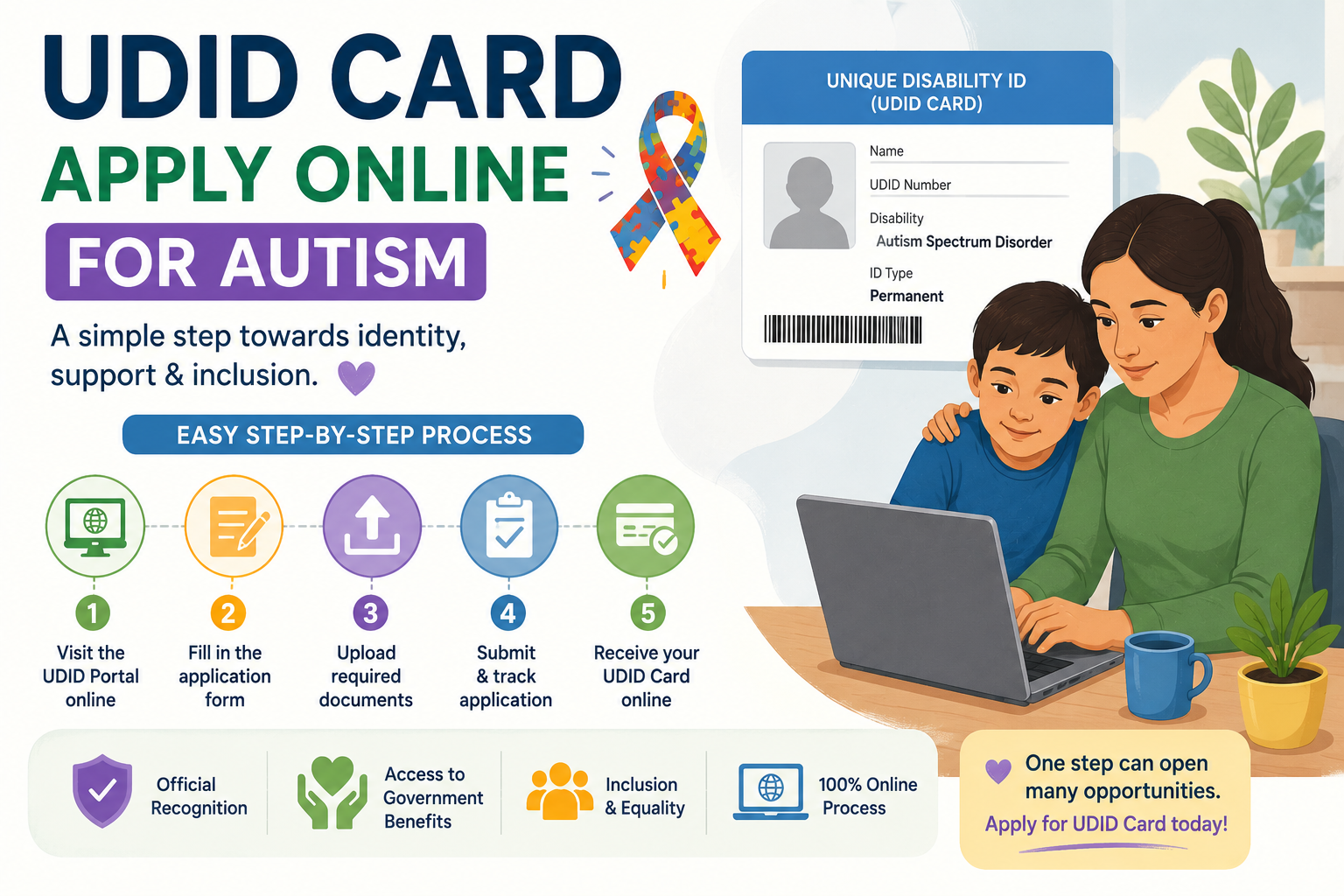
Step-by-Step Guide to UDID Card Apply Online for Autism 🎗️
UDID card apply online for autism means registering your child on the government’s swavlambancard.gov.in portal, uploading documents, booking a medical assessment, and receiving a certified disability card after evaluation. This guide walks you through every step, so nothing catches you off guard. 💙
If you’ve stared at the UDID portal wondering where to even begin, you’re not alone. Thousands of Indian parents feel that same confusion every single day. This guide turns that confusion into a clear, calm checklist. 📋

- What Is a UDID Card, and Why Does Your Autistic Child Need One? 🎫
- Real Data: Understanding Autism Disability Assessment in India 📊
- Step-by-Step: How to Apply for a UDID Card for Autism Online 🖥️
- Step 1: Gather Your Documents First 📁
- Step 2: Visit the Official Portal 🌐
- Step 3: Click “Apply for UDID Card” 🖱️
- Step 4: Fill in Your Child’s Details Carefully 📝
- Step 5: Upload Required Documents 📤
- Step 6: Submit and Note Your Enrollment Number 🔢
- Step 7: Attend the Medical Assessment 🩺
- Step 8: Track Your Application Status 🔍
- Step 9: Download Your e-UDID Card 📲
- A Real Parent Story: Rohan’s UDID Journey 👨👦
- Common Mistakes That Delay UDID Applications ⚠️
- What Happens After You Get the UDID Card? 🎉
- Voice Search Quick Answers 🎙️
- Frequently Asked Questions ❓
- 1. How do I apply for a UDID card online for autism in India step by step?
- 2. What documents are required for a UDID card application for an autistic child?
- 3. What ISAA score is needed to qualify for a UDID card for autism?
- 4. Can I convert an existing autism disability certificate into a UDID card?
- 5. How long is a UDID card valid for a child with autism?
- 6. Is the UDID card free to apply for online?
- Final Thoughts: One Step Closer to the Support Your Child Deserves 💛
What Is a UDID Card, and Why Does Your Autistic Child Need One? 🎫
The Unique Disability ID (UDID) is a single, government-recognized identity card for persons with disabilities in India, issued by the Department of Empowerment of Persons with Disabilities (DEPwD). It replaces multiple paper certificates with one digital record accepted nationwide.
Under the Rights of Persons with Disabilities (RPwD) Act, 2016, Autism Spectrum Disorder (ASD) is officially recognized as one of 21 specified disabilities. This means your autistic child can legally qualify for a UDID card, provided their assessed disability meets the required threshold. 🎯
Why This Card Matters for Autism Families 👨👩👧
- Unlocks educational accommodations (extra exam time, scribe facility, relaxed attendance rules)
- Enables travel concessions on railways and some state transport
- Provides access to reserved seats in education and government jobs (where applicable)
- Simplifies applying for disability pensions and welfare schemes
- Serves as one unified document instead of carrying multiple certificates everywhere
Real Data: Understanding Autism Disability Assessment in India 📊
Before applying, it helps to understand how autism is actually measured for certification purposes.
| Fact | Details | Source |
|---|---|---|
| Autism is recognized under 21 specified disabilities | Legally certifiable disability requiring at least 40% assessed severity (benchmark disability) | India Autism Center, 2026 |
| Assessment tool used: ISAA (Indian Scale for Assessment of Autism) | 40-item scale across 6 domains; scores range from 40–200 | Indian Journal of Psychological Medicine, 2025 |
| ISAA score of 70 corresponds to roughly 40% disability (minimum for certification) | Scores above 158 correspond to 100% disability | Inspiring Pathways, ISAA Explainer |
| Severity bands: Mild (70–107), Moderate (108–153), Severe (153+) | Determines the percentage disability recorded on your child’s certificate | Psychology Town, ISAA Guide |
| Certificate validity: 5 years for children under 18 with temporary disability status; permanent in eligible cases | You may need to renew and re-assess as your child grows | Assam Social Justice Dept. ISAA Guidelines, 2016 |
💡 Key takeaway: The medical board doesn’t just “confirm” autism — they measure its functional severity using ISAA, and that score directly decides your child’s disability percentage on the UDID card.
Step-by-Step: How to Apply for a UDID Card for Autism Online 🖥️

Step 1: Gather Your Documents First 📁
Before opening the portal, keep these ready:
- Child’s Aadhaar card (or Aadhaar enrollment ID if not yet issued)
- Passport-size photograph (recent, plain background)
- Proof of address (utility bill, ration card, or parent’s Aadhaar)
- Existing medical or diagnosis reports, if available (developmental pediatrician, psychologist reports)
- Existing disability certificate, if your child already has one to convert
Step 2: Visit the Official Portal 🌐
Go to swavlambancard.gov.in — this is the only official government website. Never share your child’s details on any third-party site claiming to “speed up” the process. ⚠️
Step 3: Click “Apply for UDID Card” 🖱️
On the homepage, select the option to apply. You’ll be asked whether you’re applying using an Aadhaar Number or Aadhaar Enrollment Number. Choose the correct one and submit.
Step 4: Fill in Your Child’s Details Carefully 📝
This section usually includes:
- Personal details (name, date of birth, gender, guardian details)
- Disability details (select “Autism Spectrum Disorder” from the disability list)
- Address and contact information
- Identity information matching Aadhaar exactly
Pro tip: Double-check spelling and date of birth against the Aadhaar card. Even small mismatches can delay approval by weeks. 🕒
Step 5: Upload Required Documents 📤
Upload the photograph, address proof, Aadhaar details, and any existing medical or diagnosis reports. Clear, well-lit scans reduce the chance of rejection.
Step 6: Submit and Note Your Enrollment Number 🔢
After submission, you’ll receive an enrollment number. Save this immediately — you’ll need it to track your application and later download the card.
Step 7: Attend the Medical Assessment 🩺
Your application is forwarded to the Chief Medical Officer (CMO) or a designated Medical Board, usually at a government hospital. This is where the ISAA assessment happens for autism cases. The evaluation typically includes:
- Developmental history discussion with parents
- Behavioral observation of the child
- ISAA scoring by a trained clinician
Step 8: Track Your Application Status 🔍
Return to the portal, click “Track Your Application,” and enter your enrollment number and date of birth to check progress.
Step 9: Download Your e-UDID Card 📲
Once the medical board approves the disability percentage, your digital UDID card becomes available for download directly from the portal — no need to visit any office in person.
A Real Parent Story: Rohan’s UDID Journey 👨👦
Vikram, a father from Pune, shared his experience applying for his 7-year-old son Rohan’s UDID card.
“The website felt overwhelming at first. I didn’t know Aadhaar mismatches could cause delays until my first attempt got stuck for three weeks over a spelling difference in Rohan’s middle name,” he said.
His second attempt, after correcting the Aadhaar details first, went through in under 10 days for the online submission stage. The medical assessment took another six weeks to schedule due to hospital wait times.
Vikram’s biggest tip for other parents: “Bring Rohan’s school reports and therapy notes to the medical assessment, even if they’re not officially required. It helped the doctor understand his day-to-day struggles beyond just the ISAA questions.” 🙌
Common Mistakes That Delay UDID Applications ⚠️
| Mistake | Why It Causes Delays | How to Avoid It |
|---|---|---|
| Aadhaar detail mismatch | System auto-rejects inconsistent name/DOB | Verify every field against Aadhaar before submitting |
| Blurry or cropped photo uploads | Medical board may request resubmission | Use a clear, recent, plain-background photo |
| Applying without prior diagnosis reports | Slows down medical board evaluation | Carry developmental pediatrician or psychologist reports |
| Missing the medical assessment appointment | Application stalls until rescheduled | Confirm hospital appointment details immediately after booking |
| Using unofficial third-party websites | Risk of data misuse, no real application filed | Only use swavlambancard.gov.in |
What Happens After You Get the UDID Card? 🎉
Once your child’s UDID card is issued, here’s what typically follows:
- Schools can use it to formally approve accommodations under the RPwD Act
- Government welfare schemes become accessible using the UDID number as identification
- Renewal reminders: mark your calendar, since certificates for children under 18 are often valid for a defined period and require reassessment
Voice Search Quick Answers 🎙️
“How do I apply for a UDID card for my autistic child?”
Visit swavlambancard.gov.in, click “Apply for UDID Card,” fill in personal and disability details, upload required documents, and attend the scheduled medical assessment for final approval.
“What is the minimum disability percentage needed for a UDID card in autism?”
Under the RPwD Act, 2016, a benchmark disability of at least 40% is required, which for autism is measured using the ISAA score of 70 or above.
“How long does it take to get a UDID card after applying online?”
Timelines vary by state and hospital availability, often ranging from a few weeks to a few months, depending on medical board scheduling.
Frequently Asked Questions ❓
1. How do I apply for a UDID card online for autism in India step by step?
Visit the official portal swavlambancard.gov.in, register using Aadhaar details, fill in personal and disability information, upload documents, and attend the medical assessment scheduled by the CMO or medical board.
2. What documents are required for a UDID card application for an autistic child?
You’ll typically need Aadhaar details, a passport-size photograph, proof of address, and any existing medical or diagnosis reports related to autism.
3. What ISAA score is needed to qualify for a UDID card for autism?
An ISAA score of 70 or higher generally qualifies as at least 40% disability, meeting the benchmark disability requirement under the RPwD Act, 2016.
4. Can I convert an existing autism disability certificate into a UDID card?
Yes. Existing certificate holders can use the “convert certificate to UDID” option on the portal instead of undergoing a fresh assessment in most cases.
5. How long is a UDID card valid for a child with autism?
For children under 18 with a temporary disability classification, certificates are typically valid for around 5 years, after which reassessment may be required; permanent status may apply in eligible cases.
6. Is the UDID card free to apply for online?
Yes, applying through the official government portal swavlambancard.gov.in does not require any application fee.
Final Thoughts: One Step Closer to the Support Your Child Deserves 💛
Applying for a UDID card can feel like just another form in an already overwhelming journey. But this single document opens doors — to school accommodations, welfare schemes, and formal recognition of what your family already knows: your child deserves support tailored to their needs.
Take it one step at a time. Gather your documents, verify every detail, and don’t hesitate to bring extra context to the medical assessment. You’re not just filling out a form — you’re building a foundation for your child’s future access to care. 🌟


