

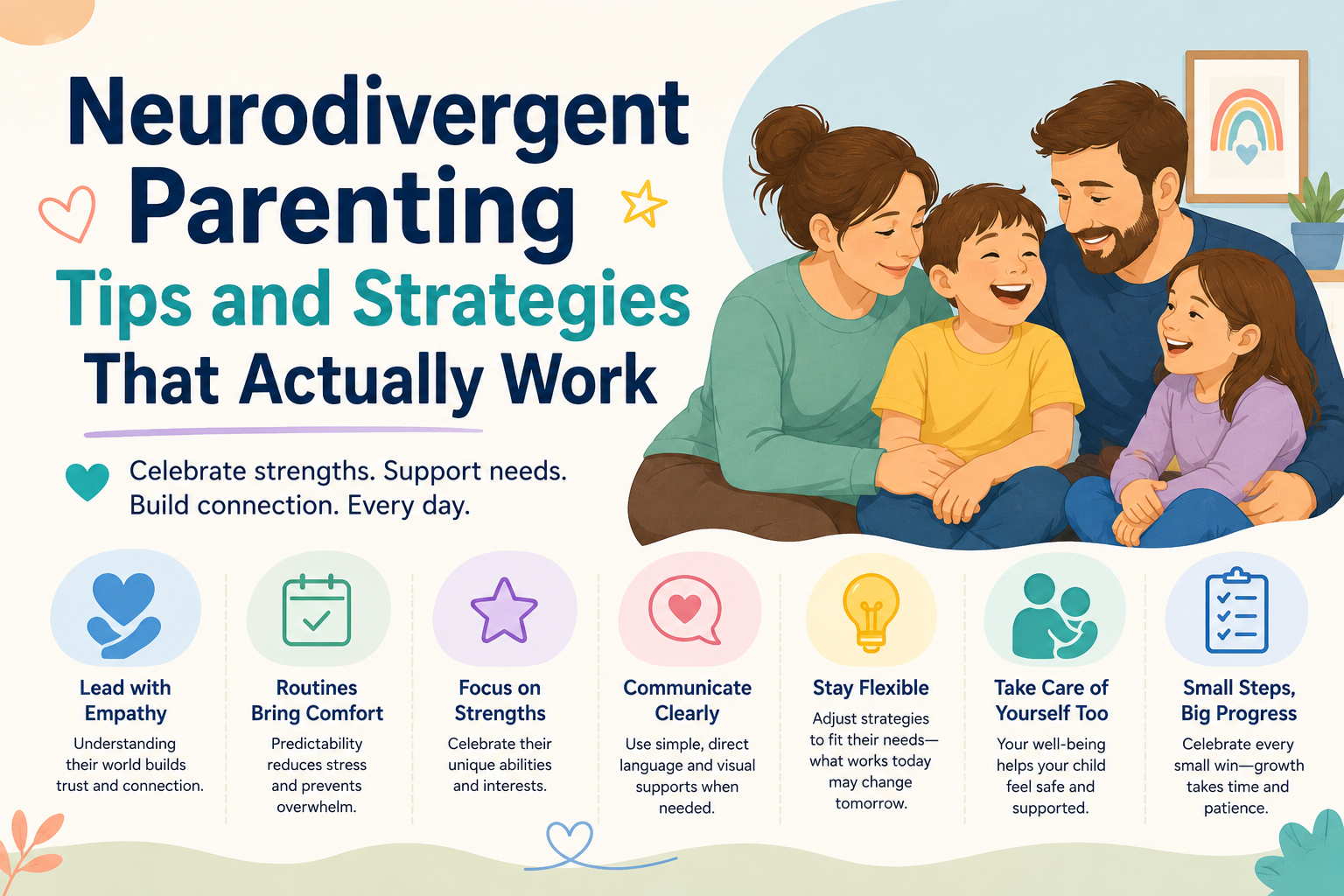
Best Neurodivergent Parenting Tips and Strategies That Actually Work 🧩
Neurodivergent parenting tips work best when they’re built around your child’s actual brain wiring, not generic advice designed for neurotypical kids. That means prioritizing predictability, sensory awareness, and connection over compliance. Here’s what genuinely helps families thrive, backed by real research. 💙
If you’ve ever followed a parenting book to the letter and watched it completely fail with your child, you’re not doing anything wrong. Most parenting advice simply wasn’t written for a neurodivergent brain. This guide was. 🌱

- What Does “Neurodivergent Parenting” Actually Mean? 🧠
- Why Standard Parenting Advice Often Fails Neurodivergent Families ⚠️
- Real Research: What the Data Tells Us About Neurodivergent Families 📊
- A Real Parent Story: Rewriting the Rulebook 👨👧👦
- Core Neurodivergent Parenting Tips That Actually Work 🌟
- 1. Prioritize Predictability Over Spontaneity 🗓️
- 2. Understand the Behavior Is Communication 💬
- 3. Build in Sensory Breaks, Not Just Discipline 🧸
- 4. Use Interest-Based Motivation 🎯
- 5. Offer Choices, Not Just Instructions 🔀
- 6. Separate “Won’t” From “Can’t” 🧩
- 7. Protect Your Own Regulation First 🧘
- 8. Build a Support Network Early 🤝
- 9. Celebrate Progress on Their Terms 🎉
- 10. Advocate Loudly at School and in Public 📢
- Neurodivergent Parenting Tips by Condition: Quick Comparison 📋
- What Most Parenting Guides Miss About Neurodivergent Families ⚠️
- Voice Search Quick Answers 🎙️
- Frequently Asked Questions ❓
- 1. What are effective neurodivergent parenting tips for managing daily meltdowns?
- 2. How can I support a neurodivergent child without using traditional reward charts?
- 3. Is it normal to feel constantly exhausted as a parent of a neurodivergent child?
- 4. How do I know if my child’s behavior is neurodivergent-related or just typical misbehavior?
- 5. What is the difference between parenting an autistic child versus an ADHD child?
- 6. How can neurodivergent parenting tips help improve family relationships overall?
- Final Thoughts: Parenting the Child You Actually Have 💛
What Does “Neurodivergent Parenting” Actually Mean? 🧠
Neurodivergent parenting means raising a child whose brain processes the world differently — this includes autism, ADHD, dyslexia, dyspraxia, sensory processing differences, and more. It also often means the parent themselves is neurodivergent, since these conditions run strongly in families.
The core shift in neurodivergent parenting tips is this: you’re not trying to make your child act neurotypical. You’re helping them thrive as who they already are. That single reframe changes almost every parenting decision that follows. 🌟
Why Standard Parenting Advice Often Fails Neurodivergent Families ⚠️
Most parenting content assumes a predictable child: one who responds to consistent consequences, calms down with a five-minute timeout, and learns social rules through gentle repetition. For many neurodivergent children, none of that holds true — not because the child is defiant, but because their brain processes rewards, transitions, and sensory input differently.
This mismatch is exactly why so many parents feel like they’re failing, when really, the advice was never built for their child in the first place.
Real Research: What the Data Tells Us About Neurodivergent Families 📊
| Statistic | What It Means for Parents | Source |
|---|---|---|
| 15–20% of the global population is estimated to be neurodivergent, including ADHD and autism | Neurodivergent parenting isn’t a rare experience — it’s a large, shared community | Gitnux Neurodivergent Statistics Report, 2026 |
| U.S. prevalence: 8.5% ADHD, 2.9% ASD, 6.4% learning disability among children aged 3–17 | Many families are managing more than one neurodivergent condition at once | National Health Interview Survey Study, NCBI |
| 100% of parents of autistic children in one clinical study reported clinically significant stress levels | Chronic parenting stress is common and measurable — not a personal shortcoming | Frontiers in Child & Adolescent Psychiatry, 2026 |
| Parents of ASD and ADHD children reported significantly higher stress scores (M=116.7 and M=88.1) than parents of neurotypical children (M=67.2) | Your exhaustion has research behind it — it’s a documented, real gap | PMC Comparative Stress Study, 2026 |
| Parenting stress in ASD correlates strongly with children’s sleep and behavioral challenges, while ADHD stress correlates more with social support levels | Different conditions need different support strategies, not one-size-fits-all advice | PMC Parenting Stress Study |
💡 Key insight: Your stress is real, studied, and shared by thousands of families — and the right strategies genuinely reduce it.
A Real Parent Story: Rewriting the Rulebook 👨👧👦
Aditya, father of two — one autistic, one with ADHD — describes his early parenting years as “constant failure by other people’s standards.”
“Every book told me to use sticker charts and consistent five-minute timeouts. My daughter would rip the sticker chart off the wall. My son couldn’t sit still for five seconds, let alone five minutes,” he shared.
The shift happened when a pediatric occupational therapist reframed his goal: instead of asking “how do I get compliance,” ask “what does my child’s brain need right now to feel safe?”
For his daughter, that meant visual schedules instead of verbal reminders. For his son, it meant movement breaks built into homework time, not punishment for fidgeting.
“Once I stopped trying to force them into a neurotypical mold, everything got calmer — including me,” Aditya said. His advice to other parents: “Stop measuring your parenting by a rulebook that was never written for your kid.” 💛
Core Neurodivergent Parenting Tips That Actually Work 🌟

1. Prioritize Predictability Over Spontaneity 🗓️
Many neurodivergent children feel safest when they know what’s coming next. Visual schedules, consistent routines, and advance warning before transitions reduce anxiety significantly more than surprises ever will.
2. Understand the Behavior Is Communication 💬
A meltdown, shutdown, or refusal is rarely random. It’s usually your child’s nervous system signaling overwhelm, sensory discomfort, or unmet needs they can’t yet put into words.
3. Build in Sensory Breaks, Not Just Discipline 🧸
Instead of treating fidgeting, pacing, or stimming as problems to correct, build regular sensory breaks into the day. A short movement break often prevents the meltdown a timeout would only follow.
4. Use Interest-Based Motivation 🎯
Neurodivergent children, especially those with ADHD or autism, often engage far more deeply when learning connects to their specific interests. Lean into it instead of fighting it.
5. Offer Choices, Not Just Instructions 🔀
Simple choices (“blue cup or green cup?”) give a sense of control without overwhelming decision-making capacity — especially helpful during transitions or stressful moments.
6. Separate “Won’t” From “Can’t” 🧩
What looks like defiance is frequently a skill gap — executive functioning, sensory regulation, or communication — not a willpower problem. Reframing this changes your entire response.
7. Protect Your Own Regulation First 🧘
Research consistently links parental stress to child behavioral outcomes. Your calm nervous system genuinely helps regulate theirs, which makes your own coping strategies part of the plan, not a luxury.
8. Build a Support Network Early 🤝
Studies show social support directly reduces parenting stress, especially for ADHD families. Whether it’s therapy, support groups, or trusted family, don’t wait until burnout to seek help.
9. Celebrate Progress on Their Terms 🎉
Growth for a neurodivergent child might look different than typical milestones — tolerating a new texture, initiating one sentence, or recovering from a meltdown faster. Celebrate those wins specifically.
10. Advocate Loudly at School and in Public 📢
Neurodivergent parenting extends beyond home. Learning your child’s rights around accommodations, and speaking up confidently, protects them in spaces that don’t always understand their needs.
Neurodivergent Parenting Tips by Condition: Quick Comparison 📋
| Condition | Common Core Need | Most Helpful Strategy |
|---|---|---|
| Autism | Predictability, sensory regulation | Visual schedules, sensory breaks |
| ADHD | Movement, novelty, immediate feedback | Short tasks, built-in movement, quick rewards |
| Dyslexia | Alternative learning pathways | Audiobooks, multisensory reading tools |
| Sensory Processing Differences | Regulated sensory environment | Weighted tools, noise control, texture awareness |
| Dyspraxia | Extra time, motor planning support | Step-by-step visual instructions, patience with physical tasks |
What Most Parenting Guides Miss About Neurodivergent Families ⚠️
- They assume one strategy fits all neurodivergent kids. A child with ADHD and a child with autism often need nearly opposite approaches — movement versus stillness, novelty versus routine.
- They ignore parent burnout as part of the plan. Research clearly shows parental stress affects child outcomes, yet most guides treat parent wellbeing as separate from “real” strategies.
- They rarely mention masking. Some neurodivergent children, especially girls, hide their struggles at school and release them at home. Recognize this pattern instead of assuming your child is “fine” because school reports say so.
- They underestimate sibling dynamics. Neurotypical or differently-neurodivergent siblings often need dedicated attention too, since household stress affects the whole family system, not just one child.
Voice Search Quick Answers 🎙️
“What are the best parenting strategies for a neurodivergent child?”
Prioritize predictable routines, treat behavior as communication, offer sensory breaks, and use interest-based motivation instead of standard reward-and-punishment systems.
“How is neurodivergent parenting different from typical parenting?”
It focuses on understanding sensory, executive functioning, and communication differences rather than expecting standard compliance-based responses to work the same way they would for neurotypical children.
“Why does my neurodivergent child struggle with typical discipline methods?”
Standard discipline often assumes skills like emotional regulation and impulse control that many neurodivergent children haven’t yet developed, making skill-building more effective than punishment.
Frequently Asked Questions ❓
1. What are effective neurodivergent parenting tips for managing daily meltdowns?
Focus on identifying sensory or cognitive triggers early, building predictable routines, and offering calming tools like noise reduction or deep-pressure support rather than relying on discipline-based responses.
2. How can I support a neurodivergent child without using traditional reward charts?
Try interest-based motivation, immediate specific praise, and choice-based systems instead of delayed sticker rewards, which often don’t align with how neurodivergent brains process motivation.
3. Is it normal to feel constantly exhausted as a parent of a neurodivergent child?
Yes, research shows parents of autistic and ADHD children report significantly higher stress levels than parents of neurotypical children, making burnout prevention and support networks essential, not optional.
4. How do I know if my child’s behavior is neurodivergent-related or just typical misbehavior?
Look for patterns: consistent triggers, sensory sensitivities, difficulty with transitions, or communication struggles often point to neurodivergent needs rather than intentional defiance, though a professional evaluation gives clarity.
5. What is the difference between parenting an autistic child versus an ADHD child?
Autism often centers on sensory regulation and predictability needs, while ADHD often centers on movement, novelty, and immediate feedback, meaning strategies frequently need to be tailored differently.
6. How can neurodivergent parenting tips help improve family relationships overall?
Understanding your child’s brain reduces conflict, builds trust, and creates a calmer household, which research links to better emotional outcomes for both the child and the entire family system.
Final Thoughts: Parenting the Child You Actually Have 💛
Neurodivergent parenting isn’t about following a perfect formula. It’s about learning to see your child clearly — their triggers, their strengths, their unique way of experiencing the world — and building your approach around that reality instead of a generic ideal.
Some days will still feel hard. The research confirms what you already know: this parenting path carries real, measurable stress. But it also carries a depth of connection that comes from truly understanding another person’s mind, one small adaptation at a time.
You’re not failing by doing things differently. You’re doing exactly what your child needs. 🌟


