

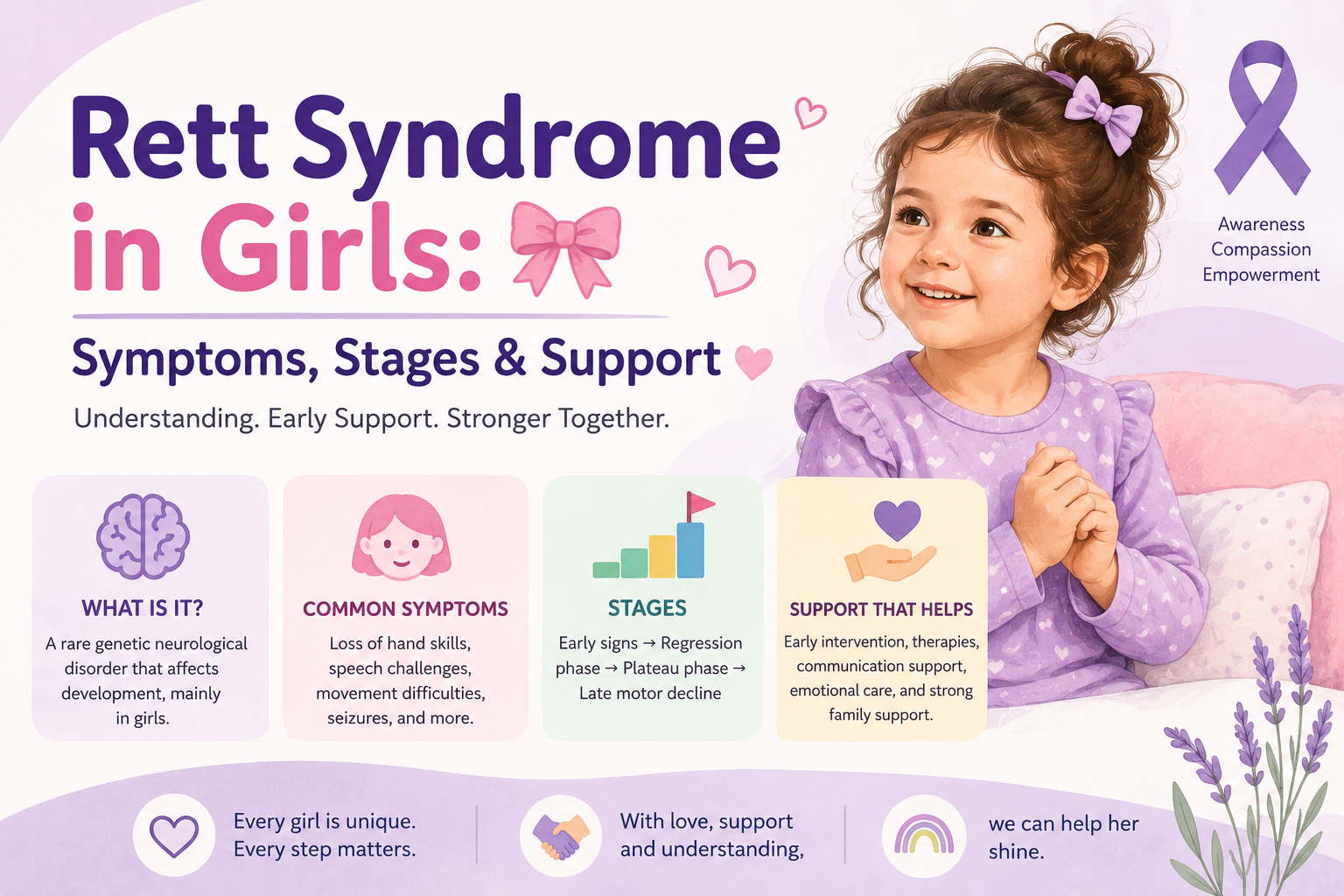
Rett Syndrome in Girls: Symptoms, Stages & Support 🎀
Rett syndrome in girls is a rare genetic neurological disorder that causes normal early development to suddenly reverse, usually between 6 and 18 months of age, leading to loss of speech, hand skills, and mobility. It’s caused by a mutation in the MECP2 gene. Here’s what every parent needs to recognize and do next. 💙
If your daughter was developing typically and then, seemingly overnight, stopped making eye contact or lost words she once said clearly, this guide will help you understand what might be happening — and what to do about it. 🫂

- What Is Rett Syndrome? A Clear, Honest Explanation 🧬
- Real Research: Understanding Rett Syndrome Through the Data 📊
- The 4 Stages of Rett Syndrome in Girls 📈
- Common Signs and Symptoms of Rett Syndrome in Girls 🔍
- Early Warning Signs (Often Missed) 👶
- Physical and Neurological Symptoms 🩺
- Behavioral and Communication Signs 🗣️
- A Real Parent Story: “She Was Right on Track, Then She Wasn’t” 👩👧
- How Is Rett Syndrome Diagnosed? 🧪
- Support Strategies That Help Girls With Rett Syndrome Thrive 🌱
- 1. Multidisciplinary Therapy Teams 👥
- 2. Augmentative and Alternative Communication (AAC) 💬
- 3. Seizure Management 💊
- 4. Orthopedic Monitoring 🦴
- 5. Emotional Support for the Whole Family 💛
- What Most Articles Get Wrong About Rett Syndrome in Girls ⚠️
- Voice Search Quick Answers 🎙️
- Frequently Asked Questions ❓
- 1. What causes Rett syndrome in girls?
- 2. At what age do symptoms of Rett syndrome typically start in girls?
- 3. Can girls with Rett syndrome communicate despite losing speech?
- 4. How long can girls with Rett syndrome live?
- 5. Is there a cure for Rett syndrome?
- 6. How is Rett syndrome different in girls compared to boys?
- Final Thoughts: Understanding Is the First Step Toward Support 💛
What Is Rett Syndrome? A Clear, Honest Explanation 🧬
Rett syndrome is a rare, X-linked genetic disorder that affects brain development, almost exclusively in girls. In about 95% of cases, it’s caused by a mutation in the MECP2 gene, which normally helps regulate how other genes in the brain switch on and off.
Here’s what makes Rett syndrome uniquely difficult to recognize early: babies with Rett syndrome typically develop normally for the first 6 to 18 months of life. They smile, babble, and often begin sitting, crawling, or even walking on schedule. Then, without warning, development stalls — and in many cases, reverses.
This regression is what makes Rett syndrome so emotionally jarring for families. You’re not imagining the change. Something real, and biological, is happening in your daughter’s brain. 🧠
Real Research: Understanding Rett Syndrome Through the Data 📊
| Statistic | What It Means for Parents | Source |
|---|---|---|
| Rett syndrome affects roughly 1 in 10,000 to 1 in 15,000 female births worldwide | It’s rare, but not so rare that you should dismiss consistent developmental regression | PMC, Abnormalities of Cell Packing Density Study |
| 95% of Rett syndrome cases are linked to mutations in the MECP2 gene | Genetic testing for MECP2 is central to confirming diagnosis | MDPI, Rett Syndrome and the Role of MECP2, 2024 |
| More than 300 to 600 distinct MECP2 mutations have been identified | No two girls with Rett syndrome present in exactly the same way | PMC, MECP2 Mutation Review |
| Survival rate is 77.8% at 25 years of age, with survival into the fifth decade typical | Rett syndrome is a lifelong condition requiring long-term, evolving care | MDPI, MECP2 Signaling to Clinical Trials Review |
| Rett syndrome in females is now understood to be biologically different, not just milder, than in males | Treatment and research approaches are shifting to reflect female-specific brain patterns | UC Davis Health, 2024 |
💡 Key insight: Because girls have two X chromosomes, only some of their brain cells carry the mutated gene — this mosaic pattern is part of why symptom severity varies so widely between individuals.
The 4 Stages of Rett Syndrome in Girls 📈
Understanding the stages helps parents know what to expect — and when to seek medical evaluation.
| Stage | Typical Age | What You Might Notice |
|---|---|---|
| Stage I: Early Stagnation | 6–18 months | Slowed development, reduced eye contact, decreased interest in play, low muscle tone (hypotonia), hand-wringing begins |
| Stage II: Rapid Regression | 1–4 years | Loss of previously gained speech and hand skills, repetitive hand movements (wringing, clapping, mouthing), breathing irregularities, autism-like behaviors |
| Stage III: Plateau | 2–10 years | Some improvement in behavior and communication may occur; motor problems, seizures, and apraxia (difficulty coordinating movement) often continue |
| Stage IV: Late Motor Deterioration | 10+ years | Reduced mobility, scoliosis, muscle weakness, but cognition and communication may remain relatively stable compared to earlier stages |
📌 Important: Not every girl follows this timeline exactly. Some symptoms overlap between stages, and progression speed varies significantly from child to child.
Common Signs and Symptoms of Rett Syndrome in Girls 🔍

Early Warning Signs (Often Missed) 👶
- Loss of purposeful hand use, replaced by repetitive movements
- Reduced or lost eye contact after previously making it
- Slower than expected head growth (microcephaly)
- Unusual calmness or “too easy” temperament as an infant
- Loss of words or babbling that had already developed
Physical and Neurological Symptoms 🩺
- Stereotyped hand movements: wringing, clapping, tapping, or mouthing
- Gait apraxia — difficulty walking or coordinating movement
- Breathing irregularities, including breath-holding or hyperventilation
- Seizures (common, though not universal)
- Scoliosis, especially as the child grows older
Behavioral and Communication Signs 🗣️
- Sudden loss of previously acquired speech
- Sleep disturbances and irritability
- Vacant staring spells, sometimes resembling seizures
A Real Parent Story: “She Was Right on Track, Then She Wasn’t” 👩👧
Sarah, a mother from Texas, remembers her daughter Emma reaching every early milestone. She babbled, made eye contact, and had even started saying “mama” clearly by ten months.
Then, over the following weeks, Emma stopped saying it. She stopped looking up when called. Her hands, once reaching for toys, began wringing together constantly.
“Our pediatrician initially reassured us it was probably nothing,” Sarah shared. “But I kept a video log comparing her at nine months versus twelve months, side by side. That’s what finally got us a referral to a pediatric neurologist.”
Genetic testing confirmed a MECP2 mutation. Emma was diagnosed with Rett syndrome at 14 months.
“The diagnosis didn’t change who Emma was,” Sarah said. “It changed how we understood her — and it opened the door to therapies that have genuinely helped her communicate in her own way, even without words.”
Sarah’s advice to other parents: “Trust the pattern you’re seeing, not just reassurance. Video evidence of regression helped us get taken seriously faster.” 📹
How Is Rett Syndrome Diagnosed? 🧪
Diagnosis typically involves:
- Clinical observation of developmental regression patterns matching Rett syndrome criteria
- Ruling out other conditions with similar early symptoms, such as autism spectrum disorder or metabolic disorders
- Neurological evaluation, including assessment for seizures and motor function
If you notice consistent regression in your daughter’s skills, don’t wait for symptoms to “resolve on their own.” Early referral to a pediatric neurologist or geneticist is essential. 🩺
Support Strategies That Help Girls With Rett Syndrome Thrive 🌱
1. Multidisciplinary Therapy Teams 👥
Physical therapy, occupational therapy, and speech-language therapy together address mobility, hand function, and communication — often through eye-gaze technology or picture-based systems when speech is limited.
2. Augmentative and Alternative Communication (AAC) 💬
Many girls with Rett syndrome understand far more than their motor limitations allow them to express. Eye-tracking devices and AAC tools give them a real voice, even without spoken words.
3. Seizure Management 💊
Since seizures are common, close coordination with a pediatric neurologist for monitoring and medication management is essential for safety and quality of life.
4. Orthopedic Monitoring 🦴
Regular monitoring for scoliosis and joint issues helps catch problems early, when bracing or intervention is most effective.
5. Emotional Support for the Whole Family 💛
Rett syndrome affects the entire family system. Connecting with organizations like the International Rett Syndrome Foundation (IRSF) and the Rett Syndrome Research Trust provides both community and access to the latest research updates, including ongoing clinical trials.
What Most Articles Get Wrong About Rett Syndrome in Girls ⚠️
- They oversimplify it as “a type of autism.” While autism-like behaviors appear, Rett syndrome is a distinct genetic condition with its own diagnostic criteria, progression pattern, and physical symptoms.
- They underplay the regression trauma parents experience. Watching a child lose skills they already had is a distinct grief experience, different from a delayed-development diagnosis, and deserves acknowledgment.
- They rarely mention that girls express Rett syndrome differently than boys biologically — not just “less severely,” but through a genuinely different cellular pattern, due to how X-chromosome inactivation works.
Voice Search Quick Answers 🎙️
“What are the first signs of Rett syndrome in girls?”
Early signs include slowed development, reduced eye contact, loss of purposeful hand use, hand-wringing movements, and slower head growth, typically appearing between 6 and 18 months of age.
“Is Rett syndrome the same as autism?”
No. Rett syndrome is a distinct genetic disorder linked to the MECP2 gene, though it can include autism-like behaviors as one of several symptoms.
“Can boys get Rett syndrome too?”
Yes, though it’s rare and typically far more severe, often presenting as a serious neonatal condition, since boys only have one X chromosome.
Frequently Asked Questions ❓
1. What causes Rett syndrome in girls?
About 95% of cases are caused by a mutation in the MECP2 gene, located on the X chromosome, which affects how brain cells regulate other genes during development.
2. At what age do symptoms of Rett syndrome typically start in girls?
Most girls show typical development for the first 6 to 18 months, followed by a noticeable regression in speech, hand use, and social engagement.
3. Can girls with Rett syndrome communicate despite losing speech?
Yes. Many girls use eye-gaze technology, picture communication systems, or other AAC tools to express themselves, even without spoken language.
4. How long can girls with Rett syndrome live?
Research shows a survival rate of approximately 77.8% at 25 years of age, with many individuals living into their 40s and beyond, depending on severity and care.
5. Is there a cure for Rett syndrome?
There is currently no cure, though ongoing gene therapy and gene-editing research trials are actively exploring targeted treatments for the MECP2 mutation.
6. How is Rett syndrome different in girls compared to boys?
Girls typically survive with a range of severity due to mosaic gene expression from having two X chromosomes, while boys, having only one X chromosome, usually experience more severe, earlier-onset symptoms.
Final Thoughts: Understanding Is the First Step Toward Support 💛
A Rett syndrome diagnosis reshapes how you see your daughter’s future — but it doesn’t erase who she is. Behind the motor challenges and communication barriers is a child who understands, feels, and connects, often more than her body lets her show.
Every therapy session, every communication device breakthrough, every small connected moment matters deeply. Progress with Rett syndrome doesn’t always look like recovery. Sometimes, it looks like your daughter finding one new way to tell you she loves you. 🌟
If you’re noticing signs of developmental regression in your daughter, don’t wait. Speak with a pediatric neurologist or geneticist as soon as possible — early evaluation opens the door to earlier, more effective support. 🩺


