

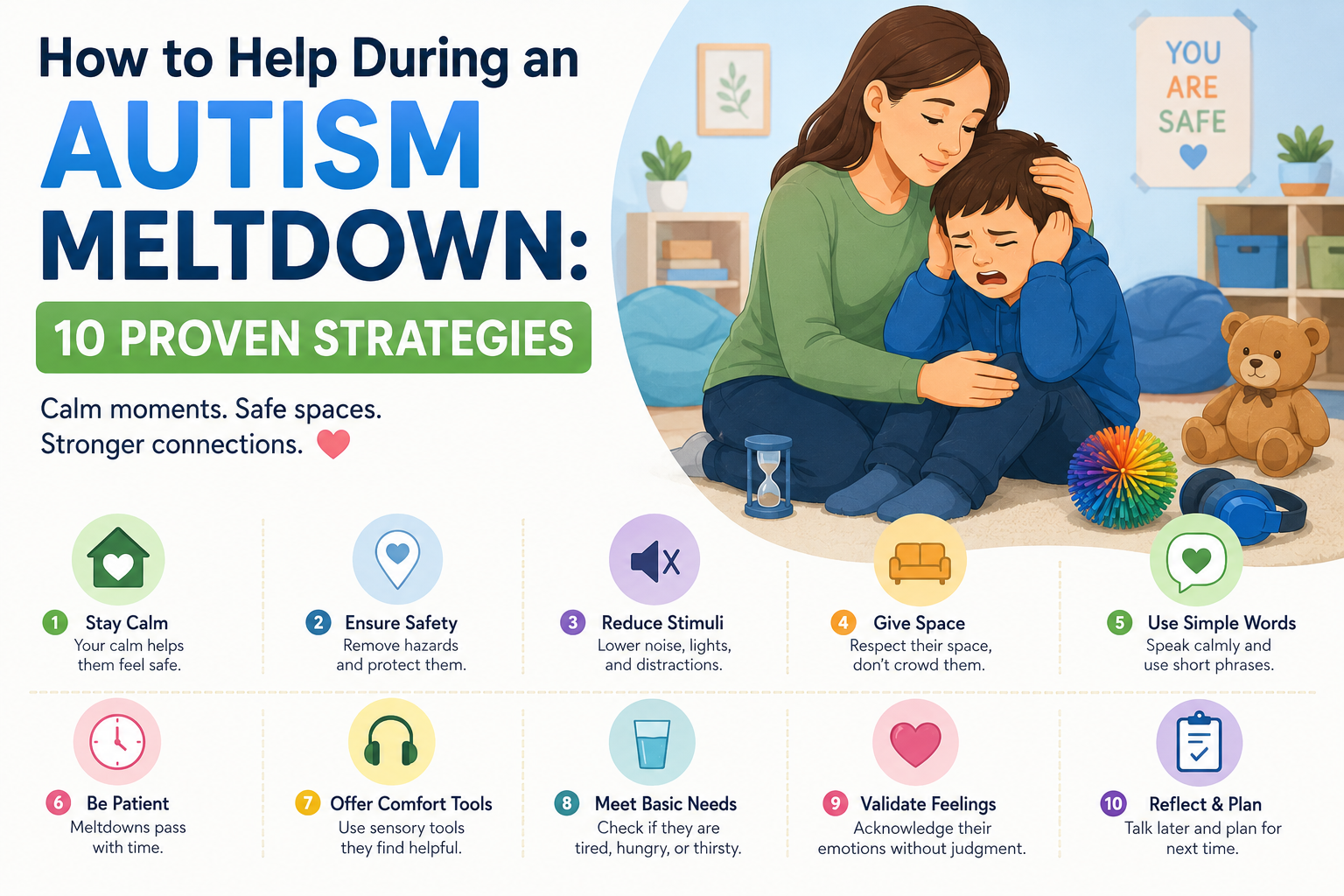
How to Help During an Autism Meltdown: 10 Proven Strategies 🌊
Autism meltdown help strategies work best when you shift from stopping the behavior to calming the nervous system behind it. That means reducing sensory input, staying quiet and steady, and giving your child space to reset — not punishment, not bargaining. Here are 10 strategies that genuinely help. 💙
If you’ve ever stood frozen while your child screamed, thrashed, or shut down completely, not knowing whether to hug them or step back, this guide was written for that exact moment. 🫂

- What Is an Autism Meltdown, Really? 🧠
- Real Research: What the Data Tells Us About Meltdowns 📊
- A Real Parent Story: The Supermarket Freeze 🛒
- 10 Proven Autism Meltdown Help Strategies 🌟
- 1. Reduce Sensory Input Immediately 🔇
- 2. Stay Calm and Quiet Yourself 🧘
- 3. Give Space, Not Pressure 🚶
- 4. Use Minimal, Predictable Language 🗣️
- 5. Identify the Trigger Type: Sensory or Cognitive 🔍
- 6. Offer a Comfort Tool, Not a Bribe 🧸
- 7. Protect Safety First, Then Everything Else 🛡️
- 8. Let the Meltdown Run Its Course 🌊
- 9. Watch for the Recovery Phase 🌤️
- 10. Debrief Later, With Compassion 💛
- Sensory Meltdown Toolkit: What to Keep on Hand 🎒
- What Most Guides Get Wrong About Meltdown Help ⚠️
- Autism Meltdown vs. Tantrum: A Quick Comparison 📋
- Voice Search Quick Answers 🎙️
- Frequently Asked Questions ❓
- 1. What are the best autism meltdown help strategies for public places?
- 2. How do I calm down my autistic child during a sensory overload meltdown?
- 3. What is the difference between an autism meltdown and a normal tantrum?
- 4. Can autism meltdowns be prevented before they start?
- 5. Should I punish my child after an autism meltdown?
- 6. What triggers most autism meltdowns in children?
- Final Thoughts: You’re Not Failing — You’re Learning Their Language 💛
What Is an Autism Meltdown, Really? 🧠
A meltdown is not a tantrum. A tantrum happens because a child wants something and doesn’t get it. A meltdown happens because a child’s nervous system has taken in more than it can process — and it has nowhere left to put that overwhelm.
Research published in Psychological Review points to the brain’s insula, the region that blends body signals with outside sensory input, as central to why autistic individuals react so intensely to stress that others barely notice. In simple terms: the alarm system in an autistic brain doesn’t quiet down the way a neurotypical brain’s does. It stays loud. 🚨
Understanding this difference is the foundation of every effective autism meltdown help strategy. You’re not managing bad behavior. You’re supporting an overloaded nervous system. 💡
Real Research: What the Data Tells Us About Meltdowns 📊
| Statistic | What It Means for Parents | Source |
|---|---|---|
| Up to 92% of autistic children experience meltdowns at some point | Meltdowns are a near-universal part of the autism experience, not a parenting failure | PX Docs, Neurological Approach to Autism Meltdowns |
| Meltdowns stem from two main trigger types: sensory overload and cognitive frustration | Knowing which type your child faces helps you choose the right calming strategy | British Psychological Society, Research Digest |
| Autistic brains often show heightened, hyper-connected neural responses to sensory input | Explains why meltdowns can happen even in seemingly “calm” environments | Augmentive, Adult Autism Meltdown Research |
| A recognized burnout phase — fatigue, slowed thinking, overwhelm — often precedes meltdowns | Catching early burnout signs can prevent a full meltdown from happening | Reframing Autism, Allies Guide |
| Sensory-inclusive training programs are now used in public venues nationwide to reduce meltdown triggers | Public spaces are increasingly building accommodations — you can ask venues about them | Neuroscience News, KultureCity Initiative |
💡 Key insight: Meltdowns aren’t random. They follow a buildup pattern — and that pattern is exactly where prevention strategies work best.
A Real Parent Story: The Supermarket Freeze 🛒
Neha, a mother of an 8-year-old autistic son named Kabir, remembers the moment everything clicked for her.
Kabir had been fine all morning. Then, mid-way through their weekly grocery run, he suddenly dropped to the floor, covered his ears, and began screaming. Neha’s first instinct was to bargain: “If you stop, we’ll get ice cream.” It didn’t work. It never did.
A store employee, trained through a sensory-inclusive program, quietly approached and asked if they needed a quiet corner. Neha followed her to a stockroom hallway — dim, silent, empty.
Within four minutes, Kabir’s breathing slowed. He didn’t need ice cream. He needed less input, not more negotiation.
Neha now carries what she calls a “meltdown kit” everywhere: headphones, a weighted lap pad, and a laminated card explaining Kabir’s needs to strangers.
Her advice to other parents: “Stop trying to talk your child out of a meltdown. Help their body come down first. The words can wait.” 💬
10 Proven Autism Meltdown Help Strategies 🌟

1. Reduce Sensory Input Immediately 🔇
The fastest way to help is often the simplest: turn down the noise. Dim the lights if possible, move away from crowds, or offer noise-cancelling headphones. Less input gives an overloaded nervous system room to recover.
2. Stay Calm and Quiet Yourself 🧘
Children in meltdown mode often mirror the energy around them. Lower your voice. Slow your movements. Avoid rapid questions like “What’s wrong?” — this adds more processing demand at the worst possible time.
3. Give Space, Not Pressure 🚶
Resist the urge to hold, restrain, or crowd your child unless safety requires it. Many autistic children need physical space during a meltdown, even if they normally enjoy hugs.
4. Use Minimal, Predictable Language 🗣️
Short phrases work better than long explanations. Try: “I’m here.” or “You’re safe.” Avoid negotiating, correcting, or asking your child to “use their words” mid-meltdown — verbal processing is often offline during peak overwhelm.
5. Identify the Trigger Type: Sensory or Cognitive 🔍
- Sensory triggers: loud sounds, bright lights, crowded spaces, uncomfortable clothing
- Cognitive triggers: sudden schedule changes, unmet expectations, transitions between activities
Knowing which one applies helps you remove the right stressor, not just any stressor.
6. Offer a Comfort Tool, Not a Bribe 🧸
A weighted lap pad, favorite object, or deep-pressure hug (only if welcomed) can help regulate the nervous system. This is different from bribery — it’s sensory support, not a reward for stopping.
7. Protect Safety First, Then Everything Else 🛡️
If your child is at risk of hurting themselves or others, gently guide them to a safer space. Remove nearby hazards. Safety always comes before any calming technique.
8. Let the Meltdown Run Its Course 🌊
This is hard to accept, but true: you cannot force a meltdown to stop faster. Trying to rush it usually extends it. Your job is to keep your child safe and calm the environment, not control the timeline.
9. Watch for the Recovery Phase 🌤️
After a meltdown, children are often exhausted, embarrassed, or disoriented. This is not the moment for lectures or consequences. Offer quiet reassurance and let their energy return naturally.
10. Debrief Later, With Compassion 💛
Once your child is fully calm — sometimes hours later — you can gently explore what happened, using simple language or visual tools. This builds long-term self-awareness without shame.
Sensory Meltdown Toolkit: What to Keep on Hand 🎒
| Tool | Purpose | Best Used For |
|---|---|---|
| Noise-cancelling headphones | Blocks overwhelming sound | Sensory-triggered meltdowns |
| Weighted lap pad or blanket | Provides calming deep pressure | Both sensory and cognitive triggers |
| Visual “calm down” card | Reduces need for verbal processing | Nonverbal or minimally verbal children |
| Familiar comfort object | Offers grounding and safety | Public or unfamiliar settings |
| Sunglasses | Reduces bright light overload | Fluorescent lighting environments |
What Most Guides Get Wrong About Meltdown Help ⚠️
- They tell you to “distract” your child. Distraction often adds more sensory or cognitive load, worsening an already overwhelmed brain. Reduction beats redirection during active meltdowns.
- They treat all meltdowns the same. A sensory meltdown and a cognitive-trigger meltdown need different responses — one needs quiet, the other often needs predictability and reassurance about what happens next.
- They skip parent regulation. Your own calm (or panic) directly affects how long a meltdown lasts. Taking three slow breaths before responding isn’t just self-care — it’s a meltdown strategy in itself.
- They ignore the burnout phase. Catching fatigue, irritability, or slowed responses before a meltdown starts is one of the most overlooked prevention tools available.
Autism Meltdown vs. Tantrum: A Quick Comparison 📋
| Feature | Meltdown | Tantrum |
|---|---|---|
| Root cause | Sensory or cognitive overload | Unmet want or desire |
| Ends when… | Nervous system fully resets | Child gets what they want, or gives up |
| Responds to bribery? | Rarely helps, can worsen it | Often stops the behavior |
| Child’s awareness | Often limited during peak overwhelm | Usually fully aware and intentional |
| Best response | Reduce input, offer safety and space | Calm, consistent boundaries |
Read more here.
Voice Search Quick Answers 🎙️
“What should I do when my autistic child has a meltdown?”
Reduce noise and light, stay calm and quiet, give physical space, and use short reassuring phrases like “I’m here” instead of asking questions or negotiating.
“How long do autism meltdowns usually last?”
Duration varies widely, from a few minutes to over an hour, depending on the trigger and how quickly sensory input is reduced.
“Is it okay to hug my child during a meltdown?”
Only if your child welcomes touch during overwhelm. Many children need space instead, so always follow their usual sensory preferences.
Frequently Asked Questions ❓
1. What are the best autism meltdown help strategies for public places?
Move to a quieter space immediately, offer noise-cancelling headphones or a comfort item, and avoid crowds until your child’s nervous system settles. Carrying a small explanation card can also reduce pressure from onlookers.
2. How do I calm down my autistic child during a sensory overload meltdown?
Reduce sensory input first by dimming lights or lowering noise, then offer deep-pressure tools like a weighted lap pad, and use minimal calm language instead of questions.
3. What is the difference between an autism meltdown and a normal tantrum?
A tantrum is goal-driven and stops once the child gets what they want. A meltdown is an involuntary nervous system response to overload and doesn’t respond to bribery or bargaining.
4. Can autism meltdowns be prevented before they start?
Some can be reduced by recognizing early burnout signs like fatigue, irritability, or slowed responses, and by lowering sensory demands before overwhelm builds further.
5. Should I punish my child after an autism meltdown?
No. Meltdowns are involuntary responses, not intentional misbehavior. Punishment after a meltdown can increase shame and anxiety without addressing the underlying overload.
6. What triggers most autism meltdowns in children?
The two most common trigger categories are sensory overload, such as loud noises or bright lights, and cognitive frustration, such as sudden changes in routine or unmet expectations.
Final Thoughts: You’re Not Failing — You’re Learning Their Language 💛
Every parent who has stood in the middle of a meltdown, unsure what to do, has felt helpless. That feeling doesn’t mean you’re doing it wrong. It means you’re facing one of the hardest, most misunderstood parts of autism parenting.
The strategies in this guide won’t make meltdowns disappear completely. But they will help you respond with calm instead of panic, safety instead of struggle, and compassion instead of confusion.
Your child isn’t choosing chaos. They’re surviving overwhelm the only way their nervous system knows how — and your steady presence, more than any single technique, is what helps them find their way back. 🌟


