
Masking in Autism Children: Signs, Risks & What to Do 🎭
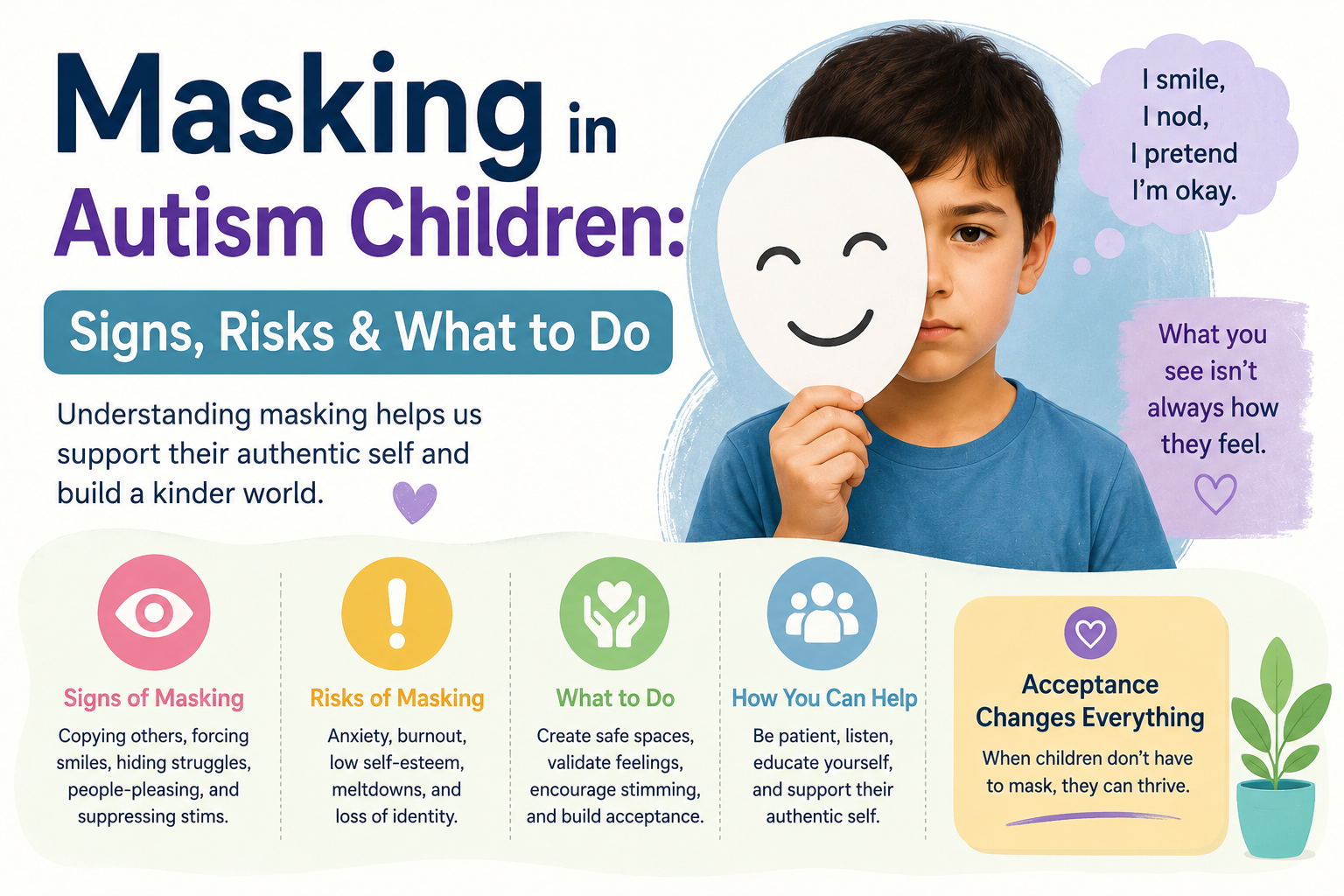
Masking autism children means your child is consciously or unconsciously hiding their natural autistic traits to appear “normal” — copying peers, suppressing stimming, and forcing eye contact just to fit in. It’s exhausting, often invisible to teachers, and linked to anxiety and burnout. Here’s how to spot it and help. 💙
If your child seems perfectly fine at school but melts down the second they walk through your front door, you’re not imagining things. That “after-school restraint collapse” is one of the clearest signs of masking — and almost nobody warns parents about it. 🚪

- What Is Masking in Autism Children? 🧩
- Why This Topic Doesn’t Get Enough Attention ⚠️
- Real Research: What the Data Tells Us 📊
- Signs Your Child May Be Masking Their Autism 🔍
- A Real Parent Story: “She Was Fine at School” 👩👧
- The Real Risks of Long-Term Masking 🚨
- What to Do If You Suspect Masking 🛠️
- 1. Trust the Home Behavior Over the School Report 🏡
- 2. Build Decompression Time Into the Daily Routine ⏰
- 3. Ask Open, Low-Pressure Questions 💬
- 4. Normalize Stimming and Natural Behaviors at Home 🙌
- 5. Seek a Masking-Aware Evaluation 🩺
- 6. Teach the Word “Masking” 📖
- What Most Articles Miss About Masking Autism Children ⚠️
- Voice Search Quick Answers 🎙️
- Frequently Asked Questions ❓
- 1. What are the early signs of masking in autistic children?
- 2. Can masking autism children be diagnosed later than typical autism cases?
- 3. How do I stop my child from masking their autism traits?
- 4. Why does my autistic child have meltdowns only after school?
- 5. Is autism masking more common in girls than boys?
- 6. Does masking cause long-term harm to autistic children?
- Final Thoughts: Seeing the Real Child Behind the Mask 💛
What Is Masking in Autism Children? 🧩
Masking (also called camouflaging) is when an autistic child learns to hide their natural behaviors and copy neurotypical ones to blend in socially. Think of it as social camouflage — worn all day, every day, often starting as young as preschool.
A masking child might:
- Force eye contact even though it feels physically uncomfortable
- Suppress stimming (hand-flapping, rocking, humming) in public
- Script conversations in advance, rehearsing what to say
- Copy classmates’ facial expressions and body language
- Hold in sensory distress until they’re somewhere “safe”
Experts describe masking as an impression management strategy — not manipulation, not dishonesty, but survival. Your child has learned, often painfully, that showing their real self leads to teasing, correction, or rejection. So they perform instead. 🎭
Why This Topic Doesn’t Get Enough Attention ⚠️
Most parenting content focuses on visible autism traits — meltdowns, sensory struggles, communication delays. But masking autism children are often the ones who slip through the cracks entirely. Teachers say “she’s doing great!” Report cards look fine. And yet, at home, something feels deeply wrong.
This gap between “how they look” and “how they feel” is exactly why masking is under-diagnosed, under-discussed, and under-supported. 📉
Real Research: What the Data Tells Us 📊
| Statistic | What It Means for Parents | Source |
|---|---|---|
| Girls are diagnosed with autism roughly 3 to 4 times less often than boys in early childhood, but the gap narrows sharply by adulthood | Masking likely delays diagnosis rather than reflecting a true difference in autism rates | Autism Speaks, 2026 |
| A Swedish study of 2.7 million people found female autism diagnosis rates peak later, between ages 15–19 | Many masking girls aren’t identified until the teen years, missing early intervention | ScienceDaily / BMJ Study, 2026 |
| Predictive modeling suggests 39% more girls should be diagnosed with autism than currently are | A large number of masking girls may be missed entirely by current diagnostic tools | PMC Case Series Study, 2024 |
| Long-term camouflaging is consistently linked to higher anxiety, depression, and burnout in autistic individuals | Masking isn’t harmless — it has measurable mental health costs over time | Frontiers in Psychiatry, Scoping Review, 2026 |
| Research from a 58-study systematic review (4,808 autistic participants) links camouflaging to burnout, damaged relationships, and identity struggles | Masking affects far more than school performance — it shapes a child’s sense of self | ScienceDirect Systematic Review, 2023 |
💡 Key insight: Masking isn’t a coping skill to be proud of. It’s a warning sign asking for support.
Signs Your Child May Be Masking Their Autism 🔍
Masking looks different in every child, but these patterns come up again and again.

At School (What Teachers See) 🏫
- Appears cooperative, quiet, or “well-behaved”
- Follows rules closely, sometimes rigidly
- Rarely raises concerns or asks for help
- Seems to have friends, even if relationships feel surface-level
At Home (What Parents See) 🏠
- Sudden meltdowns right after school — known as “restraint collapse”
- Extreme exhaustion by early evening
- Irritability, crying, or shutting down with no clear trigger
- Needing total silence or alone time to “reset”
- Talking about feeling “different” or “wrong” without knowing why
Emotionally 💭
- Low self-esteem despite good grades or behavior
- Anxiety about being “found out” or judged
- Difficulty naming their own feelings
- Perfectionism paired with fear of making mistakes
If several of these sound familiar, your child may be spending their entire school day performing — and paying for it once they get home. 😔
A Real Parent Story: “She Was Fine at School” 👩👧
Meera’s daughter, Ananya, age 9, was described by every teacher as “sweet, quiet, and easy.” No red flags. No referrals.
But at home, Ananya cried almost daily after school. She’d snap at small things, refuse dinner, and beg to skip activities she used to love. Meera assumed it was a phase — until a family friend, an occupational therapist, gently asked: “Does she seem like a different kid at school versus home?”
That question changed everything. After an evaluation, Ananya was diagnosed as autistic with high-level masking. She had been forcing eye contact, copying classmates’ laughter, and holding in sensory overwhelm for six hours straight, every single day.
Once Meera understood this, she stopped pushing Ananya to “socialize more” and instead built in decompression time right after school — no questions, no demands, just quiet space. Within weeks, the after-school meltdowns dropped by more than half.
Meera’s advice to other parents: “If your child is ‘perfect’ outside and falling apart inside, believe the falling apart. That’s the real signal.” 💛
The Real Risks of Long-Term Masking 🚨
Masking autism children often grow into masking autistic adults — and research shows this comes at a real cost.
| Risk Area | What Research Shows |
|---|---|
| Mental health | Strong links to anxiety, depression, and chronic stress (Frontiers, 2026) |
| Burnout | Sustained masking is a major contributor to autistic burnout — extreme exhaustion and loss of previously manageable skills (ScienceDirect, 2025) |
| Delayed diagnosis | Masking can delay recognition and support by years, sometimes decades (Autism Speaks, 2026) |
| Identity struggles | Long-term camouflaging can leave individuals unsure of their authentic personality and preferences (Autism.org.uk) |
This is why catching masking early matters so much. The goal isn’t to stop your child from ever adapting socially — it’s to make sure adapting doesn’t come at the cost of their wellbeing. ⚖️
What to Do If You Suspect Masking 🛠️
1. Trust the Home Behavior Over the School Report 🏡
If teachers say “all good” but home life says otherwise, believe the home pattern. It’s often more accurate than classroom observation.
2. Build Decompression Time Into the Daily Routine ⏰
Give your child 30–60 minutes of zero-demand time after school. No chores, no questions, no activities — just recovery space.
3. Ask Open, Low-Pressure Questions 💬
Instead of “How was school?” try: “What was the loudest part of your day?” or “Was there a moment you wanted to disappear?” These invite honesty without demanding performance.
4. Normalize Stimming and Natural Behaviors at Home 🙌
Let your child flap, rock, hum, or fidget freely in safe spaces. Home should be the one place they never have to mask.
5. Seek a Masking-Aware Evaluation 🩺
Not all clinicians are trained to spot masking, especially in girls or high-verbal children. Look for a developmental pediatrician or psychologist experienced specifically in female autism presentation and camouflaging.
6. Teach the Word “Masking” 📖
Older children and teens often feel enormous relief simply learning there’s a name for what they’ve been doing. It turns confusion into understanding.
What Most Articles Miss About Masking Autism Children ⚠️
- They treat masking as gender-specific. While it’s more studied in girls, boys mask too — often through humor, hyper-focus on “acceptable” interests, or excessive rule-following.
- They forget sibling comparison pressure. Masking children often mask harder around siblings who are more visibly autistic, fearing they’ll “cause more work” for parents. Watch for this quiet self-sacrifice.
Voice Search Quick Answers 🎙️
“What does autism masking look like in a child?”
It often looks like a child who behaves well and appears social at school, but becomes exhausted, irritable, or emotionally overwhelmed at home after holding it together all day.
“Why is my autistic child fine at school but not at home?”
This is commonly called restraint collapse. Your child is likely masking their autistic traits at school and releasing that built-up stress once they feel safe at home.
“Is masking more common in autistic girls than boys?”
Research suggests girls mask more frequently and are diagnosed later as a result, though boys mask too, often in less-studied ways.
Frequently Asked Questions ❓
1. What are the early signs of masking in autistic children?
Early signs include forced eye contact, copying peers’ expressions, extreme tiredness after school, and meltdowns at home despite good behavior reports elsewhere.
2. Can masking autism children be diagnosed later than typical autism cases?
Yes. Masking frequently delays diagnosis because visible signs are minimized in front of teachers and clinicians, sometimes pushing recognition into the teenage years or adulthood.
3. How do I stop my child from masking their autism traits?
The goal isn’t to force your child to stop masking everywhere, but to give them safe spaces — usually home — where they never have to. Gradually building acceptance reduces the pressure to mask constantly.
4. Why does my autistic child have meltdowns only after school?
This is restraint collapse. Your child spends the school day suppressing sensory discomfort and social exhaustion, then releases it once they feel emotionally safe with you.
5. Is autism masking more common in girls than boys?
Current research suggests girls mask more visibly and are diagnosed significantly later, though masking occurs in boys as well and is likely underrecognized.
6. Does masking cause long-term harm to autistic children?
Research links prolonged masking to higher rates of anxiety, depression, and autistic burnout, making early recognition and support important for long-term wellbeing.
Final Thoughts: Seeing the Real Child Behind the Mask 💛
Masking autism children aren’t being dishonest. They’re working incredibly hard to survive a world that often doesn’t accommodate how their brain naturally works. Every forced smile, every suppressed stim, every rehearsed sentence is effort — effort most people never see.
Your job isn’t to stop the masking overnight. It’s to become the safe place where it’s allowed to come off. 🏡
The moment your child realizes they don’t have to perform for you, everything starts to shift — for them, and for your relationship. 🌟


