
🌧️ SAD Day 2026: The Silent Winter Struggle Every Special Needs Parent Must Recognize
Every year, millions of families suffer through SAD day after SAD day (July 24th)— and most don’t even realise Seasonal Affective Disorder is the cause. 😔 Could your child’s winter withdrawal, sleep changes, and low mood actually be SAD?
This eye-opening guide reveals the shocking stats, the special needs connection nobody talks about, and the treatments that actually work. Read before winter hits.

- ☁️ What Is SAD Day — and Why Does It Matter More Than You Think?
- 📅 National Seasonal Affective Disorder (SAD) Day: Dates, History, and What It Stands For
- 🗓️ When Is SAD Day / SAD Awareness Month?
- Why SAD Day and SAD Month Matter for the Special Needs Community
- 📊 SAD Statistics 2026: The Numbers That Show How Real This Is
- 🧠 What Is Seasonal Affective Disorder (SAD)? The Science Explained Simply
- 🚨 SAD Symptoms: A Detailed Checklist for Every Season
- 🧩 SAD Day and Special Needs Children: The Connection Nobody Talks About
- A Story That Will Resonate With Many Parents
- SAD and Autism: A Challenging Intersection
- Why SAD Is Harder to Spot in Special Needs Children
- 🚨 Warning Signs of SAD in Special Needs Children (Seasonal Pattern)
- 🔗 SAD and ADHD: The Overlooked Double Burden
- 💊 SAD Treatment 2026: What Actually Works
- 💡 Treatment Option 1: Light Therapy (Most Recommended for SAD)
- 🧠 Treatment Option 2: Cognitive Behavioural Therapy (CBT)
- 💊 Treatment Option 3: Medication (When Needed)
- 🌿 Treatment Option 4: Lifestyle Strategies for Families
- 💙 SAD Day and the Parent Who Is Also Struggling
- 🌟 About SAD Day
- 🔗 Trusted SAD Resources for Families
- ❓ FAQs: SAD Day
- Q: What is SAD Day / Seasonal Affective Disorder Awareness Month?
- Q: What is Seasonal Affective Disorder (SAD)?
- Q: How common is SAD?
- Q: Can children with autism have Seasonal Affective Disorder?
- Q: Is there a link between ADHD and SAD?
- Q: What is the most effective treatment for SAD?
- Q: Can SAD come back every year?
- Q: How do I know if my special needs child has SAD or if their condition is worsening?
- Q: Can parents of special needs children get SAD?
- 💙 A Final Word — Because Every SAD Day Deserves to Be Taken Seriously
☁️ What Is SAD Day — and Why Does It Matter More Than You Think?
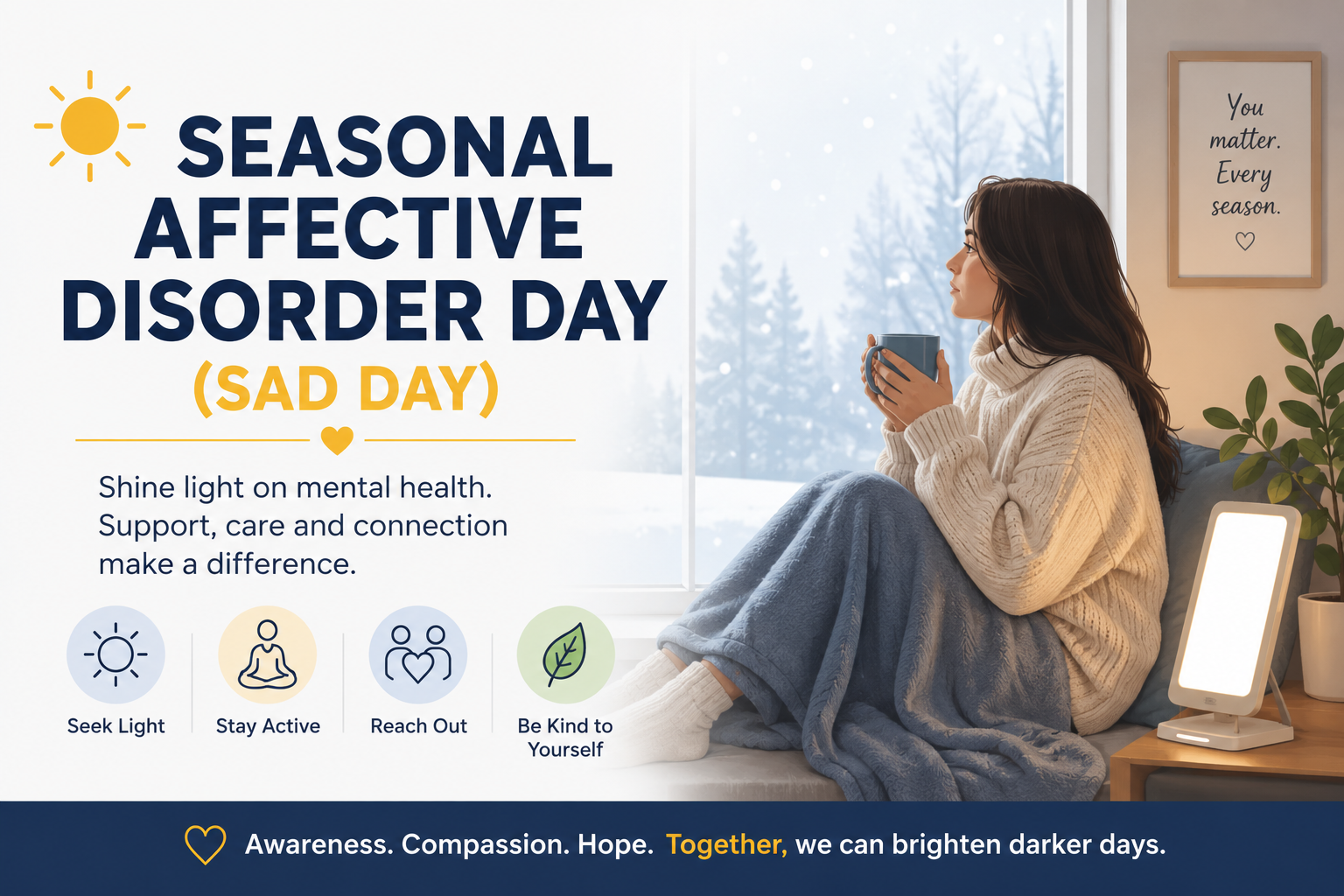
SAD day — which stands for Seasonal Affective Disorder Day — is part of a wider awareness campaign that draws attention to one of the most commonly overlooked mental health conditions in the world.
Seasonal Affective Disorder (SAD) is a real, diagnosable type of depression that arrives with the seasons — most often in autumn and winter — and lifts when daylight returns.
About 5% of adults in the U.S. experience SAD and it typically lasts about 40% of the year. The prevalence of SAD varies with geographical latitude, age, and sex. (Source: American Psychiatric Association)
For families raising children with special needs, SAD day is not just an awareness date. It is a reminder to check in — on their child, on themselves, and on every member of the family who quietly battles darker days without knowing why.
📅 National Seasonal Affective Disorder (SAD) Day: Dates, History, and What It Stands For
🗓️ When Is SAD Day / SAD Awareness Month?
December is Seasonal Affective Disorder Awareness Month. (Source: NAMI Guilford) It falls at precisely the time when SAD symptoms are peaking for most people in the Northern Hemisphere — making December the perfect moment for awareness, action, and support.
| Detail | Information |
|---|---|
| 📅 SAD Awareness Month | December — all month |
| 📌 Why December? | Peak month for SAD symptoms in Northern Hemisphere |
| 🎨 SAD Awareness Colour | Blue (reflecting low mood and winter skies) |
| 🏛️ Key Organisation (US) | NAMI (National Alliance on Mental Illness) |
| 🌍 Global Recognition | Observed across US, UK, Canada, and northern Europe |
| 💡 Primary Goal | Raise awareness, reduce stigma, encourage treatment-seeking |
| 📣 Key Hashtags | #SADAwarenessMonth #SeasonalAffectiveDisorder #WinterBlues |
Why SAD Day and SAD Month Matter for the Special Needs Community
SAD Awareness Month shines a light on a condition that disproportionately affects people with existing mental health conditions — and the caregivers who support them. For special needs families, December is often already one of the most demanding months of the year.
School routines shift. Sensory demands increase around the holidays. Therapies may be interrupted. And on top of all of that, shorter days are quietly depleting serotonin levels in everyone in the household.
Recognising SAD — in your child, in yourself, and in your partner — during SAD Awareness Month could genuinely change the course of your winter. 💙
📊 SAD Statistics 2026: The Numbers That Show How Real This Is
Each year, about 5 percent of the U.S. population experiences seasonal depression.
Four out of five people who have seasonal depression are women. The main age of onset of seasonal depression is between 20 and 30 years of age; however, symptoms can appear earlier. (Source: University of North Dakota Health Library)
| Statistic | Figure | Source |
|---|---|---|
| US adults affected by SAD annually | ~10 million (~5% of population) | APA |
| Duration of SAD symptoms per year | ~40% of the year | APA |
| SAD prevalence in New Hampshire (northern state) | 9.7% of population | PMC — SAD Overview |
| SAD prevalence in Florida (southern state) | 1.4% of population | Pfizer |
| Women vs men affected by SAD | Women 4x more likely | NIMH |
| Global prevalence range | 0–10% depending on geography | MHA |
| Recurrence rate year to year | 50–70% without treatment | NCBI StatPearls |
| % of recurrent depression cases with seasonal pattern | 10–20% | PMC — SAD Overview |
| Light therapy success rate | Improvement within first week in most patients | PMC — Light Therapy Efficacy |
| People with ADHD at higher risk of SAD | Significantly elevated | Pfizer |
A 2025 meta-analysis involving 24 studies and 32,866 participants found that higher latitude is significantly associated with increased prevalence of SAD.
These findings underscore the potential role of seasonal light variation in causing SAD across populations. (Source: ScienceDirect — Global Prevalence Meta-Analysis, 2025)
These numbers are not abstract. Behind every percentage point is a family navigating winter with less energy, less joy, and less capacity to cope — often without understanding why.
🧠 What Is Seasonal Affective Disorder (SAD)? The Science Explained Simply
Seasonal Affective Disorder (SAD) is not simply “feeling a bit down in winter.” It is a clinically recognised subtype of major depression with a clear, predictable seasonal pattern.
SAD is a type of depression characterized by a recurrent seasonal pattern, with symptoms lasting about 4–5 months out of the year. (Source: NIMH)
What Causes SAD? The Biology Behind the Blues
Three biological mechanisms drive SAD:
1. Serotonin Disruption
The reduced level of sunlight in the fall and winter months may affect an individual’s serotonin — a neurotransmitter that affects mood. Lower levels of serotonin have been shown to be linked to depression. (Source: Mental Health America)
2. Melatonin Overproduction
SAD is complex, with links to melatonin, the sleep hormone, and winter behaviours. The body produces more melatonin in darkness — leading to excessive sleepiness, fatigue, and low motivation during shorter days. (Source: Illinois Benefits)
3. Circadian Rhythm Disruption
During winter months, decreased sunlight and shorter days disrupt circadian rhythms, leading to lower serotonin levels and altered melatonin production. These biological changes can enhance feelings of depression, fatigue, and irritability. (Source: Attentive Autism Care)
Winter SAD vs. Summer SAD: What Is the Difference?
Most people know about winter SAD. But a less common summer version also exists.
| Feature | Winter-Pattern SAD | Summer-Pattern SAD |
|---|---|---|
| When it starts | Late autumn / early winter | Spring / early summer |
| When it lifts | Spring / summer | Autumn |
| Key symptoms | Oversleeping, carb cravings, fatigue, social withdrawal | Insomnia, poor appetite, agitation, anxiety |
| How common? | Most common pattern | Less common |
| Primary trigger | Reduced sunlight | Possibly excess heat or light |
| Main treatment | Light therapy, CBT, medication | Cooler environments, CBT, medication |
Winter-pattern SAD should not be confused with “holiday blues” — feelings of sadness or anxiety brought on by stresses at certain times of the year. The depression associated with SAD is related to changes in daylight hours, not the calendar. (Source: NIMH)
🚨 SAD Symptoms: A Detailed Checklist for Every Season
One of the most important aspects of SAD day awareness is recognising the symptoms — because they are easy to dismiss as “just tiredness” or “normal winter feelings.”
❄️ Winter-Pattern SAD Symptoms
- 🔴 Persistent low mood — feeling sad, hopeless, or “empty” most of the day
- 🔴 Loss of interest — things that usually bring pleasure no longer feel enjoyable
- 🔴 Excessive sleep — sleeping much more than usual; difficulty waking up in the morning
- 🔴 Carbohydrate cravings — especially sweet and starchy foods
- 🔴 Weight gain — from increased appetite and reduced activity
- 🔴 Low energy and fatigue — feeling sluggish even after sleeping
- 🔴 Difficulty concentrating — brain fog, poor memory, inability to focus
- 🔴 Irritability — short temper, easily frustrated
- 🔴 Physical aches — headaches, digestive problems without clear physical cause
SAD is a type of depression with symptoms like low energy, social withdrawal, irritability, and changes in sleep, appetite, and interest in activities that may last 4–6 months. (Source: Massachusetts Labourers’ Benefit Funds)
☀️ Summer-Pattern SAD Symptoms (Less Common)
- 🟡 Insomnia or difficulty sleeping
- 🟡 Decreased appetite and weight loss
- 🟡 Restlessness and agitation
- 🟡 Anxiety that feels seasonal in pattern
- 🟡 Violent or aggressive thoughts (in more severe cases)
🧩 SAD Day and Special Needs Children: The Connection Nobody Talks About
For HopeForSpecial readers, it is the most important section of all.
Special needs children are not immune to SAD. In fact, they are often more vulnerable — and their symptoms are often harder to identify because they overlap with their existing conditions.
A Story That Will Resonate With Many Parents
Meet Aaliya. She is the mother of a 9-year-old son named Theo, who has autism. Every October, Aaliya notices the same pattern: Theo’s meltdowns increase. His sleep falls apart.
He refuses foods he normally accepts. His engagement in therapy drops sharply. School reports describe him as “more withdrawn” and “harder to reach.”
For two years, Aaliya attributed these changes entirely to Theo’s autism. It was only when she attended a parent support group in December that another parent mentioned Seasonal Affective Disorder in children.
“I felt like someone had turned a light on,” Aaliya says. “Literally and figuratively. We tried light therapy. We increased outdoor time in the mornings. By February, Theo was noticeably calmer. The pattern finally made sense.”
Theo’s story is not rare. It is underreported.
SAD and Autism: A Challenging Intersection
For neurodivergent individuals, particularly those with ADHD or autism, seasonal affective disorder often compounds existing challenges while requiring specialised understanding of how reduced sunlight affects already-different brain chemistry. (Source: Elevating Minds Psychiatry)
Furthermore, recognising Seasonal Affective Disorder in children with autism involves identifying specific patterns in mood and behaviour that relate to seasonal changes.
It is also important to gather observations from multiple settings and informants, including teachers and therapists, to confirm that mood and behavioural changes are consistent across different environments and align with seasonal shifts. (Source: Attentive Autism Care)
Why SAD Is Harder to Spot in Special Needs Children
| Challenge | Why It Creates Difficulty |
|---|---|
| Symptom overlap | Fatigue, withdrawal, and irritability exist in many special needs conditions year-round |
| Communication barriers | Non-verbal children cannot describe low mood or hopelessness |
| Attribution bias | Parents and clinicians often attribute seasonal changes to existing conditions |
| Routine disruption | Winter schedule changes (holidays, fewer therapies) can mask or amplify SAD |
| Sensory sensitivity to light | Children who dislike bright light may resist the very treatment that would help them |
| Sleep changes | Already complex in many special needs conditions; harder to identify when SAD-related |
Caregivers and clinicians face the challenge of accurately identifying when mood and behaviour changes stem from SAD or are typical autism manifestations.
This requires careful assessment and often tailored treatment strategies — such as light therapy or behavioural interventions — to help children navigate seasonal transitions. (Source: Attentive Autism Care)

🚨 Warning Signs of SAD in Special Needs Children (Seasonal Pattern)
Watch specifically for symptoms that follow a seasonal pattern — appearing or worsening in autumn and winter, and improving in spring:
- 🔴 Increased meltdowns or outbursts from October onwards
- 🔴 Significant sleep changes — sleeping much more, difficulty waking
- 🔴 Increased food refusal or carbohydrate seeking in winter
- 🔴 Reduced engagement in therapy, school, or preferred activities
- 🔴 Increased stimming or self-soothing behaviours
- 🔴 Withdrawal from family interaction
- 🔴 Unexplained weight gain through winter months
- 🔴 Persistent tearfulness or flat affect during darker months
The critical question for parents: Does this happen every year around the same time? If the answer is yes — that seasonal pattern is the key diagnostic signal.
🔗 SAD and ADHD: The Overlooked Double Burden
For children with ADHD — another common condition in the special needs community — SAD presents a particularly complex challenge.
People are more likely to develop SAD who have conditions such as bipolar disorder, attention-deficit/hyperactivity disorder, or anxiety. (Source: Pfizer)
This diagnostic uncertainty can delay the initiation of appropriate interventions and result in prolonged suffering and functional impairment for affected children.
Effectively managing the overlap between ADHD and SAD requires a comprehensive and integrated approach that addresses the unique needs and challenges of each condition while recognising their interdependence. (Source: Integrative Psychiatry)
Furthermore, light therapy — a standard treatment for SAD — can be explored for children with ADHD due to its potential to regulate serotonin levels and reset circadian rhythms. Behavioural therapies can offer coping mechanisms, assisting children in navigating the combined challenges of both conditions. (Source: Integrative Psychiatry)
💊 SAD Treatment 2026: What Actually Works
The good news is that Seasonal Affective Disorder responds well to treatment. And many of the most effective approaches are practical, affordable, and accessible for families at home.
The main treatments are: lifestyle measures including getting as much natural sunlight as possible, exercising regularly and managing stress levels; light therapy using a special lamp called a light box; talking therapies such as cognitive behavioural therapy (CBT) or counselling; and antidepressant medicine such as selective serotonin reuptake inhibitors (SSRIs). (Source: PMC — Light Therapy Efficacy, 2023)
💡 Treatment Option 1: Light Therapy (Most Recommended for SAD)
Light therapy is the gold standard for Seasonal Affective Disorder. It is safe, effective, and can be used at home.
Light therapy can be a very effective treatment for SAD, with most seeing an improvement of symptoms within the first week. A powerful lamp that replicates natural light — high-quality light boxes are recommended as they allow patients to spend a shorter time (up to 30 minutes at a time) using them. (Source: PMC — Light Therapy Efficacy)
How it works:
- A 10,000 lux light therapy box is placed at eye level
- Used for 20–30 minutes each morning
- Mimics the effects of natural outdoor light
- Suppresses excess melatonin and supports serotonin production
For special needs children: Introduce the light box gradually. Start with 5–10 minutes. Place it at a comfortable distance. Pair it with a favourite activity — breakfast, a preferred show, or morning reading — to build a positive association.
| Light Therapy Parameter | Recommendation |
|---|---|
| Light intensity | 10,000 lux |
| Duration | 20–30 minutes per session |
| Best time of day | Morning (within 1 hour of waking) |
| Distance from face | Approximately 16–24 inches |
| Eyes open? | Yes — do not stare directly at the light |
| When to see improvement | Within 1–2 weeks for most people |
(Source: NIMH | PMC Light Therapy Review)
🧠 Treatment Option 2: Cognitive Behavioural Therapy (CBT)
CBT adapted specifically for SAD — called CBT-SAD — has strong research support. It teaches people to identify and challenge the negative thought patterns that worsen SAD symptoms. For teenagers and older children, CBT can be highly effective. (Source: NIMH)
💊 Treatment Option 3: Medication (When Needed)
For moderate to severe SAD, SSRIs (selective serotonin reuptake inhibitors) may be prescribed by a doctor. Since seasonal depression has a predictable pattern of recurrence, preventative measures may help to reduce symptoms.
Some forms of prevention that can help include beginning light therapy in the early fall before the onset of symptoms, exercising more, increasing the amount of light at home, meditation and other stress management techniques, spending more time outside, and visiting climates that have more sun. (Source: Mental Health America)
🌿 Treatment Option 4: Lifestyle Strategies for Families
These practical steps can help every family member — including parents — manage SAD day by day:
| Strategy | How It Helps |
|---|---|
| ☀️ Morning outdoor time | Natural light exposure resets the circadian clock |
| 🏃 Daily movement | Exercise boosts serotonin and endorphins — even 20 minutes helps |
| 🍎 Balanced nutrition | Reduce simple carbs; increase protein and omega-3s for brain health |
| 💤 Sleep routine | Consistent bedtime and wake time stabilise circadian rhythms |
| 🪟 Open curtains immediately on waking | Maximise natural light exposure from the start of the day |
| 🎵 Music and creative activities | Elevates mood through dopamine pathways |
| 👥 Social connection | Loneliness amplifies SAD; even one connection per day helps |
| 🛁 Warm water therapy | Baths and showers support sensory regulation and mood |
💙 SAD Day and the Parent Who Is Also Struggling
Here is the conversation most websites skip entirely: parents of special needs children are at elevated risk of SAD themselves. And when a parent’s mental health declines in winter, the entire family system feels it.
The statistics are sobering. Special needs caregivers report higher rates of depression, anxiety, and burnout than the general population — and winter amplifies all of these pressures simultaneously.
If you are reading this and recognising your own symptoms in this article — please hear this clearly:
Your mental health is not a luxury. It is a necessity. For you. And for your child.
Taking SAD seriously — seeking light therapy, talking to a doctor, reaching out to a therapist — is not self-indulgent. It is the most responsible thing a caregiver can do. You cannot pour from an empty cup. And your child needs you to be well.
Signs That You — As a Caregiver — May Be Experiencing SAD
- 🔴 You dread the approach of autumn/winter every year
- 🔴 You feel significantly lower in energy from October to February
- 🔴 You find it harder to connect with your child during winter months
- 🔴 You are sleeping more but feeling less rested
- 🔴 You have noticed this same pattern for two or more consecutive years
If four or more of these resonate, please speak with your GP or a mental health professional. SAD is treatable. And you deserve treatment too.
🌟 About SAD Day
Here are the truths no one will tell you about SAD awareness:
🔸 Special needs children can have SAD — and their symptoms often look like their disability getting worse.
The seasonal pattern is the key. If your child’s challenges are consistently worse in winter and better in summer, every year, SADs should be investigated. Do not automatically attribute everything to their primary diagnosis.
🔸 Light therapy is safe for children — but needs careful introduction.
Many special needs children have light sensitivity. Introducing a 10,000 lux light box gradually, paired with a preferred activity, can make the difference between rejection and benefit.
🔸 Non-verbal children can show SAD through behaviour alone.
Increased self-injury, aggression, food refusal, sleep disruption, and social withdrawal — especially in a seasonal pattern — may be SAD speaking through the only language available to a non-verbal child.
🔸 Parents of special needs children are at compounded SAD risk.
The isolation, reduced social contact, and physical demands of year-round caregiving create a perfect storm for SAD severity. This population is chronically under-screened and under-treated.
🔸 SAD is not “just winter blues.”
“Depression in general is a complex subject. Everything from genetics and environments to sunlight exposure and lifestyle choices can contribute to who is affected by Seasonal Affective Disorder.” — Dr. Russell Morfitt, Chief Clinical Officer, Learn to Live (Source: Illinois Benefits)
Dismissing it as “the winter blues” costs families months of preventable suffering.
🔸 For 40% of people with the condition, depressive episodes continue after winter and last through the summer, leading to a change in diagnosis from SAD to either major depressive disorder or bipolar disorder. (Source: Etactics) This is why early intervention — not waiting to see if it “passes” — is so important.
🔗 Trusted SAD Resources for Families
- 🌐 NAMI — SAD Awareness — Community support and awareness resources
- 🌐 Mental Health America — SAD — Prevention and treatment guidance
- 🌐 American Psychiatric Association — SAD — Clinical facts and statistics
- 🌐 Child Mind Institute — SAD in Children — Child-specific SAD guidance and recognition
- 🌐 Attentive Autism Care — SAD and Autism — Specialist guidance for autistic children and SAD
- 🌐 988 Suicide & Crisis Lifeline — Call or text 988 — free, confidential, 24/7
❓ FAQs: SAD Day
Q: What is SAD Day / Seasonal Affective Disorder Awareness Month?
December is Seasonal Affective Disorder Awareness Month. (Source: NAMI Guilford) It is observed throughout December to raise awareness of SAD — a real, diagnosable form of depression triggered by seasonal changes in light. The goal is to help people recognise their symptoms, reduce stigma, and seek effective treatment before the darkest months take the greatest toll.
Q: What is Seasonal Affective Disorder (SAD)?
SAD is a type of depression characterised by a recurrent seasonal pattern, with symptoms lasting about 4–5 months out of the year. (Source: NIMH) It is triggered primarily by reduced sunlight exposure, which disrupts serotonin and melatonin levels and dysregulates the body’s circadian rhythm.
Q: How common is SAD?
Around 5% of the population experiences SAD in any given year — or around 10 million Americans. It is four times more common in women than in men. (Source: Etactics) Prevalence is higher in northern states and countries with fewer winter daylight hours.
Q: Can children with autism have Seasonal Affective Disorder?
Yes. SAD presents unique difficulties for autistic children, including emotional distress, social difficulties, and disrupted routines. Managing these symptoms involves tailored interventions such as light therapy, maintaining predictable routines, and providing behavioural and emotional support. (Source: Attentive Autism Care) The key to recognising SAD in autistic children is identifying a consistent seasonal pattern to their symptoms.
Q: Is there a link between ADHD and SAD?
People are more likely to develop SAD who have conditions such as ADHD or anxiety. (Source: Pfizer) Children with ADHD may experience worsened attention, hyperactivity, and emotional regulation specifically during winter months, adding to their existing challenges.
Q: What is the most effective treatment for SAD?
Light therapy can be a very effective treatment for SAD, with most seeing an improvement of symptoms within the first week. A powerful lamp that replicates natural light — at 10,000 lux — is recommended. (Source: PMC — Light Therapy Efficacy) CBT, exercise, outdoor time, and antidepressants (when prescribed) are also effective components of a complete treatment plan.
Q: Can SAD come back every year?
Recurrence rates from one winter to the next range from 50% to 70%. (Source: NCBI StatPearls) However, with proactive treatment — particularly beginning light therapy in early autumn before symptoms develop — many people significantly reduce the severity of recurring SAD episodes.
Q: How do I know if my special needs child has SAD or if their condition is worsening?
The most important signal is the seasonal pattern. Ask yourself: Does this happen every autumn and winter? Does it improve in spring? If yes — and if you are seeing increases in sleep, appetite, withdrawal, and low mood specifically during darker months — speak with your child’s paediatrician or mental health professional about a SAD assessment.
Q: Can parents of special needs children get SAD?
Absolutely — and they are at elevated risk. Caregivers of children with special needs experience higher baseline stress, social isolation, and disrupted sleep — all of which interact with SAD risk factors. Recognising your own SAD symptoms and seeking treatment is not selfish. It is essential for your wellbeing and your ability to care for your child.
💙 A Final Word — Because Every SAD Day Deserves to Be Taken Seriously
Every sad day does not have to become a SAD day. But recognising the difference — between temporary low mood and a real, recurring, seasonal disorder — is the first step toward changing the winter experience for you and your family.
This SAD Awareness Month, give yourself permission to take your mental health as seriously as your child’s. Notice the patterns. Track the seasons. Ask the hard questions.
And if you are reading this during a dark December week, feeling exhausted and disconnected and wondering why the winter always feels this heavy — please know: you are not weak. You are not failing. You may simply be experiencing a real, biological condition that has a name, a treatment, and a path forward.
The light at the end of winter is not just a metaphor. Sometimes it is a 10,000 lux lamp on your kitchen table. And sometimes, that is enough to start changing everything. 💡💙
📌 If you or your child are experiencing symptoms of depression, please speak with a healthcare provider. For immediate crisis support, call or text 988 (Suicide & Crisis Lifeline) — available 24/7, free of charge.


