

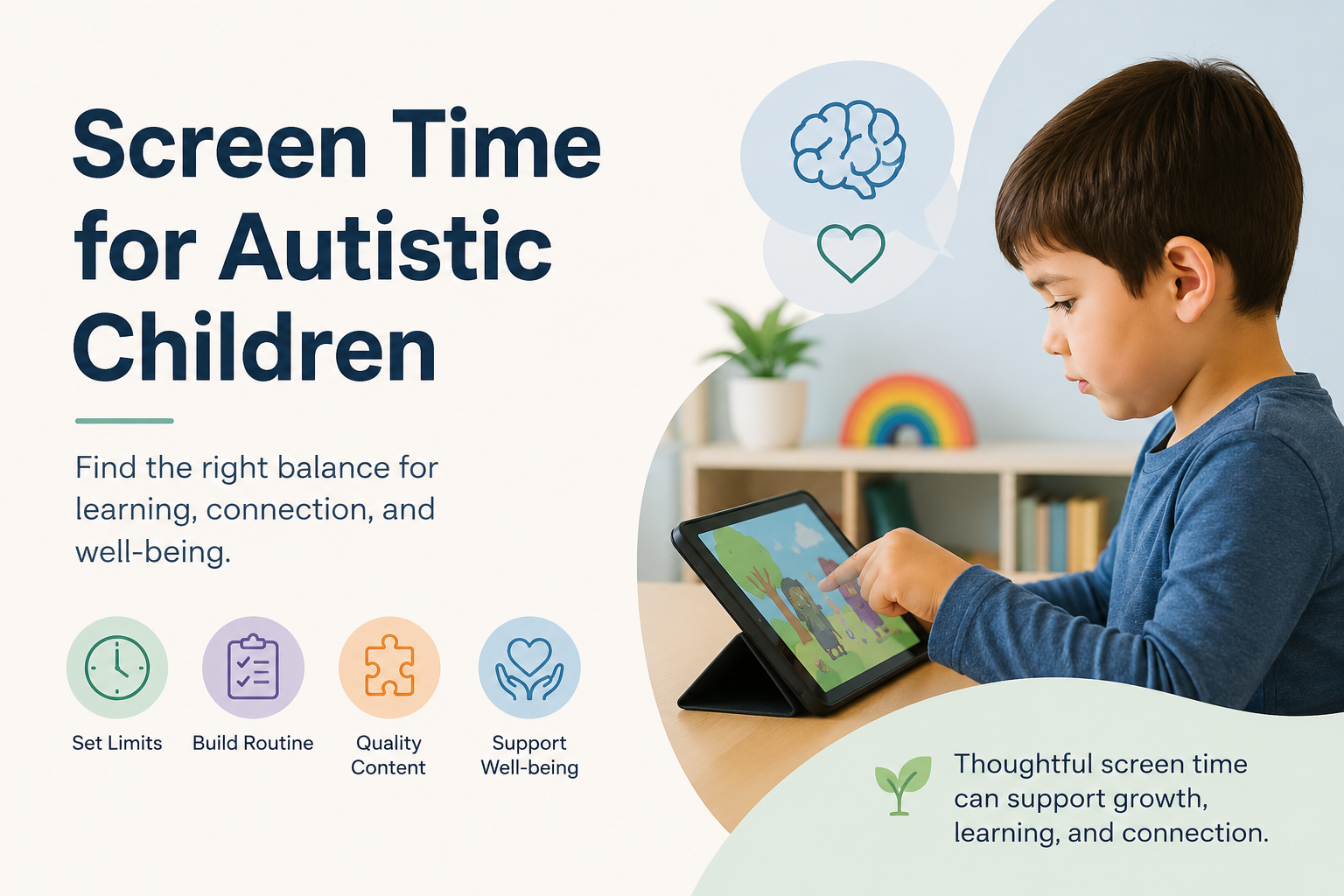
Screen Time for Autistic Children: What 2026 Research Actually Says 💛
📱 Is screen time helping or hurting your autistic child? Research shows autistic toddlers average 4.6 hours daily — 4× the recommended limit. Discover what science says works, what harms, and the 2026 guidelines every parent needs. 👇

- 🌟 How Much Screen Time Is Safe for a Child With Autism?
- 📊 Screen Time and Autism — The Statistics Every Parent Should See
- 🧠 Why Screen Time Affects Autistic Children Differently
- The Pull of Screens for Autistic Children
- The Brain Impact — What the Research Shows
- Why the Risk Is Particularly Acute in Toddlerhood
- 📋 Current Screen Time Guidelines — What Official Bodies Recommend in 2026
- Key 2026 Screen Time Guidelines — At a Glance
- The Important Caveat — Autistic Children Are Not Neurotypical Children
- ⚠️ The Risks of High Screen Time for Autistic Children — What Research Shows in 2026
- Language and Communication Development
- Social and Behavioural Development
- Motor Development
- Sleep
- Rigidity and Transitions
- ✅ The Benefits of Purposeful Screen Time for Autistic Children
- 1. 📱 AAC and Communication Apps — Life-Changing Technology
- 2. 🎮 Social Skills Practice Through Structured Digital Programmes
- 3. 📚 Special Interest Engagement and Educational Content
- 4. 🗂️ Regulatory and Transitional Support
- 5. 🎵 Sensory Regulation Through Music and Sound
- 🏠 Practical Screen Time Strategies for Special Needs Parents — What Actually Works
- Strategy 1: Distinguish Between Screen Types — Non-Negotiable
- Strategy 2: Build Transitions Into Screen Time BEFORE It Becomes a Problem
- Strategy 3: Co-View Whenever Possible
- Strategy 4: Create Screen-Free Anchor Times — Not Screen-Free Days
- Strategy 5: Replace Screens With Sensory Alternatives
- 💡 What You Must Not Miss About Screen Time and Autism
- 1. The Parent Wellbeing Factor Cannot Be Ignored
- 2. Autistic Children Who Cannot Request Screens Also Cannot Report Their Benefits or Harms
- 3. The Letter-and-Number Exception Is Clinically Significant
- 4. Not All Passive Viewing Is Equal
- 🏫 Screen Time, IEP, and School
- ❓ FAQs — Screen Time for Autistic Children 2026
- Q1: How much screen time is recommended for autistic children?
- Q2: Does screen time cause autism?
- Q3: Why does my autistic child love screens so much?
- Q4: Is it okay for my autistic child to use an iPad if they use it for AAC?
- Q5: Does screen time affect language development in autistic children?
- Q6: Should I use screen time as a reward for my autistic child?
- Q7: What are the signs that screen time is negatively affecting my autistic child?
- Q8: How do I reduce screen time for an autistic child without causing meltdowns?
- Q9: Is watching YouTube educational for autistic children?
- Q10: What screen time guidelines do autistic children’s own doctors recommend?
- 💛 Final Words: Informed, Flexible, and Personalised
🌟 How Much Screen Time Is Safe for a Child With Autism?
Screen time for autistic children is one of the most debated and most misunderstood topics in special needs parenting. The direct answer: current 2026 evidence does not support a single one-size-fits-all rule for autistic children.
However, research is clear that high screen time — particularly before age 5 and exceeding 4 hours daily — is significantly associated with delayed developmental milestones across social, motor, and language domains in children with autism. Quality, purpose, and parental involvement matter more than raw time alone.
This guide gives you the honest, up-to-date picture — including what the research says harms, what genuinely helps, how screen time affects autistic children differently than neurotypical children, and what a practical, personalised approach looks like for your family in 2026.
📊 Screen Time and Autism — The Statistics Every Parent Should See
| Statistic | Data | Source |
|---|---|---|
| Average daily screen time — young ASD children (Thailand study) | Children with ASD aged an average of 2.56 years had an average screen time of 4.60 hours per day — nearly 5× the AAP recommended limit | Frontiers in Psychiatry / PMC, 2021 |
| AAP recommendation — ages 2–5 | Screen time should be limited to 1 hour per day of high-quality programming on weekdays | American Academy of Pediatrics — Media and Children |
| ASD children vs typically developing peers | A systematic literature review conducted in 2019 showed that children with ASD spent more time watching television than the typical control group | Frontiers in Psychiatry / PMC |
| Developmental milestone delays — high vs low screen time | Significant differences in social (p=<.001), self-help (p=<.001), gross motor (p=<.001), fine motor (p=<.001), expressive language (p=<.001), language comprehension (p=<.001), and general development (p=<.001) were found between autistic children aged 2–6 with high vs low screen time | International Journal of Early Childhood Special Education, 2026 |
| Early exposure age for ASD children | The average age of first exposure to electronic devices is 2.25 years — the youngest recorded age at first exposure is 3 months (0.25 years) | PMC / Frontiers in Psychiatry |
| Children who exceed AAP guidelines | The majority of toddlers exceed the AAP recommendation of “zero” before age 2; those with neurodevelopmental differences far exceed the guideline and may be most vulnerable to experiencing early screen time | Child Psychiatry and Human Development / PMC, 2025 |
| Global ASD prevalence | Autism spectrum disorder affects millions of children globally, significantly impacting their quality of life | Annals of Medicine and Surgery, 2025 |
| Developmental test performance — higher screen time | Higher levels of screen time at 24 and 36 months were significantly associated with poorer performance on developmental screening tests at 36 and 60 months in a study of 2,441 children in Canada | PMC / Frontiers in Psychiatry, 2021 |
🧠 Why Screen Time Affects Autistic Children Differently
Before we discuss guidelines, it is essential to understand why autistic children respond to screen time differently than neurotypical peers — because this difference is the foundation of any useful guidance.
The Pull of Screens for Autistic Children
Autistic children are often drawn to screens for neurologically specific reasons. Screens:
- Offer predictability — digital content follows patterns; characters and shows do not change their behaviour unexpectedly the way people do
- Provide immediate, consistent reinforcement — games and videos deliver rewards on reliable schedules, which many autistic children find deeply satisfying
- Support special interests — screens are an ideal vehicle for diving deep into topics of fascination
These are not character flaws or parenting failures. They are neurological realities. And understanding them is the starting point for a thoughtful screen time approach.
The Brain Impact — What the Research Shows
Excessive screen time has several negative effects in the early development of children. Extended screen time does much more harm than good with negative physiological, cognitive, social, emotional, and legal consequences.
A long screen time may be linked to poor academic performance, obesity, and sleep problems. Excessive screen time may also lead to social behaviour deficits or attention problems, especially during critical periods of development. (Source: PMC / Frontiers in Psychiatry)
Additionally: research suggests that too much screen time can contribute to developmental delays and changes in brain composition. Some studies show that digital media usage can affect grey matter volume. (Source: Hopebridge Autism Therapy)
For autistic children who are already navigating developmental challenges in these very domains — social behaviour, attention, language, and sensory regulation — high screen time adds pressure to systems that are already working harder than average.
Why the Risk Is Particularly Acute in Toddlerhood
Early exposure to electronic screens can cause neurochemical and anatomical changes in the brain, and neurotransmitter changes may cause behavioural problems in children. (Source: Frontiers in Psychiatry, PMC)
The period from birth to age five is the most critical window for language acquisition, social brain development, and sensory integration. Screen time that displaces face-to-face interaction, physical play, or joint attention activities during this window has a disproportionate developmental cost — and autistic children are already navigating developmental vulnerability in exactly these areas.
📋 Current Screen Time Guidelines — What Official Bodies Recommend in 2026
Guidelines established by the American Academy of Pediatrics (AAP) in 2016 advocated restricting screen time for children aged 2–5 years to 1 hour per day of high-quality programs, with a parallel recommendation for parents to regulate screen time for children aged 6 years and older.
The AACAP (American Academy of Child and Adolescent Psychiatry) offers more specific guidance:
The AACAP recommends: until 18 months, only video chatting with an adult; between 18 and 24 months, restricted to educational programming with a caregiver; for ages 2–5 years, cap non-educational screen time to about 1 hour per weekday and 3 hours on weekends; for ages 6 years and older, advocate for healthy habits while limiting screen-related activities. (Source: Annals of Medicine and Surgery, PMC, 2025)
Key 2026 Screen Time Guidelines — At a Glance
| Age Group | General Guidelines | Notes for Autistic Children |
|---|---|---|
| Under 18 months | Video chatting only | Avoid passive screen use; face-to-face interaction is critical at this stage for all children |
| 18–24 months | Educational programming with caregiver only | Joint viewing with a parent is meaningfully different from solo viewing |
| 2–5 years | 1 hour weekdays; up to 3 hours on weekends (non-educational) | Autistic children in this range average 4.6 hours — intervention is especially needed here |
| 6 years and older | Healthy habits; consistent limits | Focus on content quality and purpose; assistive technology use is separate from recreational limits |
The Important Caveat — Autistic Children Are Not Neurotypical Children
Generalised screen time recommendations often fail to consider the unique needs and behaviours of neurodivergent children, leaving parents struggling. Smartphones and tablets are not just sources of entertainment for neurodiverse children; they are often essential tools for learning and daily functioning. (Source: CHADD — Navigating Screen Time with Neurodiverse Children, March 2025)
This is the most nuanced and important point in the entire screen time conversation for special needs families: a child using an AAC app to communicate, a social skills programme to practise conversations, or a visual schedule app to navigate transitions is NOT the same as a child passively consuming YouTube for hours.
One is therapeutic screen use. The other is recreational screen time. They require different conversations, different limits, and different approaches.
⚠️ The Risks of High Screen Time for Autistic Children — What Research Shows in 2026

Language and Communication Development
Multiple studies find a consistent association between high screen time and delayed language development in children with autism. This matters acutely because language development is already one of the primary developmental concerns for many autistic children.
Significant differences in expressive language (p=<.001) and language comprehension (p=<.001) were found between autistic children aged 2–6 with high screen time and those with low screen time. (Source: International Journal of Early Childhood Special Education, 2026)
The mechanism is straightforward: time spent on screens is time not spent in the face-to-face interactions that drive language development. Screens provide input. They rarely provide the responsive, contingent, turn-taking interaction that is essential for language to develop.
Social and Behavioural Development
Significant differences in social development (p=<.001) were found between autistic children with high screen time and those with low screen time. Social development — already one of the core areas of challenge for autistic children — is further impacted by high screen time, likely because screen time replaces rather than supplements face-to-face social interaction.
Motor Development
Significant differences in both gross motor (p=<.001) and fine motor development (p=<.001) were found between autistic children aged 2–6 with high screen time vs low screen time. High screen time typically involves sedentary behaviour — reducing the physical activity and motor exploration that drives both gross and fine motor development.
Sleep
Research consistently links high screen time with sleep disruption in children — particularly when screens are used in the hour before bedtime. Blue light from screens suppresses melatonin production, making it harder to fall asleep. For autistic children — who already experience sleep difficulties at significantly higher rates than neurotypical peers — this interaction between screen time and sleep makes bedtime screen management particularly important.
Rigidity and Transitions
Many autistic children develop rigid patterns around screens. Address this proactively. (Source: Cortica Care — Evidence-Based Screen Time Guidelines, February 2026) When screen time becomes a fixed routine element, transitioning away from screens becomes an increasingly difficult and distressing experience — exacerbating the transition challenges that many autistic children already face.
✅ The Benefits of Purposeful Screen Time for Autistic Children
Equally important — and often underrepresented in the fear-based screen time conversation — is the evidence for genuine benefit from certain types of screen use for autistic children.
1. 📱 AAC and Communication Apps — Life-Changing Technology
For nonverbal or minimally verbal children, screens can be life-changing: communication apps such as Proloquo2Go, TouchChat, and LAMP Words for Life provide augmentative and alternative communication that transforms a child’s ability to express themselves. (Source: Cortica Care, February 2026)
This is perhaps the single clearest case where screen time is unequivocally beneficial for autistic children — and where general screen time limits simply do not apply. An AAC app is not entertainment. It is a voice. It should never be included in recreational screen time limits.
2. 🎮 Social Skills Practice Through Structured Digital Programmes
Several digital programmes have been specifically designed and researched for social skills development in autistic children — using animated characters, predictable interactions, and visual social stories. When used with appropriate parental guidance, these programmes complement — not replace — real-world social development.
3. 📚 Special Interest Engagement and Educational Content
Many autistic children develop deep expertise in topics through screen-based learning — natural history, trains, astronomy, mathematics, coding, or art. This kind of hyperfocused learning, when supported rather than limited arbitrarily, builds genuine competence and confidence that serves children well throughout life.
4. 🗂️ Regulatory and Transitional Support
Visual schedule apps, social story creators, and timer apps provide scaffolding for daily routines that many autistic children genuinely need. Smartphones and tablets are often essential tools for learning and daily functioning for neurodiverse children. These uses deserve explicit exemption from general entertainment screen time limits.
5. 🎵 Sensory Regulation Through Music and Sound
For some autistic children, specific music, videos, or sounds serve genuine sensory regulation functions — helping children self-soothe, transition between activities, or prepare for challenging situations. This purposeful sensory use is meaningfully different from passive consumption and deserves to be evaluated on its own merits.
🏠 Practical Screen Time Strategies for Special Needs Parents — What Actually Works
The research is clear that high recreational screen time causes harm. But telling a parent of an autistic child to “just limit screen time” without addressing the reality of why autistic children use screens so intensely — and without providing workable alternatives — is not actually helpful.
Here is what the evidence and clinical experience say works.
Strategy 1: Distinguish Between Screen Types — Non-Negotiable
Before setting any limit, categorise your child’s screen use:
| Category | Examples | Approach |
|---|---|---|
| Therapeutic/functional screens | AAC apps, visual schedules, social skills programmes, OT games | No time limits — these are medical and educational tools |
| Co-viewed educational content | Educational programmes watched WITH a parent | Limited but not severely restricted; parental engagement is protective |
| Solo educational content | YouTube educational channels, learning apps | Time limits apply; content quality monitoring essential |
| Pure entertainment screens | Video games, social media, entertainment-only TV | Standard time limits apply; most research concerns apply here |
Strategy 2: Build Transitions Into Screen Time BEFORE It Becomes a Problem
For children with heightened sensory sensitivities or anxiety, abrupt changes to routine can trigger severe meltdowns. This makes it difficult for parents to implement strict guidelines.
The solution is not avoiding limits — it is building transitions in:
- Use a visual timer that shows time remaining before screens end
- Give a 10-minute, 5-minute, and 1-minute warning — consistently
- Create a “what comes next” visual — so the child knows what follows screens
- Build screen sessions into a predictable daily routine — not as a request-based system
Strategy 3: Co-View Whenever Possible
Parents who are aware of the AAP guidelines report less daily screen time for their children. But beyond awareness, co-viewing specifically transforms screen time quality. When a parent watches alongside a child and discusses what is happening — labelling emotions, asking questions, making connections — the screen becomes a shared social experience rather than a solo passive one.
This “serve-and-return” interaction during viewing activates the language and social learning circuits that isolated screen viewing bypasses.
Strategy 4: Create Screen-Free Anchor Times — Not Screen-Free Days
For most autistic children, eliminating screens entirely is neither realistic nor necessary. What is achievable and beneficial is creating predictable screen-free times:
- Morning routine — the first hour after waking should not begin with screens
- 1 hour before bed — protects sleep quality and melatonin production
- Outdoor time — physical activity and sensory-rich environments are irreplaceable
Strategy 5: Replace Screens With Sensory Alternatives
The reason high screen time is so difficult to reduce in autistic children is that it meets genuine neurological needs — for predictability, sensory input, dopamine reward, and low-demand engagement. Simply removing screens without replacing these functions creates distress.
Effective screen alternatives that meet similar needs:
- Sensory bins, water play, and tactile materials — meet sensory input needs
- Lego, building blocks, puzzles — provide the pattern satisfaction and predictability screens offer
- Audio stories and audiobooks — provide narrative engagement without visual screen stimulation
- Physical activity through preferred interests — swimming, trampolines, nature walks
💬 A Parent’s Experience
“Rayan is 7 and has autism and ADHD. At age 4, we counted his screen time and it was about 6 hours on weekdays. He was having massive meltdowns every time we tried to end it. Our BCBA helped us restructure. We didn’t cut screens.
We built a visual schedule where screens appeared in a clear slot — after outdoor play, before dinner. We used a timer he could see. We added a sensory bin for transitions. In three months, his daily screen time was under 2 hours, and the meltdowns at transitions were 80% less frequent.
The secret was not taking screens away — it was making everything around screens more predictable.” — Ananya S., mother of a child with autism and ADHD, Bengaluru, India
💡 What You Must Not Miss About Screen Time and Autism
This is the section that differentiates genuinely helpful guidance from surface-level advice.
1. The Parent Wellbeing Factor Cannot Be Ignored
Managing screen time for neurodiverse children can be an even greater challenge, leaving parents struggling. The reality that most articles skip: screens often give exhausted special needs parents their only break. A parent who is burned out, isolated, and overwhelmed cannot implement optimal developmental strategies. Sometimes, screens give a parent the 30 minutes they need to shower, eat, or breathe.
This is not a parenting failure. It is a caregiving reality. And sustainable screen time reduction must account for it — which means the conversation has to include caregiver support, respite care, and the systemic pressures special needs families face.
2. Autistic Children Who Cannot Request Screens Also Cannot Report Their Benefits or Harms
For non-verbal autistic children, all screen time decisions rest entirely with caregivers. There is no child feedback loop. This makes it essential that AAC devices are prioritised — not as screen time, but as the communication tools they are — while passive entertainment screens for non-verbal children are monitored with particular care.
3. The Letter-and-Number Exception Is Clinically Significant
The ability to learn letters (p=0.002) and numbers (p=0.002) was not significantly impacted by high vs low screen time in autistic children. This suggests that academic learning through screens may be relatively protected compared to developmental milestones — potentially because autistic children’s visual learning strengths translate to screen-based academic learning even when other domains are affected by high screen time.
4. Not All Passive Viewing Is Equal
Research distinguishes between fast-paced, highly stimulating content (which is associated with worse outcomes) and slow-paced, narrative content watched with a parent (which is associated with better outcomes). A child watching a rapidly-edited action video is having a different neurological experience than a child watching a slow nature documentary with a parent who narrates and asks questions.
🏫 Screen Time, IEP, and School
For school-age autistic children, screen time has implications that extend into the educational setting:
- Assistive technology listed in the IEP should never be counted against recreational screen time limits
- Teacher communication about classroom screen use is important — some children with high home screen time are also using screens more than peers at school, compounding total exposure
- Screen-based rewards in ABA programmes should be discussed with your BCBA — many practitioners now ensure that screen-based reinforcement is carefully limited and that screen breaks do not become the dominant reward system
❓ FAQs — Screen Time for Autistic Children 2026
Q1: How much screen time is recommended for autistic children?
The AACAP recommends: until 18 months, only video chatting with an adult; between 18–24 months, educational programming with a caregiver only; ages 2–5, cap non-educational screen time to 1 hour per weekday and 3 hours on weekends; ages 6 and older, healthy habits with consistent limits on recreational use. However, these guidelines apply to recreational screens — AAC apps and assistive technology are separate and should not be limited. (Source: Annals of Medicine and Surgery, PMC, 2025)
Q2: Does screen time cause autism?
No. Current research does not support a causal link between screen time and autism. Autism is a neurodevelopmental condition with complex genetic and biological origins. However, autistic children may use screens more than neurotypical children, and high screen time is associated with worse developmental outcomes across several domains. The association is not causation.
Q3: Why does my autistic child love screens so much?
Screens provide predictability, pattern, consistent sensory input, immediate reinforcement, and low social demand — all of which address neurological preferences common in autism. Autistic children often develop rigid patterns around screens because screens reliably meet deep sensory and regulatory needs. Understanding this neurological basis helps parents address the need rather than just remove the behaviour. (Source: Cortica Care, February 2026)
Q4: Is it okay for my autistic child to use an iPad if they use it for AAC?
Absolutely yes. For nonverbal or minimally verbal children, communication apps such as Proloquo2Go, TouchChat, and LAMP Words for Life can be life-changing. AAC use should never be restricted as part of entertainment screen time limits. These are essential communication tools — not discretionary screen time. (Source: Cortica Care, February 2026)
Q5: Does screen time affect language development in autistic children?
Yes — the research is consistent. Significant differences in expressive language (p=<.001) and language comprehension (p=<.001) were found between autistic children aged 2–6 with high screen time and those with low screen time. High recreational screen time displaces the face-to-face, contingent interaction that drives language development. (Source: IJES, 2026)
Q6: Should I use screen time as a reward for my autistic child?
This is a nuanced question. Screen time can be used as a motivational tool — and many ABA programmes use it as reinforcement. However, be cautious: when screens become the primary or most powerful reward, they can reinforce exactly the excessive screen use patterns research identifies as problematic. Work with your BCBA to ensure a diverse reinforcement system that does not create overreliance on screen-based rewards.
Q7: What are the signs that screen time is negatively affecting my autistic child?
Watch for: increased meltdowns specifically at transitions away from screens; progressive reduction in interest in non-screen activities that were previously enjoyable; sleep deterioration that correlates with screen use; increasing rigidity around screen access; reduced language or social engagement that was previously stronger; and emotional dysregulation that is worse than baseline during non-screen periods.
Q8: How do I reduce screen time for an autistic child without causing meltdowns?
For children with heightened sensory sensitivities or anxiety, abrupt changes to routine can trigger severe meltdowns. The key is gradual, predictable reduction with advance notice: use a visible timer, give multi-stage warnings, build screen time into a visual schedule so it becomes predictable, offer sensory alternatives at transition points, and never abruptly remove screens mid-session. Small reductions over weeks — not sudden elimination — produce sustainable results. (Source: CHADD, March 2025)
Q9: Is watching YouTube educational for autistic children?
It depends entirely on the content and context. Co-viewed, slow-paced educational content, watched with a parent who engages interactively, can be genuinely educational. Fast-paced entertainment content, watched solo for extended periods, is not. General YouTube algorithm-driven viewing — where content autoplays without curation — is one of the highest-risk screen time patterns for all children, including autistic children.
Q10: What screen time guidelines do autistic children’s own doctors recommend?
The best guidance is individualised — what works for one autistic child may not work for another. Clinical experience reveals that every autistic child has a unique profile of strengths, challenges, and sensory needs, and screen use should be personalised accordingly. Most paediatric neurologists, developmental paediatricians, and BCBAs recommend applying the AAP recreational guidelines as a starting point, explicitly exempting assistive technology, and adjusting based on the individual child’s response. (Source: Cortica Care, February 2026)
💛 Final Words: Informed, Flexible, and Personalised
Screen time for autistic children is not black and white. It is not “bad” or “good.” It is a powerful tool — with real risks when used excessively and without purpose, and real benefits when used thoughtfully and with attention to the individual child’s specific needs.
The research in 2026 is clear on the harm of high recreational screen time, particularly before age 6. It is equally clear that assistive technology, AAC apps, and purposeful educational use are genuinely different — and genuinely beneficial.
What matters most is not whether your family meets a precise daily minute count. What matters is the pattern: Is screen time replacing valuable developmental experiences? Is it disrupting sleep? Is it creating rigidity that affects daily functioning? Or is it supplementing, supporting, and occasionally giving a caregiver the break they need to show up for the next interaction?
Screens are neutral. They become positive or negative based on how they’re used in the context of a child’s overall development.
Your child is the most important variable in this equation. And you — as the parent who knows them best — are the most important interpreter of what that research means for their daily life. 💛
🔗 Essential Resources
- 🌐 AAP — Media and Children
- 🌐 CHADD — Screen Time for Neurodiverse Children
- 🌐 Cortica Care — Evidence-Based Screen Time Guide for Autism, 2026
- 🌐 PMC — Screen Time and ASD Risk Factors
- 🌐 PMC — Annals of Medicine & Surgery, 2025
- 🌐 Hopebridge — How Much Screen Time is Too Much for Children with Autism?
This article is written for educational and informational purposes only. For personalised screen time guidance for your autistic child, always consult your paediatrician, developmental paediatrician, or licensed BCBA.


