

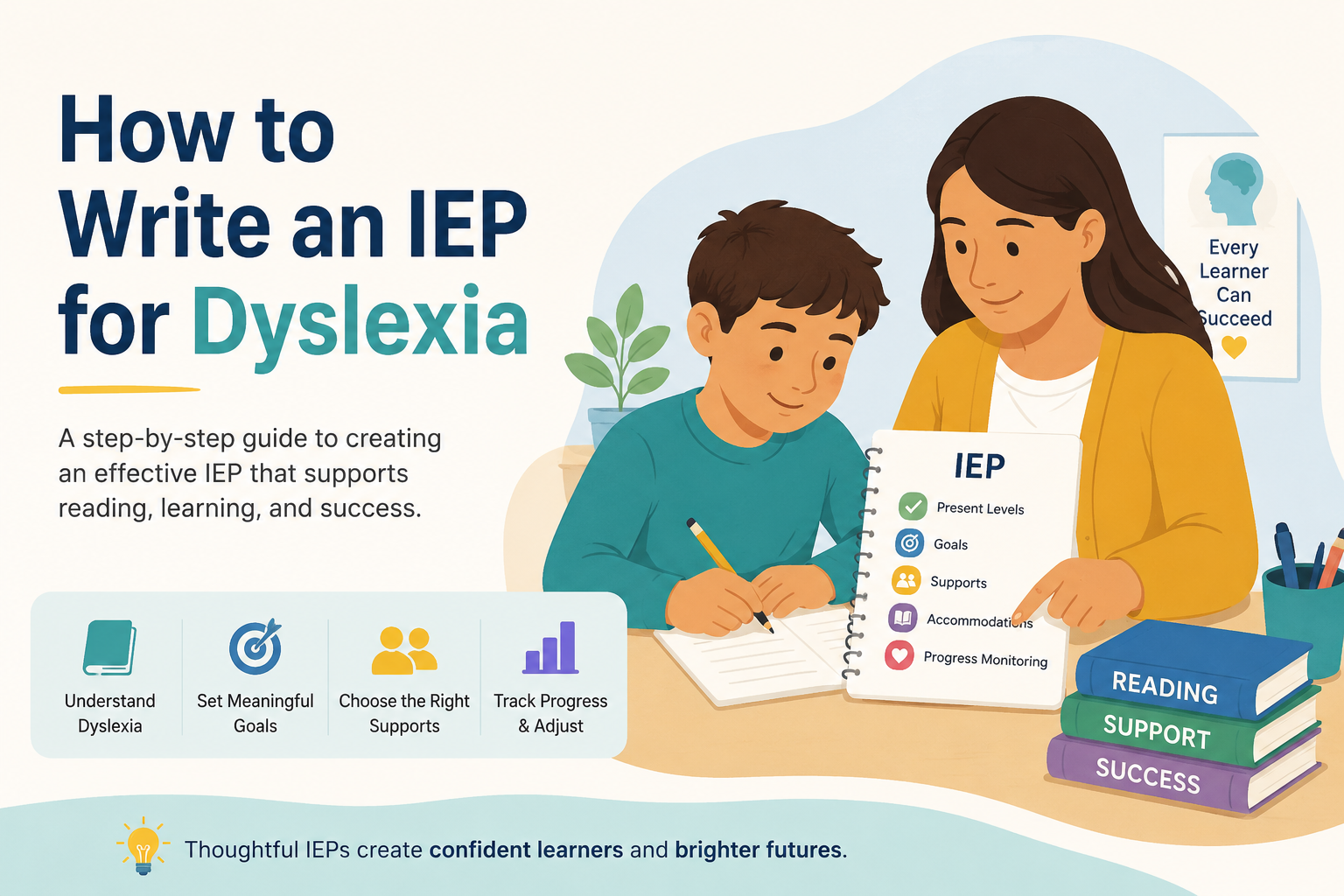
How to Write an IEP for Dyslexia: 2026 Guide with Templates, Goals, and Advocacy Tips 💛
📋 Wondering how to write an IEP for dyslexia that actually works? This 2026 complete guide covers SMART goals, PLOP statements, accommodations templates and the legal rights most parents never hear about. 💛👇

- 🌟 How Do You Write an Effective IEP for Dyslexia?
- 📊 Dyslexia and IEP — Key Statistics Every Parent and Educator Must Know
- 🧠 Understanding the Legal Framework — Why Dyslexia Qualifies for an IEP
- 📋 The Complete IEP for Dyslexia
- Present Levels of Academic Achievement and Functional Performance (PLAAFP) 📊
- 2: Annual Goals — SMART Dyslexia IEP Goals 🎯
- 📚 Complete Dyslexia IEP Goal Bank — Ready to Use and Adapt
- 🔤 Phonological Awareness Goals
- 📖 Decoding Goals
- 📏 Reading Fluency Goals
- 🧩 Reading Comprehension Goals
- ✏️ Spelling Goals
- 🗣️ Written Expression Goals
- 🤝 Self-Advocacy Goals
- 🛠️ Special Education Services — Specially Designed Instruction for Dyslexia
- 📝 Complete Dyslexia IEP Accommodations Template
- ✅ Reading Accommodations
- ✅ Writing Accommodations
- ✅ Testing and Assessment Accommodations
- ✅ Classroom Instruction Accommodations
- ✅ Spelling and Writing Conventions Accommodations
- 🔍 Progress Monitoring — How to Ensure the IEP Is Working
- 💬 The Advanced Dyslexia IEP Advocacy Guide
- 1. The “Gaslighting” Problem in Dyslexia IEPs
- 2. Name the Programme in the IEP — Not Just “Reading Intervention”
- 3. Request an Independent Educational Evaluation (IEE) If You Disagree
- 💛 Parent Story — How Getting the IEP Right Changed Everything
- ❓ FAQs — How to Write an IEP for Dyslexia 2026
- Q1: Does dyslexia qualify for an IEP?
- Q2: What is the difference between an IEP and a 504 Plan for dyslexia?
- Q3: What should be in the PLAAFP section of a dyslexia IEP?
- Q4: What are SMART goals for dyslexia?
- Q5: What reading programme should be in a dyslexia IEP?
- Q6: How often should a dyslexia IEP be updated?
- Q7: What accommodations should a dyslexia IEP include?
- Q8: Can parents request an IEP for their dyslexic child?
- Q9: What should I bring to an IEP meeting for dyslexia?
- Q10: What do I do if the IEP is not working for my dyslexic child?
- 🔗 Essential Resources for Writing a Dyslexia IEP
🌟 How Do You Write an Effective IEP for Dyslexia?
How to write an IEP for dyslexia is one of the most urgent questions parents of struggling readers ask — and most get incomplete answers. Here is the direct answer: an effective IEP for dyslexia requires a detailed PLAAFP section grounded in diagnostic data, SMART annual goals targeting phonological awareness, decoding, fluency, and comprehension, evidence-based specialised instruction such as Orton-Gillingham, and specific accommodations — all documented in a legally binding plan under IDEA’s Specific Learning Disability category.
This guide is not a surface-level overview. It is a step-by-step, section-by-section blueprint — including real goal examples, a complete accommodations template, the legal framework you need to advocate effectively, and the mistakes most IEP teams make that leave dyslexic children without the intervention they need.
Whether you are a parent preparing for your first IEP meeting, an educator writing goals, or a special education advocate supporting a family, this guide gives you the tools to build an IEP that actually teaches a child to read.
📊 Dyslexia and IEP — Key Statistics Every Parent and Educator Must Know
| Statistic | Data | Source |
|---|---|---|
| Prevalence of dyslexia in students | Dyslexia, a language-based learning disability that affects reading fluency, spelling, and comprehension, impacts approximately 1 in 5 students in the US | Yale Center for Dyslexia & Creativity via Lighthouse Therapy |
| Students with learning disabilities receiving IEPs | 7.2 million students — approximately 15% of all public school students — receive special education services under IDEA | NCES, 2024 |
| Impact without intervention | Without clear, measurable IEP goals and targeted interventions, students with dyslexia can experience frustration, low self-esteem, and academic struggles that may persist into adulthood | Lighthouse Therapy |
| IEP as legal document | Violating the IEP plan is a violation of IDEA — no changes may be made to an IEP without parental consent | The Dyslexia Initiative |
| Why IEP beats 504 for dyslexia | 504 does not include services. Because 504 is not a services law, specific goals will not be made and a specific commitment to days and duration of dyslexia remediation is not guaranteed | The Dyslexia Initiative |
| Structured literacy effectiveness | Research consistently shows structured literacy — including Orton-Gillingham based approaches — produces significantly better reading outcomes for students with dyslexia than whole-language approaches | International Dyslexia Association |
| Reading instruction timing | Children who do not achieve basic reading fluency by the end of 3rd grade are 4× more likely to drop out of school | Annie E. Casey Foundation Reading Research |
🧠 Understanding the Legal Framework — Why Dyslexia Qualifies for an IEP
Before writing a single goal, you must understand the legal foundation. Many families are wrongly told that dyslexia does not qualify for an IEP — or that a 504 Plan is sufficient. Both of these claims are incorrect and harmful.
Dyslexia Under IDEA
The Individuals with Disabilities Education Act (IDEA) is a Special Education law that covers both accommodations and services. There are 13 qualifiers for IDEA, and a Specific Learning Disability is one of them, under which dyslexia will and does fall.
In the words of Drs. Sally and Bennett Shaywitz, saying “Specific Learning Disability” is akin to saying “Infectious Disease,” but saying “Dyslexia” is akin to saying “Strep Throat.” (Source: The Dyslexia Initiative)
This means when an IEP says “Specific Learning Disability” as the eligibility category — dyslexia is the diagnosis that sits within it.
Why a 504 Plan Is Not Enough for Dyslexia
In the case of dyslexia, a 504 is not recommended. 504 Plans are about access — they are not about teaching or special education. They offer accommodations, not specially designed instruction. Extra time on a test does not help teach a child to read. (Source: A Day in Our Shoes)
This is the most critical distinction every parent must understand before their first IEP meeting:
| Feature | IEP (IDEA) | 504 Plan (Section 504) |
|---|---|---|
| Provides accommodations | ✅ Yes | ✅ Yes |
| Provides specialised instruction | ✅ Yes — legally required | ❌ No |
| Includes measurable annual goals | ✅ Yes — legally required | ❌ No |
| Guarantees dyslexia remediation services | ✅ Yes | ❌ No |
| Progress reporting to parents | ✅ Required with report cards | ❌ Not required |
| Legal recourse for non-compliance | ✅ Strong — violating is violating IDEA | ⚠️ Weaker |
| Best for dyslexia | ✅ Yes | ❌ No |
📋 The Complete IEP for Dyslexia
An IEP for dyslexia contains the same legally required sections as any IEP under IDEA. Here is how each section should be completed specifically for a student with dyslexia.

Present Levels of Academic Achievement and Functional Performance (PLAAFP) 📊
This is the most important section — and the most frequently written poorly. The PLAAFP is where all diagnostic data comes together. This section describes the student’s current skills, strengths, and needs and drives everything else in the IEP.
For a student with dyslexia, the PLAAFP must include objective, data-based information about:
Reading Domains to Address:
- Phonological awareness — the student’s ability to identify and manipulate sounds in spoken language
- Phonemic awareness — specific ability to identify, blend, segment, and manipulate individual phonemes
- Decoding — accuracy when reading unfamiliar words using phonics knowledge
- Oral reading fluency — words read correctly per minute (WCPM) at grade level
- Reading comprehension — ability to extract meaning from text
- Spelling — phonetic and orthographic spelling accuracy
Data Sources to Reference:
- Standardised psychoeducational evaluation results (e.g., WIAT-4, WJ-IV, GORT-5)
- Curriculum-Based Measurement (CBM) oral reading fluency probes
- Classroom grades and teacher observations
- Previous IEP goal progress data
- Speech-language assessment results if language processing is also affected
Example PLAAFP Statement for Dyslexia:
“As of November 2025 psychoeducational evaluation, [Student] demonstrates significant phonological processing deficits. On the WIAT-4, she scored in the 8th percentile for Word Reading and the 5th percentile for Pseudoword Decoding, indicating severe difficulty applying phonics knowledge to unfamiliar words. Oral reading fluency CBM probes from October 2025 show [Student] reads 32 words correct per minute (WCPM) on 2nd grade text, compared to the benchmark of 90 WCPM for her grade 3 peers. [Student]’s reading difficulty significantly impacts her ability to access grade-level curriculum independently. Her strengths include strong verbal comprehension, excellent listening vocabulary, and strong mathematical reasoning.”
2: Annual Goals — SMART Dyslexia IEP Goals 🎯
Annual goals must be specific, measurable, achievable, relevant, and time-bound (SMART) and must address the student’s academic and functional needs related to dyslexia.
Furthermore: the goals within the IEP must be robust, reasonable but stretch the child and the team, and measure progress against what is defined in the IEP. Overwhelming progress is a sign that the goal is inappropriate because it is too easy.
The SMART Goal Framework for Dyslexia:
| Component | What It Means | Example |
|---|---|---|
| Specific | Names the exact skill being targeted | Decoding CVC words using short vowel sounds |
| Measurable | Includes a number — percentage, WPM, trial accuracy | 80% accuracy across 3 data points |
| Achievable | Realistic given the student’s current baseline and pace of learning | Moving from 40% to 80% accuracy in 12 months |
| Relevant | Directly tied to the student’s identified need in the PLAAFP | Addresses decoding deficit identified in evaluation |
| Time-bound | Has a deadline — typically the annual review date | By [date one year from IEP] |
📚 Complete Dyslexia IEP Goal Bank — Ready to Use and Adapt
Here is a comprehensive goal bank across all major dyslexia skill areas. These goals are written in SMART format and ready to personalise with your student’s current baseline and target.
🔤 Phonological Awareness Goals
Goal 1 — Phoneme Segmentation: “By [date], [Student] will segment spoken words with 3–6 phonemes into individual sounds with 85% accuracy across 4 consecutive data collection sessions, as measured by weekly CBM phoneme segmentation probes.”
Goal 2 — Phoneme Blending: “By [date], [Student] will blend 4–6 individual phonemes into words with 80% accuracy in 4 of 5 trials, as measured by bi-weekly teacher-administered phoneme blending assessments.”
📖 Decoding Goals
Goal 3 — CVC and Short Vowel Decoding: “By [date], [Student] will decode CVC words with short vowel patterns with 90% accuracy when reading connected decodable text, across 4 of 5 data collection points, as measured by weekly decodable text reading probes.”
Goal 4 — Multisyllabic Word Decoding: “By [date], [Student] will decode multisyllabic words with 80% accuracy in 3 of 4 assessments, as measured by monthly CBM word reading assessments at grade level.”
Goal 5 — Pseudoword Decoding: “By [date], [Student] will correctly decode nonsense words using taught phonics patterns (CVC, CVCe, vowel teams) with 80% accuracy in 4 of 5 trials, as measured by bi-weekly pseudoword reading probes using DIBELS NWF.”
📏 Reading Fluency Goals
Goal 6 — Oral Reading Fluency: “By the end of the school year, [Student] will improve fluency by reading 60 words per minute with 90% accuracy on [grade] level passages, as measured by bi-weekly ORF CBM probes.”
Goal 7 — Sight Word Fluency: “By the end of the semester, [Student] will read 50 sight words correctly within one minute in 4 of 5 trials, as measured by weekly Dolch/Fry sight word assessments.”
🧩 Reading Comprehension Goals
Goal 8 — Comprehension with Grade-Level Text: “By [date], [Student] will answer comprehension questions for grade-level text with 80% accuracy, as measured by monthly curriculum-based comprehension assessments.”
Goal 9 — Comprehension with Accommodated Text: “By [date], when presented with grade-level text read aloud or via text-to-speech, [Student] will identify the main idea and 2 supporting details with 80% accuracy across 4 of 5 opportunities, as measured by bi-weekly structured reading response tasks.”
✏️ Spelling Goals
Goal 10 — Phonetic Spelling: “By [date], [Student] will use phonetic strategies to spell words with 85% accuracy on weekly spelling assessments targeting taught phonics patterns.”
Goal 11 — Orthographic Spelling: “By [date], [Student] will correctly spell grade-level high-frequency irregular words with 90% accuracy on bi-weekly spelling probes, using a cumulative review system.”
🗣️ Written Expression Goals
Goal 12 — Written Expression with Supports: “By [date], [Student] will compose a 3–5 sentence paragraph on a given topic with correct use of capitals, end punctuation, and phonetically plausible spelling for 80% of words attempted, across 4 of 5 written composition tasks, as measured by weekly writing samples.”
🤝 Self-Advocacy Goals
Goal 13 — Accommodation Self-Advocacy: “By [date], [Student] will identify and request appropriate accommodations (e.g., extra time, audiobooks, speech-to-text) in 4 out of 5 instances when struggling with a reading or writing task, as measured by teacher observation and self-reporting logs.”
🛠️ Special Education Services — Specially Designed Instruction for Dyslexia
This is where the IEP specifies what reading instruction the student will receive, how often, for how long, and where.
A dyslexic student will not be able to learn these foundational reading skills without specific instruction to target those needs. Children with dyslexia cannot learn foundational skills with a generic whole word approach.
The IEP must specify specially designed instruction (SDI) that is determined by the team to meet the child’s annual goals and allow them to access the general education curriculum. Needs drive goals — goals drive services.
What the Services Section Must Specify
| Element | What to Include | Example |
|---|---|---|
| Type of service | Named reading intervention programme | “Structured literacy instruction using Orton-Gillingham based curriculum” |
| Frequency | How often per week | 5 times per week |
| Duration | Length of each session | 45 minutes per session |
| Location | Where services are provided | Resource room (small group, maximum 3 students) |
| Provider | Who provides the instruction | Certified special education teacher with Orton-Gillingham training |
Evidence-Based Reading Programmes for Dyslexia IEPs
The following programmes are research-supported for students with dyslexia and can be named specifically in the IEP services section:
| Programme | Approach | Best For |
|---|---|---|
| Orton-Gillingham (OG) | Multisensory, structured, sequential | All dyslexia; foundational skill-building |
| Wilson Reading System | OG-based; highly structured | Severe decoding deficits |
| Barton Reading and Spelling | OG-based; parent and tutor friendly | All levels; also used at home |
| RAVE-O | Fluency and comprehension | Grades 2–5; comprehension focus |
| SPIRE (Specialized Program Individualizing Reading Excellence) | Multisensory structured literacy | Tier 3 intensive intervention |
| LIPS (Lindamood Phoneme Sequencing) | Phonemic awareness intensive | Severe phonological processing deficits |
When requesting these programmes in an IEP meeting, say: “We are requesting that the specially designed instruction be specifically named in the services section — the instruction approach, frequency, duration, and the qualifications of the provider.”
📝 Complete Dyslexia IEP Accommodations Template
Accommodations do not teach a child to read. But they ensure the child can access learning and demonstrate knowledge while their reading skills are developing. The following accommodations are specifically appropriate for students with dyslexia.
The International Dyslexia Association has a great definition for “accommodation” that makes it easier to differentiate between an accommodation and a modification: an accommodation changes how a student accesses material or demonstrates knowledge — not what they are expected to learn. (Source: NWEA Blog)
✅ Reading Accommodations
- [ ] Audiobooks for class texts and reading assignments
- [ ] Reduced reading level for independent reading (not for instruction)
- [ ] Colour overlays or adapted fonts to reduce visual crowding
- [ ] Access to digital versions of all printed materials
✅ Writing Accommodations
- [ ] Speech-to-text software for written expression tasks
- [ ] Scribe available for extended writing assessments
- [ ] Graphic organiser templates provided before writing tasks
- [ ] Reduced length requirements for written responses
- [ ] Word processor access for all written assignments
✅ Testing and Assessment Accommodations
- [ ] Extended time — 1.5× or 2× standard time for all timed tests
- [ ] Questions and passages read aloud for all assessments
- [ ] Testing in a separate, low-distraction environment
- [ ] Answers dictated orally or typed rather than handwritten
- [ ] Opportunity to demonstrate knowledge through oral response
✅ Classroom Instruction Accommodations
- [ ] Preferential seating — near the teacher and whiteboard
- [ ] Teacher-provided notes or outlines — student does not copy from the board
- [ ] Instructions given orally and in writing — step by step
- [ ] Multi-modal instruction — visual, auditory, and kinesthetic presentation
- [ ] Homework reduced in reading and writing volume (not concept demand)
✅ Spelling and Writing Conventions Accommodations
- [ ] Spell-check access on all written work
- [ ] No grade deduction for spelling on content assessments
- [ ] Grading focused on content quality, not spelling accuracy
🔍 Progress Monitoring — How to Ensure the IEP Is Working
The IEP team must show progress against the goals, or the goals are inappropriately written. These measurements must be reported to the parent at a periodic interval, typically with the report card.
For dyslexia IEPs specifically, progress monitoring should include:
- Weekly or bi-weekly CBM probes — 1-minute oral reading fluency checks on grade-appropriate decodable text
- Monthly phonics assessment — testing the specific phonics patterns being taught
- Quarterly standardised progress monitoring — tools like DIBELS Next or AIMSweb to track against benchmarks
- Written progress reports to parents at every report card period
If progress data consistently shows the student is NOT making progress — this is information the IEP team must act on. An absence of progress means either the goal needs revision (too hard) or the instruction needs revision (wrong approach or insufficient intensity). Parents have the right to request an IEP amendment meeting at any time.
💬 The Advanced Dyslexia IEP Advocacy Guide
1. The “Gaslighting” Problem in Dyslexia IEPs
Dyslexia is the one disability where the most gaslighting occurs — the most “He’s doing fine!” from school staff when the child absolutely is not doing fine.
Parents must know: if school staff say your child is “making adequate progress” or “just needs more time,” but standardised data shows your child reading at the 5th percentile for their age — that is not adequate progress. Adequate progress means closing the gap with typical peers, not simply moving forward slowly while the gap widens.
Request these specific questions to be answered at every IEP meeting:
- “What is [Student]’s current reading percentile compared to same-age peers?”
- “Is [Student] gaining ground — closing the achievement gap — or maintaining it?”
- “Is [Student]’s rate of growth in reading fluency greater than, equal to, or less than the rate of typically developing readers?”
2. Name the Programme in the IEP — Not Just “Reading Intervention”
One of the most common IEP weaknesses for dyslexia is vague service descriptions. “Reading intervention” is not sufficient. The IEP should name:
- The specific approach (e.g., Orton-Gillingham, Wilson, Barton)
- The specific qualifications required of the provider (e.g., “CERI or CALT certified”)
- The specific student-to-instructor ratio (e.g., 1:1 or maximum 1:3)
Generic descriptions are not legally enforceable in the same way specific ones are.
3. Request an Independent Educational Evaluation (IEE) If You Disagree
If you disagree with the school’s evaluation of your child’s reading abilities, you have the right to request an Independent Educational Evaluation (IEE) at the school district’s expense. This is a powerful and underused parental right under IDEA that can provide the diagnostic clarity needed to build a stronger IEP.
💛 Parent Story — How Getting the IEP Right Changed Everything
“My daughter Maya struggled to read from first grade. By third grade, she was reading at a first-grade level. Her school gave her a 504 Plan with extended time and a few accommodations. For two years, nothing changed. She cried every night about school. Her self-esteem was in pieces.
We finally hired an educational advocate. She told us Maya needed an IEP — not a 504. She helped us request a comprehensive psychoeducational evaluation. It confirmed severe dyslexia. We then requested an IEP meeting and came prepared with written goals, a list of accommodations, and a request for Orton-Gillingham instruction five times per week.
Within one school year of starting OG-based instruction through her IEP, Maya went from reading 25 words per minute to 61 words per minute. In two years, she was within the average range for her grade. She still needs accommodations. But she can read now. The IEP gave her that instruction.
The 504 never could have.” — Kavita J., mother of a child with dyslexia, New Delhi, India
❓ FAQs — How to Write an IEP for Dyslexia 2026
Q1: Does dyslexia qualify for an IEP?
Yes. There are 13 qualifiers for IDEA and a Specific Learning Disability is one of them — under which dyslexia will and does fall. A student with dyslexia who demonstrates that the disability significantly impacts educational performance is eligible for an IEP under the Specific Learning Disability category. (Source: The Dyslexia Initiative)
Q2: What is the difference between an IEP and a 504 Plan for dyslexia?
An IEP provides both specialised instruction and accommodations — it legally requires that the school teach the student using evidence-based methods. A 504 Plan provides accommodations only. Extra time on a test does not help teach a child to read. For dyslexia, where the core need is structured literacy instruction, an IEP is strongly preferred over a 504. (Source: A Day in Our Shoes)
Q3: What should be in the PLAAFP section of a dyslexia IEP?
The PLAAFP must include objective, data-based descriptions of the student’s current reading performance across all relevant domains: phonological awareness, phonemic awareness, decoding, oral reading fluency, comprehension, and spelling. The PLAAFP describes the student’s current skills, strengths, and needs — and drives everything else in the IEP. Data should come from standardised evaluations, CBM probes, and classroom observations. (Source: NASET)
Q4: What are SMART goals for dyslexia?
SMART stands for Specific, Measurable, Achievable, Relevant, and Time-bound. An example of a SMART dyslexia goal: “By [date], [Student] will decode multisyllabic words with 80% accuracy in 3 of 4 assessments, as measured by monthly CBM word reading assessments.” Every dyslexia IEP goal should include a baseline, a target, a measurement method, and a timeframe. (Source: Lighthouse Therapy)
Q5: What reading programme should be in a dyslexia IEP?
The programme should be evidence-based and multisensory — Orton-Gillingham and related structured literacy programmes (Wilson Reading System, Barton, SPIRE) are the most well-supported options for dyslexia. Children with dyslexia cannot learn foundational skills with a generic whole word approach. The programme name, provider qualifications, frequency, duration, and student-to-instructor ratio should all be explicitly named in the IEP. (Source: A Day in Our Shoes)
Q6: How often should a dyslexia IEP be updated?
An IEP must be reviewed at minimum annually. However, parents can request a review at any time — particularly if the student is not making adequate progress. No changes may be made to an IEP without parental consent. If CBM data shows the student is not making progress toward goals, an IEP amendment meeting should be requested immediately. (Source: The Dyslexia Initiative)
Q7: What accommodations should a dyslexia IEP include?
Essential accommodations for dyslexia include: text-to-speech software, audiobooks, extended time (1.5–2×) on all assessments, tests read aloud, speech-to-text for written expression, and no spelling grade deductions on content assessments. The IDA defines an accommodation as changing how a student accesses material or demonstrates knowledge — not what they are expected to learn. (Source: NWEA Blog via IDA)
Q8: Can parents request an IEP for their dyslexic child?
Yes — absolutely. Parents have the right to request an IEP evaluation in writing at any time. Put the request in writing and send it to the principal and special education coordinator via email (so there is a timestamped record). The school then has a legally mandated timeline — typically 60 days — to complete the evaluation and hold an eligibility meeting.
Q9: What should I bring to an IEP meeting for dyslexia?
Bring: any private psychoeducational evaluations, private tutor progress notes, printed CBM data showing current reading levels, a written list of your concerns and requested goals, information about the reading programme you are requesting, and a notepad. Consider recording the meeting where legally permitted. If you disagree with anything, say “I do not consent to this” and do not sign the IEP until you have reviewed it fully.
Q10: What do I do if the IEP is not working for my dyslexic child?
Request a data review with the IEP team — specifically ask for the CBM progress monitoring data. If data shows inadequate growth, the team must revise either the goals or the instruction. If the team refuses, parents have the right to request mediation, file a state complaint, or request a due process hearing under IDEA. Consider consulting a parent advocate or special education attorney.
🔗 Essential Resources for Writing a Dyslexia IEP
- 🌐 International Dyslexia Association (IDA) — Knowledge and Practice Standards for teachers; assessment resources
- 🌐 US Department of Education — IEP Guide — Federal framework and legal requirements
- 🌐 Lighthouse Therapy — Dyslexia IEP Goal Bank — Expanded goal examples
- 🌐 The Dyslexia Initiative — IEP vs 504 — Legal framework explained for parents
- 🌐 A Day in Our Shoes — IEP for Dyslexia — Practical parent advocacy guide
- 🌐 NWEA — How to Write an Effective IEP — Evidence-based writing guidance
- 🌐 Understood.org — Dyslexia and IEPs — Parent-friendly overview with checklists
This article is written for educational and informational purposes only. It does not constitute legal advice. For specific questions about your child’s IEP rights, consult a qualified special education advocate or attorney in your state.


