

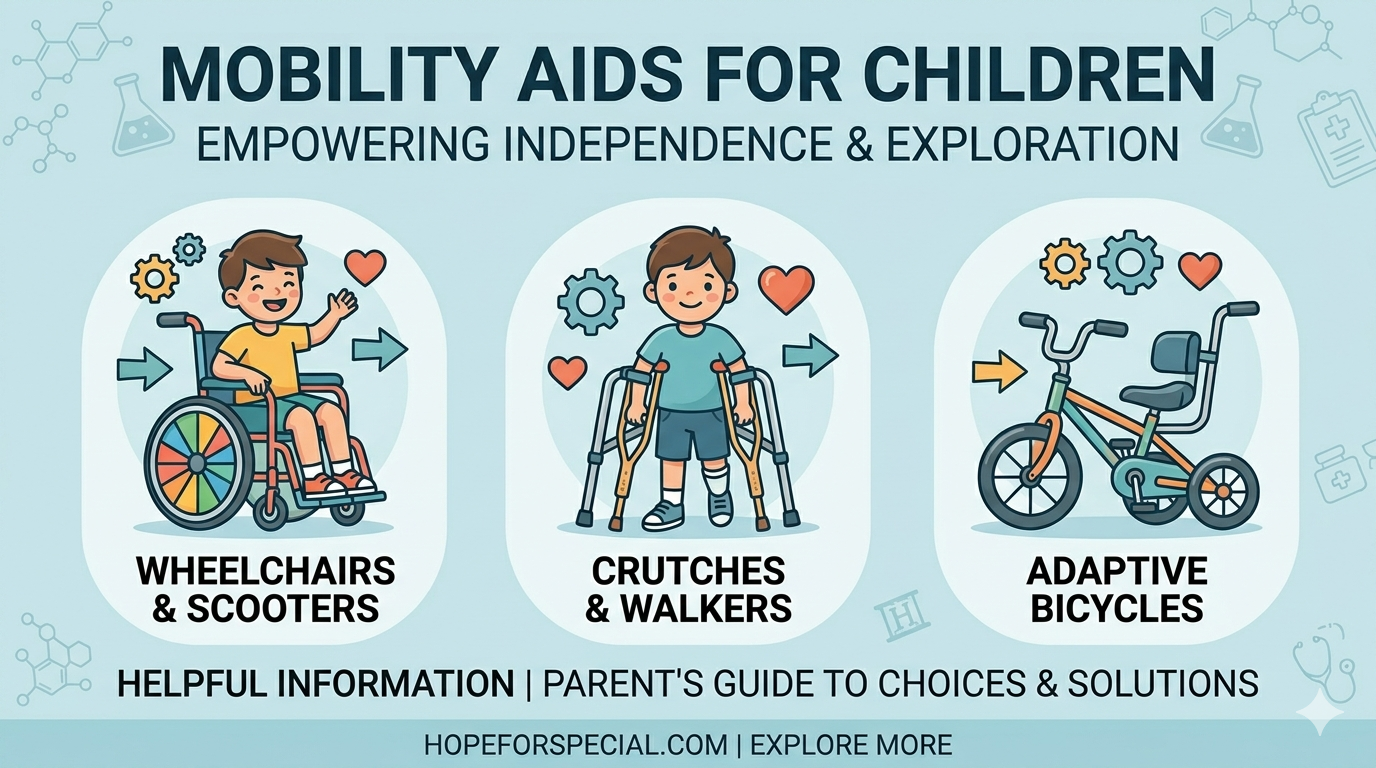
Mobility Aids for Children: Complete Parent Guide to Devices, Insurance & Free Programs (2026)
Mobility aids for children can change everything. When a child with a disability gains the ability to move independently — even a little — it opens up a world of possibilities: playing with friends, exploring a classroom, joining family activities, or simply getting from one room to another without help.
But as a parent, figuring out where to start is genuinely hard. What device is right for your child’s specific condition? Will insurance pay for it? Does your child’s school have to provide one? Are there free programs that can help?
This guide answers all of those questions in plain, simple language. Whether your child has cerebral palsy, spina bifida, autism, Down syndrome, muscular dystrophy, or another condition that affects movement, this complete parent guide to mobility aids for children will walk you through everything you need to know — from choosing the right device to getting it funded.

- 📊 How Common Are Mobility Challenges in Children?
- 🦽 Types of Mobility Aids for Children — Explained Simply
- 1. Wheelchairs
- 2. Gait Trainers and Walkers
- 3. Crutches
- 4. Mobility Scooters
- 5. Adaptive and Assistive Devices for Hearing
- 🎯 Which Mobility Aid Is Right for Your Child’s Condition?
- 🏥 Does Insurance Cover Mobility Aids for Children?
- Coverage by Insurance Type
- What “Medically Necessary” Means in Practice
- The Prior Authorization Process — Step by Step
- 🏫 Your Child’s Legal Right to Mobility Aids at School
- 💰 Free and Low-Cost Ways to Get Mobility Aids for Your Child
- Nonprofits That Help Children Get Mobility Aids
- Government Programs Worth Knowing
- Renting vs. Buying vs. Secondhand
- ✅ Safety Checklist for Each Type of Mobility Aid
- 🦽 Wheelchair Safety
- 🚶 Gait Trainer / Walker Safety
- 🛴 Mobility Scooter Safety
- 🩹 Crutches Safety
- 🔊 Hearing Device Safety
- ❓ Frequently Asked Questions About Mobility Aids for Children
- What is the most common mobility aid used for children?
- At what age can a child start using a power wheelchair?
- Does Medicaid pay for mobility aids for children?
- Can I get a free wheelchair or mobility device for my child?
- Does my child’s school have to provide a mobility aid?
- How long do mobility aids last?
- 💛 A Final Note to Parents
- 🌐 Authoritative Sources and Resources
📊 How Common Are Mobility Challenges in Children?
Before diving into the devices themselves, it helps to understand just how many families are on this same journey. You are not alone — and the need for good, clear information has never been more important.
According to the World Health Organization, an estimated 80 million people worldwide need a wheelchair. In the United States alone, millions of children live with conditions that affect their ability to walk, stand, or move independently.
Here are some important numbers every parent should know:
| Condition | How Many Children Are Affected | Common Mobility Aids Used |
|---|---|---|
| Cerebral Palsy | ~764,000 people in the US (CDC) | Gait trainers, power wheelchairs, AFO braces |
| Spina Bifida | ~1,500 newborns per year in the US (CDC) | Wheelchairs, forearm crutches, leg braces |
| Muscular Dystrophy | ~1 in 3,500–5,000 boys (CDC) | Power wheelchairs, scooters, gait aids |
| Down Syndrome | ~1 in 700 births in the US (CDC) | Gait trainers, adapted walkers, adaptive tricycles |
| Limb Differences | Thousands annually | Prosthetics, crutches, adapted scooters |
The cost of mobility aids varies enormously. As Consumer Reports points out, basic manual wheelchairs start around $100–$200, while electric or all-terrain models can cost as much as a used car.
This is exactly why understanding your insurance, school rights, and free program options is so important — and we cover all three in detail below.
🦽 Types of Mobility Aids for Children — Explained Simply
There are several main categories of mobility aids for children. The right one depends entirely on your child’s diagnosis, age, level of independence, and daily environment.
Here is a simple overview of each type:
1. Wheelchairs
Wheelchairs are among the most widely used mobility aids for children with physical disabilities. They provide independence and support for children who cannot walk or find walking very difficult.
There are four main types:
| Type | Best For | Key Features |
|---|---|---|
| Manual Wheelchair | Children with some upper body strength, or where a caregiver will push | Lightweight, portable, lower cost; user or caregiver propelled |
| Power Wheelchair | Children with limited upper body strength or more severe disabilities | Electrically powered; joystick or switch controlled; higher cost |
| Pediatric Wheelchair | Babies, toddlers, and young children | Smaller frames; grows with the child; often more colorful and child-friendly |
| Sports Wheelchair | Active older children and teens | Built for speed and agility; used for wheelchair basketball, racing, and other sports |
According to Spinal Cord Injury Info, choosing the right wheelchair involves considering the child’s posture needs, daily activities, home environment, and how much they will be using the chair independently versus with caregiver assistance.
2. Gait Trainers and Walkers
A gait trainer is a frame that supports a child’s body at the pelvis and torso while allowing their legs to move in a walking pattern. It is one of the most important mobility aids for children with cerebral palsy, Down syndrome, and similar conditions because it actively encourages walking development rather than replacing it.
Types of walkers include:
| Type | Description | Best For |
|---|---|---|
| Standard Walker | 4 fixed legs; must be lifted with each step | Short distances; early walkers |
| 2-Wheeled Walker | Front wheels roll; easier to move forward | Children learning to walk with partial support |
| 4-Wheeled Rollator | All wheels roll; often includes a seat | Longer distances; children with more stability |
| Gait Trainer (full support) | Supports pelvis and torso; allows leg movement | Children with limited walking ability; CP, Down syndrome |
According to Made for Movement, the goal of a gait trainer is not just mobility — it is about giving children the experience of upright movement, which supports bone development, cardiovascular health, and social participation.
3. Crutches
Crutches are used when a child can bear some weight on their legs but needs additional support and stability. They are commonly used after injuries, surgeries, or with conditions like spina bifida where partial leg function is present.
Types of crutches:
- Axillary (Underarm) Crutches: The most common type; cuffs fit under the arms. However, weight must go through the hands — not the armpits — to avoid nerve damage.
- Forearm (Lofstrand) Crutches: Cuffs wrap around the forearms; allow more hand and arm freedom; often preferred for long-term use by children with spina bifida or similar conditions.
- Platform Crutches: A flat forearm rest; used when a child cannot grip a handle due to hand weakness.
A physical therapist should always teach your child the correct technique before they use crutches independently. Incorrect use is one of the most common causes of preventable upper body strain and injury.
4. Mobility Scooters
Mobility scooters are motorized devices with three or four wheels that provide independent transportation for children who cannot walk for any significant distance. They are typically used for older children and teens who have the cognitive maturity to operate them safely.
| Type | Best For |
|---|---|
| 3-Wheeled Scooter | Better maneuverability; good for tighter indoor spaces |
| 4-Wheeled Scooter | Greater stability and higher weight capacity; better for outdoor use |
It is important to note that mobility scooters are generally not appropriate for very young children. Always discuss with your child’s physician and therapist whether your child is cognitively and physically ready for a scooter before purchasing.
5. Adaptive and Assistive Devices for Hearing
Many children with physical disabilities also have sensory impairments. Hearing devices are therefore an important category of mobility and assistive technology for special needs children.
The main types include:
- Hearing Aids: Electronic devices worn in or behind the ear that amplify sound for children with partial hearing loss.
- Cochlear Implants: Surgically implanted devices for children with severe to profound hearing loss; bypass damaged inner ear structures and stimulate the auditory nerve directly. (Cerebral Palsy Guidance)
- Assistive Listening Systems (FM Systems): Capture a speaker’s voice through a microphone and deliver it directly to the child’s hearing aid or earpiece — especially useful in classrooms.
- Alerting Devices: Visual or vibrating devices that signal important sounds like doorbells, alarms, or smoke detectors.
Important: Over-the-counter (OTC) hearing aids are not approved for children under 18. All children must be seen by a licensed pediatric audiologist for hearing aid fitting. (American Academy of Audiology)
🎯 Which Mobility Aid Is Right for Your Child’s Condition?
Not every device works for every child. Choosing the wrong one can cause discomfort, discourage use, or even cause injury.

Here is a condition-by-condition guide to help you have a more informed conversation with your child’s medical team:
| Condition | Typically Recommended Mobility Aid(s) | Why |
|---|---|---|
| Cerebral Palsy | Gait trainer, AFO braces, power wheelchair | Depends on CP type and severity; supports varying muscle tone (Cerebral Palsy Guidance) |
| Spina Bifida | Manual wheelchair, forearm crutches, leg braces | Level of spinal lesion determines mobility potential |
| Muscular Dystrophy | Power wheelchair, scooter | Reduces muscle strain; preserves energy as condition progresses |
| Down Syndrome | Gait trainer, adapted walker, adaptive tricycle | Supports low muscle tone; encourages independent movement |
| Autism Spectrum Disorder | Adaptive bike, sensory-friendly stroller (young children) | Supports body awareness and gross motor development; sensory factors affect device selection |
| Spinal Cord Injury | Manual or power wheelchair | Determined by injury level and remaining arm/hand function |
| Limb Difference / Amputation | Prosthetic limb, crutches, adapted scooter | Highly individualized; requires a certified prosthetist |
According to Navigate Life Texas, always ask your child’s therapist to be present during fittings or when new equipment is delivered.
This ensures the device fits correctly from the very first day — and prevents the frustrating situation of receiving equipment that does not actually work for your child.
Why You Should Always Involve a Physical or Occupational Therapist First
Before purchasing any mobility aid, always involve a licensed physical therapist (PT) or occupational therapist (OT). These professionals will:
- Assess your child’s strength, posture, balance, and motor skills
- Recommend the right device type and correct size
- Arrange a trial period before purchase
- Document medical necessity for insurance purposes
- Train your child and your family on safe, correct use
🏥 Does Insurance Cover Mobility Aids for Children?
This is the question every parent asks — and the answer is: often yes, but you need to know how to navigate the system correctly.
Mobility aids for children are classified as Durable Medical Equipment (DME) by insurance companies.
This includes wheelchairs, walkers, crutches, gait trainers, scooters, and orthotic devices. Coverage depends on your insurance type and whether a doctor documents your child’s device as medically necessary.
Coverage by Insurance Type
| Insurance Type | Covers Mobility Aids? | Key Notes |
|---|---|---|
| Medicaid | ✅ Yes — most comprehensive for children | Children aged 20 and under on Medicaid have the right to receive all medically prescribed equipment. (Navigate Life Texas) |
| Medicare (for children with qualifying disabilities) | ⚠️ Sometimes | Covers 80% of medically necessary power wheelchairs/scooters; requires face-to-face exam and written order (Pride Mobility) |
| Private / Employer Insurance | ⚠️ Varies by plan | Requires prior authorization; device must be medically necessary; often restricted to home use |
| CHIP (Children’s Health Insurance Program) | ✅ Often | Check your state’s specific CHIP program |
| FSA / HSA Accounts | ✅ Yes | Pre-tax dollars can be used for qualifying mobility equipment |
What “Medically Necessary” Means in Practice
Insurance companies need documented proof that your child requires the specific device to function at home in their daily life.
According to Pride Mobility, this includes everyday activities like moving between rooms, reaching the kitchen, getting to the bathroom, navigating school hallways, and participating in family routines.
To strengthen your claim, ask your child’s doctor to clearly document:
- Your child’s specific diagnosis
- How their mobility is limited in daily life
- Why this specific device (not a cheaper alternative) is necessary
- That the device is needed for use in the home
The Prior Authorization Process — Step by Step
- Your child’s doctor writes a prescription for the device
- Your DME provider submits medical documentation to the insurance company
- Once approved, the device is ordered and delivered — to your home or therapist’s office
If you are denied: Do not give up. Work with your doctor and DME provider to appeal. Many initial denials are successfully overturned when medical necessity is better documented.
🏫 Your Child’s Legal Right to Mobility Aids at School
Here is something many parents do not know: your child may be legally entitled to mobility aids and assistive devices at school — completely free of charge.
Under the Individuals with Disabilities Education Act (IDEA), every time your child’s IEP team meets, they are legally required to consider whether your child needs assistive technology and mobility devices to receive a free and appropriate education. (U.S. Department of Education)
This is not optional guidance. It is federal law.
| Law | What It Requires | Who It Covers |
|---|---|---|
| IDEA | Schools must consider and fund assistive technology (including mobility aids) if needed for Free Appropriate Public Education (FAPE) | All children receiving special education services |
| Section 504 | Schools must provide accommodations for students with disabilities | Students with disabilities, even those not in special education |
| ADA | All public facilities must be accessible | All people with disabilities |
Furthermore, according to Rubin Law, if the IEP team determines your child needs the device at home as well as at school, the school district must fund that too.
What You Can Do at Your Child’s Next IEP Meeting
- Ask directly: “Has the team considered whether my child needs a mobility aid or assistive technology device?”
- If not addressed, request a formal assistive technology (AT) evaluation
- If you disagree with the team’s assessment, you have the right to request an independent AT evaluation at the school’s expense (ECTA Center)
- Document everything in writing — every discussion, every decision
💰 Free and Low-Cost Ways to Get Mobility Aids for Your Child
Even if your insurance denies coverage, you still have options. There are more free and low-cost programs available than most families realize.
Nonprofits That Help Children Get Mobility Aids
| Organization | What They Provide | Contact |
|---|---|---|
| Wheelchairs 4 Kids | Free wheelchairs, ramps, lifts, and home modifications for children | wheelchairs4kids.org / 727-946-0963 |
| Variety the Children’s Charity | Mobility equipment, independence devices, and services | usvariety.org / 323-954-0820 |
| Wheel to Walk Foundation | Equipment not covered by insurance for children and young adults under 20 — gait trainers, strollers, wheelchairs, and more | United Spinal Association |
| Shriners Children’s Hospitals | Free or reduced-cost orthotics and prosthetics for children | 833-576-3145 |
| United Cerebral Palsy (UCP) | Equipment, services, and grants for children with CP and other disabilities | ucp.org |
| Project Mend | Refurbished mobility devices redistributed to people in need | 210-223-6363 |
| Friends of Man | Mobility equipment and medical aids for people of all ages | 303-798-2342 |
Government Programs Worth Knowing
- Medicaid EPSDT: Requires Medicaid to cover medically necessary assistive technology for children in all 50 states. (Disabled World)
- IDEA (School-Based Funding): Schools must fund mobility devices that are part of your child’s IEP — at no cost to you.
- State Vocational Rehabilitation Programs: May cover mobility aids for older teens transitioning toward employment.
- CHIP: Many state CHIP programs cover DME for enrolled children.
Renting vs. Buying vs. Secondhand
| Option | Best When | Key Consideration |
|---|---|---|
| Buy New | Long-term permanent need; insurance is available | Most expensive upfront; warranty included; customizable |
| Rent | Short-term recovery; waiting for insurance; trialing a device | Low upfront cost; some insurance plans cover rentals |
| Buy Secondhand | Budget is a serious barrier; short-term need | Must verify safety — check for damage, recalls, and have therapist review before use (Consumer Reports) |
When buying secondhand, always: check for cracks, rust, or loose parts; confirm no safety recalls exist by searching the model number online; and have your child’s physical therapist or doctor review the device before first use.
✅ Safety Checklist for Each Type of Mobility Aid
Getting the right device is only half the work. Using it safely matters just as much. Here is a practical safety checklist for each device type:
🦽 Wheelchair Safety
- [ ] Seat width allows approximately 1 inch of space on each side of the hips
- [ ] Footrests adjusted so knees are at a 90-degree angle
- [ ] Anti-tip devices installed and working
- [ ] Brakes lock securely before transfers in or out
- [ ] Lap belt or safety harness used during transport
- [ ] Device inspected regularly for loose bolts, worn tires, and rust
- [ ] Fit reviewed every 6–12 months as child grows
🚶 Gait Trainer / Walker Safety
- [ ] Height adjusted so child stands upright, not hunched
- [ ] All rubber tips and wheels are intact and grip the floor properly
- [ ] Not used on stairs or steep slopes without close supervision
- [ ] Prescribed and settings approved by child’s physical therapist
- [ ] Wheels lock correctly when child needs to stop or rest
🛴 Mobility Scooter Safety
- [ ] Child is cognitively mature enough to operate controls safely
- [ ] Speed settings are at the lowest appropriate level
- [ ] Used on smooth, level surfaces unless an all-terrain model
- [ ] Battery is fully charged before use
- [ ] Adult supervision maintained for younger children at all times
🩹 Crutches Safety
- [ ] Height set correctly: 2–3 finger widths between crutch top and armpit
- [ ] Weight is on the hands, NOT the armpits (nerve damage can result from improper use)
- [ ] Rubber tips are in good condition and not worn smooth
- [ ] Walking technique taught by a physical therapist before independent use
- [ ] Non-slip footwear worn at all times
🔊 Hearing Device Safety
- [ ] Batteries stored out of reach of young children (battery ingestion is a medical emergency — call 1-800-498-8666 immediately)
- [ ] Battery compartment has a child-resistant lock for young users
- [ ] Device kept dry and away from heat sources
- [ ] Cleaned regularly per manufacturer instructions
- [ ] Audiologist follow-up every 6–12 months
❓ Frequently Asked Questions About Mobility Aids for Children
What is the most common mobility aid used for children?
The Behind-the-Ear (BTE) hearing aid is the most common sensory mobility aid for children, while the manual pediatric wheelchair and gait trainer are the most widely used physical mobility aids. The right choice depends entirely on your child’s specific diagnosis and needs. A pediatric physical therapist is the best person to guide this decision.
At what age can a child start using a power wheelchair?
There is no single universal age. Readiness is determined through clinical evaluation based on the child’s physical abilities, cognitive development, safety awareness, and daily environment.
According to Pride Mobility, the correct process is to ask your child’s physician or seating and mobility specialist to assess readiness individually.
Does Medicaid pay for mobility aids for children?
Yes, in most cases. Children aged 20 and under who are on Medicaid have the right to receive all medically necessary prescribed equipment. Medicaid is actually often more comprehensive for children’s mobility aids than Medicare or private insurance. (Navigate Life Texas)
Can I get a free wheelchair or mobility device for my child?
Yes — several nonprofit organizations provide free or heavily subsidized mobility aids for children, including Wheelchairs 4 Kids, Variety the Children’s Charity, and Wheel to Walk Foundation.
Additionally, if your child has an IEP, their school district may be legally required to fund certain devices at no cost to your family. (United Spinal Association)
Does my child’s school have to provide a mobility aid?
Potentially yes. Under IDEA, if your child’s IEP team determines that a mobility device or assistive technology is necessary for your child to receive a free and appropriate education, the school district must fund it — including providing it for home use if needed. (U.S. Department of Education)
How long do mobility aids last?
DME (Durable Medical Equipment) is typically designed to last 3–5 years. However, children grow quickly, which means components like wheelchair seat widths, earmolds, and walker heights often need adjustment or replacement more frequently — sometimes every 6–12 months. Always schedule regular check-ins with your child’s therapist to ensure equipment still fits correctly.
💛 A Final Note to Parents
Choosing a mobility aid for your child is not just a practical decision. For many parents, it carries a mix of emotions — grief, hope, uncertainty, and sometimes relief, all at once. If you have felt any of this while reading this guide, you are completely normal, and you are not alone.
What therapists and experienced parents consistently observe is this: children adapt far more quickly than we expect. To a child, their wheelchair or gait trainer often becomes simply a tool — just like a bike or a pair of glasses.
The right mobility aid frequently opens up a world that was previously closed to them.
If you are finding this process emotionally difficult, please consider reaching out to:
- Parent-to-parent support programs — many disability organizations offer these at no cost
- Disability Scoop at disabilityscoop.com — news, community, and support for special needs families
You are doing something powerful for your child by seeking out this information. That effort is one of the most important gifts you can give them.
🌐 Authoritative Sources and Resources
- CDC — Cerebral Palsy Data
- CDC — Spina Bifida Data
- U.S. Department of Education — IDEA Assistive Technology Guidance
- ECTA Center — Assistive Technology
- United Spinal Association — Funding for Children
- Cerebral Palsy Guidance — Assistive Technology
- American Academy of Audiology — Children and OTC Hearing Aids
- Hearing Loss Association of America
- Consumer Reports — Buying Mobility Equipment


