

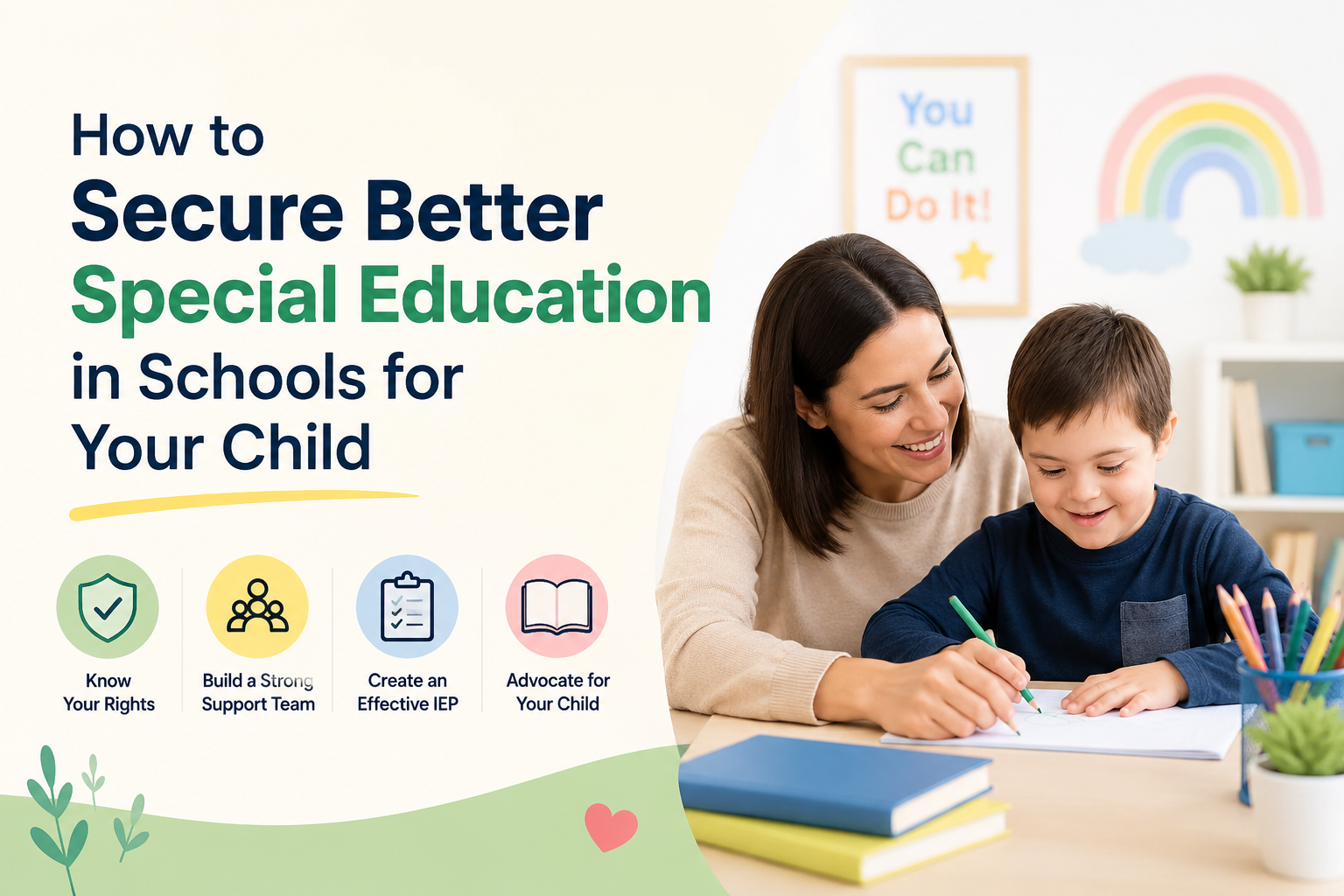
How to Secure Better Special Education in Schools for Your Child?
📚 8.2 million kids now qualify for special education in schools — yet most parents never use their full legal rights. This 2026 complete advocacy guide shows you exactly how to get your child what they deserve. 💛👇

- 🌟 What Is Special Education in Schools and How Do You Access the Best of It?
- 📊 Special Education in Schools 2026 — Key Statistics
- 🔬 Understanding Special Education in Schools — The Legal Foundation
- The Three Laws Every Parent Must Know
- IDEA — The Foundation of Special Education in Schools
- The 2026 Landscape — Why Advocacy Matters More Than Ever
- 🗺️ The Step-by-Step Roadmap to Better Special Education in Schools
- Step 1: Know the 13 IDEA Disability Categories 📋
- Step 2: Request a Formal Special Education Evaluation — In Writing 📝
- Step 3: Understand What the School Evaluation Does — and Does Not — Cover
- Step 4: Prepare for the IEP Meeting — As an Equal Team Member 🤝
- Step 5: Know What Belongs in a Strong IEP
- 💪 Advanced Advocacy Strategies — Getting More From Special Education in Schools
- Strategy 1: Use “Prior Written Notice” as Your Paper Trail
- Strategy 2: Request a Meeting at Any Time
- Strategy 3: The “Progress Monitoring” Power Move
- Strategy 4: Attend School Board Meetings
- ⚖️ When Things Go Wrong — Your Escalation Options
- Level 1: Informal Resolution
- Level 2: State Complaint
- Level 3: Mediation
- Level 4: Due Process Hearing
- Know Your State’s Dispute Resolution Options
- 🏫 The 2026 Special Education Landscape — What Parents Need to Know Now
- 1. Funding Uncertainty — The Most Urgent 2026 Issue
- 2. AI Tools in Special Education — 2026 Developments
- 3. The Keeping All Students Safe Act (December 2025)
- 🇮🇳 Special Education in Schools in India — Rights for Families
- 💬 A Parent’s Advocacy Story — From Dismissed to Supported
- 💡 What You Must Not Miss About Special Education Advocacy
- 1. Compensatory Services — Recovering Lost Time
- 2. Extended School Year (ESY) — Summer Services
- 3. Placement vs. Services — The Critical Difference
- 4. The “Educational Benefit” Standard — What Appropriate Really Means
- ❓ FAQs — Special Education in Schools 2026
- Q1: What qualifies a child for special education in schools?
- Q2: How do I get my child evaluated for special education in schools?
- Q3: What is the difference between an IEP and a 504 Plan?
- Q4: Can I request special education services at any time during the school year?
- Q5: What rights do I have at an IEP meeting?
- Q6: What happens if the school refuses to provide special education services my child needs?
- Q7: How is special education in schools funded?
- Q8: Can children with autism receive special education in schools?
- Q9: What should I do if the IEP goals seem too easy for my child?
- Q10: Are special education rights different in India than in the United States?
- 💛 Final Words: You Are Your Child’s Most Important Advocate
🌟 What Is Special Education in Schools and How Do You Access the Best of It?
Special education in schools is a federally mandated system of individualised instruction, related services, and legal protections designed to ensure every child with a disability receives an appropriate public education — at no cost to the family.
The direct answer to how you secure better access: you must understand your legal rights under IDEA, request a formal evaluation in writing, participate actively as an equal IEP team member, and know exactly when and how to escalate when the school falls short. This guide gives you every tool.
Whether your child has just been diagnosed, or whether you are years into the special education system and feeling like your child is not receiving what they deserve — this guide was written for you.
📊 Special Education in Schools 2026 — Key Statistics
| Statistic | Data | Source |
|---|---|---|
| Students receiving special education (2024) | About 8.2 million students ages 3–21 qualified for services under IDEA in 2024 — a 3.8% increase from the prior year | K-12 Dive / The Advocacy Institute, February 2026 |
| Special education as % of all students | Nearly 15% of all students age 3 to 21 received services through IDEA | EdSource, 2025 |
| Federal IDEA funding (FY2026) | Congress appropriated $15.43 billion for special education programmes under IDEA for FY2026 | ORI Learning — Biggest Challenges in Special Education, March 2026 |
| Per-pupil spending on special education | Districts spent an average of $13,127 per IDEA-eligible student — varying from $5,265 (Mississippi) to $24,443 (Connecticut) | K-12 Dive / Bellwether Analysis |
| IDEA Part C — early intervention | 458,920 infants and toddlers received early intervention services under IDEA Part C | K-12 Dive / Advocacy Institute, 2026 |
| IDEA-eligible students (fall 2022–2023) | From fall 2022 to fall 2023, the number of IDEA-eligible students ages 3–21 rose 3.4% to 7,892,433 | K-12 Dive, 2025 |
| Special education teachers using AI tools (2024–25) | 57% of licensed special education teachers reported using AI tools for IEP and 504 plan development | ORI Learning, March 2026 |
| Supreme Court — IDEA remedies | In 2025, the Supreme Court lowered the bar for families seeking remedies beyond IDEA — the third consecutive unanimous ruling in favour of children with disabilities | ORI Learning, March 2026 |
🔬 Understanding Special Education in Schools — The Legal Foundation
Before you can advocate effectively, you need to understand the legal framework. Special education in schools in the United States is governed by three primary laws — each with different scope, protections, and practical implications.
The Three Laws Every Parent Must Know
| Law | What It Covers | Key Benefit for Your Child |
|---|---|---|
| IDEA (Individuals with Disabilities Education Act) | Special education services, IEPs, evaluations, free appropriate public education (FAPE) | Legally binding plan with specialised instruction, related services, and parental rights |
| Section 504 (Rehabilitation Act) | Disability accommodations in any programme receiving federal funding | Accommodations in general education — no specialised instruction required |
| ADA (Americans with Disabilities Act) | Prohibits disability discrimination in schools and public places | Broader civil rights protection beyond educational settings |
IDEA — The Foundation of Special Education in Schools
The Individuals with Disabilities Education Act is the cornerstone law. An IEP is the plan that makes a student’s rights real during the school day. (Source: The Arc, February 2026)
IDEA covers children from birth through age 21. It has two primary parts:
- Part C — Early intervention services for infants and toddlers from birth to age 3
- Part B — Special education services for children aged 3–21
IDEA guarantees every eligible child:
- ✅ FAPE — Free Appropriate Public Education
- ✅ LRE — Least Restrictive Environment (inclusion in general education to the maximum extent appropriate)
- ✅ IDEA evaluation — at public expense, without cost to the family
- ✅ IEP — Individualized Education Program developed by a team that includes parents
- ✅ Procedural safeguards — notice, consent, due process
The 2026 Landscape — Why Advocacy Matters More Than Ever
For FY2026, Congress appropriated $15.43 billion for special education programmes — but the landscape is uncertain. The Trump administration’s 2026 budget plan calls for consolidating seven IDEA grant programmes into one allocation with no assurance that current services will be safeguarded.
This means families must become more proactive advocates than ever. When federal oversight reduces, local advocacy becomes the primary protection for your child’s rights. This guide gives you the tools to provide that advocacy.
🗺️ The Step-by-Step Roadmap to Better Special Education in Schools

Step 1: Know the 13 IDEA Disability Categories 📋
Special education in schools is available to children who meet the eligibility criteria under one or more of IDEA’s 13 disability categories:
| Disability Category | Examples |
|---|---|
| Specific Learning Disability (SLD) | Dyslexia, dysgraphia, dyscalculia |
| Other Health Impairment (OHI) | ADHD, epilepsy, diabetes affecting school participation |
| Autism Spectrum Disorder (ASD) | All autism presentations |
| Emotional Disturbance (ED) | Anxiety disorder, depression significantly affecting learning |
| Speech or Language Impairment | Articulation disorders, language delays |
| Intellectual Disability | Down Syndrome and other conditions |
| Developmental Delay | Ages 3–9; broad developmental delays |
| Multiple Disabilities | Two or more disabilities |
| Hearing Impairment / Deafness | All hearing loss conditions |
| Visual Impairment / Blindness | All vision loss conditions |
| Orthopedic Impairment | Cerebral palsy, spina bifida, amputation |
| Traumatic Brain Injury | Acquired brain injury affecting education |
| Deaf-Blindness | Combined hearing and vision loss |
Your child does not need a doctor’s diagnosis to trigger a special education evaluation — though a diagnosis strengthens the case. What matters is whether the disability significantly affects educational performance.
Step 2: Request a Formal Special Education Evaluation — In Writing 📝
This is the step that changes everything. And it is a step that many parents delay for months or years — waiting for the school to notice and refer. Do not wait.
Parents have the right to refer their child for special education services, to participate in the development of the IEP and to be informed of all program options and alternatives. (Source: California Department of Education)
Use this written request template:
“I am writing to formally request a comprehensive special education evaluation for my child, [Name], [date of birth], [current grade and school]. I am concerned that [specific concerns — e.g., my child has significant difficulty with reading, written expression, and attention that is affecting their academic performance and classroom participation]. I request a multidisciplinary evaluation across all areas of suspected disability. I understand that under IDEA, the school has 60 days to complete the evaluation and hold an eligibility meeting. I request written confirmation of receipt of this letter and the school’s response timeline. Respectfully, [Your name, date].”
Send this by email to:
- The school principal
- The special education coordinator or director
- Your child’s classroom teacher (for their awareness)
Keep a timestamped copy. The 60-day clock starts from the date the school receives it.
Step 3: Understand What the School Evaluation Does — and Does Not — Cover
In 2026, many districts continue to incorporate digital assessment tools and culturally responsive evaluation practices to reduce bias and improve accuracy. (Source: Public School Review, February 2026)
The evaluation must:
- Assess all areas of suspected disability — not just one
- Use multiple measures — not just a single test
- Be conducted by qualified professionals
- Include information from parents
- Be completed within 60 days of the written request
If you disagree with the school’s evaluation findings, you have the right to request an Independent Educational Evaluation (IEE) at the school district’s expense. This is one of the most powerful and underused parental rights in IDEA.
Request an IEE if:
- The evaluation missed areas you believe are affected
- The findings do not match what you observe at home and the private specialists report
- The school says your child does not qualify and you believe they should
Step 4: Prepare for the IEP Meeting — As an Equal Team Member 🤝
IEP teams typically include parents, general education teachers, special education teachers, and district representatives. Parents are equal members of the team and have procedural safeguards outlined in federal law. (Source: Public School Review, 2026)
Before the meeting, prepare:
- [ ] Read every page of the evaluation report before the meeting — do not read it for the first time in the meeting room
- [ ] Write down your top 5 concerns and top 5 goals for your child
- [ ] Bring any private evaluations, therapy reports, or medical documentation
- [ ] Prepare your vision statement — a short description of what you want your child’s educational experience to look like
- [ ] Know your child’s current reading level, math level, and functional skills data
- [ ] Bring a support person — a partner, friend, or parent advocate
During the meeting:
- Take notes — or ask to record the meeting where legally permitted
- Ask for clarification on anything you do not understand — never nod along out of politeness
- Say “I do not agree with that” when you disagree — do not sign the IEP at the meeting if you have concerns
- Ask: “How will we measure progress on this goal?” for every goal proposed
- Ask: “How will I know if this isn’t working?”
Step 5: Know What Belongs in a Strong IEP
An IEP is a legally binding document that includes: Present levels of academic and functional performance; measurable annual goals; special education and related services to be provided; participation in general education; accommodation and modifications; and transition planning (for students 16 and older). (Source: Public School Review, 2026)
The IEP Strength Checklist:
| IEP Section | What “Strong” Looks Like | Warning Sign |
|---|---|---|
| PLAAFP (Present Levels) | Specific data points — grade-level scores, percentiles, observation notes | Vague language: “struggles with reading” with no data |
| Annual Goals | SMART — specific, measurable, achievable, relevant, time-bound | “Will improve in reading” — unmeasurable and unenforceable |
| Services | Named programme, frequency, duration, location, provider qualification | “Reading intervention as needed” — no commitment |
| Accommodations | Specific list of tools and adjustments | “Extended time where appropriate” — not guaranteed |
| Progress reporting | How often, what data, how communicated to parent | No specified measurement method |
| Transition (16+) | Post-secondary goals, transition services, student involvement | Not present for students 16 and older |
💪 Advanced Advocacy Strategies — Getting More From Special Education in Schools
Strategy 1: Use “Prior Written Notice” as Your Paper Trail
Every time the school makes a decision about your child’s special education services — or refuses a request — they are legally required to provide Prior Written Notice (PWN). This document explains what they will or will not do and why.
Request PWN in writing for:
- Any proposed change to your child’s IEP
- Any refusal to evaluate in an area you requested
- Any refusal to add a service or accommodation you requested
- Any proposed change in placement
If the school does not provide PWN, put it in writing yourself: “I am requesting Prior Written Notice regarding [specific decision] made on [date], as required under IDEA.”
Strategy 2: Request a Meeting at Any Time
Schools are required to hold IEP meetings at least annually. But you do not have to wait a year. You can request an IEP meeting at any time — particularly if:
- Your child is not making progress toward IEP goals
- Your child’s needs have changed significantly
- You want to discuss placement or services
- Your child is experiencing a crisis at school
Put this request in writing and send it to the special education coordinator.
Strategy 3: The “Progress Monitoring” Power Move
After the IEP is in place, request monthly or bi-monthly progress data on every goal — not just at each report card. Schools are required to report progress at least as often as they report to parents of non-disabled students (typically quarterly). But more frequent data is better.
Ask: “Can you send me the weekly CBM data for [reading goal] each Friday?” Most well-implemented special education programmes collect this data weekly. Requesting it holds the school accountable — and gives you early warning if something is not working.
Strategy 4: Attend School Board Meetings
This is the strategy most parents never consider — and one of the most powerful available. School board members set policy and approve budgets. Parents who attend board meetings, speak during public comment periods, and connect with other special education families create systemic change that benefits all children in the district.
In the current funding climate — with IDEA funding under pressure — local advocacy has never been more important. There are also efforts on a state level to provide increased funding for special education, with all 50 states and the District of Columbia recognizing the need for equitable access. (Source: ORI Learning, March 2026)
⚖️ When Things Go Wrong — Your Escalation Options
Despite your best advocacy, schools sometimes fail to provide appropriate special education services. Here is the escalation ladder — in order.
Level 1: Informal Resolution
Request a meeting with the special education coordinator to discuss your specific concerns. Document this meeting in a follow-up email: “This is to confirm our meeting on [date] in which I expressed concern about [X] and we agreed to [Y].”
Level 2: State Complaint
File a formal complaint with your State Department of Education. A state complaint:
- Is free to file
- Must be resolved within 60 days
- Results in a written finding
- Can order the school to provide compensatory services if violations are found
Find your State Education Agency contact at idea.ed.gov.
Level 3: Mediation
Mediation is a voluntary, informal process where a neutral mediator helps the family and school reach agreement. It is faster and less costly than due process. Request it through your State Education Agency.
Level 4: Due Process Hearing
A due process hearing is a formal legal proceeding — similar to a court case. It is the most powerful remedy available under IDEA — but also the most complex and costly. Families typically need an attorney or experienced advocate.
Following the 2025 Supreme Court ruling that lowered the bar for families seeking remedies, the legal landscape has become meaningfully more favourable for families. (Source: ORI Learning, March 2026)
When to pursue due process:
- The school is refusing to evaluate
- The school is refusing to provide FAPE
- You have clear evidence of IEP non-implementation
- The dispute involves compensatory services for past violations
Know Your State’s Dispute Resolution Options
| Option | Best For | Cost | Timeline |
|---|---|---|---|
| Facilitated IEP | Communication breakdown between parent and school | Free | Same as standard IEP meeting |
| State Complaint | Clear IDEA procedural violations | Free | 60 days |
| Mediation | Substantive disagreements you want to resolve amicably | Free | 30 days typical |
| Due Process | Serious, sustained IDEA violations | Legal fees typically required | 45 days for resolution |
🏫 The 2026 Special Education Landscape — What Parents Need to Know Now
Several significant developments in 2026 are directly affecting special education in schools:
1. Funding Uncertainty — The Most Urgent 2026 Issue
The Trump administration’s 2026 budget plan calls for consolidating seven of IDEA’s grant programmes into one allocation. There are no assurances that the services provided by these programmes will be safeguarded. (Source: EdSource, 2025)
What parents can do right now:
- [ ] Review your child’s current IEP — ensure all services and goals are fully documented
- [ ] Communicate early and often with your child’s teacher and special education coordinator
- [ ] Attend school board meetings to monitor district-level decisions
- [ ] Connect with COPAA (Council of Parent Attorneys and Advocates) for advocacy updates: copaa.org
2. AI Tools in Special Education — 2026 Developments
57% of licensed special education teachers are using AI tools for IEP and 504 plan development. This has both benefits and risks for families.
Benefit: AI can help produce more structured, measurable IEP goals and identify accommodations that are evidence-based.
Risk: AI-generated IEP goals that are not personalised to your specific child may look adequate on paper but fail to address individual needs.
Parent action: At every IEP meeting, ask “How do these goals specifically reflect [child’s name]’s individual assessment data?” This question ensures goals are personalised, not generic.
3. The Keeping All Students Safe Act (December 2025)
Filed in December 2025, this legislation seeks to ban seclusion in schools and restrict the use of physical restraints, with bipartisan support. (Source: ORI Learning)
If your child has ever been subjected to restraint or seclusion, this legislation is directly relevant. Document every incident in writing, request the school’s incident report, and know your right to review all records related to restraint.
🇮🇳 Special Education in Schools in India — Rights for Families
For our significant Indian readership, special education is governed by different legislation — but parental rights are equally meaningful.
Key Indian Laws for Special Education
| Law | What It Provides |
|---|---|
| Rights of Persons with Disabilities Act (RPwD), 2016 | Mandates inclusive education; prohibits discrimination; requires reasonable accommodations |
| Right to Education (RTE) Act, 2009 | Free and compulsory education for all children 6–14; includes children with disabilities |
| National Policy for Persons with Disabilities | Policy framework for inclusive education and support services |
Key rights under RPwD 2016 for Indian families:
- Free education in an inclusive setting for children with benchmark disabilities
- Personal assistants and disability aids at government expense
- Barrier-free access to school infrastructure
- Exemption from third language requirement where relevant
- Extra time in examinations
Where to access support in India:
- NCPEDP (National Centre for Promotion of Employment for Disabled People) — advocacy and legal guidance: ncpedp.org
- National Trust for Welfare of Persons with Autism, Cerebral Palsy, Mental Retardation and Multiple Disabilities — thenationaltrust.gov.in
- Rehabilitation Council of India — rehabcouncil.nic.in
💬 A Parent’s Advocacy Story — From Dismissed to Supported
“My son Rohan was in third grade before anyone in his school mentioned special education. For two years, I had watched him struggle with reading — he was at first-grade level while his classmates read fluently. His teacher kept saying he was ‘just a slow learner’ who needed time.
After reading about IDEA, I sent a formal written evaluation request. Within 60 days, the school completed a full psychoeducational evaluation. It confirmed severe dyslexia. We then had an IEP meeting. I came prepared — with a written list of goals I was requesting, printed information about Orton-Gillingham instruction, and a parent advocate I had connected with online.
The first IEP meeting was difficult. The school proposed generic ‘reading support’ three times per week. I politely but firmly rejected the vague service description and requested that the specific programme be named, the frequency increased to five times per week, and the provider qualifications specified.
After two months of negotiation, Rohan’s IEP specified Orton-Gillingham instruction, five times per week, 45 minutes per session, in a group of no more than three students, with a provider holding a CERI certification. In one school year, his reading improved by two grade levels.
The difference was not his school suddenly deciding to help. It was me understanding my rights and refusing to accept less than what the law required.” — Kavita J., mother of a child with dyslexia, New Delhi, India
💡 What You Must Not Miss About Special Education Advocacy
1. Compensatory Services — Recovering Lost Time
When a school fails to provide services that are written into an IEP — either through staff shortages, miscommunication, or negligence — the student has lost services they were legally entitled to. Compensatory services are additional services awarded to make up for this loss.
Many parents do not know to request compensatory services. If your child’s IEP was not implemented as written — even partially — document the gap and request compensatory services in writing.
2. Extended School Year (ESY) — Summer Services
Students who will significantly regress over the summer and require substantial time to recover those skills may qualify for Extended School Year (ESY) services — summer special education at no cost to the family. This must be individually determined for each student and documented in the IEP.
Ask at every IEP meeting: “Has ESY eligibility been considered for my child? If not, why not?”
3. Placement vs. Services — The Critical Difference
Parents sometimes accept a placement (a specific classroom or programme) without examining whether the services within that placement actually match what the IEP requires. The placement is where your child receives services — but the services themselves are the obligation. If the available placement does not offer the services the IEP requires, the school must find or create a placement that does.
4. The “Educational Benefit” Standard — What Appropriate Really Means
IDEA requires that special education in schools provide “meaningful educational progress” — not just minimal progress. The 2017 Supreme Court ruling in Endrew F. v. Douglas County School District established that IEPs must be reasonably calculated to enable a child to make progress appropriate in light of their circumstances — not merely de minimis (minimal) progress.
If your child is making progress in their IEP goals but the goals themselves were set too low, this is a legitimate advocacy target. Request goals that are ambitious enough to close the gap with typical peers over time.
❓ FAQs — Special Education in Schools 2026
Q1: What qualifies a child for special education in schools?
A child qualifies for special education in schools under IDEA if they have a disability in one of 13 categories AND that disability significantly impacts their educational performance. A doctor’s diagnosis is helpful but not required — what matters is the impact on education. About 8.2 million students ages 3–21 qualified for IDEA services in 2024, representing approximately 15% of all students. (Source: K-12 Dive, 2026)
Q2: How do I get my child evaluated for special education in schools?
Put your request in writing to the school principal and special education coordinator. Reference IDEA explicitly. The school has 60 days from receipt of the written request to complete the evaluation and hold an eligibility meeting. Parents are entitled to request an evaluation, participate in the process, and access all evaluation materials. (Source: California Department of Education)
Q3: What is the difference between an IEP and a 504 Plan?
An IEP (under IDEA) provides both specialized instruction AND accommodations. It is a legally binding plan with annual goals, specific services, and strong parental rights. A 504 Plan (under Section 504) provides accommodations only — no specialised instruction. For children who need specialist teaching (reading intervention, speech therapy, OT), an IEP provides far stronger legal protections and more comprehensive services.
Q4: Can I request special education services at any time during the school year?
Yes. You can request a special education evaluation or an IEP meeting at any time during the school year — you do not need to wait for the annual review cycle. The school must respond to written requests and hold meetings within required timelines. Requests should always be submitted in writing to create a timestamped record.
Q5: What rights do I have at an IEP meeting?
Parents are equal members of the IEP team with procedural safeguards outlined in federal law. Key rights include: the right to participate in all IEP meetings; the right to review evaluations and request independent assessments; the right to receive prior written notice of proposed changes; and the right to disagree and request a due process hearing. An IEP is the plan that makes a student’s rights real during the school day. (Source: The Arc, February 2026)
Q6: What happens if the school refuses to provide special education services my child needs?
You have several escalation options. First, request a meeting with the special education coordinator and put your concerns in writing. If unresolved, file a state complaint with your State Department of Education — free, resolved within 60 days. If still unresolved, request mediation or file for due process. The 2025 Supreme Court ruling lowered the bar for families seeking remedies beyond IDEA — the legal landscape is increasingly favourable for families. (Source: ORI Learning, 2026)
Q7: How is special education in schools funded?
For FY2026, Congress appropriated $15.43 billion for special education programmes under IDEA. Districts spent an average of $13,127 per IDEA-eligible student — with significant variation by state. Schools can also seek Medicaid reimbursement for some IEP services. Families do not pay for special education services — they are provided free under FAPE. (Source: K-12 Dive / Bellwether)
Q8: Can children with autism receive special education in schools?
Yes. Autism is one of IDEA’s 13 eligibility categories. Children diagnosed with autism — at any point on the spectrum — who demonstrate that their autism significantly affects their educational performance are eligible for an IEP and the full range of special education services. Services may include speech-language therapy, OT, ABA, social skills instruction, and modified curriculum.
Q9: What should I do if the IEP goals seem too easy for my child?
Request an IEP meeting and bring supporting data showing your child’s current performance exceeds the targets. Under the Endrew F. standard, IEPs must be reasonably calculated to enable meaningful progress — not minimal progress. Goals that are too easy fail this standard. Request that goals be revised upward and ask the team to explain how each goal will close the achievement gap with typical peers over time.
Q10: Are special education rights different in India than in the United States?
Yes — the legal framework differs significantly. In India, special education is governed by the Rights of Persons with Disabilities (RPwD) Act 2016 and the Right to Education Act 2009. RPwD provides for free inclusive education, reasonable accommodations, and disability aids at government expense for children with benchmark disabilities. Contact the National Trust for Welfare or the Rehabilitation Council of India for India-specific guidance. (Source: National Trust)
💛 Final Words: You Are Your Child’s Most Important Advocate
The special education system in schools is not always easy to navigate. It can feel bureaucratic, overwhelming, and adversarial — especially when you believe your child is not receiving what they need.
But the law is genuinely on your side. IDEA guarantees your child a free appropriate public education. It guarantees you a seat at the table as an equal team member. It gives you the right to disagree, to request independent evaluations, to escalate, and to seek legal remedies.
In 2026 — a year of real uncertainty about federal funding and policy — your knowledge of these rights is more valuable than ever. Local advocacy, written documentation, and persistent engagement with your child’s school team are the most powerful tools available.
Your child deserves an educational experience that does not just accommodate their disability — one that builds on their strengths, closes achievement gaps, and prepares them for the fullest possible adult life.
And you — the parent who read this entire guide — are already doing the most important work. 💛
🔗 Essential Resources
- 🌐 IDEA — idea.ed.gov — Federal special education law and regulations
- 🌐 The Arc — IEP Rights Explained, 2026
- 🌐 COPAA — Council of Parent Attorneys and Advocates — Find an advocate or attorney
- 🌐 Public School Review — 2026 Special Education Guide
- 🌐 ORI Learning — Biggest Challenges in Special Education 2026
- 🌐 Wrightslaw — Special Education Law and Advocacy — The most comprehensive parent advocacy resource
- 🌐 National Trust India — Disability Services — India-specific special education resources
This article is written for educational and informational purposes only. It does not constitute legal advice. For specific questions about your child’s special education rights, consult a qualified special education advocate or attorney in your state or country.


