

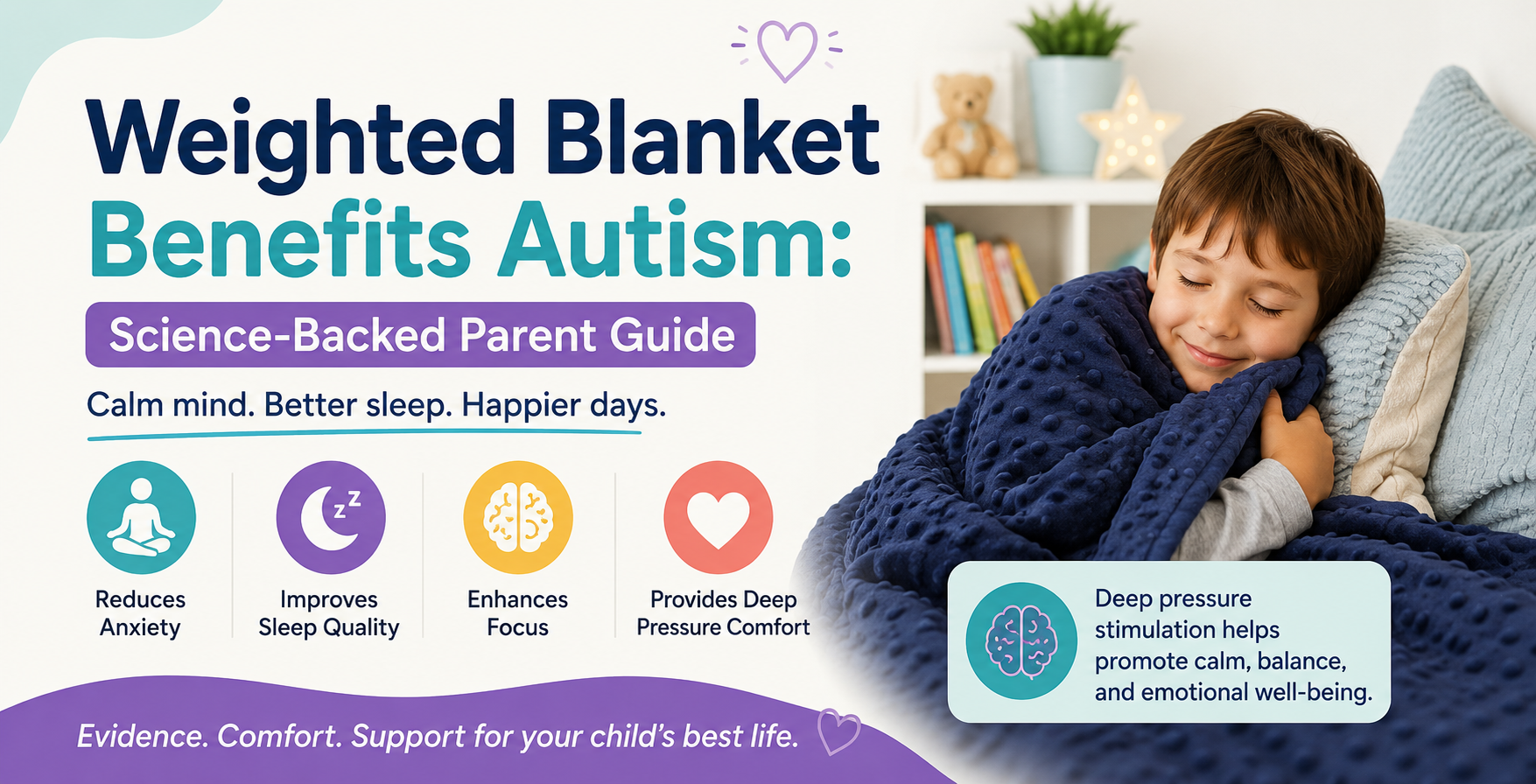
🧸 Weighted Blanket Benefits Autism: 2026 Science-Backed Parent Guide
Weighted blanket benefits for autism include reduced anxiety, improved sleep onset, better sensory regulation, fewer meltdowns, and a deeper sense of physical security — all supported by a growing body of occupational therapy research. In short: yes, weighted blankets genuinely help many autistic children, the mechanism is well-understood, and for the right child used correctly, they are one of the most accessible, affordable, and non-invasive sensory tools available.
This guide gives you the complete, honest picture — including what works, what the science actually shows, and how to choose the right one. 💛

- 🔬 Why Weighted Blankets Work: The Science of Deep Touch Pressure
- 📊 The Research: What Studies Actually Show
- 📊 The Numbers: Sleep, Anxiety, and Sensory Challenges in Autism
- 🌟 THE 7 CORE WEIGHTED BLANKET BENEFITS FOR AUTISM
- 😌 Benefit 1: Anxiety Reduction
- 😴 Benefit 2: Improved Sleep Onset and Sleep Quality
- 🧠 Benefit 3: Sensory Regulation
- 💥 Benefit 4: Meltdown Prevention and De-escalation
- 🫂 Benefit 5: Sense of Security Without Social Touch
- 🎯 Benefit 6: Improved Focus and Task Engagement
- 🌅 Benefit 7: Morning Mood Enhancement
- 👁️ Who Benefits Most — and When They May Not Help
- 🛒 HOW TO CHOOSE THE RIGHT WEIGHTED BLANKET FOR AUTISM
- 🌱 HOW TO INTRODUCE A WEIGHTED BLANKET WITHOUT RESISTANCE
- 📅 Week 1: Exposure Without Demand
- 📅 Week 2: Partial Use During Preferred Activities
- 📅 Week 3: Structured Bedtime Introduction
- 📅 Week 4 Onward: Consistent Use and Review
- ⚖️ Weighted Blankets vs. Other Sensory Tools: A Comparison
- 🔍 What You Must Not Miss About This Topic
- 1. 🔊 The Fill Material Matters for Auditory-Sensitive Children
- 2. 🌡️ Temperature Regulation Is the Leading Compliance Problem
- 3. 🧩 The Sensory Profile Must Come First
- 4. 🕐 Duration Guidelines Are Almost Never Mentioned
- 💙 A Parent’s Story: The Night That Finally Changed
- ❓ FAQs About Weighted Blanket Benefits for Autism
- Q: What are the benefits of a weighted blanket for autism?
- Q: How heavy should a weighted blanket be for an autistic child?
- Q: Do weighted blankets help autistic children sleep better?
- Q: Are weighted blankets safe for autistic children?
- Q: Can a weighted blanket reduce autism meltdowns?
- Q: What is the best material for a weighted blanket for autism?
- 🔗 Trusted Resources for Families
- 💙 Final Thoughts: Simple Tool, Real Difference
🔬 Why Weighted Blankets Work: The Science of Deep Touch Pressure
Understanding why weighted blanket benefits for autism exist helps parents use them more effectively — and helps explain why one child responds immediately while another needs a gradual introduction.
Weighted blankets work through a mechanism called Deep Touch Pressure (DTP) — also known as Deep Pressure Stimulation (DPS). This is the same gentle, sustained pressure experienced during a firm hug, a gentle massage, or being swaddled.
Deep touch pressure stimulation works by activating the parasympathetic nervous system — the body’s “rest and digest” counterpart to the “fight or flight” stress response. Weighted blankets are designed to provide deep touch pressure stimuli, acting as a calming mediator by increasing parasympathetic activity.
On a neurochemical level, the mechanism is even more specific. DTP stimulates the release of serotonin, a neurotransmitter that regulates mood and behaviour. Serotonin is then converted into melatonin, which helps regulate sleep-wake cycles.
Additionally, research indicates that deep pressure experienced under a weighted blanket can increase the production of dopamine — the neurotransmitter associated with reward and motivation — and increase oxytocin, the social bonding hormone. Weighted blankets have been shown to help ease anxiety, increase oxytocin in the brain, and help individuals with sensory processing disorders feel more relaxed.
Why this matters specifically for autism: Autistic brains often process sensory input differently — either overreacting to ordinary stimuli (hypersensitivity) or underreacting and seeking more input (hyposensitivity).
The structured, predictable, even pressure of a weighted blanket provides sensory input that many autistic nervous systems find regulating. Weighted blankets provide calming sensory input that helps regulate the sensory system.
📊 The Research: What Studies Actually Show
Intellectual honesty matters here. The research on weighted blanket benefits for autism is genuinely promising — but it is not without nuance, and parents deserve accurate expectations.
The strong evidence:
A 2015 study involving adults in inpatient mental health settings found a 60% reduction in anxiety levels when using weighted blankets.
Bolic Baric et al. (2021) examined the effectiveness of weighted blanket use on sleep and activities of daily living among participants with diagnoses of autism spectrum disorder and attention deficit hyperactivity disorder. They found that weighted blankets improved sleep at night and relaxation during the day.
Regarding sleep specifically for autism, a study involving children with autism found that using weighted blankets led to enhanced morning mood and decreased time to fall asleep.
A 2022 study found that melatonin was secreted in young adults when provided with a weighted blanket at bedtime — confirming the serotonin-to-melatonin conversion mechanism in real subjects. Meth et al. (2022) found that melatonin was secreted in young adults when provided with a weighted blanket at bedtime.
The honest caveat:
A study involving children with autism found that using weighted blankets led to enhanced morning mood and decreased time to fall asleep, although the overall changes in sleep quality were minimal and not robust enough for clinical recommendation.
A systematic review concluded that weighted blankets might be an appropriate therapeutic tool in reducing anxiety; however, the authors indicated that more evidence is needed to recommend their use in improving sleep quality among diverse populations.
The practical conclusion: The anxiety-reducing and sensory-calming benefits of weighted blankets for autism are the most consistently supported by current evidence. Sleep benefits are real for many children but less universally robust.
This means weighted blankets are most strongly indicated for daytime sensory regulation and anxiety management — with sleep improvement a welcome but not guaranteed additional benefit.
📊 The Numbers: Sleep, Anxiety, and Sensory Challenges in Autism
| Statistic | Figure | Source |
|---|---|---|
| Autistic individuals experiencing sleep disturbances | 44%–83% | Brighter Strides ABA — Weighted Blankets for Autism |
| Autistic individuals experiencing sleep difficulties (alternate estimate) | ~80% | Grateful Care ABA — Weighted Blankets |
| Anxiety reduction in mental health setting study (weighted blankets) | 60% reduction | Advanced Autism Services — Weighted Blankets |
| Children with ASD and ADHD: sleep improvement with weighted blankets | Statistically significant (Bolic Baric et al. 2021) | ClinicalTrials.gov — DTP Research |
| Autistic individuals experiencing sensory processing differences | 90–95% | Documented across multiple ASD literature reviews |
| Recommended blanket weight (occupational therapy standard) | 10–15% of body weight | Advanced Autism Services |
| Melatonin secretion confirmed with weighted blanket at bedtime | Yes (Meth et al. 2022) | ClinicalTrials.gov DTP Protocol |
| OT recommendation for weighted blankets in autism | Widely recommended as complementary tool | Grateful Care ABA — Weighted Blankets |
🌟 THE 7 CORE WEIGHTED BLANKET BENEFITS FOR AUTISM

😌 Benefit 1: Anxiety Reduction
This is the most consistently supported weighted blanket benefit for autism in the published research.
The deep pressure provided by the blanket calms the autonomic nervous system — reducing the physiological indicators of anxiety (elevated heart rate, cortisol levels, shallow breathing) in a way that does not require verbal instruction, compliance, or any active effort from the child.
Weighted blankets have been shown to reduce anxiety by providing a sense of comfort and security. The deep pressure touch can help to calm the nervous system and reduce feelings of stress and anxiety.
What this looks like in practice:
- A child who arrives home from school in a state of overwhelm uses the weighted blanket to decompress without needing to articulate their feelings
- Pre-appointment anxiety (dental visits, haircuts, medical procedures) is reduced by using the blanket in the waiting room or car
- Transitional anxiety between activities or locations is managed more effectively with sensory support readily available
😴 Benefit 2: Improved Sleep Onset and Sleep Quality
Sleep is arguably the most significant daily challenge for many autistic families. Between 44% and 83% of autistic individuals experience sleep disturbances — and the consequences of chronic poor sleep in autism extend far beyond tiredness, affecting behaviour, learning, emotional regulation, and family wellbeing throughout the day.
Weighted blankets have been shown to improve sleep and increase the amount of time spent in deep sleep. This can lead to improved mood, behaviour, and overall health.
The serotonin-to-melatonin conversion mechanism confirmed in research means that the DTP provided at bedtime may genuinely support the biological sleep-onset process — not just the psychological sense of security.
What this looks like in practice:
- Reduced time lying awake before sleep onset
- Improved morning mood — one of the most consistently reported findings in weighted blanket sleep studies
- Fewer nighttime wake episodes for children who are arousal-sensitive to environmental stimuli
Honest expectation-setting: Sleep improvement varies significantly between children. Some families report transformative results; others see minimal change.
The most consistent finding is decreased sleep latency (time to fall asleep) rather than changes to total sleep time or night waking frequency.
🧠 Benefit 3: Sensory Regulation
This is the mechanistic foundation of all other weighted blanket benefits for autism. Many autistic individuals experience sensory processing differences — including both hypersensitivity (overreactive responses to ordinary sensory input) and hyposensitivity (seeking additional sensory input to meet regulatory needs).
Weighted blankets enhance overall sensory processing capabilities by providing calming sensory input that helps regulate the sensory system.
The proprioceptive input provided by the blanket’s even weight gives the nervous system the type of grounding, body-awareness feedback that occupational therapists use in sensory integration therapy — making it a practical, home-accessible extension of clinical sensory interventions.
💥 Benefit 4: Meltdown Prevention and De-escalation
Meltdowns occur when sensory, emotional, or situational overwhelm exceeds the child’s regulatory capacity. They are not behavioural choices — they are neurological responses to overload.
Weighted blankets support meltdown prevention in two ways:
1. Proactively: Using the blanket during anticipated high-demand situations (new environments, social events, transitions) reduces the baseline sensory load, leaving more regulatory reserve.
2. Reactively: During early stages of escalation — before a full meltdown occurs — the blanket can provide the regulatory input that interrupts the escalation pathway.
The calming effect of weighted blankets can help mitigate sensory overload and meltdowns.
🫂 Benefit 5: Sense of Security Without Social Touch
This benefit is uniquely important for autistic individuals and is almost never discussed specifically in general weighted blanket guides.
Many autistic children want physical comfort and a sense of being held and secure — but find direct physical touch from other people aversive, unpredictable, or overwhelming. A weighted blanket provides the deep pressure sensation of being embraced without any of the social complexity, unpredictability, or sensory variation that comes from human contact.
Weighted blankets offer a feeling akin to a hug — especially beneficial for those averse to physical touch.
For a child who cannot tolerate cuddles but clearly craves deep pressure, a weighted blanket fills a profound emotional and sensory need that nothing else quite replicates.
🎯 Benefit 6: Improved Focus and Task Engagement
Sensory regulation and attentional capacity are directly connected. A child who is dysregulated — preoccupied with managing overwhelming sensory input — has significantly less cognitive capacity available for learning, communication, and task completion.
Research indicates that deep pressure stimulation can help lessen self-stimulatory behaviours and sensory sensitivities, making it easier for children to relax and focus.
Using a weighted blanket during desk-based work, reading, or homework time can reduce the sensory seeking behaviours (rocking, fidgeting, getting up repeatedly) that interrupt concentration, allowing the child to direct more cognitive resources toward the task.
🌅 Benefit 7: Morning Mood Enhancement
Weighted blanket use led to enhanced morning mood in children with autism — one of the most consistently reported outcomes across studies.
For many autistic children, waking up is genuinely difficult — the transition from sleep to wakefulness is a regulatory challenge in itself, and the morning is when families experience some of their most intense behavioural challenges.
A weighted blanket used through the night or in the morning transition period provides the regulatory input that supports a calmer, more manageable start to the day.
👁️ Who Benefits Most — and When They May Not Help
Most likely to benefit:
- Children who seek deep pressure spontaneously (like tight spaces, heavy clothing, being squeezed or compressed)
- Children with documented sensory hypersensitivity or sensory-seeking profiles
- Children with significant sleep latency challenges (takes a long time to fall asleep)
- Children who experience anxiety around transitions, new environments, or anticipatory events
- Children who respond well to occupational therapy involving deep pressure
May not benefit or may find counterproductive:
- Children with significant tactile hypersensitivity who find pressure aversive
- Very young children (under 2–3 years) — safety concerns with independent use
- Children who experience anxiety or claustrophobia from feeling confined
- Children who tend to overheat — the additional weight adds warmth
While highly beneficial for many, responses can vary. Not all individuals will benefit equally from weighted blankets.
This variability is exactly why consulting with your child’s occupational therapist before purchasing is always recommended. An OT assessment can identify whether your child’s sensory profile suggests they are likely to be a responder — saving you money and your child a potentially aversive experience.
🛒 HOW TO CHOOSE THE RIGHT WEIGHTED BLANKET FOR AUTISM
📐 Weight: The Most Critical Variable
When choosing a weighted blanket, select one that is 10–15% of the individual’s body weight.
Weight guide:
| Child’s Weight | Recommended Blanket Weight |
|---|---|
| 20–25 kg (44–55 lbs) | 2–3 kg (4–7 lbs) |
| 25–35 kg (55–77 lbs) | 3–4 kg (7–9 lbs) |
| 35–50 kg (77–110 lbs) | 4–6 kg (9–13 lbs) |
| 50+ kg (110+ lbs) | 6–8 kg (13–18 lbs) |
Start at the lower end of the 10–15% range. If your child tolerates it well and seems to respond positively, you can try a slightly heavier option. Too heavy is worse than too light — it can be physically uncomfortable and potentially unsafe.
🧵 Material and Fill
| Material | Best For | Notes |
|---|---|---|
| Cotton | Breathable; good for sensory-sensitive skin | Most versatile; easy to wash |
| Bamboo | Temperature regulation; very soft | Ideal for children who overheat or have tactile sensitivity |
| Flannel/fleece | Warmth, soft texture | Better for cooler climates; may trap heat |
| Glass bead fill | Even weight distribution, quieter | Preferred over plastic pellets for sensory-sensitive children who hear internal movement |
| Plastic pellet fill | Less expensive | Can make noise during movement — may be irritating for auditory-sensitive children |
📏 Size
The blanket should cover the child’s body but not hang over the edges of the bed — this creates a fall or entrapment risk. A lap-sized blanket (for desk use) and a full-body blanket (for sleep) are often purchased separately for maximum versatility.
🔒 Safety Features
- The blanket must be designed so that the individual can easily remove it independently in case of discomfort or emergency.
- Look for double-stitched seams that will not rupture and release fill material
- Confirm fill is non-toxic and lead-free
- Check that the weight is evenly distributed, not concentrated in sections
🌱 HOW TO INTRODUCE A WEIGHTED BLANKET WITHOUT RESISTANCE
The introduction method matters as much as the blanket itself — particularly for tactile-sensitive children who may initially resist the new sensation.
📅 Week 1: Exposure Without Demand
Place the blanket in your child’s sensory space or bedroom without any expectation of use. Let them examine it, touch it, sit on it — on their terms. Do not ask them to get under it.
📅 Week 2: Partial Use During Preferred Activities
Try draping the blanket over their lap during a preferred activity — screen time, reading, drawing. Short exposure during positive contexts builds positive association.
📅 Week 3: Structured Bedtime Introduction
Begin offering the blanket at bedtime, on top of their regular bedding. Stay nearby. If they remove it, accept this calmly. The goal is gradual habituation, not compliance.
📅 Week 4 Onward: Consistent Use and Review
Consistent use typically produces the most reliable regulatory benefits. Review how your child is responding after 2–4 weeks of regular use and adjust based on their response.
⚖️ Weighted Blankets vs. Other Sensory Tools: A Comparison
| Tool | Mechanism | Best For | Portability | Cost |
|---|---|---|---|---|
| Weighted blanket | Deep touch pressure; whole-body coverage | Sleep, extended calm periods, desk work | Low | Moderate (₹2,000–₹8,000) |
| Weighted vest | Deep pressure to torso/shoulders | Active school hours, community settings | High | Moderate |
| Compression clothing | Even, constant pressure to whole body | Sustained daytime regulation | High | Moderate |
| Sensory swing | Vestibular + proprioceptive input | Active sensory seeking | Very low | Moderate-High |
| Lap pad | Targeted deep pressure to lap and thighs | Desk work, transitions | Medium | Low |
| Body sock | Deep pressure, proprioceptive feedback | Play-based sensory input | Low | Low |
The practical conclusion: Weighted blankets excel in sleep and rest contexts. For daytime, community, and school use, a weighted vest or compression clothing often provides more practical sensory support. Many OTs recommend having both — a blanket for home and a vest or lap pad for school.
🔍 What You Must Not Miss About This Topic
1. 🔊 The Fill Material Matters for Auditory-Sensitive Children
Almost no weighted blanket guide specifically flags that plastic pellet fills can make audible rustling and clicking sounds when the child moves — which can be significantly dysregulating for children with auditory hypersensitivity.
Glass bead fills are quieter and produce more even weight distribution. For a child with auditory sensitivity, this single material difference may determine whether the blanket is tolerated or rejected.
2. 🌡️ Temperature Regulation Is the Leading Compliance Problem
Most guides recommend weighted blankets without addressing the most common reason autistic children stop using them: they get too hot. Autistic thermoregulation differences mean many autistic children are particularly temperature-sensitive.
A bamboo or moisture-wicking cotton cover — rather than fleece or standard cotton — can make the difference between a blanket that is used consistently and one that is thrown off within minutes.
3. 🧩 The Sensory Profile Must Come First
Multiple OT specialists emphasise that weighted blankets are specifically for children with a proprioceptive-seeking or deep pressure-seeking sensory profile. A child with severe tactile hypersensitivity may find the weight aversive, not calming.
Using a weighted blanket without an OT sensory assessment is essentially guessing — and a wrong guess can create negative sensory associations that make future therapeutic tools harder to introduce.
4. 🕐 Duration Guidelines Are Almost Never Mentioned
Occupational therapists typically recommend that weighted blanket use be limited to approximately 20 minutes at a time during waking hours — not worn continuously throughout the day.
Continuous pressure can lead to habituation (the nervous system adapts and stops responding) and potentially reduce the beneficial effect over time. Sleep use is generally considered continuous and appropriate. This duration guidance is consistently missing from consumer-facing guides.
💙 A Parent’s Story: The Night That Finally Changed
For three years, Meera’s bedtime with her son Vikram — age 8 and autistic — had followed the same devastating pattern. Lights off at 9pm. Vikram lying awake until 11pm or later, getting up repeatedly, unable to settle.
“He was not being difficult,” Meera says clearly. “He was dysregulated. He could not switch off. And by 11pm, both of us were exhausted and distressed.”
Their occupational therapist assessed Vikram’s sensory profile and identified significant proprioceptive seeking — he consistently sought tight spaces, heavy clothing, and physical compression. She recommended a weighted blanket at approximately 10% of his body weight.
The first night, Vikram pulled the blanket off within five minutes.
“We persisted gently,” Meera says. “I put it on his lap during his evening cartoon for a week first. No bedtime expectation. Just a lap blanket during TV.”
Week three, they tried it at bedtime again.
“He fell asleep in 40 minutes,” Meera says. “That was the fastest in three years.”
Within a month, Vikram’s average sleep onset time had dropped from over two hours to approximately 45 minutes. Morning behaviour improved noticeably.
“He still has hard nights,” Meera says honestly. “The blanket did not solve everything. But the worst nights became rare instead of routine. That is not a small thing when you have a child who needs good sleep to function — and a family that needs rest too.”
The weighted blanket cost the equivalent of ₹3,500. The sleep change it supported has been, by Meera’s estimation, invaluable.
❓ FAQs About Weighted Blanket Benefits for Autism
Q: What are the benefits of a weighted blanket for autism?
Weighted blanket benefits for autism include reduced anxiety and stress, improved sensory regulation, de-escalation of meltdowns, and an enhanced sense of security. Research also documents improved sleep onset, better morning mood, decreased self-stimulatory behaviour, and improved focus during seated tasks. Benefits vary by child, with anxiety reduction and sensory calming showing the most consistent research support.
Q: How heavy should a weighted blanket be for an autistic child?
Select a weighted blanket that is 10–15% of the individual’s body weight. For most children, starting at the lower end of this range (10% of body weight) is recommended and increasing weight only if the child responds positively and tolerates the initial weight well. Always consult with your child’s occupational therapist to confirm the appropriate weight for your specific child’s profile.
Q: Do weighted blankets help autistic children sleep better?
Research shows mixed but overall positive results. Studies have found enhanced morning mood and decreased time to fall asleep in children with autism who used weighted blankets. The most consistently reported sleep benefit is reduced sleep latency — the time it takes to fall asleep. Total sleep time changes are less consistently documented. Many families report significant real-world sleep improvements despite the research results being modest.
Q: Are weighted blankets safe for autistic children?
Yes, when used appropriately and with size and weight guidelines followed. The blanket must be designed so that the individual can easily remove it independently in case of discomfort or emergency. Avoid weighted blankets for children under 2 years or for children who cannot independently remove the blanket. Always ensure the blanket’s weight is appropriate (10–15% of body weight) and that the fill is non-toxic.
Q: Can a weighted blanket reduce autism meltdowns?
The calming effect of weighted blankets can help mitigate sensory overload and meltdowns — particularly when used proactively during anticipated high-demand situations rather than only after a meltdown has begun. The blanket supports the regulatory capacity that prevents meltdowns rather than stopping them once they are fully underway.
Q: What is the best material for a weighted blanket for autism?
Cotton and bamboo are the most recommended materials for autistic children due to their breathability and temperature regulation. Glass bead fill is preferred over plastic pellet fill for children with auditory sensitivity, as it is quieter when the child moves. Always prioritise the child’s individual sensory preferences — some children have strong reactions to specific textures.
🔗 Trusted Resources for Families
| Resource | What It Offers | Link |
|---|---|---|
| 🔬 MDPI — Weighted Blankets and Sleep in ASD (Research) | Peer-reviewed research on weighted blankets and autism | mdpi.com/2227-9067/8/1/10 |
| 🏥 PsychCentral — Weighted Blankets and Autism | Evidence-based overview with clinical references | psychcentral.com |
| 🏛️ AOTA — Sensory Integration Resources | Occupational therapy guidance on deep pressure tools | aota.org |
| 🧩 Autism Speaks — Sensory Issues in Autism | Family-facing sensory resource overview | autismspeaks.org/sensory-issues |
| 👩⚕️ Brighter Strides ABA — Weighted Blankets for Autism | Accessible clinical overview for parents | brighterstridesaba.com |
💙 Final Thoughts: Simple Tool, Real Difference
Weighted blanket benefits for autism are grounded in genuine science — the deep touch pressure mechanism is well-understood, the neurochemical pathway from DTP to serotonin to melatonin is confirmed, and the anxiety-reducing effects are documented across multiple clinical populations.
For the right child — particularly one with a proprioceptive-seeking or deep pressure-seeking sensory profile — a weighted blanket can be one of the most impactful, most accessible, and most affordable sensory tools in a family’s toolkit. It requires no professional to deliver. It is available at home 24 hours a day. And it provides the kind of physical comfort that many autistic children desperately need but cannot access through conventional means.
Start with an OT consultation to confirm your child’s sensory profile. Choose a weight at 10% of body weight. Introduce gradually. And give it enough time — at least 2–4 weeks of consistent use — before evaluating the results.
Your child’s calmer nights — and calmer days — may be closer than you think. 💛
📝 This article is for informational and educational purposes only. Always consult your child’s occupational therapist before introducing a weighted blanket, particularly for children with significant sensory differences or medical conditions. Safety guidelines should be strictly followed, especially for young children.


