

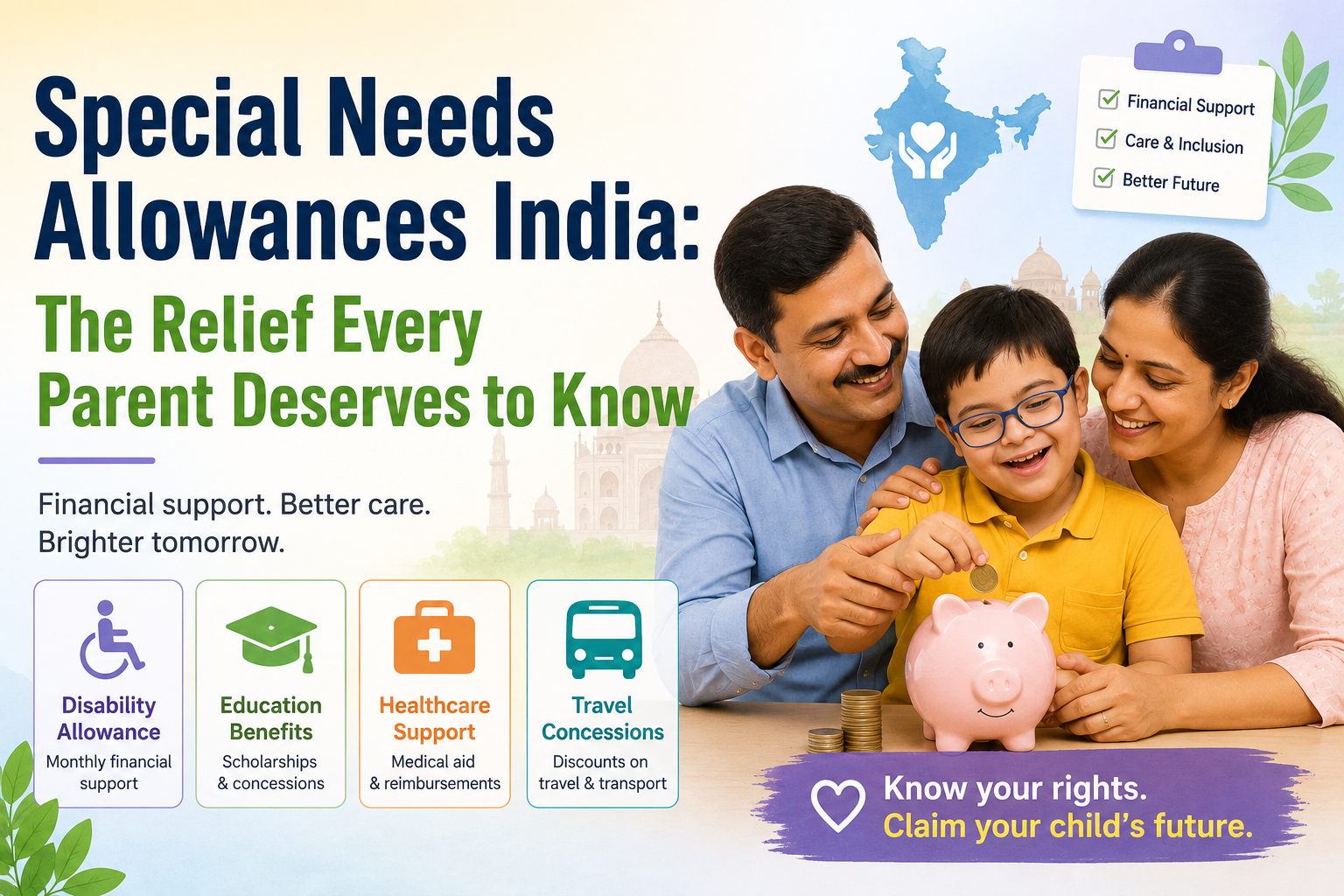
👉 Special Needs Allowances in India 2026: The Relief Every Parent Deserves to Know 🤝
Special needs allowances India offers can genuinely ease a family’s financial load. In short: the central and state governments run pension, tax, education, and equipment schemes for children with disabilities, worth anywhere from a few hundred rupees a month to over ₹1 lakh a year in benefits. 💰
If you’re a tired parent googling this at midnight, wondering what help actually exists — you’re in the right place. Let’s break it down simply, with real numbers and real links.

- Why This Guide Is Different
- What Are Special Needs Allowances in India? (Quick Answer)
- Main Special Needs Allowances India Families Can Access
- The Two Tax Sections Every Parent Should Know
- A Parent’s Process: Ritu’s Story
- Signs You’re Likely Eligible (Quick Checklist)
- How to Apply: A Simple Step-by-Step Path
- Frequently Asked Questions (Special Needs Allowances India)
- What is the monthly disability pension amount in India?
- Can both parents claim Section 80DD for the same child?
- Is the UDID card mandatory for special needs allowances in India?
- Does autism qualify as a disability for tax benefits in India?
- What is Niramaya health insurance and who can apply?
- Can special needs allowances in India be claimed under the new tax regime?
- The Bottom Line 🌟
Why This Guide Is Different
Most articles list scheme names and stop there. This guide goes further. It explains who qualifies, how much you actually get, and where to apply. It also shares a real parent process, so you’re not starting from zero. No jargon. No confusion. Just clear, useful facts. ✅
What Are Special Needs Allowances in India? (Quick Answer)
Simple answer: Special needs allowances in India are financial benefits given by the central or state government to people with disabilities, or their families. These include monthly pensions, tax deductions, scholarships, and equipment aid. Most require a valid disability certificate showing 40% or more disability.
Think of these allowances like different taps in one house. Some taps give cash every month. Some give tax savings once a year. Some give free equipment. You often need to turn on more than one tap to get real support. 🚰

Main Special Needs Allowances India Families Can Access
| Scheme / Benefit | What It Offers | Who Qualifies | Source |
|---|---|---|---|
| Disability Pension (State schemes) | Monthly cash aid, often around ₹300+ per month, higher for age 80+ | Adults 18–79 with 80%+ disability, usually BPL households | India Autism Center scheme guide |
| Section 80U (Income Tax Act) | Tax deduction of ₹75,000 (40–80% disability) or ₹1,25,000 (80%+ disability), for the disabled person themselves | Resident individuals with a valid medical certificate | ClearTax, Section 80U guide |
| Section 80DD (Income Tax Act) | Same deduction amounts as 80U, but claimed by a parent or guardian for a dependent child with a disability | Parents/guardians of a child with 40%+ disability, old tax regime only | PolicyBazaar, Section 80DD guide |
| Niramaya Health Insurance (National Trust) | Health cover up to ₹1 lakh for autism, cerebral palsy, and multiple disabilities | Children and adults with autism, CP, or multiple disabilities | ChildRaise scheme summary |
| ADIP Scheme | Subsidised or free aids and appliances (wheelchairs, hearing aids, and more) | Persons with disabilities across income groups, income-based subsidy | India Autism Center scheme guide |
| Education Scholarship | ₹3,000 to ₹8,000 or more per year for school or college students | Students with a valid disability certificate | India Autism Center scheme guide |
| Unemployment Allowance | ₹400 to ₹1,000 per month while job-seeking | Age 18–48, 10th-grade pass, registered unemployed with disability | MyGov welfare schemes blog |
📌 Quick answer for voice search: “What allowances can special needs children get in India?” Families can access a monthly disability pension, income tax deductions up to ₹1,25,000 under Section 80DD, health insurance up to ₹1 lakh through Niramaya, and free or subsidised equipment through the ADIP scheme.
The Two Tax Sections Every Parent Should Know
This is the part most blogs get wrong or skip entirely. Let’s fix that.
Section 80DD: Built for Parents
Section 80DD is the one that matters most if your child has the disability, not you. It lets a parent or guardian claim a fixed deduction from taxable income. The deduction covers medical treatment, training, and rehabilitation costs. Here’s the simple breakdown:
- 40% to 80% disability: deduction of ₹75,000 per year
- 80% or more disability (called “severe disability,” and this includes autism and cerebral palsy by definition): deduction of ₹1,25,000 per year
You do not need to submit medical bills for this fixed deduction. You do need Form 10-IA, a certificate from a government-approved medical authority (source: ClearTax).
⚠️ Important: Section 80DD only works under the old tax regime. If you’ve switched to the new tax regime for lower rates, you lose this deduction. Run the numbers both ways before you file. 🧮
Section 80U vs. 80DD: Don’t Mix Them Up
Many parents confuse these two. Here’s the easy way to remember it:
| Section | Who It’s For |
|---|---|
| 80U | You have the disability yourself |
| 80DD | Your child (or another dependent) has the disability |
A parent almost always wants 80DD, not 80U, when claiming for a child.
A Parent’s Process: Ritu’s Story
Ritu’s son, Aarav, is 8 and has autism. For two years, Ritu paid for therapy out of pocket. She didn’t know disability benefits existed for her family. A friend at a support group mentioned the UDID card — the Unique Disability ID.
Here’s what Ritu did next:
- Got Aarav’s disability assessed at a government hospital
- Applied for the UDID card online, which took about six weeks
- Used the certificate to claim Section 80DD on her tax return, saving ₹75,000 in taxable income
- Applied for Niramaya health insurance to help cover ongoing therapy costs
- Registered at her state’s ADIP camp and received a subsidised communication device
Result: Ritu’s family didn’t get rich from these schemes. But she saved real money on taxes, therapy, and equipment. More than that, she felt like the system finally saw her son. 💙
This is the honest truth about special needs allowances India provides: not life-changing wealth, but real, stacking relief.
Signs You’re Likely Eligible (Quick Checklist)
Use this to check if it’s worth applying. 📋
- ✅ Your child has a documented developmental, physical, sensory, or intellectual disability
- ✅ You haven’t yet applied for a UDID (Unique Disability ID) card
- ✅ You pay income tax and haven’t claimed Section 80DD
- ✅ Your family income falls under state BPL limits (for pension schemes)
- ✅ Your child needs equipment like wheelchairs, hearing aids, or communication devices
- ✅ You’re paying full price for therapy or medical care without any insurance support
If you checked two or more, it’s worth starting an application this month.
How to Apply: A Simple Step-by-Step Path
| Step | What to Do | Why It Matters |
|---|---|---|
| 1. Get a disability certificate | Visit a government hospital or Medical Board for assessment | This is the foundation document for almost every scheme |
| 2. Apply for a UDID card | Apply online through your state’s social justice portal | One card unlocks pension, scholarship, and travel benefits |
| 3. Claim Section 80DD | Submit Form 10-IA with your income tax return | Saves up to ₹1,25,000 in taxable income per year |
| 4. Apply for Niramaya insurance | Register through a National Trust-registered NGO near you | Covers up to ₹1 lakh in health costs for autism and related conditions |
| 5. Visit an ADIP camp | Check your district’s disability office for camp dates | Free or subsidised equipment, based on income |
⚠️ Scheme amounts and rules can vary by state. Always confirm current details with your local Social Welfare Department or District Disability Office before applying.
Frequently Asked Questions (Special Needs Allowances India)
What is the monthly disability pension amount in India?
Amounts vary by state, but many state pension schemes start around ₹300 per month for adults with 80%+ disability from BPL households, with higher amounts for those aged 80 and above. Some states, like Delhi, offer higher amounts — up to ₹2,500 per month under their subsistence allowance scheme (source: Delhi Social Welfare Department).
Can both parents claim Section 80DD for the same child?
No. Only one parent or guardian can claim the Section 80DD deduction for a dependent child’s disability in a given financial year.
Is the UDID card mandatory for special needs allowances in India?
It isn’t legally mandatory for every scheme, but it’s highly recommended. Many pension, scholarship, and travel benefits now require a UDID card as proof of disability status.
Does autism qualify as a disability for tax benefits in India?
Yes. Autism is specifically listed as a condition that can qualify for “severe disability” status under Section 80DD and 80U, entitling families to the higher ₹1,25,000 deduction when certified at 80% or more.
What is Niramaya health insurance and who can apply?
Niramaya is a National Trust health insurance scheme offering coverage up to ₹1 lakh for people with autism, cerebral palsy, mental retardation, and multiple disabilities. There’s no exclusion based on pre-existing condition, and anyone with a qualifying disability can apply through a registered NGO.
Can special needs allowances in India be claimed under the new tax regime?
No. Both Section 80DD and Section 80U deductions are only available under the old tax regime. If you’ve opted into the new regime, you cannot claim these benefits.
The Bottom Line 🌟
Special needs allowances India provides can genuinely lighten a family’s load — but only if you know they exist and apply for them. Here’s what’s true right now:
- Tax deductions under Section 80DD can save parents up to ₹1,25,000 a year
- Health insurance through Niramaya covers up to ₹1 lakh for eligible conditions
- Equipment support through ADIP can significantly cut therapy and mobility costs
- Most benefits require just one starting document: a disability certificate or UDID card
You’ve already done the hardest part — showing up for your child every single day. Let the system carry a little of that weight too. 💙
Take one small step this week. Start the UDID application. Book that hospital assessment. Ask your tax advisor about Section 80DD. You don’t need to unlock every scheme today. You just need to start.
This article is for learning only. It does not replace legal, tax, or financial advice. Scheme names, amounts, and eligibility rules change and vary by state. Please confirm current details with your local Social Welfare Department, District Disability Office, or a qualified tax advisor before applying or filing.
Sources cited in this article:
- India Autism Center, “List of Government Schemes for Disabled Persons in India” — https://indiaautismcenter.org/blog/list-of-government-schemes-for-disabled-persons-in-india/
- ClearTax, “Section 80U Deduction Guide” — https://cleartax.in/s/section-80u-deduction
- PolicyBazaar, “Section 80DD: Tax Deductions for Disabled People” — https://www.policybazaar.com/income-tax/section-80dd/
- ChildRaise, “Committed to the Empowerment of Special Children & Disability Issues” (Niramaya scheme details) — https://www.childraise.com/schemes.html
- MyGov Blogs, “Welfare Schemes for Persons with Disabilities” — https://blog.mygov.in/welfare-schemes-for-persons-with-disabilities/
One honest note: scheme amounts and eligibility genuinely vary by state in India, and central schemes get updated periodically.


