

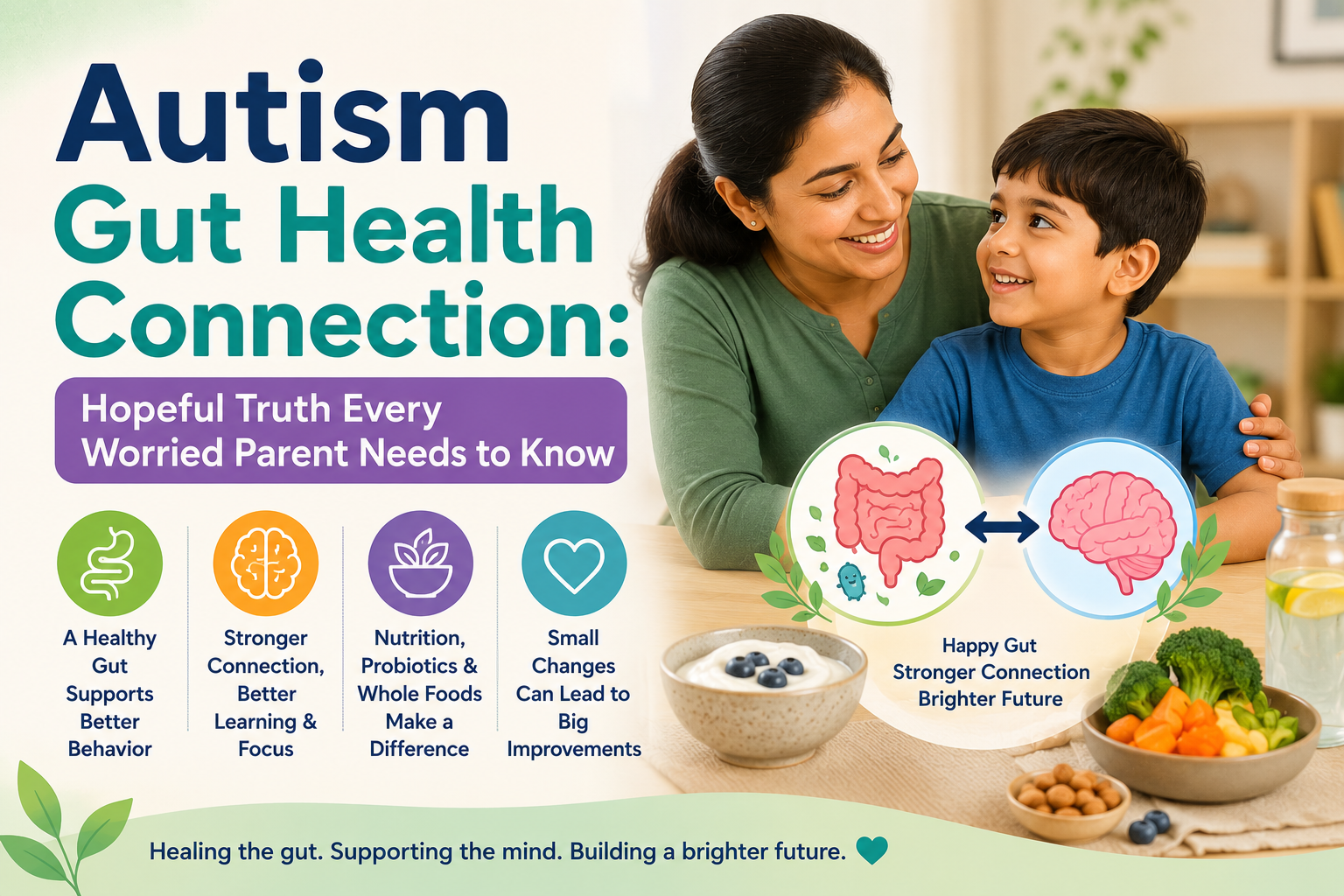
👉 Autism Gut Health Connection 2026: Hopeful Truth Every Worried Parent Needs to Know 🌱
Autism gut health is one of the most searched topics among special needs parents today. It’s also one of the most misunderstood. Research shows a real link between gut bacteria and autism symptoms. But this link is correlation, not proof of cause. Gut issues do not cause autism itself. 🧠💛
If you clicked on this article at 11 p.m. because your child was doubled over with stomach pain again, or because their meltdown started right after lunch — you are not imagining things. And you are not alone.
Why I’m Writing This (A Quick, Honest Note)
I’ve spent hours combing through 2025 and early-2026 peer-reviewed studies — from journals like Nutrients, Frontiers in Microbiology, and Nature Scientific Reports — so you don’t have to.
This guide translates dense medical research into plain, calm language. No fear-mongering. No miracle cures. Just facts, real numbers, and practical next steps. ✅

- Why I’m Writing This (A Quick, Honest Note)
- What Is the Autism Gut Health Connection?
- How Common Are Gut Problems in Autistic Children? (Real Numbers)
- What Does the Science Actually Say? (No Hype, Just Research)
- 1. The Gut-Brain-Microbiota Triangle Is Real
- 2. Diet and Bacteria Are Deeply Connected
- 3. What Actually Helped in Clinical Trials
- 4. The Important Reality Check ⚠️
- A Parent’s Story: Maya’s Journey
- Signs Your Child’s Behavior Might Be Gut-Related
- Gentle, Research-Informed Steps Parents Can Take Today
- Frequently Asked Questions (Autism Gut Health)
- Does gut health cause autism?
- Can probiotics help autism symptoms?
- What percentage of autistic children have digestive issues?
- Is the GAPS or specific carbohydrate diet backed by research?
- What is the gut-brain axis in simple terms?
- How do I know if my nonverbal child has gut pain?
- The Bottom Line 🌟
What Is the Autism Gut Health Connection?
Simple answer: Many autistic kids have a different mix of gut bacteria than other kids. This is called the “microbiome.” That different mix links to both tummy trouble and some behavior patterns. Scientists are still working out exactly why.
This connection runs through something called the gut-brain axis. Think of it as a two-way highway. It links your child’s gut to their brain. Gut microorganisms play a key role in this axis. They affect nervous system growth and behavior. An imbalance in gut bacteria has been tied to both behavior and digestive symptoms in autistic people (source: PMC/National Institutes of Health).
Think of the gut-brain axis like a two-lane highway. Traffic (signals) moves both ways. When one lane gets congested — say, from inflammation or bacterial imbalance — the whole commute slows down, including messages that affect mood, focus, and behavior. 🚦
How Common Are Gut Problems in Autistic Children? (Real Numbers)
Parents often ask: “Is it normal for my autistic child to have constant stomach issues?” The honest answer, backed by data: yes, it’s extremely common — far more common than in neurotypical children.
| Statistic | What It Means for Your Family | Source |
|---|---|---|
| ASD now affects 1 in 31 eight-year-olds (32.2 per 1,000 children) in the U.S. | Autism prevalence continues to rise, meaning more families need this information than ever | CDC, 2025 data cited in Biagioli et al., Nutrients (2025) — NCBI/PMC source |
| GI symptoms occur in a wide range — 2% to 95% of autistic children depending on the study and assessment method | The huge range shows GI issues are under-diagnosed, not rare — trust your own observations | Autism Research Institute clinical review — autism.org source |
| 42.5% of autistic children studied met clinical criteria for functional constipation | Nearly half — so if your child struggles here, they are far from alone | Ferguson et al., Autism Research, 2017, University of Michigan study — autism.org source |
| GI symptom severity often correlates with autism symptom severity | Managing gut discomfort may ease some behavioral flare-ups (not a cure, but real relief) | Frontiers systematic review, 2025 (Shaaban et al., Lin et al.) — Frontiers source |
📌 Quick answer for voice search: “How common are gut problems in autism?” Studies show many autistic kids have tummy symptoms. Rates vary widely by study. Constipation alone hits roughly 4 in 10 kids studied.
What Does the Science Actually Say? (No Hype, Just Research)

1. The Gut-Brain-Microbiota Triangle Is Real
A 2025 review in the journal Nutrients looked closely at this link. It found that dysbiosis — an imbalance in gut bacteria — is linked to both behavior and digestive symptoms in autistic people. Researchers are now testing new therapies. These include probiotics and fecal microbiota transplants to help ease symptoms (News-Medical summary of the study).
2. Diet and Bacteria Are Deeply Connected
A 2025 study in Frontiers in Cellular Neuroscience dug into this. It found that a mother’s diet can affect her child’s gut bacteria and autism risk. Earlier research in the journal Cell found the reverse is also true. A child’s food choices, like picky eating, can shape their gut bacteria too. It’s a two-way street (Nature/Scientific Reports source).
This is hopeful news. Diet is not just a side effect of autism. It’s also a tool parents can gently use. 🥦
3. What Actually Helped in Clinical Trials
A big 2025 review in Frontiers in Microbiology checked many treatment studies. The early results are hopeful:
- Several studies found real gut health gains after probiotic use. One study linked better GI symptoms to lower autism severity scores
- One trial tested a prebiotic fiber called guar gum. Every child with constipation who took it had more regular bowel movements
Source: Frontiers in Microbiology, 2025
4. The Important Reality Check ⚠️
Good research means being honest about its limits, too. Science magazine (AAAS) looked closely at the top studies in this field. It found that many use tiny sample sizes and weak methods. Few results have been repeated in later studies. Some studies even disagree on whether autistic kids have more or less of certain gut bacteria (Science.org source).
Why we’re telling you this: Because you deserve honesty, not hype. The autism gut health connection is real and worth exploring — but it is not a proven “cause” of autism, and no supplement or diet has been shown to cure autism. Anyone selling you that promise is selling you something false. 🚫
A Parent’s Story: Maya’s Journey
Maya is 6. She had meltdowns almost every afternoon. Her mom, Priya, spotted a pattern. The worst days came after 3-4 days of constipation. Maya’s doctor confirmed it. Remember, this affects roughly 4 in 10 autistic kids studied.
Priya didn’t chase a “cure.” Instead, she worked with Maya’s doctor to:
- Add more fiber and water gradually (not overnight — that backfires)
- Introduce a pediatrician-approved probiotic
- Track symptoms in a simple notebook for 8 weeks
Result: Maya’s constipation eased within a month. Her afternoon meltdowns dropped from near-daily to about twice a week. Did the gut work “fix” her autism? No — and Priya is clear about that. But her daughter was more comfortable, and comfort made everything else — therapy, school, sleep — a little easier. 💛
This is what the research really supports: not a cure, but real relief.
Signs Your Child’s Behavior Might Be Gut-Related
Use this list to start a talk with your pediatrician. It’s not a diagnosis. 📋
- ✅ Meltdowns or irritability that spike after meals
- ✅ Self-injury or pressure-seeking behavior around the abdomen (pressing, lying on stomach)
- ✅ Sudden behavior changes with no clear environmental trigger
- ✅ Picky eating combined with visible discomfort (bloating, gas)
- ✅ Sleep disruption alongside digestive symptoms
- ✅ Non-verbal or limited-verbal child who cannot describe pain directly
If you checked two or more, it’s worth raising with your child’s doctor at the next visit.
Gentle, Research-Informed Steps Parents Can Take Today
| Step | What It Looks Like | Why Research Supports It |
|---|---|---|
| 1. Track before you treat | Keep a simple 2-week log of food, mood, and bathroom habits | This helps you and your doctor spot real patterns, not guesses |
| 2. Add fiber slowly | Add small amounts of fruit, oats, or prebiotic fiber over time | Prebiotic fiber use significantly improved bowel regularity in trials (Frontiers, 2025) |
| 3. Ask about probiotics | Talk with your doctor about safe strains and doses | Many trials link probiotics to real gut symptom gains |
| 4. Rule out constipation first | Book a simple check-up with your pediatrician | Constipation alone affects close to 42.5% of autistic kids studied |
| 5. See a GI specialist if symptoms stay | Ask your pediatrician for a referral | Gut symptom severity often tracks with behavior severity, per a 2025 Frontiers review |
⚠️ Always talk to your child’s doctor first. Do this before you start any new supplement, probiotic, or big diet change. This article is for learning, not medical advice.
Frequently Asked Questions (Autism Gut Health)
Does gut health cause autism?
No. Research shows a strong link between gut bacteria and autism symptoms. But the proof that gut bacteria actually cause autism is still weak. Many studies are small and often disagree with each other. Experts believe autism comes from a mix of genes and environment, not gut bacteria alone.
Can probiotics help autism symptoms?
Some studies show probiotics can ease gut symptoms like bloating and irregular bowel movements. One study even linked this to lower behavior severity scores. Probiotics do not cure autism. Always check with your child’s doctor first.
What percentage of autistic children have digestive issues?
Studies show a wide range. Rates run from 2% up to 95%, depending on how symptoms were measured. Constipation alone affects close to half of the children in one major study.
Is the GAPS or specific carbohydrate diet backed by research?
The evidence is thin and mixed. These strict diets can also cause missing nutrients in growing kids. Talk to a pediatric dietitian before you try one.
What is the gut-brain axis in simple terms?
It’s a two-way message system. It links your child’s gut to their brain. Nerves, hormones, and immune signals carry the messages. Gut pain can affect mood. Mood can affect the gut, too.
How do I know if my nonverbal child has gut pain?
Watch for signs like these: pressing on the belly, arching the back, or sudden crankiness after eating. Sleep changes are a clue too. So is self-injury near mealtimes. Bring a symptom log to your pediatrician.
The Bottom Line 🌟
The autism gut health connection is one of the most promising, actively-researched areas in autism science today — but it’s still evolving. Here’s what’s true right now:
- Gut symptoms are common in autistic kids. You are not imagining it.
- Easing gut pain can bring real daily comfort, and sometimes calmer behavior.
- No gut plan cures autism. Anyone who says so is wrong.
- Small, tracked, doctor-guided steps beat sudden big changes.
You know your child best. Research gives you words for what you already sensed. It also gives you real data to bring to your next doctor’s visit. That’s not nothing — that’s power. 💛
Take one small step this week. Start the food-and-mood log. Book that pediatrician chat. Ask one clear question. You don’t need to solve everything today. You just need to start.
This article is for learning only. It does not replace medical advice. Please ask your child’s doctor before making any diet or supplement changes.
Sources cited in this article:
- Biagioli et al., “Gut Microbiota and Autism: Unlocking Connections,” Nutrients, 2025 — https://www.ncbi.nlm.nih.gov/pmc/articles/PMC12694261/
- Autism Research Institute, “Nutrition and the Gut-Brain Connection” — https://autism.org/nutrition-gut-brain-connection/
- Frontiers in Microbiology, “Microbiota-based interventions for autism spectrum disorder: a systematic review,” 2025 — https://www.frontiersin.org/journals/microbiology/articles/10.3389/fmicb.2025.1648118/full
- Chen, Q. et al., “Gut microbiota analysis in children with autism spectrum disorder and their family members,” Nature Scientific Reports, 2025 — https://www.nature.com/articles/s41598-025-27822-z
- Młynarska et al., “The Gut–Brain–Microbiota Connection and Its Role in Autism Spectrum Disorders,” Nutrients, 2025 — https://pmc.ncbi.nlm.nih.gov/articles/PMC11990867/
- “Research linking gut microbes to autism is deeply flawed, critics say,” Science (AAAS) — https://www.science.org/content/article/research-linking-gut-microbes-autism-deeply-flawed-critics-say


