

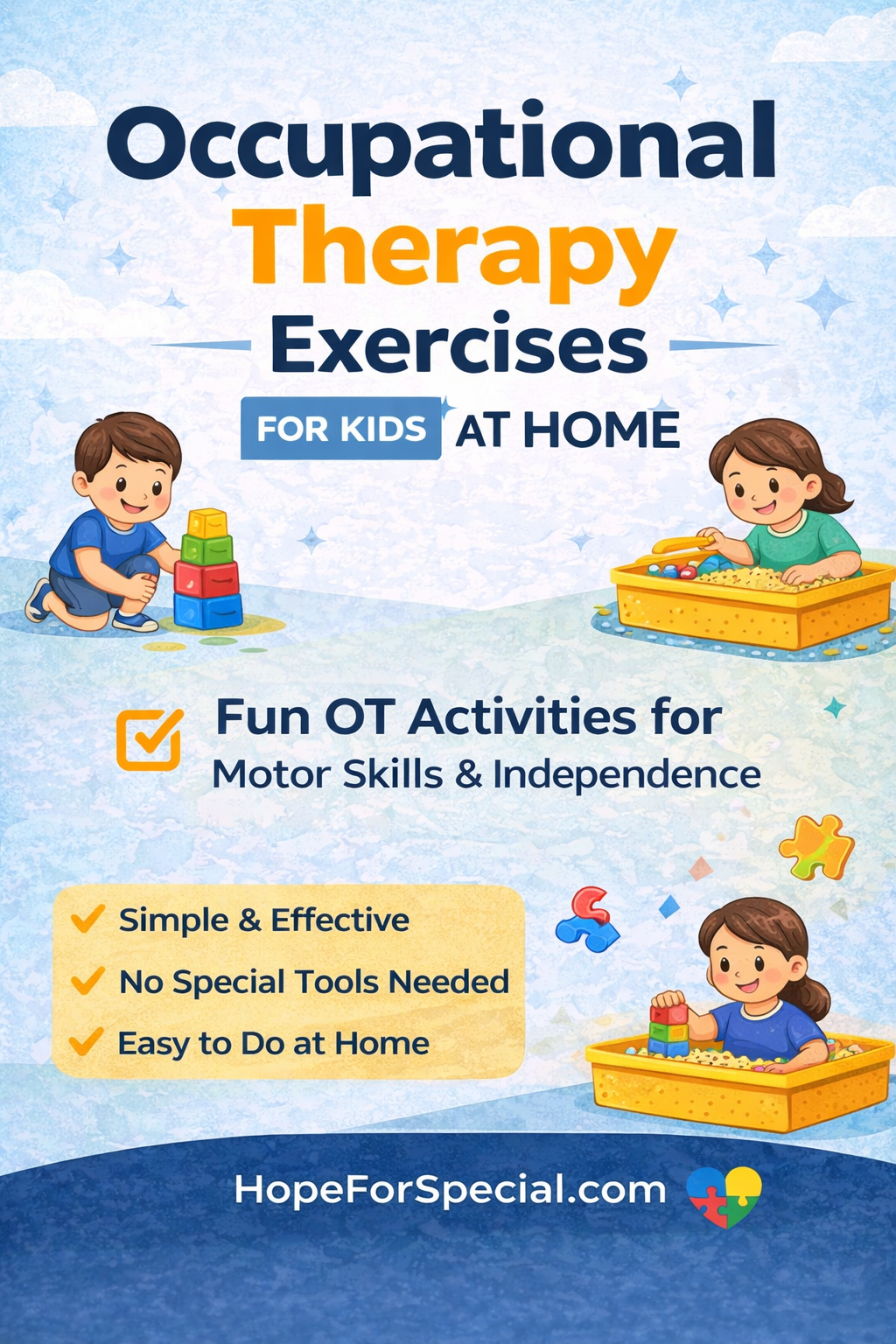
Occupational Therapy Exercises for Kids at Home (2026 Parent Guide)
Helping your child develop daily life skills can feel challenging. However, small activities at home can make a big difference.
That’s where occupational therapy exercises for kids at home come in.
These exercises improve:
- Motor skills
- Coordination
- Focus
- Independence
The best part? You can do them easily at home.

- What Is Occupational Therapy for Kids?
- Why Do Occupational Therapy Exercises at Home?
- Signs Your Child May Need Occupational Therapy
- 🖐️ 1. Fine Motor Skill Exercises
- ✍️ 2. Handwriting and Pre-Writing Exercises
- ⚖️ 3. Gross Motor Skill Exercises
- 🎯 4. Hand-Eye Coordination Activities
- 🧠 5. Sensory Activities
- 💪 6. Strength and Core Exercises
- 🧩 7. Daily Living Skill Exercises
What Is Occupational Therapy for Kids?
Occupational therapy (OT) helps children develop skills needed for everyday life.
This includes:
- Writing
- Eating
- Dressing
- Playing
According to the American Occupational Therapy Association, OT supports children in becoming more independent in daily activities.
👉 Learn more: https://www.aota.org/practice/children-youth

Why Do Occupational Therapy Exercises at Home?
Home-based exercises are powerful.
They help children:
- Practice regularly
- Feel comfortable
- Learn faster
Research shows that consistent practice improves motor and cognitive development.
https://www.ncbi.nlm.nih.gov/pmc/articles/PMC6259545/
Signs Your Child May Need Occupational Therapy
Your child may benefit if they:
- Struggle with handwriting
- Have poor balance
- Avoid physical activities
- Find it hard to focus
- Have sensory sensitivities
If you notice these signs, simple exercises can help.
Best Occupational Therapy Exercises for Kids at Home
Let’s explore easy and effective exercises.
🖐️ 1. Fine Motor Skill Exercises
These improve hand strength and coordination.
Activities:
✔ Playdough Play
- Squeeze, roll, and shape
- Improves finger strength
✔ Bead Threading
- Use strings and beads
- Improves hand-eye coordination
✔ Paper Cutting
- Use child-safe scissors
- Builds control
✔ Button Practice
- Improves independence
✍️ 2. Handwriting and Pre-Writing Exercises
Writing can be difficult for many children.
✔ Tracing Lines
- Use worksheets
- Practice straight and curved lines
✔ Sand Writing
- Write letters in sand
- Adds sensory experience
✔ Chalkboard Writing
- Use large chalk
- Builds grip strength
According to Centers for Disease Control and Prevention, early skill development supports better academic outcomes.
👉 https://www.cdc.gov/ncbddd/childdevelopment/index.html
⚖️ 3. Gross Motor Skill Exercises
These improve body coordination.
✔ Jumping Activities
- Jump rope
- Jump on spot
✔ Obstacle Course
- Use pillows, chairs
- Improves balance
✔ Ball Play
- Throw and catch
- Improves coordination
🎯 4. Hand-Eye Coordination Activities
✔ Catching Games
- Use soft balls
✔ Stacking Blocks
- Build towers
✔ Ring Toss
- Improves accuracy
🧠 5. Sensory Activities
These help children who are sensitive to touch, sound, or movement.
✔ Sensory Bins
- Use rice, beans, sand
✔ Water Play
- Pouring and splashing
✔ Texture Exploration
- Touch different fabrics
Experts highlight sensory play as important for brain development.
https://www.autismspeaks.org/sensory-issues
💪 6. Strength and Core Exercises
Strong muscles support daily tasks.
✔ Animal Walks
- Bear walk
- Crab walk
✔ Plank Hold
- Hold for few seconds
✔ Wheelbarrow Walk
- Parent holds legs
🧩 7. Daily Living Skill Exercises
These build independence.
✔ Dressing Practice
✔ Brushing Teeth
✔ Packing School Bag
These skills improve confidence.
Weekly Occupational Therapy Schedule Example
Here’s a simple weekly plan.
| Day | Activity |
|---|---|
| Monday | Fine motor + sensory |
| Tuesday | Gross motor + coordination |
| Wednesday | Writing practice |
| Thursday | Sensory + balance |
| Friday | Strength + daily skills |
| Saturday | Fun play activities |
| Sunday | Rest / light play |
How to Make OT Exercises Fun
Children learn better when they enjoy activities.
✔ Turn Activities into Games
✔ Use Rewards
✔ Keep Sessions Short (15–30 minutes)
✔ Follow Child’s Interests
Benefits of Occupational Therapy Exercises at Home
These exercises help children:
✔ Improve coordination
✔ Build confidence
✔ Increase independence
✔ Improve focus
Common Mistakes Parents Should Avoid
Avoid these:
❌ Forcing the child
❌ Long sessions
❌ Ignoring breaks
❌ Comparing with others
Tips for Parents
✔ Be Consistent
✔ Stay Patient
✔ Celebrate Small Wins
✔ Work with Therapists
Real-Life Example
Riya struggled with writing and coordination.
Her parents started simple OT exercises at home.
They:
- Practiced daily for 20 minutes
- Used fun activities
After a few months:
✔ Better handwriting
✔ Improved confidence
Expert Insights
Experts agree:
👉 Early and consistent OT exercises improve long-term outcomes.
According to World Health Organization, early intervention supports better development in children.
👉 https://www.who.int/teams/maternal-newborn-child-adolescent-health-and-ageing/child-health
FAQs: Occupational Therapy Exercises for Kids at Home
1. How often should I do OT exercises?
Daily or at least 4–5 times a week.
2. How long should sessions be?
15–30 minutes is enough.
3. Can I do OT without a therapist?
Yes, but professional guidance is helpful.
4. What age is best to start?
Early childhood is ideal.
5. Are these exercises safe?
Yes, if done correctly and supervised.
Final Thoughts
Doing occupational therapy exercises for kids at home is simple and effective.
You do not need expensive tools.
Just:
👉 Stay consistent
👉 Keep it fun
👉 Focus on progress
Small steps every day can lead to big improvements.


Pingback: URL
Pingback: essentials
Pingback: หวย24
Pingback: ole777
Pingback: แทงบอลวันนี้