

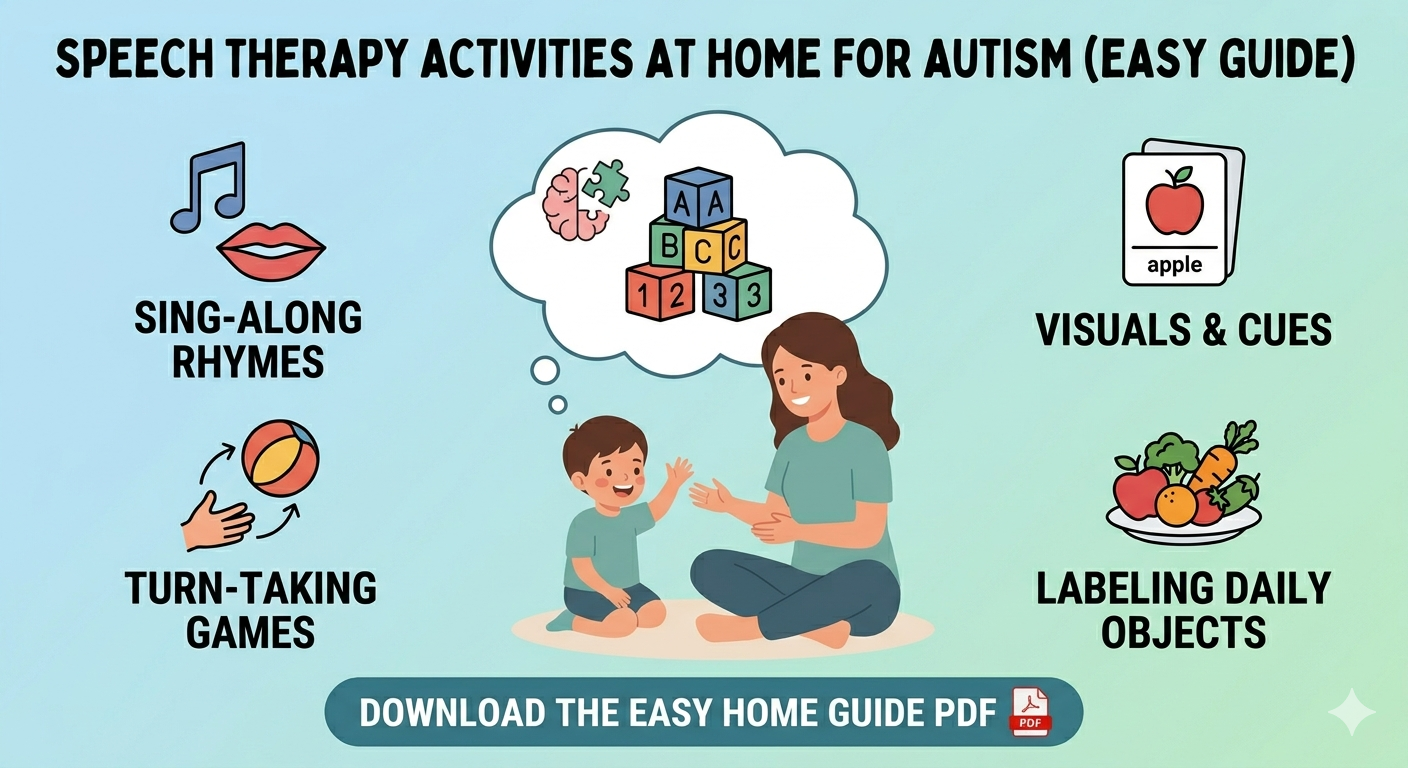
Speech Therapy Activities at Home for Autism (2026 Parent Guide)
Helping a child with autism communicate better is one of the most important goals for parents.
The good news is this:
👉 You can support your child’s speech development right at home.
This guide shares the best speech therapy activities at home for autism. These are simple, practical, and easy to follow.

- Why Speech Therapy Is Important for Autism
- Can You Do Speech Therapy at Home?
- Key Tips Before You Start
- ✔ Keep It Simple
- ✔ Be Consistent
- ✔ Follow Your Child’s Interest
- ✔ Use Positive Reinforcement
- ✔ Be Patient
- 1. Naming Objects Activity
- 2. Picture Cards Practice
- 3. Imitation Games
- 4. Choice-Making Activity
- 5. Reading Together
- 6. Singing Songs
- 7. Daily Routine Talk
- 8. Turn-Taking Games
- 9. Use of Visual Supports
- 10. Expand Sentences
- 11. Mirror Practice
- 12. Sound Play Activities
- 13. Asking Simple Questions
- 14. Role Play Activities
- 15. Use of Technology (Apps)
Why Speech Therapy Is Important for Autism
Children with autism may have challenges with:
- Speaking
- Understanding language
- Expressing needs
Speech therapy helps improve these skills step by step.
According to the Centers for Disease Control and Prevention, early support improves communication and development outcomes.
https://www.cdc.gov/autism/treatment/index.html

Can You Do Speech Therapy at Home?
Yes, you can.
While professional therapy is important, home practice makes a big difference.
Experts say that daily interaction and repetition help children learn faster.
https://www.asha.org/public/speech/disorders/autism/
👉 Even small activities can create big progress.
Key Tips Before You Start
Before starting any activity, follow these tips:
✔ Keep It Simple
Use short and clear instructions.
✔ Be Consistent
Practice daily, even for 10–15 minutes.
✔ Follow Your Child’s Interest
Use toys or topics your child likes.
✔ Use Positive Reinforcement
Praise small efforts.
✔ Be Patient
Progress takes time.
Best Speech Therapy Activities at Home for Autism
Now let’s explore step-by-step activities you can use.
1. Naming Objects Activity
How to Do It:
- Show an object (toy, fruit, book)
- Say its name clearly
- Ask your child to repeat
Example:
“This is a ball. Say ball.”
👉 Start with simple words.
2. Picture Cards Practice
Steps:
- Use flashcards with pictures
- Ask “What is this?”
- Encourage answers
This improves:
- Vocabulary
- Recognition
3. Imitation Games
How to Play:
- Say simple sounds or words
- Ask your child to copy
Example:
- “Ba-ba”
- “Ma-ma”
👉 Imitation builds speech foundation.
4. Choice-Making Activity
Steps:
- Offer two items
- Ask: “Do you want apple or banana?”
- Encourage verbal response
This teaches:
- Decision-making
- Communication
5. Reading Together
How:
- Read simple books
- Point to pictures
- Ask questions
Example:
“What is this?”
👉 Reading improves language understanding.
6. Singing Songs
Songs help with:
- Rhythm
- Memory
- Word repetition
Try:
- Nursery rhymes
- Action songs
7. Daily Routine Talk
Use everyday moments.
Example:
- During meals
- While dressing
Say:
“We are eating.”
“Put on shoes.”
👉 Real-life context improves learning.
8. Turn-Taking Games
Steps:
- Play simple games
- Take turns
Example:
- Rolling a ball
This builds:
9. Use of Visual Supports
Visual aids help children understand better.
Use:
- Charts
- Picture schedules
Experts recommend visual supports for children with autism.
https://www.autismspeaks.org/tool-kit-excerpt/visual-supports-and-autism
10. Expand Sentences
If your child says:
“Car”
You say:
“Yes, red car”
👉 This helps build longer sentences.
11. Mirror Practice
Steps:
- Sit in front of a mirror
- Practice mouth movements
This helps with:
- Pronunciation
- Awareness
12. Sound Play Activities
Focus on sounds:
- Animal sounds (moo, bark)
- Vehicle sounds (vroom)
👉 Fun and effective.
13. Asking Simple Questions
Start with:
- What
- Where
Example:
“Where is the ball?”
14. Role Play Activities
Act out real-life situations:
- Shopping
- Talking on phone
👉 Improves communication skills.
15. Use of Technology (Apps)
Some apps support speech development.
Choose:
- Simple
- Interactive apps
Weekly Speech Therapy Routine Example
Here is a simple plan:
| Day | Activity |
|---|---|
| Monday | Naming objects |
| Tuesday | Flashcards |
| Wednesday | Reading |
| Thursday | Songs |
| Friday | Role play |
| Saturday | Outdoor communication |
| Sunday | Review & fun games |
How Long Should You Practice?
Start with:
- 10–15 minutes daily
Then increase gradually.
👉 Short sessions work better than long ones.
Signs of Progress
Look for:
✔ More words
✔ Better response
✔ Improved eye contact
✔ Increased interaction
Even small progress matters.
Common Mistakes to Avoid
Avoid these:
❌ Forcing the child
❌ Long sessions
❌ Complex words
❌ Lack of consistency
Instead:
✔ Keep it fun
✔ Keep it simple
When to Seek Professional Help
Home activities help. But sometimes you need expert support.
Consult a speech therapist if:
- No speech development
- Regression
- Difficulty understanding
Speech-language pathologists provide structured therapy.
https://www.asha.org/public/speech/disorders/
Benefits of Speech Therapy at Home
Home practice helps:
- Improve communication
- Build confidence
- Strengthen parent-child bond
Real-Life Example
Priya, a mother of a 5-year-old child with autism, started simple activities at home.
She:
- Used flashcards
- Practiced daily conversations
- Read books regularly
Within months:
✔ Her child started using words
✔ Communication improved
Expert Insights
Experts agree:
👉 Daily practice at home improves therapy results.
Consistency is the key.
FAQs: Speech Therapy Activities at Home for Autism
1. Can I replace professional therapy with home practice?
No. Both should work together.
2. How long does it take to see results?
It depends on the child. Progress takes time.
3. What is the best activity to start with?
Start with:
- Naming objects
- Imitation
4. Can non-verbal children benefit?
Yes. Use visuals and gestures.
5. How do I keep my child engaged?
Use:
- Games
- Songs
- Favorite toys
Final Thoughts
Using speech therapy activities at home for autism can make a big difference.
Remember:
👉 Start small
👉 Stay consistent
👉 Make it fun
Your daily efforts can help your child communicate better and feel more confident.


