

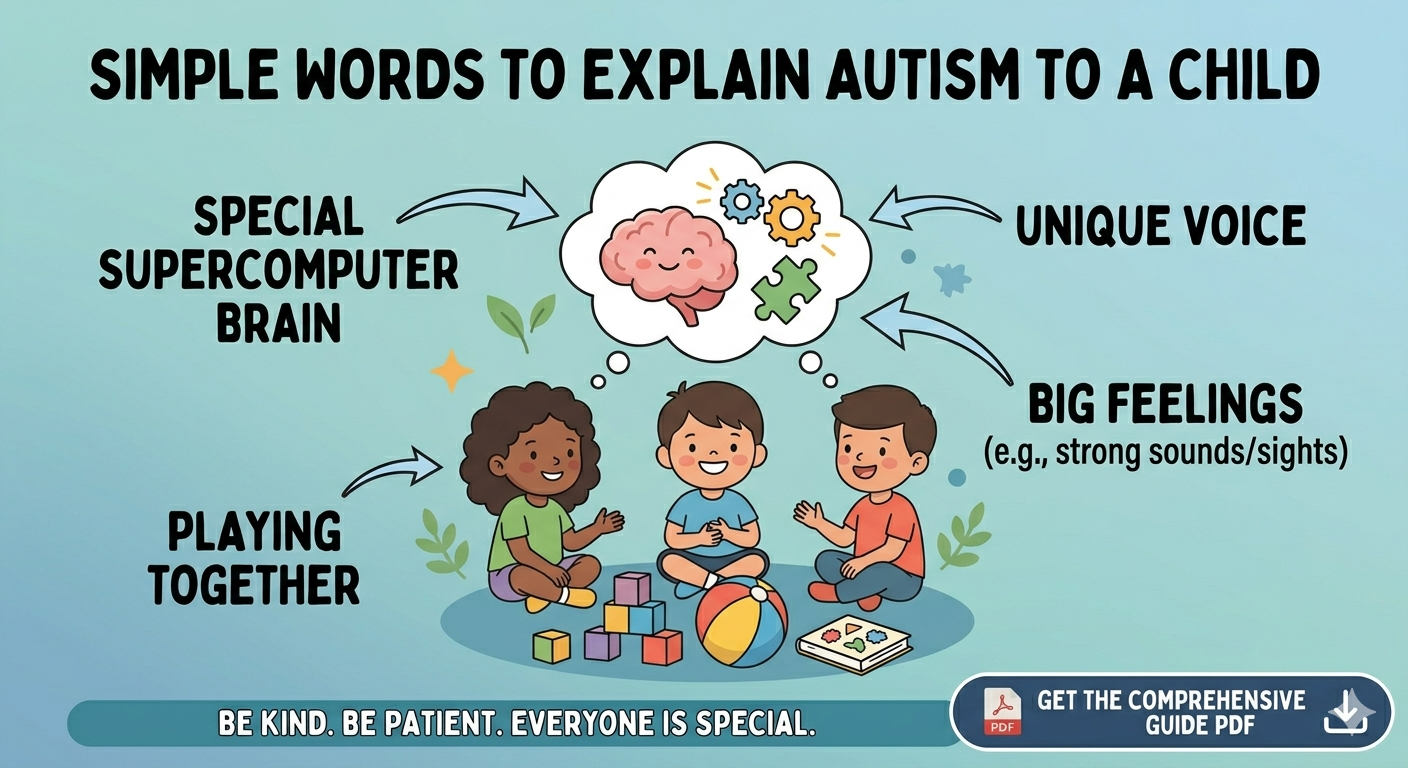
How to Explain Autism to a Child (Simple Words Guide for Parents – 2026)
Talking to a child about autism can feel difficult. You may wonder:
👉 What should I say?
👉 Will they understand?
👉 How do I keep it simple?
The good news is this:
You don’t need perfect words. You just need honest, simple, and kind communication.
This guide will show you exactly how to explain autism to a child in simple words, using easy examples and real-life conversations.

- What Is Autism? (Simple Explanation for Kids)
- Why It Is Important to Explain Autism to Children
- When Should You Talk to a Child About Autism?
- 1. Start with What They Already Know
- 2. Use Simple and Clear Words
- 3. Focus on Strengths and Differences
- 4. Explain Challenges Gently
- 5. Use Real-Life Examples
- 6. Encourage Questions
- 7. Teach Kindness and Acceptance
- 🌟 Example Story
- 👶 Young Children (Ages 3–6)
- 🧒 School-Age Children (Ages 7–12)
- 👦 Teens
- ❓ “Why does he not talk much?”
- ❓ “Why does she act differently?”
- ❓ “Can autism go away?”
- ❓ “Can we still be friends?”
- ✔ Use Books and Visuals
- ✔ Repeat the Message
- ✔ Model Kind Behavior
- ✔ Be Patient
What Is Autism? (Simple Explanation for Kids)
Before explaining it to a child, you need a simple way to describe autism.
You can say:
👉 “Autism means the brain works in a different way.”
Or:
👉 “Some people think, learn, and feel things differently. That is called autism.”
Keep it short. Keep it clear.
According to the CDC, autism is a developmental condition that affects communication, behavior, and social interaction.
https://www.cdc.gov/autism/index.html

Why It Is Important to Explain Autism to Children
Children notice differences. If we don’t explain, they may feel confused.
Explaining autism helps:
- Build understanding
- Reduce fear
- Encourage kindness
Experts say early conversations help children develop empathy and acceptance.
https://www.autismspeaks.org/what-autism
When Should You Talk to a Child About Autism?
There is no “perfect age.”
However, you can start when:
- A child asks questions
- They notice differences
👉 The key is: Start simple. Add more details later.
How to Explain Autism to a Child (Simple Words)
Let’s break it into easy steps.
1. Start with What They Already Know
Begin with something familiar.
Example:
“Everyone is different. Some people are good at drawing. Some are good at sports.”
Then add:
“Some people’s brains work differently. That is called autism.”
2. Use Simple and Clear Words
Avoid medical terms.
Instead of:
❌ “Neurodevelopmental disorder”
Say:
✔ “The brain works differently”
3. Focus on Strengths and Differences
Do not only talk about challenges.
Say:
👉 “People with autism can be very good at things like memory, art, or numbers.”
This creates a positive understanding.
4. Explain Challenges Gently
You can say:
👉 “Sometimes, people with autism may find it hard to talk, make friends, or handle loud sounds.”
Keep your tone calm and supportive.
5. Use Real-Life Examples
Examples make things clear.
For instance:
👉 “If a room is very noisy, it might feel too loud for them.”
6. Encourage Questions
Let the child ask anything.
Answer honestly.
If you don’t know, say:
👉 “That’s a great question. Let’s find out together.”
7. Teach Kindness and Acceptance
End with an important message:
👉 “Everyone deserves kindness and respect.”
Simple Script: How to Explain Autism to a Child
Here is a ready-to-use script:
“Autism means a person’s brain works a little differently. They may learn or play in their own way. Sometimes they may find things like talking or loud sounds hard. But they can also be very good at many things. Everyone is different, and we should always be kind.”
Storytelling Method (Best for Kids)
Children understand stories better than explanations.
🌟 Example Story
“Riya and Arjun were best friends. Arjun loved numbers and puzzles. But loud sounds made him uncomfortable.
One day, Riya asked why.
Arjun said, ‘My brain works differently. It’s called autism.’
Riya smiled and said, ‘That’s okay. We are still friends.’
And they continued playing together.”
👉 This method builds empathy naturally.
Ways to Explain Autism Based on Age
👶 Young Children (Ages 3–6)
Use very simple words:
👉 “Some kids learn and play differently. That’s okay.”
🧒 School-Age Children (Ages 7–12)
You can add more detail:
👉 “Autism means the brain works differently. It can affect talking, learning, and behavior.”
👦 Teens
Use deeper explanations:
👉 “Autism is a lifelong condition. It affects how people communicate and experience the world.”
Common Questions Children Ask (And How to Answer)
❓ “Why does he not talk much?”
👉 “He communicates in a different way.”
❓ “Why does she act differently?”
👉 “Her brain works differently. That’s part of autism.”
❓ “Can autism go away?”
👉 “No, but people with autism can learn and grow in many ways.”
❓ “Can we still be friends?”
👉 “Yes, of course. Everyone can be a good friend.”
Mistakes to Avoid When Explaining Autism
Avoid these common mistakes:
❌ Using complicated words
❌ Making autism sound negative
❌ Giving too much information at once
❌ Ignoring the child’s questions
Instead:
✔ Keep it simple
✔ Stay positive
✔ Be honest
Tips for Parents and Teachers
✔ Use Books and Visuals
Children learn better with visuals.
✔ Repeat the Message
Repetition helps understanding.
✔ Model Kind Behavior
Children learn from what they see.
✔ Be Patient
Understanding takes time.
Real-Life Parent Experience
A parent shared:
“When my son asked about autism, I kept it simple. I said, ‘Everyone’s brain works differently.’ He understood and became more caring.”
👉 Simple words create big impact.
Expert Insights
Experts agree that:
👉 Simple and positive explanations help children understand autism better.
According to child development research, early conversations about differences improve social understanding and empathy.
https://www.nimh.nih.gov/health/topics/autism-spectrum-disorders-asd
Benefits of Explaining Autism to Children
When children understand autism:
✔ They become more accepting
✔ They show kindness
✔ They build better friendships
Simple Checklist for Parents
✔ Use simple words
✔ Focus on strengths
✔ Explain differences
✔ Encourage questions
✔ Promote kindness
FAQs: How to Explain Autism to a Child Simple Words
1. What is the simplest way to explain autism?
👉 “It means the brain works differently.”
2. Should I talk about autism early?
Yes. Early conversations help understanding.
3. What if my child does not understand?
Repeat and use examples.
4. Should I focus on challenges?
Balance both strengths and challenges.
5. Can storytelling help?
Yes. Stories make learning easier.
Final Thoughts
Now you know how to explain autism to a child in simple words.
Remember:
👉 Keep it simple
👉 Stay positive
👉 Be honest
You don’t need perfect words.
You just need kind words.
Because when children understand differences, they learn acceptance.
And that creates a better world.


