

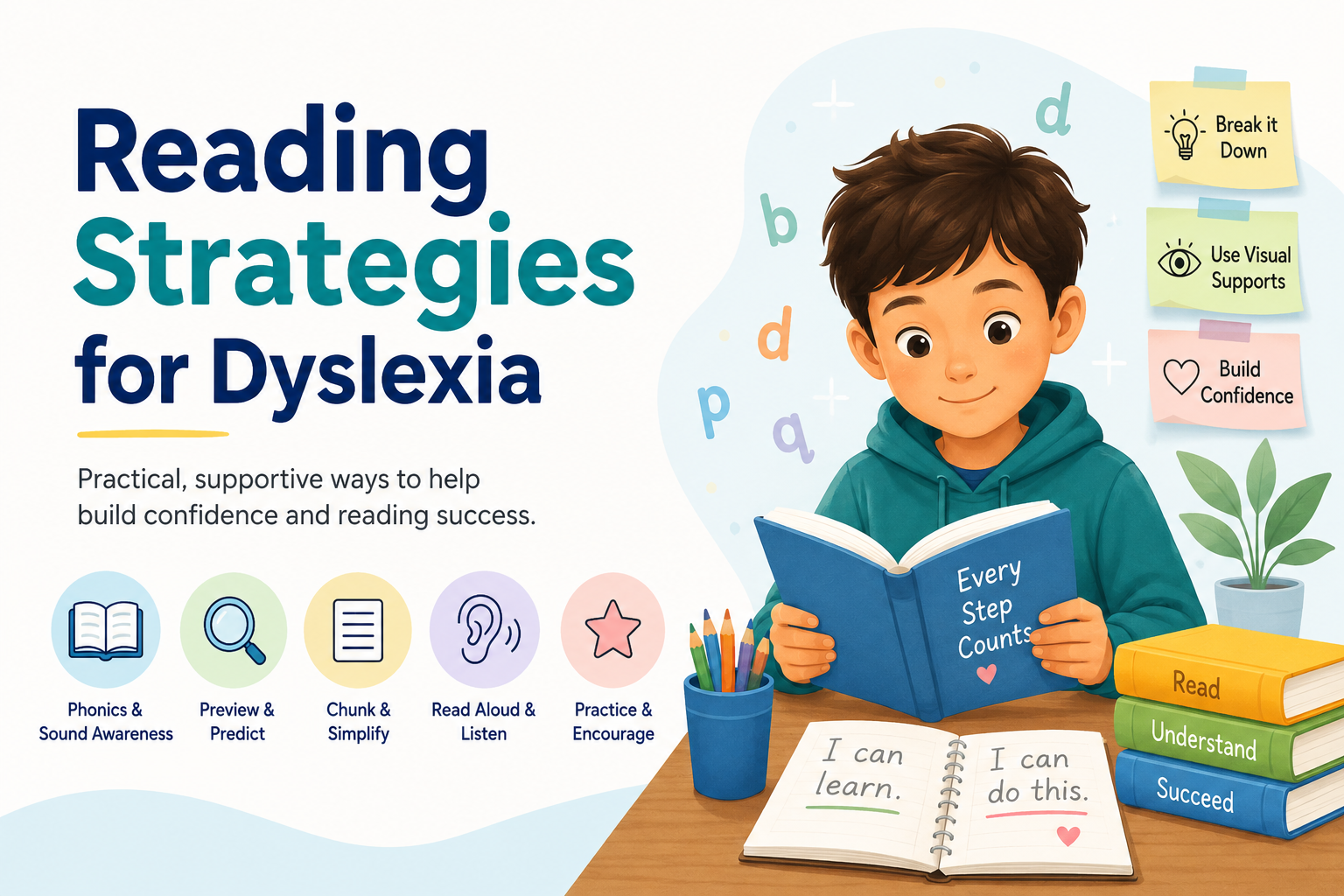
Reading Strategies for Dyslexia: 2026 Evidence-Based Guide for Parents and Teachers 💛
📖 74% of poor readers in 3rd grade stay behind in high school — unless the right reading strategies for dyslexia are used. This 2026 complete guide reveals every evidence-based technique that actually works. 💛👇

- 🌟 What Are the Best Reading Strategies for Dyslexia?
- 📊 Dyslexia and Reading — The Statistics That Drive Urgency
- 🧠 Why Standard Reading Strategies Don’t Work for Dyslexia
- 🏗️ The Structured Literacy Framework — The Foundation of All Reading Strategies for Dyslexia
- 📚 Complete Reading Strategies for Dyslexia — Skill by Skill
- Strategy Set 1: Phonological Awareness Strategies 🔊
- Strategy Set 2: Phonics and Decoding Strategies 🔡
- 2.1 The Orton-Gillingham (OG) Approach
- 2.2 Decodable Texts — A Critical and Often Missed Strategy
- 2.3 The Elkonin Box (Sound Box) Method
- Strategy Set 3: Multisensory Reading Strategies for Dyslexia 🤲
- 3.1 Finger Tracing on Textured Surfaces
- 3.2 Air Writing
- 3.3 Colour-Coding Phonics Patterns
- 3.4 Body Movement for Phonics Rules
- Strategy Set 4: Reading Fluency Strategies 📖
- 4.1 Repeated Reading (RR)
- 4.2 Echo Reading
- 4.3 Partner Reading with Corrective Feedback
- 4.4 Phrase-Cued Reading
- Strategy Set 5: Vocabulary Strategies for Dyslexic Readers 🗣️
- Strategy Set 6: Reading Comprehension Strategies for Dyslexia 🧩
- 🛠️ Reading Strategies for Dyslexia at Home — A Parent’s Practical Guide
- 💡 The Technology Layer — Reading Strategies for Dyslexia in 2026
- 🏫 Classroom Reading Strategies for Dyslexia — What Teachers Should Implement
- ❓ FAQs — Reading Strategies for Dyslexia 2026
- Q1: What are the most effective reading strategies for dyslexia?
- Q2: What is structured literacy and how is it different from whole language?
- Q3: At what age should reading strategies for dyslexia begin?
- Q4: How long does it take to see progress with reading strategies for dyslexia?
- Q5: Should children with dyslexia use audiobooks instead of reading?
- Q6: What is the Orton-Gillingham approach?
- Q7: What reading strategies for dyslexia can parents use at home?
- Q8: Are decodable books necessary for children with dyslexia?
- Q9: What should a dyslexia reading intervention session look like?
- Q10: Is dyslexia related to intelligence?
- 💛 Final Words: The Strategy That Changes Everything Is Consistency
🌟 What Are the Best Reading Strategies for Dyslexia?
Reading strategies for dyslexia are specialised, evidence-based instructional techniques that address the phonological processing deficits at the core of the condition — and the research is clear about what works.
The most effective reading strategies for dyslexia are those within the structured literacy framework: explicit, systematic, cumulative instruction in phonological awareness, phonics, decoding, fluency, and comprehension, delivered through multisensory techniques. With timely, well-implemented support, success rates for achieving grade-level reading can reach 90–95%.
This guide gives you every major reading strategy for dyslexia — organised by skill area, backed by current research, with practical examples your child’s teacher can implement tomorrow and strategies parents can use at home today.
📊 Dyslexia and Reading — The Statistics That Drive Urgency
| Statistic | Data | Source |
|---|---|---|
| Global prevalence of dyslexia | 20% of the population has dyslexia — 1 in 5 people; up to 700 million people globally have some degree of dyslexia | WifaTalents Dyslexia Report, February 2026 |
| Dyslexia as % of all learning disabilities | Dyslexia affects 80–90% of all individuals with learning disabilities — the most common LD | WifaTalents, 2026 |
| Poor readers in 3rd grade | 74% of children who are poor readers in 3rd grade remain poor readers through high school without effective intervention | WifaTalents, 2026 |
| Early intervention impact | Early intervention programmes (ages 5–9) can reduce reading gaps by 40–60% for dyslexic students | WorldMetrics Dyslexia Statistics, 2026 |
| Success rate with proper intervention | With timely support, the success rate for achieving grade-level reading can soar to 90–95% | Mastermind Behavior, 2025 |
| Students formally diagnosed in schools | Only about 1 in 4 students with dyslexia are formally diagnosed in schools, leading to a significant gap in support | Mastermind Behavior, 2025 |
| Genetic risk factor | There is a 40–60% chance of a child having dyslexia if a parent has it; genes account for 40–70% of the risk | WifaTalents, 2026 |
| Dropout rate with dyslexia | The dropout rate for individuals with dyslexia can reach as high as 35% — significantly above the national average | Mastermind Behavior, 2025 |
| OG-based outcomes | Orton-Gillingham-based interventions produce significant gains in word reading, spelling, and reading comprehension | PRIDE Reading Program / Annals of Dyslexia |
| Progress timeline | Most students show measurable progress within 6–12 weeks of consistent, targeted structured literacy instruction | PRIDE Reading Program, June 2026 |
🧠 Why Standard Reading Strategies Don’t Work for Dyslexia
Before implementing the right reading strategies for dyslexia, it is essential to understand why standard approaches fail.
Dyslexia is a neurobiological condition — not a vision problem, not laziness, not limited intelligence. Functional MRI studies show reduced activity in the left occipitotemporal cortex (the brain’s “word form area”) during reading tasks in dyslexic individuals. Brain scans show people with dyslexia use the right hemisphere more for reading tasks than neurotypical readers. (Source: WifaTalents, 2026)
Standard whole-language approaches — where children are expected to recognise words as units, predict from context, or learn to read through exposure — rely on the very neural pathways that function differently in dyslexic children.
The most common ineffective approaches:
| Ineffective Approach | Why It Fails for Dyslexia |
|---|---|
| Whole language / balanced literacy | Relies on pattern recognition in the word form area — exactly where dyslexic brains are most different |
| “Reading more will fix it” | More exposure to text the child cannot decode increases frustration, not skill |
| Look-say / sight word memorisation only | Without phonics, the child cannot decode unfamiliar words — reading ceiling is permanent |
| Timed reading without fluency support | Dyslexic readers are slower by neurology, not effort — timing without support creates shame |
| Context guessing strategies | “Use the picture” or “use the first letter and guess” masks poor decoding without fixing it |
Research shows that students with dyslexia benefit most from structured literacy approaches that explicitly teach the building blocks of language. These interventions are explicit, systematic, cumulative, and diagnostic. (Source: HMH — Evidence-Based Dyslexia Strategies, February 2026)
🏗️ The Structured Literacy Framework — The Foundation of All Reading Strategies for Dyslexia
All effective reading strategies for dyslexia fall within the structured literacy framework — a research-validated approach endorsed by the International Dyslexia Association. Structured literacy breaks reading and writing into teachable components so students can build skills in a logical sequence rather than relying on guessing or memorising.
The Six Components of Structured Literacy
| Component | What It Is | Why It Matters for Dyslexia |
|---|---|---|
| Phonological Awareness | Awareness of sound structure of spoken language | The earliest and most foundational reading skill; deficits here are the core of dyslexia |
| Phonics | The systematic relationship between letters and sounds | Decoding ability — the mechanism that makes reading possible |
| Fluency | Automatic, accurate reading at an appropriate pace | Frees cognitive resources for comprehension |
| Vocabulary | Word meaning knowledge | Comprehension depends on knowing what words mean |
| Morphology | The study of word parts — prefixes, suffixes, roots | Enables reading and understanding complex words |
| Comprehension | Understanding and extracting meaning from text | The ultimate purpose of reading |
The Four Principles That Define Good Structured Literacy
- Explicit — Nothing is left to inference. Each skill is directly taught.
- Systematic — Skills are taught in a defined, logical sequence from simple to complex.
- Cumulative — Each new skill builds on previously mastered skills.
- Diagnostic — Teaching is adjusted based on ongoing assessment of what the child knows.
📚 Complete Reading Strategies for Dyslexia — Skill by Skill

Strategy Set 1: Phonological Awareness Strategies 🔊
Phonological awareness is the ability to hear, identify, and manipulate the sound structure of spoken language — independently of its meaning or spelling. It is the single strongest predictor of reading success, and deficits in phonological awareness are the primary cause of dyslexic reading difficulty.
Evidence-based phonological awareness reading strategies for dyslexia:
1.1 Phoneme Segmentation
What it is: Breaking spoken words into their individual sounds (phonemes).
How to do it:
- Say a word slowly: “cat” = /k/ /a/ /t/
- Start with simple CVC words (cat, dog, run) and progress to CCVC (stop, plan) and beyond
Practice script: “I’m going to say a word. You push a button for every sound you hear. Ready? The word is… ‘ship.'” (Child should push 3 buttons: /sh/ /i/ /p/)
1.2 Phoneme Blending
What it is: Combining individual sounds to form a word.
How to do it:
- Say sounds in isolation with a 1-second pause: “/m/… /a/… /p/…”
- Ask: “What word did I say?”
- Build from 3-sound words to 5-sound words
Partner game: One person segments, the other blends — can be played in the car, at the dinner table, anywhere.
1.3 Onset-Rime Activities
What it is: Recognising that words share a pattern — the “rime” (the vowel + what follows).
How to do it:
- Sort picture cards by rime pattern
- Build a “word ladder” by changing only the onset: cat → bat → hat → mat
Strategy Set 2: Phonics and Decoding Strategies 🔡
Decoding — the ability to sound out words by connecting letters to sounds — is the engine of reading. Students with dyslexia often need additional support with phonics, so instruction must be explicit and sequential with opportunities for adequate practice. (Source: HMH, February 2026)
2.1 The Orton-Gillingham (OG) Approach
Orton-Gillingham is the foundational evidence-based programme for reading strategies in dyslexia. It is structured, sequential, multisensory (visual, auditory, and kinesthetic), and individually paced.
Core OG principles:
- Teach phoneme-grapheme relationships explicitly — one at a time, with practice to mastery
- Review previously learned concepts in every session before introducing new ones
- Use all three sensory pathways simultaneously
- Never move forward until the current skill is automatic
The OG teaching sequence (simplified):
- Short vowels (a, i, o, u, e) with CVC words
- Consonant blends (st, bl, cr)
- Consonant digraphs (sh, ch, th, wh)
- Long vowels — silent e (CVCe pattern)
- Vowel teams (ai, ee, oa)
- R-controlled vowels (ar, er, ir, or, ur)
- Diphthongs (oi, oy, ou, ow)
- Multisyllabic words — syllable types and division rules
- Prefixes, suffixes, and roots
2.2 Decodable Texts — A Critical and Often Missed Strategy
Decodable texts are books written specifically to include only phonics patterns the student has already been taught. These are not the same as “levelled readers” — which are selected based on the assumption that children will use context and pictures to compensate for unknown words.
A student using decodable texts:
- Reads every word using the phonics knowledge they have learned
- Gets repeated practice with target phonics patterns in connected text
- Builds confidence because the text is within their current ability to decode
A common mistake: Sending a child with dyslexia home with “just right” levelled readers that are beyond their decoding level. The child cannot read these books through phonics — they are guessing, predicting, or memorising. This is not reading practice; it is an endurance test.
2.3 The Elkonin Box (Sound Box) Method
The Elkonin box method is one of the most powerful reading strategies for dyslexia at the phoneme-grapheme level:
- Draw 3–5 boxes on a card (one box per sound in the target word)
- Say the word slowly; the student places a letter tile or pushes a counter into each box for each sound
- Then read the word back, blending left to right
- Reverse: write the word as you segment (spelling and reading trained simultaneously)
Strategy Set 3: Multisensory Reading Strategies for Dyslexia 🤲
Multisensory reading approaches combine visual, auditory, and kinesthetic-tactile input to help the brain form stronger connections between sounds and letters. These techniques work because they create redundant neural pathways — meaning even when one processing route is weak, others can compensate. (Source: PRIDE Reading Program, June 2026)
3.1 Finger Tracing on Textured Surfaces
What it is: The student traces letters in sand, salt, a textured mat, or a rough surface while simultaneously saying the letter name and sound.
The triple-input rule: Say the letter name — say the sound — feel the shape. All three at the same time.
Research basis: Kinesthetic engagement activates motor memory pathways — providing an additional route to store and retrieve letter-sound associations independent of the auditory or visual routes.
3.2 Air Writing
What it is: The student writes letters and words in the air using their whole arm — large, sweeping movements while saying the sounds aloud.
Why it works: Large motor movements engage proprioceptive memory differently from writing on paper. The arm, shoulder, and body muscle systems add a fourth sensory channel to the learning experience.
3.3 Colour-Coding Phonics Patterns
What it is: Each phonics pattern or vowel type is consistently represented in the same colour across all materials.
Example system:
- Short vowels → red
- Long vowels → blue
- Vowel teams → green
- R-controlled vowels → orange
Practice: When marking up a passage for reading, the student highlights each vowel pattern in its designated colour before reading aloud. This activates visual attention to the specific patterns that govern decoding.
3.4 Body Movement for Phonics Rules
What it is: Attaching a specific body movement to a phonics rule or sound to create kinesthetic memory.
Examples:
- Short /a/ sound → tap the desk twice, quickly
- Long /a/ sound → draw a long, slow line in the air
- Digraph “sh” → put finger to lips (the “quiet” sound)
Strategy Set 4: Reading Fluency Strategies 📖
Fluency is the bridge between decoding and comprehension. A student who reads slowly — even if they decode accurately — is spending most of their cognitive resource on word identification, leaving little capacity for meaning-making. Fluency strategies are therefore among the most important reading strategies for dyslexia beyond the early stages.
4.1 Repeated Reading (RR)
What it is: The student reads the same short passage multiple times until they reach a target fluency level (measured in words correct per minute — WCPM).
Research support: Repeated reading is one of the most extensively researched fluency interventions in the special education literature, showing consistent gains in both fluency and comprehension.
How to implement:
- Select a passage at the student’s instructional level (90–94% accuracy in initial reading)
- Time the first read and record WCPM and error count
- Read the same passage up to 4 times across the session or the week
- Record progress after each reading
Goal: Each repeated reading should show measurable improvement. If it does not, the passage is too hard or the student has insufficient phonics foundations to decode that level of text.
4.2 Echo Reading
What it is: The teacher or parent reads a sentence aloud; the student immediately reads the same sentence back, imitating the phrasing and expression.
Why it works: Echo reading provides a fluent model for the student to imitate — building prosody (the rhythm and expression of fluent reading) alongside accuracy and pace.
Progression: Start with sentence-level echo reading → move to paragraph-level → eventually whole-passage echo reading.
4.3 Partner Reading with Corrective Feedback
What it is: Two students read together — one slightly stronger reader, one with dyslexia. The stronger reader reads first; the struggling reader reads the same passage second. The stronger reader gives immediate, gentle corrective feedback.
Critical rule: Corrective feedback must be immediate (within 3 seconds of the error), non-punitive, and followed by the student re-reading the corrected word in context.
4.4 Phrase-Cued Reading
What it is: Passages are marked with slashes to show natural phrase boundaries — helping the student group words into meaningful units rather than reading word-by-word.
Example: “The big dog / ran across the yard / and jumped over the fence.”
Reading in phrases dramatically improves comprehension by showing the student how words cluster into meaning units.
Strategy Set 5: Vocabulary Strategies for Dyslexic Readers 🗣️
Reading vocabulary and listening vocabulary develop differently in children with dyslexia. Because dyslexic students read less due to their decoding difficulty, they encounter fewer words in print — which can slow vocabulary growth over time. Vocabulary instruction is therefore a critical component of comprehensive reading strategies for dyslexia.
5.1 Explicit Vocabulary Pre-Teaching
What it is: Before reading a passage, 5–10 key vocabulary words are explicitly taught — their meaning, a student-friendly definition, examples and non-examples.
The “Frayer Model” for vocabulary:
- Centre of a divided card: the word
- Top left: definition in own words
- Top right: characteristics or features
- Bottom left: examples
- Bottom right: non-examples
5.2 Morphology Instruction — Understanding Word Parts
For older students (grades 3+), morphology instruction is one of the highest-leverage reading strategies for dyslexia because it unlocks the meaning of thousands of words simultaneously.
Example: Learning the root rupt (meaning “break”) unlocks: disrupt, interrupt, rupture, erupt, bankrupt, abrupt.
Teaching sequence:
- Prefixes (un-, re-, pre-, dis-, mis-)
- High-frequency suffixes (-tion, -ment, -ful, -less, -ly)
- Latin roots (struct, port, rupt, vis, aud)
- Greek roots (phon, graph, bio, geo)
Strategy Set 6: Reading Comprehension Strategies for Dyslexia 🧩
A frequently overlooked dimension of reading strategies for dyslexia is comprehension. Many programmes focus exclusively on decoding and fluency — but comprehension strategies are equally important, particularly as students reach the middle grades.
Effective interventions for reading comprehension difficulties involve training to promote oral language skills and text comprehension strategies, with vocabulary instruction being a particularly important technique. (Source: PMC / Journal of Child Psychology and Psychiatry)
6.1 Text-to-Speech and Audiobooks for Comprehension Access
An important distinction: using audiobooks and text-to-speech is not a substitute for decoding instruction. However, it provides access to grade-level content and comprehension experiences while decoding skills develop.
Recommended platforms:
- Learning Ally — learningally.org — human-read audiobooks for students with dyslexia
- Microsoft Immersive Reader — built into Microsoft 365; reads text aloud with dyslexia-friendly formatting
6.2 Graphic Organizers for Text Structure
Dyslexic students often have strong oral comprehension but struggle to extract and organise information from text. Graphic organisers provide a visual framework that scaffolds this process.
Types:
- Cause-and-effect map
- Sequencing organiser (story map)
- Compare-and-contrast Venn diagram
- Main idea + supporting details web
6.3 The “Stop and Think” Strategy
What it is: The student stops at pre-marked points in the text — usually every paragraph — and answers three questions before continuing:
- What happened in this section?
- Is there any word I don’t understand?
- What do I predict will happen next?
This metacognitive strategy catches comprehension failures immediately — rather than at the end of the passage.
🛠️ Reading Strategies for Dyslexia at Home — A Parent’s Practical Guide
OT-like embedding of reading strategies for dyslexia into daily life is one of the most powerful things a parent can do between tutoring sessions.
The 15-Minute Daily Home Reading Programme
Minutes 1–3: Phonological awareness warm-up (phoneme segmentation or blending game)
Minutes 4–9: Decodable text reading aloud — the student reads; the parent listens and provides immediate, gentle corrective feedback
Minutes 10–12: Phonics word reading — the student reads a list of 15–20 words targeting the current phonics pattern
Minutes 13–15: Spell it back — the parent dictates 5 of the same words; the student spells them without looking
Consistency principle: 15 minutes every day produces better outcomes than 45 minutes twice a week. Frequency matters more than duration.
💬 A Parent’s Experience
“My daughter Arya was in second grade and reading at a kindergarten level. Her school was giving her levelled readers and ‘reading support’ that was not structured literacy. After her dyslexia diagnosis, we found an Orton-Gillingham tutor who worked with her twice a week.
But the tutor was clear: ‘What I do twice a week matters. What you do every day matters more.’ We did the 15-minute daily programme without fail for 10 months. By the end of third grade, Arya was reading at a second-grade level.
By the end of fourth grade, she was at grade level. She is now in sixth grade, reading above grade level, with a vocabulary that surprises her teachers. The consistency was everything.” — Nandini R., mother of a child with dyslexia, Bengaluru, India
💡 The Technology Layer — Reading Strategies for Dyslexia in 2026
Technology should never replace systematic, teacher-led instruction. Rather, it should extend learning opportunities and provide strategic support where needed. (Source: Australian Literacy and Numeracy Foundation via Learning and Literacy Clinic, 2025)
Evidence-Supported Technology for Dyslexia Reading Strategies
| Tool | What It Does | Best For |
|---|---|---|
| Lexia Core5 | Adaptive phonics and structured literacy progression | Grades K–5; school and home |
| Fast ForWord | Phonological processing training targeting specific deficits | Children with phonological processing difficulties |
| Nessy Reading & Spelling | OG-based games and structured sequence | Ages 5–12; home and school |
| Learning Ally | Human-voiced audiobooks for grade-level access | All grades; comprehension access |
| Bookshare | Free accessible books with text-to-speech | Students with qualifying disabilities |
| Microsoft Immersive Reader | Text spacing, font, background colour, read aloud | Any age; built into Microsoft 365 |
| Dyslexia Quest | Game-based phonological awareness | Ages 7–11 |
🏫 Classroom Reading Strategies for Dyslexia — What Teachers Should Implement
When teachers use approaches that are grounded in research, they can more easily pinpoint where a student needs more support, adjust instruction in real time, and provide scaffolded practice that leads to genuine progress. (Source: HMH, February 2026)
Non-Negotiable Classroom Accommodations
- ✅ Extended time on all reading and writing tasks
- ✅ Printed text read aloud using text-to-speech or a human reader for all assessments
- ✅ Dyslexia-friendly fonts — Open Dyslexic, Arial, or Verdana at 14pt minimum
- ✅ Coloured overlays or paper — reduces visual stress for some students
- ✅ Reduced copying from the board — pre-printed notes provided
- ✅ No timed reading tests — reading speed in dyslexia is neurological, not effort
- ✅ Decodable texts for independent reading — not levelled readers beyond decoding ability
- ✅ No round-robin reading — reading aloud unprepared in front of peers is profoundly shaming
❓ FAQs — Reading Strategies for Dyslexia 2026
Q1: What are the most effective reading strategies for dyslexia?
The most effective reading strategies for dyslexia are within the structured literacy framework — explicit, systematic phonological awareness and phonics instruction using multisensory techniques, delivered sequentially from simple to complex. Research shows these approaches, including Orton-Gillingham based programmes, produce significant gains in word reading, spelling, and reading comprehension. With proper intervention, success rates for grade-level reading can reach 90–95%. (Source: Mastermind Behavior, 2025)
Q2: What is structured literacy and how is it different from whole language?
Structured literacy explicitly teaches phonological awareness, phonics, fluency, vocabulary, morphology, and comprehension in a defined sequential progression. It is explicit (nothing is inferred), systematic (follows a defined sequence), cumulative (new skills build on mastered ones), and diagnostic (responsive to assessment data). Whole language approaches rely on exposure, context guessing, and pattern recognition — exactly the neural pathways that function differently in dyslexic brains. (Source: HMH, February 2026)
Q3: At what age should reading strategies for dyslexia begin?
As early as possible — ideally before formal reading instruction fails. Early intervention programmes for ages 5–9 can reduce reading gaps by 40–60%. Phonological awareness can be developed from age 4–5 before formal reading begins. The earlier structured literacy support begins, the better the outcomes. However, research confirms that intervention is effective at any age — older students and adults with dyslexia also respond to structured literacy instruction.
Q4: How long does it take to see progress with reading strategies for dyslexia?
Most students show measurable progress within 6–12 weeks of consistent, targeted structured literacy instruction. However, closing a significant reading gap takes longer — typically months to years of intensive intervention. Early identification and daily consistent practice are the strongest predictors of rate of progress. (Source: PRIDE Reading Program, June 2026)
Q5: Should children with dyslexia use audiobooks instead of reading?
Audiobooks and text-to-speech are invaluable for providing grade-level content access while decoding skills develop — they are not a substitute for reading instruction. Technology should extend learning opportunities, not replace systematic instruction. Use audiobooks for content learning; use structured literacy for building actual reading skill. Both are necessary and complementary.
Q6: What is the Orton-Gillingham approach?
Orton-Gillingham (OG) is a research-supported, multisensory structured literacy approach for teaching reading, spelling, and writing — specifically designed for people with dyslexia. It is explicit, sequential, and individualized. OG programmes teach phoneme-grapheme relationships directly and practice them through simultaneous visual, auditory, and kinesthetic-tactile pathways. It is the gold standard approach underlying most of the best-known dyslexia reading programmes. (Source: University of Michigan Dyslexia Help)
Q7: What reading strategies for dyslexia can parents use at home?
Parents can implement daily 15-minute sessions including: phonological awareness games (phoneme segmentation and blending), decodable text reading with immediate corrective feedback, phonics word list reading, and spelling dictation of the same words. Consistency matters more than duration — daily practice produces better outcomes than longer, infrequent sessions. Technology tools like Nessy, Lexia, and Learning Ally support home practice effectively.
Q8: Are decodable books necessary for children with dyslexia?
Yes — for children in the early stages of reading instruction. Decodable texts allow children to practise their phonics knowledge in connected text — using only the patterns they have been taught. Levelled readers that are beyond the child’s decoding ability require guessing and picture-dependence rather than true reading, which reinforces ineffective compensatory strategies rather than building actual reading skill.
Q9: What should a dyslexia reading intervention session look like?
A structured literacy session typically follows this sequence: (1) warm-up review of previously learned phonics patterns; (2) phonological awareness activity; (3) explicit introduction or review of one phonics pattern; (4) word-level practice reading and spelling; (5) connected text reading in decodable text; (6) dictation/spelling. The session is explicit, multisensory, and moves between reading and spelling as paired skills. Evidence-based programmes like Wilson, Barton, and PRIDE follow this session structure.
Q10: Is dyslexia related to intelligence?
No — dyslexia occurs across all intelligence levels and is not an indicator of cognitive ability. It is a neurobiological difference in how the brain processes phonological information — not a reflection of intelligence or effort. Many people with dyslexia demonstrate high ability in visual-spatial reasoning, creative problem-solving, and holistic thinking. Dyslexic brains show structural and functional differences in specific reading-related neural pathways — not in intelligence or potential.
💛 Final Words: The Strategy That Changes Everything Is Consistency
Every reading strategy for dyslexia in this guide is evidence-based. Every one of them works — when implemented correctly and consistently.
But the research is equally clear on what does not work: waiting for the child to “catch up” on their own; whole-language approaches that rely on visual memory and context; and levelled readers that send a struggling decoder home with books they cannot actually read through phonics.
The reading strategies for dyslexia that transform outcomes share four non-negotiable features: they are explicit, systematic, multisensory, and consistent. When these four elements are present — in a school programme, with a private tutor, or in a daily 15-minute home practice session — the research shows that 90–95% of children with dyslexia can reach grade-level reading.
Your child deserves that outcome. And you now have the roadmap to help them get there. 💛
🔗 Essential Resources
- 🌐 International Dyslexia Association (IDA) — Knowledge standards, research, practitioner directory
- 🌐 University of Michigan Dyslexia Help — Reading Programmes — Evidence-based programme database
- 🌐 HMH — Evidence-Based Dyslexia Strategies, February 2026
- 🌐 PRIDE Reading Programme — Structured literacy for teachers and parents
- 🌐 Learning Ally — Audiobooks for Dyslexia
- 🌐 Understood.org — Dyslexia Strategies and Resources
This article is written for educational and informational purposes only. For a formal evaluation and personalised reading strategy plan for a child with dyslexia, always consult a qualified educational psychologist, licensed reading specialist, or certified structured literacy interventionist.


