

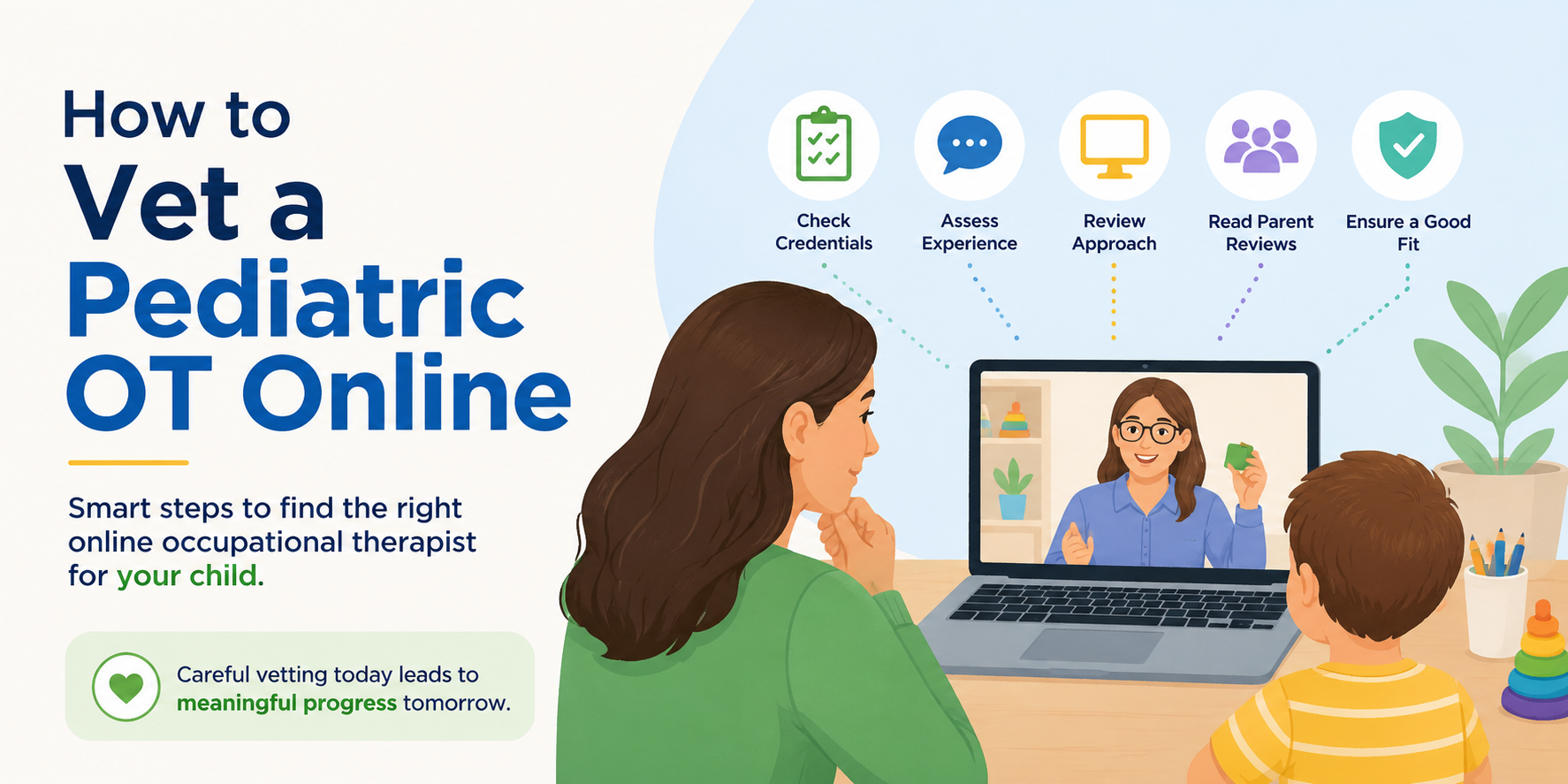
🔍 How to Vet a Pediatric OT Online: 2026 Parent Guide
Finding a qualified Pediatric OT online can feel overwhelming — especially when your child’s development depends on making the right choice. To vet a Pediatric OT online, you need to verify their license, confirm their pediatric specialisation, check their telehealth experience, review their approach to your child’s specific needs, and ask the right questions before booking a single session.
This guide walks you through every step. No guesswork. No wasted time. Just a clear, honest roadmap that puts your child first. 💛

- 💡 Why Vetting a Pediatric OT Online Matters More Than Ever
- 👩⚕️ What Is a Pediatric OT? (And Why “OT” Alone Is Not Enough)
- ✅ The 9-Step Vetting Framework for Pediatric OT Online
- 🔐 How to Verify a Pediatric OT’s Credentials and License
- 🚩 Red Flags to Watch For When Searching Online
- ❓ Key Questions to Ask Before Your First Session
- 🔬 Telehealth Pediatric OT: What the Research Actually Says
- 🔎 The Hidden Vetting Things You Must Not Skip
- 1. 🌐 Interstate Telehealth Licensing — The Gap Most Parents Never Check
- 2. 🧠 Supervision Status — Is the Person You See the Person in Charge?
- 3. 🔄 Platform Security — Not All Video Tools Are Appropriate
- 4. 📋 Written Treatment Plans — Your Legal Right in Many Countries
- 5. 🧩 Sensory Equipment at Home — Who Is Responsible?
- 💛 A Parent’s Story: How Getting It Wrong (Then Right) Changed Everything
- 📊 Statistics Every Parent Needs to Know
- 🏅 Specialist Certifications to Look For in a Pediatric OT
- ❓ FAQs About Vetting a Pediatric OT Online
- Q: How do I find a qualified Pediatric OT online?
- Q: What does OTR/L mean and why does it matter?
- Q: Can a Pediatric OT diagnose my child online?
- Q: How do I verify a Pediatric OT’s licence online?
- Q: Is telehealth Pediatric OT as effective as in-person?
- Q: How many sessions of Pediatric OT does my child need online?
- Q: What red flags should I watch for in an online Pediatric OT?
- Q: Do I need a referral to book a Pediatric OT online?
- 🔗 Trusted Resources to Help You Search
- 💙 Final Thoughts: The Right Pediatric OT Is Out There — Find Them Safely
💡 Why Vetting a Pediatric OT Online Matters More Than Ever
Online therapy has transformed access to care for families of children with special needs. That is genuinely wonderful. Families in rural areas, families with transport challenges, and families managing complex medical schedules can now access high-quality Pediatric OT services without leaving home.
But here is the reality that most parent-facing websites gloss over: not every therapist you find online is equally qualified — or equally qualified for your specific child.
Telehealth saw a 1,000% increase during COVID-19, and 62% of occupational therapy practitioners now incorporate some virtual services. That explosive growth brought enormous benefit — and also brought some providers with limited paediatric experience into online spaces they were not fully prepared for. (Source: Beaming Health — OT Statistics 2025)
Furthermore, over half of pediatric occupational therapists continue to use telehealth post-pandemic, according to a 2025 study in the International Journal of Telerehabilitation. The virtual space is here to stay. (Source: NIH PMC — Telehealth OT Post-COVID Study)
Your job as a parent is to use the tools in this guide to separate the truly excellent Pediatric OT providers from those who simply have a professional-looking website.
👩⚕️ What Is a Pediatric OT? (And Why “OT” Alone Is Not Enough)
An Occupational Therapist (OT) is a licensed healthcare professional who helps people perform the tasks of daily life. For children, those tasks include self-care (dressing, eating, toileting), fine and gross motor skills, sensory processing, handwriting, social participation, and play.
A Pediatric OT specifically focuses on children — from infancy through adolescence. This specialisation matters enormously. An occupational therapist trained primarily in adult rehabilitation (after strokes, surgeries, or workplace injuries) has a very different skillset from one trained in child development, neurodiversity, sensory integration, and early intervention.
Think of it this way: A cardiologist and a general practitioner are both doctors. But you would not ask a GP to perform heart surgery. Similarly, an OT who works primarily with elderly patients in hospitals is not the right fit for your three-year-old with sensory processing challenges.
When you search for a Pediatric OT online, you are not just looking for a licensed OT. You are looking for a licensed OT with genuine, documented experience working with children — ideally children whose needs match your child’s profile.
✅ The 9-Step Vetting Framework for Pediatric OT Online
This is the framework most parents wish they had found before booking their first session. Work through each step in order. Do not skip any. 📋
| Step | What to Do | Why It Matters |
|---|---|---|
| 1 | Verify their licence online | Confirms legal authorisation to practise in your state or country |
| 2 | Confirm their NBCOT certification (US) | Verifies they passed national board exams |
| 3 | Check for paediatric specialisation | Ensures they actually work with children, not just adults |
| 4 | Confirm telehealth training and experience | Online delivery requires specific skills beyond in-person therapy |
| 5 | Ask about experience with your child’s diagnosis | ADHD, autism, cerebral palsy, sensory processing — all require different approaches |
| 6 | Review their initial evaluation process | A thorough intake is a strong signal of quality |
| 7 | Ask about their goal-setting approach | Goals should be functional, measurable, and family-centred |
| 8 | Check for parent/caregiver involvement | The best Pediatric OT includes YOU in every session |
| 9 | Look for transparency about limitations | An honest therapist will tell you when telehealth is not the right fit |
Let us now walk through the most important of these steps in detail.
🔐 How to Verify a Pediatric OT’s Credentials and License
This is the single most important step — and it takes less than five minutes. Here is exactly how to do it.

🇺🇸 In the United States
Step 1: Verify NBCOT Certification
The National Board for Certification in Occupational Therapy (NBCOT) is the gold standard for OT credential verification in the US. Every licensed OT in the US must pass the NBCOT exam. You can verify any therapist’s credentials for free here:
👉 NBCOT Credential Verification Tool — Enter the therapist’s name and instantly confirm their certification status, expiry date, and any disciplinary history.
Step 2: Verify Their State Licence
NBCOT certification is national — but OTs must also hold a valid state licence to practise in each state they serve clients in. For telehealth, this typically means they need a licence in your state (where your child is physically located during sessions), not just theirs.
Use this comprehensive directory to find your state’s licence verification tool: 👉 HealthGuideUSA — OT Licence Lookup by State
What to look for when you search:
- ✅ Active licence status
- ✅ No disciplinary actions or suspensions
- ✅ Licence expiry date is current
- ✅ Licence type matches “Occupational Therapist” (not “OT Assistant” unless appropriate)
🇬🇧 In the United Kingdom
In the UK, OTs must be registered with the Health and Care Professions Council (HCPC). You can verify registration here: 👉 HCPC Register Check
Additionally, many UK-based Paediatric OTs are members of the Royal College of Occupational Therapists (RCOT). Membership indicates commitment to continuing professional development, though it is not a legal requirement.
🌍 Outside the US and UK
Ask the therapist directly which regulatory body governs their licence. Then visit that body’s website independently — do not rely on a link provided by the therapist — and verify for yourself.
🚩 Red Flags to Watch For When Searching Online
Unfortunately, not everything you find online is trustworthy. Here are the warning signs that should make you pause — or walk away entirely.
❌ Red Flags in a Pediatric OT’s Online Profile
- Vague or generic credentials — “Certified Child Therapist” or “Developmental Specialist” are not the same as a licensed Occupational Therapist
- No mention of supervised clinical hours — A qualified OT has completed hundreds of supervised hours; this should be part of their background
- They cannot name the regulatory body that governs them — This is a basic professional literacy issue
- Only works via WhatsApp, Facebook Messenger, or unencrypted video calls — Legitimate telehealth must be HIPAA-compliant (US) or GDPR-compliant (EU/UK)
- Promises specific outcomes or “cures” — No honest, qualified therapist makes guaranteed promises about a child’s progress
- No formal intake/evaluation process — Jumping straight to sessions without assessing your child first is a significant quality concern
- No parent involvement in sessions — Research consistently shows that the best Pediatric OT telehealth actively includes caregivers
- Heavily sales-focused first contact — Pressure to commit to packages before you have met is a warning sign
⚠️ Red Flags in Telehealth Platforms
- No HIPAA-compliant or GDPR-compliant platform disclosure
- No secure consent process before sessions begin
- Unable to tell you which state(s) they are licenced in
- No written treatment plan or goal documentation offered
❓ Key Questions to Ask Before Your First Session
Before you book anything, schedule a free consultation call. Most qualified Pediatric OT providers offer this — and if they do not, that itself is worth noting. Here are the most important questions to ask: 🗣️
About Credentials and Experience:
- “How many years have you worked specifically with children?”
- “Have you worked with children who have [your child’s diagnosis]?”
- “What formal training have you done in telehealth delivery?”
About Their Approach:
- “How do you conduct your initial evaluation online?”
- “How do you involve me as a parent during sessions?”
- “What does a typical session plan look like for a child my child’s age?”
- “How do you measure progress over time?”
About Fit and Limitations:
- “Are there goals that you feel are better addressed in person than online?”
- “What would cause you to recommend we transition to in-person care?”
- “How do you handle a child who struggles with attention or screen engagement?”
A great Pediatric OT will answer every one of these questions clearly and without hesitation. They will also ask you a lot of questions — about your child’s daily life, sensory profile, communication style, and your family’s priorities. If the conversation feels one-sided, pay attention to that.
🔬 Telehealth Pediatric OT: What the Research Actually Says
Parents searching for online therapy deserve honest information about what the research supports — and what it does not yet fully confirm. Here is the current evidence-based picture.
✅ What Research Shows Telehealth Pediatric OT Does Well
Telehealth has been utilised across a variety of pediatric populations, including those with autism spectrum disorder, cerebral palsy, feeding difficulties, and ADHD. It has been implemented in school-based, early intervention, and outpatient settings. (Source: NIH PMC — Telehealth OT Post-COVID)
Research published on pediatric telehealth confirmed that parents who received occupation-based coaching via telehealth became more frequently engaged in child play activities and tried more skill-based activities in daily routines — outcomes that extended far beyond the session itself. (Source: Beaming Health / Sprypt)
The AJOT 2024 study by Davis, Cass, Marvizi, and Stone found that caregiver coaching and involvement — combined with clear communication between therapist, child, and family — were the primary predictors of effective pediatric OT telehealth outcomes. This means that when a Pediatric OT actively coaches you as a parent during sessions, the results are significantly better. (Source: AJOT 2024 via Sprypt)
Additionally, a 2024 paper in the American Journal of Occupational Therapy showed that Ayres Sensory Integration® — a core evidence-based approach for autism — can be meaningfully adapted for telehealth delivery, potentially bridging service gaps for families who face challenges accessing in-person services. (Source: AJOT — ASI Telehealth Adaptation)
⚠️ What Research Also Tells Us
- A scoping review noted that studies focused on narrower, targeted OT goals in pediatric telehealth tend to show the strongest outcomes — suggesting that session design specificity matters more than broad delivery-mode comparisons.
- Young children — particularly those under three — have naturally very short attention spans (around four minutes, per the Telehealth Resource Center’s 2024 OT Telehealth Toolkit). Sessions need to be highly structured and engaging.
- Some goals — particularly those requiring physical handling, sensory equipment, or close physical facilitation — are genuinely better served in person. An honest Pediatric OT will tell you this.
🔎 The Hidden Vetting Things You Must Not Skip
There are several critical areas that almost no one talks about Pediatric OT online. Here they are.
1. 🌐 Interstate Telehealth Licensing — The Gap Most Parents Never Check
This is arguably the most missed issue. For telehealth, the relevant licence is typically the one in your child’s state at the time of the session — not the therapist’s home state. Some therapists use interstate compacts or hold multiple licences to address this. Many do not.
What to ask: “Are you licenced in [your state]? If not, how are you legally authorised to provide telehealth services to my child here?”
If they cannot answer this clearly, that is a significant concern.
2. 🧠 Supervision Status — Is the Person You See the Person in Charge?
Some online platforms use OT Assistants (COTAs — Certified Occupational Therapy Assistants) rather than fully qualified OTs to deliver sessions. COTAs are valuable team members — but they must work under the supervision of a licensed OT, and that OT should be actively involved in your child’s treatment planning.
What to ask: “Will my child’s sessions be led by an OTR/L (registered, licensed OT) or a COTA? If a COTA, who is the supervising OTR/L, and how involved are they?”
3. 🔄 Platform Security — Not All Video Tools Are Appropriate
Many parents do not realise that using regular Zoom, FaceTime, or WhatsApp for therapy sessions may not meet legal HIPAA (US) or GDPR (UK/EU) requirements for health data privacy. A legitimate Pediatric OT will use a healthcare-specific, HIPAA-compliant platform.
What to ask: “What platform do you use for sessions, and is it HIPAA or GDPR compliant?”
4. 📋 Written Treatment Plans — Your Legal Right in Many Countries
In the US, if your child receives Pediatric OT services through school under IDEA (Individuals with Disabilities Education Act), you have legal rights to written goals, progress reports, and the opportunity to participate in plan development. Even for private online therapy, you should always receive a written treatment plan with measurable goals.
If a therapist cannot or will not provide this — that is a clear red flag.
5. 🧩 Sensory Equipment at Home — Who Is Responsible?
Good telehealth Pediatric OT often requires specific items at home — crash cushions, swings, textured materials, fidget tools, resistance bands. Ask in advance what you will need. A disorganised therapist who forgets to prepare you for sessions wastes your child’s therapy time.
💛 A Parent’s Story: How Getting It Wrong (Then Right) Changed Everything
Jirti’s son Dev was four years old when they started searching for a Pediatric OT online. Dev had sensory processing challenges and struggled enormously with dressing, transitions, and anything with unexpected textures.
“The first therapist I found had a beautiful website,” Kirti recalls. “She said she worked with ‘children and families.’ I never thought to check her licence. I never thought to ask how long she had worked specifically with sensory kids.”
Three sessions in, Kirti realised something was off. The therapist was doing activities that seemed designed for older children. She never asked Kirti to be part of the session. There was no written plan. When Kirti asked about progress goals, the therapist said she would “know them when we see them.
Dev was bored. Dev was dysregulated. The sessions were not working.
Kirti stopped. She went back to basics. She found this kind of guide. She verified credentials. She asked the right questions. She found a new therapist — an OTR/L with seven years of paediatric experience, specific training in sensory integration, and a clear, written treatment plan from day one.
“Within three months, Dev could dress himself with only minor support,” Kirti says. “He started tolerating his school uniform. We cried — actual happy tears — the first day he put his jumper on without a meltdown.”
The difference was not magic. It was the right therapist, found the right way.
📊 Statistics Every Parent Needs to Know
| Statistic | Figure | Source |
|---|---|---|
| OT telehealth growth during COVID-19 | 1,000% increase | Beaming Health — OT Statistics |
| % of OT practitioners now offering virtual services | 62% | Beaming Health — OT Statistics |
| % of pediatric OTs still using telehealth post-pandemic | Over 50% | NIH PMC — Telehealth OT Study 2025 |
| Improvement in fine motor skills within 6 months of OT | 65% of children show improvement | Beaming Health — OT Statistics |
| Technology-enhanced interventions improve home programme follow-through by | 31% | Beaming Health — OT Statistics |
| Caregiver involvement identified as primary predictor of telehealth OT success | Yes (AJOT 2024) | AJOT 2024 via Sprypt |
| Comprehensive initial evaluation reduces treatment duration by | Average 3.4 sessions | Beaming Health — OT Statistics |
| Standardised assessments improve treatment planning accuracy by | 45% | Beaming Health — OT Statistics |
🏅 Specialist Certifications to Look For in a Pediatric OT
Beyond the basic OTR/L licence, some Pediatric OT practitioners hold additional specialisation credentials. These are worth knowing about — but they are bonuses, not requirements.
| Credential | What It Means | Relevant For |
|---|---|---|
| BCP (Board Certified in Paediatrics) | Recognised paediatric specialisation from AOTA | Any child with developmental or physical needs |
| SIS (Sensory Integration and Praxis Tests certified) | Training in SI assessment and intervention | Sensory processing challenges, autism |
| SIPT (Sensory Integration Praxis Test certified) | Specific assessment qualification | Sensory processing evaluation |
| NDT / Bobath Certified | Neurodevelopmental treatment approach | Cerebral palsy, motor disorders |
| CEIS (Certified Early Intervention Specialist) | Focus on 0–3 years | Infants and toddlers with developmental concerns |
| DIR/Floortime trained | Relationship-based developmental approach | Autism, social-emotional development |
| PROMPT certified | Motor speech intervention | Children with speech and motor coordination challenges |
💡 Important note: A therapist without these additional certifications can still be excellent. What matters most is their core OTR/L licence, their genuine paediatric experience, and their specific knowledge of your child’s needs. Certifications support — they do not replace — clinical skill and experience.
❓ FAQs About Vetting a Pediatric OT Online
Q: How do I find a qualified Pediatric OT online?
Start by searching for an OTR/L (registered and licensed occupational therapist) who specifically lists paediatric experience on their profile. Then verify their licence through NBCOT.org (US) or your country’s equivalent regulatory body. Confirm they have telehealth training, ask about their experience with your child’s specific diagnosis, and schedule a free consultation before committing to sessions.
Q: What does OTR/L mean and why does it matter?
OTR/L stands for Occupational Therapist Registered and Licensed. “Registered” means they passed the NBCOT national board examination. “Licensed” means they hold a valid state licence to practise. Both are required for a legitimate Pediatric OT in the US. If someone calls themselves an “occupational therapist” online but cannot provide both credentials, investigate further before proceeding.
Q: Can a Pediatric OT diagnose my child online?
No. Occupational therapists do not diagnose conditions like autism, ADHD, or sensory processing disorder. They assess functional performance — how your child manages daily tasks — and provide therapy based on those findings. Diagnoses come from paediatricians, child psychologists, or developmental neurologists.
Q: How do I verify a Pediatric OT’s licence online?
In the US, visit NBCOT.org to check their national certification. Then search your state’s occupational therapy board to verify their state licence. A comprehensive directory of state licence verification tools is available at HealthGuideUSA.org. In the UK, use the HCPC Register.
Q: Is telehealth Pediatric OT as effective as in-person?
Research shows telehealth Pediatric OT is highly effective for many goals — particularly when sessions are structured around specific targets and actively include parents or caregivers as partners. Some goals requiring physical handling, sensory equipment, or close physical facilitation are better addressed in person. A qualified therapist will be transparent about this distinction.
Q: How many sessions of Pediatric OT does my child need online?
This depends entirely on your child’s specific needs, goals, and rate of progress. A well-qualified Pediatric OT will discuss this in the initial evaluation and revisit it regularly. Research suggests that a comprehensive initial evaluation reduces total treatment duration by an average of 3.4 sessions — so never skip that step. Always ask for a written treatment plan with measurable goals so you can track progress objectively.
Q: What red flags should I watch for in an online Pediatric OT?
Key red flags include: inability to share a verifiable licence number, no formal intake or evaluation process before starting sessions, no written treatment plan, using non-HIPAA-compliant video platforms, making guarantees about outcomes, not involving you as a parent in sessions, and being unable to explain their approach to your child’s specific challenges.
Q: Do I need a referral to book a Pediatric OT online?
In most cases, no — you can self-refer to a private Pediatric OT. However, if you are seeking services through insurance, Medicaid, or school-based programmes, a referral or IEP documentation may be required. Always check your insurance provider’s requirements in advance.
🔗 Trusted Resources to Help You Search
Here are the most authoritative starting points for finding and vetting a Pediatric OT online:
| Resource | What It Offers | Link |
|---|---|---|
| 🏅 NBCOT Credential Verification | Free verification of any US OT’s national certification | nbcot.org |
| 🗺️ AOTA OT Finder | Directory of licensed OTs in the US by specialisation | aota.org |
| 🇬🇧 HCPC Register | Free UK OT registration verification | hcpc-uk.org |
| 📋 OT Telehealth Toolkit (2024) | Free guide on best practice for OT via telehealth | Telehealth Resource Center |
| 📚 AOTA — OT Practice Framework | Official guide to OT scope and approach | aota.org |
| 🔬 NIH Telehealth OT Research | Post-pandemic study on paediatric OT telehealth | pmc.ncbi.nlm.nih.gov |
| 📝 SimplePractice — Paediatric OT Assessments | Guide to assessments usable in telehealth | simplepractice.com |
| 🌐 HealthGuideUSA — State OT Licence Lookup | Directory of all US state OT licence verification sites | healthguideusa.org |
💙 Final Thoughts: The Right Pediatric OT Is Out There — Find Them Safely
Searching for a Pediatric OT online is one of the most important decisions you will make for your child. The access that telehealth provides is genuinely life-changing for many families. But that access only delivers results when the therapist on the other side of the screen is truly qualified, truly paediatric-focused, and truly invested in your child’s specific journey.
Use the 9-step framework. Verify every licence. Ask every question. Trust your instincts when something feels off — and keep looking until it feels right.
Your child deserves the best. And with the right tools, you can find it. 💛
📝 This article is for informational and educational purposes only. It does not constitute medical or professional advice. Always consult qualified healthcare professionals for your child’s specific needs.


