

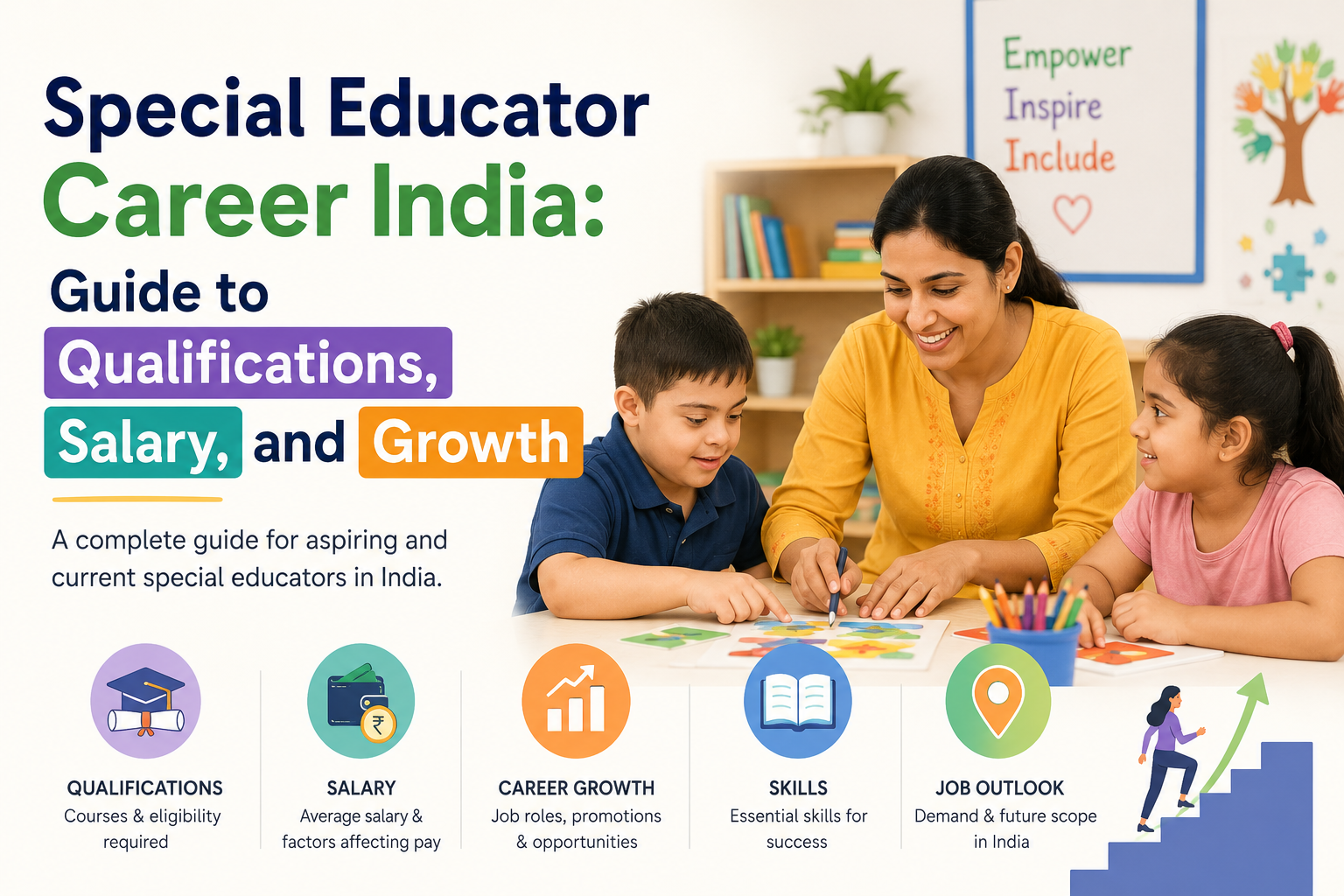
🎓 Special Educator Career India: 2026 Guide to Qualifications, Salary, and Growth
A special educator career in India is one of the most in-demand, socially impactful, and professionally rewarding paths available in 2026 — with government vacancies at an all-time high, salaries rising significantly under the 7th Pay Commission, and the full implementation of NEP 2020 making inclusive education a national priority. In short: if you are asking whether this is the right time to enter this field, the answer is yes.
This guide covers everything. Qualifications, salary, RCI registration, top colleges, government exams, growth paths, and the real stories behind the role. 💛

- 👩🏫 What Is a Special Educator in India — and Why the Role Has Changed
- 📊 The Numbers: India’s Disability Landscape and Career Demand
- 📚 Qualifications: The Complete Roadmap from Class 12 to RCI Registration
- 🔵 Step 1: Class 12 — Your Starting Point
- 🔵 Step 2: Choose Your Course Level
- 🔵 Step 3: Choose Your Specialisation Area
- 🔵 Step 4: Clear Entrance Examinations
- 🔵 Step 5: Register With the Rehabilitation Council of India (RCI)
- 🏛️ Top Courses and Colleges for Special Education in India
- 🏫 Government Jobs: Exams, Vacancies, and Salary in 2026
- 🔴 DSSSB Special Educator Recruitment 2026 (Delhi)
- 🟠 UP Special Educator Vacancy 2026
- 🟡 HPRCA Special Educator Recruitment 2025-26 (Himachal Pradesh)
- 🟢 Punjab Special Educator Recruitment 2025
- 💼 Private Sector and NGO Career Paths
- 💰 Salary Guide: What a Special Educator Actually Earns in India
- ☀️ Day in the Life: What This Career Genuinely Involves
- 🔍 What You Must Not Miss About This Career
- 1. 🧩 The IEP Is the Heart of the Job — and It Is Almost Never Discussed in Career Guides
- 2. 🌐 The International School Opportunity Is Massively Underreported
- 3. 🏛️ The Supreme Court Is Actively Strengthening This Career
- 4. 🎓 IGNOU Makes This Career Accessible From Anywhere
- 5. 🤝 Collaboration Skills Are as Important as Disability Knowledge
- 💙 A Teacher’s Story: Why She Chose This Path and Never Looked Back
- ❓ FAQs About Special Educator Career in India
- Q: What qualifications are needed for a special educator career in India?
- Q: What is RCI registration and why is it mandatory?
- Q: What is the salary of a special educator in India in 2026?
- Q: Is a special educator career in India a good choice in 2026?
- Q: Can a science or commerce student become a special educator in India?
- Q: What are the government exams for special educator jobs in India?
- 🔗 Trusted Resources for Aspiring Special Educators
- 💙 Final Thoughts: This Career Is a Calling — But It Is Also a Strong, Stable Profession
👩🏫 What Is a Special Educator in India — and Why the Role Has Changed
A special educator is a trained professional who works with children and young people who have disabilities — including autism, intellectual disability, visual impairment, hearing impairment, learning disabilities like dyslexia, and physical and multiple disabilities. Their work bridges the gap between a child’s potential and what the traditional education system is designed to deliver.
In 2026, the role has evolved significantly. The full implementation of the National Education Policy (NEP) 2020 and a heightened focus on Inclusive Education mean that special educators are no longer confined to segregated special schools. Today, they work as shadow teachers in mainstream classrooms, resource room teachers, IEP specialists, assistive technology coordinators, and inclusion consultants across a vast range of settings.
As one senior consultant in inclusive education and RCI Member described the evolution: “The future of Indian education is inclusive, not segregated. A special educator in 2026 is a ‘Learning Architect’ who doesn’t just teach a child, but re-engineers the entire classroom environment using assistive technology and Universal Design for Learning.” (Source: IndCareer — Career as a Special Educator 2026)
This shift has expanded the special educator career in India dramatically — in demand, in scope, and in professional recognition.
📊 The Numbers: India’s Disability Landscape and Career Demand
| Statistic | Figure | Source |
|---|---|---|
| DSSSB Special Educator Vacancies (2026) | 613 posts in one notification alone (out of 1,417 total teacher vacancies) | Adda247 — DSSSB Teacher Vacancy 2026 |
| Punjab Special Educator Vacancies (2025) | 725 posts (393 Primary + 332 Master Cadre) | PW Live — Punjab Special Educator 2025 |
| HPRCA Special Educator Vacancies (2025-26) | 270 posts in Himachal Pradesh | Testbook — HPRCA Special Educator 2026 |
| DSSSB TGT Special Educator Gross Salary | ₹80,000–₹85,000/month | Adda247 — DSSSB Teacher Vacancy 2026 |
| DSSSB PRT Special Educator Gross Salary | ₹68,000–₹73,000/month | Adda247 — DSSSB Teacher Vacancy 2026 |
| Punjab PRT Special Educator Salary | ₹29,200/month (Level 5, 7th Pay Commission) | PW Live — Punjab Special Educator 2025 |
| Punjab Master Cadre (TGT) Salary | ₹35,400/month (Level 6, 7th Pay Commission) | PW Live — Punjab Special Educator 2025 |
| Private school entry-level salary (India-wide) | ₹3.5–5 lakhs per year | Lingaya’s Vidyapeeth — Special Education Career Guide, 2026 |
| NEP 2020 mandate | Universal inclusive education — all schools must accommodate diverse learners | National Education Policy 2020 |
💡 What this means for you: Government vacancies for special educators are not scattered — they are being released in the hundreds, across multiple states, with urgent deadlines. The field is genuinely short-staffed and actively recruiting. If you are qualified and RCI registered, the job market is strongly in your favour.
📚 Qualifications: The Complete Roadmap from Class 12 to RCI Registration
This is the most important section for anyone beginning their special educator career in India. Here is the exact pathway, step by step.

🔵 Step 1: Class 12 — Your Starting Point
Students from any stream — Arts, Science, or Commerce — can enter the special education field. You need a minimum of 50% marks in Class 12 (45% for reserved categories) to be eligible for diploma and degree programmes.
🔵 Step 2: Choose Your Course Level
| Course | Duration | Level | Teaches You to Work With |
|---|---|---|---|
| D.Ed. Spl. Ed. (Diploma in Special Education) | 2 years | Primary level (Classes 1–5) | Students with intellectual disability, autism, visual or hearing impairment (depending on specialisation) |
| B.Ed. in Special Education | 2 years (after graduation) | Secondary level (Classes 6–10) | Broader age range; specialisation by disability area |
| M.Ed. in Special Education | 2 years (after B.Ed.) | Senior secondary, research, administration | Advanced therapeutic and research roles |
| PG Diploma in Special Education | 1 year | Supplementary qualification | Working professionals adding specialisation |
The most common and recommended pathway: Complete any graduation degree, then pursue a B.Ed. in Special Education from an RCI-approved college. (Source: Shiksha — How to Become a Special Educator in India)
🔵 Step 3: Choose Your Specialisation Area
Special education in India is divided into distinct disability-specific specialisations. Your B.Ed. or D.Ed. will be in one of these areas:
| Specialisation | Abbreviation | Disability Focus |
|---|---|---|
| Intellectual Disability | ID | Children with cognitive delays and intellectual disabilities |
| Visual Impairment | VI | Children who are blind or have low vision |
| Hearing Impairment | HI | Children who are deaf or hard of hearing |
| Learning Disability | LD | Dyslexia, dyscalculia, dysgraphia, and related conditions |
| Autism Spectrum Disorder | ASD | Children on the autism spectrum |
| Multiple Disabilities and Deafblindness | MD/DB | Children with two or more co-occurring disabilities |
Choosing the right specialisation is one of the most important decisions in your career. Talk to working special educators. Observe classrooms if possible. The day-to-day work varies significantly across specialisations.
🔵 Step 4: Clear Entrance Examinations
CUET (Common University Entrance Test): Used by many central and state universities for B.Ed. Special Education admissions.
State B.Ed. JEE: States like Uttar Pradesh, Maharashtra, and West Bengal conduct their own common entrance tests for B.Ed. seats. (Source: IndCareer — Career as a Special Educator 2026)
CTET / State TET: For government teaching positions, you must also qualify the Central Teacher Eligibility Test (CTET) for central government schools or your state’s equivalent Teacher Eligibility Test. This is mandatory for almost all government special educator recruitment notifications. (Source: DSSSB Eligibility Criteria — Testbook)
🔵 Step 5: Register With the Rehabilitation Council of India (RCI)
This is the most critical and non-negotiable step in a special educator career in India.
The Rehabilitation Council of India (RCI) is the statutory body under the Ministry of Social Justice and Empowerment that regulates all special education qualifications and practice in India. Registration with RCI and obtaining a CRR (Central Rehabilitation Register) number is mandatory to legally practise as a special educator anywhere in India.
Without RCI registration, you cannot:
- Apply for any government special educator position
- Legally work as a special educator in most private schools
- Call yourself a qualified special educator under Indian law
How to register with RCI:
- Complete your RCI-approved course (B.Ed. Spl. Ed. or D.Ed. Spl. Ed.)
- Apply for registration through the RCI official portal at rehabcouncil.nic.in
- Submit required documents including mark sheets, degree certificate, and identity proof
- Pay the registration fee
👉 Apply at: rehabcouncil.nic.in
🏛️ Top Courses and Colleges for Special Education in India
Choosing an RCI-approved institution is mandatory. Here are the most respected government institutes:
| Institute | Location | Specialisation | Website |
|---|---|---|---|
| NIEPID (National Institute for Empowerment of Persons with Intellectual Disabilities) | Secunderabad | Intellectual Disability | niepid.nic.in |
| AYJNISHD (Ali Yavar Jung National Institute of Speech and Hearing Disabilities) | Mumbai | Hearing Impairment, Communication Disorders | ayjnishd.gov.in |
| NIEPVD (National Institute for Empowerment of Persons with Visual Disabilities) | Dehradun | Visual Impairment | niepvd.nic.in |
| NIMH (National Institute for the Mentally Handicapped) | Secunderabad | Intellectual Disability | Part of NIEPID network |
| IGNOU — Special Education Distance Programmes | Pan-India | Multiple disability areas | ignou.ac.in |
| Sri Ramachandra Institute | Chennai | Multiple disability areas | sriramachandra.edu.in |
(Source: IndCareer — Career as a Special Educator 2026)
Additionally, IGNOU offers special education courses through distance learning — making the qualification accessible to working adults, those in smaller towns, and career changers who cannot relocate.
🏫 Government Jobs: Exams, Vacancies, and Salary in 2026
The special educator career in India’s government sector has seen explosive growth in 2026. Here is the current landscape of major recruitment drives:
🔴 DSSSB Special Educator Recruitment 2026 (Delhi)
The Delhi Subordinate Services Selection Board released notification 03/2026, recruiting 613 special educator positions out of 1,417 total teacher vacancies — making this one of the largest special education recruitment drives in recent history.
- TGT Special Educator: B.Ed. Special Education + CTET Elementary Stage + RCI registration
- PRT Special Educator (Primary): D.Ed. Special Education or equivalent + CTET Primary Stage + RCI registration
- Salary: TGT: ₹80,000–₹85,000/month gross | PRT: ₹68,000–₹73,000/month gross
- Application period: 16 June to 15 July 2026
- Selection: Single written examination (CBT) — no interview
These are among the highest entry-level packages in India’s teaching sector. (Source: Adda247 — DSSSB Teacher Vacancy 2026)
🟠 UP Special Educator Vacancy 2026
The UP Basic Education Department issued notification on 12 March 2026 — a Supreme Court-directed process for regularising contract special educators and opening fresh positions.
- Eligibility: RCI-approved qualifications + CTET or State TET + valid CRR number
- Documents required: RCI CRR certificate, appointment order, educational certificates
- Application: Via email submission to [email protected] (Source: Adda247 — UP Special Educator 2026)
🟡 HPRCA Special Educator Recruitment 2025-26 (Himachal Pradesh)
270 special educator vacancies across Himachal Pradesh government schools.
- Post: Special Educator for Classes VI–VIII
- Eligibility: Graduate + B.Ed. Special Education (RCI-recognised) + TET + RCI registration
- Exam Date: 27 May 2026 (Source: Testbook — HPRCA Special Educator)
🟢 Punjab Special Educator Recruitment 2025
725 vacancies across Punjab government schools.
- Primary Cadre Salary: ₹29,200/month (Level 5)
- Master Cadre Salary: ₹35,400/month (Level 6)
- All salaries per 7th Pay Commission (Source: PW Live — Punjab Special Educator 2025)
💼 Private Sector and NGO Career Paths
Government is not the only path. The special educator career in India’s private sector is also actively expanding. Here are the most common employment settings:
| Setting | What You Do | Approximate Salary Range |
|---|---|---|
| Private mainstream schools (inclusive model) | Resource room teaching, shadow teaching, IEP coordination | ₹3.5–8 lakhs/year |
| Special schools (disability-specific) | Full-time teaching, therapy coordination | ₹3–7 lakhs/year |
| NGOs (ASHA, CRY, HelpAge, local organisations) | Community-based rehabilitation, family counselling, outreach | ₹3–6 lakhs/year |
| Private therapy centres | One-to-one intervention, assessments | ₹4–9 lakhs/year |
| Online tutoring platforms | Remote special education support | ₹3–7 lakhs/year (highly variable) |
| Samagra Shiksha programme | Government scheme implementation in schools | State-determined contract rates |
| Corporate CSR programmes | Training and programme development | ₹5–12 lakhs/year (senior roles) |
| International schools | Inclusion coordination, IEP management | ₹6–18 lakhs/year |
| Teacher training colleges (B.Ed.) | Lecturing in special education methodology | ₹5–12 lakhs/year |
💰 Salary Guide: What a Special Educator Actually Earns in India
| Category | Setting | Monthly Salary | Notes |
|---|---|---|---|
| Entry level, private school | Delhi/Mumbai/Bangalore | ₹25,000–₹45,000 | With B.Ed. Spl. Ed. and RCI |
| Entry level, private school | Tier 2–3 cities | ₹15,000–₹25,000 | With D.Ed. or B.Ed. Spl. Ed. |
| Government PRT (Delhi) | DSSSB 2026 | ₹68,000–₹73,000 (gross) | 7th Pay Commission + allowances |
| Government TGT (Delhi) | DSSSB 2026 | ₹80,000–₹85,000 (gross) | 7th Pay Commission + allowances |
| Government (Punjab) | PRT Level | ₹29,200/month | Level 5 scale |
| Government (Punjab) | TGT Level | ₹35,400/month | Level 6 scale |
| Senior/experienced private | Metro cities | ₹50,000–₹90,000/month | 8–15 years experience |
| International school | Major metros | ₹60,000–₹1,50,000/month | English-medium, IB/CBSE |
| Private practice (consulting) | Any location | ₹500–₹2,000/session | Self-employed, varies widely |
The salary gap between government and private is significant at entry level. However, private metro positions — particularly in international schools or premium therapy centres — narrow this gap considerably with experience and additional certifications.
☀️ Day in the Life: What This Career Genuinely Involves
A final-year B.Ed. Special Education student described their typical day candidly: “Morning starts with one-on-one sensory sessions, followed by ‘shadow teaching’ in a mainstream classroom, and afternoons are spent collaborating with parents and speech therapists.” (Source: IndCareer, 2026)
A typical special educator career in India involves:
- Morning: Individual or small-group sessions targeting specific IEP goals — reading, number concepts, communication, self-care
- Mid-morning: Co-teaching or shadow teaching in a mainstream classroom — supporting inclusion, implementing accommodations
- Afternoon: IEP writing, progress documentation, preparing adapted materials for the next day
- Regular: Parent meetings, team meetings with speech therapists and occupational therapists, training classroom teachers on accommodation strategies
The honest reality: This career demands emotional resilience, patience, and genuine passion. The workload is significant. The paperwork can be heavy. And there are moments when progress is painfully slow.
But most special educators describe their work as irreplaceable. When a child who has never spoken says their first word — or a student who struggled for years finally reads a sentence independently — those moments are reported consistently as making the entire career worthwhile.
🔍 What You Must Not Miss About This Career
1. 🧩 The IEP Is the Heart of the Job — and It Is Almost Never Discussed in Career Guides
Most special educator career India guides focus entirely on qualifications and salary. Almost none explain that the Individualized Education Program (IEP) is the central professional document of the role — and that writing a good IEP, measuring progress against it, and communicating its contents to parents and school teams is where the majority of a special educator’s professional skill is exercised. Prospective students should understand this before entering the field.
2. 🌐 The International School Opportunity Is Massively Underreported
Very few career guides mention that international schools in India — following IB, Cambridge, or American curriculum frameworks — have significantly higher salaries and stronger professional development cultures for special educators than most domestic school settings. This career path requires English fluency and often an understanding of international inclusion frameworks, but represents a genuinely premium employment option for qualified candidates.
3. 🏛️ The Supreme Court Is Actively Strengthening This Career
The UP Special Educator vacancy 2026 was issued in compliance with a Supreme Court order — meaning the highest court in India is actively directing state governments to employ qualified special educators. This legal momentum significantly strengthens job security and career prospects in this field beyond what any education policy alone provides.
4. 🎓 IGNOU Makes This Career Accessible From Anywhere
Most career guides list elite residential institutes without acknowledging that IGNOU offers RCI-approved special education courses through distance learning — making this career path genuinely accessible to people in smaller towns, working adults, and career changers who cannot relocate. This is one of the most underreported access points into the field.
5. 🤝 Collaboration Skills Are as Important as Disability Knowledge
The modern special educator role — particularly in inclusive settings — requires as much skill in collaborating with classroom teachers, paediatricians, therapists, and parents as it does in direct teaching. Yet training programmes rarely prepare graduates for this collaborative dimension. Prospective students should actively seek programmes and placements that develop multidisciplinary team skills, not just classroom instruction.
💙 A Teacher’s Story: Why She Chose This Path and Never Looked Back
Divya had completed her B.Com and was working in a bank when her younger brother was diagnosed with autism at age four.
“I watched the therapists who worked with him,” she recalls. “I watched how they understood him differently. How they celebrated things that the rest of the world did not even notice. How he changed — slowly, but undeniably — in their hands.”
She quit the bank at 27. She enrolled in a B.Ed. Special Education (Autism) programme at an RCI-approved college in Pune.
“My family thought I was making a mistake,” she says honestly. “They talked about salary. They talked about status. And I understood. Those things matter.”
Five years later, Divya holds an RCI registration, a government teaching position in Delhi under DSSSB, and a gross monthly salary significantly higher than her banking role.
“But that is not actually the point,” she says. “The point is that this work is mine. When a child I have worked with for two years first looks me in the eye deliberately and says my name — Divya — I cannot explain what that is worth. It is not a number.”
She pauses.
“My brother is in a mainstream school now. He has an IEP. He has a special educator who sees him the way I once watched other educators see him. I know what that professional is doing for my family. And I know I am doing it for other families. That is enough. It is more than enough.”
❓ FAQs About Special Educator Career in India
Q: What qualifications are needed for a special educator career in India?
To begin a special educator career in India, you need Class 12 with at least 50% marks, followed by a D.Ed. in Special Education (for primary level) or a B.Ed. in Special Education (for secondary level) from an RCI-approved institution. You must also register with the Rehabilitation Council of India (RCI) and obtain a CRR number. For government positions, you additionally need CTET or State TET qualification.
Q: What is RCI registration and why is it mandatory?
RCI — the Rehabilitation Council of India — is the statutory body that regulates all special education practice in India. Registration with RCI and obtaining a Central Rehabilitation Register (CRR) number is legally mandatory for all practising special educators. Without RCI registration, you cannot apply for government positions or legally practise in most educational settings. Register through the official portal at rehabcouncil.nic.in.
Q: What is the salary of a special educator in India in 2026?
Government special educator salaries in India vary significantly by state and level. In Delhi (DSSSB 2026), TGT Special Educators earn ₹80,000–₹85,000 gross per month and PRT Special Educators earn ₹68,000–₹73,000 gross per month — among the highest in India. In Punjab, PRT level pays ₹29,200/month and TGT level pays ₹35,400/month under the 7th Pay Commission. Private school entry-level salaries range from ₹3.5–5 lakhs per year.
Q: Is a special educator career in India a good choice in 2026?
Yes — 2026 is one of the best years to enter a special educator career in India. Government vacancies are at a historic high, with hundreds of positions released across Delhi, Punjab, UP, Himachal Pradesh, and other states. NEP 2020’s inclusive education mandate is driving demand across private schools. Salaries under the 7th Pay Commission are competitive. And the social impact of this career is irreplaceable.
Q: Can a science or commerce student become a special educator in India?
Yes. Students from any stream — Arts, Science, or Commerce — are eligible to pursue a special educator career in India. The only requirement is Class 12 with at least 50% marks in aggregate, followed by a D.Ed. or B.Ed. in Special Education from an RCI-approved institution.
Q: What are the government exams for special educator jobs in India?
The main government recruitment pathways are: DSSSB (Delhi Subordinate Services Selection Board) for Delhi government school positions, state public service commissions or education recruitment boards for state government positions (such as Punjab, HP, UP), and Central Government school networks including KVS, NVS, and Army Public Schools. All require CTET or State TET certification in addition to RCI registration.
🔗 Trusted Resources for Aspiring Special Educators
| Resource | What It Offers | Link |
|---|---|---|
| 🏛️ Rehabilitation Council of India | Official RCI registration portal | rehabcouncil.nic.in |
| 🏥 NIEPID — Secunderabad | Premier national institute for intellectual disability | niepid.nic.in |
| 🔊 AYJNISHD — Mumbai | National institute for speech and hearing disabilities | ayjnishd.gov.in |
| 👁️ NIEPVD — Dehradun | National institute for visual disability | niepvd.nic.in |
| 📚 IGNOU — Special Education Programmes | Distance learning RCI-approved courses | ignou.ac.in |
| 📋 DSSSB Teacher Vacancy 2026 | Current government recruitment notification | adda247.com |
| 🎓 IndCareer — Special Educator Guide 2026 | Comprehensive career overview with entrance exam and college details | indcareer.com |
💙 Final Thoughts: This Career Is a Calling — But It Is Also a Strong, Stable Profession
A special educator career in India is not just meaningful work. In 2026, it is also a stable, growing, well-compensated profession with clear qualification pathways, strong government demand, legal protections, and a Supreme Court-backed policy environment actively supporting its growth.
If you are considering this path — whether you are a recent Class 12 graduate, a working professional seeking to change direction, or a parent of a child with special needs who has seen first-hand what this work can do — the timing is genuinely right.
The children who need you exist in every school, every town, every family in India. The law now requires that someone trained like you be there for them. And the profession has never been better positioned to reward that commitment with both meaning and a livelihood.
Start with Class 12 marks. Find an RCI-approved programme. Take the CTET. Register with RCI. And begin building a career that pays you in salary — and in moments no other profession can offer. 💛
📝 This article is for informational and educational purposes only. Salary figures, vacancy numbers, and eligibility criteria are based on publicly available 2025–2026 recruitment notifications and may change. Always verify current details directly with RCI, the relevant recruitment board, or the institution’s official website before making career decisions.


