

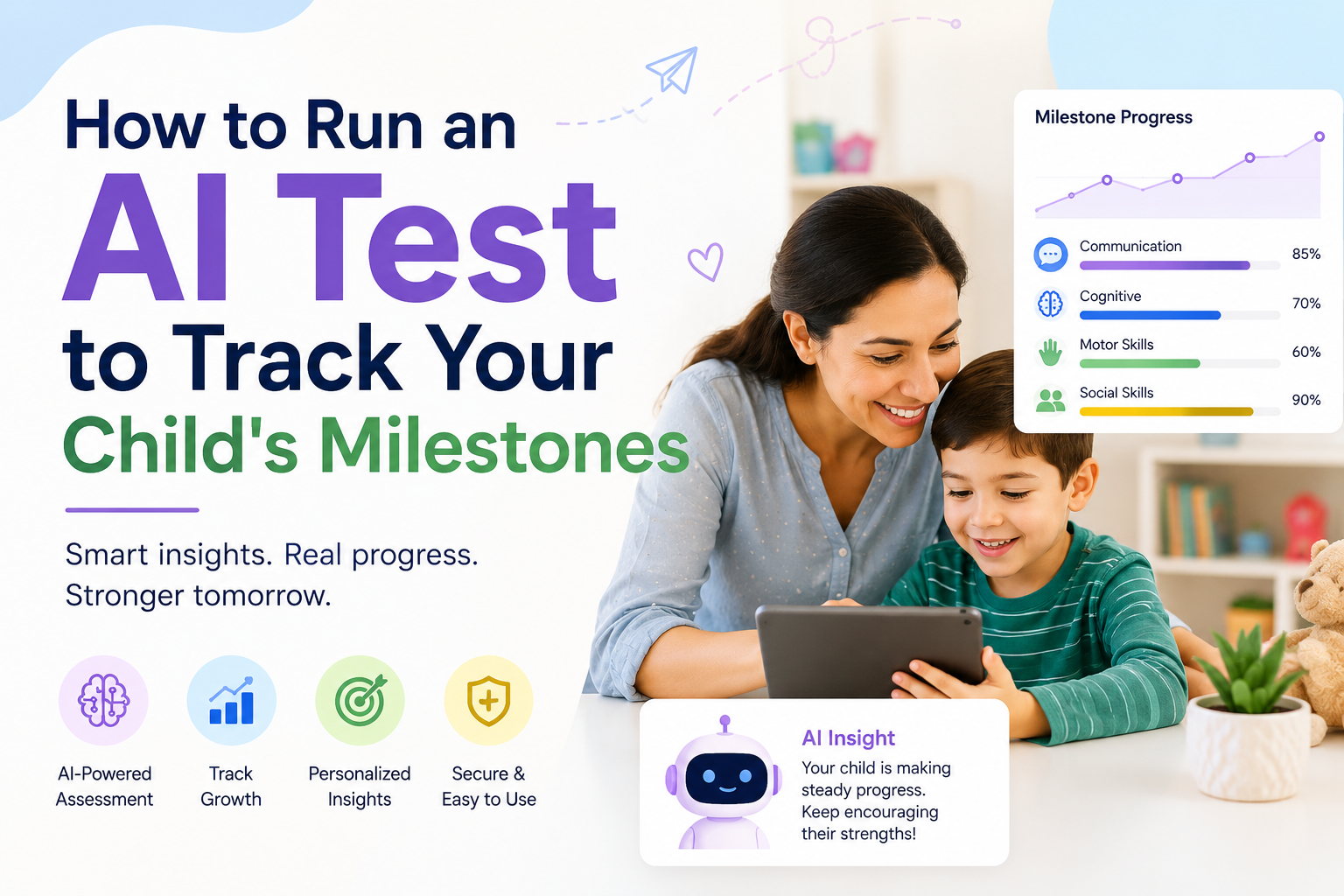
🧠 How to Run an AI Test to Track Your Child’s Milestones: 2026 Parent Guide
An AI test for tracking developmental milestones is a digital screening tool — ranging from structured questionnaires to home-video analysers — that helps parents gather objective, timestamped behavioural data before a formal clinical assessment for autism, ADHD, or developmental delay. These tools do not replace a diagnosis. But used correctly, they can meaningfully shorten the path to getting one.
This guide shows you exactly what exists, how to use it, and what to do with the results. 💛

- 💡 Why Parents Are Turning to AI Tests Before Clinical Assessments
- ⚠️ The Important Distinction: Screening vs. Diagnosis
- 📊 The Numbers: Developmental Screening Evidence and AI Accuracy
- 🛠️ What Types of AI Test Tools Actually Exist
- ✅ THE 8-STEP FRAMEWORK FOR RUNNING A HOME-BASED MILESTONE AI TEST
- 📅 Step 1: Define Your Specific Concerns Before Starting
- 📋 Step 2: Choose Your Questionnaire AI Test Tool
- 📱 Step 3: Download Your Milestone Tracker App
- 🎥 Step 4: Record Your Home Videos
- 📝 Step 5: Complete the Canvas Dx Process (If Available Through Your Provider)
- 🗓️ Step 6: Create a Developmental Timeline Document
- 📊 Step 7: Organise Your Data Package
- 🩺 Step 8: Present Your Data Constructively at the Appointment
- 🔍 What You Must Not Miss About This Topic
- 1. 📹 Video Evidence Is the Most Valuable Asset Parents Have and the Least Used
- 2. 🔄 The Regression Question Is Almost Never Specifically Addressed
- 3. 🌍 Parent Acceptability of Digital AI Tests Is High — and Rarely Communicated
- 4. ⚖️ FDA Clearance Is the Quality Signal Most Parents Never Know to Look For
- 💙 A Parent’s Story: The Data That Changed the Appointment
- ❓ FAQs About AI Tests for Child Milestone Tracking
- Q: What is an AI test for child developmental milestones?
- Q: Is Canvas Dx FDA approved for autism screening?
- Q: How accurate is AI at detecting autism from home videos?
- Q: What is the M-CHAT-R/F and how do I use it?
- Q: Can I use an AI test to get a diagnosis for my child?
- Q: How do I record home videos for a developmental AI test?
- Q: What should I bring to my child’s developmental assessment appointment?
- 🔗 Trusted Resources for Families
- 💙 Final Thoughts: Preparation Is the Most Powerful Thing You Can Bring
💡 Why Parents Are Turning to AI Tests Before Clinical Assessments
If you have a nagging feeling that your child’s development is not quite on track, you are probably already doing what most parents do: Googling milestone checklists, joining online parent groups, and waiting for the next well-child visit to raise the concern.
What fewer parents know is that there is now a growing category of AI-powered screening tools — specifically designed to help families gather structured, clinically relevant developmental data at home — before, or while waiting for, a formal evaluation.
The reason this matters is practical and urgent. Waitlists for developmental paediatric assessments are long. In many US regions, families wait six months to over a year for an autism or ADHD evaluation. In the UK, NHS waiting times for autism assessment frequently exceed a year. During that wait, the child continues developing — and the window for early intervention narrows.
An AI test run at home during this waiting period serves two functions:
- It gives you structured, objective data — not just a parent’s subjective impression — to bring to the assessment appointment
- It may help your paediatrician prioritise your referral if the data shows clear, documented patterns
Furthermore, research from Boston Children’s Hospital and Harvard Medical School confirms that multimodal AI screening tools, which combine video analysis, caregiver questionnaires, and behavioural observation, consistently outperform any single screening component alone. (Source: MDPI Children — AI-Enabled Technologies for Autism Identification, Dec 2025)
Used wisely and honestly, an AI test is not a shortcut. It is preparation — and preparation is one of the most powerful things a parent can bring to an assessment.
⚠️ The Important Distinction: Screening vs. Diagnosis
This must be said clearly before anything else — because the distinction protects your family from reaching the wrong conclusions.
Screening identifies children who may be at elevated risk for a developmental condition and should have further evaluation. A positive screen means “this child should be assessed further.” It does not mean the child has autism or ADHD.
Diagnosis is a clinical determination made by a qualified professional — a developmental paediatrician, child psychologist, or neuropsychologist — based on comprehensive assessment using validated tools in a clinical setting.
An AI test at home is a screening tool, not a diagnostic tool. A sizable proportion of children flagged as elevated risk in AI screening will not meet diagnostic criteria after full clinical evaluation — and this is normal and expected in any screening system. (Source: PMC — AI-Enabled Technologies and Autism Identification, 2025)
This does not diminish the value of an AI screening approach. It simply means you must interpret results accurately: a flagged result is a signal to pursue clinical evaluation, never a label.
📊 The Numbers: Developmental Screening Evidence and AI Accuracy
| Statistic | Figure | Source |
|---|---|---|
| AI home-video autism analysis accuracy (AUC) | 0.83 (area under ROC curve) | npj Digital Medicine — AI Home Video Autism Study, Oct 2025 |
| AI home-video autism analysis overall accuracy | 0.75 | npj Digital Medicine, 2025 |
| Canvas Dx — FDA clearance status | FDA-cleared multimodal AI screening tool | PMC — AI Technologies for Autism, Dec 2025 |
| Canvas Dx approach | Caregiver questionnaire + clinician questionnaire + 2 home videos | PMC, 2025 |
| TOY8 digital screening sensitivity (any developmental delay) | 0.77 overall; 0.84 for severe delay | PMC — TOY8 Case-Control Study, Dec 2025 |
| TOY8 parental acceptability — easy/very easy to use | 98.4% of parents | PMC — TOY8 Study, Dec 2025 |
| TOY8 parental acceptability — found useful | 99.2% of parents | PMC — TOY8 Study, Dec 2025 |
| US children with autism spectrum disorder | Approximately 1 in 36 (CDC) | CDC — ADDM Network Data |
| Average age of autism diagnosis in US | Around 4–5 years — despite signs often appearing before age 2 | npj Digital Medicine, 2025 |
💡 What these numbers mean for parents: The gap between when signs appear and when a diagnosis is received is measured in years for many families.
AI screening tools with documented accuracy in the 0.75–0.84 range can meaningfully support earlier identification — not as replacements for clinical assessment, but as structured data-gathering systems that accelerate the path to clinical attention.
🛠️ What Types of AI Test Tools Actually Exist
Understanding the categories of tools helps you choose the right AI test approach for your child’s age, your concerns, and your technical comfort level.
| Category | How It Works | Best For | Examples |
|---|---|---|---|
| Structured digital questionnaires | Parent answers standardised questions about observed behaviours; AI analyses patterns | Initial data gathering; any age | M-CHAT-R/F (autism), Vanderbilt (ADHD), CDC milestone checkers |
| Home video analysis | Parent records 2–5 minutes of natural play; AI analyses gaze, movement, vocalisation, interaction | Ages 6 months to 5 years; autism risk specifically | Canvas Dx (FDA-cleared), academic research tools |
| Eye-tracking apps | Tablet or phone uses camera to track where child looks during specific stimuli | Research settings; some consumer apps emerging | Research platforms — not yet widely consumer-deployed |
| Acoustic/vocal analysis | Records child’s vocalizations; AI analyses speech patterns for delays or atypical features | Early language delays, ASD vocalization patterns | Research stage — limited consumer tools |
| Milestone tracker apps with AI | Parents log observed milestones; AI flags gaps and suggests follow-up | General developmental monitoring | Bright by Text, CDC Milestone Tracker, Baby Sparks |
| Multimodal combined systems | Combines questionnaire + video + behavioural data | Most accurate results; closest to clinical screening | Canvas Dx (clinician-administered), research programmes |
Most accessible for parents right now: Structured digital questionnaires combined with home video recording is the most immediately practical AI test approach — it requires no specialist equipment, is evidence-backed, and produces the structured data most useful for clinical appointments.
✅ THE 8-STEP FRAMEWORK FOR RUNNING A HOME-BASED MILESTONE AI TEST
Use this complete framework to gather structured developmental data before your child’s clinical assessment.

📅 Step 1: Define Your Specific Concerns Before Starting
Before running any AI test or questionnaire, write down the specific behaviours that concern you. Be concrete and specific:
- “She does not respond when her name is called, even in a quiet room”
- “He lines up toys rather than playing with them imaginatively”
- “She does not point to show me interesting things she sees”
- “He has significant difficulty transitioning between activities”
These written observations are your anchor. They help you select the right questionnaire and ensure you are documenting what matters — not just completing a checklist.
📋 Step 2: Choose Your Questionnaire AI Test Tool
For autism concerns, the gold-standard parent-accessible screening tool is the M-CHAT-R/F (Modified Checklist for Autism in Toddlers, Revised with Follow-Up), validated for children 16–30 months. It is available free from the official source.
👉 M-CHAT-R/F — Official Screening Tool
For ADHD concerns, the Vanderbilt Assessment Scale is the most commonly used parent-completed screening tool for school-age children. Your paediatrician can provide this, or it is available through the American Academy of Pediatrics.
For general developmental concerns across domains, the CDC’s online milestone checklist at cdc.gov/ncbddd/actearly covers communication, movement, social skills, and cognition by age.
Complete all relevant questionnaires in one sitting, in a calm moment — not after a difficult day. Aim to answer based on what is typical for your child, not their best or worst day.
📱 Step 3: Download Your Milestone Tracker App
While completing questionnaires gives you structured data on current concerns, a milestone tracking app gives you longitudinal data — a record across time. This is particularly valuable if you are tracking a child under age 3, where rapid developmental change makes point-in-time observations less informative than trend data.
Recommended free options:
- CDC Milestone Tracker app — Official CDC app, free, covers ages 2 months to 5 years, tracks across all developmental domains, generates printable summaries — cdc.gov/ncbddd/actearly/milestones
- Baby Sparks — Free tier available, detailed milestone tracking with activity suggestions
- Bright by Text — SMS-based milestone tracking with AI-powered responses
Begin logging immediately — even if your clinical appointment is months away, a three-month milestone log carries significantly more weight than a one-day observation.
🎥 Step 4: Record Your Home Videos
Home video is the most powerful AI test input available to parents — because it captures natural, unscripted behaviour that cannot be adequately described in a questionnaire.
What to record:
- 3–5 minutes of natural, unstructured play (child playing independently with preferred toys)
- 1–2 minutes of a transition (moving from one activity to another)
- A mealtime segment (eating, self-feeding behaviour, response to food textures)
Recording tips:
- Shoot at face level — not looking down from above
- Ensure good lighting — no backlit silhouettes
- Capture both the child’s face and the context (toys, environment, other people)
- Record on multiple separate days — behavioural patterns are more meaningful than single instances
- Keep videos under 5 minutes each for easier review
Label each video clearly: “Free play — age 2y3m — living room — Tuesday morning”
Research using home videos analysed by AI models achieved an AUC of 0.83 — a clinically meaningful result that outperforms many traditional single-modality screening approaches. (Source: npj Digital Medicine — AI Home Video Autism Analysis, 2025)
📝 Step 5: Complete the Canvas Dx Process (If Available Through Your Provider)
Canvas Dx is currently the most clinically validated AI screening tool that incorporates home video into its multimodal analysis. It has received FDA clearance, making it the most authoritative AI test currently available. It combines:
- A caregiver questionnaire
- A clinician-administered questionnaire (completed with your paediatrician)
- Two short home videos submitted for AI analysis
Its internal validation demonstrated that the multimodal algorithm consistently outperformed any single component — meaning the combination of questionnaire and video is significantly more accurate than either alone. (Source: PMC — AI Technologies for Autism, 2025)
Ask your paediatrician specifically whether Canvas Dx is available in their practice. If not, your completed questionnaires and labelled home videos still provide the same types of data — just without the formalised AI analysis layer.
🗓️ Step 6: Create a Developmental Timeline Document
This is the step most parents skip — and it is the one clinicians say makes the biggest difference to their assessment.
Create a simple timeline document covering:
| Age | Domain | What You Observed | Date Noted |
|---|---|---|---|
| 6 months | Social | Began making eye contact reliably | March 2024 |
| 12 months | Language | No babbling; not responding to name | September 2024 |
| 14 months | Social | Lost previous eye contact — regression | November 2024 |
| 18 months | Language | Still no words; no pointing | March 2025 |
| 22 months | Motor | Walking steadily; limited hand gestures | July 2025 |
This timeline is not a diagnosis. It is a chronological record of your direct observation — the most valuable context a clinician can receive from a parent.
📊 Step 7: Organise Your Data Package
Before your clinical appointment, assemble everything into a clear, organised package:
Your AI Test Data Package should include:
- ✅ Completed M-CHAT-R/F or Vanderbilt questionnaire (printed or PDF)
- ✅ CDC Milestone Tracker summary (printed or screenshot)
- ✅ Developmental timeline document (2–3 pages maximum)
- ✅ Your written list of specific concerns from Step 1
- ✅ Any previous professional observations (preschool reports, speech therapy notes)
This package communicates to the clinician: this parent has been observing carefully, is prepared to contribute meaningfully, and has documentation that supplements rather than duplicates what the clinical assessment will measure.
🩺 Step 8: Present Your Data Constructively at the Appointment
How you present your AI test results matters as much as what you have collected.
Do say:
- “I completed the M-CHAT-R/F at home and the score flagged for follow-up in these specific areas.”
- “I have logged milestone observations over the past three months — here is the summary.”
- “I have short video clips of some of the behaviours I am concerned about. Would it be helpful to show you?”
Do not say:
- “The AI test says he has autism.” (It does not — it flags risk for further evaluation)
- “I already know what the diagnosis is.” (This closes the collaborative dynamic needed for a productive assessment)
The goal is to be the most informed, most prepared parent the clinician has met this week. Informed parents who arrive with structured data — not just anxiety — consistently receive more productive assessment appointments.
🔍 What You Must Not Miss About This Topic
1. 📹 Video Evidence Is the Most Valuable Asset Parents Have and the Least Used
Almost no parent guide about preparing for a developmental assessment specifically teaches parents to record labelled, systematic video clips of the behaviours they are concerned about. Yet home-video-based AI analysis has AUC of 0.83 in published research — and even without AI analysis, a short video clip of your child during a specific behaviour communicates in 30 seconds what a parent might struggle to describe accurately in twenty minutes of consultation.
2. 🔄 The Regression Question Is Almost Never Specifically Addressed
One of the most diagnostically significant data points in autism assessment is developmental regression — a child who previously acquired skills and then lost them. Standard milestone trackers capture “has not yet achieved” but rarely specifically prompt parents to document “achieved and then lost.” A developmental timeline that explicitly notes when skills appeared and whether they were maintained is far more clinically useful than a point-in-time snapshot.
3. 🌍 Parent Acceptability of Digital AI Tests Is High — and Rarely Communicated
The TOY8 digital developmental screening study found that 98.4% of parents rated the tool as easy or very easy to use, and 99.2% found it useful — evidence that parent acceptability of digital AI screening is high, not a barrier. Yet many guides still treat AI screening tools as technically complex or intimidating. Most tools are simpler to use than most parents expect.
4. ⚖️ FDA Clearance Is the Quality Signal Most Parents Never Know to Look For
Canvas Dx has received FDA clearance, signaling momentum for wider clinical deployment. (Source: PMC — AI Technologies for Autism, 2025) This is the single most important quality indicator for any medical AI screening tool — yet most parent resources never mention it. Asking your paediatrician whether any AI screening tool they recommend has received FDA clearance is a reasonable, important question.
💙 A Parent’s Story: The Data That Changed the Appointment
Priyanka had been worried about her son Arjun since his 18-month check-up. He had a few words at 14 months, then lost them. He did not point. He did not respond to his name in busy environments.
Her paediatrician had said: “Some children develop later. Let’s check again at two.”
So Priyanka waited. And she watched. And she documented.
She completed the M-CHAT-R/F online. It flagged concerns in seven areas. She downloaded the CDC Milestone Tracker and began logging weekly. She recorded three short videos: Arjun playing alone, Arjun at the dinner table, and Arjun during a transition from playtime to bath.
She created a simple timeline in a Google Doc. It went back to birth. She noted when he first smiled, when he first babbled, when the babbling stopped.
At the two-year appointment, instead of saying “I’m worried because something just seems off,” she handed the paediatrician a printed summary and showed two video clips on her phone.
“The appointment was completely different,” Priyanka recalls. “My paediatrician looked at the M-CHAT-R/F score, asked to see the videos, and said: ‘This is helpful. I’d like to make a referral today rather than waiting another six months.'”
The referral went out that afternoon.
“Three weeks later, we had an appointment with a developmental paediatrician,” she says. “I believe the preparation — the data — is why we were prioritised. I was not just a worried parent. I was a prepared one.”
Arjun was diagnosed with autism at 26 months. Early intervention started at 28 months.
“Every week of early intervention matters,” Priyanka reflects. “The data I gathered was not the diagnosis. But it was the reason we didn’t wait another year to get there.”
❓ FAQs About AI Tests for Child Milestone Tracking
Q: What is an AI test for child developmental milestones?
An AI test for child developmental milestones is a digital screening tool that uses artificial intelligence to analyse parent-reported observations, structured questionnaires, or home video footage to identify patterns associated with developmental delays or conditions like autism or ADHD. These tools are not diagnostic — they identify children who may benefit from further clinical evaluation and help parents gather structured data before a formal assessment.
Q: Is Canvas Dx FDA approved for autism screening?
Canvas Dx has received FDA clearance for autism screening. It is a multimodal tool combining caregiver questionnaire, clinician questionnaire, and two short home videos, with AI analysing the combined data. Its internal validation found the multimodal algorithm consistently outperformed any single component. Ask your paediatrician whether Canvas Dx is available in their practice.
Q: How accurate is AI at detecting autism from home videos?
Published research in npj Digital Medicine (2025) found that AI analysis of home videos achieved an area under the ROC curve (AUC) of 0.83 and an overall accuracy of 0.75 in identifying autism spectrum disorder. This is a clinically meaningful result comparable to or exceeding traditional single-modality screening approaches. Accuracy is highest when video is combined with questionnaire data in a multimodal approach.
Q: What is the M-CHAT-R/F and how do I use it?
The M-CHAT-R/F (Modified Checklist for Autism in Toddlers, Revised with Follow-Up) is a free, validated autism screening questionnaire for children aged 16 to 30 months. Parents answer 20 yes/no questions about observed behaviours. A follow-up section for flagged items increases accuracy. Results indicate low, medium, or high risk for autism and guide further action. Access it free at mchatscreen.com.
Q: Can I use an AI test to get a diagnosis for my child?
No. An AI test can screen for developmental concerns and help identify children who should receive further evaluation — but it cannot provide a clinical diagnosis. Diagnosis requires comprehensive assessment by a qualified professional (developmental paediatrician, child psychologist, or neuropsychologist) using validated clinical tools in a formal assessment setting. AI screening tools are pre-assessment data-gathering tools, not diagnostic instruments.
Q: How do I record home videos for a developmental AI test?
Record 3–5 minutes of natural unstructured play, 2–3 minutes of parent-child joint attention interaction, and 1–2 minutes during a transition. Record at the child’s face level with good lighting. Label each video with the child’s age, the context, and the date. Record across multiple days rather than in a single session. This produces the pattern evidence most useful for both AI analysis and clinical review.
Q: What should I bring to my child’s developmental assessment appointment?
Bring completed screening questionnaires (M-CHAT-R/F, Vanderbilt, or CDC milestone checklist), a milestone timeline document showing your observations across the child’s life, labelled short video clips of the specific behaviours that concern you, any previous professional reports (school observations, speech therapy notes), and your specific written list of concerns. This preparation transforms a 20-minute consultation into a genuinely productive clinical interaction.
🔗 Trusted Resources for Families
| Resource | What It Offers | Link |
|---|---|---|
| ✅ M-CHAT-R/F — Autism Screening Tool | Free validated autism screening for children 16–30 months | mchatscreen.com |
| 📱 CDC Milestone Tracker App | Free developmental milestone tracking, all domains | cdc.gov/ncbddd/actearly/milestones |
| 🔬 PMC — AI Technologies for Autism Identification | Peer-reviewed Boston Children’s/Harvard research, Dec 2025 | pmc.ncbi.nlm.nih.gov |
| 📊 npj Digital Medicine — Home Video AI Study | Published research on AI home video accuracy | nature.com/articles/s41746-025-01993-5 |
| 🏥 CDC — Autism Data and Statistics | Official US autism prevalence data | cdc.gov/ncbddd/autism/data.html |
| 📖 Autism Speaks — Screen Your Child | Guidance on screening tools and next steps | autismspeaks.org/screen-your-child |
| 🏛️ AAP — Developmental Screening Resources | American Academy of Pediatrics guidance | healthychildren.org |
💙 Final Thoughts: Preparation Is the Most Powerful Thing You Can Bring
Waiting for a formal assessment when you know something is not quite right is one of the most difficult experiences a parent faces. You want answers. You want action. You want someone to take your concern seriously.
An AI test and structured milestone tracking system does not give you answers on its own. But it gives you something almost as valuable: the data, the documentation, and the preparation that transforms you from a worried parent into an informed one.
That shift — from “I’m concerned” to “I have documented evidence, organised data, and labelled video footage of the specific behaviours I am concerned about” — genuinely changes clinical appointments. It changes who gets prioritised. It changes how quickly the process moves.
Your instinct that something is different is worth trusting. Your data is what turns that instinct into action. 💛
📝 This article is for informational and educational purposes only. AI screening tools and digital questionnaires are pre-assessment data-gathering resources and cannot provide a clinical diagnosis. Always work with qualified healthcare professionals for any developmental concerns. Never interpret AI screening results as diagnostic conclusions.


