

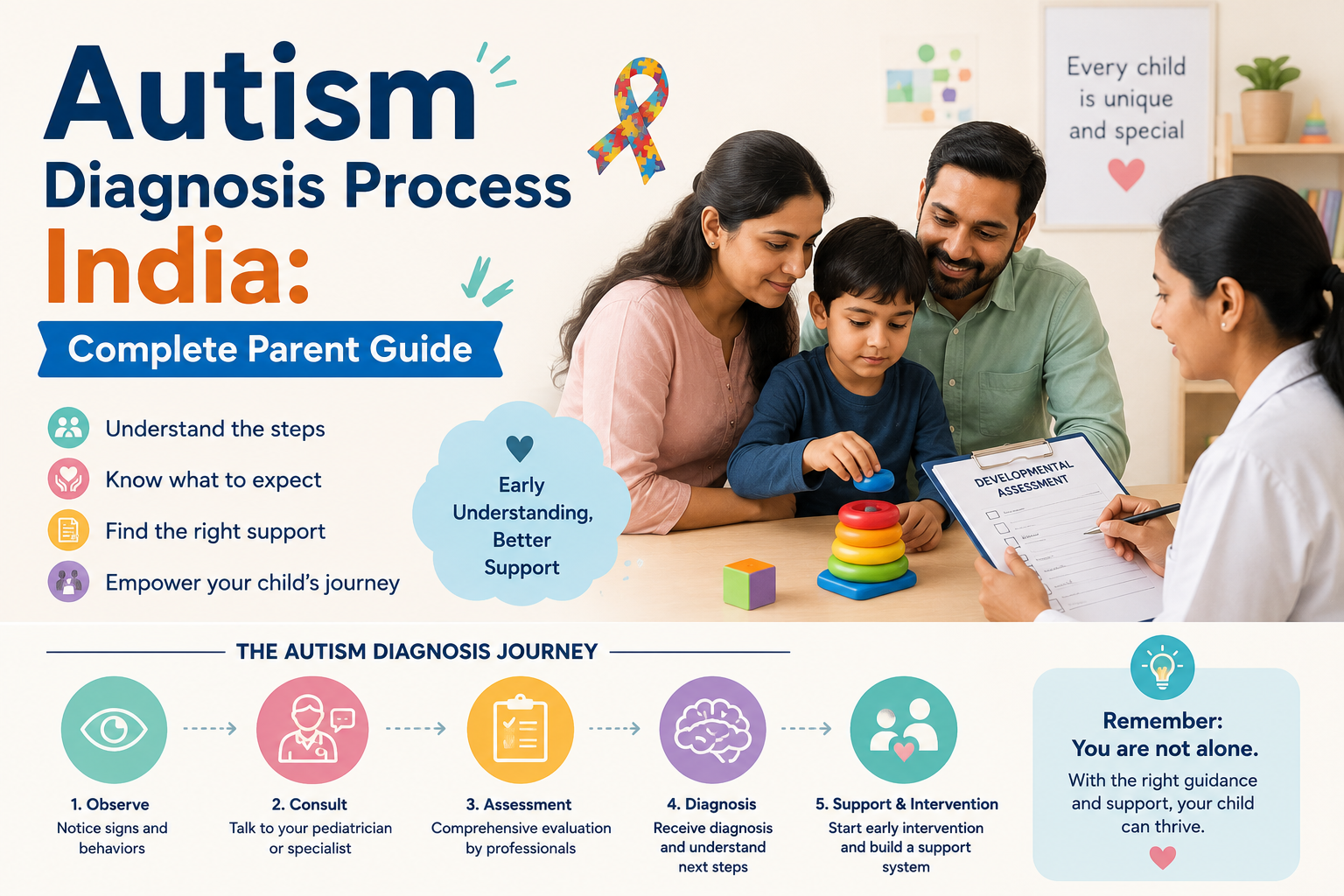
🧩 Autism Diagnosis Process India: 2026 Complete Parent Guide
The autism diagnosis process in India follows a structured two-stage pathway — first a developmental screening, then a formal clinical assessment using validated diagnostic tools like ISAA, ADOS, or the INCLEN diagnostic tool — and can take anywhere from a few weeks to several months depending on your city, your specialist, and your access to government or private services.
This guide walks you through every step — from the first sign you notice to the diagnosis report in your hands. 💛

- 💡 Why Early Diagnosis in India Is Both Critical and Challenging
- 📊 The Numbers: Autism Prevalence and the Diagnostic Gap in India
- 👁️ STAGE 1 — Developmental Screening: The First Step Every Parent Should Take
- 🔍 When to Begin Screening
- 📋 The M-CHAT R/F — India’s Most Widely Used Screening Tool
- 📝 Other Screening Tools Used in India
- 🏥 STAGE 2 — Formal Clinical Assessment: What It Involves and Who Conducts It
- 🔬 Diagnostic Tools Used in India: ISAA, ADOS, INCLEN, DSM-5 Explained
- 🔵 ISAA — Indian Scale for Assessment of Autism
- 🔵 ADOS-2 — Autism Diagnostic Observation Schedule
- 🔵 INCLEN Diagnostic Tool (INDT-ASD)
- 🔵 DSM-5 — The Global Standard
- 👩⚕️ Who Can Diagnose Autism in India? Specialists, Centres, and Eligibility
- 🏛️ Government Resources for Autism Diagnosis in India
- 💼 Private Sector Options: What to Expect and What It Costs
- 📄 What the Diagnosis Certificate Means Legally in India
- 🔍 What You Must Miss About This Topic
- 1. 🏛️ The RBSK Programme Is the Most Under-Known Free Resource
- 2. 📄 The ISAA-Disability Certificate Connection Is Almost Never Explained to Parents
- 3. 🌍 Urban-Rural Diagnostic Inequality Is Severe and Rarely Discussed Honestly
- 4. 👨⚕️ Many Families See Multiple Wrong Specialists Before Finding the Right One
- 5. 🧠 Adult Autism Diagnosis in India Is an Almost Entirely Unaddressed Gap
- 💙 A Parent’s Story: From First Concern to the Report That Changed Everything
- ❓ FAQs About the Autism Diagnosis Process in India
- Q: What is the autism diagnosis process in India?
- Q: Which doctors can diagnose autism in India?
- Q: What is the ISAA used for in autism diagnosis in India?
- Q: Is autism diagnosis free at government hospitals in India?
- Q: How much does a private autism diagnosis cost in India?
- Q: What benefits does an autism disability certificate provide in India?
- Q: What are the first signs of autism in Indian children I should watch for?
- 🔗 Trusted Resources for Indian Families
- 💙 Final Thoughts: The Diagnosis Is a Beginning, Not an Ending
💡 Why Early Diagnosis in India Is Both Critical and Challenging
India is home to one of the largest populations of individuals with autism spectrum disorder in the world, yet awareness, diagnosis, and intervention remain deeply inadequate compared to the scale of the need. (Source: Sparshmind Innovations — Autism in India 2025 Update)
This gap between prevalence and access is the defining challenge of the autism diagnosis process in India — and it is something every parent in this situation needs to understand clearly before starting their journey.
The good news: the science is clear, the diagnostic tools are validated and available, and there are both government and private pathways to access them. The harder truth: specialist availability is concentrated in cities, waitlists can be long, and awareness among general practitioners remains uneven — meaning many children receive their diagnosis years later than the evidence suggests is optimal.
Why early diagnosis matters so much:
Research consistently shows that early intervention — started before age 3 and ideally before age 5 — produces significantly better long-term outcomes in communication, social skills, and adaptive behaviour.
Furthermore, under the Rights of Persons with Disabilities (RPWD) Act 2016, a formal diagnosis is the gateway to legal protections, educational accommodations, and government disability benefits that your child is entitled to. Without the diagnosis certificate, these doors remain closed.
Starting the autism diagnosis process in India as early as your instinct tells you something is different is always the right decision.
📊 The Numbers: Autism Prevalence and the Diagnostic Gap in India
| Statistic | Figure | Source |
|---|---|---|
| ASD prevalence in urban Indian children (community studies) | 0.11%–1.5% depending on study population and tools used | Neurology India — ASD Prevalence Systematic Review |
| Children diagnosed in M-CHAT R/F + INDT-ASD two-stage study | 1.5% of 400 screened children (median age 20.5 months) | ResearchGate — ASD Prevalence India Systematic Review |
| Weighted ASD prevalence estimate, Kolkata school children | 0.23% (lower-bound estimate; likely undercount) | PMC — Kolkata ASD Prevalence Study |
| Estimated total ASD individuals in India | Over 18 million (estimated from population + prevalence data) | MedicoExperts — Autism India Prevalence |
| Proportion of autistic adults with formal diagnosis in India | Extremely small — most studies stop at childhood | MedicoExperts, 2025 |
| M-CHAT R/F sensitivity in Indian community studies | Confirmed 77%–85.5% of medium-risk cases in two-stage testing | ResearchGate — ASD Prevalence India Study |
| RPWD Act 2016 disability categories that include ASD | Yes — autism is a recognised disability under Schedule of RPWD Act 2016 | RPWD Act 2016 — Ministry of Law and Justice India |
| ISAA used for legal disability certification in India | Yes — mandated for government disability certificate (Divyangjan) | NIMHANS — ISAA Validation Research |
💡 What these numbers mean for Indian families: Autism is significantly more prevalent than most Indian families realise — and significantly under-diagnosed. The Indian healthcare system has made meaningful progress in developing India-specific diagnostic tools and legal frameworks. But awareness and access remain uneven. This guide helps you navigate the system that exists, not the one we wish were there.

👁️ STAGE 1 — Developmental Screening: The First Step Every Parent Should Take
The autism diagnosis process in India begins not with a specialist, but with a screening — a structured set of observations or questions that identifies children who may be at elevated risk for ASD and should receive further evaluation.
🔍 When to Begin Screening
The first signs of autism can appear as early as 12–18 months. Parents should initiate screening if they notice:
- No eye contact or significantly reduced eye contact by 6–8 months
- No babbling by 12 months
- No words by 16 months
- No two-word phrases (without imitation) by 24 months
- Not responding to name consistently by 12 months
- Unusual repetitive behaviours (spinning, hand-flapping, lining up objects)
Any one of these signs — especially language regression or consistent failure to respond to name — warrants immediate discussion with your paediatrician. Do not wait for the next scheduled well-child visit if you are concerned.
📋 The M-CHAT R/F — India’s Most Widely Used Screening Tool
The Modified Checklist for Autism in Toddlers, Revised with Follow-Up (M-CHAT R/F) is the most widely used and best-validated autism screening tool in India. It is:
- Free and publicly available
- Validated in Indian community studies
- Suitable for children aged 16–30 months
- Completed by parents in under 10 minutes
- A two-stage tool: initial 20-question checklist, followed by a targeted follow-up interview for flagged items
In a two-stage Indian community study using M-CHAT R/F followed by the INCLEN diagnostic tool (INDT-ASD), the process correctly identified 85.5% of confirmed ASD cases. The researchers concluded that M-CHAT R/F “may be adopted by policy makers to use as an epidemiological survey tool to early anticipate and take remedial measures.” (Source: ResearchGate — ASD Prevalence India)
Access the M-CHAT R/F online at: mchatscreen.com
📝 Other Screening Tools Used in India
| Tool | Full Name | Age Range | Who Uses It |
|---|---|---|---|
| M-CHAT R/F | Modified Checklist for Autism in Toddlers | 16–30 months | Paediatricians, parents, community workers |
| SCDC | Social and Communication Disorders Checklist | School-age | Teachers and parents (Kolkata study used this) |
| SCQ | Social Communication Questionnaire | 4+ years | Paediatricians, psychologists |
| ISAA | Indian Scale for Assessment of Autism | 3–22 years | Trained professionals — both screening and severity assessment |
🏥 STAGE 2 — Formal Clinical Assessment: What It Involves and Who Conducts It
A positive screening result does not mean your child has autism. It means your child should receive a comprehensive clinical assessment by a qualified professional. This is Stage 2 of the autism diagnosis process in India — and it is significantly more involved than Stage 1.
What a Formal Autism Assessment in India Typically Includes
A comprehensive autism assessment includes:
- Detailed developmental history — A structured interview with parents covering pregnancy, birth history, developmental milestones, regression, and family history
- Standardised diagnostic tool administration — ADOS-2, ISAA, or INCLEN INDT-ASD (see next section for details)
- Cognitive assessment — To understand the child’s intellectual functioning, which influences both diagnosis and treatment planning
- Speech and language assessment — Typically conducted by a Speech-Language Pathologist (SLP) as part of the diagnostic team
- Sensory profile assessment — Occupational therapy assessment to document sensory processing differences
- Medical evaluation — Paediatric neurologist review to rule out co-occurring conditions; EEG if seizures are a concern; genetic testing in some cases
- School or preschool teacher report — Formal observations from the child’s educational setting
How Long Does It Take?
The assessment is rarely completed in a single appointment. Most comprehensive assessments in India across government settings take 2–5 appointments over several weeks. In private multidisciplinary clinics, some condensed assessments can be completed in 1–2 intensive days, though this is more expensive.
The reality of waitlists: At premier government centres like NIMHANS (Bengaluru) or AIIMS (New Delhi), waiting times for a comprehensive autism assessment can range from several weeks to several months. Private centres and private paediatric psychiatrists often have significantly shorter waits.
🔬 Diagnostic Tools Used in India: ISAA, ADOS, INCLEN, DSM-5 Explained
This section explains the most important diagnostic tools in the autism diagnosis process in India — in plain language, for parents who deserve to understand what is happening during their child’s assessment.
🔵 ISAA — Indian Scale for Assessment of Autism
What it is: The ISAA (Indian Scale for Assessment of Autism) is India’s own nationally validated autism assessment tool, developed with Indian populations in mind. It is widely used across Indian clinical and research settings and, crucially, is the tool mandated by the Government of India for disability certification under the Divyangjan Disability Certificate system. (Source: NIMHANS — ISAA Research, SAGE Journals)
What it measures: Social relationship and reciprocity, emotional responsiveness, speech-language and communication, behaviour patterns, sensory aspects, and cognitive component — across 40 items rated on a 5-point scale.
Who administers it: A trained professional — clinical psychologist, psychiatrist, special educator, or rehabilitation professional — who has been trained in ISAA administration.
Why it matters for parents: The ISAA score directly influences the percentage of disability assigned to your child in the government disability certificate — which determines the level of government benefits and entitlements your child accesses. Understanding this is critically important.
🔵 ADOS-2 — Autism Diagnostic Observation Schedule
What it is: The ADOS-2 (Autism Diagnostic Observation Schedule, Second Edition) is the most widely used direct observational assessment for autism internationally. It is considered a “gold standard” tool in autism diagnosis globally.
How it works: The assessor conducts structured activities and conversations with the child specifically designed to elicit and observe social communication behaviour. The assessor codes specific behaviours during the session and calculates a score that contributes to a diagnostic determination.
Where it is used in India: ADOS-2 is primarily available at major urban hospital centres, research institutes like NIMHANS, AIIMS, and large private hospitals. It requires specific training and the kit itself is expensive, limiting its availability in smaller cities and government primary care settings.
🔵 INCLEN Diagnostic Tool (INDT-ASD)
What it is: The INCLEN diagnostic tool for Autism Spectrum Disorder (INDT-ASD) is an India-specific tool developed through INCLEN India (International Clinical Epidemiology Network) research — specifically as an AIIMS-modified version validated for Indian community settings.
Why it matters: It was specifically developed to make accurate ASD diagnosis possible in lower-resource settings without requiring expensive imported tools like ADOS-2. This makes it particularly important for community health and tier-2/tier-3 city settings across India.
🔵 DSM-5 — The Global Standard
What it is: The Diagnostic and Statistical Manual of Mental Disorders, Fifth Edition (DSM-5) provides the internationally accepted diagnostic criteria for Autism Spectrum Disorder. Any clinical diagnosis in India must meet DSM-5 (or ICD-11, the WHO equivalent) criteria to be internationally valid.
All the tools described above — ISAA, ADOS-2, INDT-ASD — are used to gather evidence that the assessing clinician then evaluates against DSM-5 criteria to reach a diagnostic conclusion.
👩⚕️ Who Can Diagnose Autism in India? Specialists, Centres, and Eligibility
A question that confuses many families: who is actually authorised to give a formal autism diagnosis in India?
| Professional | Can They Diagnose ASD? | Notes |
|---|---|---|
| Developmental Paediatrician | ✅ Yes | Best first specialist to see; can diagnose and provide ISAA-based disability certificate |
| Child Psychiatrist | ✅ Yes | Particularly trained for complex cases with co-occurring psychiatric conditions |
| Clinical Psychologist (RCI registered) | ✅ Yes (with MD/MBBS physician co-signature for some certificates) | Conducts psychometric assessment; works in multidisciplinary teams |
| Paediatric Neurologist | ✅ Yes | Important when seizures or neurological findings are present |
| General Paediatrician | ⚠️ Screening only | Can refer but typically not trained for formal ASD assessment |
| Special Educator | ❌ No | Can support documentation but cannot provide a clinical diagnosis |
| Speech-Language Pathologist | ❌ No | Contributes to the assessment but cannot issue an autism diagnosis alone |
The best pathway for most families: Start with your general paediatrician — raise your concerns and ask for a referral to a developmental paediatrician or child psychiatrist at a specialist centre.
🏛️ Government Resources for Autism Diagnosis in India
The autism diagnosis process in India has a strong government infrastructure — but many families are unaware of what exists and where to access it.
| Institution | Location | What It Offers |
|---|---|---|
| NIMHANS (National Institute of Mental Health and Neurosciences) | Bengaluru | Comprehensive ASD assessment, research, therapy — government rates |
| AIIMS (All India Institute of Medical Sciences) | New Delhi, Bhopal, Bhubaneswar, and other locations | Multidisciplinary assessment; INCLEN-developed tools used |
| NIEPID (National Institute for Empowerment of Persons with Intellectual Disabilities) | Secunderabad | ASD + intellectual disability evaluation; training centre |
| District Early Intervention Centres (DEICs) | One per district (RBSK scheme) | Free screening and early identification for children 0–18 years in government schools and AWCs |
| Rashtriya Bal Swasthya Karyakram (RBSK) | Pan-India | Government child health screening programme — includes ASD screening in community settings |
| State Composite Regional Centres | Various states | Disability evaluation, certification, and rehabilitation services |
🌟 The RBSK Programme — What Parents Should Know
The Rashtriya Bal Swasthya Karyakram (RBSK) is one of the most important government initiatives for early autism identification in India. It provides:
- Free health screening for all children from birth to 18 years in government schools and Anganwadi centres
- District Early Intervention Centres (DEICs) in every district for referral and further assessment
- Free treatment and intervention where available
If your child attends a government school or Anganwadi, ask the DEIC about their autism screening process. This is a free, legally mandated service most parents do not know to ask for.
💼 Private Sector Options: What to Expect and What It Costs
For families who cannot access government centres due to waitlists, distance, or other constraints, private diagnosis is an important option.
Typical cost breakdown for a private comprehensive autism assessment in India (metro cities, 2026):
| Assessment Component | Approximate Cost Range |
|---|---|
| Developmental paediatrician consultation | ₹800–₹3,000 per session |
| Clinical psychologist assessment (ISAA/ADOS-2 administration) | ₹3,000–₹8,000 |
| Speech-language assessment | ₹2,000–₹5,000 |
| Occupational therapy sensory assessment | ₹2,000–₹4,000 |
| Paediatric neurologist consultation | ₹1,500–₹4,000 |
| Full multidisciplinary assessment package | ₹15,000–₹40,000 (all components bundled) |
| ADOS-2 (specialised tool, metro private only) | ₹5,000–₹12,000 additional |
Smaller cities typically offer lower rates — sometimes 40–60% less than metro pricing. However, tool availability (particularly ADOS-2) may be more limited outside major cities.
Insurance coverage: Most Indian health insurance policies currently do not cover autism assessment and diagnosis costs. Some corporate policies have begun including neurodevelopmental assessment coverage — always check your specific policy before assuming zero coverage.
📄 What the Diagnosis Certificate Means Legally in India
This is the section most autism diagnosis guides in India fail to cover — and it is the most practically important information for families after receiving a diagnosis.
A formal autism diagnosis in India, paired with an ISAA-based assessment, allows families to apply for the Disability Certificate (Divyangjan Certificate) issued by the designated medical authority.
What the Disability Certificate unlocks:
| Benefit | Who It Is For |
|---|---|
| Income Tax deduction under Section 80DD | Parents/caregivers of dependents with disability |
| Reservation in government jobs and educational institutions | Person with disability |
| Concession in rail travel (50–75% discount) | Person with disability + one escort |
| RPWD Act educational accommodations | Child in any school — mainstream or special |
| National Scholarship for disabled students | School and college-going students |
| Priority in housing schemes | Person with disability |
| Samagra Shiksha Abhiyan support | Children with special needs in school |
How to apply for the Disability Certificate:
- Approach the designated medical board in your district (typically at a government hospital or Composite Regional Centre)
- Bring your diagnosis report and ISAA assessment
- The medical board reviews the documentation and issues a certificate with a stated percentage of disability
- This certificate is valid nationally
Important note: The ISAA is specifically mandated for autism disability certification in India. Ensure your private assessment also includes ISAA administration if you plan to apply for a disability certificate.
🔍 What You Must Miss About This Topic
1. 🏛️ The RBSK Programme Is the Most Under-Known Free Resource
Very few autism information resources in India mention the Rashtriya Bal Swasthya Karyakram by name or explain that it provides free autism screening through District Early Intervention Centres available in every district. For families in smaller towns and rural areas, this is not a supplementary option — it is the primary, legitimate, government-funded pathway.
2. 📄 The ISAA-Disability Certificate Connection Is Almost Never Explained to Parents
Families are told to “get an autism diagnosis” without being told that the specific tool used — ISAA — and the specific form of assessment directly determines what disability percentage is assigned and what government benefits follow. Parents who receive a comprehensive private assessment using only ADOS-2 without ISAA may find they cannot directly apply for a government disability certificate without an additional ISAA assessment.
3. 🌍 Urban-Rural Diagnostic Inequality Is Severe and Rarely Discussed Honestly
Most autism diagnosis process India guides are written for families in Delhi, Mumbai, or Bengaluru. The reality for families in smaller towns and villages is fundamentally different — and almost no mainstream guide honestly addresses this gap or the DEIC-based solution that partially bridges it.
4. 👨⚕️ Many Families See Multiple Wrong Specialists Before Finding the Right One
A common pattern in Indian autism diagnosis journeys is that families first see an ENT specialist (for speech delay or hearing concerns), then a general paediatrician, then potentially a neurologist — before reaching a developmental paediatrician or child psychiatrist who can actually conduct the assessment.
This mismatch costs months of precious early intervention time. Knowing to ask specifically for a developmental paediatrician or child psychiatrist from the outset saves enormous time.
5. 🧠 Adult Autism Diagnosis in India Is an Almost Entirely Unaddressed Gap
A large number of autistic adolescents and adults exist below the radar of the Indian healthcare system. Most Indian epidemiological work on autism stops at childhood. (Source: MedicoExperts — Autism India Prevalence) For older adolescents and adults who were missed in childhood, NIMHANS and AIIMS adult psychiatry departments are among the few settings where adult autism assessment is available.
💙 A Parent’s Story: From First Concern to the Report That Changed Everything
Lakshmi noticed it first at fourteen months. Her son Arjun was not responding when she called his name — not always, not reliably. He had been babbling. Now he was quiet.
“Our paediatrician said boys are slower,” she recalls. “At eighteen months, I went back. She said, ‘let’s see at two.'”
Lakshmi did not wait. She found M-CHAT R/F online. She completed it that evening. The score flagged high risk across multiple areas.
“I printed it and took it to the paediatrician at the next visit,” she says. “That changed the conversation. She gave me a referral letter to the developmental paediatrics department at the government medical college.”
The wait at the government hospital was eight weeks. During those eight weeks, Lakshmi started speech therapy privately — not waiting for the diagnosis to begin support.
The assessment at the medical college took three sessions across two months. ISAA was administered. Cognitive assessment was done. A speech-language assessment was conducted separately.
“The day of the report, I cried,” Lakshmi says simply. “Not because it said autism. I had known in my heart for months. I cried because it was finally real. It was finally something I could hold in my hands and show to a school, show to a therapist, show to a government office. It was not just my worry anymore. It was a document. It was the beginning of getting him real help.”
Arjun is four now. He has early intervention five days a week. He has a disability certificate. He has accommodations in his preschool under RPWD Act. He is learning to use picture exchange cards.
“The diagnosis did not define him,” Lakshmi reflects. “It opened a door that had been locked.”
❓ FAQs About the Autism Diagnosis Process in India
Q: What is the autism diagnosis process in India?
The autism diagnosis process in India follows a two-stage pathway. First, a developmental screening is conducted using a tool like M-CHAT R/F by a paediatrician or community health worker. If the screening is positive, the child is referred for a comprehensive clinical assessment by a developmental paediatrician, child psychiatrist, or clinical psychologist using validated tools like ISAA, ADOS-2, or the INCLEN INDT-ASD tool, evaluated against DSM-5 diagnostic criteria.
Q: Which doctors can diagnose autism in India?
Autism can be formally diagnosed in India by developmental paediatricians, child psychiatrists, and RCI-registered clinical psychologists (typically working within a multidisciplinary team). General paediatricians and neurologists can contribute to the assessment and refer appropriately. Special educators and speech-language pathologists contribute important information to the assessment but cannot issue a formal autism diagnosis independently.
Q: What is the ISAA used for in autism diagnosis in India?
The Indian Scale for Assessment of Autism (ISAA) is India’s own validated autism assessment tool, widely used in clinical and community settings. Crucially, ISAA is the tool mandated by the Government of India for the autism component of disability certification under the RPWD Act 2016. An ISAA-based assessment is necessary to obtain the official Divyangjan Disability Certificate, which unlocks government benefits, reservations, and educational accommodations.
Q: Is autism diagnosis free at government hospitals in India?
Yes, in many cases. Government medical colleges, NIMHANS, AIIMS, and state composite regional centres offer autism assessment at significantly reduced or nominal cost. The Rashtriya Bal Swasthya Karyakram (RBSK) provides free developmental screening through District Early Intervention Centres (DEICs) in every district — a particularly important resource for families in smaller towns and rural areas.
Q: How much does a private autism diagnosis cost in India?
A comprehensive private autism assessment in metro cities costs approximately ₹15,000–₹40,000 for a full multidisciplinary evaluation. Individual component costs range from ₹800–₹3,000 for specialist consultations to ₹3,000–₹12,000 for specific assessment tools like ISAA or ADOS-2. Costs in smaller cities are typically 40–60% lower. Most current Indian health insurance policies do not cover autism diagnosis costs.
Q: What benefits does an autism disability certificate provide in India?
A disability certificate under the RPWD Act 2016 for autism provides income tax deductions for parents under Section 80DD, educational reservation and accommodations, railway travel concessions, national disability scholarships, priority in housing schemes, Samagra Shiksha Abhiyan support in schools, and access to government rehabilitation services. The certificate is obtained from the designated medical board in your district using the diagnosis report and ISAA assessment.
Q: What are the first signs of autism in Indian children I should watch for?
Watch for: not responding consistently to name by 12 months, no babbling by 12 months, no words by 16 months, no two-word phrases by 24 months, loss of previously acquired speech or social skills, limited eye contact, not pointing to share interest in objects, and repetitive behaviours like hand-flapping, spinning, or lining up objects. Any one of these signs — particularly language regression — warrants immediate discussion with your paediatrician and M-CHAT R/F screening.
🔗 Trusted Resources for Indian Families
| Resource | What It Offers | Link |
|---|---|---|
| 📋 M-CHAT R/F — Official Screening Tool | Free autism screening for children 16–30 months | mchatscreen.com |
| 🏛️ NIMHANS — Bengaluru | Premier government autism assessment and research centre | nimhans.ac.in |
| 🏥 AIIMS New Delhi — Child Neurology | Government comprehensive assessment | aiims.edu |
| 🏗️ NIEPID — Secunderabad | National institute for intellectual and developmental disabilities | niepid.nic.in |
| 📄 RPWD Act 2016 | Full text of India’s disability rights law | legislative.gov.in |
| 🌐 Autism Society of India | Family support, information, and advocacy | autismindiatrust.com |
| 📊 INCLEN India | Research tools including INDT-ASD | inclentrust.org |
💙 Final Thoughts: The Diagnosis Is a Beginning, Not an Ending
The autism diagnosis process in India can feel slow, confusing, and emotionally overwhelming. There are waiting rooms and referral letters and assessments that take weeks to schedule. There are professionals who use unfamiliar terminology and reports filled with clinical language.
But at the end of that process is a document — a report, a certificate — that sees your child clearly for the first time. That opens doors. That gives you language. That converts your instinct into something the world must now respond to.
Start with the M-CHAT R/F. Ask for a referral to a developmental paediatrician. Do not wait another “let’s see at two.” Because early is always better. And the system, for all its imperfections, does have pathways for your child.
Find them. Use them. Know your rights. 💛
📝 This article is for informational and educational purposes only. It does not constitute medical advice or diagnosis. Always consult qualified healthcare professionals for concerns about your child’s development. Costs, availability, and service details may vary — verify directly with institutions before visiting.


