

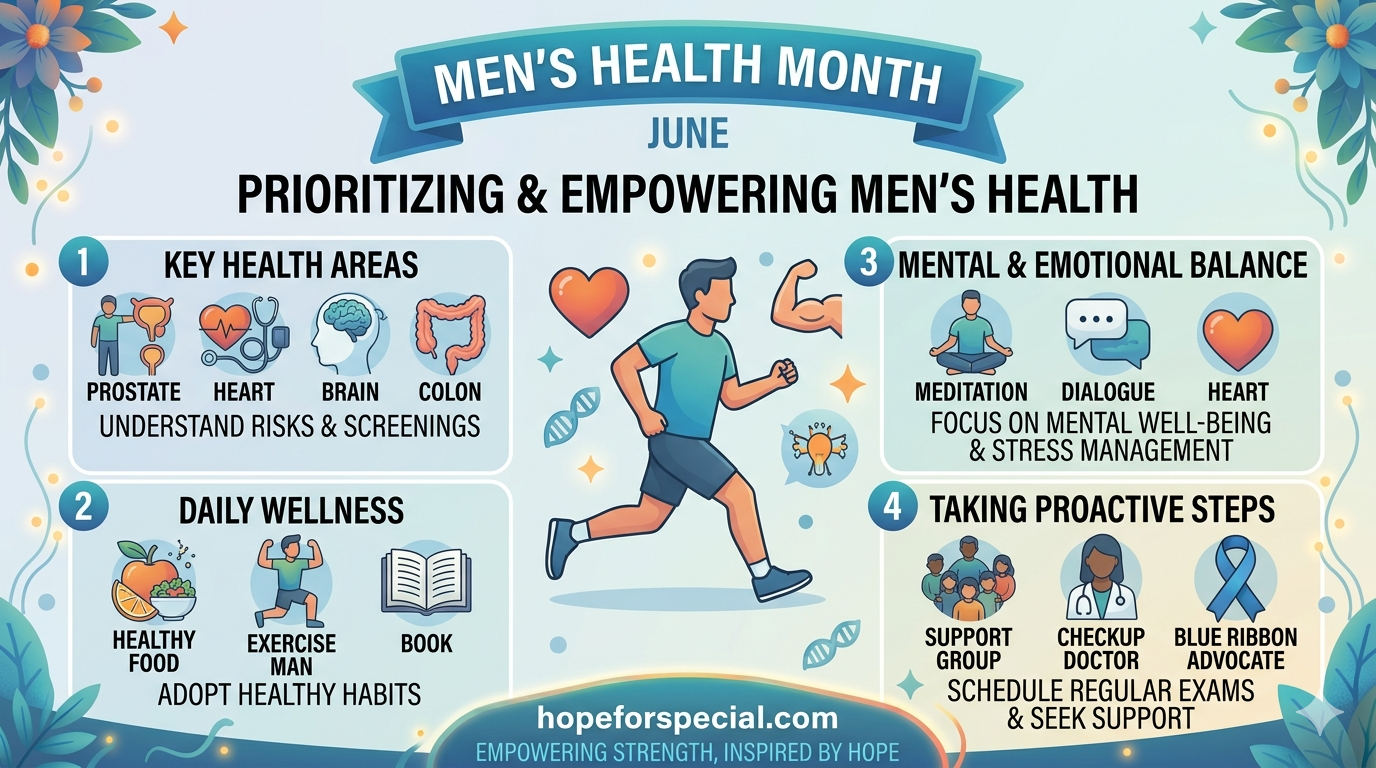
💪 Men’s Health Month 2026: The Truths Dads of Special Needs Kids Can’t Afford to Ignore and How to Finally Take Action
Men’s Health Month 2026 is internationally celebrated in June and sometimes throughout November via “Movember”. It serves as a crucial annual reminder to prioritize the physical, mental, and emotional well-being of men and boys across the globe. While life can get incredibly busy, taking a moment to focus on preventative healthcare can truly save lives.
Consequently, this month is dedicated to breaking the stigma around medical checkups, encouraging open conversations about mental health, and promoting healthier lifestyle choices.

- 🩺 What Is Men’s Health Month — and Why Should You Actually Care?
- 🗓️ Men’s Health Month 2026: Key Facts at a Glance
- 📊 Men’s Health Month 2026: Statistics That Should Alarm Every Family
- 👨👧 The Hidden Crisis: Dads of Special Needs Children and Men’s Health Month
- A Story That Rings True for Many Dads
- What the Research Says About Dads of Special Needs Children
- Warning Signs Dads of Special Needs Kids Should Never Ignore 🚨
- 🫀 Men’s Health Month: The Top Health Threats Every Man Must Know
- 1️⃣ Heart Disease: The Quiet Killer
- 2️⃣ Prostate Cancer: Early Detection Saves Lives
- 3️⃣ Mental Health: The Crisis Men Are Suffering in Silence
- 4️⃣ Cancer and Other Key Health Threats
- 🧠 Men’s Health Month and Mental Health: Breaking the Silence
- 🏳️🌈 LGBTQIA+ Pride and Men’s Health Month: Why June Holds Space for Everyone
- 📋 Men’s Health Month Screenings: A Complete Checklist for Dads
- 💡 7 Things Special Needs Families Must Know
- 🌿 5 Simple Ways to Start Prioritizing Your Health This Men’s Health Month
- 🔗 Trusted Resources for Men’s Health Month 2026
- ❓ FAQs: Men’s Health Month Long-Tail Questions Answered
- Q: When is Men’s Health Month 2026?
- Q: When is Men’s Health Week 2026?
- Q: What is the color for Men’s Health Month?
- Q: Why do men avoid going to the doctor?
- Q: What are the leading causes of death in men?
- Q: When should men get a prostate cancer screening?
- Q: How does men’s health affect special needs families?
- Q: What is the connection between Men’s Health Month and LGBTQIA+ Pride Month?
- 💙 A Final Word — From One Caregiver Family to Another
🩺 What Is Men’s Health Month — and Why Should You Actually Care?
Men’s health month is observed every June in the United States. It is a national campaign dedicated to raising awareness about the preventable health issues that affect men and boys of all ages. In simple words: it is the one month of the year that tells men — loud and clearly — that their health matters too.
Men’s Health Month focuses on improving the lifestyles of men. While there are several approaches to improving overall health, diet and exercise are the targets of any changes. All month long, community events and clinics take place to increase awareness of the leading health concerns men face. (Source: National Day Calendar)
If you are the father, partner, brother, grandfather, or male caregiver of a child with special needs, this month was made for you. Because the data is clear: men are not taking care of themselves. And when a caregiver breaks down, the whole family feels it.
🗓️ Men’s Health Month 2026: Key Facts at a Glance
Men’s Health Month is observed every year for the entire month of June. Men’s Health Week falls during the week leading up to Father’s Day — placing it between June 9 and June 16 in 2026. (Sources: Impactful Ninja | Awareness Days)
| Detail | Information |
|---|---|
| 📅 When is Men’s Health Month? | June 1–30, 2026 |
| 🗓️ Men’s Health Week 2026 | June 9–15, 2026 (week before Father’s Day) |
| 🎨 Color/Symbol | Blue — Wear Blue Day falls on Friday, June 13 |
| 📌 Hashtag | #MensHealthMonth #WearBlue |
| 🏛️ Established | 1994, signed into law by President Bill Clinton |
| 🌐 Official website | menshealthmonth.org |
| 🎯 Purpose | Raise awareness of preventable health issues in men and boys |
Men’s Health Month in the United States is observed every June. This month aims to raise awareness of the same health concerns as Men’s Health Week but lasts the whole month. During the month of June, men are encouraged to set goals for their own health and wellness and begin to create a roadmap for achieving those goals. (Source: Brown University Health)
📊 Men’s Health Month 2026: Statistics That Should Alarm Every Family
The numbers surrounding men’s health in America are deeply concerning. They reveal a quiet crisis happening in millions of homes — including homes where a father or male caregiver is raising a child with special needs.
| Statistic | Figure | Source |
|---|---|---|
| Men who skip annual doctor visits | 40% wait until something is seriously wrong | IU Medicine |
| Men’s mortality rate vs. women | 41% higher overall | AJMC, 2025 |
| Men diagnosed with some form of cancer in their lifetime | 1 in 2 men | CHDC |
| Prostate cancer — 1 in 8 men diagnosed in lifetime | Most common cancer in men | CHDC |
| Prostate cancer 5-year survival rate when caught early | 99% | AJMC |
| Men who die by suicide vs. women | Nearly 80% of all US suicides are men | Psychiatric Times |
| Men’s suicide rate vs. women’s rate | 4x higher | CDC/Statista |
| Men who received mental health treatment (2023) | Only 13.4% (vs. 24.7% of women) | Psychiatric Times |
| Men who avoid mental health services entirely | Up to 70% of young US men | ForeMind 2026 |
| Average years men live less than women | 5–6 fewer years | Summit Medical / CHDC |
These numbers are not just statistics. They represent fathers who are missing from the dinner table. They represent dads who held on too long and didn’t ask for help. This Men’s Health Month, let’s change that.
👨👧 The Hidden Crisis: Dads of Special Needs Children and Men’s Health Month
Raising a child with special needs is one of the most demanding, most rewarding, and most emotionally complex experiences a parent can have. And when it comes to fathers, the pressure is often invisible.

A Story That Rings True for Many Dads
Meet Marcus. He is a 42-year-old father of two — one of whom has autism. Marcus wakes up at 5:30 AM every day. He manages morning meltdowns before work. He attends IEP meetings during his lunch hour.
He advocates at school board meetings on Thursday evenings. He researches therapies on weekends. He rarely complains.
He also hasn’t seen a doctor in four years.
He hasn’t told his wife how exhausted he really is. He hasn’t mentioned the chest tightness he’s been feeling. And he certainly hasn’t brought up the fact that he cries alone in his car twice a week.
Marcus is not unusual. Marcus is the norm.
What the Research Says About Dads of Special Needs Children
Parents of children with special needs and disabilities who require long-term healthcare are at high risk of parental burnout. (Source: MDPI / Journal of Psychology, 2024)
Parental burnout ensues from enduring stress and the relentless demands of parenting, resulting in a state of physical, emotional, and mental exhaustion. It can lead to feelings of hopelessness, helplessness, and a lack of motivation to engage with children and complete necessary parenting tasks. Certain child-related factors can place a parent at higher risk, including having a child with a chronic illness, disability, or behavioral/emotional problems. (Source: Journal of Pediatric Health Care, 2024)
And crucially — fathers are largely missing from this research. Most burnout studies focus on mothers. Dads are left out of the conversation entirely. That silence is dangerous during Men’s Health Month and beyond.
Warning Signs Dads of Special Needs Kids Should Never Ignore 🚨
Many of these signs can hide behind “I’m just tired” or “I’m fine”:
- 🔴 Persistent fatigue that sleep doesn’t fix
- 🔴 Irritability or sudden anger that seems out of proportion
- 🔴 Feeling emotionally numb or detached from your family
- 🔴 Physical symptoms you keep putting off checking (chest pain, headaches, changes in digestion)
- 🔴 Using alcohol or other substances to “decompress”
- 🔴 Withdrawing from friends and community
- 🔴 Feeling like your family would “be better off” without you
If any of these resonate, please keep reading. And please talk to someone — a doctor, a therapist, or a trusted friend. Your health is not a luxury. It is a necessity.
🫀 Men’s Health Month: The Top Health Threats Every Man Must Know
Men’s health month shines a light on the health conditions that disproportionately affect men. Here is a clear breakdown of the biggest threats — and what you can do right now.
1️⃣ Heart Disease: The Quiet Killer
Heart disease is the leading cause of death for men in the United States. (Source: NY State Department of Health)
Research shows that people who experience loneliness and isolation are at increased risk of heart disease, dementia, stroke, depression and anxiety. Lacking social connection can even increase the risk of premature death to levels comparable to smoking. (Source: Brown University Health)
For dads of special needs children who are often isolated, this is especially relevant.
What you can do:
- Get a blood pressure check (it takes 5 minutes)
- Ask your doctor about a cholesterol screening
- Walk 30 minutes a day — even if it’s just to clear your head
- Reduce processed food and sodium intake
2️⃣ Prostate Cancer: Early Detection Saves Lives
Prostate cancer is the most common cancer found in men in the U.S., with 1 in 8 men being diagnosed with this form of cancer in their lifetime. (Source: CHDC Men’s Health 2025)
The urgently hopeful news? Early detection of prostate cancer is crucial, with a 99% five-year survival rate when diagnosed early. (Source: AJMC 2025)
Prostate Screening Age Guidelines:
| Risk Level | When to Start Discussing Screening |
|---|---|
| Average risk | Age 50 |
| High risk (family history or Black men) | Age 45 |
| Even higher risk | Age 40 |
(Source: American Cancer Society | CDC Prostate Cancer Screening)
3️⃣ Mental Health: The Crisis Men Are Suffering in Silence
This is the area that matters most during Men’s Health Month — and the one men are least likely to talk about.
Over 6 million men in the U.S. experience depression annually, but it often goes undiagnosed. Males account for nearly 80% of all suicide deaths in the U.S. Suicide rates are highest among men ages 75+, but it is also a leading cause of death for men ages 15–34. (Source: ADAA)
According to CDC data, only 13.4% of men received mental health treatment compared with 24.7% of women. Of those with a known mental illness, only 40% to 42% of men received treatment, versus 52% to 59% of women. Just 7.2% of men engage in talk therapy compared with 11.7% of women. (Source: Psychiatric Times)
Up to 70% of young US men avoid mental health services altogether, waiting until problems reach crisis point. 1 in 4 US males aged 15–34 reported feeling lonely “a lot of the day” in a 2025 Gallup analysis. 15% of US men report having no close friends, up from just 3% in 1990. (Source: ForeMind 2026)
For dads raising children with special needs, the loneliness and isolation factor is multiplied. Their social world often shrinks dramatically after a diagnosis. Their friendships fade. Their identity narrows to “caregiver.”
That is exactly why Men’s Health Month matters so deeply for this community.
4️⃣ Cancer and Other Key Health Threats
1 in 2 men are diagnosed with cancer in their lifetime, compared with 1 in 3 women. On average, men live about 6 years less than women. 83% of men have experienced stress in the last six months. Nearly 1 in 10 men in the U.S. have daily feelings of anxiety or depression. (Source: CHDC)
| Health Threat | Key Stat | Action Step |
|---|---|---|
| Heart disease | Leading cause of death in men | Annual BP + cholesterol check |
| Prostate cancer | 1 in 8 men lifetime risk | PSA discussion with doctor at 50 (or 40–45 if high risk) |
| Colorectal cancer | Screening recommended from age 45 | Schedule colonoscopy or stool test |
| Lung cancer | Leading cancer killer | Screening if smoker/former smoker in past 15 years |
| Testicular cancer | Most common in men 15–35 | Monthly self-exam |
| Type 2 Diabetes | Disproportionately affects Black and Hispanic men | Blood sugar screening annually |
| Skin cancer | Highly treatable when caught early | Annual skin check by dermatologist |
| Mental health | 80% of suicides are male | Talk to a doctor or therapist — now |
🧠 Men’s Health Month and Mental Health: Breaking the Silence
This section deserves its own spotlight. Because the single biggest reason men die younger isn’t biology — it’s silence.
Too often men hold back from speaking up about their health – they push through pain, downplay their symptoms, or avoid it altogether. Seeking support isn’t a sign of weakness — it’s a smart, selfless decision that benefits both you and your loved ones. (Source: NY State Department of Health, 2025)
Why Men Don’t Ask for Help — and Why It’s Costing Lives
Only 60 percent of men go to the doctor for a yearly, routine check up, and 40 percent won’t go until something is seriously wrong. Despite these statistics, 20 percent of men report seeing a doctor so their significant other or a loved one will stop nagging them. (Source: IU Medicine)
The reasons men avoid help include:
- 💬 Fear of being seen as weak
- 💬 Believing they “can handle it” alone
- 💬 Feeling guilty about taking time away from their caregiving role
- 💬 Not having a primary care doctor established
- 💬 Worrying about what a diagnosis might mean for their family
For fathers of special needs children, add one more reason: “My child needs me. I can’t be sick.”
That thinking, while deeply loving, can be deadly.
The Loneliness Epidemic Among Fathers
15% of US men report having no close friends — up from just 3% in 1990. (Source: ForeMind 2026)
Fathers of children with special needs face an amplified version of this. Their social circles narrow after their child’s diagnosis. Friendships become harder to maintain. Date nights become rare. The isolation builds quietly, over years.
This Men’s Health Month, let’s name what’s happening: many of these dads are lonely, exhausted, and invisible — and they need someone to ask them how they’re really doing.
🏳️🌈 LGBTQIA+ Pride and Men’s Health Month: Why June Holds Space for Everyone
June is special — and crowded with purpose. It is simultaneously Men’s Health Month and LGBTQIA+ Pride Month. And for families in the special needs community, both observances carry deep meaning.
LGBTQIA+ Men and Their Unique Men’s Health Challenges
LGBTQIA+ men — including gay, bisexual, transgender, and queer men — face all the same men’s health risks as other men. But they also face compounding barriers that make accessing care even harder.
Transgender adults in the US are nearly 9 times more likely to attempt suicide at some point in their lifetime compared to the general population. (Source: ForeMind 2026)
Men are far more likely to complete a suicide but far less likely to be diagnosed with depression or anxiety. A significant proportion of men who die by suicide have no known history of mental illness — often due to underdiagnosis or not seeking care. (Source: Health City / Boston Medical Center)
For LGBTQIA+ men, this risk is even higher — compounded by discrimination, minority stress, and barriers to affirming healthcare.
What This Means for Special Needs Families
If you are raising a child who is both neurodiverse or disabled AND navigating an LGBTQIA+ identity, you may have a son, daughter, or non-binary child who faces intersecting health risks — particularly in mental health.
During this June, as Men’s Health Month and LGBTQIA+ Pride Month run together:
- 💙 Remind the men in your life that their health matters
- 🏳️🌈 Create space for LGBTQIA+ members of your family to access affirming healthcare
- 💬 Talk openly about mental health — for fathers AND for children
Both observances share the same core message: every person deserves to be seen, supported, and cared for.
📋 Men’s Health Month Screenings: A Complete Checklist for Dads
This is the practical section. Print it. Put it on the fridge. Share it with the dad in your life.
🩺 Men’s Health Screening Checklist by Age
| Screening | When to Start | Frequency |
|---|---|---|
| Blood pressure check | Any age | Annually (or every 2 years if normal) |
| Cholesterol test | Age 35 (or 20+ if risk factors exist) | Every 5 years, more often if abnormal |
| Blood sugar / Diabetes | Age 35–40 | Every 3 years |
| Prostate cancer discussion (PSA) | Age 50 (age 40–45 if high risk) | As recommended by doctor |
| Colorectal cancer screening | Age 45 | Every 10 years (colonoscopy) |
| Testicular self-exam | Age 15+ | Monthly |
| Skin cancer check | Any age | Annually with dermatologist |
| Vision exam | Any age | Every 1–2 years |
| Mental health screening | Any age — but especially now | Annually; more often if struggling |
| Lung cancer screening | Smokers/former smokers over 50 | Annually |
(Sources: CDC | ACS | Brown University Health)
💡 7 Things Special Needs Families Must Know
Here is what you need to know as part of the HopeForSpecial community:
1. Dads are often the forgotten caregiver.
Research on special needs parenting burnout focuses overwhelmingly on mothers. Fathers’ mental health needs are systematically under-studied and under-served.
2. Caregiver health IS child health.
When a dad’s health declines, the entire family system is affected. Your special needs child depends on you being well — body and mind.
3. Special needs parenting creates unique health risks for men.
The chronic stress, sleep disruption, financial pressure, and social isolation that come with raising a disabled child are independent risk factors for heart disease, depression, and immune dysfunction.
4. Men avoid help more when they feel “needed.”
Counterintuitively, fathers of children with high needs are often LESS likely to seek medical care — because they feel they can’t afford to be vulnerable. This pattern needs to be named and challenged.
5. Many men don’t have a primary care provider.
Men 15–65 years of age are significantly less likely than women to seek preventive care services, and they are more likely to report not having a primary care provider. (Source: Brown University Health) This means many dads don’t even have a doctor to call when something feels wrong.
6. Nutrition and sleep are often the first casualties.
When you’re managing a child’s complex medical and behavioral needs, healthy eating and sleep become luxuries. But they are also the foundation of your cardiovascular and mental health.
7. Asking for help is an act of strength — not weakness.
“There is nothing stronger than taking care of yourself. Seeking support isn’t a sign of weakness — it’s a smart, selfless decision that benefits both you and your loved ones.” — NY State Health Commissioner Dr. James McDonald (Source: NY State Department of Health, 2025)
🌿 5 Simple Ways to Start Prioritizing Your Health This Men’s Health Month
You don’t need to overhaul your life overnight. Start here:
- 📞 Call a doctor today. Just schedule the appointment. That one action can start a cascade of positive health decisions.
- 🚶 Walk 30 minutes a day. Exercise is one of the most evidence-based interventions for depression, anxiety, cardiovascular health, and cognitive function. You don’t need a gym.
- 💬 Tell one person how you’re actually doing. Not “I’m fine.” Actually tell someone. A friend, a partner, a therapist, a support group. One honest conversation can break a cycle of isolation.
- 😴 Protect your sleep. Sleep deprivation worsens everything — your mood, your immune function, your decision-making, your cardiovascular risk. Even 30 more minutes of sleep per night can make a measurable difference.
- 🩺 Complete the screening checklist. Use the table above. Pick one overdue screening and schedule it this month.
🔗 Trusted Resources for Men’s Health Month 2026
Bookmark these authoritative sources:
- 🌐 Men’s Health Network — Official Men’s Health Month website and 2026 toolkit
- 🌐 CDC Men’s Health — Leading causes of death, screenings, and prevention
- 🌐 American Cancer Society — Prostate Cancer — Screening guidelines and risk information
- 🌐 HeadsUpGuys — Men’s depression and suicide prevention resources
- 🌐 ADAA Men’s Mental Health — Anxiety and depression resources for men
- 🌐 Brown University Health — Men’s Health Month — Comprehensive preventive care guidance
- 🌐 988 Suicide & Crisis Lifeline — Call or text 988, available 24/7
- 🌐 National Fatherhood Initiative — Resources specifically for fathers
❓ FAQs: Men’s Health Month Long-Tail Questions Answered
Q: When is Men’s Health Month 2026?
Men’s Health Month is observed every June — from June 1 to June 30, 2026. Men’s Health Month is dedicated to raising awareness about preventable health problems among men and boys and encouraging them to seek early detection and treatment. (Source: Impactful Ninja)
Q: When is Men’s Health Week 2026?
Men’s Health Week is observed annually during the week leading up to Father’s Day, placing it between June 9th and June 16th in 2026. (Source: Awareness Days)
Q: What is the color for Men’s Health Month?
The color for Men’s Health Month is blue. Wearing blue during the month of June is a simple way to show solidarity and spark conversations about men’s health. Wear Blue Day is observed on the Friday before Father’s Day. (Source: Impactful Ninja)
Q: Why do men avoid going to the doctor?
About 21% of men admit to avoiding the doctor because they’re too nervous to find out what might be wrong. More than half of men said their health wasn’t something they talk about. (Source: Summit Medical) The pressure to appear strong — and for special needs dads, the sense of being “needed” — amplifies this avoidance.
Q: What are the leading causes of death in men?
According to the Centers for Disease Control and Prevention, the leading causes of death among men are heart disease, cancer, and accidental death. (Source: National Day Calendar / CDC) Men also have higher mortality rates for 8 out of 10 leading causes of death compared to women.
Q: When should men get a prostate cancer screening?
Men are encouraged to begin discussing prostate cancer screening at age 50 for those at average risk, age 45 for those at high risk, and age 40 for those at even higher risk. High-risk individuals include Black men and those with a family history of prostate cancer. (Source: AJMC 2025)
Q: How does men’s health affect special needs families?
When a father or male caregiver’s health declines — physically or mentally — the impact on a special needs child can be profound. Parental burnout leads to physical, emotional, and mental exhaustion, and can result in a lack of motivation to engage with children and complete necessary parenting tasks. (Source: Journal of Pediatric Health Care, 2024) A healthy dad is one of the best gifts you can give your child.
Q: What is the connection between Men’s Health Month and LGBTQIA+ Pride Month?
Both are observed in June. Both focus on communities that face significant health disparities due to stigma, avoidance, and structural barriers to care. LGBTQIA+ men — particularly transgender men — face compounding mental health risks and deserve inclusive, affirming healthcare during Men’s Health Month and beyond.
💙 A Final Word — From One Caregiver Family to Another
If you are the dad reading this at midnight, after your child finally fell asleep — this section is for you.
You show up every single day. You love fiercely. You carry more than most people will ever understand. You smile through the hard days for the sake of your child. You are needed, and you know it.
But here is what we need you to hear this Men’s Health Month:
You cannot pour from an empty cup.
Your health is not selfish. Seeing a doctor is not weakness. Telling your partner you’re struggling is not failure. Getting a therapist is not giving up. It is the most courageous, loving thing you can do — for your child, for your family, and for yourself.
This June, during Men’s Health Month, do one thing for yourself. Just one. Book the appointment. Make the call. Take the walk. Open up to someone.
The bravest thing you can do this month is take care of the man your family needs most. 💙
📌 If you or someone you know is in crisis, please call or text 988 (Suicide & Crisis Lifeline). Help is available 24/7, free of charge.


