

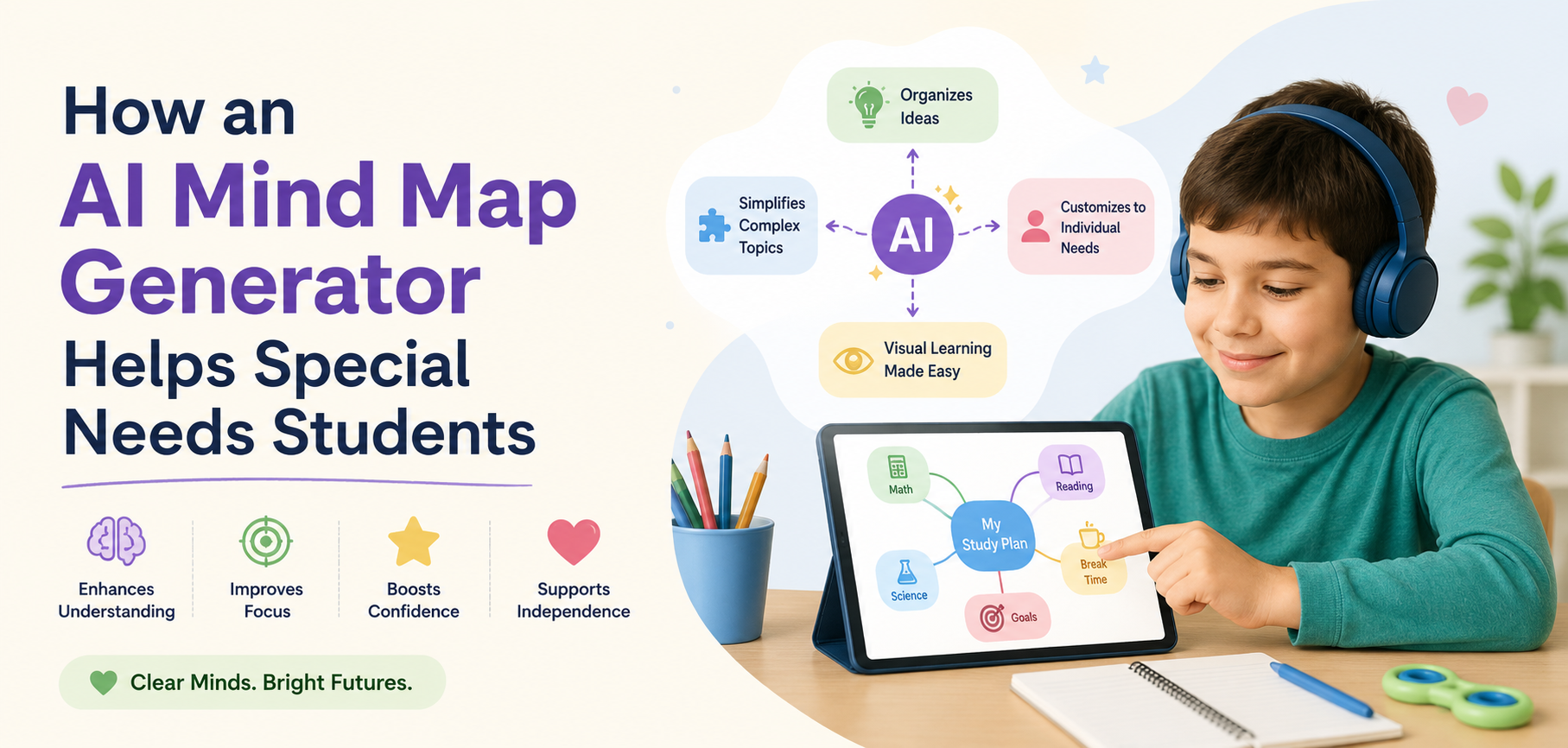
How an AI Mind Map Generator Helps Special Needs Students: 2026 Guide for Parents and Educators 💛
🧠 Could a visual AI tool finally unlock learning for your special needs child? Research confirms AI mind map generators boost memory by 10%+ and transform how neurodivergent students think and create. Discover how in 2026.

- 🌟 What Is an AI Mind Map Generator and Can It Really Help Your Special Needs Child?
- 📊 The Research Case for AI Mind Mapping With Special Needs Students
- 🧠 What Is Mind Mapping? The Science Behind Why It Works
- 🤖 What Is an AI Mind Map Generator Specifically?
- 🎯 How an AI Mind Map Generator Helps Each Type of Special Needs Learner
- 🔵 For Students with Autism Spectrum Disorder (ASD)
- 🟡 For Students with ADHD
- 🟠 For Students with Dyslexia
- 🟢 For Students with Intellectual Disability
- 🔴 For Students with Dysgraphia
- 🛠️ The Best AI Mind Map Generators for Special Needs Students in 2026
- 📋 How to Integrate an AI Mind Map Generator Into an IEP
- 🏠 Practical Ways Parents Can Use AI Mind Mapping at Home
- 💡 What Most Websites Miss About AI Mind Mapping for Special Needs
- 1. Mind Mapping Reduces Emotional Distress, Not Just Cognitive Load
- 2. Collaborative Mind Mapping Builds Social Skills in Autistic Students
- 3. AI Mind Mapping Is an IEP-Eligible Assistive Technology — But Most Parents Don’t Know This
- 4. Voice Input Transforms the Tool for Non-Writers
- ❓ FAQs — AI Mind Map Generator for Special Needs Students 2026
- Q1: What is an AI mind map generator?
- Q2: Is there research proving that mind mapping helps children with ADHD and autism?
- Q3: Can a mind map be used as evidence in an IEP meeting?
- Q4: What is the best free AI mind map generator for special needs students?
- Q5: How does an AI mind map generator help students with dyslexia specifically?
- Q6: Can a child with intellectual disability use an AI mind map generator?
- Q7: How do AI mind maps reduce cognitive overload for special needs students?
- Q8: Can AI mind mapping be used for exam revision with special needs students?
- Q9: Is AI mind mapping suitable for non-verbal or minimally verbal students?
- Q10: How can I introduce my special needs child to an AI mind map generator at home?
- 💛 Final Words: Your Child’s Thinking Is More Organised Than You Know
🌟 What Is an AI Mind Map Generator and Can It Really Help Your Special Needs Child?
An AI mind map generator is a digital tool that uses artificial intelligence to transform ideas, notes, or topics into visual, branching diagrams — helping students see connections between concepts rather than process information in rigid, linear text. Yes — it genuinely helps special needs students.
Research published in BMC Psychology confirms that AI-enhanced digital mind mapping produced statistically significant improvements in creative thinking among students with neurodevelopmental disorders including ADHD, autism, and dyslexia.
For children whose brains process information differently, seeing ideas visually mapped rather than written linearly is not just helpful. It is transformational.
This guide explains exactly how an AI mind map generator works, why it is so effective for specific learning differences, which tools are best in 2026, and how parents and educators can integrate mind mapping into IEPs and daily learning routines.
📊 The Research Case for AI Mind Mapping With Special Needs Students
| Statistic | Data | Source |
|---|---|---|
| Creative thinking improvement in neurodivergent students | AI-enhanced digital mind mapping produced statistically significant improvements in Fluency, Originality, Elaboration, and overall creativity scores in students with neurodevelopmental disorders (ADHD, autism, dyslexia) — confirmed by Wilcoxon signed-rank test (p = 0.05) | BMC Psychology / Fang, Abdallah & Vorfolomeyeva, 2024 |
| Memory retention improvement with mind maps vs. linear notes | Students using mind maps improved long-term memory retention by 10% compared to traditional note-taking methods | FE News / Mind Mapping Research, March 2025 |
| AI in special education — early intervention benefit | AI-driven platforms can identify struggling students and provide adaptive resources tailored to their specific needs, facilitating timely and targeted support | Springer AI and Ethics — Inclusive Education, 2025 |
| Visual learning for dyslexic students | Children with dyslexia are multidimensional visual thinkers — mind maps mimic their natural cognitive processing style and significantly improve comprehension | EERA Blog — Mind Maps and Dyslexia |
| Multi-modal learning effectiveness | Mind maps naturally engage multiple learning modalities — visual, spatial, and kinesthetic — making them highly effective for diverse learners with dyslexia, ADHD, ASD, dyscalculia, and dysgraphia | MindMapAI Blog, November 2025 |
| AI tools for special education — IEP integration | AI tools can be incorporated into a student’s IEP as assistive technology, accommodations, or modifications | Undivided, February 2026 |
| Dyslexia cognitive strengths — visual-spatial reasoning | Dyslexic individuals excel in visual-spatial reasoning, creative problem-solving, and holistic thinking — mind maps directly leverage these strengths | MindMapAI Blog — Dyslexic Learners, November 2025 |
| Study participants with neurodevelopmental disorders | BMC Psychology study: 163 participants — 28 with neurodevelopmental disorders including 9 with ADHD, 7 with autism, and 4 with dyslexia — all showed measurable improvement with digital mind mapping | PMC / BMC Psychology, 2024 |
🧠 What Is Mind Mapping? The Science Behind Why It Works
Mind mapping was developed by British psychologist Tony Buzan in the 1970s. Rather than recording information linearly — the way most school notes look — a mind map places a central concept at the centre and branches outward with related ideas, each branch leading to further sub-ideas.
The result is a visual web of connected thoughts that mirrors how the brain actually stores and retrieves information — through association, not sequence.
The circular design of a mind map involves both left and right brain hemispheres — integrating logical structure (left) with visual creativity (right).
For neurodivergent students whose brain processing does not match the linear, sequential demands of traditional education, this whole-brain engagement is a profound advantage.
Why Traditional Learning Methods Fail Special Needs Students
Traditional education is built on a linear process: listen, take linear notes, memorise, recall. This works reasonably well for students whose brains process information sequentially — which is most of the population.
But for students with:
- Autism — who may think in highly interconnected, associative patterns
- ADHD — whose attention jumps between ideas non-sequentially
- Dyslexia — who process information visually and spatially rather than text-based
- Dyscalculia — who need visual representations of mathematical relationships
- Dysgraphia — who struggle with the physical demands of written note-taking
- Intellectual disability — who benefit from chunked, simplified, visual information
…the linear lecture-and-text model creates unnecessary barriers to learning that have nothing to do with their actual intelligence.
An AI mind map generator removes those barriers. It allows the student’s natural thinking patterns — visual, associative, branching — to become the format of their learning.
🤖 What Is an AI Mind Map Generator Specifically?
A traditional mind map could be created with pen and paper. An AI mind map generator takes this further in three specific ways:
The Three AI Advantages Over Traditional Mind Mapping
| Feature | Traditional Mind Map | AI Mind Map Generator |
|---|---|---|
| Starting point | Student must generate all ideas manually — which is especially hard for students with ADHD or writer’s block | AI generates a starting structure from a topic, prompt, or text — removing the blank-page barrier |
| Expansion | Student must know enough to expand branches themselves | AI suggests related concepts, subtopics, and connections the student might not have considered |
| Simplification | Student must understand complex text before mapping it | AI can simplify complex language — breaking down difficult terminology into accessible phrases before mapping |
Ayoa’s AI-powered mind-mapping tool includes an AI Idea Bank that gets projects started with ideas and prompts — particularly helping students with ADHD get past the first hurdle and into a productive rhythm.
The platform’s AI feature also simplifies terms and phrases that may be too complicated for some users to understand. (Source: Science Times / Ayoa, October 2024)
This is the core of what an AI mind map generator does for special needs students. It is not a shortcut. It is a scaffold — removing the barriers between what the student knows and their ability to demonstrate and organise that knowledge.
🎯 How an AI Mind Map Generator Helps Each Type of Special Needs Learner

🔵 For Students with Autism Spectrum Disorder (ASD)
Students with autism often think in highly specific, detailed patterns with strong internal connections between ideas — but the traditional demand to express those ideas in linear sentences and structured paragraphs can mask their genuine understanding.
An AI mind map generator gives them a format that matches their cognitive style:
- Visual organisation replaces the anxiety of blank-page writing
- Colour-coded branches allow the student to create meaningful categories that make sense to their own thinking
- AI-generated starting nodes provide a predictable structure that reduces decision fatigue
- Non-linear branching matches the associative thinking that many autistic students experience naturally
For autistic students who struggle with transitions between ideas in writing — but who deeply understand a topic — the mind map becomes a revelatory tool: finally, a format where their knowledge is visible.
🟡 For Students with ADHD
Attention-Deficit/Hyperactivity Disorder creates specific challenges in writing and studying: ideas come fast and scattered, sustained linear attention is difficult, and the demand to organise thoughts sequentially before expressing them creates significant frustration.
Mind mapping allows students with ADHD to brainstorm thoughts without worrying about maintaining a rigid order and structure. (Source: Life Skills Advocate, May 2025)
An AI mind map generator specifically helps by:
- Capturing ideas rapidly as they come — no waiting for the right order
- Allowing the student to add to any branch at any moment — matching their non-linear thought pattern
- Using the AI suggestion engine to fill gaps when attention wanders — keeping momentum
- Providing visual progress that is motivating — students can see their thinking grow on screen
The result is that ADHD students, who often have genuinely creative and wide-ranging minds, can finally produce organised work that reflects what they actually know — rather than losing ideas in the gap between thinking and writing.
🟠 For Students with Dyslexia
Dyslexia affects how the brain processes written language, leading to challenges in decoding and reading fluency. However — and this is critical — dyslexic individuals excel in visual-spatial reasoning, creative problem-solving, and holistic thinking. (Source: MindMapAI, November 2025)
An AI mind map generator directly leverages these strengths:
- Images replace text — mind maps allow information to be anchored in visual symbols rather than dense words
- Radiant branching structures mimic dyslexic thinking — curved, organic branches radiating from a central image match the associative pattern of dyslexic cognitive styles
- Reduced cognitive load — mind maps break complex information into manageable, focused segments without overwhelming the text-processing system
- Dyslexic view options (tools like Ayoa) offer colour schemes that reduce visual stress when reading text on screen
The research confirms this: children with dyslexia are multidimensional visual thinkers, and mind maps turn monotonous, large amounts of information into manageable chunks with only keywords — precisely fitting the dyslexic processing style. (Source: EERA Blog)
🟢 For Students with Intellectual Disability
For students with intellectual disability, the challenge of academic tasks is often not lack of knowledge or curiosity — it is the processing demand of complex text, abstract instructions, and multi-step tasks.
An AI mind map generator simplifies this in several ways:
- Single-idea nodes — each branch holds one clear concept; no paragraph-length processing required
- Visual hierarchies — the student can see which ideas are central and which are detail
- AI simplification of language — the AI tool can break down complex source material into simple, mapped keywords
- Image support — most AI mind map generators allow icons or images to be added to each node, providing visual anchoring for concepts that are hard to hold in verbal memory
🔴 For Students with Dysgraphia
Dysgraphia — a learning difference affecting writing — creates enormous barriers in traditional note-taking. Students with dysgraphia know things but cannot efficiently translate knowledge into handwritten text.
An AI mind map generator removes this barrier almost entirely:
- Typing or voice-input replaces handwriting in all quality AI mind map generators
- AI-generated initial structure means the student never faces a blank canvas
- Minimal text required — keywords, not sentences, are the currency of mind maps
- Visual output is the deliverable — the mind map itself is the product of learning, not a text-heavy document
🛠️ The Best AI Mind Map Generators for Special Needs Students in 2026
| Tool | Best For | Key Accessibility Features | Cost |
|---|---|---|---|
| Ayoa | ADHD, dyslexia, autism | AI Idea Bank; dyslexic view; voice input; curved organic branches; customisable fonts and backgrounds | Free basic; paid tiers |
| Mindomo | Inclusive classroom use | Screen reader compatible; voice input from phones; audio file upload into diagrams; text enlargement | Free basic; paid |
| MindMapAI | All learning differences | AI-generated mind maps from text; image support; quick generation from prompts | Free and paid |
| Mindmapi | ADHD, dyslexia, autism | Focused on neurodivergent users; AI-powered generation; simple interface | Paid |
| Miro AI | Collaborative learning | AI map generation; whiteboard; visual collaboration; good for classroom settings | Free basic; paid |
| Canva Mind Map | Visual learners | Drag-and-drop; image-rich; simple interface; widely accessible | Free and paid |
| ChatGPT + Mind Map Export | Flexible, no dedicated tool needed | Generates mind map content in text; export to any mind map software | Free basic; paid |
Which Tool Is Right for Your Child?
| Your Child’s Primary Need | Best Tool to Start With |
|---|---|
| ADHD — needs AI idea generation to start | Ayoa — AI Idea Bank specifically designed for this |
| Dyslexia — needs visual-spatial, minimal text | Ayoa (dyslexic view) or MindMapAI |
| Autism — needs predictable structure and colour | Mindomo or Miro AI |
| Intellectual disability — needs simplest interface | Canva Mind Map or Mindomo |
| Dysgraphia — needs voice input or typing | Mindomo (voice input) or Ayoa |
| Classroom/teacher-led use | Mindomo or Miro AI (collaboration features) |
📋 How to Integrate an AI Mind Map Generator Into an IEP
For HopeForSpecial families, it is where the real power lies.
AI tools can be incorporated into a student’s IEP as assistive technology, accommodations, or modifications. (Source: Undivided, 2026) This means the AI mind map generator is not just a home study tool — it can and should be part of your child’s formal educational support plan.
Requesting AI Mind Mapping in the IEP — What to Say
Ask the IEP team to include the following:
As Assistive Technology: “[Student] will use an AI mind map generator (specify tool) as assistive technology to support written expression, note-taking, and content organisation across all subject areas.”
As an Accommodation: “[Student] may submit mind map-format responses in lieu of written paragraph responses in all classes, where the task is assessing content knowledge rather than writing mechanics.”
As a Modification (for students with intellectual disability): “[Student’s] written output expectations are modified — AI-generated mind maps with keyword labelling are accepted as equivalent to written responses.”
IEP Goals That Pair Well With AI Mind Mapping
| IEP Goal Area | How AI Mind Maps Support It |
|---|---|
| Written expression | Student produces a completed AI mind map on a given topic independently in X minutes |
| Reading comprehension | Student uses AI mind map to identify main idea and 3 supporting details from a passage |
| Executive function | Student uses AI mind map to plan a project before beginning — reduces impulsive starting |
| Vocabulary | Student creates an AI mind map of new vocabulary words with images and definitions |
| Science/Social Studies | Student demonstrates content knowledge through a labelled AI mind map rather than a written test |
🏠 Practical Ways Parents Can Use AI Mind Mapping at Home
For parents who want to support learning at home — beyond what happens at school — here is a practical guide to using an AI mind map generator in everyday life.
For Homework Support
When your child comes home with a chapter to read or a topic to learn, try this:
- Open your chosen AI mind map tool together
- Type the central topic into the centre node
- Ask your child to tell you everything they know — you type it into branches as they speak
- Then ask the AI to suggest what else might belong in the map
- Review together — “Does this make sense? Is there anything missing?”
This approach takes the pressure off the blank page and turns a passive reading task into active, visual engagement.
For Test Preparation
Rather than re-reading notes before a test, create an AI mind map summary:
- Generate the central topic as the centre node
- Ask the AI to suggest the key sub-topics that typically appear in that subject
- Fill in knowledge on each branch — what the child remembers without looking
- Identify gaps — branches that are empty show what still needs review
Research shows that students using mind maps improved long-term memory of factual information by 10% compared to traditional note-taking — making this a genuinely effective exam preparation strategy. (Source: FE News, March 2025)
For Daily Organisation and Planning
For children with ADHD or executive function challenges, an AI mind map generator is not just an academic tool — it is a daily life scaffold.
Use it for:
- Morning routine mapping — visual sequence of what needs to happen before school
- Project planning — breaking a multi-step task into manageable visual nodes
- Emotional processing — mapping feelings and responses as a visual tool for self-regulation
💬 A Parent’s Experience
“My son Aryan has dyslexia and ADHD. He hated every form of note-taking — his handwriting is difficult for him and typing linearly in documents felt like a wall. His learning support teacher introduced Ayoa’s AI mind mapping tool in sixth grade.
Within two weeks, Aryan produced the most organised piece of work he had ever submitted — a research project on space exploration, entirely mapped visually with the AI help expanding his branches when he got stuck. His teacher said she finally understood what he actually knew.
He said it was the first time he felt smart at school. That tool changed how he sees himself as a learner. I don’t use the word transformation lightly. It was transformation.” — Shalini K., mother of a child with dyslexia and ADHD, Pune, India
💡 What Most Websites Miss About AI Mind Mapping for Special Needs
Here is what makes this section uniquely valuable.
1. Mind Mapping Reduces Emotional Distress, Not Just Cognitive Load
For many special needs students, the anxiety of academic tasks — the blank page, the expectation to produce written text, the fear of failing — is as debilitating as the cognitive challenge. An AI mind map generator reduces emotional distress because:
- It provides an immediate start (AI generates the initial structure)
- It externalises thinking — ideas are “out there” on screen rather than trapped inside
- It makes progress visible — each new branch is evidence of something the student knows
- It is forgiving — nothing needs to be in the right place; branches can be moved, changed, deleted
2. Collaborative Mind Mapping Builds Social Skills in Autistic Students
The BMC Psychology research was specifically about collaborative AI-enhanced mind mapping — students with neurodevelopmental disorders working together with peers to build shared mind maps.
This collaboration format is particularly powerful for autistic students, who may struggle with conventional social interaction but can thrive in structured, task-focused collaboration. The mind map provides a shared external focus — instead of the ambiguous social demand of unstructured group work.
3. AI Mind Mapping Is an IEP-Eligible Assistive Technology — But Most Parents Don’t Know This
Most families know about text-to-speech software and AAC devices as IEP assistive technology. Very few know that AI mind mapping tools can be formally listed as assistive technology accommodations — meaning the school is required to provide access to them during class and on assessments. This significantly increases the tool’s impact.
4. Voice Input Transforms the Tool for Non-Writers
Many special needs students cannot type efficiently — either due to motor challenges (dysgraphia, cerebral palsy) or developmental factors. Mindomo specifically offers voice input from phones as a core feature, meaning a student can verbally describe their ideas and watch them appear in the mind map. This transforms the tool for students who are verbal thinkers but non-writers.
❓ FAQs — AI Mind Map Generator for Special Needs Students 2026
Q1: What is an AI mind map generator?
An AI mind map generator is a digital tool that uses artificial intelligence to help create visual, branching diagrams of ideas and concepts. Rather than requiring a student to organise all their thoughts before starting, the AI generates an initial structure from a topic or prompt — allowing students to build on it. For special needs students, this removes the blank-page barrier that can cause significant anxiety and avoidance. (Source: Ayoa / Science Times)
Q2: Is there research proving that mind mapping helps children with ADHD and autism?
Yes — published in a peer-reviewed journal. Research published in BMC Psychology found that AI-enhanced digital mind mapping produced statistically significant improvements in Fluency, Originality, Elaboration, and overall creativity scores in students with neurodevelopmental disorders including ADHD, autism, and dyslexia (p = 0.05, Wilcoxon signed-rank test). (Source: BMC Psychology, 2024)
Q3: Can a mind map be used as evidence in an IEP meeting?
Yes — a completed AI mind map demonstrating a student’s knowledge of a topic is a legitimate form of work sample evidence for IEP teams. Additionally, AI mind mapping tools can be listed in the IEP as assistive technology, meaning the student has the right to use them during class tasks and assessments. AI tools can be incorporated into a student’s IEP as assistive technology, accommodations, or modifications. (Source: Undivided, 2026)
Q4: What is the best free AI mind map generator for special needs students?
Ayoa and Mindomo both offer free basic tiers with strong accessibility features for neurodivergent users. Mindomo is particularly strong for classroom inclusive use, with screen reader compatibility, voice input, audio file upload, and text enlargement. Ayoa is particularly strong for ADHD and dyslexia with its AI Idea Bank and dyslexic view feature. (Source: PMC / BMC Psychology)
Q5: How does an AI mind map generator help students with dyslexia specifically?
Dyslexic students are multidimensional visual thinkers who excel in visual-spatial reasoning. Mind maps directly leverage these strengths by replacing dense text with visual, branching structures anchored in images and keywords. AI mind map generators additionally simplify complex language, provide organic branching structures that match dyslexic thinking patterns, and offer dyslexic-view colour schemes that reduce visual stress from black-on-white text. (Source: MindMapAI / EERA Blog)
Q6: Can a child with intellectual disability use an AI mind map generator?
Yes — with appropriate support and the right tool selection. The simplest interfaces (Canva Mind Map) provide accessible entry points with drag-and-drop simplicity. Key features to look for are image support (so concepts can be anchored visually), minimal text requirement (keywords rather than sentences), and AI that simplifies complex language into accessible phrases. Start with the child’s teacher or learning support advisor to identify the best fit.
Q7: How do AI mind maps reduce cognitive overload for special needs students?
Mind maps are particularly effective at reducing cognitive overload by breaking complex information into manageable, focused segments. Rather than processing a paragraph of dense text as a whole, the student focuses on one node at a time. The visual hierarchy — central concept, branches, sub-branches — provides an organising framework that external memory can hold, reducing the demand on working memory that is often impaired in ADHD, autism, and intellectual disability. (Source: MindMapAI, November 2025)
Q8: Can AI mind mapping be used for exam revision with special needs students?
Yes — and research supports it. Students using mind maps improved long-term memory of factual information by 10% compared to traditional note-taking methods. For exam revision specifically, encourage the student to create a mind map from memory first — filling in what they can recall — then identifying the empty branches as the focus of further study. This active retrieval approach significantly outperforms passive re-reading. (Source: FE News, March 2025)
Q9: Is AI mind mapping suitable for non-verbal or minimally verbal students?
With the right tool, yes. Mindomo offers voice input so students can speak their ideas rather than type. Many AI mind map generators support image and icon uploads, meaning non-verbal students can build maps anchored in images rather than words. For students using AAC, the mind map can serve as a planning scaffold before using their device to compose speech or text.
Q10: How can I introduce my special needs child to an AI mind map generator at home?
Start with a topic your child loves — a special interest, a favourite book, or a hobby. Open a free tool (Ayoa or Mindomo are good starting points) and put the topic in the centre node together. Ask your child to tell you everything they know about it while you add their ideas to branches. Let the AI suggest what else might go in — then ask your child whether they agree. Keep the first session short and fun — the goal is demonstrating that their knowledge can look this organised and this impressive visually.
💛 Final Words: Your Child’s Thinking Is More Organised Than You Know
Traditional education asks students to demonstrate knowledge in formats that do not match how many special needs students think. Linear text. Sequential paragraphs. Handwritten notes.
An AI mind map generator asks something different. It says: show me how your mind connects ideas. Show me the web of what you know. And it provides the AI scaffolding to make that web visible — even when the child cannot yet express it in conventional academic formats.
The research is clear. The creative thinking improvements are statistically significant. The memory retention gains are real. The emotional relief of finally having a format that works is immeasurable.
Your child’s thinking is more organised than their written work has ever shown. An AI mind map generator might be the tool that finally shows the world — and them — exactly how much they know. 💛
🔗 Essential Resources
- 🌐 BMC Psychology — AI Mind Mapping Research (2024)
- 🌐 Ayoa — Neurodivergent Mind Mapping Tool
- 🌐 Mindomo — Inclusive Mind Mapping
- 🌐 MindMapAI — AI Mind Maps for Learning Disabilities
- 🌐 FE News — Mind Mapping for Neurodivergent Students
- 🌐 Life Skills Advocate — Mind Mapping for Teens with ADHD and Autism
- 🌐 Undivided — AI in Special Education IEP Guide
This article is written for educational and informational purposes only. For decisions about assistive technology and IEP accommodations, always work with your child’s qualified special education team.


