

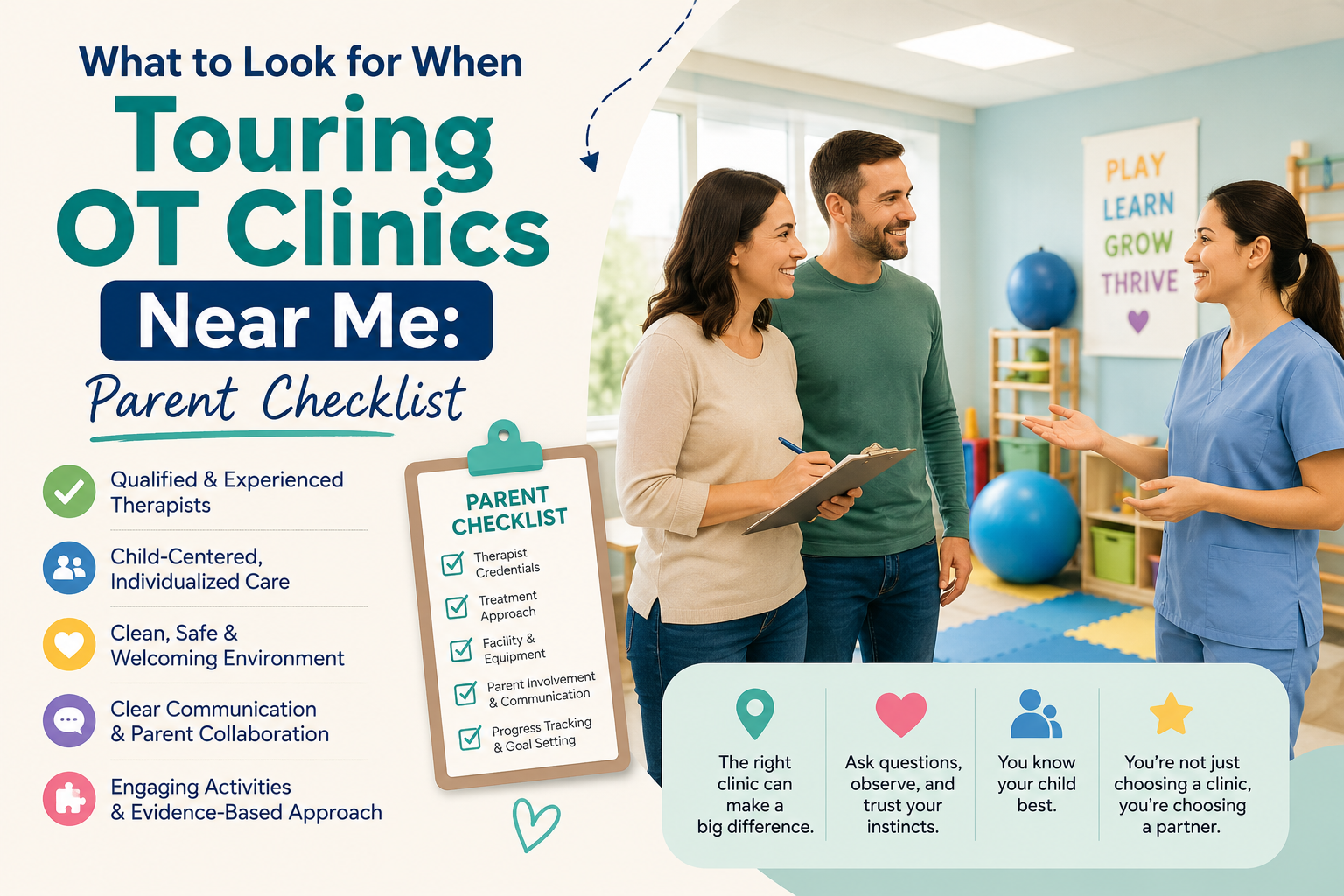
🏥 What to Look for When Touring OT Clinics Near Me: 2026 Parent Checklist
When parents search for OT clinics near me, they typically tour two or three local options, see some swings and colourful walls, and pick the one that felt warmest. But the features that actually predict therapeutic quality — suspended equipment variety, calming zone design, ceiling height, therapist-to-child ratios, and safety protocols — are almost never on the average parent’s checklist.
This guide changes that. 💛

- 💡 Why Most OT Clinic Tours Miss What Matters Most
- 📊 The Numbers: Pediatric OT, Sensory Gyms, and What the Research Shows
- ✅ THE 12-POINT EXPERT CHECKLIST FOR TOURING OT CLINICS NEAR ME
- 🏋️ What a Quality Sensory Gym Actually Looks Like
- 🔄 Suspended Equipment: What to Look For (and What to Ask)
- 🌿 Calming Zones and Regulation Spaces — Why They Matter as Much as the Gym
- 🚪 Treatment Room Standards
- 🔍 What You Must Not Miss About Touring OT Clinics
- 1. 🚨 The Marketing-Quality Mismatch Is Almost Never Named Directly
- 2. 📏 Specific Dimensions Are Almost Never Shared With Parents
- 3. 🔒 Safety Documentation Is Almost Never Discussed
- 4. 🌿 The Calming Zone Conversation Is Almost Entirely Absent
- 5. 🧑⚕️ Therapist Training Specific to Equipment Is Never Raised
- ❓ Questions to Ask That Most Parents Never Think to Ask
- 💙 A Parent’s Story: The Second Tour That Changed Everything
- ❓ FAQs About Touring OT Clinics Near Me
- Q: What should I look for when touring OT clinics near me?
- Q: How big should a pediatric OT sensory gym be?
- Q: Why does ceiling height matter in an OT clinic?
- Q: What is a calming zone in a pediatric OT clinic?
- Q: What questions should I ask when touring an OT clinic?
- Q: How do I know if an OT clinic’s equipment is safe?
- 🔗 Trusted Resources for Families
- 💙 Final Thoughts: Look Up First. Ask Second. Trust What You See.
💡 Why Most OT Clinic Tours Miss What Matters Most
The challenge with touring OT clinics near me is that most clinics invest heavily in visual first impressions — bright, branded colours, a cheerful reception area, and one impressive swing visible through a window — while the features that genuinely predict whether your child will make progress are less visible, less discussed, and almost never explained to parents during standard tours.
A clinic with a beautiful logo and a friendly front desk can have inadequate ceiling clearance for safe suspended equipment use, no dedicated calming zone for children who dysregulate, and a treatment-to-storage ratio that leaves therapists constantly adapting around space constraints.
Conversely, a less polished-looking clinic with adequate ceiling height, varied suspension points, multiple sensory zones at different intensity levels, and documented safety protocols for equipment inspection may deliver significantly better outcomes for your child.
This guide puts the real evaluation tools in your hands — before you book, before you tour, and before you sign anything.
📊 The Numbers: Pediatric OT, Sensory Gyms, and What the Research Shows
Understanding what quality spaces actually require helps you evaluate what you see during a tour with informed eyes.
| Standard / Statistic | Detail | Source |
|---|---|---|
| Sensory gym recommended square footage | 250–300 sq ft minimum | Kidstart Pediatric Therapy — 2025 OT Space Standards |
| Minimum ceiling height for suspended equipment | 10 feet | Kidstart Pediatric Therapy, 2025 |
| Minimum treatment room size (per child + family + wheelchair) | 150 sq ft per room | Kidstart Pediatric Therapy, 2025 |
| Required clearance zone around suspended equipment | 6 feet in all directions | BTE Technologies — Pediatric OT Equipment Guide, 2025 |
| Maximum weight rating for most pediatric swings | 100–200 lbs (must be posted) | BTE Technologies, 2025 |
| Sensory gym design principle (layout center-out) | Therapists should have sightlines to all stations from one position | [Fun Factory Sensory Gym — Commercial Design Standards](https://www.funfactorysensory gym.com/commercial-systems/) |
| Equipment connection point safety standard (commercial grade) | Independently tested to 500 lbs minimum | Summit Sensory Gym — Summit Adventure Series |
| US students ages 3–21 receiving IDEA special education services | 7.5 million | NCES — Students With Disabilities |
💡 What these numbers mean for your tour: You now have specific, expert-sourced standards to hold in your mind when you walk through a clinic. A ceiling that looks tall may be 8 feet — not the 10-foot minimum needed for safe suspension work.
A sensory gym that looks well-equipped may have one suspension point in a room where your child needs to move freely in all directions.
✅ THE 12-POINT EXPERT CHECKLIST FOR TOURING OT CLINICS NEAR ME

Print this. Take it with you. Check each item during your tour — not after.
| # | What to Check | What Meets the Standard |
|---|---|---|
| 1 | Sensory gym size | At least 250–300 square feet of open floor space |
| 2 | Ceiling height | Minimum 10 feet — preferably higher |
| 3 | Suspended equipment variety | Multiple suspension types, not just one swing |
| 4 | Clearance zones around equipment | At least 6 feet of open space around all suspension points |
| 5 | Weight limits posted on equipment | Visible, current, and respected |
| 6 | Dedicated calming/regulation zone | Physically separate from the active gym space |
| 7 | Lighting control | Adjustable from bright to dim in at least one space |
| 8 | Sound management | Acoustic treatment, soft surfaces, or sound-control options |
| 9 | Treatment room size | At least 150 square feet with room for child, family, and wheelchair |
| 10 | Sightlines | Therapist can see all active areas from one position |
| 11 | Equipment inspection evidence | Documentation available; inspection records visible or shareable |
| 12 | Parent involvement space | A clear, designated area for caregiver presence during sessions |
🏋️ What a Quality Sensory Gym Actually Looks Like
The sensory gym is the most important space in any OT clinic near you evaluating for sensory integration work. Here is what to genuinely look for — and what to question.
📐 Space and Dimensions
Sensory gyms in quality clinics have a minimum of 250–300 square feet and high ceilings — a minimum of 10 feet — for suspended equipment. (Source: Kidstart Pediatric Therapy, 2025)
Why does ceiling height matter so much? Suspended equipment — swings, hammocks, bolsters, platform swings — hangs from the ceiling.
If the ceiling is too low, the arc of movement is restricted, reducing the vestibular and proprioceptive input the equipment is designed to provide. A low ceiling also limits which children can safely use the equipment, since taller or heavier children need more clearance, not less.
During your tour, look up. If you cannot comfortably estimate at least 10 feet between the floor and the highest mounting point, ask directly: “What is the ceiling height in this gym?”
🏗️ Layout and Sightlines
Quality sensory gym design is built from the center out so therapists can monitor multiple stations, transition between activities, and manage group sessions with clear sightlines. (Source: Fun Factory Sensory Gym — Commercial Design Guide)
Stand in the center of the sensory gym during your tour. Can you see all the equipment from where you stand? A good therapist should be able to spot a child at the crash pad while simultaneously monitoring a child on the swing, without turning their back on either. If the room is so cluttered or oddly shaped that sightlines are blocked, child supervision is compromised.
🧸 Equipment Variety
A sensory gym contains suspended equipment, balls, climbing structures, crash pads, and other sensory equipment. (Source: Kinetic Kids OT — Sensory Gym Description) The variety of equipment matters because different children need different types of sensory input — and the same child may need different input at different points in their therapy journey.
When visiting OT clinics near me, look specifically for:
- Swing variety — Is there more than one swing type? A simple platform swing, a bolster swing, and a net swing serve different vestibular input needs.
- Proprioceptive equipment — Crash pads, weighted blankets, squeeze machines, and body socks address deep pressure needs.
- Climbing structures — Walls, ladders, or ropes support proprioceptive and motor planning goals.
- Ground-level sensory items — Ball pits, textured mats, and tunnel systems for children who are not yet ready for suspension work.
A gym with one swing in the corner and a few therapy balls is not a sensory gym. It is a room with a swing.
🔄 Suspended Equipment: What to Look For (and What to Ask)
Suspended equipment is the most technically demanding and safety-critical aspect of any pediatric OT sensory gym — and it is the area most parents evaluate least carefully during tours.
🔒 Safety Standards to Verify
All pediatric suspension equipment should be inspected before each session, checking for wear, rust, or loose connections. Weight limits must be clearly posted and never exceeded — most pediatric swings support 100–200 pounds maximum.
A 6-foot clearance zone must be maintained around all suspended equipment at all times. (Source: BTE Technologies — Pediatric OT Equipment Guide, 2025)
Furthermore, every connection point on commercial-grade sensory gym equipment should be independently tested to support at least 500 pounds — providing a substantial safety margin above the maximum clinical load. (Source: Summit Sensory Gym, 2024)
What to ask during your tour:
- “Can I see the weight rating for your suspension hardware?”
- “How often is your suspension equipment formally inspected, and can I see recent inspection records?”
- “Who inspects the mounting points — in-house staff or a certified inspector?”
- “What happens when a piece of equipment is found to be worn or damaged?”
A clinic that cannot answer these questions clearly, or that seems surprised you are asking, has told you something important.
🔄 Suspension Point Flexibility
The best suspension systems allow equipment to be repositioned flexibly based on each child’s specific needs. Connection points spaced every six inches — offering unmatched versatility for therapy providers — allow therapists to attach, adjust, and reposition equipment with precision across the session. (Source: Summit Sensory Gym — Adventure Series)
Ask whether the clinic’s suspension points are fixed or flexible. A clinic with multiple, repositionable mounting points can adapt the space to your child’s changing needs over time. A clinic with a single fixed beam in the center of the room will always be limited in how it can serve your child’s evolving therapy goals.
🌿 Calming Zones and Regulation Spaces — Why They Matter as Much as the Gym
This is the area most parent-facing OT clinic guides almost never discuss — and it is, in the clinical view of many occupational therapists, as important as the active gym space itself.
A quality OT clinic near me will have dedicated quiet retreat areas: spaces where overstimulated children can decompress with low lighting and minimal sensory input. (Source: Kidstart Pediatric Therapy, 2025)
Why a Calming Zone Is Non-Negotiable
Children who are sensory-sensitive do not always begin a session in a regulated state. A child who arrives from a challenging school day, a stressful car journey, or a transition they struggled with may need to downregulate before any active therapeutic work is productive.
A clinic that has only a gym — only stimulating equipment and active movement options — has no space for the first phase of therapy that many children need most.
What a genuine calming zone should include:
- 🔇 Sound management — Quieter than the main gym, ideally with acoustic treatment or soft surfaces absorbing ambient noise
- 💡 Adjustable lighting — LED lighting that can shift from bright, energising tones to soft, calming hues based on therapeutic needs. (Source: Kidstart Pediatric Therapy, 2025)
- 🧸 Tactile comfort items — Weighted blankets, body pillows, textured walls or floors for grounding through touch
- 📏 Physical separation — Not just a corner of the gym, but a genuinely separate or semi-enclosed space where a child can feel contained and safe
During your tour, ask directly: “Where does a child go if they become dysregulated or overwhelmed during a session?” If the answer is vague, if the therapist points to a corner of the main gym, or if there is no clear answer, that tells you something important about the clinic’s understanding of regulation-before-engagement.
🚪 Treatment Room Standards
Beyond the sensory gym, the individual treatment rooms where fine motor work, feeding therapy, and desk-based activities happen also matter enormously.
Minimum treatment room size in quality clinics is at least 150 square feet per room, with enough space to accommodate children, families, wheelchairs, and therapy equipment simultaneously. (Source: Kidstart Pediatric Therapy, 2025)
During your tour, evaluate each treatment room for:
| Feature | What to Look For |
|---|---|
| Size | Enough space for child, family member, and therapist to move comfortably |
| Natural light | Windows or quality adjustable artificial lighting |
| Sound privacy | Can you hear adjacent rooms? Sound bleed affects concentration and confidentiality |
| Parent seating | A clear, specific place for you to sit and observe during sessions |
| Equipment accessibility | Fine motor materials, adaptive seating, and therapeutic tools stored accessibly rather than piled in a corner |
| Child-appropriate furniture | Tables and chairs sized appropriately for the age range served |
🔍 What You Must Not Miss About Touring OT Clinics
Here is what you must not genuinely miss about OT clinic tour guides.
1. 🚨 The Marketing-Quality Mismatch Is Almost Never Named Directly
No parent-facing guide directly tells parents that a beautiful website, a branded waiting room, and a warm reception staff do not predict therapeutic layout quality. This guide names that disconnect directly, giving parents permission to look past the first impression and evaluate the actual therapeutic environment.
2. 📏 Specific Dimensions Are Almost Never Shared With Parents
Almost no parent-facing resource tells families that a sensory gym should be at least 250–300 square feet with a minimum 10-foot ceiling, or that a treatment room should be at least 150 square feet.
These are real, expert-sourced standards. Knowing them turns a vague impression (“this feels small”) into a specific, evaluable question (“is this room at least 150 square feet?”).
3. 🔒 Safety Documentation Is Almost Never Discussed
Most touring guides mention “looking for clean, well-maintained equipment” without telling parents that suspension equipment should be formally inspected, that weight limits should be posted, and that inspection records should be available on request. These are specific, documentable safety standards — and asking about them distinguishes a genuinely prepared parent from one a clinic can easily impress with appearances.
4. 🌿 The Calming Zone Conversation Is Almost Entirely Absent
Almost no parent resource discusses regulation spaces or calming zones as a specific feature to evaluate during a tour. Yet for many sensory-sensitive children, the availability of a dedicated downregulation space is more important to outcomes than the variety of equipment in the main gym. This guide’s calming zone section fills a genuine, important gap.
5. 🧑⚕️ Therapist Training Specific to Equipment Is Never Raised
All staff should complete hands-on training for suspension equipment before working independently with clients. (Source: BTE Technologies, 2025) Parents are rarely told to ask about specific equipment training — as distinct from general OT licensure — when evaluating a clinic.
❓ Questions to Ask That Most Parents Never Think to Ask
Beyond the visual checklist above, here are the most powerful questions to ask during any OT clinic near me tour.
About the space:
- “What is the ceiling height in your sensory gym?”
- “How large is your sensory gym in square feet?”
- “Do you have a dedicated regulation or calming zone separate from the main gym?”
About equipment:
- “How many suspension points do you have, and are they fixed or repositionable?”
- “Are weight limits posted on all suspension equipment?”
- “How often is your suspension hardware formally inspected, and by whom?”
About therapist training:
- “What specific training do your therapists have on using suspended equipment safely?”
- “Does your clinic have a written equipment safety protocol?”
About parent involvement:
- “Where will I sit during my child’s sessions?”
- “How are parents typically involved in session goals and home programming?”
About the calming zone:
- “What happens when a child becomes dysregulated during a session?”
- “Can I see the space you use when a child needs to downregulate?”
A quality clinic will answer every one of these questions confidently and clearly. If any question is met with defensiveness, vagueness, or a redirect to marketing materials, that response is itself informative.
💙 A Parent’s Story: The Second Tour That Changed Everything
Marisol toured the first clinic on a Friday afternoon. The reception area was warm and colourful. The receptionist was friendly. There was a swing in the main room that her son Julio immediately wanted to try.
“It looked exactly like what I had pictured in my head,” she admits. “I almost booked on the spot.”
She did not, because a friend who had been through the process twice before had given her a different kind of checklist. When Marisol looked up, she noticed the ceiling was low — perhaps eight feet. The one swing had barely a foot of clearance above the highest point of its arc.
There was no weight limit posted on the equipment. And when she asked where a child would go if they became overwhelmed, the therapist gestured vaguely at a beanbag in the corner of the same gym.
She asked about inspection records. The therapist did not know what she meant.
Marisol did not book.
The second clinic looked plainer from the outside. The waiting room was modest.
But when she entered the gym, she looked up first — and counted at least twelve feet of ceiling space. She counted four different suspension points, all with posted weight limits. She asked to see the calming zone and was taken to a completely separate, softly lit room with acoustic panels, low furniture, and weighted items available.
She asked about inspection records. The therapist produced a binder.
“Julio started there the following month,” Marisol says. “Three months later, his occupational therapist called me to say he had met one of his longest-standing IEP goals. It was the first time in two years we had met any of them.”
She pauses. “The first clinic had a better swing. The second clinic had a better plan.”
❓ FAQs About Touring OT Clinics Near Me
Q: What should I look for when touring OT clinics near me?
Look beyond the reception area and marketing visuals. Evaluate the sensory gym size (at least 250–300 square feet), ceiling height (minimum 10 feet for safe suspension work), variety of suspended equipment, presence of a dedicated calming or regulation zone, treatment room size (minimum 150 square feet), and whether safety protocols for equipment are documented and available to review.
Q: How big should a pediatric OT sensory gym be?
Expert standards recommend sensory gyms of at least 250 to 300 square feet with a minimum ceiling height of 10 feet for suspended equipment. Anything smaller or lower will limit the type and range of suspended equipment that can be safely used and restrict the arc of movement that makes vestibular input therapeutically effective.
Q: Why does ceiling height matter in an OT clinic?
Suspended equipment — swings, bolsters, platform swings, and hammocks — needs adequate ceiling height to function safely and therapeutically. A ceiling lower than 10 feet restricts the arc of movement, limits which equipment can be safely installed, and reduces the vestibular input that makes suspension therapy effective. During any clinic tour, always look up and estimate or ask about ceiling height.
Q: What is a calming zone in a pediatric OT clinic?
A calming zone is a dedicated space, physically separate from the active sensory gym, where children who become dysregulated or overwhelmed during a session can decompress. Quality calming zones include adjustable or dim lighting, sound management, low-stimulus furniture, and tactile comfort items like weighted blankets. The presence of a genuine calming zone, rather than just a corner of the main gym, reflects a clinic’s understanding of regulation as the foundation of therapeutic progress.
Q: What questions should I ask when touring an OT clinic?
The most important questions are: What is the ceiling height in your sensory gym? Are weight limits posted on all suspension equipment? Do you have formal inspection records for your suspension hardware? Is there a dedicated regulation or calming zone? Where will I observe my child’s sessions? How are parents involved in goal-setting and home programming? A quality clinic will answer every one of these questions clearly and without hesitation.
Q: How do I know if an OT clinic’s equipment is safe?
Look for posted weight limits on all suspension equipment, ask about formal inspection protocols and records, check that at least 6 feet of clearance space surrounds all suspended equipment, and ask specifically which staff are trained in safe use of suspension equipment before working independently with children. A clinic that cannot provide these details on request has told you something important about its safety culture.
🔗 Trusted Resources for Families
| Resource | What It Offers | Link |
|---|---|---|
| 🏛️ AOTA — Find an OT | Official US occupational therapist directory | aota.org |
| 🏅 NBCOT — Verify OT Credentials | Free national certification verification | nbcot.org |
| 🌟 STAR Institute — Sensory Processing Resources | Leading sensory processing research and clinician directory | sensoryhealth.org |
| 🏥 BTE Technologies — Pediatric OT Equipment Standards | Equipment safety and selection guidance for clinics | btetechnologies.com |
| 🏫 NCES — Special Education Statistics | Official US data on students receiving special education services | nces.ed.gov |
💙 Final Thoughts: Look Up First. Ask Second. Trust What You See.
When you tour OT clinics near me, the most valuable thing you can bring is not a list of names or reviews or star ratings. It is the knowledge of what a genuinely therapeutic space actually looks like — and the confidence to ask questions that go beyond what a clinic puts in its brochure.
Look up at the ceiling. Walk into the calming zone and notice how it actually feels. Ask to see the inspection binder. Watch whether the therapist answers your questions or redirects them.
You are not being difficult. You are being the parent your child needs you to be. And now you know exactly what to look for. 💛
📝 This article is for informational and educational purposes only. Space standards, equipment specifications, and safety protocols may vary by region, regulatory body, and clinical setting. Always verify current requirements directly with the specific clinic, your state or national OT licensing authority, and any relevant accrediting organisations in your area.


