

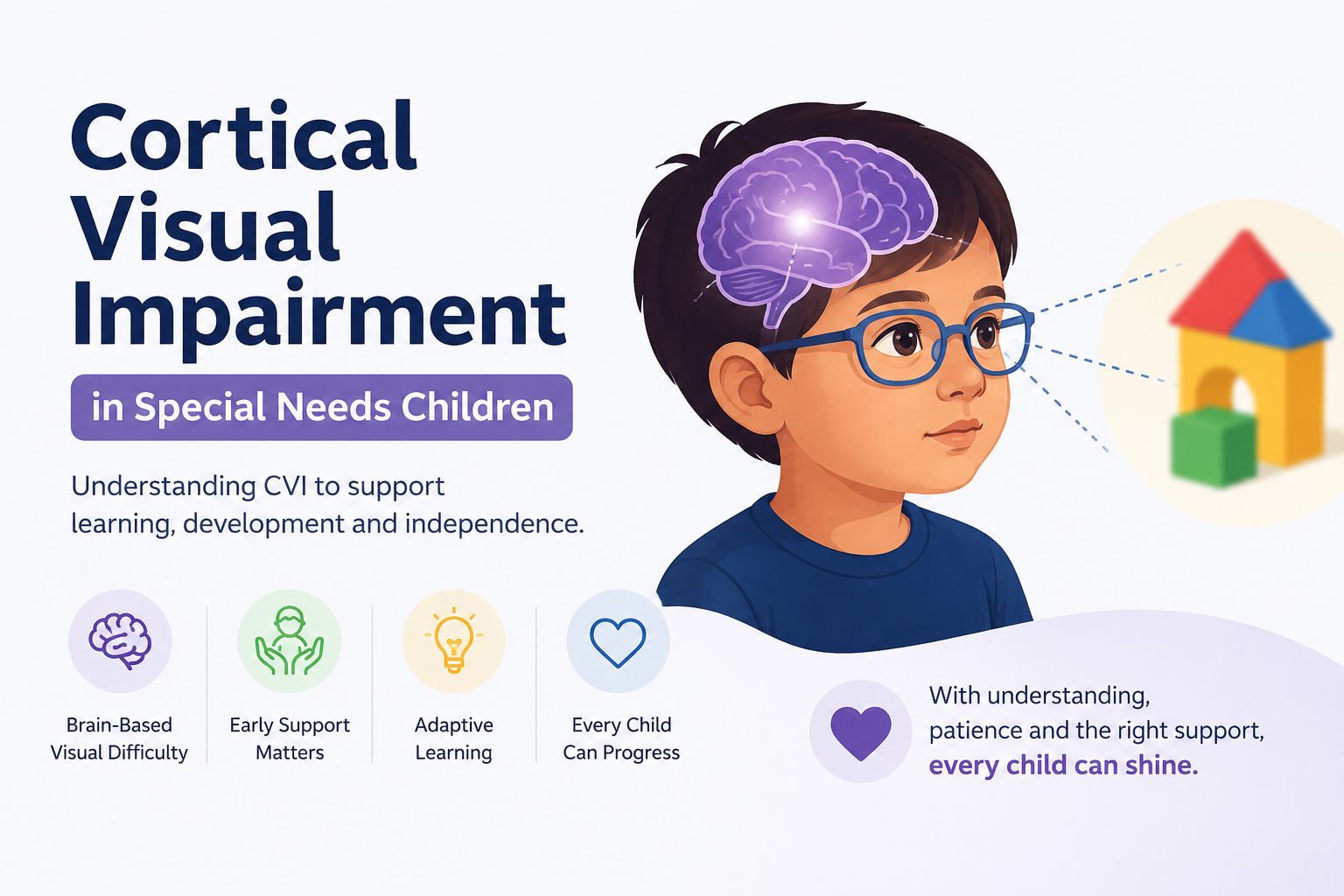
👁️ Cortical Visual Impairment 2026: The Brain-Based Vision Condition Answers That Could Change Your Child’s World
Did you know cortical visual impairment is the leading cause of childhood blindness — yet fewer than 20% of affected children ever get a diagnosis? 😔 Your child may be seeing the world completely differently and nobody knows why. Discover the shocking signs, the school strategies that transform outcomes, and what every special needs parent must demand from their medical team. Read this before your next appointment.

- 👁️ What Is Cortical Visual Impairment — and Why Does Every Special Needs Parent Need to Know?
- 📊 CVI Statistics 2026: The Numbers That Show How Urgent This Is
- 🧠 What Causes Cortical Visual Impairment? The Brain Science Explained Simply
- 🚨 Signs and Symptoms of Cortical Visual Impairment in Children
- 🧩 CVI and Special Needs Children: The Critical Connections
- CVI and Cerebral Palsy
- CVI and Neurodevelopmental Conditions (STXBP1, Genetic Syndromes)
- CVI and Autism Spectrum Disorder
- CVI and Epilepsy / Seizure Disorders
- The NIH Recognition of CVI as a Major Priority
- 💔 A Story That Will Resonate With Every Special Needs Parent
- 🩺 How Is Cortical Visual Impairment Diagnosed?
- 🎓 CVI in School: What Every Parent, Teacher, and IEP Team Must Know
- Evidence-Based Classroom Strategies for Children with CVI
- What to Request in an IEP for a Child with CVI
- 🌟 What Special Needs Families Must know About CVI
- 💙 The CVI Parent’s Advocacy Toolkit
- 🔗 Trusted Resources for CVI Families
- ❓ FAQs: Cortical Visual Impairment
- Q: What is cortical visual impairment in simple terms?
- Q: How common is cortical visual impairment in children?
- Q: What causes cortical visual impairment in children?
- Q: How is cortical visual impairment diagnosed?
- Q: Can cortical visual impairment be confused with autism?
- Q: Is cortical visual impairment treatable?
- Q: How does cortical visual impairment affect learning at school?
- Q: What colours can children with CVI see most easily?
- 💙 A Final Word — Because Your Child’s Eyes Are Telling You Something
👁️ What Is Cortical Visual Impairment — and Why Does Every Special Needs Parent Need to Know?
Cortical visual impairment (CVI) is a brain-based visual condition in which the eyes themselves are healthy but the brain cannot properly process what they see. It is not an eye problem — it is a brain problem.
Cortical visual impairment (CVI) happens when vision problems come from brain damage, not the eyes. It can affect how kids learn and interact with the world. A child may have trouble recognising faces, reaching for objects, or seeing objects on patterns. (Source: Cleveland Clinic — CVI, June 2025)
For families raising children with special needs — particularly those with cerebral palsy, autism, Down syndrome, epilepsy, or premature birth histories — cortical visual impairment is one of the most important and most underdiagnosed conditions to understand in 2026.
📊 CVI Statistics 2026: The Numbers That Show How Urgent This Is
CVI is the leading cause of childhood blindness and low vision in the US, yet it is underdiagnosed at an alarming rate. Fewer than 20% of kids with CVI have an official diagnosis. (Source: Undivided.io — CVI 101, updated February 2026)
| Statistic | Figure | Source |
|---|---|---|
| CVI as cause of childhood blindness/low vision | Leading cause in the US | AAP Pediatrics, Dec 2024 |
| Children with CVI who have an official diagnosis | Fewer than 20% | Undivided.io, 2026 |
| CVI prevalence in general child population | ~3% | PMC — CVI in NDDs, 2025 |
| CVI prevalence in children with developmental delays | At least 10% | PMC, 2025 |
| CVI prevalence in children with developmental disabilities (NIH) | 10.5% | Pediatric CVI Society / NIH |
| CVI in young children with profound visual impairment (India) | 44% | AAP Pediatrics / Pehere et al. |
| CVI in children with visual impairment (Denmark, 2022) | 36% of all visual impairment | Frontiers in Human Neuroscience |
| CVI in neurodevelopmental disorder cohort (STXBP1/8p) | 44–54% | PMC — CVI Across NDDs, 2025 |
The prevalence of CVI may be underestimated, especially in children with special needs or disabilities.
CVI is a leading cause of paediatric visual impairment in nations with developed economies and is increasing in those with developing economies. (Source: AAP Pediatrics — Clinical Report on CVI, December 2024)
These numbers reveal a crisis of recognition. Millions of children — including millions of special needs children — are navigating a world they cannot process visually, without anyone understanding why.
🧠 What Causes Cortical Visual Impairment? The Brain Science Explained Simply
Cortical visual impairment happens when the visual processing areas of the brain — not the eyes themselves — are damaged or underdeveloped. The eyes can be perfectly formed and functioning. But if the brain cannot correctly interpret the signals the eyes send, the child cannot make meaningful sense of what they see.
The most common underlying aetiology of cortical visual impairment is hypoxic-ischaemic encephalopathy, particularly in premature children. Other causes include seizures, hydrocephalus, trauma, and infections. (Source: PubMed — Advances in CVI Evaluation and Management)
Common Causes of CVI in Children
| Cause | How It Leads to CVI |
|---|---|
| Hypoxic-ischaemic encephalopathy (HIE) | Lack of oxygen to the brain before, during, or after birth damages visual processing areas |
| Premature birth | Underdeveloped brain at birth; white matter injury affects visual pathways |
| Periventricular leukomalacia (PVL) | Brain white matter injury near the ventricles — common in premature babies |
| Seizure disorders / epilepsy | Repeated seizures can damage visual processing areas over time |
| Brain infections | Meningitis, encephalitis causing damage to visual cortex |
| Traumatic brain injury | Head injuries affecting occipital or parietal brain regions |
| Hydrocephalus | Fluid pressure on the brain affects visual pathway development |
| Genetic conditions | Specific neurodevelopmental syndromes affecting brain-based visual processing |
| Metabolic disorders | Mitochondrial disease and other metabolic conditions affecting brain development |
(Source: Cleveland Clinic — CVI | NIH CVI Registry)
The number of children with CVI is increasing, elevating it to a public health concern of high significance. This has occurred because of medical advances that have led to better visual outcomes in retinopathy of prematurity, congenital glaucoma, and congenital cataracts, and at the same time improved survival of children with central nervous system diseases. (Source: Pediatric CVI Society)
In other words: medical advances are saving more children who previously would not have survived — and CVI is one of the most significant conditions in those children.
🚨 Signs and Symptoms of Cortical Visual Impairment in Children
This is where cortical visual impairment becomes deeply confusing for families and healthcare providers alike. The signs are not always about not being able to see. They are about how the brain fails to make sense of visual information.

10 Hallmark Signs of CVI in Children
These are the characteristics that Dr. Christine Roman-Lantzy — one of the world’s leading CVI researchers — identified through decades of work with children with CVI:
- 🔴 Preference for colour — particularly red and yellow objects, which are easier for the affected visual brain to process
- 🔴 Need for movement — moving objects are often easier to detect than stationary ones
- 🔴 Visual latency — delayed visual response; the child takes longer than expected to look at something
- 🔴 Visual field preferences — consistently looking to one side, often the peripheral visual field
- 🔴 Difficulty with visual complexity — overwhelmed by busy environments, patterned surfaces, or cluttered visual scenes
- 🔴 Light gazing — staring at lights or windows rather than people or objects
- 🔴 Difficulty with distance viewing — objects are easier to see when close
- 🔴 Atypical visual reflexes — the child does not blink or react to objects moving toward the face
- 🔴 Difficulty with visual novelty — familiar objects are easier to see than new ones
- 🔴 Absent or atypical visually guided reach — difficulty reaching accurately for objects based on sight
(Source: Perkins School for the Blind — CVI by the Numbers | Pediatric CVI Society)
Why These Signs Are So Commonly Missed
A child with CVI may avoid crowded hallways, seem overwhelmed by too much visual clutter or noise, or struggle to recognise familiar faces — even a parent’s face. Many parents (and even medical providers or school teams) have not heard enough about cortical visual impairment. (Source: Undivided.io — CVI 101)
The crucial insight is that these symptoms look like many other things:
| CVI Symptom | What It Is Commonly Mistaken For |
|---|---|
| Not making eye contact | Autism |
| Not recognising faces | Autism; intellectual disability |
| Overwhelmed in busy environments | Sensory processing disorder; ADHD |
| Looking at lights instead of people | Autism; visual stimming |
| Reaching inaccurately | Dyspraxia; motor delay |
| Difficulty with written text | Dyslexia; learning disability |
| Appearing not to notice things | Hearing or attention problems |
This misattribution is one of the most damaging aspects of under-diagnosed CVI. A child receives therapies and strategies for autism or ADHD — while the underlying visual processing condition goes entirely unaddressed.
🧩 CVI and Special Needs Children: The Critical Connections
This is the section that makes cortical visual impairment directly relevant to every HopeForSpecial reader.
CVI and Cerebral Palsy
Because of neurologic comorbidities, children with CVI often present challenges in diagnosis and characterisation of visual deficits. Caregiver questionnaires may aid in assessment of visual functioning. (Source: PubMed — Advances in CVI Evaluation) Cerebral palsy is one of the most frequent co-occurring conditions with CVI, because both often share the same root cause — brain injury around the time of birth.
CVI and Neurodevelopmental Conditions (STXBP1, Genetic Syndromes)
CVI is particularly relevant in children with neurodevelopmental disorders yet remains underdiagnosed. A retrospective chart review of 85 patients found CVI in 44%, most commonly in children with 8p-related disorders (54%) and STXBP1 disorder (50%).
CVI was significantly associated with greater developmental impairment, with higher overall severity scores and lower adaptive behaviour scores. (Source: PMC — CVI Across Neurodevelopmental Disorders, 2025)
CVI and Autism Spectrum Disorder
For children with autism, cortical visual impairment presents a particularly complex diagnostic challenge — because so many CVI characteristics (avoiding eye contact, being overwhelmed by visual clutter, stimming on lights) overlap with autistic presentations.
However, the interventions for CVI are fundamentally different from those for autism. A child whose visual avoidance is CVI-driven — not autism-driven — needs a completely different support strategy. Treating only the autism while missing the CVI means the child is never given the visual access they need to learn and communicate.
CVI and Epilepsy / Seizure Disorders
Children with epilepsy — particularly those with early-onset or frequent seizures — are at significantly elevated risk of CVI. The seizure activity itself, alongside any underlying brain pathology, can damage the visual processing pathways over time.
The NIH Recognition of CVI as a Major Priority
The NIH CVI Registry is under development and will be a multi-institutional protocol coordinated by the National Eye Institute. The NIH CVI Registry aims to gain insights into current diagnostic and rehabilitation practices, characterise various presentations of CVI, and facilitate further research into the condition. (Source: NIH CVI — cvi.nih.gov)
The fact that the NIH has prioritised CVI to this degree underlines its status as a major public health concern — one that disproportionately affects children with special needs.
💔 A Story That Will Resonate With Every Special Needs Parent
Meet Lena. She is the mother of a 6-year-old boy named Oscar who has cerebral palsy. Oscar was born at 28 weeks and spent his first three months in the NICU.
By age 2, Lena noticed something: Oscar did not seem to see his toys unless they were red. He never reached for things accurately. He would stare at the window for long stretches. He did not recognise her face at any distance.
Every specialist she saw said the same thing: it was the cerebral palsy. It was the developmental delay. It was just how Oscar processed the world.
At 5 years old, Oscar was finally referred to a CVI specialist at a children’s hospital. The assessment confirmed what Lena had been sensing for three years: Oscar had severe cortical visual impairment that had been completely overlooked because everyone was focusing on his cerebral palsy.
He began a CVI-specific vision programme. His therapy team adapted his learning materials — high-contrast, red and yellow, isolated from clutter. Within six months, Oscar was making accurate reach-and-touch responses for the first time in his life.
“It changed everything,” Lena says. “Not because he suddenly could see like other kids. But because we finally understood how he sees — and we could finally meet him there.”
Oscar’s story is the story of hundreds of thousands of children whose CVI is hidden behind other diagnoses. And Achalasia Awareness Month — like every awareness effort — is only meaningful if it reaches families like Lena’s early enough to make a difference.
🩺 How Is Cortical Visual Impairment Diagnosed?
This is where parents frequently hit barriers — because CVI diagnosis requires specialist expertise that is not widely available in standard paediatric settings.
Delay in diagnosis of CVI can negatively affect education, making early detection and management important. Knowledge of the characteristics of CVI as well as risk factors for CVI will assist the paediatrician in identifying children with CVI. (Source: AAP Pediatrics — Clinical Report on CVI)
The Diagnostic Pathway for CVI
| Step | What It Involves |
|---|---|
| 1. Paediatrician or neurologist referral | Based on risk factors (prematurity, HIE, cerebral palsy, seizures) or parental concern |
| 2. Standard ophthalmology exam | Rules out or identifies co-occurring eye conditions |
| 3. CVI-specific functional vision assessment | Specialist assessment using CVI Range (Roman-Lantzy) or other validated tools |
| 4. Neuroimaging review | MRI findings — particularly white matter injury, periventricular leukomalacia |
| 5. Caregiver questionnaire | Structured questionnaire about visual behaviours in everyday settings |
| 6. CCSA-vision tool (for NDDs) | Validated tool showing high specificity (95.9%) for CVI identification in neurodevelopmental disorders |
(Source: PMC — CVI in NDDs, 2025 | PubMed — Advances in CVI Evaluation)
A CCSA-vision subdomain cutoff score ≥11 showed high specificity (95.9%) and positive predictive value (94.3%) for identifying CVI in children with neurodevelopmental disorders. (Source: PMC — CVI Across NDDs, August 2025)
Who to Ask For
Do not simply request a “vision test.” Specifically ask for:
- ✅ A paediatric low vision specialist or CVI specialist
- ✅ A teacher of the visually impaired (TVI) with specific CVI training
- ✅ A review by a neurologist who is aware of CVI
- ✅ A functional vision assessment — not just an acuity test
🎓 CVI in School: What Every Parent, Teacher, and IEP Team Must Know
Cortical visual impairment has profound implications for how a child learns at school. And yet most schools are completely unprepared to address CVI — because the condition is so frequently undiagnosed.
Strategies are necessary for early identification of CVI to promote early diagnosis and referral for vision services that may allow a child with CVI to engage more fully in school, activities of daily living, vocational pursuits, and recreational activities. (Source: AAP Pediatrics)
Evidence-Based Classroom Strategies for Children with CVI
| Strategy | How It Helps | Implementation |
|---|---|---|
| Reduce visual clutter | Cluttered environments overwhelm CVI visual processing | Remove busy backgrounds; use plain backdrops for materials |
| Use high-contrast materials | Black/white or bright single colours are easier to process | High-contrast printed worksheets; avoid pastel coloured materials |
| Favour red and yellow | These colours are most reliably processed by CVI visual systems | Use red/yellow for target objects, attention tools, and key materials |
| Use movement to attract attention | Moving stimuli are more easily detected | Introduce objects with slight movement before presenting static |
| Allow extra response time | Visual latency means the brain needs more time | Wait 5–10 seconds after presenting visual information |
| Reduce lighting complexity | Avoid placing children near windows or in flickering light | Consistent, even lighting; avoid glare |
| Present items one at a time | Complexity overwhelms visual processing | Single-item presentation rather than arrays |
| Use familiar objects and faces | Novelty suppresses visual response in CVI | Start with highly familiar materials; introduce new items gradually |
| Utilise preferred visual field | Many children with CVI have field preferences | Present materials in the child’s preferred visual field consistently |
(Source: Perkins School for the Blind — CVI Resources | Pediatric CVI Society)
What to Request in an IEP for a Child with CVI
If your child has diagnosed or suspected CVI, request the following in their Individualised Education Programme (IEP):
- ✅ Formal CVI assessment by a qualified Teacher of the Visually Impaired (TVI)
- ✅ Functional vision assessment updated annually
- ✅ CVI-specific learning media assessment — to determine whether braille, print, or other formats are appropriate
- ✅ Environmental modifications documented in the IEP
- ✅ Training for all school staff — class teachers, teaching assistants, and therapists
🌟 What Special Needs Families Must know About CVI
Here is what HopeForSpecial families truly need:
🔸 CVI is not just about visual acuity.
A child with CVI may pass a standard Snellen eye chart test and still have severe cortical visual impairment. Standard vision screening is almost entirely ineffective at identifying CVI. Only a CVI-specific functional assessment captures the true picture.
🔸 The autism-CVI overlap is dangerously under-recognised.
Research suggests that a significant proportion of children with autism may also have co-occurring CVI that has never been identified. The visual behaviours look similar, but they have different causes and require different interventions.
🔸 Schools are not legally required to provide CVI-specific services in most areas — but families can advocate for them.
Under IDEA (Individuals with Disabilities Education Act), visual impairment is a qualifying category that triggers the right to specialist services. CVI is a visual impairment. Parents who know this are in a much stronger position to advocate.
🔸 Neuroimaging is important — but not sufficient.
Many children with CVI have white matter findings on MRI. But the severity of CVI does not always correlate with the extent of neuroimaging findings. Functional vision assessment is essential regardless of what the MRI shows.
🔸 CVI presentations change with development.
Children with CVI can make progress. The brain-based nature of CVI does not mean outcomes are fixed. Early, appropriate intervention — with properly designed visual environments — can improve functional vision over time.
🔸 The NIH is building a CVI registry.
The NIH CVI Registry aims to gain insights into current diagnostic and rehabilitation practices and characterise various presentations of CVI. (Source: NIH CVI) Enrolling your child in this registry contributes to the research that will build better tools for every future CVI family.
💙 The CVI Parent’s Advocacy Toolkit
The SEE Framework for CVI Advocacy 👁️
| Letter | Action | What It Means Practically |
|---|---|---|
| S | Suspect early | Know the risk factors; if your child has CP, HIE, prematurity, or epilepsy — ask about CVI proactively |
| E | Evaluate specifically | Request CVI-specific functional vision assessment — not just a standard eye exam |
| E | Educate the team | Share CVI information with your child’s teachers, therapists, and medical team — many will not know |
🔗 Trusted Resources for CVI Families
- 🌐 NIH CVI — cvi.nih.gov — National Eye Institute’s CVI initiative; registry and research hub
- 🌐 Perkins School for the Blind — CVI Centre — Most comprehensive CVI resource library available
- 🌐 Pediatric CVI Society — What is CVI; diagnostic guidance; family resources
- 🌐 American Academy of Paediatrics — Clinical Report on CVI — The 2024 AAP clinical guidance for paediatricians
- 🌐 CVI Now — Perkins — CVI education and advocacy platform
- 🌐 American Foundation for the Blind — CVI — Resources for families and educators
- 🌐 ClinicalTrials.gov — CVI — Open research trials for children with CVI
❓ FAQs: Cortical Visual Impairment
Q: What is cortical visual impairment in simple terms?
Cortical visual impairment happens when vision problems come from brain damage, not the eyes. The child may have trouble recognising faces, reaching for objects, or seeing objects on patterns. (Source: Cleveland Clinic, 2025) It is a brain-based vision condition — the eyes work, but the brain cannot interpret what they see.
Q: How common is cortical visual impairment in children?
CVI affects approximately 3% of children in the general population and at least 10% of those with developmental delays. (Source: PMC — CVI Across Neurodevelopmental Disorders, 2025) Despite this, fewer than 20% of kids with CVI have an official diagnosis. (Source: Undivided.io)
Q: What causes cortical visual impairment in children?
The most common underlying aetiology is hypoxic-ischaemic encephalopathy, particularly in premature children. Other causes include seizures, hydrocephalus, trauma, and infections. (Source: PubMed — Advances in CVI Evaluation) Genetic neurodevelopmental conditions are also increasingly recognised as a cause.
Q: How is cortical visual impairment diagnosed?
CVI requires a functional vision assessment by a specialist — not a standard eye chart test. A child with CVI can pass an acuity test and still have severe visual processing impairment. Knowledge of the characteristics of CVI as well as risk factors for CVI will assist the paediatrician in identifying children who need referral for CVI-specific assessment. (Source: AAP Pediatrics)
Q: Can cortical visual impairment be confused with autism?
Yes — this is one of the most clinically important overlaps in paediatric neurology. Many CVI characteristics (avoiding eye contact, light gazing, overwhelm in busy environments) are identical to autistic presentations. A child can have both — but CVI requires its own specific visual support strategies that differ entirely from autism-based approaches.
Q: Is cortical visual impairment treatable?
Although no standard therapy for paediatric CVI currently exists, advances in neuroimaging and functional vision assessment are improving understanding. Children with CVI can make progress with appropriately designed visual environments and structured vision intervention programmes. (Source: PubMed — Advances in CVI) Early intervention is strongly associated with better outcomes.
Q: How does cortical visual impairment affect learning at school?
Because vision is the predominant sense used for learning, delay in diagnosis of CVI can negatively affect education. CVI-specific intervention may allow a child with CVI to engage more fully in school, activities of daily living, vocational pursuits, and recreational activities. (Source: AAP Pediatrics) Classroom modifications — reduced clutter, high-contrast materials, single-item presentation — can be transformative.
Q: What colours can children with CVI see most easily?
Research consistently shows that children with cortical visual impairment process red and yellow most reliably. CVI children are expected to have higher fixation saliency values on maps of colour, especially red and yellow, contrast, orientation, and luminance. (Source: Frontiers in Human Neuroscience) This is why red and yellow objects are used as the starting points for CVI-specific visual intervention programmes.
💙 A Final Word — Because Your Child’s Eyes Are Telling You Something
If your child stares at lights. If they struggle to recognise faces. If they are overwhelmed in busy hallways but calm in quiet rooms. If they only reliably reach for red objects. If they seem to see some days and not others.
These observations may not be explained fully by their primary diagnosis. They may be cortical visual impairment — a brain-based visual condition that is the leading cause of childhood visual impairment in the developed world, yet one that fewer than 1 in 5 affected children ever receives a diagnosis for.
You are your child’s most important observer. The patterns you notice at home — over months and years — are clinical data. Share them. Document them. And ask specifically: “Has my child been assessed for cortical visual impairment?”
Because when the right support finally reaches a child with CVI — when the clutter is cleared, the red toy is placed in their preferred visual field, when the world is finally designed around how they actually see — the change can be profound.
They were seeing all along. They just needed the world to meet them where they are. 💙👁️
📌 To find CVI specialist resources, visit the NIH CVI initiative at cvi.nih.gov, the Perkins School for the Blind CVI Centre, or the Pediatric CVI Society at pcvis.vision.


