Alopecia in Children 2026: What Every Special Needs Parent Must Know Before It’s Too Late
Did you know your special needs child may be at up to 5x higher risk of alopecia? 😢 This deeply researched 2026 guide reveals the hidden signs, causes, emotional impact, and breakthrough treatments — including what most doctors never tell parents. Read before your next appointment. 👇

- What Is Alopecia and Why Should Special Needs Parents Pay Close Attention?
- 📖 Understanding Alopecia: The Basics Every Parent Needs to Know
- 📊 Alopecia Statistics 2026: The Numbers That Will Surprise You
- 🧬 What Causes Alopecia in Children? (And Why Special Needs Kids Are More Vulnerable)
- 🚨 Warning Signs of Alopecia in Children — A Parent’s Checklist
- 🧠 The Emotional Impact of Alopecia on Children with Special Needs
- 💊 Alopecia Treatments for Children in 2026 — A Complete Guide
- Treatment Options by Severity
- 🔬 The JAK Inhibitor Breakthrough
- 🔬 Promising Research: Dupilumab for Children
- 💡 Practical Tips for Managing Treatment in Children with Special Needs
- 🗓️ Alopecia Awareness Month 2026 — Everything You Need to Know
- When Is Alopecia Awareness Month?
- Key Events and Dates in 2026
- Why This Month Matters for Special Needs Families
- How to Celebrate and Participate in 2026
- 🏫 How to Support a Child with Alopecia at School
- 🍽️ Nutrition and Lifestyle Support for Children with Alopecia
- ❓ Frequently Asked Questions About Alopecia in Children (2026)
- Q1: What is the most common type of alopecia in children?
- Q2: Is alopecia in children permanent?
- Q3: Is alopecia more common in children with Down Syndrome?
- Q4: Can stress cause alopecia in a child?
- Q5: What is the best treatment for alopecia in a child in 2026?
- Q6: Is alopecia areata in children contagious?
- Q7: When is Alopecia Awareness Month?
- Q8: Can a child with alopecia participate in normal school activities?
- Q9: Does alopecia affect nail growth in children?
- Q10: Are there support groups for families of children with alopecia?
- 🤝 The Unique Intersection of Alopecia and Special Needs
- 💛 Final Words: You Are Not Navigating This Alone
What Is Alopecia and Why Should Special Needs Parents Pay Close Attention?
Alopecia is not just hair loss. For a child, especially one with special needs, it can be the beginning of a painful emotional journey — and one that too many families face completely unprepared.
Simply put, alopecia is a medical condition where the immune system mistakenly attacks hair follicles, causing hair loss that can range from small patches to complete loss of hair on the scalp or body. The good news? It is not contagious, it is not life-threatening, and in 2026, more treatment options exist than ever before.
Children with Down Syndrome, autism, atopic dermatitis, and other special needs conditions face a significantly higher risk of developing alopecia. Alopecia areata affects 6–10% of those with Down Syndrome, compared to the general population prevalence of just over 2%. That is up to five times higher risk — yet most parents are never warned.
This guide is written specifically for you: parents and caregivers of special needs children who deserve complete, compassionate, and research-backed information.
📖 Understanding Alopecia: The Basics Every Parent Needs to Know
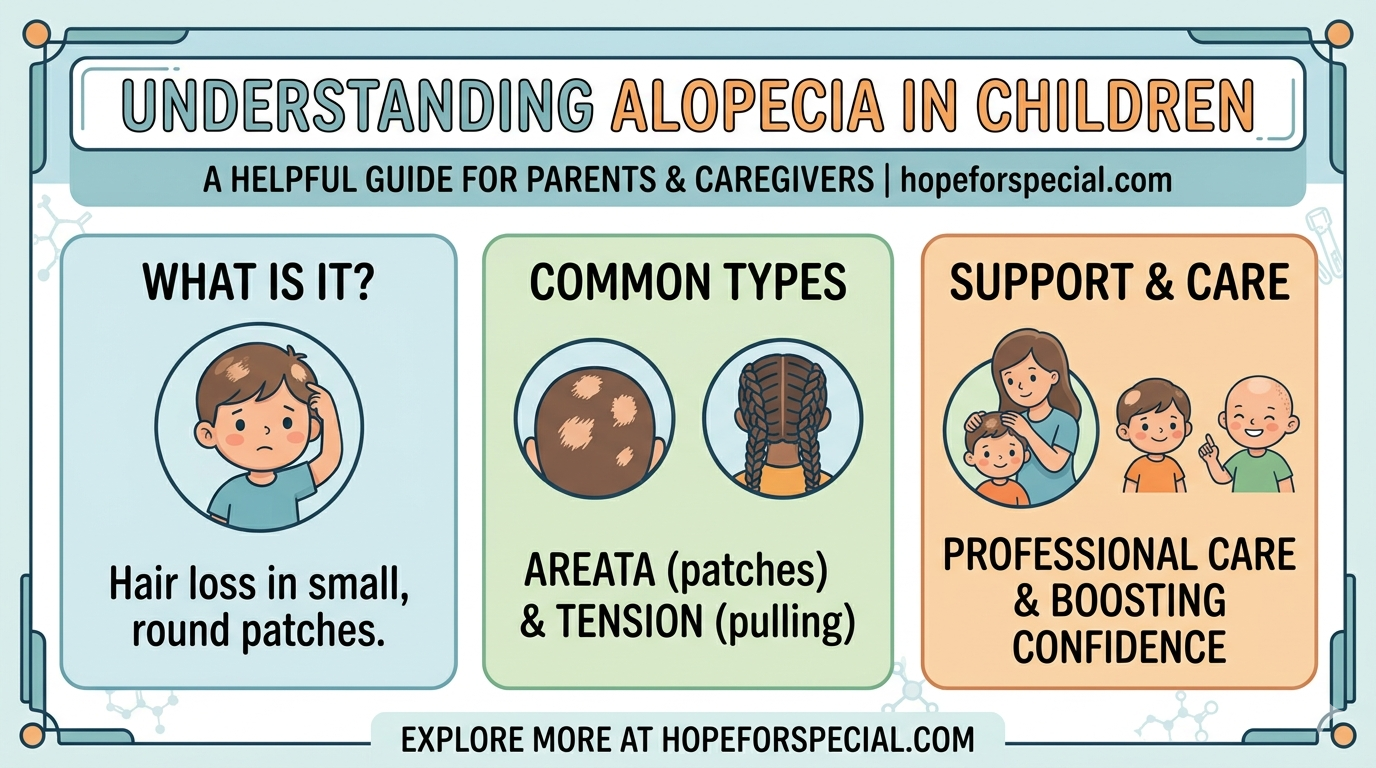
Alopecia is an umbrella term. It covers several different types of hair loss, each with its own cause and pattern. Before anything else, understanding which type your child may have is essential.
The Main Types of Alopecia
| Type of Alopecia | What It Looks Like | Who It Affects |
|---|---|---|
| Alopecia Areata (AA) | Round, smooth bald patches on scalp or body | Children and adults of any age — most common type |
| Alopecia Totalis (AT) | Complete loss of all scalp hair | Children and adults with more severe AA |
| Alopecia Universalis (AU) | Complete loss of hair all over the body including eyebrows and lashes | Severe progression from AA |
| Androgenetic Alopecia | Gradual thinning along hairline and crown | Teens — more common in boys |
| Traction Alopecia | Hair loss at hairline from tight hairstyles | Children with certain hair types |
| Congenital Alopecia | Present from birth; rare | Newborns and infants |
Among all of these, alopecia areata is the most common type seen in children with special needs. It is also the most researched — and increasingly, the most treatable.
📊 Alopecia Statistics 2026: The Numbers That Will Surprise You
Most parents are shocked when they see just how common — and emotionally significant — alopecia really is. Here is what the latest research tells us:
| Statistic | Data | Source |
|---|---|---|
| Lifetime prevalence of alopecia areata worldwide | ~2% of the global population | NIH / PMC |
| Children who develop first patch before age 20 | 60% of all AA patients | DermNet NZ |
| US children diagnosed with AA per 100,000 | 220 cases per 100,000 children | AJMC, 2026 |
| AA prevalence in children with Down Syndrome | 6–10% (vs. 2% in general population) | DermNet NZ |
| Children with AA who also have atopic dermatitis | 33% | Mount Sinai |
| Lifetime prevalence of psychiatric disorders in AA patients | 66–74% | PMC / NIH |
| Children with AA also having asthma | 21% | Mount Sinai |
| Patients who develop AA before age 20 face higher depression risk | 40% of all AA begins before age 20 | Mount Sinai |
| South Asian children’s elevated AA risk vs. White children | 3.3× higher | AJMC, 2026 |
| Children with AA and family history | Up to 25% have an affected family member | DermNet NZ |
These numbers paint a clear picture. Alopecia in children is not rare — and for special needs children, it is even more common than most people think.
🧬 What Causes Alopecia in Children? (And Why Special Needs Kids Are More Vulnerable)
This is the question every parent asks first. And it deserves a real, clear answer.
Alopecia areata is an autoimmune condition. This means the body’s own immune system — which normally fights off infections — mistakenly targets hair follicles as if they were foreign invaders. The follicles don’t die. They simply stop producing hair. That is why, in many cases, hair can grow back.
Key Causes and Triggers
- Genetics — Up to 25% of children with alopecia will have at least one affected family member, and many have multiple relatives with the condition. This strong family pattern confirms a genetic component.
- Immune dysregulation — In children with Down Syndrome, Turner Syndrome, and other chromosomal conditions, the immune system already behaves differently. Alopecia areata is reported to be common in Down Syndrome and Turner Syndrome, as autoimmune disease is particularly common in Turner Syndrome.
- Atopic conditions — Alopecia areata developing in the first ten years of life is strongly associated with atopic dermatitis in approximately one third of cases.
- Stress and emotional triggers — Research shows that stressful life events frequently precede hair loss in children. This is critically important for children with special needs who may experience higher baseline anxiety.
💡 Why Special Needs Children Are More at Risk
Children with the following conditions carry a measurably elevated risk:
| Special Needs Condition | Connection to Alopecia |
|---|---|
| Down Syndrome | Alopecia areata affects 6–10% of those with Down Syndrome, compared to over 2% in the general population |
| Turner Syndrome | Strongly linked due to high rates of autoimmune conditions |
| Atopic Dermatitis / Eczema | 33% of children with AA also have atopic dermatitis (Mount Sinai) |
| Asthma & Allergies | Among children with alopecia areata, 21% have asthma, 20% have hay fever, and 14% have another type of allergy |
| Autoimmune thyroid disease | Commonly co-occurs in older children with AA |
This information is not just statistics. It is a call to action for every parent of a special needs child to include skin and hair monitoring as part of routine care.
🚨 Warning Signs of Alopecia in Children — A Parent’s Checklist
Catching alopecia early makes a real difference. The earlier it is identified, the more treatment options exist and the better the emotional outcomes for your child.
Watch for these signs:
Early Signs
- ✅ One or more smooth, round, coin-sized bald patches on the scalp
- ✅ Patches appearing suddenly — sometimes overnight
- ✅ Hair that comes out easily when gently tugged
- ✅ Small “exclamation mark” hairs at the edge of bald patches (tapered at the base — a classic sign)
- ✅ Patchy loss in eyebrows or eyelashes
Signs in Nails (Often Overlooked)
- ✅ Tiny pits or dents on the fingernails (nail pitting)
- ✅ Rough, ridged nails — called trachyonychia
- ✅ Nail changes are seen in almost 50% in one large series of children with alopecia areata, particularly pitting and trachyonychia.
Emotional and Behavioral Signs in Children
- ✅ Wearing hats or hoods indoors
- ✅ Increased anxiety, withdrawal, or mood changes
- ✅ Asking to not participate in activities like swimming where hair is visible
💬 A Parent’s Story — Maya’s Journey
“When my daughter Maya, who has Down Syndrome, started losing patches of hair at age 6, I thought maybe she’d pulled it out herself. I didn’t realize it was alopecia areata. It took three different doctor visits before anyone mentioned the link to her chromosomal condition. O
nce we got the right diagnosis, things moved quickly. She’s now 10, in treatment, and her confidence has come back. I wish someone had just told me earlier.” — Priya S., parent of a child with Down Syndrome and alopecia areata
This story is not unique. Many families go through months of confusion before reaching the right diagnosis. Knowing the signs — and asking the right questions — can cut that journey short.
🧠 The Emotional Impact of Alopecia on Children with Special Needs
Alopecia is not “just cosmetic.” For a child — especially one who is already navigating the challenges of a special need — sudden, visible hair loss can trigger a cascade of emotional consequences.
A 66–74% lifetime prevalence of psychiatric disorders has been reported in alopecia areata patients, with a 38–39% lifetime prevalence of depression and a 39–62% prevalence of generalized anxiety disorder.
Let that sink in. Almost two thirds of people living with alopecia areata will experience a significant mental health condition during their lifetime.
For children with special needs, this risk is compounded. These children may already struggle with:
- Sensory sensitivities that make wearing wigs or hats distressing
- Greater vulnerability to bullying and peer rejection
- Lower ability to self-advocate at school

What the Research Says
Compared with controls, children with alopecia areata had more psychiatric symptoms in general, and symptoms of anxiety or depression in particular. They were more anxious or depressed, withdrawn, aggressive, and delinquent, and also had more somatic problems as well as problems in social relations and in attention.
Furthermore, adolescents are particularly prone to body image disorders due to their need for peer acceptance and establishment of their identity.
🌈 What Parents Can Do Right Now
You do not have to wait for a diagnosis to start protecting your child’s emotional wellbeing.
- Talk about it openly — Use simple, age-appropriate language. Tell your child their hair follicles are “resting” and that it has nothing to do with anything they did wrong.
- Normalize difference — Read books with characters who look different. Celebrate what makes your child unique.
- Connect with other families — The National Alopecia Areata Foundation (NAAF) hosts virtual support groups specifically for children and their caregivers.
- Speak to school staff — Ask teachers to proactively address any bullying and to include discussions about diversity in appearance.
💊 Alopecia Treatments for Children in 2026 — A Complete Guide
The treatment landscape for alopecia — especially in children — has changed dramatically in recent years. There is more hope now than at any point in history.
Treatment Options by Severity
| Severity | Recommended Treatment | Approved For Children? |
|---|---|---|
| Mild AA (less than 25% hair loss) | Potent topical corticosteroids | ✅ Yes — first-line treatment |
| Mild-Moderate AA | Topical corticosteroids + oral minoxidil | ✅ With physician guidance |
| Moderate AA | Intralesional steroid injections | ✅ In older children |
| Severe AA / AT / AU | JAK inhibitors (oral) | ✅ Ritlecitinib (Litfulo®) approved for ages 12+ |
| Acute, rapidly progressing | Short-term systemic corticosteroids | ✅ With caution |
| Experimental / Newer | Dupilumab (being studied) | 🔬 Clinical trials ongoing |
🔬 The JAK Inhibitor Breakthrough
This is the biggest development in alopecia treatment in decades. After decades with no new treatments, since 2022, the FDA has approved three JAK inhibitors — Olumiant® (baricitinib), Litfulo® (ritlecitinib), and Leqselvi® (deuruxolitinib) — as treatments for severe alopecia areata.
Of these, ritlecitinib (Litfulo®, from Pfizer) is approved for adolescents 12 years old and up — the only JAK inhibitor currently FDA-approved for use in children.
How do JAK inhibitors work? They block the overactive immune pathway that attacks hair follicles. Think of them like a “stop signal” that tells the immune system to stand down. When that signal works, the hair follicle can resume its normal growth cycle.
Important consideration for parents: Most patients — about 80% — will lose their hair regrowth if they stop treatment. This means treatment is likely to be ongoing. That is a significant conversation to have with your child’s dermatologist.
🔬 Promising Research: Dupilumab for Children
Mount Sinai received $6.6 million from the NIH to study dupilumab — a targeted biologic already approved for eczema and asthma — specifically for children with alopecia areata.
There is evidence of a strong relationship between alopecia areata and atopic diseases like eczema, allergic rhinitis, asthma, and food allergy in the general population, and an even stronger association in children.
This connection is exactly why researchers believe dupilumab could be effective.
💡 Practical Tips for Managing Treatment in Children with Special Needs
- For children with sensory sensitivities, topical treatments may need special application strategies — ask your dermatologist about alternatives to rubbing creams directly on sensitive scalps.
- For children who resist eye drops or medications, work with an occupational therapist to create a routine that reduces anxiety around treatment.
- Document with photos — take weekly photos of affected areas in consistent lighting. This helps track progress far better than memory.
- Always ask about clinical trials — Pfizer is actively recruiting children as young as 12 who have lost at least 50% of their scalp hair for a Phase 3 clinical trial of ritlecitinib.
🗓️ Alopecia Awareness Month 2026 — Everything You Need to Know
When Is Alopecia Awareness Month?
Alopecia Awareness Month is observed every September. It is led by the National Alopecia Areata Foundation (NAAF) — the world’s leading organization dedicated to finding a cure for alopecia areata and supporting those affected.
Key Events and Dates in 2026
| Event | Date | Details |
|---|---|---|
| Alopecia Awareness Month | All of September 2026 | Global awareness campaigns, fundraising, education drives |
| NAAF’s 4th Annual Walk For Alopecia | September 26, 2026 | Flagship sites in Boston, Philadelphia, and San Francisco |
| Virtual Support Groups (ongoing) | Monthly | Open to children, adults, and caregivers at naaf.org/events |
Why This Month Matters for Special Needs Families
September is not just a month of awareness — it is a month of action. For families of children with special needs who are also navigating alopecia, this month offers:
- Free educational resources from NAAF, including the new Confidence Guide — a practical resource for people living with alopecia
- Community events where your child can see they are not alone
- Fundraising opportunities that directly support research for pediatric treatments
- School awareness campaigns — September is perfect timing for back-to-school inclusion conversations
How to Celebrate and Participate in 2026
✨ Wear your awareness: Share a photo or video using #AlopeciaAwarenessMonth and #HopeForSpecial to connect with other families.
✨ Talk to your child’s school: Request that teachers acknowledge alopecia awareness this September. A simple classroom conversation about hair differences can prevent bullying before it starts.
✨ Register for the Walk: The NAAF Walk for Alopecia on September 26, 2026 is open to families. Walking as a team with your special needs child sends a powerful message: we belong here, too.
✨ Donate to pediatric research: NAAF’s 2025 Early Career and Research Grant recipients are actively working on solutions specifically for children. Your support directly funds those efforts.
🏫 How to Support a Child with Alopecia at School
School is where alopecia becomes most visible — and most painful. For children with special needs who already experience social challenges, adding alopecia to the mix requires proactive planning.
A Step-by-Step School Advocacy Checklist
Before School Starts:
- [ ] Meet with the teacher, school counselor, and special education coordinator together
- [ ] Request that the school’s anti-bullying policy specifically acknowledges appearance-based teasing
- [ ] Ask if the school can include alopecia in any diversity or inclusion activities in September
During the School Year:
- [ ] Check in weekly with your child about how they feel at school
- [ ] Ask the school psychologist to monitor for signs of withdrawal or anxiety
- [ ] Consider connecting your child with a peer buddy or mentor program
If Bullying Occurs:
- [ ] Document every incident with dates, descriptions, and who was involved
- [ ] Request a formal meeting with the school principal
- [ ] Involve your child’s medical team to provide a letter explaining their condition
- [ ] Contact NAAF for advocacy resources and support letters
🍽️ Nutrition and Lifestyle Support for Children with Alopecia
While there is no diet that “cures” alopecia, supporting the immune system through nutrition can make a meaningful difference in overall health — especially for children with special needs who may already have nutritional challenges.
Nutrients That Support Hair and Immune Health
| Nutrient | Role in Hair Health | Best Food Sources |
|---|---|---|
| Zinc | Supports hair follicle repair; low levels linked to AA | Pumpkin seeds, chickpeas, beef, lentils |
| Iron | Deficiency can trigger hair shedding | Spinach, lentils, tofu, red meat |
| Vitamin D | Low levels commonly found in children with AA | Sunlight, salmon, fortified milk |
| Biotin (B7) | Supports keratin structure of hair | Eggs, almonds, sweet potatoes |
| Omega-3 Fatty Acids | Reduces inflammation; supports immune balance | Salmon, flaxseeds, walnuts |
| Selenium | Antioxidant that protects hair follicles | Brazil nuts (1–2 per day), tuna, eggs |
💡 Always speak to your child’s pediatrician or dietitian before starting supplements. Children with Down Syndrome or other special needs may have specific dietary needs or medication interactions that make certain supplements inappropriate without professional guidance.
❓ Frequently Asked Questions About Alopecia in Children (2026)
Q1: What is the most common type of alopecia in children?
Alopecia areata is the most common type seen in children. It causes round, smooth bald patches on the scalp. The global prevalence of alopecia areata is approximately 0.1%–2.1%, with a lifetime risk nearing 2%. It can appear at any age, including in infants and toddlers.
Q2: Is alopecia in children permanent?
Not always. Many children — especially those with limited patches — see spontaneous hair regrowth within a year without any treatment. However, more extensive types like alopecia totalis and alopecia universalis are harder to treat and can become long-term. Children and adolescents with alopecia areata are prone to developing alopecia totalis and alopecia universalis, and early onset is clearly linked to poor treatment results. This is why early diagnosis matters.
Q3: Is alopecia more common in children with Down Syndrome?
Yes, significantly. Alopecia areata affects 6–10% of those with Down Syndrome, compared to a general population prevalence of just over 2%. Parents of children with Down Syndrome should mention this elevated risk to their child’s dermatologist and request regular skin and hair checks.
Q4: Can stress cause alopecia in a child?
Stress is recognized as a trigger. Research shows that stressful life events frequently precede hair loss episodes in children. For special needs children who may experience higher levels of daily stress due to sensory challenges, school pressures, or medical appointments, this is an important factor for parents to discuss with the care team.
Q5: What is the best treatment for alopecia in a child in 2026?
Treatment depends on the severity. For mild alopecia, topical corticosteroids are the first-line approach. For severe alopecia in children aged 12 and above, ritlecitinib (Litfulo®) is the only JAK inhibitor currently FDA-approved for use in children. Treatment plans should always be personalized by a pediatric dermatologist.
Q6: Is alopecia areata in children contagious?
No. Alopecia areata is an autoimmune condition. It cannot be passed from one child to another through touch, sharing hats, or any other contact. This is important to explain to your child’s classmates and teachers to prevent social stigma.
Q7: When is Alopecia Awareness Month?
Alopecia Awareness Month is observed every September. It is led by the National Alopecia Areata Foundation (NAAF). In 2026, the flagship Walk for Alopecia event takes place on September 26 in Boston, Philadelphia, and San Francisco.
Q8: Can a child with alopecia participate in normal school activities?
Absolutely, yes. Alopecia does not affect a child’s physical ability to participate in any school activity. However, children may need emotional support and occasionally practical accommodations — like permission to wear a hat in school — to feel comfortable and confident. Talk to the school team proactively.
Q9: Does alopecia affect nail growth in children?
Yes. Nail changes are seen in almost 50% of children with alopecia areata, particularly pitting and trachyonychia. These nail changes do not correlate with the severity of hair loss, but they are an important sign that a doctor should check.
Q10: Are there support groups for families of children with alopecia?
Yes. The National Alopecia Areata Foundation (NAAF) offers virtual support groups open to children, adults, and caregivers. These groups are led by a psychotherapist with over 25 years of personal experience with alopecia, and they are free to join.
🤝 The Unique Intersection of Alopecia and Special Needs
Here are the unique challenges of families raising special needs children with alopecia.
1. Sensory challenges with treatment.
Applying creams or drops to a child with sensory processing disorder is not simple. Parents need practical strategies — not just a prescription.
2. IEP and 504 plan considerations.
A child with alopecia and special needs may qualify for appearance-related accommodations. This is almost never mentioned.
3. The parental emotional toll.
Parental anxiety, frustration, guilt, and expectations must also be proactively managed to ensure an overall holistic management of the patient. Parents need support too — not just their children.
4. The Down Syndrome connection.
This statistically significant link is real, documented, and critically underreported to families at the time of a Down Syndrome diagnosis.
5. Alopecia and school bullying in the special needs context.
A neurotypical child may develop coping strategies independently. A child with autism or intellectual disability may not — and needs direct, explicit support.
💛 Final Words: You Are Not Navigating This Alone
Alopecia is one more thing on an already full plate. We know that. If you are a parent reading this after noticing a bald patch on your special needs child’s head, take a breath. You came to the right place.
Here is what matters most:
- Alopecia areata is not your fault and not your child’s fault
- It is more common in special needs children — and that means you deserve specialized guidance, not generic advice
- In 2026, more treatments exist than ever before
- Your child’s hair does not define their beauty, their capability, or their future
- And there is a whole community of families — including right here at HopeForSpecial — who understand exactly what this feels like 💛
🔗 Helpful Resources for Parents
- 🌐 National Alopecia Areata Foundation (NAAF) — Support groups, treatment guides, research updates
- 🌐 American Academy of Dermatology – Alopecia — Trusted clinical information
- 🌐 DermNet NZ – Alopecia in Children — Detailed pediatric guide
- 🌐 NIH / PMC – Epidemiology of Pediatric AA — Latest research
- 🌐 NAAF Treatment Guide — Including JAK inhibitor information
- 🌐 Children’s Hospital of Philadelphia – Alopecia — Pediatric specialist directory
This article is written for educational and informational purposes only. It does not constitute medical advice. Always consult a qualified pediatric dermatologist for diagnosis and treatment of alopecia in your child.