

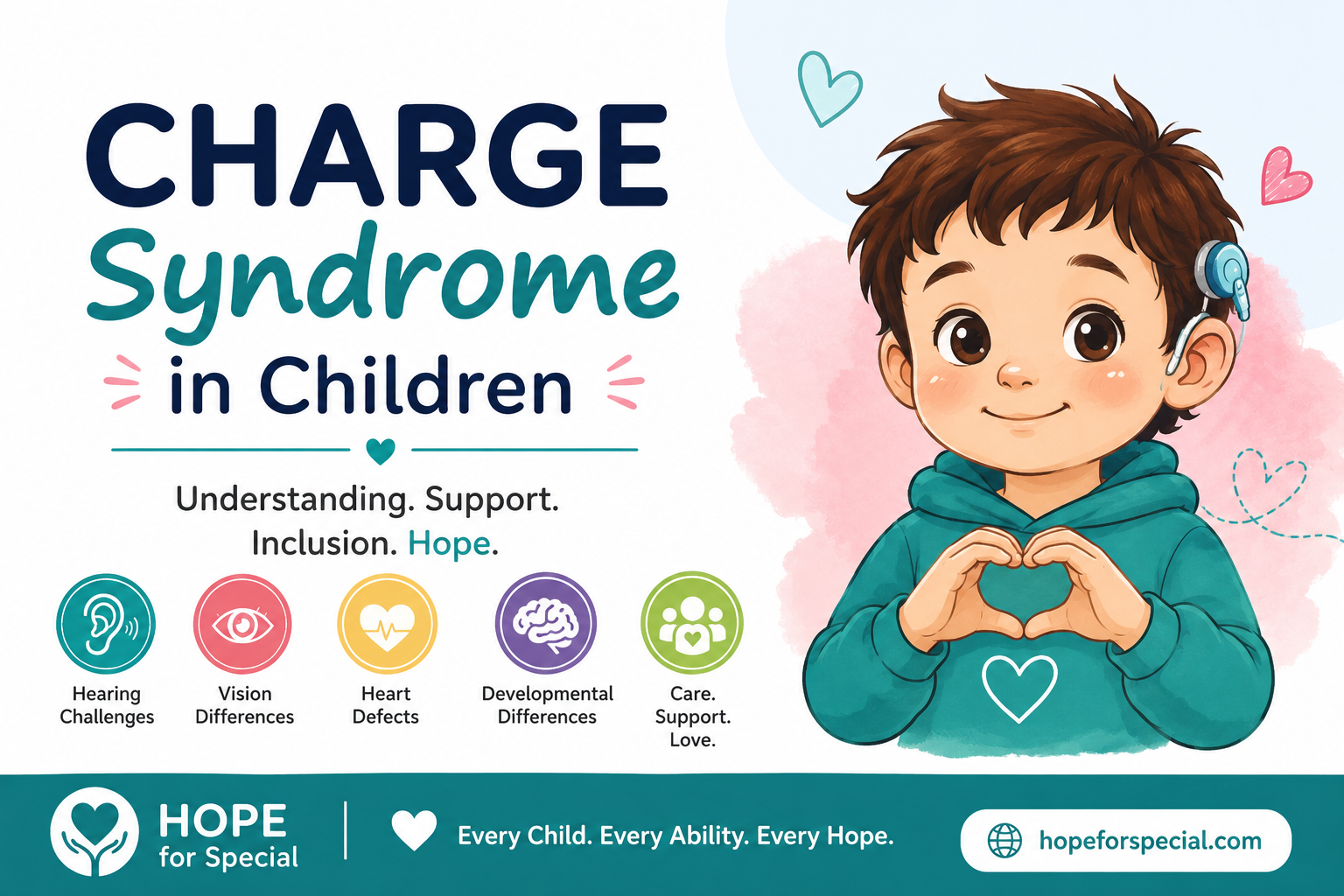
CHARGE Syndrome | CHARGE Association (Hall-Hittner Syndrome) in Children
CHARGE syndrome is a rare but complex genetic condition that affects multiple body systems in children from birth, causing a unique combination of challenges including heart defects, hearing loss, vision problems, and developmental delays. In short: no two children with CHARGE syndrome are exactly alike — and that is both the hardest and most important thing to understand.
If you have just received this diagnosis for your child, take a breath. You are not alone. Thousands of families around the world are raising children with CHARGE syndrome, and many of those children are thriving — in their own beautifully unique way.
This guide will walk you through everything: what CHARGE syndrome is, what causes it, how it is diagnosed, what treatment looks like, and most importantly — how you as a parent can give your child the best possible start. 💛

- 🔬 What Is CHARGE Syndrome?
- 📜 The History: CHARGE Association and Hall-Hittner Syndrome
- 🔤 What Does CHARGE Stand For? The Full Breakdown
- 🧬 CHARGE Syndrome Causes: The CHD7 Gene
- 📊 CHARGE Syndrome Statistics: The Numbers You Need to Know
- 🩺 Signs and Symptoms: What to Look For
- 🔍 How Is CHARGE Syndrome Diagnosed?
- 💊 Treatment Options: What Helps Most
- ⏰ Early Intervention: Why It Changes Everything
- 💛 A Parent’s Story: Navigating Life With a CHARGE Child
- 🔎 Hidden Challenges Families Face
- 1. 🧩 The “Diagnostic Odyssey” Problem
- 2. 🥲 Caregiver Grief That Is Not Spoken About
- 3. 🏫 The School System Battle
- 4. 🤝 The Isolation of Rarity
- 5. 🔄 Behavioural Misunderstanding
- 🎓 Schooling and Education for Children With CHARGE Syndrome
- 🌈 Tips for Parents: Day-to-Day Life With CHARGE Syndrome
- ❓ FAQs About CHARGE Syndrome
- Q: What is CHARGE syndrome in simple terms?
- Q: What does CHARGE stand for in CHARGE syndrome?
- Q: What is the difference between CHARGE syndrome and CHARGE association?
- Q: What is Hall-Hittner syndrome?
- Q: Is CHARGE syndrome hereditary?
- Q: What is the life expectancy of a child with CHARGE syndrome?
- Q: Can CHARGE syndrome be detected before birth?
- Q: What therapies help children with CHARGE syndrome most?
- Q: What schools are best for children with CHARGE syndrome?
- Q: Where can families find support for CHARGE syndrome?
- 🔗 Resources and Support for CHARGE Syndrome Families
- 💙 Final Thoughts: There Is Hope. There Is Help.
🔬 What Is CHARGE Syndrome?
CHARGE syndrome is a rare genetic disorder that causes a recognisable pattern of birth defects affecting multiple organ systems. The condition is present from conception and is typically diagnosed in early infancy — though in some milder cases, it may not be identified until later in childhood.
The word “syndrome” here is important. It means that a specific group of features tends to occur together. However, not every child with CHARGE syndrome will have all features. Some children have severe, life-threatening complications from birth. Others have milder presentations and go on to lead relatively independent lives.
What makes CHARGE syndrome particularly challenging — and particularly fascinating from a medical standpoint — is its extraordinary variability. Individuals with CHARGE syndrome often experience motor delays impacting their balance, flexibility, and hand–eye coordination.
Due to medical complications, around 40% of children with CHARGE syndrome will not develop functional communication skills, and many more will have difficulty with speech and oral communication. (Source: MDPI — Caregiving for Children with CHARGE Syndrome)
This is why a personalised, multidisciplinary approach to care is absolutely essential. No single treatment plan fits every child.
📜 The History: CHARGE Association and Hall-Hittner Syndrome
CHARGE syndrome was not always called by that name. Understanding its history helps parents appreciate how far our knowledge has come — and why some older medical records may use different terminology.
B.D. Hall first described what would later become known as the CHARGE association in a 1979 journal paper, describing about 17 children who had been born with choanal atresia. During the same year, H.M. Hittner independently described 10 children who had choanal atresia alongside coloboma, congenital heart defect, and hearing loss.
Because both Hall and Hittner described overlapping clusters of features around the same time, the condition became informally known as Hall-Hittner syndrome — a term you may still encounter in older medical literature or in some countries’ health records.
Then, in 1981, researcher R.A. Pagon coined the acronym CHARGE to describe this cluster of associated features more systematically. The term CHARGE association was used for many years — with “association” indicating a recognised pattern of anomalies not yet fully understood. As genetic research advanced, it became known as CHARGE syndrome following the discovery of its primary genetic cause.
Today, the terms CHARGE syndrome, CHARGE association, and Hall-Hittner syndrome all refer to the same condition — though CHARGE syndrome is now the medically preferred and most widely used term worldwide.
🔤 What Does CHARGE Stand For? The Full Breakdown
The acronym CHARGE describes the most commonly observed features of the condition. Here is what each letter means, explained in plain language:
| Letter | What It Stands For | What It Means for Your Child |
|---|---|---|
| C | Coloboma of the eye | A gap or hole in the structure of the eye — affecting the iris, retina, or optic nerve. Can range from minor to severe vision loss |
| H | Heart defects | Structural problems with the heart, present from birth. One of the most medically urgent features |
| A | Atresia of the choanae | A blockage in the nasal passages that can make breathing and feeding very difficult, especially in newborns |
| R | Retardation of growth and development | Slower physical growth and developmental delays — including learning, motor, and language milestones |
| G | Genital and/or urinary abnormalities | Underdeveloped genitalia or urinary tract differences, more commonly noticeable in males |
| E | Ear abnormalities and deafness | Unusually shaped outer ears, and hearing loss that ranges from mild to profound — including nerve deafness |
It is important to understand that a child does not need all six features to be diagnosed with CHARGE syndrome. The diagnosis is based on a combination of major and minor criteria — which your specialist will assess individually. (Source: NORD — CHARGE Syndrome)
🧬 CHARGE Syndrome Causes: The CHD7 Gene
What causes CHARGE syndrome? The short answer is: a change (also called a mutation or pathogenic variant) in a gene called CHD7.
The CHD7 gene — which stands for Chromodomain Helicase DNA-Binding Protein 7 — sits on chromosome 8 (specifically at position 8q12). This gene plays a critical role in early fetal development, particularly in the formation of the nervous system, heart, ears, and eyes.
Over 70–90% of typical CHARGE syndrome patients have variants in the CHD7 gene. The cause of CHARGE syndrome is usually a new (de novo) variant in the CHD7 gene, or rarely, genomic alterations in the region of chromosome 8 where the CHD7 gene is located. (Source: NORD — CHARGE Syndrome)
What does “de novo” mean? It means the mutation happened for the first time in the affected child — it was not inherited from either parent. In most cases, both parents’ genetic tests will come back normal.
This can be confusing and emotionally difficult for families, who often wonder “Why did this happen?” The honest answer is: in most cases, it is a random occurrence, and it was not caused by anything the parents did or did not do.
The disease recurrence rate in cases where parents are unaffected is approximately 2%. Some studies have linked the father’s increasing age to the condition in their children. (Source: ScienceDirect — CHARGE Syndrome from Occurrence to Treatment)
There is also a small subset of patients — around 10–30% — who meet clinical criteria for CHARGE syndrome but do not have an identifiable CHD7 mutation. Researchers continue to investigate whether other genes may be responsible in these cases. (Source: NIH GeneReviews — CHD7 Disorder)
📊 CHARGE Syndrome Statistics: The Numbers You Need to Know
Understanding the scope of CHARGE syndrome helps families feel less isolated — and helps healthcare systems plan better support.
| Statistic | Figure | Source |
|---|---|---|
| Global prevalence | 1 in 10,000 live births (average estimate) | ScienceDirect, 2023 |
| Prevalence range | 1 in 8,500 to 1 in 15,000 live births | NIH — CHARGE Syndrome Research Funding Study, 2025 |
| Gender difference | Males and females affected equally | ScienceDirect, 2023 |
| CHD7 gene mutation found in | 70–90% of CHARGE syndrome patients | NORD, 2024 |
| Congenital heart defects present in | 75–80% of patients | NIH — CHARGE Syndrome, PMC |
| Choanal atresia present in | ~65% of patients | PMC — Sporadic Case Study |
| Survival rate to age 5 | ~70% (highest risk in first year) | PMC — CHD7 Molecular Aspects |
| Children not developing functional communication | ~40% | MDPI — Caregiving Study, 2025 |
| Leading cause of congenital deafblindness (US) | Yes — as of 2009 and ongoing | MalaCards |
| De novo mutation recurrence risk | ~2% in unaffected parents | ScienceDirect, 2023 |
💡 Key takeaway: CHARGE syndrome is rare — but its impact is significant and wide-ranging. Early diagnosis and early intervention are the two factors that most consistently improve outcomes.
🩺 Signs and Symptoms: What to Look For
CHARGE syndrome symptoms can appear at birth, in early childhood, or even in adolescence for some milder features. Here is a comprehensive overview, divided into major and minor/additional features:
✅ Major Features (The “Classic Four”)
These are the features most strongly associated with CHARGE syndrome and are the primary basis for diagnosis:
- 👁️ Coloboma — A keyhole-shaped gap in the iris, retina, or optic disc. May affect one or both eyes. Vision impact ranges from minimal to significant
- 👃 Choanal atresia — Blocked nasal passages. Bilateral (both sides) choanal atresia is a medical emergency in newborns as babies are obligate nose-breathers
- 👂 CHARGE ear — Unusually shaped outer ears, often low-set, with a distinctive “lop ear” appearance. Accompanied by hearing loss in most cases
- 🧠 Cranial nerve differences — Affecting facial movement, swallowing, smell, taste, or balance. This is one of the most under-recognised but impactful features
📋 Minor and Additional Features
| Feature | Details |
|---|---|
| ❤️ Heart defects | Ventricular septal defects, tetralogy of Fallot, and other structural heart abnormalities |
| 📏 Growth delays | Slower physical growth, often requiring supplemental nutrition or feeding tubes |
| 🫁 Feeding difficulties | Swallowing problems, reflux, aspiration risk — very common in infancy |
| 🦷 Cleft lip and/or palate | Present in a subset of children |
| 🧪 Genital differences | Underdeveloped genitalia, more common in males |
| 🔄 Balance problems | Semicircular canal hypoplasia (underdevelopment) affecting vestibular function |
| 🛑 Immune differences | Some children have low T-cell counts, similar to DiGeorge syndrome |
| 💊 Hormone differences | Hypothyroidism or growth hormone deficiency in some cases |
| 🌀 Behavioural features | Repetitive behaviours, sensory sensitivities — sometimes resembling autism spectrum traits |
It is worth noting that the behavioural profile of CHARGE syndrome is an emerging area of research. Many children with CHARGE syndrome display behaviours that overlap with autism spectrum disorder, sensory processing disorder, and ADHD — though these are secondary to the sensory deprivations caused by vision and hearing loss, not separate diagnoses in most cases. (Source: NIH StatPearls — CHARGE Syndrome)
🔍 How Is CHARGE Syndrome Diagnosed?
Diagnosis of CHARGE syndrome involves both clinical assessment and genetic testing — and it can happen before birth, at birth, or in early childhood.
🏥 Clinical Diagnosis
The diagnosis of CHARGE syndrome should be made by a medical geneticist based on the presence of at least one major criterion and several minor and/or occasional criteria. The most widely used criteria are the Blake Criteria and the Verloes Criteria, which weigh the classic four features most heavily.
🧪 Genetic Testing
To confirm a diagnosis, your provider will perform a genetic test, where they’ll remove a small sample of blood to look for genetic changes in the CHD7 gene. To make sure your child’s symptoms aren’t life-threatening, additional blood, urine or imaging tests might be necessary to check the health of their internal organs. (Source: Cleveland Clinic — CHARGE Syndrome)
👶 Prenatal Diagnosis
Prenatal diagnosis of CHARGE syndrome is rare, but potential prenatal scan findings may include growth restriction, congenital heart disease, cleft lip and/or palate, polyhydramnios and renal problems. If any of these are found on prenatal scans, genetic counselling and targeted CHD7 testing may be recommended.
📌 Diagnosis Timeline
| When | How | What Happens Next |
|---|---|---|
| Before birth | Detailed prenatal scan anomalies | Genetic counselling, CHD7 testing of fetal DNA |
| At birth | Physical examination of features | Immediate clinical assessment, cardiology and ENT review |
| First weeks of life | Hearing screening failure + other features | Referral to genetics, multidisciplinary team activation |
| Early childhood | Developmental delays + sensory features | Late diagnosis — genetic testing, specialist referrals |
💊 Treatment Options: What Helps Most
There is currently no cure for CHARGE syndrome. However — and this is critical — CHARGE syndrome is very much treatable in its individual components. A personalised, multidisciplinary treatment plan can dramatically improve quality of life and long-term outcomes.
Treatment for CHARGE syndrome is unique to your child and focuses on alleviating their symptoms. Treatment options could include surgery to repair cleft lip or palate, heart problems or atresia, and participating in occupational, physical or speech therapy to teach your child positive feeding habits or to improve speech and language challenges. (Source: Cleveland Clinic)
🔧 Surgical Interventions
| Surgery | Purpose | When Usually Done |
|---|---|---|
| Choanal atresia repair | Opens blocked nasal passages for breathing | Typically in first days of life |
| Heart surgery | Corrects structural cardiac defects | Depends on defect severity |
| Cochlear implant | Restores partial hearing in eligible children | After thorough audiological assessment |
| Eye surgery | Treats specific coloboma-related complications | If and when indicated |
| Cleft repair | Closes cleft lip and/or palate | Usually 3–18 months of age |
| Gastrostomy (G-tube) | Provides nutritional support when feeding orally is not safe | Early infancy in severe cases |
🧠 Therapies and Ongoing Management
- Speech and language therapy — Addresses feeding, swallowing, and communication
- Occupational therapy — Builds daily living skills, fine motor function, sensory processing
- Physical therapy — Addresses balance, coordination, and motor delays
- Orientation and mobility training — For children with vision impairment
- Audiology support — Hearing aids, cochlear implants, and ongoing monitoring
- Psychological and behavioural support — For the child and the family
The multidisciplinary team model is the gold standard for CHARGE syndrome management. The patient’s treatment plan is a multidisciplinary team effort to alleviate quality of life and further increase life expectancy. This typically involves a cardiologist, neurologist, ophthalmologist, otolaryngologist, gastroenterologist, endocrinologist, physiotherapist, and special education professionals working together.
⏰ Early Intervention: Why It Changes Everything
If there is one message every parent of a child with CHARGE syndrome needs to hear loud and clear, it is this: early intervention is not optional. It is the single most powerful thing you can do.
Research consistently shows that children who access therapy, specialist support, and structured learning programmes early — ideally within the first three years of life — make significantly better developmental progress than those who start later.
Children with CHARGE syndrome benefit from early intervention services, including physical therapy, occupational therapy, and speech-language therapy. These programmes address developmental delays and promote functional independence.
Educators adapt teaching methods to accommodate sensory processing challenges and cognitive differences. Visual supports, structured routines, and multisensory learning enhance educational outcomes. (Source: FasterCapital — Navigating CHARGE Syndrome)
🌟 Early Intervention Priorities for CHARGE Syndrome
| Priority Area | Why It Matters | Action to Take |
|---|---|---|
| Hearing | Hearing loss slows language acquisition rapidly | Arrange hearing assessment within weeks of birth |
| Vision | Coloboma may limit visual input for learning | Early ophthalmology review + low-vision support |
| Feeding | Swallowing difficulties create aspiration risk | Immediate feeding therapy + dietitian support |
| Communication | Speech may be delayed due to multiple factors | Start AAC (augmentative and alternative communication) early |
| Balance | Semicircular canal issues affect all motor milestones | Vestibular physiotherapy from early infancy |
| Cardiac monitoring | Heart defects may be dynamic | Regular cardiology follow-ups even after surgery |
💛 A Parent’s Story: Navigating Life With a CHARGE Child
When Maya was born, she was taken straight to the NICU. Her parents did not hold her for three days.
Her nose was blocked. Her heart had a hole in it. One eye looked slightly different. The doctors kept using words that felt like walls — atresia, coloboma, CHD7.
It took six weeks to get the full diagnosis: CHARGE syndrome.
“I remember Googling it on my phone at 2am,” her mother recalls. “Everything I read scared me. Nobody told me what a CHARGE child could do. Only what she could not.”
Today, Maya is seven. She has had two heart surgeries. She wears hearing aids. She communicates through a mix of sign language, speech, and an AAC device. She attends a specialist school where her teachers understand sensory processing. She loves music. She loves bubbles. She lights up the room.
“The first year was survival,” her mother says. “The second year was learning. The third year was when I stopped grieving what I thought we had lost — and started celebrating who she actually is.”
Maya’s story is not unique. It is not a miracle. It is what happens when a child with CHARGE syndrome gets the right support, early enough, from a team that understands her needs.

🔎 Hidden Challenges Families Face
The lived experience of families includes challenges that rarely make it into the literature — and that parents desperately need acknowledged.
1. 🧩 The “Diagnostic Odyssey” Problem
Many families wait months or even years for a confirmed CHARGE syndrome diagnosis. During that time, they are often told their child has separate, unrelated conditions — when in fact all the pieces fit together. This delay costs precious early intervention time.
What to do: If your child has two or more of the CHARGE features and no diagnosis yet, specifically request a referral to a clinical geneticist and ask about CHD7 testing by name.
2. 🥲 Caregiver Grief That Is Not Spoken About
Parents of children with severe disabilities can endure feelings of significant loss resulting in grief. This grief can significantly impact their quality of life as well as their relationship with other family and friends. Unfortunately, parental loss and grief are not included in many support services. (Source: MDPI — Caregiving Study)
This is not weakness. It is a natural response to navigating a life that looks very different from what was expected. Naming this grief — and getting support for it — is not a luxury. It is a necessity.
3. 🏫 The School System Battle
Accessing and advocating for services and accommodations can be a daunting and overwhelming task for many parents, especially when they encounter barriers, obstacles, or resistance from the systems or professionals involved. (Source: FasterCapital)
Most teachers have never heard of CHARGE syndrome. Most schools are not equipped without advocacy from parents. Building a strong IEP (Individualised Education Plan) or EHCP (Education, Health and Care Plan in the UK) requires knowledge — and persistence.
4. 🤝 The Isolation of Rarity
Because CHARGE syndrome affects only around 1 in 10,000 children, local communities rarely have another family in the same position. This isolation can make parents feel invisible. Online communities and international CHARGE syndrome foundations become lifelines.
5. 🔄 Behavioural Misunderstanding
Children with CHARGE syndrome are often misunderstood. Their behaviours — which can include self-stimulation, withdrawal, repetitive movements, and apparent non-compliance — are almost always driven by sensory deprivation and communication challenges. They are not behavioural problems. They are communication. Understanding this shifts everything in how a child is supported at home and at school.
🎓 Schooling and Education for Children With CHARGE Syndrome
Education for a child with CHARGE syndrome requires genuine individualisation. There is no single “right” setting — what matters is that the environment is adapted to the child’s specific sensory, motor, and communication profile.
Planning for adulthood is an exciting time in a young person’s life. When that young person has CHARGE syndrome, extra care and thought must go into the process as families move from entitlement-based services to eligibility-based services.
Planning is crucial to obtain the necessary supports for independent living, employment, medical care, continuing education, recreation and social needs. (Source: CHARGE Syndrome Foundation — Education)
🏫 Key Educational Considerations
- Interveners — Trained professionals who work one-to-one with deafblind students, facilitating communication and environmental access. Essential for many CHARGE children
- Multisensory learning environments — Tactile, olfactory, and proprioceptive learning approaches compensate for limited vision and hearing
- AAC (Augmentative and Alternative Communication) — Picture exchange, sign language, speech-generating devices, and object symbols
- Structured routines — Predictability reduces anxiety and supports regulation for children with sensory processing differences
- Low student-to-teacher ratios — Small group or 1:1 settings are often necessary, particularly in the early years
- Regular reviews — A child with CHARGE syndrome changes rapidly. Educational plans must be reviewed at least annually, and updated whenever medical or developmental changes occur
🌈 Tips for Parents: Day-to-Day Life With CHARGE Syndrome
Living with a child with CHARGE syndrome is, without question, demanding. But it is also full of moments of connection, joy, and progress that you could not have anticipated. Here are practical, honest tips from the caregiving research and parent community:
✅ Build your team early.
Do not wait for services to come to you. Actively seek out a developmental paediatrician, audiologist, ophthalmologist, speech therapist, and geneticist. The earlier you build the team, the better coordinated your child’s care will be.
✅ Document everything.
Keep a medical binder or digital folder with all diagnoses, test results, surgical reports, therapy notes, and school assessments. This becomes invaluable when you change providers, move regions, or advocate for services.
✅ Join a CHARGE-specific community.
The CHARGE Syndrome Foundation (US-based, global reach) is the leading international organisation for families. Their annual conference, parent resources, and family connections can be transformative.
✅ Prioritise communication above all else.
Whether your child uses speech, sign, AAC, or a combination — the goal is always communication and connection. Do not wait for “perfect speech.” Give your child every possible tool to tell you what they need and how they feel.
✅ Take care of your own mental health.
You cannot pour from an empty cup. Caregiver burnout in CHARGE families is real and documented. Seek peer support, respite care, and if needed, professional counselling. Your wellbeing directly impacts your child’s wellbeing.
✅ Celebrate different milestones.
Your child’s journey does not follow the standard developmental chart — and that is okay. Make your own chart. Celebrate the first intentional communication attempt. The first independent bite of solid food. The first time they tolerate headphones. These victories are real. They matter enormously.
✅ Speak up in medical settings.
You know your child better than any specialist. If something feels wrong, say so. If a treatment is not working, ask for alternatives. You are not just a parent in the room — you are a core member of the care team.
❓ FAQs About CHARGE Syndrome
Q: What is CHARGE syndrome in simple terms?
CHARGE syndrome is a rare genetic condition present from birth that causes a range of physical differences including eye problems, heart defects, blocked nasal passages, hearing loss, growth delays, and genital abnormalities. It is caused by a change in the CHD7 gene in most cases. No two children with CHARGE syndrome are the same — each child is affected differently.
Q: What does CHARGE stand for in CHARGE syndrome?
CHARGE is an acronym: C = Coloboma of the eye, H = Heart defects, A = Atresia of the choanae (blocked nasal passages), R = Retardation of growth and development, G = Genital and/or urinary abnormalities, E = Ear abnormalities and deafness.
Q: What is the difference between CHARGE syndrome and CHARGE association?
The terms refer to the same condition. “CHARGE association” was the original name, used before the genetic cause was identified. Once researchers confirmed that changes in the CHD7 gene cause the condition, it was reclassified as “CHARGE syndrome.” Both terms appear in medical literature.
Q: What is Hall-Hittner syndrome?
Hall-Hittner syndrome is an older name for CHARGE syndrome. It honours the two researchers — B.D. Hall and H.M. Hittner — who first independently described the condition in 1979. The name is rarely used in current clinical practice but may appear in older records.
Q: Is CHARGE syndrome hereditary?
In most cases, no. The majority of CHARGE syndrome cases occur due to a spontaneous (de novo) mutation in the CHD7 gene that was not inherited from either parent. The risk of having a second affected child when parents are unaffected is approximately 2%. In rare cases, a mildly affected parent can pass the condition to a child.
Q: What is the life expectancy of a child with CHARGE syndrome?
The life expectancy of patients with CHARGE syndrome varies widely, with individuals living anywhere from five days to at least 46 years. Actuarial analysis of survival in children with CHARGE showed a 70% survival rate to five years of age, with the highest rate of mortality in the first year of life. The rate of mortality is highest in infants with a combination of choanal atresia and heart defects or tracheoesophageal fistula. Many individuals with milder presentations can have a normal or near-normal life expectancy. (Source: NIH PMC — CHD7 Mutation Study)
Q: Can CHARGE syndrome be detected before birth?
Prenatal detection is possible but uncommon. Some features such as heart defects, growth restriction, cleft palate, or polyhydramnios may be seen on detailed ultrasound scans. However, a definitive diagnosis typically requires genetic testing after birth. If prenatal anomalies are found, CHD7 genetic testing can be performed on fetal DNA through amniocentesis.
Q: What therapies help children with CHARGE syndrome most?
The most beneficial therapies are speech and language therapy (especially for feeding and communication), occupational therapy (for sensory processing and daily living skills), physical therapy (for balance and motor development), and specialist support for vision and hearing. Early, intensive, coordinated therapy starting in the first months of life consistently produces the best outcomes.
Q: What schools are best for children with CHARGE syndrome?
There is no single “best” school type. The right school depends on the individual child’s needs. Some children thrive in specialist schools for children with sensory and complex needs. Others do well in mainstream settings with strong 1:1 support and an adapted curriculum. The key is a school that understands sensory deprivation, uses multisensory teaching methods, and includes trained interveners for deafblind students.
Q: Where can families find support for CHARGE syndrome?
The CHARGE Syndrome Foundation is the leading international resource, offering a family directory, professional resources, conference, and support network. In the UK, Sense offers specialist support for families of deafblind children including those with CHARGE syndrome. The IASP and NORD also provide valuable medical and family guidance.
🔗 Resources and Support for CHARGE Syndrome Families
Here are the most authoritative and helpful external resources for families navigating CHARGE syndrome:
| Resource | What It Offers | Link |
|---|---|---|
| 🌐 CHARGE Syndrome Foundation | Global family support, conference, education resources | chargesyndrome.org |
| 🧬 NORD — Rare Diseases | Comprehensive medical overview, updated 2024 | rarediseases.org |
| 🏥 NIH GeneReviews — CHD7 Disorder | Detailed genetic and clinical guidance | ncbi.nlm.nih.gov/books/NBK1117 |
| 🏥 Cleveland Clinic | Patient-friendly diagnosis and treatment guide | my.clevelandclinic.org |
| 🇬🇧 Sense UK | UK-based support for deafblind children with CHARGE | sense.org.uk |
| 📚 NIH StatPearls | Clinical review for healthcare providers | ncbi.nlm.nih.gov/books/NBK559199 |
| 🧪 Immune Deficiency Foundation | CHARGE and immunological overlap | primaryimmune.org |
💙 Final Thoughts: There Is Hope. There Is Help.
CHARGE syndrome is complex. It is demanding. It will test you in ways you never expected.
But here is what the families who are living it — and thriving — want you to know: your child is more than their diagnosis. The features listed in that acronym are just the starting point. What your child becomes, what they communicate, what they love, and who they are — those things are still unfolding.
Every child with CHARGE syndrome is fighting hard every single day. And every parent walking this road deserves support, knowledge, and a community that truly gets it.
You found this article because you are already doing the most important thing: you are learning, and you are showing up. 💛
That matters more than you know.
📝 This article is for educational and informational purposes. Always consult your child’s medical team for personalised advice. If you are concerned about your child’s development or have received a CHARGE syndrome diagnosis, seek a referral to a clinical geneticist and a multidisciplinary paediatric team as early as possible.


