

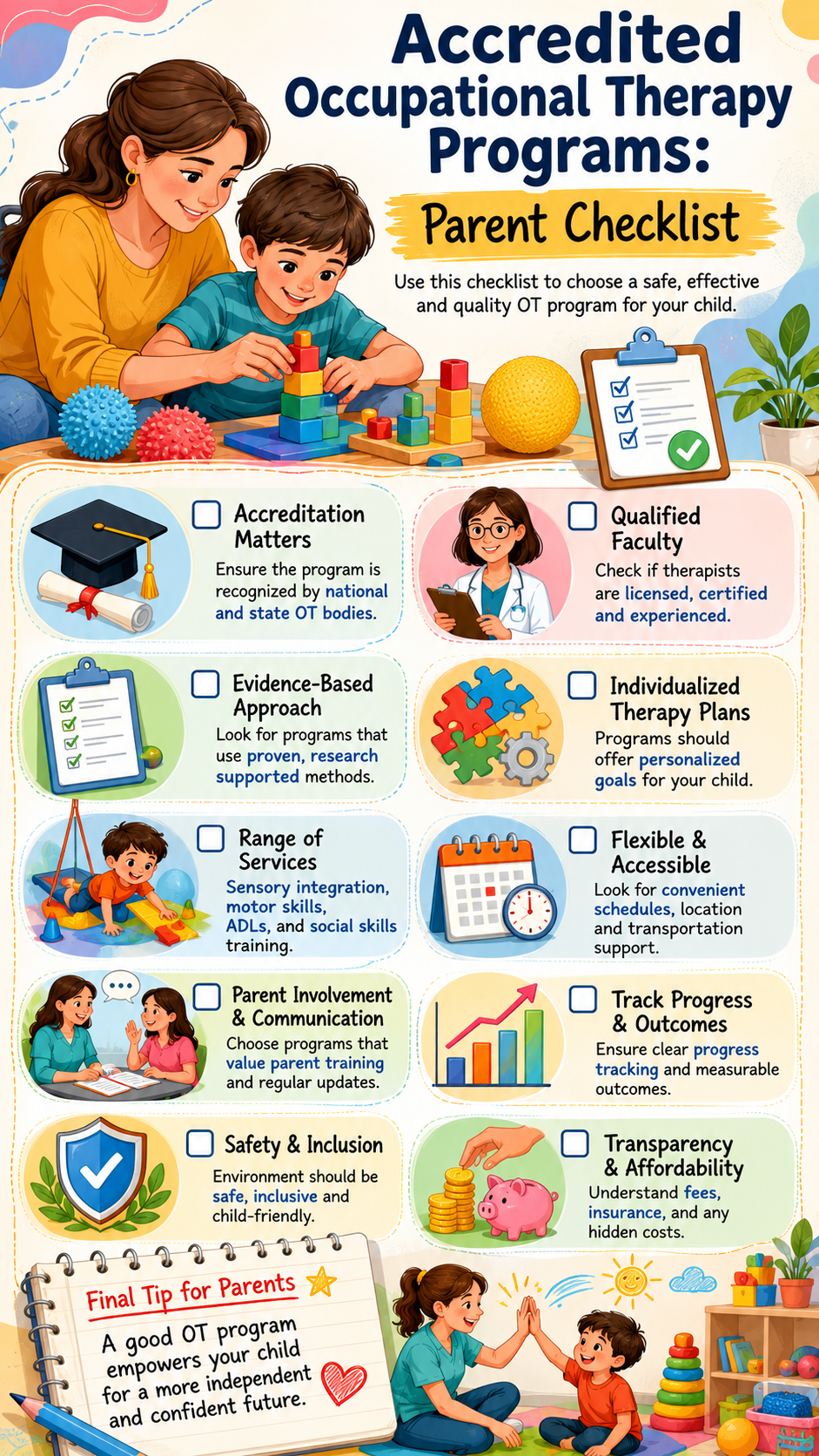
🎓 Accredited Occupational Therapy Programs: 2026 Parent Checklist That Protects Your Child
Accredited Occupational Therapy Programs are university and college training programs that have been formally reviewed and approved to meet national education standards for occupational therapists. In short: your child’s OT must have graduated from one of these accredited programs to be legally certified and licensed — and knowing how to verify this single fact can protect your child from receiving care from someone underqualified.
This guide explains exactly what program accreditation means, why it matters so much for your child specifically, and the simple steps you can take today to check it. 💛

- 🔍 What Are Accredited Occupational Therapy Programs?
- 💛 Why This Matters So Much for YOUR Child
- 📊 The Numbers: OT Education and Workforce Growth in 2026
- 🏛️ Who Accredits These Programs — and What That Body Actually Checks
- ✅ THE 6-STEP PROCESS TO VERIFY YOUR CHILD’S OT TRAINED AT AN ACCREDITED PROGRAM
- 🎓 Degree Levels Explained: OTD, MOT, and OTA Programs
- 🚩 Red Flags: Warning Signs of an Unaccredited or Problematic Program
- 🔍 What You Must Not Miss About This Topic
- 1. 🔄 Accreditation Status Can Change Over Time
- 2. 📉 Pass Rate Data Is Public — and Most Parents Never Look
- 3. 🧩 The OTA Supervision Question Almost Nobody Asks
- 4. 🌐 International Equivalency Is Rarely Explained Clearly
- 💙 A Parent’s Story: The Question I Never Thought to Ask
- ❓ FAQs About Accredited Occupational Therapy Programs
- Q: What does it mean if an occupational therapy program is accredited?
- Q: How do I check if my child’s occupational therapist graduated from an accredited program?
- Q: Can an occupational therapist practise legally without graduating from an accredited program?
- Q: What is the difference between an OTD, MOT, and OTA program?
- Q: Does a doctorate-level OT (OTD) provide better care than a master’s-level OT (MOT)?
- Q: What should I do if I cannot verify my child’s therapist’s accredited training?
- Q: Are occupational therapy programs outside the United States held to similar accreditation standards?
- 🔗 Trusted Resources for Families
- 💙 Final Thoughts: A Small Check With a Big Payoff
🔍 What Are Accredited Occupational Therapy Programs?
Accredited Occupational Therapy Programs are degree programs at universities and colleges that have undergone a formal review process to confirm they meet established national standards for training occupational therapists.
In the United States, ACOTE accreditation is a review process that evaluates whether occupational therapy and Occupational Therapy Assistant programs meet educational standards established by the Accreditation Council for Occupational Therapy Education. (Source: Stanbridge University — ACOTE Accreditation Explained)
Here is why this single fact matters more than almost anything else when choosing — or simply trusting — your child’s occupational therapist: students generally must graduate from an ACOTE-accredited program to qualify for NBCOT certification eligibility and state licensure pathways. (Source: Stanbridge University)
In plain terms: If the person treating your child did not attend an accredited program, they cannot be legally licensed to practise occupational therapy in the United States. Accreditation is not a nice-to-have credential. It is the foundation underneath every other qualification your child’s therapist holds.
💛 Why This Matters So Much for YOUR Child
You are not applying to occupational therapy school. You are trying to protect your child. So why should a parent care about university accreditation processes at all?
Here is the honest answer: because accreditation is the invisible gatekeeper standing between “anyone can call themselves a therapist” and “this person met a rigorous, nationally recognised standard before ever touching your child’s care plan.”
ACOTE-accredited occupational therapy and occupational therapy assistant educational programs satisfy the states’ educational requirements in all states, the District of Columbia, and Puerto Rico. Students graduating from an ACOTE-accredited program are eligible to take the National Board for Certification in Occupational Therapy certification exam and apply for licensure in all states. (Source: Tufts University — Department of Occupational Therapy)
This matters for your child specifically because paediatric occupational therapy involves highly specialised skills — sensory integration, fine motor development, feeding therapy, and developmental assessment — all of which are built on the foundational education that accredited programs are specifically reviewed to ensure.
When you verify that your child’s OT trained at an accredited program, you are confirming something deeper than a piece of paper. You are confirming that this person sat through supervised fieldwork, was tested on clinical reasoning, and met a standard set by professionals — not simply a standard set by a marketing website.
📊 The Numbers: OT Education and Workforce Growth in 2026
Understanding the scale and structure of OT education helps parents see exactly why accreditation oversight matters at a national level.
| Statistic | Figure | Source |
|---|---|---|
| Total ACOTE-accredited OT programs (occupational therapist level) | 152 programs | AOTA — ACOTE Academic Leadership Council Update, April 2025 |
| Programs offering Occupational Therapy Doctorate (OTD) | 91 programs (60% of total) | AOTA — ACOTE Update, 2025 |
| Programs offering Master of Occupational Therapy (MOT) | 32 programs (21% of total) | AOTA — ACOTE Update, 2025 |
| Projected growth in occupational therapist employment | 14% increase | AOTA — ACOTE Update, citing Bureau of Labor Statistics |
| Projected growth in Occupational Therapy Assistant employment | 23% increase | AOTA — ACOTE Update, citing Bureau of Labor Statistics |
| OTA programs cited for certification exam pass rate concerns (2024) | 23% of programs | AOTA — ACOTE Update, 2025 |
| Example program NBCOT certification pass rate (2022–2025, Stanbridge OTA) | 79% | NBCOT — School Performance Data via Stanbridge University |
💡 What this tells parents: Occupational therapy is a fast-growing field, with accredited programs expanding to meet rising demand. But growth also means more variation in program quality — which is exactly why national accreditation oversight, and your own quick verification habit, both matter more than ever in 2026.
🏛️ Who Accredits These Programs — and What That Body Actually Checks
Understanding exactly who is responsible for this oversight gives you confidence in what the credential actually represents.
ACOTE’s purpose is to accredit occupational therapy educational programs and occupational therapy assistant educational programs. ACOTE establishes, approves, and administers educational standards to evaluate occupational therapy and occupational therapy assistant educational programs. (Source: ACOTE — About)
📋 What ACOTE Actually Reviews
Based on official accreditation standards, programs are evaluated across several critical areas:
| Area Reviewed | What This Means for Your Child’s Future Therapist |
|---|---|
| Curriculum design | Ensures the therapist learnt the right clinical foundations, not just isolated techniques |
| Faculty qualifications | Confirms instructors themselves are properly credentialed and experienced |
| Fieldwork requirements | Confirms hands-on, supervised clinical training before graduation |
| Certification exam pass rates | Tracks how well-prepared graduates actually are for licensure |
| Diversity, equity, and inclusion standards | Ensures programs prepare therapists to work with diverse populations and needs |
| Sufficient faculty-to-student ratios | Ensures students receive adequate supervision and mentorship during training |
ACOTE processes accreditation action letters following scheduled annual meetings, and offers self-study workshops to support institutions developing new programs. (Source: ACOTE — Official Site) This is an ongoing, active oversight process — not a one-time stamp of approval that is never revisited.
🌍 Beyond the United States
Outside the US, similar accrediting bodies exist. In the UK, occupational therapy programs are approved by the Health and Care Professions Council (HCPC) and recognised by the Royal College of Occupational Therapists (RCOT).
In Australia, Occupational Therapy Australia and the Australian Health Practitioner Regulation Agency (AHPRA) serve similar oversight functions. If you live outside the US, ask your child’s therapist which national accrediting body governs their training, and verify independently through that body’s official website.
✅ THE 6-STEP PROCESS TO VERIFY YOUR CHILD’S OT TRAINED AT AN ACCREDITED PROGRAM
This is the practical heart of this guide — exactly how to check, in under five minutes.

| Step | What to Do | Where to Do It |
|---|---|---|
| 1 | Ask your child’s OT directly which university or college they graduated from, and what degree they hold (OTD, MOT, or OTA) | Ask in conversation or via your intake paperwork |
| 2 | Search that specific institution’s OT or OTA program on the official ACOTE program list | acoteonline.org |
| 3 | Confirm the programme is listed as currently or formerly accredited (note any “Inactive” or “Probation” status) | ACOTE’s official program directory |
| 4 | Cross-check your therapist’s NBCOT certification directly | nbcot.org — Verify Credentials |
| 5 | Confirm their active state licence through your state’s occupational therapy licensing board | Your state’s official licensing board website |
| 6 | If anything is unclear or inconsistent, ask directly — a qualified therapist will answer confidently and transparently | Direct conversation |
A note on timing: This entire process typically takes under ten minutes and can be done before your child’s very first appointment, or at any point afterward if you simply have not yet thought to check.
🎓 Degree Levels Explained: OTD, MOT, and OTA Programs
One of the most confusing parts of researching Accredited Occupational Therapy Programs is understanding the different credential levels you might encounter. Here is a clear breakdown.
| Credential | Full Meaning | Education Length | What They Can Do |
|---|---|---|---|
| OTD | Occupational Therapy Doctorate | Typically 3+ years post-bachelor’s | Full scope of OT practice; doctoral-level clinical training |
| MOT | Master of Occupational Therapy | Typically 2–2.5 years post-bachelor’s | Full scope of OT practice; this credential level is gradually transitioning toward OTD in many institutions |
| OTA | Occupational Therapy Assistant | Typically associate degree, around 2 years | Works under the supervision of a licensed OT; cannot independently evaluate or design treatment plans |
Some institutions have transitioned their MOT programs directly into Occupational Therapy Doctorate programs, reflecting a broader trend across the profession toward doctoral-level entry training. (Source: Wayne State University — NBCOT Results)
What this means for your family: All three credential levels can provide excellent, qualified care for your child — as long as the underlying programme was properly accredited, and (for OTAs specifically) supervision by a licensed OT is properly in place. Do not assume a doctorate is automatically “better” for your child’s needs than a master’s-trained therapist with years of paediatric experience. Accreditation status and clinical experience both matter more than degree title alone.
🚩 Red Flags: Warning Signs of an Unaccredited or Problematic Program
Most of the time, your search will confirm everything is in order. But here is what should give you pause.
⚠️ Warning Signs to Watch For
- The therapist cannot or will not name their graduating institution — this is a basic, reasonable question any qualified professional should answer comfortably
- The institution does not appear on the official ACOTE program list at all
- The program shows a status of “Probation” or “Withdrawal of Accreditation” on official records
- No active state licence can be found under their name
- The therapist trained entirely outside the country and cannot clearly explain their equivalent credentialing pathway into your country’s licensure system
✅ What Reassures You
- The institution appears clearly on ACOTE’s official accredited program list
- NBCOT certification is active and verifiable
- State licensure is active with no disciplinary history
- The therapist answers your questions about their training openly and without hesitation
🔍 What You Must Not Miss About This Topic
Here is what you should not ignore about accredited OT programs from a parent’s point of view.
1. 🔄 Accreditation Status Can Change Over Time
This is a critical gap in most parent-facing content. A programme that was accredited when your therapist graduated five or ten years ago is not necessarily relevant today — and conversely, a programme’s accreditation status at the time of your therapist’s graduation is what actually matters, not its status right now.
Accreditation listings often specify exact date ranges, such as accreditation “through 2028/2029,” showing that accreditation is reviewed and renewed on a defined cycle rather than granted permanently. (Source: Stanbridge University) When verifying, always check the accreditation status as of your therapist’s actual graduation year, which ACOTE’s historical records can confirm.
2. 📉 Pass Rate Data Is Public — and Most Parents Never Look
ACOTE actively tracks certification exam pass rate citations across programs, with data showing 23% of OTA programs received pass rate citations in 2024 alone. (Source: AOTA — ACOTE Academic Leadership Council Update, 2025) This means that even among accredited programs, performance genuinely varies — and that data is publicly available through NBCOT’s official school performance reports, yet almost no parent-facing resource tells families this exists or how to access it.
3. 🧩 The OTA Supervision Question Almost Nobody Asks
If your child’s primary in-person therapist is an OTA rather than a fully licensed OT, they work under appropriate supervision requirements tied to their accredited training (Source: Stanbridge University) — but very few parents know to ask who that supervising OT is, how often they review the treatment plan, and how accessible they are if concerns arise. This single follow-up question can reveal a great deal about the overall quality of care your child is receiving.
4. 🌐 International Equivalency Is Rarely Explained Clearly
Families who relocate internationally, or who see a therapist trained abroad, often have no clear resource explaining how foreign occupational therapy credentials translate into US (or other national) licensure requirements. If your child’s therapist trained outside your country, ask specifically how their foreign credential was evaluated for equivalency, and verify that evaluation through your country’s official licensing authority — not simply through the therapist’s own explanation.
💙 A Parent’s Story: The Question I Never Thought to Ask
Hannah had been taking her son Eli to occupational therapy for almost a year before a conversation with another special needs parent stopped her in her tracks.
“She asked me, very casually, ‘Did you check where his OT went to school?’ And I genuinely had never even considered it,” Hannah admits. “I found the clinic through our paediatrician’s referral list. I assumed that meant everything had already been checked.”
That evening, Hannah asked Eli’s therapist directly which university programme she had graduated from. The therapist answered immediately and warmly, naming her university without hesitation.
“I went home and looked it up on the official ACOTE site,” Hannah says. “It took maybe four minutes. The programme was right there, clearly accredited, exactly matching what she had told me.”
Hannah describes the experience not as catching a problem, but as something more subtle and equally important: peace of mind. “It did not change anything about Eli’s care. He was already doing brilliantly with her. But something shifted in how I trusted the whole process. I was not just hoping things were fine. I knew.”
Hannah now recommends the same simple check to every special needs parent she meets. “It takes less time than scrolling through reviews on Google. And it tells you something reviews never can — that the foundation underneath everything else is actually solid.”
❓ FAQs About Accredited Occupational Therapy Programs
Q: What does it mean if an occupational therapy program is accredited?
It means the program has been formally reviewed by the Accreditation Council for Occupational Therapy Education (ACOTE) and meets nationally recognised educational standards. Graduating from an accredited program is generally required for a therapist to sit the NBCOT certification exam and obtain state licensure to legally practise.
Q: How do I check if my child’s occupational therapist graduated from an accredited program?
Ask your therapist directly which institution and degree program they graduated from. Then search that institution on ACOTE’s official accredited program directory at acoteonline.org. You can also independently verify their NBCOT certification at nbcot.org and confirm their active state licence through your state’s occupational therapy licensing board.
Q: Can an occupational therapist practise legally without graduating from an accredited program?
Generally, no, within the United States. Graduation from an ACOTE-accredited program is typically required to be eligible for NBCOT certification and state licensure. A therapist practising without this foundation would not meet standard legal requirements to hold an active occupational therapy licence.
Q: What is the difference between an OTD, MOT, and OTA program?
An OTD (Occupational Therapy Doctorate) and MOT (Master of Occupational Therapy) both qualify graduates for full-scope, independent occupational therapy practice after passing the NBCOT exam. An OTA (Occupational Therapy Assistant) program prepares graduates to work under the supervision of a licensed OT and typically takes about two years to complete.
Q: Does a doctorate-level OT (OTD) provide better care than a master’s-level OT (MOT)?
Not necessarily. Both credential levels qualify graduates for full, independent occupational therapy practice following successful licensure. Many highly experienced, excellent paediatric therapists hold a master’s degree, particularly those who graduated before the profession’s broader shift toward doctoral-level entry training. Clinical experience and specialisation in paediatrics often matter more than degree title alone.
Q: What should I do if I cannot verify my child’s therapist’s accredited training?
Speak with the therapist or clinic directly and ask for clarification. A legitimate, properly licensed therapist will be able to provide their graduating institution, NBCOT certification number, and state licence details without hesitation. If discrepancies remain after asking, consider contacting your state’s occupational therapy licensing board directly to confirm their credentials independently.
Q: Are occupational therapy programs outside the United States held to similar accreditation standards?
Many countries have their own equivalent accrediting and regulatory bodies, such as the Health and Care Professions Council (HCPC) in the United Kingdom or Occupational Therapy Australia and AHPRA in Australia. If your child’s therapist trained internationally, ask how their qualification was evaluated for equivalency in your country, and verify independently through your national regulatory authority.
🔗 Trusted Resources for Families
| Resource | What It Offers | Link |
|---|---|---|
| 🏛️ ACOTE — Official Accredited Program Directory | Search and verify accredited OT and OTA programs | acoteonline.org |
| 🏅 NBCOT — Verify Credentials | Free verification of any US occupational therapist’s national certification | nbcot.org/home/VerifyCredentials |
| 📊 NBCOT — School Performance Data | Public certification exam pass rate data by program | nbcot.org/Educators-Folder/SchoolPerformance |
| 🗺️ AOTA — American Occupational Therapy Association | Professional body offering broader OT resources and state licensure information | aota.org |
| 🇬🇧 HCPC — Check the Register (UK) | UK occupational therapist registration verification | hcpc-uk.org/check-the-register |
| 🇦🇺 AHPRA — Occupational Therapy Board of Australia | Australian occupational therapist registration verification | ahpra.gov.au |
💙 Final Thoughts: A Small Check With a Big Payoff
You already do so much to advocate for your child — researching diagnoses, chasing referrals, sitting through evaluations, and showing up to appointment after appointment.
Checking whether your child’s occupational therapist trained at one of the genuinely Accredited Occupational Therapy Programs takes only a few minutes. But it gives you something profound: the quiet confidence that the person guiding your child’s progress was held to a real, nationally recognised standard before they ever walked into the room.
You do not need a clinical background to ask this question. You simply need to know that it is worth asking — and now, you do. 💛
📝 This article is for informational and educational purposes only and does not constitute legal or medical advice. Always verify your therapist’s specific credentials directly through official accrediting and licensing bodies, as accreditation status and program details can change over time.


