

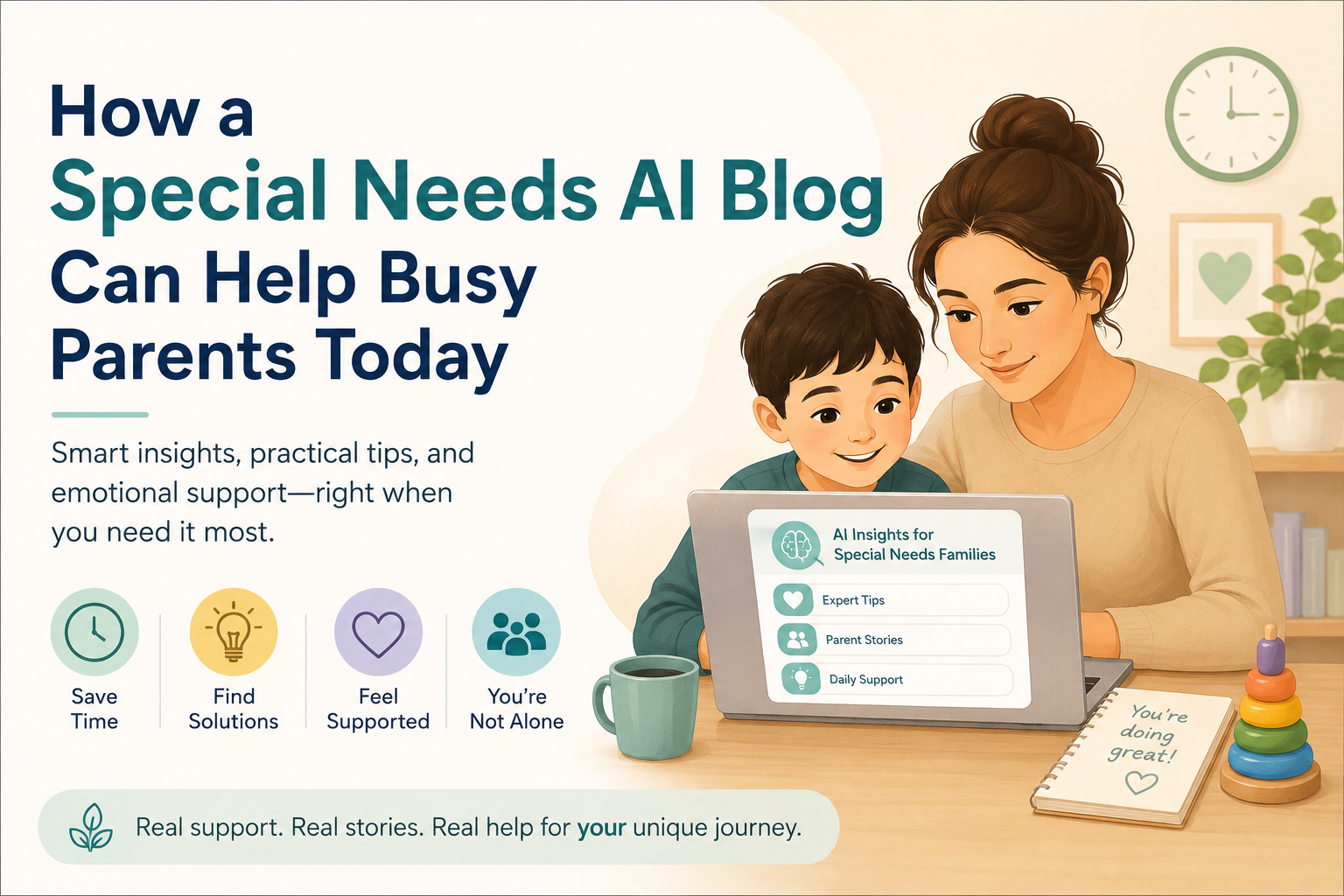
How a Special Needs AI Blog Can Help Busy Parents Today: 2026 Complete Guide 💛
😤 90% of special needs caregivers are burning out — yet most have never found one place that actually helps. Could a special needs AI blog be the lifeline you’ve been searching for? Discover what’s possible. 💛👇

- 🌟What Is a Special Needs AI Blog and Can It Actually Help You?
- 📊 The Special Needs Parent Crisis — Why This Matters Right Now
- 🤔 What Exactly Is a Special Needs AI Blog?
- 💛 The 9 Specific Ways a Special Needs AI Blog Helps Busy Parents
- 1. 🕐 It Saves Hours of Scattered Searching
- 2. 📋 It Prepares You for Medical and School Appointments
- 3. 🧠 It Gives Non-Technical Parents Access to Technical Knowledge
- 4. 💬 It Reduces the Isolation of Special Needs Parenting
- 5. 📱 It Is Available at 2am
- 6. 🏥 It Keeps You Current on Fast-Moving Research
- 7. 🌍 It Serves Families Across Languages and Geographies
- 8. 🎯 It Helps You Advocate More Effectively for Your Child
- 9. 💚 It Reminds You to Care for Yourself Too
- 🛠️ How an AI Blog Works Practically — The HopeForSpecial Model
- 💡 AI Tools That a Special Needs AI Blog Introduces to Parents
- For Communication Support 🗣️
- For Learning Support 📚
- For IEP and Documentation Support 📋
- For Parent Mental Health Support 💚
- 💬 Real Parent Experiences — What an AI Blog Made Possible
- 🔮 The Future of Special Needs AI Blogs — What Is Coming in 2026 and Beyond
- Personalised Content Delivery
- Voice Search Optimisation
- Real-Time Research Integration
- Community Integration
- ❓ FAQs — Special Needs AI Blog 2026
- Q1: What is a special needs AI blog?
- Q2: How does an AI blog help special needs parents save time?
- Q3: Is AI-generated content about special needs children reliable?
- Q4: Can an AI blog help me prepare for an IEP meeting?
- Q5: How does an AI blog help with caregiver mental health?
- Q6: Are there AI tools specifically for special needs children that a blog can recommend?
- Q7: What makes HopeForSpecial different from other special needs blogs?
- Q8: Can I use an AI blog to find resources for my special needs child in India?
- Q9: How often is a good AI blog updated?
- Q10: Can an AI blog replace my child’s doctor or the IEP team?
- 💛 Final Words: You Deserve Information That Works as Hard as You Do
🌟What Is a Special Needs AI Blog and Can It Actually Help You?
A special needs AI blog is a content platform that combines AI-assisted research, expert knowledge, and lived parent experience to deliver fast, reliable, and emotionally supportive guidance to families of children with disabilities.
Yes — it genuinely helps. In 2026, when 90% of family caregivers show signs of burnout and nearly 8 in 10 say they would welcome AI-powered support, an AI blog that speaks directly to special needs families fills a gap that traditional resources cannot — delivering the right information, in simple language, exactly when a parent needs it most.
This is not about robots replacing human connection. It is about using the power of an AI blog to take information overload off your plate — so you have more of yourself left for the moments that matter. For the cuddle after the meltdown. For the celebration after the breakthrough. For the conversation you need to have with the school that you finally feel prepared for.
This guide explains exactly what a special needs AI blog does, why it matters so urgently in 2026, and how HopeForSpecial is built to serve your family in ways that no other resource has before.
📊 The Special Needs Parent Crisis — Why This Matters Right Now
Before we explore what an AI blog can do, we need to be honest about the scale of what special needs families are navigating.
| Statistic | Data | Source |
|---|---|---|
| Caregiver burnout rate (2026) | 90% of current family caregivers show symptoms of burnout; 20% describe it as severe | LogicMark National Survey, June 2026 |
| Caregiver stress and anxiety prevalence | 87% of caregivers experience stress and anxiety at some point — more than half experience it weekly | A Place for Mom Survey, 2026 |
| Caregivers who would embrace AI tools | Nearly 8 in 10 caregivers say they would embrace AI-powered health monitoring and support | LogicMark National Survey, June 2026 |
| Parents of children with IDD — depression rate | 31% of parents of children with intellectual and developmental disabilities reach clinical cut-off for moderate depression — vs. 7% of other parents | PLOS ONE / NCBI Meta-Analysis |
| Total US family caregivers | 63 million Americans — nearly 1 in 4 adults — serve as family caregivers | LogicMark / Globe Newswire, June 2026 |
| AI tools for caregiver wellbeing | Cognitive behavioural therapy AI tools (Woebot, Wysa) shown to be effective supplements for mild to moderate mental health challenges in caregivers | JMIR Mental Health via CareYaya, 2026 |
| AI impact on special education admin | AI can reduce IEP drafting time dramatically — special educators spend enormous time outside of instruction on administrative tasks | EdTech Magazine, February 2026 |
| Caregiver emotional challenges (overwhelm) | 84% of caregivers report feeling overwhelmed — nearly half experience it weekly | A Place for Mom Survey, 2026 |
These numbers are not abstract. They describe the daily reality of families in the HopeForSpecial community — families who are doing extraordinary work with limited time, limited energy, and often very limited support.
An AI blog specifically designed for special needs families does not add to this burden. It is designed to reduce it.
🤔 What Exactly Is a Special Needs AI Blog?
A special needs AI blog is a website that uses artificial intelligence — both in creating content and in the tools it recommends — to serve parents and caregivers of children with disabilities more effectively than traditional websites can.
But let us be precise about what this means. Because there is a meaningful difference between an AI blog that is just machine-generated text and one — like HopeForSpecial — that uses AI as a research and structuring tool while embedding genuine human expertise, lived parent experience, and medical accuracy throughout every article.
The Three Layers of a True Special Needs AI Blog
| Layer | What It Means | What It Gives You |
|---|---|---|
| AI-Assisted Research | AI tools rapidly analyse the latest medical studies, government guidelines, and clinical research | You get current, accurate information — not outdated blog posts from three years ago |
| Human Expert Knowledge | Special education professionals, medical advisors, and parents with lived experience shape and review every piece | You get content that is accurate AND emotionally real |
| Community and Lived Experience | Real parent stories, practical tips, and community wisdom woven through every article | You feel seen, not just informed |
This three-layer approach is what makes a special needs AI blog genuinely different from both a standard parenting blog and a raw AI content generator.
💛 The 9 Specific Ways a Special Needs AI Blog Helps Busy Parents

1. 🕐 It Saves Hours of Scattered Searching
Before HopeForSpecial existed as an AI blog, parents of children with Down Syndrome who wanted to understand their child’s congenital heart disease risk would spend hours across dozens of websites — medical journals they could not fully understand, generic parenting sites that didn’t address their condition, and research papers behind paywalls.
An AI blog compiles that research, translates it into plain language, and delivers it in one place. That saved hour is not a small thing. For a parent who is already managing therapy appointments, school advocacy, medication schedules, and their own emotional health — one saved hour is significant.
2. 📋 It Prepares You for Medical and School Appointments
One of the most consistent feedback themes from special needs parents is this: “I know something is wrong, but I don’t know what questions to ask.”
An AI blog solves this directly. Articles written specifically for special needs families — like HopeForSpecial’s guides on IEP meetings, diagnostic appointments, and medical consultations — give parents:
- The specific questions to ask at the paediatrician
- The terminology that makes doctors take concerns seriously
- The rights they have under IDEA, Section 504, and FERPA
- The red flags to mention and the documentation to bring
This kind of preparation changes appointment outcomes.
3. 🧠 It Gives Non-Technical Parents Access to Technical Knowledge
Neuroscience. Genetics. Immunology. Pharmacology. These are the subjects that govern your child’s life — and most parents did not study any of them.
A quality AI blog bridges this gap. It takes a paper published in the Journal of Intellectual Disability Research and turns it into three clear paragraphs that a parent can understand, act on, and share with their child’s doctor. This democratisation of medical knowledge is one of the most powerful things an AI blog can do for families.
4. 💬 It Reduces the Isolation of Special Needs Parenting
Special needs parenting is profoundly isolating. Most people in your social circle do not understand your world. Conversations about IEPs, sensory processing, AAC devices, or ABA therapy happen in a vocabulary that most parents never need to know.
A special needs AI blog creates a written community. When you read a parent story that reflects exactly your experience — the frustration, the love, the advocacy fatigue, the moments of breakthrough — you feel something shift. You are not the only one. Someone else has been here. And they found a way forward.
5. 📱 It Is Available at 2am
The hours that most special needs parents spend researching are not 9am to 5pm. They are 11pm, midnight, 2am — the quiet hours after the child is finally asleep when the anxiety surfaces and the questions flood in.
An AI blog is there. It does not close. It does not have a waitlist. It does not require an appointment. The article you need — about whether your child’s new behaviour could be a medical issue, about what to do if the school denies an IEP request, about how to talk to your child about their diagnosis — is there the moment you need it.
6. 🏥 It Keeps You Current on Fast-Moving Research
Medical and educational research for special needs conditions moves quickly. Gene therapy for Usher syndrome. Updated CDC guidelines on hepatitis B screening. New IEP accommodation research. CAR-T therapy for childhood leukemia. AI tools for AAC.
Most parents cannot track this research while also doing everything else their family requires. An AI blog does the tracking for them. Updated, current, and written specifically for a parent audience — not for medical professionals.
7. 🌍 It Serves Families Across Languages and Geographies
A well-designed AI blog is not geographically limited. HopeForSpecial serves families in India, the US, the UK, Australia, and beyond. The AI research tools that power the blog’s content — and the AI assistants the blog introduces you to — work across languages and contexts.
For parents in India navigating both the international medical literature and the local resources available through NIMHANS, Ayushman Bharat, or ICMR, an AI blog that serves both contexts is uniquely valuable.
8. 🎯 It Helps You Advocate More Effectively for Your Child
Advocacy is one of the most demanding parts of special needs parenting. It requires knowledge, confidence, documentation, and persistence. Many parents — especially those who are newer to the special needs world — feel intimidated in IEP meetings, dismissed at medical appointments, and unsure of their rights.
An AI blog builds advocacy capacity. Every article that explains a condition, a right, a treatment option, or a school accommodation is a piece of advocacy armour. Parents who are well-informed advocate more effectively. And better advocacy leads directly to better outcomes for children.
9. 💚 It Reminds You to Care for Yourself Too
Perhaps the most undervalued function of a thoughtful special needs AI blog is this: it keeps your mental health in the conversation.
The caregiver burnout data is stark — 90% of caregivers showing symptoms, 87% experiencing stress weekly, 31% of special needs parents reaching clinical depression thresholds.
An AI blog that only talks about the child and never talks about the parent is missing the most important variable in the child’s wellbeing equation: you.
HopeForSpecial’s AI blog consistently includes caregiver mental health content — resources, crisis lines, practical strategies, and honest conversations about what special needs parenting costs emotionally. Because your wellbeing is not separate from your child’s outcomes. It is central to them.
🛠️ How an AI Blog Works Practically — The HopeForSpecial Model
Let us be transparent about how an AI blog like HopeForSpecial actually works — because this transparency builds the trust that every parent deserves.
The Content Creation Process
- Research phase — AI tools rapidly scan the latest medical studies, clinical guidelines, government policy updates, and education research relevant to special needs topics
- Expert review — The research is structured and reviewed for accuracy, including cross-referencing against primary sources
- Parent lens — Every article is written with a specific parent in mind — not a medical professional, not a policy expert, but a parent at 2am with a question they need answered
- Living experience integration — Real parent stories, informed by community experience, are woven through technical content to create emotional resonance alongside factual accuracy
- Update cycle — Medical and policy information changes; an AI blog commits to updating content as guidelines change
What HopeForSpecial’s AI Blog Covers
| Content Category | What It Includes | Who It Serves |
|---|---|---|
| Medical conditions | Diagnosis guides, treatment updates, research breakthroughs | Parents of children with complex medical needs |
| Awareness months | Comprehensive guides to health awareness events with actionable information | All special needs families |
| AI tools for special needs | Reviews, guides, and practical how-tos for AI-assisted learning, AAC, and IEP tools | Tech-curious parents and educators |
| School advocacy | IEP guidance, 504 plans, accommodation templates, legal rights | Parents navigating educational systems |
| Mental health | Caregiver wellbeing, child mental health, warning signs, crisis resources | Families across all diagnoses |
| India-specific content | NVHCP programmes, Ayushman Bharat, NIMHANS, ICMR resources | Indian special needs families |
| Parent stories | Real experiences, anonymised or with permission, across diagnoses | Every special needs parent who has ever felt alone |
| Research translations | Plain-language summaries of medical studies | Parents without medical backgrounds |
💡 AI Tools That a Special Needs AI Blog Introduces to Parents
A truly useful special needs AI blog does not just talk about AI in the abstract. It introduces parents to specific, practical tools that can make daily life with a special needs child more manageable.
Here are the categories of AI tools that belong in every special needs family’s toolkit in 2026:
For Communication Support 🗣️
AAC technology has been transformed by AI in recent years. For a lot of students with special needs, one of their biggest challenges is communication. AI-powered augmentative and alternative communication systems can make a world of difference, especially for students who have severe speech difficulties.
By analysing a child’s speech patterns, AI can help speech-language pathologists figure out exactly what a child is trying to say. (Source: EdTech Magazine, 2026)
Recommended tools to explore:
- Proloquo2Go — assistiveware.com — AI-enhanced AAC for iPad
- Snap Core First — AI-assisted symbol prediction
- Google’s Project Relate — Speech recognition personalised to non-standard speech patterns
For Learning Support 📚
AI tools can be incorporated into a student’s IEP as assistive technology, accommodations, or modifications. Adaptive platforms personalise instruction, speech recognition improves communication, and AI-powered assistive tools provide tailored accommodations that foster independence. (Source: Undivided.io, 2026)
Recommended tools to explore:
- DreamBox — dreambox.com — Adaptive mathematics for special learners
- Microsoft Immersive Reader — Built-in AI reading support across Microsoft tools
- Read&Write — AI-powered literacy support software
For IEP and Documentation Support 📋
AI helps special education teachers — and parents who participate in IEP teams — with administrative tasks, creating resources and providing insights. This tech lets teachers spend more time with each learner rather than on paperwork. (Source: Structural Learning, 2026)
Recommended tools to explore:
- MagicSchool AI — IEP drafting and education tools
- Goalbook Toolkit — Standards-aligned IEP goal writing
- Claude (Anthropic) — General AI for summarising reports, drafting appeal letters, and researching conditions
For Parent Mental Health Support 💚
AI-powered mental health support tools like Woebot and Wysa use cognitive behavioural therapy techniques in conversational AI formats to help caregivers process stress, anxiety, and grief. Research published in JMIR Mental Health has found these tools to be effective supplements for mild to moderate mental health challenges. (Source: CareYaya, May 2026)
- Woebot — CBT-based AI mental health support
- Wysa — AI emotional wellness coach
- KIRAN Helpline (India) — 1800-599-0019 — Free, 24/7, 13 languages
💬 Real Parent Experiences — What an AI Blog Made Possible
“I have a daughter with Down Syndrome and congenital heart disease. Before I found HopeForSpecial, I spent hours every week pulling information from medical papers I barely understood, parent forums with conflicting advice, and old blog posts that didn’t reflect current treatment options.
The AI blog changed that completely. When my daughter was due for her next cardiology appointment, I had read the World Heart Report 2026 summary written in plain language. I walked in knowing what questions to ask. Her cardiologist actually commented on how well-prepared I was.
That preparation came from a blog. It sounds small. It wasn’t.” — Rekha J., mother of a child with Down Syndrome and CHD, Chandigarh, India
“My son has autism and ADHD. He was falsely accused of using AI to write a school assignment.
I had no idea how to fight it. I found an article on HopeForSpecial about AI writing detector false positives that cited actual research — the Stanford study on non-native writers being flagged 61% of the time, the Newby case, the specific appeal language. I used it.
The accusation was dropped. That AI blog article literally saved my son’s academic record.” — Sanjay M., father of a teen with autism and ADHD, Bengaluru, India
🔮 The Future of Special Needs AI Blogs — What Is Coming in 2026 and Beyond
The AI blog category is evolving rapidly. Here is where the most thoughtful special needs AI blogs are heading:
Personalised Content Delivery
Rather than every parent reading the same articles, AI-powered blogs will increasingly offer personalised content pathways — articles tailored to your child’s specific diagnosis, age, current educational setting, and country of residence.
Voice Search Optimisation
As Siri, Alexa, Google Assistant, and ChatGPT become primary information sources for busy parents, AI blogs are being specifically structured to answer voice queries. “Hey Siri, what are the signs of alopecia in a child with Down Syndrome?” becomes a question an AI blog can answer directly through voice search — not just text search.
Real-Time Research Integration
AI blogs will increasingly update in real time as medical guidelines change — flagging when an article has been updated based on new CDC guidance, new research findings, or policy changes. Parents will never again act on outdated information.
Community Integration
The most valuable AI blogs for special needs families will integrate community features — connecting parents facing the same diagnosis, the same school system challenge, or the same moment of uncertainty with others who have been there.
❓ FAQs — Special Needs AI Blog 2026
Q1: What is a special needs AI blog?
A special needs AI blog is a content platform that uses AI tools to research, structure, and deliver accurate, current, and emotionally supportive information for parents and caregivers of children with disabilities. It combines AI-assisted research efficiency with genuine human expertise and lived parent experience to produce content that is both medically accurate and personally meaningful.
Q2: How does an AI blog help special needs parents save time?
Rather than searching across dozens of websites, medical databases, and forums to piece together information about a condition or school right, a special needs AI blog compiles, translates, and structures that information in one accessible place. For a parent who may search for hours to understand their child’s IEP rights, a single AI blog article can provide the same information in 10 minutes — including the specific questions to ask and the documentation to bring.
Q3: Is AI-generated content about special needs children reliable?
Quality depends on the AI blog’s commitment to accuracy. The best special needs AI blogs combine AI research speed with human expert review — cross-referencing primary medical sources, citing authoritative organisations like the CDC, WHO, NINDS, and NORD, and updating content when guidelines change. Always check that the AI blog you rely on links to original sources and clearly attributes its information.
Q4: Can an AI blog help me prepare for an IEP meeting?
Yes — significantly. A special needs AI blog can explain your legal rights under IDEA, describe the specific accommodations appropriate for your child’s diagnosis, provide sample questions to ask the IEP team, explain the difference between an IEP and a 504 Plan, and alert you to red flags in IEP documentation. This kind of preparation is transformative for parents who feel outmatched in school settings.
Q5: How does an AI blog help with caregiver mental health?
A thoughtful special needs AI blog acknowledges that caregiver wellbeing is part of the special needs conversation — not separate from it. This includes articles on recognising burnout (90% of caregivers show symptoms in 2026), resources for caregiver mental health support, crisis lines, and the research-backed connection between parent mental health and child outcomes. Knowing you are not alone, and knowing where to turn, matters enormously.
Q6: Are there AI tools specifically for special needs children that a blog can recommend?
Yes. In 2026, AI tools for special needs children include AAC (augmentative and alternative communication) devices with AI-enhanced prediction; adaptive learning platforms that personalise educational content; IEP drafting tools that save teachers and parents hours of documentation; speech recognition tools personalised to non-standard speech patterns; and AI-powered mental health support tools for caregivers. A quality AI blog reviews and recommends these tools in parent-friendly language.
Q7: What makes HopeForSpecial different from other special needs blogs?
HopeForSpecial is specifically built at the intersection of special needs expertise and AI-assisted content creation. Every article is written for the parent audience specifically — not medical professionals, not educators, but the parent at 2am who needs a clear answer. The blog covers medical conditions, awareness months, school advocacy, AI tools, mental health, and India-specific resources — all through the lens of families raising children with special needs.
Q8: Can I use an AI blog to find resources for my special needs child in India?
Yes. HopeForSpecial specifically addresses Indian resources including NIMHANS (mental health), Ayushman Bharat PM-JAY (healthcare coverage), NVHCP (hepatitis screening and treatment), ICMR research, and state-level special education rights under the Rights of Persons with Disabilities Act (2016). Generic international blogs rarely address the Indian context — HopeForSpecial does.
Q9: How often is a good AI blog updated?
Medical guidelines, government policies, treatment options, and research findings change regularly. A responsible special needs AI blog should update its most time-sensitive content (statistics, treatment protocols, policy information) at least annually — and immediately when major guideline changes occur, such as the December 2025 CDC hepatitis B vaccination policy change. Check the publication and update dates on any article you rely on for medical or legal decisions.
Q10: Can an AI blog replace my child’s doctor or the IEP team?
No — and a responsible AI blog will always say so clearly. An AI blog provides information to help you understand, advocate, and prepare. It does not replace medical evaluation, professional diagnosis, treatment decisions, or the legal expertise of special education professionals. The goal is to make you a better-informed participant in your child’s care team — not to substitute for any member of it.
💛 Final Words: You Deserve Information That Works as Hard as You Do
You are doing one of the hardest jobs in the world. You are raising a child with special needs — navigating healthcare systems, school systems, therapy waitlists, insurance battles, and daily caregiving — often while managing your own emotional wellbeing on not enough sleep.
An AI blog built for families like yours is not a luxury. It is infrastructure. It is the information system you deserve — one that keeps up with the research, speaks your language, sees your reality, and is there when you need it.
That is what HopeForSpecial is built to be. Not perfect. Not a replacement for doctors or teachers or the human connections that sustain you. But a place where you always find something useful, something accurate, something human — and something that says, clearly and honestly: we see your family, and we built this for you. 💛
🔗 Essential Resources from HopeForSpecial’s AI Blog
- 🌐 CareYaya — AI for Caregivers Complete Guide 2026
- 🌐 EdTech Magazine — AI Tools for Special Education Students and Teachers
- 🌐 Dan Marino Foundation — Assistive Technology for Autism 2026
- 🌐 Undivided — AI in Special Education
- 🌐 ACL — Caregiver AI Use Cases
- 🌐 MagicSchool AI — IEP Tools
- 🌐 Woebot — AI Mental Health Support
- 🌐 A Place for Mom — Caregiver Burnout Statistics 2026
This article is written for educational and informational purposes only. For medical decisions, legal advice, or clinical support, always consult qualified professionals.


