

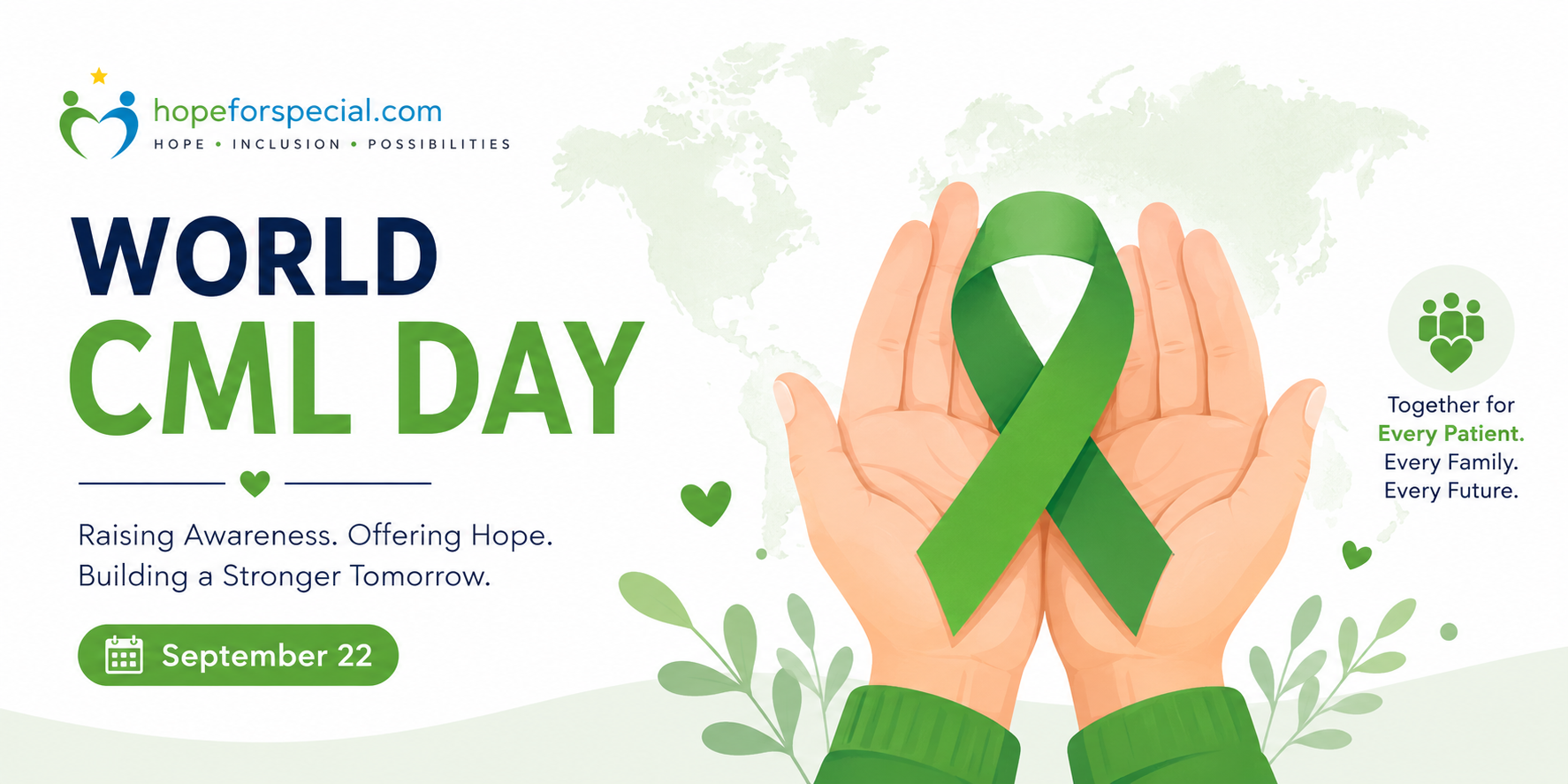
🩸 World CML Day 2026: The Remarkable Cancer Story Every Family Deserves to Know
World CML Day falls on September 22 — but most families have never heard of CML. Could this be the most transformative cancer story of our lifetime? Discover the truth now.

- 🩸 What Is World CML Day — and Why Should Every Family Know About It?
- 🗓️ World CML Day 2026: Key Facts at a Glance
- 📊 CML Statistics 2026: The Numbers Behind the Story
- 🧬 What Is CML? The Biology Made Simple
- 🚨 CML Symptoms: Why It Is Called the “Silent Cancer”
- 💊 The TKI Revolution: How One Drug Changed Everything
- ⚠️ When TKIs Stop Working: The Challenge of Resistance and Intolerance
- 💔 A Story That Reflects a Million Families
- 🌍 The Global Equity Problem: CML Treatment Is Not the Same Everywhere
- 🔬 CML and the Dream of Treatment-Free Remission
- 💙 CML and the Special Needs Community: A Connection That Matters
- 🌟 What You Must Not Skip About World CML Day
- 🔗 Trusted Resources for World CML Day 2026
- ❓ FAQs: World CML Day
- Q: When is World CML Day 2026?
- Q: What does CML stand for?
- Q: Is CML curable?
- Q: How is CML diagnosed?
- Q: What is the Philadelphia chromosome?
- Q: Can a parent with CML still care for their special needs child?
- Q: What is a TKI for CML?
- Q: Why is World CML Day important?
- 💙 World CML Day: A Final Word — Because This Story Belongs to All of Us
🩸 What Is World CML Day — and Why Should Every Family Know About It?
World CML Day is observed every year on September 22 — a date deliberately chosen because it symbolises the chromosomal change at the heart of Chronic Myeloid Leukaemia: the switching of genetic material between chromosomes 9 and 22.
CML is a type of blood cancer that, 25 years ago, was considered a death sentence — and today, thanks to one of medicine’s greatest breakthroughs, most patients can expect a near-normal life expectancy.
Every year on 22nd September, the CML Advocates Network and blood cancer communities around the globe come together to mark World Chronic Myeloid Leukemia Day. The date is poignant because it symbolises the cause of CML, which is the genetic change of chromosomes 9 and 22. (Source: CML Advocates Network via LinkedIn)
For families in the special needs community — including those where a parent, grandparent, or sibling has received a CML diagnosis — understanding this condition in 2026 is both medically important and genuinely hopeful.
🗓️ World CML Day 2026: Key Facts at a Glance
| Detail | Information |
|---|---|
| 📅 Date | September 22, 2026 |
| 🧬 Why September 22? | Symbolises chromosomes 9 and 22 — which swap genetic material to cause CML |
| 🏛️ Organised by | CML Advocates Network |
| 🎗️ Part of | Blood Cancer Awareness Month (September) |
| 🌐 Official resource | CML Advocates Network |
| 🎯 Core message | Awareness, early diagnosis, access to treatment |
| 📣 Hashtags | #WorldCMLDay #CMLDay #ChronicMyeloidLeukemia |
📊 CML Statistics 2026: The Numbers Behind the Story
In the United States in 2025 there were approximately 9,560 new cases of CML and approximately 1,290 deaths. The average age of a patient with CML is 66 years. The average lifetime risk of CML in the United States among both sexes is approximately 0.2% — 1 in 500 Americans. (Source: Merck Manual Professional Edition / American Cancer Society, February 2026)
| Statistic | Figure | Source |
|---|---|---|
| US new CML cases (2025) | ~9,560 | Merck Manual / ACS, 2026 |
| US CML deaths (2025) | ~1,290 | Merck Manual / ACS, 2026 |
| Lifetime CML risk (US) | ~0.2% (1 in 500) | Merck Manual, 2026 |
| Average age at diagnosis | 66 years | Merck Manual, 2026 |
| 5-year survival with TKI (chronic phase) | >90% | Merck Manual, 2026 |
| Median survival PRE-TKI era | 4–7 years | Merck Manual, 2026 |
| Annual death rate PRE-TKI | 10–15% per year | Merck Manual, 2026 |
| CML patients needing TKI change | ~25% will adjust first TKI | Takeda Oncology |
| Patients achieving near-normal life expectancy | Most — with optimal TKI response | EBMT |
These numbers tell one of the most dramatic transformation stories in all of oncology. From a condition with a median survival of 4–7 years to one where most patients can now expect to live as long as the general population — this is what World CML Day celebrates.
🧬 What Is CML? The Biology Made Simple
Chronic Myeloid Leukaemia (CML) is a type of cancer that starts in the blood-forming cells of the bone marrow. It begins with a single genetic mistake — and understanding that mistake is the key to understanding everything that has changed in CML treatment over the past 25 years.
CML occurs when a genetic change takes place in early, immature versions of cells that form red blood cells, platelets and most types of white blood cells. This change involves pieces of chromosomes 9 and 22 switching with each other, forming the Philadelphia chromosome. As a result, the abnormal gene BCR-ABL1 is formed, which leads to the cell becoming damaged and cancerous. (Source: Takeda Oncology — Blood Cancer Awareness Month)
The Philadelphia Chromosome: Why a Date Was Named After a Mutation
The genetic swap between chromosomes 9 and 22 creates what is known as the Philadelphia chromosome — named after the city where it was discovered in 1960. This produces the abnormal BCR-ABL1 gene, which acts as a permanently switched-on signal telling blood cells to divide uncontrollably.
The BCR-ABL1 gene became the target of one of the most celebrated drug developments in medical history — the development of Imatinib (Gleevec/Glivec), the first TKI to treat CML. World CML Day exists, in part, to mark that revolution.
The Three Phases of CML
CML progresses through up to three phases if untreated:
| Phase | What Happens | Prognosis With Treatment |
|---|---|---|
| Chronic Phase | Gradual increase in white blood cells; most patients diagnosed here | Excellent — >90% 5-year survival with TKI |
| Accelerated Phase | More rapid progression; less responsive to treatment | Moderate — more intensive treatment required |
| Blast Phase (Blast Crisis) | Resembles acute leukaemia; most serious | Poor — requires urgent, aggressive treatment |
(Source: Merck Manual Professional Edition, 2026)
🚨 CML Symptoms: Why It Is Called the “Silent Cancer”
One of the most important messages of World CML Day is this: CML often produces no symptoms in its early stages. This makes awareness essential — because early diagnosis, before disease progression, dramatically improves outcomes.
CML is often hard to diagnose early because patients do not always present with symptoms, and when they do, symptoms can be non-specific. As a result, CML is sometimes diagnosed through routine blood tests performed for other reasons. (Source: Takeda Oncology)
Common CML Symptoms (When They Do Appear)
- 🔴 Fatigue — persistent, unexplained exhaustion
- 🔴 Unexplained weight loss
- 🔴 Night sweats
- 🔴 Enlarged spleen — felt as fullness or pain on the left side of the abdomen
- 🔴 Feeling full quickly when eating
- 🔴 Bone pain — particularly in the ribs and sternum
- 🔴 Fever without infection
- 🔴 Easy bruising or bleeding
- 🔴 Pale skin — from anaemia
The crucial point: a routine blood test that shows an elevated white blood cell count — even in the absence of all these symptoms — can be the first clue that leads to a CML diagnosis. This is why regular health check-ups matter.
💊 The TKI Revolution: How One Drug Changed Everything
Before World CML Day can be fully appreciated, it is essential to understand what happened in 2001 — the year that changed CML from a death sentence into a manageable chronic condition.
Twenty years ago, the first patients with CML were treated with a new class of targeted therapy known as tyrosine kinase inhibitors (TKIs). Outcomes exceeded all expectations where most patients achieved a normal life expectancy. In the decades that followed, ongoing development of TKIs and a greater understanding of the disease continued to transform CML care. Patients can now live with this chronic disease rather than it being deemed fatal. (Source: CML Advocates Network / LinkedIn)
With the advent of the tyrosine kinase inhibitors more than twenty years ago, the survival of patients diagnosed with CML has substantially increased, being almost comparable to the general population in those patients achieving optimal response. (Source: EBMT — European Bone Marrow Transplantation)
FDA-Approved TKIs for CML in 2026
| Drug (Brand Name) | Generation | FDA Approval | Best For |
|---|---|---|---|
| Imatinib (Gleevec) | 1st generation | 2001 | First-line; the original TKI revolution |
| Dasatinib (Sprycel) | 2nd generation | 2006 | First-line or imatinib intolerance/resistance |
| Nilotinib (Tasigna) | 2nd generation | 2007 | First-line; faster deep response |
| Bosutinib (Bosulif) | 2nd generation | 2012 | After prior TKI failure |
| Ponatinib (Iclusig) | 3rd generation | 2012 | T315I mutation; multi-resistant CML |
| Asciminib (Scemblix) | STAMP inhibitor | 2021 | After 2+ prior TKIs; novel mechanism |
(Source: NCCN Clinical Practice Guidelines — CML, version 1.2026)
The development of multiple generations of TKIs means that when one drug fails or causes intolerable side effects, there are now several alternatives — a situation unimaginable in the pre-TKI era.
⚠️ When TKIs Stop Working: The Challenge of Resistance and Intolerance
World CML Day does not only celebrate progress. It also acknowledges the challenges that remain — including the reality that not every patient’s treatment journey is straightforward.
About one quarter of people living with CML will need to adjust their first TKI treatment at one point during the course of their disease, as they may no longer be able to tolerate the initial TKI therapy, or the initial TKI therapy may stop working. People living with CML can become intolerant — meaning that side effects or toxicity leads to discontinuation — or resistant — meaning that they lack or lose response to the TKI. (Source: Takeda Oncology)
The Most Common TKI Side Effects
Research involving 10,769 CML patients across 43 studies identified the following GI side effects as the most common:
Examination of combined TKI average gastrointestinal adverse event incidence found diarrhoea most prevalent (22.5%), followed by nausea (20.6%), and vomiting (12.9%). Other TKI GI adverse events included constipation (9.2%), abdominal pain (7.6%), gastrointestinal haemorrhage (3.5%), and pancreatitis (2.2%). Mean GI adverse event incidence was significantly different between TKIs: bosutinib (52.9%), imatinib (24.2%), dasatinib (20.4%), and nilotinib (9.1%). (Source: PMC — Meta-Analysis of GI Adverse Events from TKIs for CML)
Non-GI side effects that families should be aware of include:
- 🟡 Fluid retention (oedema, swelling)
- 🟡 Muscle cramps and joint pain
- 🟡 Skin rashes
- 🟡 Cardiovascular effects (varies by TKI — particularly important with nilotinib and ponatinib)
- 🟡 Pulmonary effects (dasatinib can cause pleural effusion)
- 🟡 Fatigue
The key message: side effects are manageable and treatable. Regular communication with your haematology team — and never stopping TKI without medical guidance — is essential.
💔 A Story That Reflects a Million Families
Meet Thomas. He is 61 years old and the grandfather of two grandchildren, one of whom has Down syndrome. At a routine pre-operative blood test for a knee replacement, his doctor called him back with an unusual result: significantly elevated white blood cells. Thomas had no symptoms. He felt fine.
Within three weeks, he had been seen by a haematologist, a bone marrow biopsy confirmed CML in chronic phase, and he had started imatinib.
His granddaughter Mia — who has Down syndrome and who he helps care for three days a week — was his first concern. “Will I still be there for her?” he asked his consultant.
The answer was yes. Three years later, Thomas has achieved a deep molecular response. His blood counts are normal. He still picks Mia up from her specialist school on Tuesdays and Thursdays.
“The diagnosis changed my perspective,” he says. “Not in a bad way. It made me even more determined to be present. And I am.”
Thomas’s story reflects what modern CML treatment has made possible. For families in the special needs community — where a grandparent, parent, or sibling may carry a CML diagnosis — this is the reality of 2026 CML care.
🌍 The Global Equity Problem: CML Treatment Is Not the Same Everywhere
World CML Day also shines a light on one of the most troubling realities in global CML care: the dramatic inequality in access to life-saving TKI treatment.
The advent of tyrosine kinase inhibitors in the early 2000s revolutionised the treatment for chronic myeloid leukaemia, enabling substantial improvement in outcomes leading to a near-normal life expectancy. However, clinical trials evaluating TKIs have not been accessible to participants representative of the global CML patient population.
There is a significant lack of availability for tyrosine kinase inhibitors on the global level, and a lack of equitable distribution of trials across countries. (Source: PMC — Global Trial Representation and TKI Availability for CML)
In wealthy, high-income countries, CML is increasingly manageable. In low- and middle-income countries, access to TKIs remains severely limited — and patients who would survive with access to imatinib are dying without it. This is one of the central advocacy goals of World CML Day: to push for equitable global access to proven, life-saving medications.
🔬 CML and the Dream of Treatment-Free Remission
One of the most exciting frontiers in CML care — and a significant theme in 2026 World CML Day discussions — is Treatment-Free Remission (TFR).
TFR means exactly what it sounds like: stopping TKI therapy altogether while maintaining complete molecular remission. For a disease that was once treated with lifelong chemotherapy, and then with lifelong TKI therapy, the possibility of being medication-free is extraordinary.
As is the case with various chronic benign diseases, like diabetes and hypertension, rationally administering these inhibitors can be related to normal age- and sex-expected life duration. Research continues on defining which patients can safely discontinue TKI therapy while maintaining remission. (Source: PMC — Current Perspectives for the Treatment of CML)
Current research suggests that approximately 40–60% of carefully selected patients who have achieved a deep molecular response (DMR) for a sustained period may be able to successfully discontinue TKI therapy. However, this must only be attempted in specialist centres with very close molecular monitoring — as relapse is possible and requires prompt re-treatment.
For families, the message is: TFR is a realistic goal for some patients, but not all. The conversation about whether TFR is right for any individual patient should be part of every CML care plan.
💙 CML and the Special Needs Community: A Connection That Matters
One of the unique values of HopeForSpecial covering World CML Day is addressing how CML intersects with the lives of special needs families.
When a Parent or Caregiver Has CML
For parents and caregivers of children with special needs, a CML diagnosis creates a specific set of challenges:
- 🔴 Treatment adherence around caregiving demands — a daily oral TKI sounds simple, but fitting medication into the schedule of intensive special needs parenting is not always easy
- 🔴 Fatigue management — TKI side effects, particularly fatigue, compound the exhaustion of caregiving
- 🔴 Appointment burden — CML requires regular monitoring blood tests, molecular tests, and haematology appointments. For families already managing multiple appointments for a special needs child, this adds significant pressure
- 🔴 Emotional complexity — managing your own cancer diagnosis while maintaining the emotional and physical capacity to care for a child with special needs requires extraordinary reserves
Practical Strategies for Caregivers With CML
- ✅ Tell your haematology team explicitly that you are a primary caregiver — this should influence appointment scheduling and side effect management priorities
- ✅ Ask about telehealth monitoring options where appropriate — saving you travel time
- ✅ Connect with the CML Advocates Network — peer support from other CML patients is invaluable
- ✅ Never adjust or stop TKI therapy without specialist guidance — even if caregiving pressures feel overwhelming
🌟 What You Must Not Skip About World CML Day
Here is what you must not skip about CML day:

🔸 The monitoring tests are as important as the treatment.
Regular monitoring is recommended to help ensure that a person’s current treatment plan remains effective and well tolerated. Regular monitoring is also critical as patients may not always experience new symptoms when a treatment is no longer working. (Source: Takeda Oncology) Missing monitoring tests is one of the most common reasons TKI failure is caught late.
🔸 The quality of life burden is real — even when treatment is “working.”
People often do not realise the impact of the continued need for treatment adherence, the influence that diagnosis and treatment have on daily life like work, family, and social life. A nurse or nurse practitioner has an important role in managing side effects, encouraging therapeutic adherence, and supporting patients and relatives in processing this diagnosis and its impact on their life. (Source: EBMT)
🔸 CML in younger adults is different.
While average age at diagnosis is 66, CML does occur in working-age adults and even young adults. For a parent of a special needs child in their 30s or 40s, the implications of a CML diagnosis are profoundly different from those for a retired patient.
🔸 The global access disparity must be part of the conversation.
Without the advocacy work of organisations like the CML Advocates Network, patients in low-income countries would have no voice in the conversation about equitable TKI access.
🔗 Trusted Resources for World CML Day 2026
- 🌐 CML Advocates Network — global patient advocacy and World CML Day organiser
- 🌐 American Cancer Society — CML — statistics, treatment information, and patient resources
- 🌐 EBMT — European Bone Marrow Transplantation — research and clinical guidance on CML
- 🌐 NCCN Clinical Guidelines — CML — current clinical practice guidelines for CML treatment
- 🌐 LLS — Leukemia & Lymphoma Society — patient education, financial assistance, and clinical trial support
- 🌐 Blood Cancer UK — UK-focused CML patient resources
- 🌐 ClinicalTrials.gov — CML — current open clinical trials for CML
❓ FAQs: World CML Day
Q: When is World CML Day 2026?
World CML Day is observed every year on September 22. The date symbolises the cause of CML, which is the genetic change of chromosomes 9 and 22. (Source: CML Advocates Network) In 2026, World CML Day falls on Tuesday, September 22, 2026.
Q: What does CML stand for?
CML stands for Chronic Myeloid Leukaemia (or Chronic Myelogenous Leukaemia) — a type of blood cancer that starts in the bone marrow and is caused by the formation of the Philadelphia chromosome (the genetic swap between chromosomes 9 and 22), which produces the abnormal BCR-ABL1 gene.
Q: Is CML curable?
With use of tyrosine kinase inhibitors, survival is greater than 90% at 5 years after diagnosis for chronic phase CML. Before tyrosine kinase inhibitors were used, median survival was 4 to 7 years. (Source: Merck Manual, 2026) Most patients now live near-normal lifespans. A minority can achieve Treatment-Free Remission (TFR) — stopping TKI while remaining in remission.
Q: How is CML diagnosed?
CML is often diagnosed incidentally through a routine blood test showing elevated white blood cells. Confirmation requires peripheral blood smear, bone marrow biopsy, and molecular testing to identify the Philadelphia chromosome and BCR-ABL1 gene. CML is frequently discovered before symptoms appear.
Q: What is the Philadelphia chromosome?
The Philadelphia chromosome is the abnormal chromosome that causes CML. It is formed when pieces of chromosomes 9 and 22 swap with each other. This creates the abnormal BCR-ABL1 fusion gene, which produces a permanently active protein that causes uncontrolled cell division. It was first identified in Philadelphia in 1960 — hence the name.
Q: Can a parent with CML still care for their special needs child?
Yes — and for most patients who respond well to TKI therapy, daily functioning is close to normal. The key is close communication with your haematology team about your caregiving role, managing side effects proactively, and never missing monitoring appointments. Many parents with CML continue their full caregiving responsibilities with the right medical support. Contact the CML Advocates Network for peer support from families navigating similar situations.
Q: What is a TKI for CML?
A TKI — Tyrosine Kinase Inhibitor — is the targeted oral medication that forms the cornerstone of CML treatment. TKIs work by blocking the BCR-ABL1 protein that drives CML. The first TKI, imatinib (Gleevec), was approved in 2001 and transformed CML outcomes. Second and third generation TKIs including dasatinib, nilotinib, bosutinib, ponatinib, and asciminib are available for patients who need an alternative to first-line treatment.
Q: Why is World CML Day important?
World CML Day matters for three reasons. First, it celebrates the most successful story of targeted cancer therapy in medical history. Second, it acknowledges that challenges remain — including TKI resistance, treatment side effects, and profound global inequalities in access to life-saving medications. Third, it raises awareness that CML is often symptomless in early stages — meaning regular blood tests can literally save lives.
💙 World CML Day: A Final Word — Because This Story Belongs to All of Us
Twenty-five years ago, a CML diagnosis meant years, not decades. It meant a bone marrow transplant, if you were lucky enough to find a donor. It meant a rapid, cruel progression.
Today, for most people, it means a pill. A daily pill, with monitoring appointments, and a life that continues — fully, meaningfully, and for as long as expected.
This transformation — from death sentence to manageable chronic condition — is the most hopeful cancer story medicine has to tell. And World CML Day on September 22 is the moment we honour it, demand that its benefits reach every patient worldwide, and continue pushing for the next breakthrough: the day when no CML patient anywhere needs treatment at all.
For the families in the HopeForSpecial community — caregivers already navigating extraordinary daily challenges — knowing that a CML diagnosis is no longer what it once was is not a small thing. It is everything. 💙🩸
📌 For CML support, advocacy, and World CML Day resources, visit the CML Advocates Network or the Leukemia & Lymphoma Society.


