

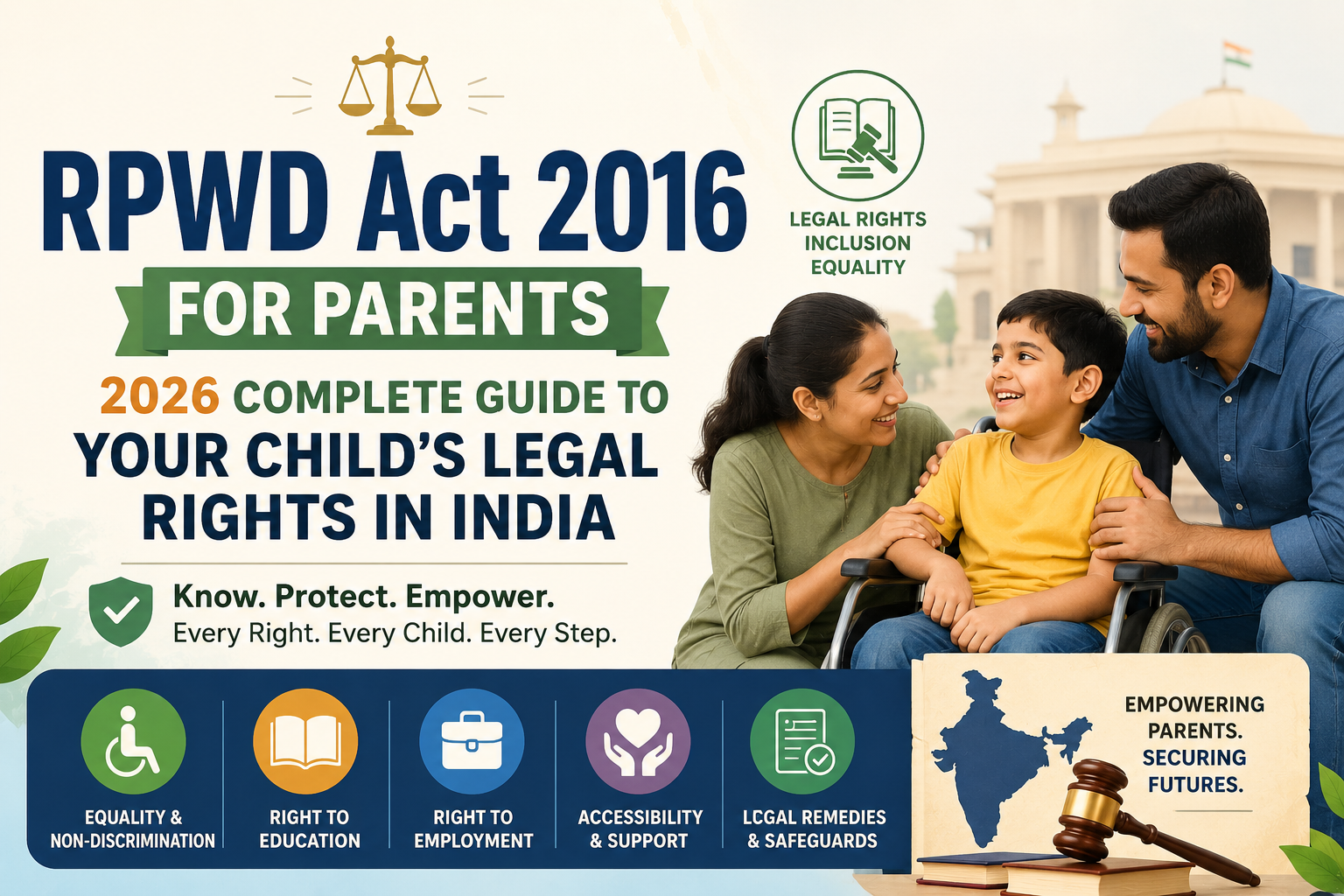
⚖️ RPWD Act 2016 for Parents: 2026 Complete Guide to Your Child’s Legal Rights in India
The RPWD Act 2016 for parents — the Rights of Persons with Disabilities Act 2016 — is India’s landmark disability law that guarantees your child with a disability the legal right to free education, school accommodations, anti-discrimination protection, and government benefits. In short: these are not charitable favours. They are enforceable legal rights that your child is entitled to — and this guide shows you exactly how to claim every one of them.

- 📜 What the RPWD Act 2016 Actually Is — and Why It Changed Everything
- 🧩 The 21 Disabilities Recognised — Is Your Child Included?
- 📊 The Numbers: Key Provisions, Thresholds, and Legal Entitlements
- 🎫 The Disability Certificate: The Key That Unlocks Everything
- 🏫 Your Child’s Education Rights Under the RPWD Act 2016
- ✅ Right 1: Free Education (Section 31)
- ✅ Right 2: Inclusive Education Without Discrimination
- ✅ Right 3: Reasonable Accommodation
- ✅ Right 4: 5% Reservation in Higher Education
- ✅ Right 5: Scribe Access (Extended by Supreme Court, 2025)
- 💰 Financial Benefits and Government Schemes for Parents
- 🚫 Anti-Discrimination Rights: What Schools and Institutions Cannot Do
- 📣 Where to Complain When Rights Are Violated
- ⚖️ Landmark Supreme Court Rulings Every Parent Should Know (2024–2026)
- 🔍 What You Must Not Miss About This Topic
- 1. 🔑 The UDID Card Is Faster and More Useful Than Parents Realise
- 2. 📊 Schools Are Required to Conduct Surveys — Parents Can Use This
- 3. 💼 The National Trust Act Works Alongside the RPWD Act
- 4. 📱 Digital Accessibility Is Now a Fundamental Right
- 5. 🏫 Private Schools Are Not Fully Exempt
- 💙 A Parent’s Story: The Law That Changed Her Son’s School
- ❓ FAQs About the RPWD Act 2016 for Parents
- Q: What is the RPWD Act 2016 for parents?
- Q: Which disabilities are covered under the RPWD Act 2016?
- Q: What is benchmark disability and why does it matter for parents?
- Q: Can a private school refuse admission to my child with a disability?
- Q: How do I get a disability certificate for my child in India?
- Q: What tax benefits does the RPWD Act 2016 give parents?
- Q: Where do I complain if my child’s school is violating their RPWD Act rights?
- 🔗 Trusted Resources for Indian Families
- 💙 Final Thoughts: Your Child’s Rights Are Real. Now Use Them.
💛
📜 What the RPWD Act 2016 Actually Is — and Why It Changed Everything
The Rights of Persons with Disabilities (RPwD) Act 2016 is India’s landmark disability rights law. It replaced the older Persons with Disabilities (Equal Opportunities, Protection of Rights and Full Participation) Act 1995 and gives effect to the United Nations Convention on the Rights of Persons with Disabilities (UNCRPD), which India ratified in 2007.
The Act came into force on 19 April 2017 and marks a decisive shift from a charity or medical model of disability towards a rights-based, social model. (Source: Legacy IAS — RPWD Act 2016 Complete Guide, July 2026)
Before the RPWD Act 2016 for parents, the 1995 law recognised only 7 types of disability. Millions of families raising children with autism, dyslexia, cerebral palsy, blood disorders, or speech and language disabilities had no formal legal standing — no disability certificate, no reservations, no accommodation rights.
The RPWD Act 2016 for parents changed that fundamentally. Courts have repeatedly described the RPWD Act as a “super-statute” flowing from Articles 14, 15, 16, and 21 of the Constitution, shifting from a medical to a functional understanding of disability. (Source: Legacy IAS, 2026)
This means your child’s disability rights are not administrative policy. They are constitutional rights. And you — as a parent — are your child’s primary advocate for ensuring those rights are delivered.
🧩 The 21 Disabilities Recognised — Is Your Child Included?
One of the most transformative changes in the RPWD Act 2016 for parents is the expansion from 7 to 21 recognised disability categories.
Before the RPwD Act 2016, only 7 conditions were legally recognized as disabilities in India. Millions of people living with conditions like autism, specific learning disabilities, blood disorders, and neurological diseases had no formal legal standing.
The 21 disabilities are organised across five broad categories:
🦾 Category 1: Physical Disabilities
| Disability | Description |
|---|---|
| Locomotor disability | Impairment in bones, joints, or muscles affecting movement |
| Visual impairment | Blindness and low vision |
| Hearing impairment | Deaf and hard of hearing |
| Speech and language disability | Permanent impairment in communication |
| Intellectual disability | Significant limitation in intellectual functioning |
| Specific Learning Disabilities | Dyslexia, dyscalculia, dysgraphia — newly added |
| Mental illness | Substantial disorder of thinking, mood, perception, or memory |
🧠 Category 2: Conditions Newly Added Under RPWD Act 2016
These are the conditions that simply did not exist legally before 2016 — and they matter enormously for the RPWD Act 2016 for parents of children with special needs:
- Autism Spectrum Disorder (ASD)
- Specific Learning Disabilities (dyslexia, dyscalculia, dysgraphia)
- Cerebral palsy
- Muscular dystrophy
- Chronic neurological conditions (multiple sclerosis, Parkinson’s disease)
- Multiple sclerosis
- Thalassemia
- Haemophilia
- Sickle cell disease
- Acid attack victims
- Dwarfism
- Multiple disabilities including deafblindness
The expansion to 21 recognized types changed that.
Each additional category recognized under the Act means more individuals can obtain a disability certificate from the Department of Empowerment of Persons with Disabilities, access educational accommodations, secure job reservations, and benefit from welfare programs that were previously out of reach. (Source: Teachers Institute — 21 Disabilities RPWD Act 2016)
The Central Government retains the power to add further categories — meaning this list can expand as medical understanding evolves.
📊 The Numbers: Key Provisions, Thresholds, and Legal Entitlements
| Provision | Detail | Source |
|---|---|---|
| Disabilities recognised | 21 (up from 7 under 1995 Act) | RPWD Act 2016 — India Code |
| Benchmark disability threshold | ≥ 40% disability certification | Legacy IAS — RPWD Act 2016, 2026 |
| Free education right (age) | 6 to 18 years (Section 31) | RICE IAS — RPWD Act 2016 |
| Government job reservation | Minimum 4% for benchmark disabilities | LDExplained — RPWD Act Features |
| Higher education reservation | Minimum 5% in government-aided institutions | LDExplained — RPWD Act Features |
| Age relaxation in education | 5 years for persons with benchmark disabilities | LDExplained — RPWD Act Features |
| Housing reservation | 5% in housing allotment and poverty alleviation schemes | Teachers Institute — RPWD Act Disabilities |
| Act came into force | 19 April 2017 | Legacy IAS, 2026 |
| First offence penalty for violation | Up to ₹10,000 | Legacy IAS, 2026 |
| Subsequent violation penalty | ₹50,000–₹5 lakh | Legacy IAS, 2026 |
🎫 The Disability Certificate: The Key That Unlocks Everything
The most practical starting point of the RPWD Act 2016 for parents is obtaining your child’s Disability Certificate — also called the Divyangjan Certificate or Unique Disability ID (UDID).
Without this certificate, your child cannot legally access most of the rights the Act provides. With it, every door — education accommodations, government schemes, reservations, tax benefits — opens.
📋 Who Qualifies
Any child with a recognised disability under the RPWD Act 2016 can apply for a disability certificate. For benchmark disability benefits (the higher tier of entitlements), your child must be certified as having 40% or more of a specified disability by an authorised medical authority.
Importantly, the Supreme Court has clarified that the 40% threshold is a “floor, not a ceiling” — the State cannot impose an upper disability percentage limit to exclude persons from benefits. (Source: Legacy IAS, 2026)
📝 How to Apply for the Disability Certificate
- Visit your nearest designated government hospital or composite regional centre
- Bring your child’s diagnosis report from a qualified specialist (developmental paediatrician, child psychiatrist, or clinical psychologist)
- For autism specifically, bring an ISAA (Indian Scale for Assessment of Autism) assessment report — this is mandated for autism disability certification
- The medical board assesses your child and assigns a percentage of disability
- Receive the certificate — apply for UDID simultaneously through swavlambancard.gov.in
The UDID card (Unique Disability ID) digitises your child’s certificate into a single, nationally valid card — usable for accessing all government schemes, education accommodations, and reservations across India.
🏫 Your Child’s Education Rights Under the RPWD Act 2016
Education is where the RPWD Act 2016 for parents is most immediately relevant — and most frequently violated.

Here is exactly what the law guarantees.
✅ Right 1: Free Education (Section 31)
Every child with a benchmark disability between 6 and 18 years has the right to free education in a neighborhood school or special school of their choice.
This right applies regardless of whether the school is a government school, government-aided school, or — in many states — a private school receiving any government funding.
What this means in practice: If your child has a disability certificate, no school in India can legally charge them for education from ages 6 to 18. If they attempt to do so, this is a violation of the RPWD Act 2016.
✅ Right 2: Inclusive Education Without Discrimination
Children with disabilities have the right to inclusive education without discrimination. The Act specifically prohibits any educational institution from refusing admission to a child on the basis of disability.
✅ Right 3: Reasonable Accommodation
Schools are legally required to provide reasonable accommodation to your child — meaning modifications that allow your child to participate equally in education.
Reasonable accommodation refers to necessary modifications that allow persons with disabilities to participate equally in workplaces, educational institutions, and public services. Failure to provide reasonable accommodation without valid justification may amount to a violation of the Act.
What reasonable accommodation looks like in school:
| Accommodation Type | Examples |
|---|---|
| Curriculum adaptation | Simplified text, reduced written workload, alternative formats |
| Assessment accommodation | Extra time in examinations, scribe, reader, oral assessment |
| Communication support | AAC devices, visual supports, sign language interpreter |
| Physical accessibility | Ramps, accessible toilets, accessible classrooms |
| Assistive technology | Braille textbooks, JAWS screen reading software, hearing aids |
| Special educator support | Resource room access, shadow teacher, learning support staff |
Students are entitled to aids and appliances matched to their disability – from Braille books and large-print textbooks for the visually impaired, to hearing aids, wheelchairs, and communication devices for others.
Under IEDSS guidelines, screen reading software such as JAWS and speech recognition tools are also recognised as required resources for students who need them. (Source: Teachers Institute — Educational Rights India)
✅ Right 4: 5% Reservation in Higher Education
When your child reaches college age, the RPWD Act 2016 guarantees 5% reservation in all government and government-aided higher educational institutions — with an additional 5 years of age relaxation for persons with benchmark disabilities. (Source: LDExplained — RPWD Act Features)
✅ Right 5: Scribe Access (Extended by Supreme Court, 2025)
A landmark 2025 Supreme Court ruling extended the right to a scribe in examinations to all disabled candidates, not only those with benchmark disability — significantly expanding the right beyond the Act’s original text. (Source: Legacy IAS, 2026)
💰 Financial Benefits and Government Schemes for Parents
The RPWD Act 2016 for parents unlocks several financial benefits — many of which parents are simply not told about.
| Benefit | Details | Where to Claim |
|---|---|---|
| Income Tax — Section 80DD | Deduction of ₹75,000 (40–80% disability) or ₹1,25,000 (severe — 80%+) for parents supporting a disabled dependent | Income Tax filing — Form 10-IA required |
| Section 80U | Deduction for the person with disability themselves (₹75,000 or ₹1,25,000 depending on severity) | Income Tax filing |
| National Scholarship for Disabled | Financial scholarships for school and college students with disability | scholarships.gov.in |
| Samagra Shiksha AT support | Free assistive devices through the school scheme (hearing aids, communication boards, etc.) | Through your child’s school — request in writing |
| ADIP Scheme | Assistive Devices for Persons with Disabilities — free aids and appliances | Through Artificial Limbs Manufacturing Corporation (ALIMCO) |
| Housing reservation — 5% | Priority in government housing allotment and poverty alleviation schemes | State housing authority |
| Railway travel concession | 25–75% concession in rail travel for person with disability + one escort | Indian Railways — form from station booking office |
| State-specific schemes | Each state has additional schemes — often including monthly disability pension (₹500–₹3,000/month in most states) | Your district’s Social Justice and Empowerment department |
🚫 Anti-Discrimination Rights: What Schools and Institutions Cannot Do
This section of the RPWD Act 2016 for parents is critical — because many parents do not know that specific acts by schools or institutions are not just unfair but illegal under Indian law.
Schools and institutions are prohibited from:
- Denying admission to a child solely on the basis of their disability
- Excluding a child from any activity, programme, or event because of their disability
- Applying different and inferior standards or treatment to a child with disability
- Refusing to provide reasonable accommodation that does not impose a disproportionate burden
- Creating an environment of hostility, indignity, or humiliation for a disabled child
Furthermore: Accessibility is now a fundamental right.
In the landmark Rajive Raturi v. Union of India (2024) ruling, the Supreme Court held that accessibility to public spaces and services is a fundamental right — and struck down a rule that made accessibility standards merely recommendatory, directing the government to create mandatory accessibility standards. (Source: Legacy IAS, 2026)
📣 Where to Complain When Rights Are Violated
Knowing your rights under the RPWD Act 2016 for parents is half the battle. Knowing how to enforce them is the other half.
🏛️ The Complaint Pathway
Step 1: Send a written complaint to the school principal or institution head
Always start with a formal written complaint (email or registered post). Document the specific right violated and quote the relevant RPWD Act section. This creates a paper trail.
Step 2: Approach the State Commissioner for Persons with Disabilities
Every state has a State Commissioner for Disabilities — a statutory authority with the power to receive and investigate complaints under the RPWD Act. Contact details are available at ccpd.nic.in
Step 3: Approach the Chief Commissioner for Persons with Disabilities (Central)
For complaints against central government establishments or for matters crossing state boundaries, approach the Chief Commissioner for Persons with Disabilities (CCPD) at ccpd.nic.in
Step 4: Special Courts
The RPWD Act 2016 mandates a Special Court in each district specifically for disability rights cases. These courts handle violations of the Act directly and can impose penalties up to ₹5 lakh for repeated violations.
Step 5: File an RTI (Right to Information) Application
If a government school, department, or authority is denying your child’s rights, an RTI application requesting documentation of how they are implementing RPWD Act provisions can be extremely effective in forcing compliance.
⚠️ Penalty Structure Under RPWD Act 2016
| Offence | Penalty |
|---|---|
| First violation of the Act | Fine up to ₹10,000 |
| Subsequent violations | Fine between ₹50,000 and ₹5,00,000 |
| Atrocity or sexual exploitation of a person with disability | Imprisonment 6 months to 5 years |
⚖️ Landmark Supreme Court Rulings Every Parent Should Know (2024–2026)
The RPWD Act 2016 for parents has been significantly strengthened by a wave of Supreme Court rulings between 2024 and 2026. Here is what every parent should know:
| Case | Year | What It Decided | Why It Matters for Parents |
|---|---|---|---|
| Rajive Raturi v. Union of India | 2024 | Accessibility is a fundamental right; mandatory standards required | Schools and public spaces must be physically accessible to your child — by law, not suggestion |
| Digital Accessibility Ruling | 2025 | Digital access (including accessible KYC/digital verification) is a fundamental right under Article 21 | Digital educational platforms and government portals must be accessible for children with disabilities |
| Scribe Facility Extension | 2025 | Right to a scribe extended to all disabled candidates, not only those with benchmark disability | Your child can request a scribe for any examination, regardless of their disability percentage |
| Prabhu Kumar v. State of Himachal Pradesh | Ongoing | 40% benchmark is a “floor” not a “ceiling” — states cannot impose upper limits | States cannot exclude children with higher disability percentages from benefits |
(Source: Legacy IAS — RPWD Act 2016 Updated July 2026)
🔍 What You Must Not Miss About This Topic
1. 🔑 The UDID Card Is Faster and More Useful Than Parents Realise
Most RPWD Act guides mention disability certificates without specifically recommending the Unique Disability ID (UDID) card — the digital, nationally valid version of the certificate available at swavlambancard.gov.in.
The UDID eliminates the need to carry multiple state-specific certificates, is accepted at institutions across India, and is required for many central government scheme applications. Every parent with a disabled child should pursue UDID registration simultaneously with the disability certificate.
2. 📊 Schools Are Required to Conduct Surveys — Parents Can Use This
The RPwD Act 2016 also mandates school surveys every five years to identify children with disabilities and assess the extent to which their educational needs are being addressed. Most parents do not know this provision exists.
If your school has not conducted such a survey or if your child was not identified, you can formally request information about the survey results through an RTI application — and use the absence of a proper survey as grounds for a complaint to the State Commissioner.
3. 💼 The National Trust Act Works Alongside the RPWD Act
The National Trust Act 1999 — which operates specifically for persons with autism, cerebral palsy, intellectual disability, and multiple disabilities — provides legal guardianship support (the Legal Guardian Certificate under the National Trust) that is separate from but complementary to the RPWD Act.
For parents of children with these specific conditions, the National Trust registration opens additional legal protections and schemes not covered by the RPWD Act alone.
4. 📱 Digital Accessibility Is Now a Fundamental Right
The 2025 Supreme Court ruling on digital accessibility — declaring accessible digital services a fundamental right under Article 21 — has direct implications for parents of children with disabilities using educational technology. Schools and government portals that deploy inaccessible digital tools are now potentially violating a constitutionally protected right. This is a 2025–2026 development almost no parent-facing RPWD Act guide has yet addressed.
5. 🏫 Private Schools Are Not Fully Exempt
Many parents believe the RPWD Act applies only to government schools. This is not entirely accurate. Schools receiving any government funding or government recognition are bound by RPWD Act provisions on reasonable accommodation, non-discrimination, and inclusive education. The full scope of private school obligations under the Act continues to be defined through state-level implementation and ongoing litigation — but the principle that no school can discriminate on the basis of disability applies broadly.
💙 A Parent’s Story: The Law That Changed Her Son’s School
When Meera’s son Rohan was seven, his school in Pune refused to let him take his third-grade final examination because of his dyslexia. He was told he was “not ready” — and that the school could not “manage him” during the examination.
“I did not know my rights then,” Meera says. “I thought the school could do whatever they wanted. I thought I had no choice.”
A parent in an online group mentioned the RPWD Act 2016 for parents. Meera spent three evenings reading about it.
She discovered that dyslexia is a recognised disability under the Act. That specific learning disabilities are legally covered. That Rohan had the right to accommodation in examinations. That what the school did was potentially a violation of Section 31 and the anti-discrimination provisions.
She wrote a formal letter to the principal quoting the RPWD Act. She applied for Rohan’s disability certificate — which was processed in three weeks. She presented the certificate to the school and formally requested reasonable accommodation: extra time and a reader for his examinations.
“The school’s attitude changed overnight,” she recalls. “Not warmly — but it changed. They could not say no to a legal document.”
Rohan wrote his examination with 50% extra time and a reader. He passed with strong scores in all subjects except written Hindi.
“He had always been bright,” Meera says quietly. “The law did not make him smarter. It simply made the school stop pretending he was not.”
She is now a disability rights volunteer, helping other parents in her district understand the RPWD Act 2016 for parents. She describes it as the most important document in her child’s life.
“Every Indian parent of a child with a disability needs to read this Act,” she says. “Not because it is easy to enforce. But because you cannot fight for something you do not know exists.”
❓ FAQs About the RPWD Act 2016 for Parents
Q: What is the RPWD Act 2016 for parents?
The RPWD Act 2016 — Rights of Persons with Disabilities Act 2016 — is India’s disability rights law that came into force in April 2017. For parents, it is the legal framework guaranteeing children with disabilities the right to free education between ages 6 and 18, reasonable accommodation in schools, anti-discrimination protection, government job reservations for adults, higher education reservations, and access to government schemes and financial benefits.
Q: Which disabilities are covered under the RPWD Act 2016?
The RPWD Act 2016 recognises 21 categories of disability, organised across five broad groups. These include autism spectrum disorder, specific learning disabilities such as dyslexia, cerebral palsy, intellectual disability, locomotor disability, visual impairment, hearing impairment, speech and language disability, mental illness, muscular dystrophy, multiple sclerosis, thalassemia, haemophilia, sickle cell disease, dwarfism, and multiple disabilities including deafblindness.
Q: What is benchmark disability and why does it matter for parents?
Benchmark disability is defined in Section 2(r) of the RPWD Act 2016 as a disability of not less than 40% as certified by an authorised government medical authority. Children and persons with benchmark disability access the full range of entitlements under the Act — including the right to free education, government job reservations (4%), higher education reservations (5%), housing priority, and additional government scheme benefits.
Q: Can a private school refuse admission to my child with a disability?
No school in India can refuse admission to a child solely on the basis of their disability. This is prohibited under the anti-discrimination provisions of the RPWD Act 2016. Children with disabilities also have the right to reasonable accommodation in schools — meaning schools must make necessary modifications to enable equal participation. Refusal to provide accommodation without valid justification may itself constitute a violation of the Act.
Q: How do I get a disability certificate for my child in India?
Visit your nearest designated government hospital or composite regional centre. Bring your child’s diagnosis report from a qualified specialist. For autism, an ISAA assessment report is required. The designated medical board will assess your child and assign a disability percentage. Simultaneously register for the UDID card at swavlambancard.gov.in for a nationally valid digital version of the certificate.
Q: What tax benefits does the RPWD Act 2016 give parents?
Under Section 80DD of the Income Tax Act, parents supporting a child with a disability can claim deductions of ₹75,000 per year for 40–80% disability or ₹1,25,000 per year for 80% or above disability. Form 10-IA must be filed with the disability certificate. These deductions are available regardless of whether you also have a home loan or other deductions.
Q: Where do I complain if my child’s school is violating their RPWD Act rights?
Start with a formal written complaint to the school principal quoting the specific RPWD Act provision violated. If unresolved, approach the State Commissioner for Persons with Disabilities in your state — contact details at ccpd.nic.in. For central government institutions, approach the Chief Commissioner for Persons with Disabilities. You can also file a complaint in the Special Court for Disability Rights in your district.
🔗 Trusted Resources for Indian Families
| Resource | What It Offers | Link |
|---|---|---|
| 📄 RPWD Act 2016 — Full Official Text | Complete text of the Rights of Persons with Disabilities Act | indiacode.nic.in |
| 🏛️ Department of Empowerment of Persons with Disabilities (DEPwD) | Nodal ministry, schemes, and official RPWD Act resources | depwd.gov.in |
| 🎫 UDID Card Registration | Apply for Unique Disability ID card | swavlambancard.gov.in |
| 📣 Chief Commissioner for Persons with Disabilities | Complaints, grievance redressal, state commissioner contacts | ccpd.nic.in |
| 🏥 National Trust | Legal guardianship and support for autism, CP, ID, MD families | thenationaltrust.gov.in |
| 🎓 National Scholarships Portal | Disability scholarships for school and college students | scholarships.gov.in |
| 📊 Teachers Institute — Educational Rights Guide | Plain-language education rights under RPWD Act | teachers.institute |
| 🔍 LDExplained — RPWD Act Features | Specific learning disability rights under RPWD Act | ldexplained.org |
💙 Final Thoughts: Your Child’s Rights Are Real. Now Use Them.
The RPWD Act 2016 for parents did not create charity. It created legal rights — enforceable in courts, backed by the Constitution, and designed specifically to ensure that your child’s disability is never a reason they are excluded, diminished, or denied what they deserve.
Free education. School accommodations. Anti-discrimination protection. A disability certificate that opens government schemes. Tax deductions. College reservations. A complaint system. Special courts.
These are not aspirational promises. They are the law.
Most parents raising children with disabilities in India are not failing to advocate for their children. They are failing to advocate with knowledge — because no one handed them this guide.
You have it now. Use it. 💛
📝 This article is for informational and educational purposes only and does not constitute legal advice. Always consult a qualified disability rights advocate or legal professional for guidance specific to your child’s situation. Law provisions, schemes, and judicial interpretations may evolve — verify current details with official government sources.


