
Managing Special Needs Child in Public: Parent Survival Guide 🧩
Managing a special needs child in public gets easier the moment you swap “control the meltdown” for “prevent the trigger.” That single mindset shift — paired with a prep routine, sensory tools, and a calm exit plan — is what actually helps families enjoy grocery runs, restaurants, and family gatherings again. This guide shows you exactly how. 💪
If you’ve ever frozen in a supermarket aisle while your child melted down and strangers stared, you already know the feeling this article is written for. You’re not alone. And you’re not doing it wrong. 🫂

- Why Public Outings Feel So Hard (And Why That’s Not Your Fault) 🧠
- Real Statistics Every Special Needs Parent Should Know 📊
- A Real Parent Story: The Grocery Store Turning Point 🛒
- Step-by-Step: How to Manage a Special Needs Child in Public 🗺️
- 1. Prep Before You Leave the House 🎒
- 2. Choose Low-Stress Times and Places 🕒
- 3. Use a Simple Signal System 🤝
- 4. Have an Exit Plan, Not Just a Backup Plan 🚪
- 5. Ignore the Stares, Not the Child 👀
- 6. Debrief After, Not During 💬
- Sensory-Friendly Tools That Actually Help 🧸
- Know Your Rights: Legal Protections in Public Spaces ⚖️
- What Most Guides Get Wrong (And What Actually Helps) ⚠️
- Voice Search Quick Answers 🎙️
- Frequently Asked Questions ❓
- 1. How do I stop judgmental stares from strangers when my special needs child has a meltdown in public?
- 2. What is the best sensory kit for a special needs child in public places?
- 3. How can I prepare my special needs child for a first-time public outing like a restaurant?
- 4. Do stores offer sensory-friendly shopping hours for special needs children?
- 5. What should I do if my special needs child runs off in a crowded public place?
- 6. Is it normal to feel embarrassed managing a special needs child in public?
- Final Thoughts: You’re Doing Better Than You Think 💛
Why Public Outings Feel So Hard (And Why That’s Not Your Fault) 🧠
Public spaces are loud. They’re bright. They’re unpredictable. For a neurotypical brain, that’s background noise. For a child with autism, ADHD, sensory processing disorder, or another developmental difference, it’s a full sensory assault happening all at once.
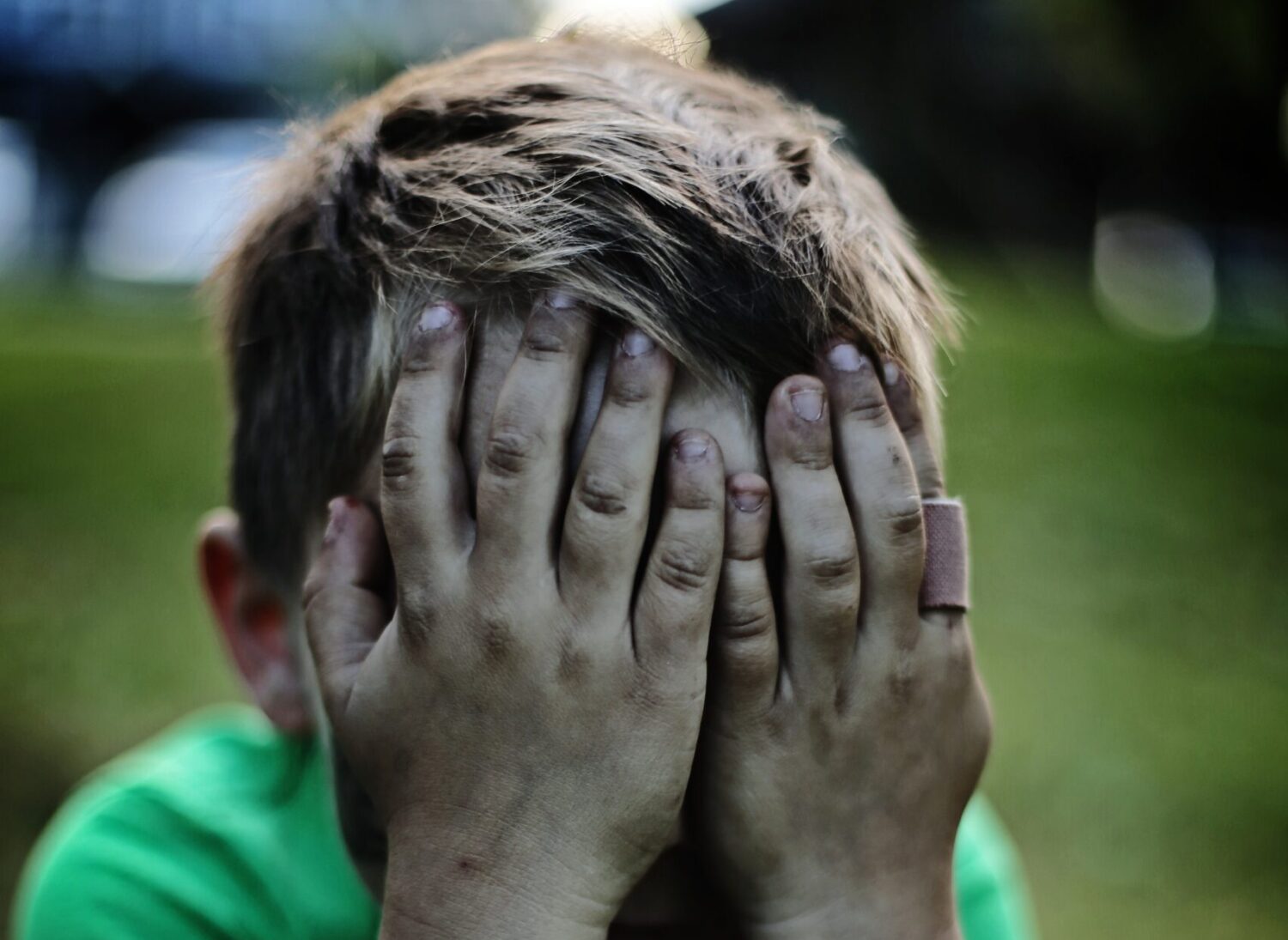
Here’s the part most articles skip: the meltdown isn’t misbehavior. It’s a nervous system overload. Your child isn’t choosing to scream in the cereal aisle. Their brain is drowning in fluorescent lights, squeaky carts, overlapping conversations, and unfamiliar smells — and it has nowhere left to put all of that input.
Once you understand this, everything changes. You stop parenting the behavior and start parenting the trigger. 🎯
Real Statistics Every Special Needs Parent Should Know 📊
Numbers help. They remind you that you’re managing something real, common, and studied — not something rare or “just your kid.” Here’s research-backed data, cross-referenced from government and clinical sources.
| Statistic | What It Means for You | Source |
|---|---|---|
| 1 in 31 8-year-olds in the U.S. is identified with autism spectrum disorder (2022 data) | Your family is part of a large, growing community — not an isolated case | CDC ADDM Network, 2025 |
| 1 in 20 boys vs. 1 in 70 girls are diagnosed with autism | Boys are diagnosed far more often — girls’ sensory struggles are frequently missed or masked | Autism Society of North Carolina, 2025 |
| 5% to 16% of all school-aged children show signs of sensory processing disorder | Sensory overload in public is more common than most people realize — even outside autism | UC San Francisco Research, 2013 |
| 7.3 million+ U.S. students (about 15% of public school enrollment) receive IDEA special education services | Your child’s needs are legally recognized and supported at a national scale | Pew Research Center, 2023 |
| 1 in 100 children globally are estimated to be on the autism spectrum | This is a worldwide parenting experience, not a local or rare one | World Health Organization |
💡 Key takeaway: You’re managing a documented, widely-studied challenge — not failing at an invisible one.
A Real Parent Story: The Grocery Store Turning Point 🛒
Priya’s 6-year-old son, Arjun, has autism and severe sound sensitivity. Every grocery trip ended the same way: a meltdown by the dairy aisle, judgmental stares, and Priya in tears in the parking lot.
Then an occupational therapist gave her one tip: shop during “quiet hours” — most large stores now offer low-light, low-noise time slots — and pack noise-cancelling headphones plus one “safe” snack Arjun could hold the entire trip.
The next visit wasn’t perfect. But it was different. Arjun made it through checkout. Priya called it her “small miracle.”
That’s the pattern worth remembering: small, specific changes beat big, vague willpower. 🌱
Step-by-Step: How to Manage a Special Needs Child in Public 🗺️

1. Prep Before You Leave the House 🎒
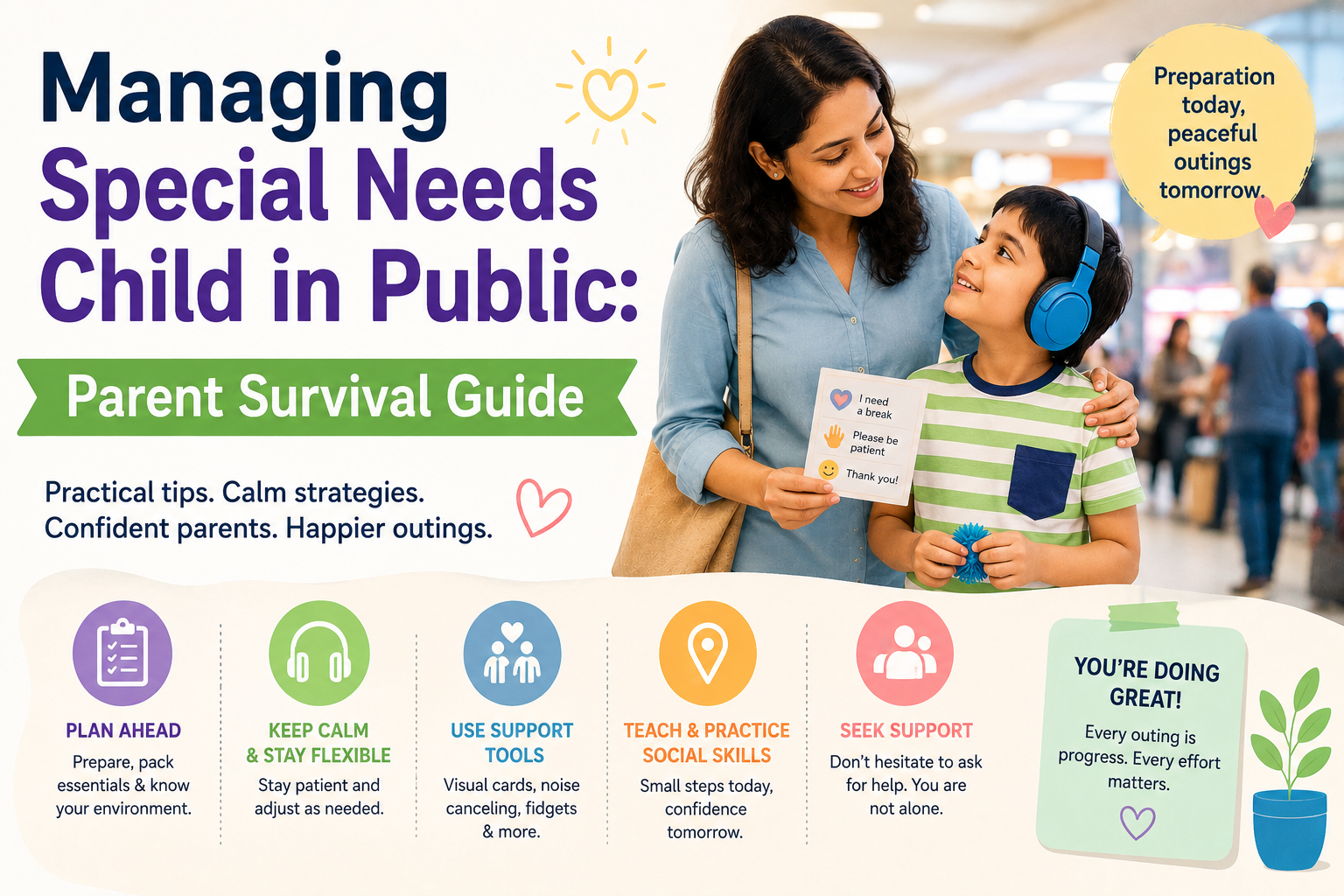
- Pack a sensory kit: noise-cancelling headphones, fidget toy, chewable jewelry, sunglasses
- Show your child photos or a simple visual schedule of where you’re going
- Use short, clear language: “First store, then home.”
- Bring a comfort item — a small toy, blanket corner, or object that feels familiar
2. Choose Low-Stress Times and Places 🕒
- Ask stores about sensory-friendly hours (many major retailers now offer dimmed lights and no announcements)
- Go early morning or late evening when crowds are thinner
- Scope out the quietest exit route in advance, just in case
3. Use a Simple Signal System 🤝
Teach your child (and yourself) a quiet hand signal or phrase for “I need a break now.” This removes the need for words during overwhelm, when speech is often the first thing to shut down.
4. Have an Exit Plan, Not Just a Backup Plan 🚪
Know your closest quiet space — car, restroom, empty aisle — before you need it. Walking toward a known calm spot is far more effective than trying to calm down in the middle of chaos.
5. Ignore the Stares, Not the Child 👀
This is hard, but it matters: the stranger judging you in aisle 7 will forget this moment in five minutes. Your child will remember whether you stayed calm or panicked with them. Some parents carry a small card explaining “My child has autism and is not misbehaving” to hand to onlookers — it works. 🎴
6. Debrief After, Not During 💬
Once things settle, gently talk (or use pictures) about what happened. This builds your child’s self-awareness over time and gives you data for the next outing.
Sensory-Friendly Tools That Actually Help 🧸
| Tool | Best For | Why It Works |
|---|---|---|
| Noise-cancelling headphones | Auditory overload | Blocks overlapping sounds without isolating the child completely |
| Weighted lap pad | Anxiety, restlessness | Deep pressure calms the nervous system |
| Visual schedule cards | Transitions, uncertainty | Reduces fear of “what’s next” |
| Chewable jewelry | Oral sensory seeking | Redirects chewing/biting safely |
| Portable fidget tools | Restlessness, waiting | Keeps hands busy, reduces stimming intensity |
Know Your Rights: Legal Protections in Public Spaces ⚖️
Many parents don’t realize how much legal backing exists.
- The Americans with Disabilities Act (ADA) requires public businesses to make reasonable accommodations for children with disabilities. Learn more at ADA.gov.
- Service dogs supporting autistic children are legally permitted in most public spaces under ADA rules — staff generally cannot ask for medical documentation, only two limited questions.
- Many airports, stadiums, and theme parks now offer official sensory-friendly programs and quiet rooms — always check the venue’s accessibility page before you go.
Knowing your rights turns anxiety into confidence. You’re not asking for a favor. You’re asking for what’s already legally yours. ✅
What Most Guides Get Wrong (And What Actually Helps) ⚠️
Most articles tell you to “stay calm” and “plan ahead.” True, but incomplete. Here’s what’s usually missing:
- They don’t mention sibling impact. Brothers and sisters often absorb stress silently. Give them a small job during outings (holding the snack bag, being the “helper”) so they feel included, not sidelined.
- They skip regulation for YOU, the parent. Your nervous system co-regulates with your child’s. A few slow breaths before you respond can change the entire outcome of a meltdown.
- They ignore recovery time. After a big public outing, your child (and you) may need a full quiet day to reset. This isn’t a setback — it’s part of the process.
Voice Search Quick Answers 🎙️
“How do I calm my autistic child in public?”
Move to a quieter spot immediately, offer a sensory tool like headphones or a fidget item, and use short, calm words. Avoid asking questions — give one simple instruction at a time.
“What causes public meltdowns in special needs children?”
Sensory overload from noise, lights, crowds, and unpredictability, combined with communication difficulty, is the most common cause.
“Are stores required to accommodate special needs children?”
Yes. Under the ADA, public businesses must provide reasonable accommodations, though specific offerings vary by location.
Frequently Asked Questions ❓
1. How do I stop judgmental stares from strangers when my special needs child has a meltdown in public?
You can’t control strangers, but you can carry a short explanation card, ignore hostile looks, and focus fully on your child. Most onlookers forget the moment quickly; your child needs your attention more than a stranger’s approval.
2. What is the best sensory kit for a special needs child in public places?
A strong starter kit includes noise-cancelling headphones, one fidget toy, chewable jewelry, sunglasses, and a familiar comfort item. Customize it based on your child’s specific sensory sensitivities.
3. How can I prepare my special needs child for a first-time public outing like a restaurant?
Use a visual schedule beforehand, choose off-peak hours, request a corner or quiet table, and bring a sensory kit. Practice with short, low-pressure outings before attempting longer ones.
4. Do stores offer sensory-friendly shopping hours for special needs children?
Many major retailers now offer designated low-light, low-noise hours weekly. Call ahead or check the store’s website for “sensory-friendly hours” or “quiet hour” listings.
5. What should I do if my special needs child runs off in a crowded public place?
Prevention matters most: use a child ID bracelet, GPS tracker, or harness if appropriate, and teach a “stop” signal at home. If it happens, alert staff immediately and describe your child’s appearance and needs.
6. Is it normal to feel embarrassed managing a special needs child in public?
Yes, and it’s extremely common. Embarrassment doesn’t mean you love your child less — it means you’re human. Many parents find that connecting with other special needs families reduces this feeling significantly.
Final Thoughts: You’re Doing Better Than You Think 💛
Managing a special needs child in public isn’t about achieving a perfect, meltdown-free outing. It’s about showing up prepared, staying regulated yourself, and giving your child tools to navigate a world that wasn’t built with their sensory needs in mind.
Every small win — a completed grocery trip, a calm exit, a successful signal — is real progress. Celebrate it. 🎉
You are not failing. You are learning your child’s language in a world that rarely speaks it. And that makes you exactly the parent they need. 🌟


