

🧠 MND (Motor Neurone Disease) 2026: The Heartbreaking Truth Families Need to Know and How to Fight Back With Knowledge
Although MND is a life-shortening illness with no known cure yet, global research is moving faster than ever. Furthermore, specialized care and advanced treatments can significantly manage symptoms, helping individuals maintain their quality of life and independence for as long as possible.
Ultimately, raising awareness remains a vital step toward finding effective therapies and supporting families navigating this condition.

- 🔬 What Is MND — and Why Does Every Family Need to Understand It?
- 📅 MND Awareness: Key Facts at a Glance
- 📊 MND Global Statistics 2026: Numbers That Demand Attention
- 🧩 Types of MND: What Every Parent Should Know
- 👶 MND in Children and Special Needs
- Juvenile ALS (JALS) — When MND Strikes Young
- Spinal Muscular Atrophy (SMA) — An MND of Childhood
- 🚨 Early Warning Signs of MND in Children
- 🧬 What Causes MND? Risk Factors and Genetics Explained Simply
- ⏱️ The Diagnosis Problem: Why MND Takes Over a Year to Identify
- 💊 MND Treatment in 2026: What Is Available Right Now
- 💊 FDA-Approved MND Medications
- 🔬 Groundbreaking Research: A 2025 Breakthrough You Need to Know
- 🩺 Multidisciplinary Care: The Gold Standard for MND Management
- 💔 The Hidden Weight: How MND Affects the Whole Family
- A Story That Needs to Be Told
- What Research Says About MND Caregivers
- Impact on Children When a Parent Has MND
- Anticipatory Grief in MND Families
- 🛡️ What Families Can Do: A Practical Support Framework
- 🔍 What You Need to Know About MND
- 🔗 Trusted Resources for MND Families
- ❓ FAQs: MND
- Q: What does MND stand for?
- Q: Is MND the same as ALS?
- Q: Can children get MND?
- Q: What is the life expectancy with MND?
- Q: How long does it take to diagnose MND?
- Q: Is there a cure for MND?
- Q: What are the first signs of MND?
- Q: How does MND affect family members and carers?
- Q: What new MND treatments are being developed in 2025 and 2026?
- 💙 A Final Word — Because This Fight Belongs to All of Us
🔬 What Is MND — and Why Does Every Family Need to Understand It?
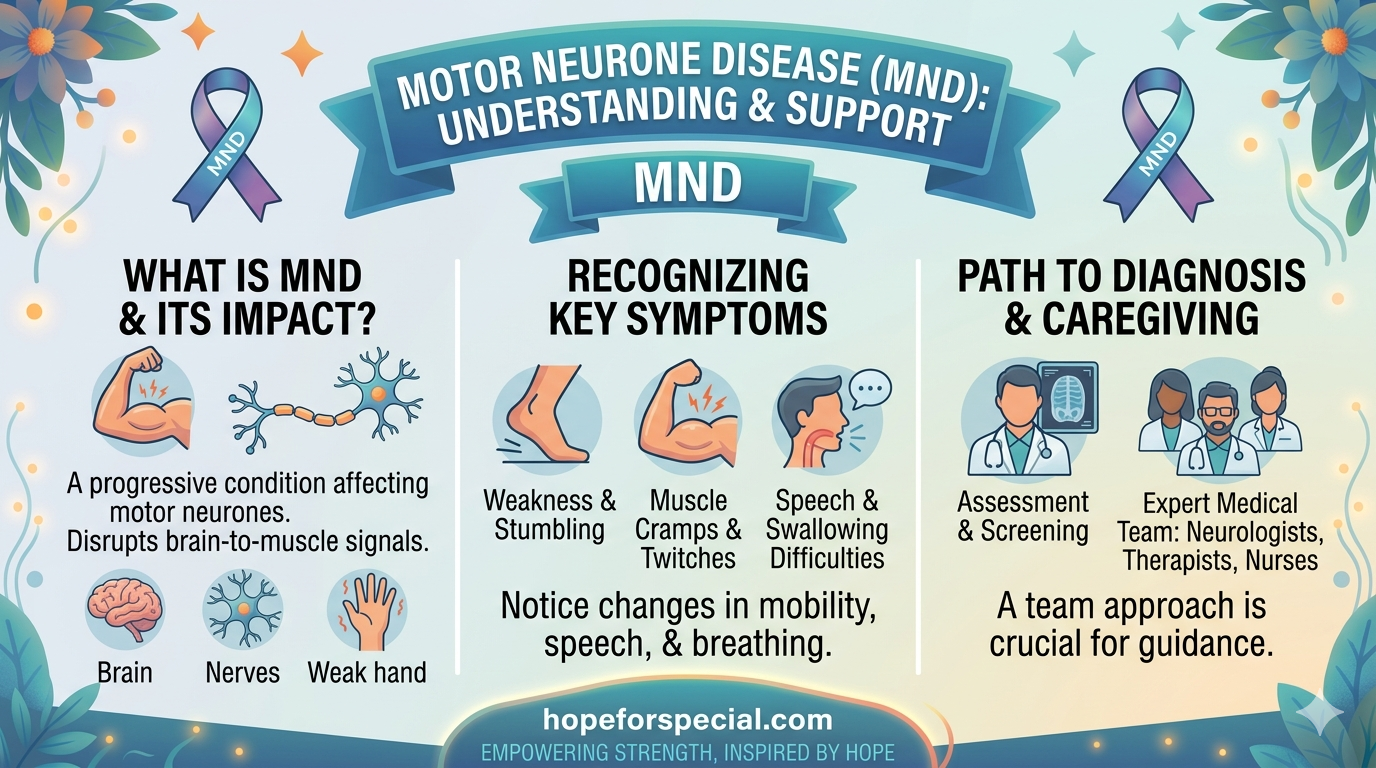
MND, or Motor Neurone Disease, is a progressive and currently incurable group of neurological conditions that gradually destroys the nerve cells controlling movement, speech, swallowing, and breathing. In simple terms: the brain slowly loses its ability to send movement signals to the body.
Motor neuron disease (MND) is a group of neurological disorders that gradually destroy your motor neurons — the nerve cells that control muscle movement involved in activities like breathing, speaking, swallowing, and walking. (Source: Cleveland Clinic)
For families in the special needs community, understanding MND matters deeply. Because some forms of MND begin in childhood. Because parents of children with neurodevelopmental conditions are often the first to notice something is changing. And because every month of earlier diagnosis can mean months more of quality life.
📅 MND Awareness: Key Facts at a Glance
| Detail | Information |
|---|---|
| 📛 Full name | Motor Neurone Disease (MND) |
| 🌍 Also known as | ALS (Amyotrophic Lateral Sclerosis) in the US and Canada |
| 🎗️ MND Awareness Day | June 21 every year |
| 🎨 MND colour | Red |
| 🏛️ Established awareness campaign | MND Association (UK), ALS Association (US) |
| 🌐 Official resource | mndassociation.org |
| 🧬 Cure available? | No — but treatments can slow progression |
| ⏱️ Average time to diagnosis | 12 months from first symptoms |
📊 MND Global Statistics 2026: Numbers That Demand Attention
The global burden of MND is rising. And the numbers behind it tell a story that the world is only beginning to fully understand.
| Statistic | Figure | Source |
|---|---|---|
| Global MND prevalence (2021) | 272,732 cases worldwide | PMC / GBD 2021 |
| Global prevalence increase 1990–2021 | +68.43% | PMC / GBD 2021 |
| Global incidence increase 1990–2021 | +74.54% | PMC / GBD 2021 |
| Annual incidence rate (global) | ~2 per 100,000 people | ScienceDirect, 2024 |
| Prevalence rate (global) | 5–7 per 100,000 people | ScienceDirect, 2024 |
| Median survival from symptom onset | 24–48 months | ScienceDirect, 2024 |
| Average diagnostic delay | 12 months from first symptoms | ScienceDirect, 2024 |
| Annual cost per MND patient (US) | ~$70,000 | PMC / NCBi |
| USA MND mortality increase 1990–2021 | +118% | Frontiers in Neurology, 2025 |
| Global MND mortality increase 1990–2021 | +156% | Frontiers in Neurology, 2025 |
| Male-to-female ratio of MND cases | 1.3:1 to 1.5:1 | ScienceDirect, 2024 |
| Peak age of incidence | 60–75 years | ScienceDirect, 2024 |
From 1990 to 2021, global MND prevalence increased by 68.43%, reaching 272,732 cases, while incidence increased by 74.54%. Projections indicate that incidence, mortality, and DALYs will continue to rise in low- and middle-SDI regions due to aging populations. (Source: PMC / Journal of Neurology, 2025)
These numbers are rising. They are not declining. And that makes awareness — especially in the special needs community — more urgent than ever.
🧩 Types of MND: What Every Parent Should Know
MND is not a single disease. It is an umbrella term. Under it sit several distinct conditions — some of which specifically affect children. Understanding the types is the first step toward recognizing warning signs early.
Motor neurons are nerve cells that connect your brain and spinal cord to your muscles. They are responsible for all the movements you make — voluntary and involuntary. So when you take a walk, talk to a friend, or even breathe, motor neurons are behind these movements. (Source: WebMD)
🔶 MND Types: A Clear Comparison Table
| Type of MND | Motor Neurons Affected | Who Is Most at Risk | Prognosis |
|---|---|---|---|
| ALS (Amyotrophic Lateral Sclerosis) | Both upper and lower | Adults 45–75; slightly more men | Median survival 2–5 years |
| Progressive Bulbar Palsy (PBP) | Brain stem (lower) | Adults; often progresses to ALS | Poor; often progresses |
| Primary Lateral Sclerosis (PLS) | Upper motor neurons only | Adults; Juvenile form affects children | Not fatal; slower progression |
| Progressive Muscular Atrophy (PMA) | Lower motor neurons (spinal) | Adults; rare | Slow but progressive |
| Spinal Muscular Atrophy (SMA) | Lower motor neurons | Children — genetic cause | Depends on SMA type |
| Juvenile ALS (JALS) | Both upper and lower | Children and young adults under 25 | Variable; some slower |
| Pseudobulbar Palsy | Upper motor neurons | Adults; affects chewing/swallowing | Significant disability |
Juvenile primary lateral sclerosis occurs in children. Spinal muscular atrophy (SMA) is an inherited MND that develops in children. There are three types, all caused by a genetic change known as SMA1. It tends to affect the trunk, legs, and arms. (Source: Medical News Today)
👶 MND in Children and Special Needs
Here is the truth: MND is not only a disease of older adults. Certain forms of MND begin in childhood. And for families already navigating special needs, recognising these conditions early can make a profound difference to quality of life.
Juvenile ALS (JALS) — When MND Strikes Young
Typical ALS generally manifests in middle to late adulthood — with an average age of onset around 58–60 years. In contrast, Juvenile ALS is defined as onset of symptoms before age 25. Pediatric ALS refers to even earlier onset, often during childhood (under age 18). (Source: HopeforSpecial — Pediatric ALS Guide)
There are also rare juvenile-onset forms of familial ALS. About 10 to 12 percent of familial cases result from mutations in the gene that encodes the enzyme copper-zinc superoxide dismutase 1 (SOD1). (Source: NIH / NINDS)
Spinal Muscular Atrophy (SMA) — An MND of Childhood
SMA is one of the most important MND conditions for special needs families to understand. It is genetic, it begins in infancy or childhood, and it affects the lower motor neurons. Unlike adult MND, SMA is now the subject of a genuine treatment revolution — with gene therapy changing outcomes dramatically for children diagnosed early.
| SMA Type | Onset | Characteristics |
|---|---|---|
| SMA Type 1 (Werdnig-Hoffmann) | Before 6 months | Most severe; affects breathing and feeding |
| SMA Type 2 | 6–18 months | Can sit but not walk independently |
| SMA Type 3 (Kugelberg-Welander) | After 18 months | Can walk; muscle weakness progresses slowly |
| SMA Type 4 | Adulthood | Mild; late-onset |
🚨 Early Warning Signs of MND in Children
In special needs children, early signs of MND may be subtle and may overlap with or be attributed to existing developmental disorders such as cerebral palsy, neuromuscular disorders, or genetic syndromes. That is why careful monitoring over time and periodic reassessment is crucial. (Source: HopeforSpecial)
Watch carefully for:
- 🔴 Progressive muscle weakness — especially in arms, legs, or around the shoulders
- 🔴 Difficulty swallowing or frequent choking — especially at mealtimes
- 🔴 Slurred, slow, or suddenly changed speech
- 🔴 Muscle twitching (fasciculations) or unusual cramping
- 🔴 Gradual loss of a previously mastered skill (regression)
- 🔴 Trouble breathing, especially during sleep
- 🔴 Stiffness or exaggerated reflexes
- 🔴 Unexplained fatigue and reduced stamina
- 🔴 Foot drop — catching the toe when walking
- 🔴 Emotional changes — unexplained laughing or crying
The key question to ask yourself: Is my child losing abilities they previously had? If yes, seek a neurological evaluation without delay.
🧬 What Causes MND? Risk Factors and Genetics Explained Simply
MND does not have a single known cause. However, research has identified several contributing factors — and for families with a genetic history, this information is essential.

About 90 to 95 percent of MND cases are sporadic, meaning they arise with no known family history. Approximately 5 to 10 percent are familial, meaning they are inherited. (Source: ALS Wikipedia / NINDS)
MND Risk Factors: A Clear Overview
| Risk Factor | Details |
|---|---|
| Age | Risk rises sharply after 50; peak incidence 60–75 years |
| Sex | Men are 1.3–1.5x more likely to develop MND than women |
| Genetics (familial) | SOD1, FUS, C9orf72 mutations linked to familial MND |
| Juvenile ALS genetics | FUS mutations in ~25% of early-onset sporadic ALS cases |
| Military service | Veterans have 1.5–2x higher risk (research ongoing) |
| Heavy metal exposure | Some evidence linking lead and mercury exposure |
| Smoking | Associated with increased MND risk in some studies |
| Head injury / electric shock | Identified as possible risk factors in research |
| Geographic location | New Zealand has the world’s highest rate of MND |
Anyone can get a motor neuron disease, but some people do have a higher risk. MNDs tend to affect slightly more men than women, and more people over 40, with the highest risk age group being between 50 and 70. New Zealand has the highest rate of this type of disease in the world. (Source: WebMD)
⏱️ The Diagnosis Problem: Why MND Takes Over a Year to Identify
One of the most devastating aspects of MND is not just the disease itself — it is the time it takes to get a diagnosis. And that lost time costs lives.
Motor neurone disease is an uncommon but invariably fatal condition with a median survival of 24–48 months from symptom onset. Although there is no cure, early diagnosis is crucial to enable timely access to multidisciplinary care and enrolment in clinical trials.
Unfortunately, diagnostic delays remain common, and the average delay between symptom onset and diagnosis is 12 months. Large numbers of specialist referrals have been suggested as a key contributor to diagnostic delays. (Source: ScienceDirect, 2024)
That 12-month delay is not just a statistic. It is a year of a family’s life — a year of confusion, wrong diagnoses, dismissed symptoms, and fear without answers.
Why Is MND So Hard to Diagnose?
- There is no single blood test or scan that confirms MND
- Early symptoms mimic many other conditions (back pain, carpal tunnel, stroke)
- Symptoms can start in just one limb or area, making the pattern hard to see
- Many GPs have never seen an MND case — it is relatively rare
- For children, symptoms are often attributed to other developmental conditions
If you suspect MND — in yourself or in your child — ask specifically for a referral to a neurologist who specialises in motor neuron diseases. Do not wait.
💊 MND Treatment in 2026: What Is Available Right Now
There is currently no cure for MND. But that does not mean there is nothing to be done. Treatment has advanced significantly — and for families navigating MND, knowing the options gives power back.
Currently, treatments for MND include Riluzole and Edaravone, which slow disease progression, as well as supportive therapies like physical therapy, respiratory support, and nutritional care. (Source: Open Med Science, 2025)
💊 FDA-Approved MND Medications
| Medication | How It Works | What Research Shows |
|---|---|---|
| Riluzole | Reduces glutamate (a toxic chemical in MND) | Extends survival by 6–19 months (Source: MND Australia) |
| Edaravone (RADICAVA®) | Antioxidant — reduces oxidative damage to motor neurons | Slows functional decline in early-stage ALS (Source: MND Australia) |
| Tofersen | Gene therapy targeting SOD1 mutations | First gene-related MND therapy; approved in the US (Source: PubMed) |
Riluzole is approved for the treatment of amyotrophic lateral sclerosis in most countries. Research shows that taking riluzole may prolong life by 6 to 19 months. Edaravone has been shown to slow the progression in a small group of people with ALS, with the potential to help these people preserve function longer. (Source: MND Australia)
🔬 Groundbreaking Research: A 2025 Breakthrough You Need to Know
A team of researchers from the University of Wollongong discovered that a unique trio of medications could hold the key to improved treatment outcomes for hereditary MND caused by SOD1 mutations.
In mice, the drug combination reduced the progression of MND, increased survival rates, diminished levels of the unstable SOD1 protein, and protected motor neurons. The project was funded by a FightMND $1 million Drug Development Grant. (Source: University of Wollongong, March 2026)
This is real, measurable hope. Research is accelerating. And the families of today are funding the cures of tomorrow.
🩺 Multidisciplinary Care: The Gold Standard for MND Management
Evidence-based management involves riluzole, multidisciplinary care, provision of noninvasive ventilation and gastrostomy, and symptomatic treatments. The role of the multidisciplinary team in MND care has become clearer and does seem to benefit care, with studies showing improvement in symptom management and prognosis when an MDT is involved. (Source: PubMed, 2024)
A good MND care team typically includes:
- 🧠 Neurologist (specialist in MND)
- 🫁 Respiratory specialist
- 🗣️ Speech and language therapist
- 🍽️ Dietitian / nutritionist
- 🖐️ Occupational therapist
- 🏃 Physiotherapist
- 💬 Psychologist or counsellor
- 👩⚕️ Palliative care team (from time of diagnosis, not just at end of life)
💔 The Hidden Weight: How MND Affects the Whole Family
A diagnosis of MND never lands on just one person. It lands on the entire family. And for families in the special needs community who are already carrying significant caregiving responsibilities, that weight can feel impossible.
A Story That Needs to Be Told
Meet Sarah. She is 41. Her husband David was diagnosed with ALS 14 months ago at age 44. They have two children — one of whom has autism.
Every school run, every therapy appointment, every meltdown now happens against the backdrop of watching David slowly lose the use of his hands.
“People ask how David is,” Sarah says. “Nobody asks how we are.”
It is the quiet reality of thousands of families living with MND right now.
What Research Says About MND Caregivers
The diagnosis of motor neurone disease has a profound effect on the functioning and well-being of both the patient and their family, with studies describing an increase in carer burden and depression as the disease progresses. Studies have reported that family caregivers suffer from anxiety, depression, strain, burden, fatigue, impaired quality of life, and reduced social contacts. (Source: Cambridge University Press / Palliative & Supportive Care)
Without sufficient support, carer burden can be overwhelming. Caregivers’ needs encompass the provision of information and training, availability of respite care, counselling, and access to trained paid-for carers. (Source: PubMed)
Impact on Children When a Parent Has MND
When a parent is diagnosed with MND, children in the family — including those with special needs — are profoundly affected. They may experience:
- 🔴 Fear and confusion about what is happening to their parent
- 🔴 Disruption to routine (which is especially destabilising for children with autism or ADHD)
- 🔴 Regression in behaviour or development
- 🔴 Increased anxiety, clinginess, or withdrawal
- 🔴 Taking on age-inappropriate caring roles
- 🔴 Grief before death — known as anticipatory grief
MND inevitably affects the wider family that are caring for their relative, whether they are partners, adult children or parents. As one woman said, “The illness really is our illness, not just Peter’s.” (Source: University of Oxford — Hexi)
Anticipatory Grief in MND Families
A cross-sectional study of 75 MND carers from the UK and USA found that 50.7% of carers were experiencing common grieving reactions, 22.6% presented intense grieving emotions, and 26.7% presented low grieving responses. Disease severity and behavioural changes in the person with MND were the strongest predictors of carer anticipatory grief. (Source: PMC / NCBI, 2024)
Grief does not begin at death. In MND families, it begins at diagnosis. And that grief needs to be acknowledged, supported, and addressed — not silently endured.
🛡️ What Families Can Do: A Practical Support Framework
You cannot stop MND. But you can build a structure around your family that makes the journey more bearable — and better supported.
The PACE Framework for MND Families 💙
| Letter | Action | What It Looks Like |
|---|---|---|
| P | Plan early | Legal documents, financial planning, care preferences — as soon as possible |
| A | Assemble your team | Neurologist, MDT, palliative care, social worker — build the team before you desperately need it |
| C | Connect to community | MND associations, peer support groups, online communities for carers |
| E | Engage emotional support | Therapy, counselling, or peer support for yourself AND your children |
For Families With Special Needs Children at Home
If you are raising a child with special needs and also caring for someone with MND, these additional steps matter:
- ✅ Inform your child’s school or IEP team about the family situation — they can provide additional support
- ✅ Maintain your child’s routine as much as possible — consistency is protective
- ✅ Consider specialist therapy for your child (play therapy or art therapy for younger children works particularly well)
- ✅ Join a carer support group specifically for families managing MND — the peer understanding is irreplaceable
- ✅ Accept help when it is offered — and ask for it when it is not
🔍 What You Need to Know About MND
Here are the truths most special needs families did not know about MND:
🔸 Children can develop MND.
Spinal Muscular Atrophy and Juvenile ALS are real. They affect real children. And families managing other neurodevelopmental conditions deserve to know the warning signs.
🔸 The diagnostic delay is catastrophic.
Twelve months of missed diagnosis in a disease where median survival is 24–48 months is not acceptable. Families who advocate loudly and specifically get faster answers.
🔸 Anticipatory grief is real and it starts at diagnosis.
The mental health needs of MND families — including children — need professional support from day one, not as an afterthought.
🔸 Special needs children in MND households are invisible in research.
There is almost no published data on how children with autism, Down syndrome, or other conditions experience a parent’s MND diagnosis. That silence is a problem — and families in these situations deserve tailored support.
🔸 Non-pharmacological interventions for MND caregivers show promising psychosocial results, but further research is needed to develop a core outcome set for support programmes. (Source: PMC / NCBI, 2025) In other words — caregivers are still not getting the structured support they need.
🔸 Cost is a forgotten barrier.
The standardised total annual cost per MND patient in the United States is approximately $70,000. (Source: PMC) For a family already managing special needs costs, this financial weight is enormous and rarely discussed.
🔗 Trusted Resources for MND Families
Bookmark these authoritative, non-competitor sources:
- 🌐 MND Association (UK) — Treatment guidance, support, and research updates
- 🌐 ALS Association (US) — Support for US families; research funding and clinical trials
- 🌐 MND Australia — Australian families’ comprehensive resource
- 🌐 Cleveland Clinic — MND — Evidence-based patient education
- 🌐 FightMND (Australia) — Research funding, awareness, and community
- 🌐 Spinal Muscular Atrophy Foundation — For families of children with SMA
- 🌐 Cure SMA — Clinical trials and treatment resources for SMA families
❓ FAQs: MND
Q: What does MND stand for?
MND stands for Motor Neurone Disease. It is a group of progressive neurological conditions that destroy the motor neurons controlling movement, speech, breathing, and swallowing. In the United States and Canada, the most common form — ALS — is more widely used as the general term.
Q: Is MND the same as ALS?
Yes and no. Motor neuron disease (MND) is a broader term for a group of neurological disorders. ALS (Amyotrophic Lateral Sclerosis) is the most common type of MND, affecting both upper and lower motor neurons. (Source: Cleveland Clinic) In the UK, MND is the preferred term. In the US, ALS is more commonly used.
Q: Can children get MND?
Yes. Spinal muscular atrophy (SMA) is an inherited MND that develops in children. Juvenile primary lateral sclerosis also occurs in children. (Source: Medical News Today) Juvenile ALS can also begin before age 25. Families of special needs children should be aware of these childhood-onset forms.
Q: What is the life expectancy with MND?
MND has a median survival of 24–48 months from symptom onset. (Source: ScienceDirect, 2024) However, this varies greatly by type. Some people — including Stephen Hawking, who lived with ALS for over 50 years — survive much longer than average. Primary Lateral Sclerosis is not fatal and progresses more slowly.
Q: How long does it take to diagnose MND?
The average delay between symptom onset and diagnosis is 12 months. Large numbers of specialist referrals have been suggested as a key contributor to diagnostic delays. (Source: ScienceDirect, 2024) If you suspect MND, ask your GP specifically for a referral to a neurologist who specialises in motor neuron diseases.
Q: Is there a cure for MND?
There is currently no cure for MND. However, riluzole can prolong life by 6 to 19 months, and edaravone has been shown to slow functional decline in some patients. (Source: MND Australia) New research — including the 2025 University of Wollongong SOD1 drug combination study — is generating real hope for more effective treatments.
Q: What are the first signs of MND?
Early signs of MND include unexplained muscle weakness, slurred or slow speech, difficulty swallowing, muscle twitching, cramping, and tripping or stumbling. MND is a group of neurological disorders that gradually destroy motor neurons — the nerve cells that control muscle movement involved in activities like breathing, speaking, swallowing, and walking. (Source: Cleveland Clinic) Do not wait for symptoms to worsen — seek a neurological evaluation early.
Q: How does MND affect family members and carers?
The diagnosis of MND has a profound effect on the functioning and well-being of both the patient and their family, with studies describing an increase in carer burden and depression as the disease progresses. Family caregivers suffer from anxiety, depression, strain, burden, fatigue, impaired quality of life, and reduced social contacts. (Source: Cambridge University Press) Caregivers need professional support, respite care, and community connection — from the moment of diagnosis.
Q: What new MND treatments are being developed in 2025 and 2026?
Researchers from the University of Wollongong discovered in 2025 that a combination of three drugs targeting the SOD1 protein reduced MND progression and increased survival rates in mice. The discovery of neurofilaments as MND biomarkers and the development of novel gene-based therapies also provide growing optimism for more powerful neuroprotective treatments in the coming years. (Source: University of Wollongong, 2026)
💙 A Final Word — Because This Fight Belongs to All of Us
MND does not ask for permission. It does not pick the convenient moment. It arrives — often slowly, often misread — and then it changes everything.
But here is what it cannot change: the human capacity to love fiercely, to advocate loudly, to research relentlessly, and to refuse to let the people they love disappear without a fight.
If you are the parent of a child with special needs and you are now navigating MND too — in yourself, in your partner, in a parent — we see you. The double caregiving burden you carry is real. Your exhaustion is real. And your courage, though you may not feel it, is extraordinary.
This is why awareness matters.
Because awareness creates earlier diagnosis. Earlier diagnosis creates more time. And more time creates more moments — more birthdays, more laughter, more mornings together.
Know the signs. Trust your instincts. Ask the hard questions. And never stop advocating. 💙
📌 If you or someone you know needs support with MND, contact the MND Association (UK) or the ALS Association (US). You do not have to navigate this alone.


