

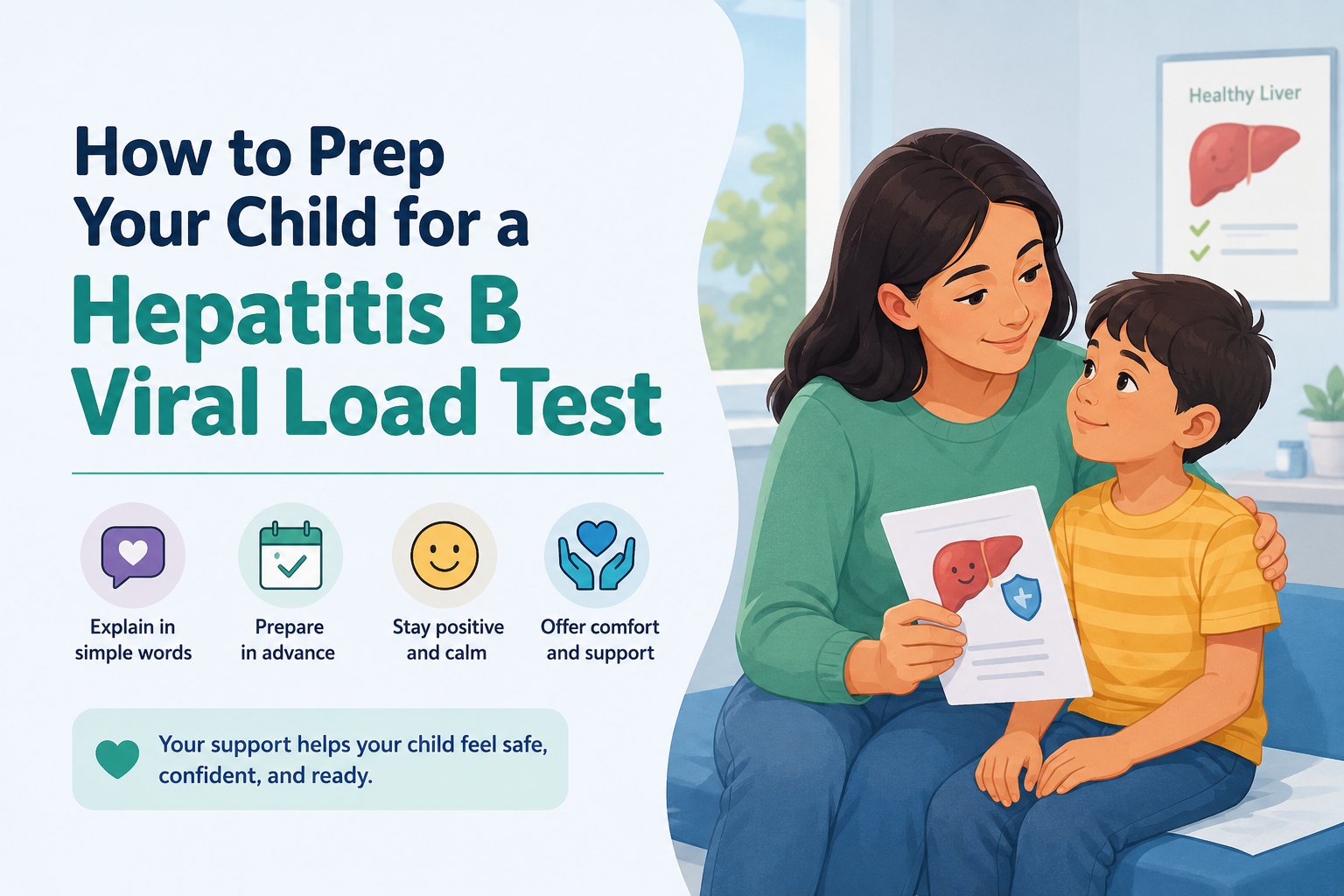
💉 How to Prep Your Child for a Hepatitis B Viral Load Test: 2026 Parent Guide
The Hepatitis B Viral Load Test is one of the most important blood tests a child with chronic hepatitis B will have — often repeatedly throughout their life. To prepare your child, start with honest, age-appropriate explanation at least 2–3 days before the appointment. Then layer in comfort strategies like topical numbing cream, distraction tools, a consistent pre-test routine, and your calm presence throughout. Preparation is not just helpful — it is transformative.
This guide gives you everything: what the test actually is, why it matters, how to explain it to your child at every age, and the step-by-step strategies that genuinely work — especially for children with special needs, sensory sensitivities, or medical anxiety. 💛

- 🔬 What Is a Hepatitis B Viral Load Test?
- ❤️ Why This Test Matters So Much for Children
- 📊 The Numbers: Hepatitis B in Children Globally
- 😰 Why Children Fear Blood Tests — and Why That Is Normal
- ✅ THE 11-STEP PREPARATION FRAMEWORK
- 🗓️ STEP 1: Give Advance Notice — But the Right Amount
- 📖 STEP 2: Explain Honestly — Using Simple, True Words
- 🧸 STEP 3: Use Play-Based Preparation at Home
- 💧 STEP 4: Hydrate Well the Night Before and Morning Of
- 🧴 STEP 5: Request or Apply Topical Numbing Cream
- 🎯 STEP 6: Give Your Child a Job and a Sense of Control
- 🎧 STEP 7: Plan Your Distraction Strategy in Advance
- 🏥 STEP 8: Inform the Lab or Clinic in Advance
- 🧘 STEP 9: Teach a Simple Breathing Technique
- 🎁 STEP 10: Plan a Meaningful Reward
- 📝 STEP 11: Debrief Kindly Afterward
- 👶 Age-by-Age Preparation Guide
- 🧩 Special Considerations: Children With Special Needs
- 🎒 What to Bring to the Appointment
- 🩸 During the Test: What You and Your Child Can Do
- 🌟 After the Test: Recovery, Reward, and Results
- 📋 Understanding the Results: A Plain-Language Guide
- 🔍 What You Should Not Miss About Preparing Kids for HBV Tests
- 1. 🔄 The Cumulative Effect of Repeated Testing
- 2. 🧠 The Parent’s Own Anxiety Is Contagious
- 3. 🏷️ Framing the Test Positively — Without Lying
- 4. 📍 Choosing the Right Phlebotomist or Facility
- 💛 A Parent’s Story: From Panic to Calm
- ❓ FAQs About the Hepatitis B Viral Load Test in Children
- Q: What is a Hepatitis B Viral Load Test in simple terms?
- Q: How often does my child need a Hepatitis B Viral Load Test?
- Q: Does my child need to fast before a Hepatitis B Viral Load Test?
- Q: How do I explain Hepatitis B and the viral load test to my child?
- Q: What if my child has a meltdown at the blood test appointment?
- Q: Can numbing cream make the Hepatitis B blood test painless?
- Q: What does an undetectable Hepatitis B Viral Load result mean for my child?
- Q: How long does it take to get Hepatitis B Viral Load Test results?
- 🔗 Trusted Resources for Families
- 💙 Final Thoughts: Every Test Is a Step Toward a Healthier Future
🔬 What Is a Hepatitis B Viral Load Test?
A Hepatitis B Viral Load Test — also known as an HBV DNA test or HBV quantitative test — is a blood test that measures the amount of Hepatitis B virus (HBV) present in your child’s bloodstream.
Unlike a simple antigen test (which just tells you whether the virus is present), the Hepatitis B Viral Load Test tells you how much virus is there. This distinction is critical. The quantity of virus circulating in your child’s blood directly informs:
- Whether the virus is actively replicating
- How well current treatment is working
- Whether the infection is progressing, stabilising, or improving
The hepatitis B viral load blood test measures the levels of HBV in the bloodstream using a Polymerase Chain Reaction (PCR) test, which gives accurate results. The PCR technique involves using a machine to multiply the DNA from a blood sample to determine the amount of HBV present.
Hepatitis B viral load blood tests are essential for monitoring the progression of hepatitis B and examining whether any ongoing treatment is working. (Source: Medical News Today — Hepatitis B Viral Load)
In simple terms for parents: This test is like taking a “snapshot” of the virus activity inside your child’s liver at a given moment. It is a small blood draw — typically from the arm — but the information it provides can shape your child’s entire treatment journey.
And it is a test most children with chronic HBV will have many times over the years. Getting it right — making it as calm and manageable as possible — matters enormously for your child’s long-term relationship with medical care.
❤️ Why This Test Matters So Much for Children
If your child has been diagnosed with chronic Hepatitis B, you already understand what is at stake. Chronic HBV, left unmonitored, can lead to liver inflammation, cirrhosis, and hepatocellular carcinoma over time. Regular monitoring — including the Hepatitis B Viral Load Test — is how doctors catch problems early and intervene before serious damage occurs.
HBV DNA (quantitative viral load) indicates viral burden and viral replication. It is used to assess recovery from infection and candidacy for antiviral therapy and to differentiate between inactive carrier state and chronic active hepatitis in chronic HBV infection. (Source: Medscape — Hepatitis B Testing)
For children specifically, the picture is nuanced. Childhood-acquired HBV infection is characterised by lower HBV DNA levels, greater serum transaminase elevation, and higher necroinflammatory liver disease than in perinatally acquired HBV infection. Most acute HBV infections in children are asymptomatic. (Source: NIH — Pediatric HBV Guidelines)
This is the challenge that makes the Hepatitis B Viral Load Test so essential: your child may look and feel perfectly well even when their viral load is elevated and liver activity is significant. The blood test is the only way to know what is happening beneath the surface.
Furthermore, children and adults in the “immune tolerant” stage can have viral loads in the millions or even billions, which is why regular monitoring is so important. (Source: Hepatitis B Foundation — HBV DNA Test Guide)
The stakes are high. The test is necessary. And your preparation as a parent can make the difference between a traumatic experience and a manageable one.
📊 The Numbers: Hepatitis B in Children Globally
Understanding the scope of hepatitis B in children helps families appreciate both the importance of testing and the scale of support available.
| Statistic | Figure | Source |
|---|---|---|
| Global prevalence of chronic HBV in children under 5 (2024) | 0.6% (95% UI: 0.5–0.8%) | WHO — Hepatitis B Fact Sheet |
| WHO African Region HBV prevalence in under-5s | 1.4% — highest globally | WHO — Hepatitis B Fact Sheet |
| People globally aware of their HBV infection status (2024) | Only 27% (65 million of ~240 million) | WHO — Hepatitis B Fact Sheet |
| Infants infected in first year of life who develop chronic infection | 80–90% | NIH PMC — HBV Prevalence in Children |
| Children infected before age 6 developing chronic infection | 30–50% | NIH PMC — HBV Prevalence in Children |
| Countries achieving WHO target of <0.1% HBsAg in under-5s | 147 countries | Infectious Diseases & Immunity — Pediatric HBV Review |
| PCR test agreement rate for HBV viral load assays | 90.0% between leading assay platforms | NIH PMC — Xpert HBV Evaluation |
| Recommended antiviral treatment cutoff (HBeAg-positive) | HBV DNA ≥ 20,000 IU/mL | Medscape — HBV Testing Reference |
💡 What this means for your family: Hepatitis B in children is a genuinely global health priority. Testing — including the Hepatitis B Viral Load Test — is the cornerstone of monitoring and managing the condition. Your child’s test is part of a carefully designed medical plan to protect their long-term health.
😰 Why Children Fear Blood Tests — and Why That Is Normal
Before diving into preparation strategies, it is worth understanding why children find blood tests so difficult. This understanding helps parents respond with empathy rather than frustration — and makes preparation far more effective.
Blood draws can be hard for children of all ages and developmental levels. Children can find it hard because of things like fear of needles and/or pain, having to wait before the blood draw, the tightness of the tourniquet, and the feeling of alcohol swabs and band-aids. (Source: Boston Children’s Hospital — Preparing Your Child for a Blood Draw)
The specific fears children typically experience include:
- Fear of the unknown — not knowing what will happen is often scarier than the procedure itself
- Fear of pain — even a small blood draw involves a needle, and children have no reference for how much (or little) it will hurt
- Fear of losing control — being held still, having something done to them
- Fear of blood — the sight of blood can be distressing for children (and some adults)
- Accumulated fear — children who have had previous difficult experiences carry those memories into every new appointment
For children with special needs, sensory processing differences, autism, ADHD, or anxiety disorders, these fears can be significantly amplified. A child who is hypersensitive to touch may find the tourniquet, alcohol swab, and bandage as distressing as the needle itself. A child who struggles with transition and unpredictability may find the unfamiliar clinical environment overwhelming before any procedure even begins.
The good news: Preparation genuinely works. Research and clinical experience consistently show that children who are prepared — honestly, age-appropriately, and with practical coping tools — have significantly better experiences during blood draws. And each better experience builds confidence for the next time.
✅ THE 11-STEP PREPARATION FRAMEWORK
This is the step-by-step system that covers everything — from the week before to the moment the bandage goes on.

🗓️ STEP 1: Give Advance Notice — But the Right Amount
Timing matters enormously. Tell your child too early and they will spend days or weeks worrying. Tell them too late and they will feel blindsided and betrayed.
Advance warning of a medical intervention such as a blood draw can be given a week ahead of time. For younger children (5 and under), 1–2 days before is sufficient. This allows children to have time to process, discuss, and share fears but does not give a long period of time to worry about it. (Source: Brookline Pediatrics — Needle Phobia Tips)
Practical guidance:
- Under 5 years: Tell them 1–2 days before
- Ages 5–9: Tell them 3–5 days before, giving time for questions and play-based preparation
- Ages 10+: Tell them 1–2 weeks before, respecting their need for information and time to mentally prepare
📖 STEP 2: Explain Honestly — Using Simple, True Words
Never tell your child “it will not hurt at all.” If it hurts even a little, you have broken their trust — and that damages every future medical interaction.
Instead, be honest and specific.
Try: “The nurse will clean your arm with a cold wipe. Then there will be a quick pinch from a tiny needle. It might sting for a moment. And then it is finished. The whole thing takes about as long as it takes to count to ten.”
Honesty is very important, but too much information can make a child nervous. Try to explain the procedure in simple steps and allow time for your child to ask questions. Use language they will understand without describing the intervention in detail. (Source: Sydney Children’s Hospital Network)
Tell them the purpose in age-appropriate terms:
- For young children: “The doctor needs a tiny bit of your blood to check on the tummy germ we keep an eye on. This is how we keep you healthy.”
- For older children: “The test checks how much of the Hepatitis B virus is in your blood right now. It helps the doctor decide if you need any medicine, or if everything is going well.”
🧸 STEP 3: Use Play-Based Preparation at Home
Play-based preparation is one of the most powerful tools for young children — and it is backed by child psychology research. Let your child play “doctor” on a stuffed animal or doll, mimicking the steps of a blood draw: wiping the arm, applying a bandage.
Younger children can practise “playing doctor” on stuffed animals. Using a doctor kit with play can help them understand instruments used in an appointment. Children can also have the opportunity to see items used during a visit such as gloves, prep pads, and band-aids. (Source: Brookline Pediatrics)
This demystifies the process. When children have “practised” something in safe play, the real experience feels less alien.
💧 STEP 4: Hydrate Well the Night Before and Morning Of
This is one of the most practical — and most overlooked — preparation steps.
Encourage your child to drink plenty of water before the blood draw. Staying well-hydrated can make their veins more accessible and reduce the chances of difficulties during the procedure. (Source: The Bloodline — Phlebotomy Tips for Scared Kids)
When veins are easy to access, the draw is faster and often requires fewer attempts. Fewer attempts mean less pain and less distress. Make hydration a family priority from the evening before the appointment.
Hydration tip: For children who resist plain water, diluted fruit juice or a flavoured water they enjoy can help. Avoid sugary drinks. A well-hydrated child makes the phlebotomist’s job easier — and the appointment shorter.
🧴 STEP 5: Request or Apply Topical Numbing Cream
This single step can transform a blood draw experience — and yet many parents do not know it is an option.
A numbing cream or rubbing ice on the area may help. You can request a prescription for numbing cream from your healthcare provider. (Source: Boston Children’s Hospital — Helping Your Child with Needle Phobia)
Ask your child’s doctor about EMLA cream (lidocaine/prilocaine) or similar topical anaesthetics well in advance. These are typically applied 30–60 minutes before the blood draw on the area where the needle will go, significantly reducing or eliminating the pain of the needle.
How to manage this:
- Ask for a prescription at the appointment before the test
- Apply the cream at home before leaving for the clinic, following timing instructions precisely
- Cover with a small dressing to keep it in place during transit
🎯 STEP 6: Give Your Child a Job and a Sense of Control
Children cope much better with medical procedures when they have some element of control — even something very small.
You can create your own Poke Plan to bring to the visit. This allows your child to be part of the process. Your child can handle the gloves and band-aids, giving them a job and opportunity to feel in control. (Source: Brookline Pediatrics)
Small choices that restore a sense of control:
- Let them choose which arm (ask the phlebotomist which is preferable)
- Let them choose their own bandage (character bandages or their favourite colour)
- Let them choose whether to watch or look away
- Let them choose a comfort item to hold — a small toy, a sensory fidget, a family photograph
- Let them press the timer themselves and count down to “done”
🎧 STEP 7: Plan Your Distraction Strategy in Advance
Distraction is one of the most evidence-supported methods for reducing pain and anxiety during paediatric blood draws. But it works best when it is planned and specific to your child.
Age-appropriate distraction strategies:
| Age Group | Effective Distraction Options |
|---|---|
| Infants and toddlers | Breastfeeding or bottle during draw; comforter toy; familiar smell (parent’s clothing) |
| Ages 2–4 | Blowing bubbles; singing a favourite song; parent narrating a familiar story |
| Ages 4–7 | Tablet with favourite video; counting backward; guided imagery (“imagine we are at the beach”) |
| Ages 7–11 | Music through headphones; audiobook; simple hand game with parent; mindful breathing |
| Ages 12+ | Podcast or audiobook; controlled breathing technique; phone game; conversation |
Ask your child if they want to watch the blood draw. If your child doesn’t want to watch, you can try to distract your child with a book or by telling a story. (Source: UMass Memorial Health — When Your Child Needs a Blood Test)
🏥 STEP 8: Inform the Lab or Clinic in Advance
This step takes five minutes and can completely change how your child is treated.
Let the child’s doctor and office staff know ahead of time your child has a fear of needles and/or has a difficult time getting shots or blood draws. Try to schedule appointments with medical staff so they can prepare and support your child. (Source: Brookline Pediatrics)
When you call to confirm the appointment, say: “My child has significant anxiety about blood draws. Can you note this in their file? We would like to be seen quickly once we arrive rather than waiting in a busy area. We will be bringing distraction materials.”
For children with special needs or autism, add: “My child has sensory processing challenges. Please let the phlebotomist know so they can be prepared.”
🧘 STEP 9: Teach a Simple Breathing Technique
Controlled breathing is a powerful, portable, and free anxiety management tool. It works for children as young as four or five — and it gives them something active to do during the procedure.
The “belly breathing” technique for children:
- Place one hand on your tummy
- Breathe in slowly through your nose for 4 counts — your tummy should rise
- Hold for 2 counts
- Breathe out slowly through your mouth for 4 counts — your tummy falls
- Repeat three times
Practise this at home, not just on the day. When children have practised a breathing technique in calm moments, they can access it far more easily in anxious moments.
For older children, the 5-4-3-2-1 grounding technique — naming 5 things they can see, 4 they can touch, 3 they can hear, 2 they can smell, 1 they can taste — is a powerful anxiety-interruption tool.
🎁 STEP 10: Plan a Meaningful Reward
A reward does not need to be expensive or elaborate. What matters is that it is something your child genuinely looks forward to — and that it is clearly communicated in advance.
“After your blood test, we are going to [insert activity they love]: the park, a favourite meal, a movie, choosing a new book, an extra screen time hour.”
The reward serves multiple purposes:
- It gives the child something positive to focus on during the procedure
- It reinforces their bravery rather than just their compliance
- It creates a positive association with the medical experience over time
Critically: Describe the reward as something they deserve for being brave, not something they will only get if they cooperate perfectly. A child who cries and still gets through the appointment has been brave. They deserve the reward regardless.
📝 STEP 11: Debrief Kindly Afterward
After the appointment — on the same day or the next morning — have a brief, warm conversation about how it went.
Ask: “What was the hardest part?” Listen. Validate. Then: “What helped you most?” Make notes. What worked this time, keep. What did not, adjust. This is how you build a better experience each subsequent time — because for many children with chronic HBV, this test will recur regularly for years.
If your child finds the blood test particularly upsetting, validate their feelings and engage with them to help them process the experience. (Source: Children’s Liver Disease Foundation — Coping with Needle Phobia)
👶 Age-by-Age Preparation Guide
| Age | Key Fear | Best Preparation Approach | Distraction Method | Special Tips |
|---|---|---|---|---|
| 0–12 months | Pain, unfamiliar environment | Stay close, maintain calm voice | Breastfeed or bottle during draw; familiar toy | Skin-to-skin contact if possible |
| 1–3 years | Separation, restraint | Role play with toy doctor kit 1–2 days before | Bubbles, favourite song, favourite toy | Short notice (day before); don’t use word “hurt” |
| 3–6 years | The needle, the unknown | Simple honest explanation + play preparation | Tablet video, counting, storytelling | Let them choose bandage; celebrate bravery loudly |
| 6–10 years | Pain, embarrassment, loss of control | Detailed honest preparation; create “poke plan” | Headphones, music, books, conversation | Give meaningful choice; acknowledge that being scared is okay |
| 10–14 years | Social anxiety, loss of dignity | Treat them as partners in the process | Podcast, phone, breathing technique | Offer option for parent to step back if they prefer |
| 14+ years | Control, privacy | Discuss openly; offer to attend or not based on their preference | Music, breathing, mindfulness | Respect autonomy completely; treat as a young adult |
🧩 Special Considerations: Children With Special Needs
For children with autism spectrum disorder, ADHD, intellectual disabilities, sensory processing disorder, or significant medical anxiety, standard preparation strategies may need significant adaptation. Here is what makes the most difference.
🌈 For Children With Autism
- Use visual schedules — Create a visual strip showing each step of the appointment (arrive, wait, go to room, arm cleaned, pinch, bandage, done, reward)
- Request the same phlebotomist where possible — familiarity significantly reduces anxiety for autistic children
- Arrange a pre-visit to the clinic on a non-test day to familiarise your child with the environment
- Sensory preparation — Warn your child about the cold alcohol wipe, the smell, the tourniquet pressure, and the bandage well in advance
- Use AAC or communication tools — if your child uses picture exchange or a communication device, ensure they have a way to signal “stop” or “I need a break”
🧠 For Children With ADHD
- Schedule the appointment at the time of day when your child’s attention and regulation are typically best
- Keep the waiting time minimal — call ahead and arrange to wait in the car or outside rather than in a busy waiting room
- Bring a high-interest distraction (specific game, specific video) reserved only for medical appointments
- Use short, clear instructions: “Put your arm here. Look at the screen. Breathe out.”
💙 For Children With Intellectual Disabilities
- Use simple, concrete language: “A small pinch. Then done.”
- Repeated role play is especially effective — normalise through consistent practice over many weeks
- Use preferred objects and sensory items throughout
- Consider requesting a specialist paediatric nurse or child life specialist if available at your facility
🎒 What to Bring to the Appointment
Preparation is not just emotional — it is practical. Here is your complete packing list for a Hepatitis B Viral Load Test appointment.
Medical essentials:
- ☐ EMLA or numbing cream (applied correctly timed before leaving home)
- ☐ Previous test results or referral letter from the doctor
- ☐ Insurance card or health document
- ☐ Any medication list (in case asked)
Comfort essentials:
- ☐ Your child’s comfort item — specific toy, blanket, or familiar object
- ☐ Sensory fidget or stress ball
- ☐ Noise-cancelling headphones or earbuds with a loaded playlist/video
- ☐ Snack and drink for immediately after the test
- ☐ Character bandage or special bandage your child has chosen
- ☐ Visual schedule (for children who benefit from these)
- ☐ Fully charged tablet or device with distraction content
For parents:
- ☐ Your own calm energy — children read parental anxiety precisely. If you are tense, your child will be tense. Practise your own breathing technique too.
🩸 During the Test: What You and Your Child Can Do
The appointment has arrived. Here is how to manage each moment.
In the waiting area:
- Avoid discussing the test repeatedly — this amplifies anxiety. Distract with conversation, a game, or your device
- If the wait is long, ask to be called when it is almost time rather than sitting for extended periods in a clinical environment
- Maintain physical closeness — a hand to hold, a shoulder to lean on
Entering the room:
- Let your child carry their comfort item in
- Speak calmly to the phlebotomist about your child’s needs: “She’s nervous. We’ve been practising deep breathing. Can we do that together while you set up?”
- Position yourself so your child can see your face
During the draw: Stay with your child for the blood test. But if an older child asks you not to, respect their wishes. (Source: UMass Memorial Health)
- Activate your chosen distraction immediately
- Count aloud together if that helps
- Keep your voice calm and low
- If your child cries, do not tell them to stop. Say: “I know. You’re doing it. Nearly there.”
- Never hold your child down forcibly if it can be avoided — this creates lasting trauma
🌟 After the Test: Recovery, Reward, and Results
Immediately after:
- Acknowledge what just happened: “You did it. That was hard, and you did it.”
- Apply the chosen bandage
- Give the promised reward or begin the promised activity as soon as realistically possible
- Offer the snack and drink
In the days that follow:
- Notice and name your child’s bravery in conversation — not just to them but to others in their presence: “She had her blood test this week. She was so brave.”
- Children internalise how the adults around them narrate their experiences
Waiting for results: The Hepatitis B Viral Load Test results typically take several days to a week, depending on the laboratory. Some specialised labs provide results in 24–48 hours.
The sensitivity of HBV DNA tests may vary with each lab, so it is a good idea to use the same lab for your test consistently. Labs usually measure down to less than 200 IU/mL. Below the threshold, the viral load is considered “undetectable.” (Source: Hepatitis B Foundation)
Your doctor will contact you to discuss results and what they mean for your child’s specific situation.
📋 Understanding the Results: A Plain-Language Guide
When your Hepatitis B Viral Load Test results arrive, they may look confusing. Here is a simple guide.
| Result | What It Means | What Typically Happens Next |
|---|---|---|
| Undetectable (< 200 IU/mL) | Very little or no active virus replication | Monitoring continues; a positive sign of stability or treatment response |
| Low (200–2,000 IU/mL) | Some viral activity | Close monitoring; may indicate inactive carrier state or early reactivation |
| Moderate (2,000–20,000 IU/mL) | Moderate viral replication | Further evaluation of liver enzymes and HBeAg status required |
| High (> 20,000 IU/mL) | Significant viral replication | Discussion of antiviral treatment likely, alongside liver function review |
| Very High (millions of IU/mL) | Immune tolerant phase or active disease | Treatment decision based on full clinical picture including ALT levels and liver biopsy if indicated |
Important: Numbers alone do not determine treatment. Indications for treatment are based not only on HBV DNA but also on serum Alanine Aminotransferase (ALT) levels and the severity of liver disease. (Source: Medscape) Always interpret results with your child’s specialist.
The Hepatitis B Foundation provides an excellent plain-language guide to HBV DNA test interpretation for patients and families, available at hepb.org.
🔍 What You Should Not Miss About Preparing Kids for HBV Tests
Here is what matters enormously for Hepatitis B families specifically.
1. 🔄 The Cumulative Effect of Repeated Testing
For children with chronic Hepatitis B, the Hepatitis B Viral Load Test is not a one-time event. It is a recurring feature of their life — often every 3–6 months for years or decades. This changes everything about how preparation should be approached.
Each test experience builds on the last. A traumatic test experience creates a more fearful child next time. A well-managed experience creates a slightly more confident one. Over years, these experiences compound dramatically. Every single appointment is worth preparing for — even the ones that seem routine.
2. 🧠 The Parent’s Own Anxiety Is Contagious
Research in paediatric psychology is clear on this point: children are exquisitely sensitive to parental anxiety. When a parent is tense, rushed, or visibly worried before a blood test, the child’s anxiety escalates proportionally.
Preparing your child starts with preparing yourself. Before the appointment, practise your own breathing. Remind yourself that this test is protecting your child, not harming them. If you have your own medical anxiety, it is worth acknowledging it — and potentially seeking support.
You know your child best, and you will have the best idea of how much they are able to tolerate. Build open channels of communication with the doctors and nurses you are dealing with — engage them in a dialogue to develop a plan for the procedure. (Source: Children’s Liver Disease Foundation)
3. 🏷️ Framing the Test Positively — Without Lying
Many parents inadvertently frame blood tests as something to be endured or survived. A reframe that many families find transformative is to position the Hepatitis B Viral Load Test as an act of care — something the medical team and your family are doing for your child, not to them.
“This test is how we look after your liver. We check on it, and the doctor uses the information to keep you strong.”
This framing is honest, age-appropriate, and shifts the narrative from threat to care.
4. 📍 Choosing the Right Phlebotomist or Facility
Not all blood draw environments are equal for children. A specialist paediatric phlebotomy unit — often found in children’s hospitals — has staff trained specifically in child-centred technique, child life support, and paediatric anxiety management. If your child’s Hepatitis B Viral Load Test can be scheduled at a paediatric facility rather than a general adult laboratory, this alone can significantly improve the experience.
💛 A Parent’s Story: From Panic to Calm
Nadia had known since her son Luca was three that he had chronic Hepatitis B — inherited perinatally. He was now six. And every six months, a Hepatitis B Viral Load Test was required.
The first two had been nightmares. Luca had screamed from the waiting room. The second time, it had taken three adults to hold him still enough for the blood draw. Nadia had cried in the car on the way home.
“I dreaded those appointments more than he did,” she says. “I think he could feel that.”
Before the third test, Nadia found a community of other hepatitis B parents online. She learnt about numbing cream. She learnt about distraction. She learnt that telling Luca the day before — not the day of — gave him time to ask questions and feel less blindsided.
She bought a toy doctor kit. For three evenings, Luca practised drawing blood from his stuffed rabbit. They talked about what would happen, step by step. She let him choose a dinosaur bandage. She promised him a trip to the science museum afterward.
She called ahead and explained Luca’s anxiety. They were seen within five minutes of arrival.
At the appointment, Luca held his rabbit and watched a video on the tablet. His mother held his free hand. He cried a little when the needle went in — but just a little.
“You did it,” she told him.
And then he looked up, wiped his face, and said: “Can we go see the dinosaurs now?”
That was eighteen months ago. The last three tests have been managed. Not perfect — but managed. Each one slightly better than the last.
“Preparation changed everything,” Nadia says. “Not just for him. For me.”
❓ FAQs About the Hepatitis B Viral Load Test in Children
Q: What is a Hepatitis B Viral Load Test in simple terms?
The Hepatitis B Viral Load Test is a blood test that measures how much Hepatitis B virus is active in your child’s blood at the time of the test. It uses a highly accurate PCR (Polymerase Chain Reaction) method. The result helps your doctor understand how active the infection is and whether treatment is needed or working.
Q: How often does my child need a Hepatitis B Viral Load Test?
The frequency depends on your child’s specific situation — their current phase of infection, whether they are on treatment, and their liver health. Generally, monitoring every 3–6 months is common for children with chronic HBV. Your child’s specialist hepatologist or paediatrician will set the schedule.
Q: Does my child need to fast before a Hepatitis B Viral Load Test?
The Hepatitis B Viral Load Test itself does not typically require fasting. However, if additional liver function tests are being taken at the same blood draw appointment, some of those tests may require fasting. Ask your doctor or the lab in advance to confirm the specific requirements for your child’s appointment.
Q: How do I explain Hepatitis B and the viral load test to my child?
Use age-appropriate, honest language. For young children: “The doctor checks on the tummy germ in your blood. The test helps us keep you healthy.” For older children: “Hepatitis B is a virus that lives in your liver. The blood test tells the doctor how active the virus is right now so they can decide the best way to look after you.” Avoid alarming language. Focus on the care and monitoring purpose.
Q: What if my child has a meltdown at the blood test appointment?
This is more common than you think — and it does not mean you or your child has failed. If a meltdown occurs, stay calm, stay close, and work with the clinical team. Some children may benefit from sedation or anaesthetic cream at subsequent visits. Ask your child’s doctor about referral to a child life specialist or clinical psychologist who can provide targeted support for medical anxiety.
Q: Can numbing cream make the Hepatitis B blood test painless?
Topical numbing cream (such as EMLA cream) can significantly reduce or eliminate the pain of the needle at the application site. It does not numb the whole arm — just the surface area where it is applied. It must be applied 30–60 minutes before the blood draw and kept covered. Ask your doctor for a prescription in advance of the appointment.
Q: What does an undetectable Hepatitis B Viral Load result mean for my child?
An undetectable result — typically below 200 IU/mL — means that the virus is not actively replicating at a measurable level. This is a positive sign. It may indicate that the infection is in an inactive phase or that treatment is working well. Your doctor will interpret this result in the context of your child’s full clinical picture.
Q: How long does it take to get Hepatitis B Viral Load Test results?
Results typically take between 2 and 7 business days, depending on the laboratory and the type of PCR assay used. Some specialist laboratories offer faster turnaround. Your doctor or clinic will usually contact you to discuss results and next steps.
🔗 Trusted Resources for Families
| Resource | What It Offers | Link |
|---|---|---|
| 💙 Hepatitis B Foundation — HBV DNA Test Guide | Plain-language guide to understanding HBV viral load results | hepb.org |
| 🌍 WHO — Hepatitis B Fact Sheet | Global statistics and prevention guidance | who.int |
| 🏥 Hepatitis B Foundation — Blood Tests Explained | Overview of all hepatitis B blood tests | hepb.org/prevention-and-diagnosis |
| 👶 Boston Children’s Hospital — Preparing for a Blood Draw | Evidence-based parent preparation guide | childrenshospital.org |
| 🏃 Children’s Colorado — Overcoming Fear of Needles | Tips for managing needle phobia in children | childrenscolorado.org |
| 🫀 Children’s Liver Disease Foundation — Needle Phobia | Specialist guidance for children with liver conditions | childliverdisease.org |
| 🧬 CDC — Hepatitis B Surveillance Guidance | Clinical and surveillance information for HBV | cdc.gov |
| 📚 NIH — HBV in Children with HIV | Clinical guidelines for paediatric HBV management | clinicalinfo.hiv.gov |
💙 Final Thoughts: Every Test Is a Step Toward a Healthier Future
The Hepatitis B Viral Load Test is not the enemy. It is one of the most important tools available to protect your child’s liver health for the long term. The information it provides guides every key decision about monitoring, treatment, and care.
Your child may cry. You may feel helpless. The waiting room may be difficult. The appointment may not go perfectly.
But every time you show up — prepared, calm, and present — you are giving your child something that no medication can: the message that they are safe, that they are cared for, and that they can get through hard things. 💛
Over time, those messages become the foundation of a child who knows how to manage medical care with courage, because they have learnt — appointment by appointment — that they can.
Prepare. Show up. Celebrate the brave.
📝 This article is for informational and educational purposes only. It does not constitute medical advice. Always consult your child’s hepatologist, paediatrician, or specialist regarding their specific Hepatitis B management plan and testing schedule.


