

👉 Bladder Cancer Awareness Month 2026: Bladder Cancer Ribbon, Signs & Hope
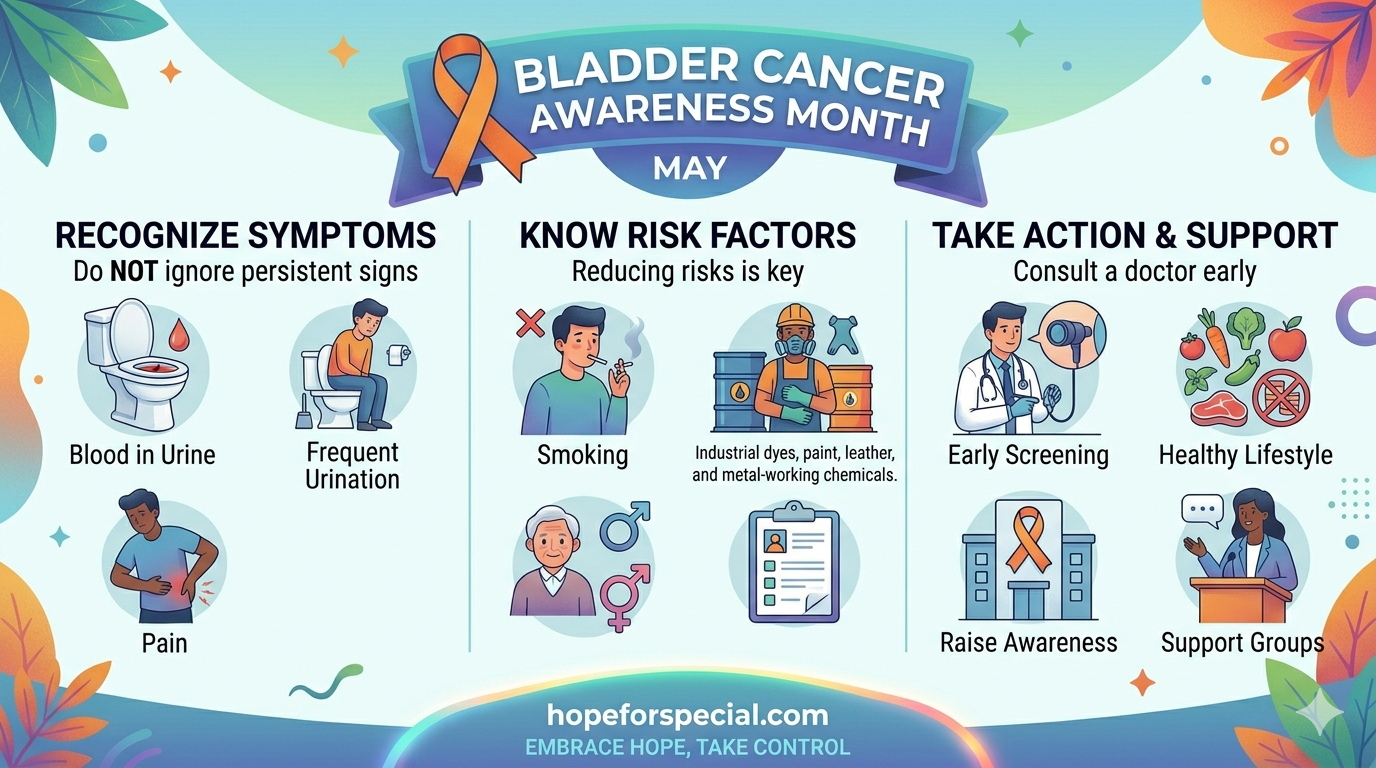
Bladder cancer awareness month is observed every May — and if you just heard those words for the first time, you are already one step ahead of most people. Bladder cancer is the 9th most commonly diagnosed cancer in the world. The bladder cancer ribbon is blue, yellow, and purple — a tricolor symbol representing the bladder, the fight for early detection, and the hope every survivor carries. 💛💙💜
This article is written for families, caregivers, and parents — including those raising children with special needs — who deserve to know everything about bladder cancer in language that is clear, honest, and kind.
Let’s go through it together.

- 📅 What Is Bladder Cancer Awareness Month?
- 💛💙💜 The Bladder Cancer Ribbon: Colors, Meaning & Symbolism
- 📊 Bladder Cancer Statistics: The Numbers That Cannot Be Ignored
- 🧠 What Is Bladder Cancer? A Simple, Clear Explanation
- ⚠️ Signs and Symptoms of Bladder Cancer: What to Watch For 🔍
- 🩺 Risk Factors for Bladder Cancer: Are You or Your Family at Risk?
- 🔬 2026 Bladder Cancer Research: Reasons for Real Hope 💙
- 🌍 2026 Global Awareness Campaign: “Feeling Unsure? Get Checked”
- 💜 Bladder Cancer and the Special Needs Community: What Parents Must Know
- 🎀 How to Participate in Bladder Cancer Awareness Month 2026
- 🩺 Diagnosis: What Happens When You Go to the Doctor?
- ❓ Frequently Asked Questions: Bladder Cancer Awareness Month
- Q: When is Bladder Cancer Awareness Month?
- Q: What color ribbon is for bladder cancer?
- Q: What is the 2026 bladder cancer awareness theme?
- Q: What are the early signs of bladder cancer?
- Q: Is bladder cancer common in children?
- Q: How can I support someone with bladder cancer?
- Q: Can bladder cancer be prevented?
- Q: What is the hashtag for Bladder Cancer Awareness Month 2026?
- 📚 Trusted Resources for Bladder Cancer Awareness
- 🌟 Conclusion: This May, Choose Awareness
📅 What Is Bladder Cancer Awareness Month?
Every May, the world turns its attention to bladder cancer — the lives it impacts, the research inspiring hope, and the communities fighting for better care. Bladder Cancer Awareness Month was launched in 2005 by the Bladder Cancer Advocacy Network (BCAN).
May 2026 is Bladder Cancer Awareness Month, a time to unite and raise awareness for a disease impacting 725,000 people in the US alone.
That number is not a statistic. It is 725,000 families. 725,000 caregivers. 725,000 people who woke up one day and had their world changed.
For special needs families especially, this month matters. Why? Because many children and adults with certain disabilities — including those with spina bifida, neurogenic bladder conditions, or recurrent urinary tract infections — have a higher level of interaction with bladder health throughout their lives. Understanding bladder cancer awareness is not just a health literacy exercise. For some families, it is personal.
💛💙💜 The Bladder Cancer Ribbon: Colors, Meaning & Symbolism
So, what color is the bladder cancer ribbon?
The bladder cancer ribbon is blue, yellow, and purple. The combination of these three colors signifies the bladder and the need for increased awareness and research into bladder cancer.
Each color carries its own meaning:
| Color | What It Represents |
|---|---|
| 💙 Blue | Strength and the bladder organ itself |
| 💛 Yellow | Hope, warmth, and survival |
| 💜 Purple | Dignity, compassion, and advocacy |
Together, the tricolor bladder cancer ribbon is one of the most meaningful symbols in cancer advocacy. Wearing it is more than a gesture — it sparks conversations, honors fighters and survivors, and keeps awareness visible in communities.
How to wear or display the ribbon during May:
- 🎀 Pin a tricolor ribbon to your clothing or bag
- 🏫 Display the ribbon at school or workplace events
If you are a parent or caregiver of a child with special needs, showing your child what awareness ribbons mean is a powerful lesson in empathy and community.
📊 Bladder Cancer Statistics: The Numbers That Cannot Be Ignored
Before we talk about what families can do, let’s look at what the numbers tell us.
| Statistic | Figure | Source |
|---|---|---|
| New U.S. cases (2025 est.) | ~85,000 | American Cancer Society |
| People living with bladder cancer in U.S. | ~725,000 | BCAN |
| Global new cases annually | ~610,000 | World Bladder Cancer Patient Coalition |
| Global deaths per year (2020 data) | ~200,000 | World Bladder Cancer Patient Coalition |
| Global cancer ranking | 9th most common | World Bladder Cancer Patient Coalition |
| U.S. cancer death ranking | 10th leading cause | American Cancer Society via Ezra |
| Share of all U.S. cancers | ~5% | American Bladder Cancer Society via MNT |
| Gender gap | Men are significantly more likely to develop it than women | Medical News Today |
Looking at these numbers, one thing becomes very clear. Bladder cancer is not rare. It is not only an older adult issue. And it is absolutely an issue that deserves far more public attention than it currently gets.
🧠 What Is Bladder Cancer? A Simple, Clear Explanation
Bladder cancer starts in the cells that line the inside of the bladder. The bladder is the balloon-shaped organ in your pelvis that stores urine before it leaves your body.
When cells in that lining start to grow and divide abnormally, bladder cancer begins. Most bladder cancers start early — meaning they have not yet spread deep into the bladder wall. This is why early detection makes such a massive difference. Caught early, the chances of successful treatment are significantly higher.
The three main types of bladder cancer:
| Type | Description | How Common |
|---|---|---|
| Urothelial carcinoma (transitional cell) | Starts in cells lining the bladder | Most common — over 90% of cases |
| Squamous cell carcinoma | Linked to chronic irritation or infection | Less common |
| Adenocarcinoma | Starts in mucus-secreting cells | Rare |
For families caring for individuals with spina bifida, cerebral palsy, or neurogenic bladder conditions, it is worth noting that chronic urinary tract infections and the long-term use of catheters can increase irritation of the bladder lining over time. This is not a reason for alarm — but it is a reason to stay informed and maintain regular medical check-ins.
⚠️ Signs and Symptoms of Bladder Cancer: What to Watch For 🔍
Bladder cancer is often called a “silent” cancer because its early symptoms are easy to dismiss or explain away. But the earlier you catch it, the better.
The most common early warning signs include:
- 🩸 Blood in the urine (hematuria) — This is the #1 sign. The urine may look pink, orange, or red. Importantly, it is sometimes not visible to the naked eye and only shows up in a urine test.
- 🚽 Frequent urination — Needing to go more often than usual, especially at night
- 😣 Painful urination — A burning or stinging feeling when urinating
- 🔄 Urgent urination — A sudden, strong need to urinate even when the bladder is not full
- 🔻 Difficulty urinating — A weak stream or inability to empty the bladder fully
- 💢 Pelvic or back pain — Especially in more advanced cases
The 2026 global awareness campaign highlights one key challenge: people often hesitate to seek medical advice when they notice possible symptoms — especially blood in the urine. This hesitation can delay diagnosis and significantly reduce treatment success.
For caregivers of non-verbal individuals or children with special needs:
This is especially important. A non-verbal child or adult may not be able to tell you they are in pain or that something feels wrong when they urinate. Watch for behavioral changes like:
- Increased irritability or distress during bathroom routines
- Refusing to use the toilet or showing fear around urination
- Changes in urination frequency or output
- Visible changes in urine color
Trust your instincts. If something feels off, it is always right to ask a doctor.
🩺 Risk Factors for Bladder Cancer: Are You or Your Family at Risk?
Some risk factors can be changed. Others cannot. Knowing both is the first step to protecting your family.
Modifiable Risk Factors (things you can change):
| Risk Factor | What You Can Do |
|---|---|
| Smoking 🚬 | Quitting smoking is the single most impactful prevention step |
| Exposure to chemicals | Avoid prolonged exposure to industrial dyes, paints, and rubber chemicals |
| Dehydration | Drinking enough water helps flush the bladder regularly |
| Chronic UTIs | Treat infections promptly; do not let them go unmanaged |
| Long-term catheter use | Work with your medical team on best practices for catheter hygiene |
Non-Modifiable Risk Factors (things you cannot change):
| Risk Factor | Detail |
|---|---|
| Age | Risk increases with age, especially after 55 |
| Gender | Men are roughly 3–4 times more likely to develop bladder cancer than women |
| Race/ethnicity | White individuals are diagnosed more often, though outcomes are worse for Black individuals |
| Family history | A family history of bladder cancer can raise personal risk |
| Prior cancer treatment | Certain chemotherapy drugs and radiation can increase risk |
For families managing a child’s special needs, it is worth knowing that some medications used long-term — particularly those affecting kidney or bladder function — may warrant regular urine screening as a routine precaution. Always discuss this with your child’s specialist.
🔬 2026 Bladder Cancer Research: Reasons for Real Hope 💙
One of the most important messages of bladder cancer awareness month in 2026 is this: research is moving fast, and hope is very real.
Here are some of the most exciting developments happening right now:
1. Immunotherapy breakthroughs
🧬 Immune checkpoint inhibitors have transformed treatment for advanced bladder cancer. Drugs that help the immune system recognize and attack cancer cells are now approved for certain bladder cancer patients and are under active research for earlier-stage disease. Source: National Cancer Institute
2. Targeted therapy advances
🎯 Researchers are identifying specific gene mutations in bladder cancer tumors and creating treatments that target only those mutations — meaning less damage to healthy cells. This is particularly promising for patients who cannot tolerate aggressive chemotherapy.
3. Liquid biopsies for early detection
💧 Scientists are working on urine-based tests that can detect bladder cancer from a simple sample — no invasive procedures needed. For caregivers managing non-verbal individuals who struggle with medical procedures, this could be life-changing. Source: American Cancer Society
4. BCAN’s Walk to End Bladder Cancer
🚶 Each May, the Bladder Cancer Advocacy Network (BCAN) coordinates the Walk to End Bladder Cancer — a national event bringing thousands together across the country to raise money for research and care.
🌍 2026 Global Awareness Campaign: “Feeling Unsure? Get Checked”
2026 marks the final year of the three-year global awareness campaign “Feeling Unsure? Get Checked,” led by the World Bladder Cancer Patient Coalition. The campaign focuses on one key challenge: people often hesitate to seek medical advice when they notice possible symptoms, especially blood in the urine.
This hesitation has a name. Researchers call it “symptom normalisation” — the tendency to explain away warning signs as something less serious. A UTI. Stress. Something you ate. Dehydration.

For parents of children with complex health needs, symptom normalisation is especially common. You are already managing so much that adding another concern feels impossible.
But bladder cancer is one of those conditions where early action truly changes outcomes. The campaign encourages people to act quickly when they spot a change — because when you spot a drop of blood in your urine, acting fast matters.
Simple message to remember in 2026:
🔴 Blood in urine = Call your doctor that day. No exceptions.
💜 Bladder Cancer and the Special Needs Community: What Parents Must Know
Why does bladder cancer awareness matter specifically for special needs families?
1. Children and adults with neurogenic bladder conditions
Many individuals with spina bifida, cerebral palsy, Down syndrome, or spinal cord injuries live with neurogenic bladder — a condition where nerves controlling the bladder are damaged. These individuals often experience:
- Chronic urinary tract infections
- Long-term catheter dependence
- Reduced bladder sensation
All of these factors increase the need for regular bladder monitoring throughout life. Parents and caregivers should ask their medical team: “Given my child’s bladder management needs, how often should we screen for bladder health changes?”
2. Difficulty recognising and communicating symptoms
Non-verbal individuals, or those with limited communication, cannot easily describe pain, urgency, or discomfort. This makes caregiver observation even more critical. Build bladder health into your regular observation routine — just as you would monitor skin integrity or bowel changes.
3. Anxiety around medical appointments
Many individuals with autism or sensory processing differences find medical procedures deeply distressing. If bladder screening becomes necessary, work with your care team on:
- Preparing visual schedules ahead of appointments
- Requesting sensory accommodations (quiet rooms, dimmed lights, familiar staff)
- Bringing comfort items
4. Caregiver health must not be forgotten
Parents of children with special needs are statistically more likely to delay their own healthcare. Bladder cancer awareness is a call to action — not just for patients, but for the caregivers who are quietly putting their own health last.
If you are a caregiver reading this, your health matters as much as your child’s. Please schedule your own check-ups too. 💙
🎀 How to Participate in Bladder Cancer Awareness Month 2026
You do not need to be a medical professional to make a difference this May. Here are meaningful, practical ways to get involved:
For individuals and families:
- 💛 Wear the blue, yellow, and purple ribbon throughout May
- 💬 Start a conversation about bladder health in your community or parent group
For special needs schools and therapy centres:
- 📚 Include bladder cancer in your May health awareness curriculum
- 🎨 Let children participate in ribbon-making crafts using the three colors
- 📣 Invite a local oncology nurse to speak about early detection in simple language
For caregivers:
- 🚶 Join the BCAN Walk to End Bladder Cancer in your city
- 💰 Donate to Bladder Cancer Advocacy Network (BCAN)
In 2026, BCAN is also launching a new multi-year Bladder Cancer Awareness Month Grant Programme to support sustained, locally led awareness-raising efforts in low- and middle-income countries — making this a truly global movement.
🩺 Diagnosis: What Happens When You Go to the Doctor?
If you visit a doctor with concerns about bladder cancer symptoms, here is what to typically expect:
Step 1 — Urine tests Your doctor will test your urine for blood, infection, and abnormal cells. This is called a urinalysis or urine cytology. It is painless and quick.
Step 2 — Imaging An ultrasound or CT scan may be done to look at the bladder and surrounding structures.
Step 3 — Cystoscopy If there is concern, a cystoscopy is performed — a small camera passed into the bladder through the urethra. This allows direct visual examination of the bladder lining.
Step 4 — Biopsy If anything suspicious is seen, a small tissue sample (biopsy) is taken for laboratory testing.
For caregivers supporting someone with communication challenges: Prepare a written summary of observed symptoms to bring to the appointment. Include dates, frequency, and any behavioral changes you noticed. This documentation is invaluable for doctors when direct patient communication is limited.
❓ Frequently Asked Questions: Bladder Cancer Awareness Month
Q: When is Bladder Cancer Awareness Month?
Bladder Cancer Awareness Month is every May. It was launched in 2005 by the Bladder Cancer Advocacy Network (BCAN) and is now observed globally. World Bladder Cancer Awareness Month is also recognized in May by international organizations.
Q: What color ribbon is for bladder cancer?
The bladder cancer ribbon is blue, yellow, and purple — a tricolor ribbon. Blue represents strength and the bladder, yellow represents hope and survival, and purple represents compassion and advocacy. You may see it worn, shared on social media, or displayed at events throughout May.
Q: What is the 2026 bladder cancer awareness theme?
2026 marks the final year of the three-year global campaign “Feeling Unsure? Get Checked,” led by the World Bladder Cancer Patient Coalition. The campaign encourages people not to hesitate when they notice possible symptoms like blood in the urine.
Q: What are the early signs of bladder cancer?
The most important early sign is blood in the urine (hematuria) — which may appear pink, red, or orange. Other signs include frequent urination, painful urination, sudden urgency to urinate, and difficulty emptying the bladder. If you notice blood in your urine, see a doctor the same day.
Q: Is bladder cancer common in children?
Bladder cancer is extremely rare in children. However, children and young adults with certain conditions — such as neurogenic bladder, spina bifida, or chronic bladder infections — may have an increased lifetime risk and should have regular bladder health monitoring. Always discuss this with your child’s urologist.
Q: How can I support someone with bladder cancer?
You can offer emotional support, help with medical appointments and transportation, assist with daily tasks, and connect them with organizations like BCAN (bcan.org) for patient resources and support groups. During May, wearing the blue, yellow, and purple ribbon and raising awareness online also makes a meaningful difference.
Q: Can bladder cancer be prevented?
While there is no guaranteed prevention, the most impactful steps are: quitting smoking, drinking adequate water daily, avoiding prolonged exposure to industrial chemicals, and seeking prompt treatment for recurring urinary tract infections. Regular medical check-ups are especially important for those with elevated risk.
Q: What is the hashtag for Bladder Cancer Awareness Month 2026?
Use #BladderCancerAwareness, #BladderCancerMonth, and #FeelingUnsureGetChecked to join the global conversation on social media throughout May 2026.
📚 Trusted Resources for Bladder Cancer Awareness
| Organisation | What They Offer | Link |
|---|---|---|
| Bladder Cancer Advocacy Network (BCAN) 🇺🇸 | Research, support groups, Walk to End Bladder Cancer | bcan.org |
| World Bladder Cancer Patient Coalition 🌍 | Global campaign, grant programmes, patient resources | worldbladdercancer.org |
| American Cancer Society | Diagnosis, treatment, and statistics | cancer.org |
| National Cancer Institute | Research updates, clinical trials | cancer.gov |
| BEAT Bladder Cancer 🇦🇺 | Australia and New Zealand focused resources | beatbladdercancer.org |
| MyBladderCancerTeam | Peer community for patients and caregivers | mybladdercancerteam.com |
🌟 Conclusion: This May, Choose Awareness
Bladder cancer awareness month is not just a healthcare campaign. It is a community calling together — families, caregivers, survivors, advocates, and ordinary people who want to make sure that no one faces this disease alone. 💙💛💜
For the special needs community specifically, this month is a reminder that our health — and the health of those we love and care for — deserves attention, urgency, and compassion. It is a reminder that caregiver health matters too. That non-verbal individuals need advocates who notice changes. That awareness is the first treatment.
Wear the ribbon. Share the colors. Learn the signs. And if you notice blood in your urine — or notice changes in someone you care for — please do not wait.
Act fast. Get checked. And never, ever stop advocating. 💪
📌 This article was written by the HopeForSpecial editorial team in the spirit of Bladder Cancer Awareness Month 2026. For medical advice, always consult a qualified healthcare professional. For bladder cancer resources, visit bcan.org and worldbladdercancer.org.


