
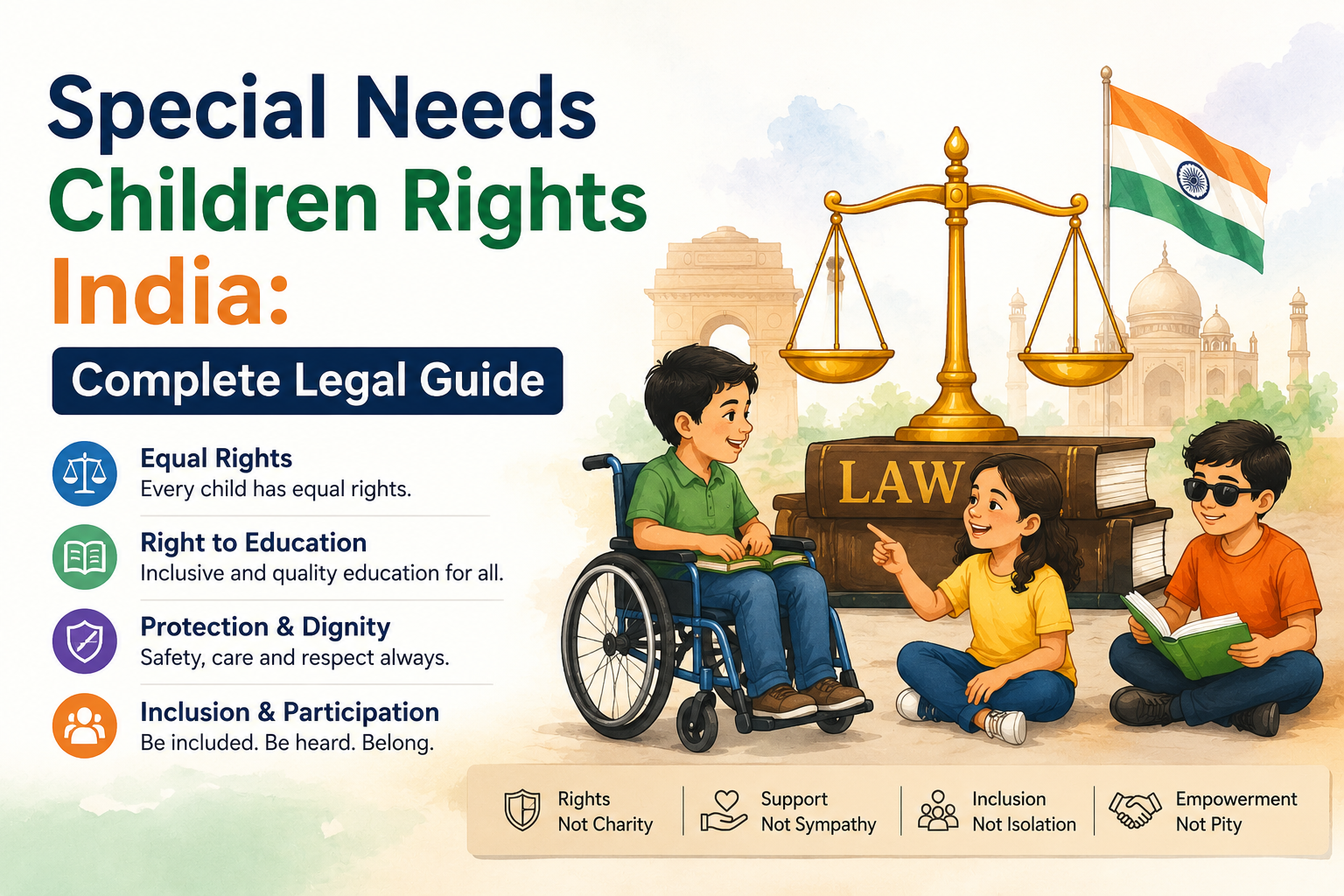
🇮🇳 Special Needs Children Rights India: 2026 Complete Legal Guide
Special needs children rights in India are protected under five interlocking laws — the RPWD Act 2016, the RTE Act 2009, the National Trust Act 1999, the Rehabilitation Council of India Act 1992, and the National Education Policy 2020 — giving children with disabilities the legal right to free education, individual learning plans, assistive technology, home-based education, and protection from discrimination in every school in India.
The problem is not that these rights do not exist. The problem is that most parents — and even most schools — do not know about them. This guide changes that. 💛

- 🚨 Why Understanding Special Needs Children Rights in India Is Urgent in 2026
- 📚 The Five-Law Framework: How India Protects Children With Special Needs
- 📊 The Numbers: Children With Special Needs in India’s Education System
- 🏫 RIGHT 1: Free Education — What the Law Actually Guarantees
- 📝 RIGHT 2: The IEP — Your Child’s Individualised Education Plan
- 🎒 RIGHT 3: Samagra Shiksha — Free Support, Devices, and Stipends
- 🏠 RIGHT 4: Home-Based Education for Severe Disabilities
- 🏛️ RIGHT 5: Protection From Discrimination and Accessible Schools
- 👨👩👧 The National Trust Act 1999: Specific Rights for Autism, CP, ID, and MD
- 🏥 The RBSK Programme: Free Health and Developmental Screening
- 🎓 NEP 2020 and the Future of Special Needs Children Rights in India
- 📣 How to Enforce Your Child’s Rights: A Step-by-Step Parent Action Plan
- 🔍 What You Must Not Miss About This Topic
- 1. 📝 The IEP Is a Legal Entitlement, Not a School’s Discretionary Offering
- 2. 🏠 Home-Based Education Is Almost Never Mentioned in Parent Guides
- 3. 🔗 The Multi-Law Approach Changes Everything
- 4. 💰 The DBT Stipend for Girls Is Consistently Underclaimed
- 💙 A Parent’s Story: Five Rights She Did Not Know She Had
- ❓ FAQs About Special Needs Children Rights India
- Q: What are the rights of special needs children in India?
- Q: Is an IEP mandatory for children with disabilities in India?
- Q: What does the RTE Act provide for children with special needs?
- Q: What is the National Trust Act and who does it help?
- Q: What is the RBSK programme for special needs children?
- Q: Can a school in India refuse admission to a child with special needs?
- Q: What financial support does the government provide for girls with special needs in India?
- 🔗 Trusted Resources for Indian Families
- 💙 Final Thoughts: Your Child’s Rights Are Not Favours. They Are Laws.
🚨 Why Understanding Special Needs Children Rights in India Is Urgent in 2026
India has some of the most comprehensive disability and special education legislation in Asia. Yet a persistent, well-documented gap exists between what the law promises and what children actually receive — primarily because parents, teachers, and even school administrators are unaware of what is legally required.
For example, every child with a disability in India is legally entitled to an Individualised Education Plan (IEP) — a personalised learning document developed collaboratively by teachers, special educators, and parents. Yet most parents have never been offered one.
Each child with a disability is entitled to an IEP — a personalised learning plan developed collaboratively by teachers, special educators, and parents — that outlines specific goals, support strategies, and progress milestones. (Source: Teachers Institute — Educational Rights for Students with Disabilities)
This is the reality of special needs children rights in India: the laws exist. The entitlements are real. But the delivery depends almost entirely on whether a parent knows to ask for them.
This guide is your asking tool.
📚 The Five-Law Framework: How India Protects Children With Special Needs
Special needs children rights in India are not based on a single law. They arise from a layered framework of five intersecting pieces of legislation — each covering a different dimension of your child’s rights.
| Law | Year Enacted | Primary Focus | Who It Covers |
|---|---|---|---|
| Rehabilitation Council of India (RCI) Act | 1992 | Regulates professionals who work with disabled children | Ensures qualified special educators work with your child |
| RTE Act (Right to Education) | 2009 | Free and compulsory elementary education | All children 6–14; specific provisions for disabilities |
| National Trust Act | 1999 | Welfare and legal guardianship | Children with autism, CP, intellectual disability, multiple disabilities |
| RPWD Act (Rights of Persons with Disabilities) | 2016 | Comprehensive disability rights framework | All 21 recognised disabilities from birth |
| NEP 2020 (National Education Policy) | 2020 | Educational framework and inclusive reform | All learners, with special emphasis on inclusion |
Together, these five laws create what experts describe as a “multi-layered approach” that addresses different aspects of the child’s development and ensures comprehensive support — with a child with autism, for example, potentially benefiting simultaneously from RCI-certified educators, National Trust Act provisions, RTE Act school protections, and RPWD Act reasonable accommodations. (Source: Teachers Institute — Key Disability Acts India)
Understanding all five — not just the most famous — is what separates a parent who gets their child’s full entitlement from one who gets only a fraction of it.
📊 The Numbers: Children With Special Needs in India’s Education System
| Statistic | Figure | Source |
|---|---|---|
| Support per CWSN per year (Samagra Shiksha) | Enhanced from ₹3,000 to ₹3,500 per child per annum | Samagra Shiksha — CWSN Provisions |
| Girls with special needs getting stipend (Samagra Shiksha) | Classes I to XII (expanded from previous IX–XII) | Samagra Shiksha CWSN |
| Children with severe/multiple disabilities receiving home-based education (2018-19) | 43,996 children — ₹9.22 crore outlay | Samagra Shiksha CWSN |
| Private school seat reservation for disadvantaged children under RTE | 25% of seats | RTE Forum — About RTE Act |
| Free education age range (RTE Act) | 6–14 years | RTE Act, 2009 |
| Free education age range (RPWD Act) | 6–18 years (benchmark disability) | RICE IAS — RPWD Act Features |
| 21 disabilities recognised under RPWD Act 2016 | Yes — up from 7 in 1995 | RPWD Act 2016 — India Code |
| National Trust Act beneficiary conditions | Autism, Cerebral Palsy, Intellectual Disability, Multiple Disabilities | DEPwD — National Trust Act |
| RBSK programme coverage | All children 0–18 years in government schools and AWCs | Government of India, Health Ministry |
🏫 RIGHT 1: Free Education — What the Law Actually Guarantees
Special needs children rights in India include the most comprehensive free education protections in the country’s legislative history — layered across two laws that operate differently.
Under the RTE Act 2009 (Ages 6–14):
The RTE Act mandates free and compulsory education for all children aged 6 to 14 years, including those with disabilities. It ensures free admission to neighbourhood schools, special training for children with disabilities, and provisions for accessible infrastructure and learning materials. (Source: LegalEye — Special Education Laws India)
Additionally, the RTE Act 2012 amendment specifically mandates that a child with multiple and/or severe disabilities has the right to opt for home-based education — an entitlement that must be provided by the government at no cost. (Source: Samagra Shiksha — CWSN Provisions)
A critical but underused provision of the RTE Act: private schools that receive government land or receive government aid must reserve 25% of their seats for disadvantaged children — which includes children with disabilities. (Source: RTE Forum) If a private school near you has government land, your child with a disability may be entitled to free admission in that school’s 25% quota.
Under the RPWD Act 2016 (Ages 6–18):
The RPWD Act extends the right to free education from age 14 up to age 18 — specifically for children with benchmark disabilities (40% or above certified disability). This is a critical four-year extension beyond what the RTE Act alone provides, ensuring secondary school is not a financial barrier for disabled children.
Together, these two laws guarantee:
| Age | Free Education Right | Law |
|---|---|---|
| 6–14 years | All children with disabilities | RTE Act 2009 |
| 14–18 years | Children with benchmark disabilities | RPWD Act 2016 |
| 0–6 years (early childhood) | Support through RBSK + Samagra Shiksha | Government schemes |
📝 RIGHT 2: The IEP — Your Child’s Individualised Education Plan
This is one of the most powerful and most consistently denied special needs children rights in India — and most parents have never been told it exists.
Every child with a disability in India is legally entitled to an Individualised Education Plan (IEP). This is a personalised learning document developed collaboratively by teachers, special educators, and parents, that outlines the child’s specific learning goals, support strategies, assessment adaptations, and progress milestones. (Source: Teachers Institute — Educational Rights India)
The IEP is not optional. It is not something schools provide only to children they choose to support extra well. It is a legal entitlement.
What Your Child’s IEP Should Include
- Current performance level — where your child is academically and functionally right now
- Annual goals — specific, measurable targets for the year ahead
- Short-term objectives — smaller steps toward each annual goal
- Support services — exactly who will provide what support and how often
- Accommodation details — what modifications apply to instruction and assessment
- Transition planning — for older students, what comes after school
How to Request an IEP
Write a formal letter to your child’s school principal with:
- Your child’s name and class
- Their disability certificate details
- A specific request for an IEP to be developed within 30 days
- A request to be included as a participant in the IEP development meeting
If the school does not respond within 30 days, escalate to your state’s District Education Officer — and reference your child’s rights under the RPWD Act and Samagra Shiksha scheme guidelines.
🎒 RIGHT 3: Samagra Shiksha — Free Support, Devices, and Stipends
The Samagra Shiksha scheme is the government’s primary implementation mechanism for special needs children rights in India — and most families receive less than they are entitled to simply because they do not know what the scheme covers.
Samagra Shiksha is an integrated scheme for school education covering children with special needs from Classes 1 to 12 under the Department of School Education and Literacy. (Source: International SEVA — Special Education India)
What Samagra Shiksha Provides for Your Child
| Entitlement | Details |
|---|---|
| Per-child support | ₹3,500 per child per annum for CWSN-specific support |
| Stipend for girls | Provided through Direct Benefit Transfer (DBT) for girls with special needs, Classes I to XII |
| Home-based education | For children with severe/multiple disabilities who cannot attend school — extended to Class XII |
| Special educator support | Schools are funded for special educators at elementary and secondary level |
| Assistive technology | Screen readers, text-to-speech, speech recognition, modified hardware — schools are funded to procure these |
| Transport allowance | For students with mobility challenges — provided under IEDSS and Samagra Shiksha |
| Therapeutic services | Schools are expected to provide or facilitate therapeutic services, counselling, and vocational support |
| Physical accessibility | Ramps, accessible toilets, accessible classrooms, libraries, labs, playgrounds — all mandated |
How to claim Samagra Shiksha benefits for your child:
- Ensure your child’s name is registered in the school’s CWSN (Children With Special Needs) record
- Ask the school’s Special Educator or headteacher which Samagra Shiksha provisions your child is currently accessing
- Request documentation of the annual per-child support allocation for your child
- Ask specifically about assistive technology procurement — schools have budget for this but often do not proactively provide it
🏠 RIGHT 4: Home-Based Education for Severe Disabilities
This is one of the least-known but most important special needs children rights in India — and it applies specifically to families whose children cannot attend school due to the severity of their disability.
The RTE Act 2012 amendment mandates that a child with multiple and/or severe disabilities has the right to opt for home-based education. This right has been extended under Samagra Shiksha to cover right up to Class XII. (Source: Samagra Shiksha — CWSN Provisions)
What home-based education provision includes:
- A qualified resource teacher or special educator visits your home — at government expense
- The education follows the regular curriculum, adapted to your child’s needs
- The scheme is funded centrally and implemented through the state education department
- Your child continues to be registered as a school student and can appear for examinations with accommodation
In 2018-19 alone, 43,996 children received home-based education under this provision — with a government outlay of ₹9.22 crore. (Source: Samagra Shiksha)
How to access home-based education:
Write to your District Education Officer (DEO) and your Block Resource Coordinator (BRC) requesting home-based education under the Samagra Shiksha scheme. Attach your child’s disability certificate and a medical opinion on why school attendance is not possible. The BRC is responsible for arranging a special educator to visit your home.
🏛️ RIGHT 5: Protection From Discrimination and Accessible Schools
Special needs children rights in India specifically include protection from discrimination in educational settings — and accessibility obligations that schools must meet.
The RPWD Act prohibits discrimination against persons with disabilities in education. It mandates reasonable accommodation — meaning schools must provide modifications that allow your child to participate equally. Failure to provide reasonable accommodation without valid justification is a legal violation. (Source: Disability Activists — RPWD Act Guide)
What schools are legally obligated to provide:
- Physical ramps and accessible toilets
- Accessible classrooms and laboratories
- Accessible library and playground
- Braille textbooks and large-print materials for visually impaired students
- Hearing aids and communication devices as required
- Screen reading software like JAWS where needed
- Modified assessment formats and examination accommodations
The Sugamya Bharat Abhiyan (Accessible India Campaign) — a nationwide initiative by DEPwD — specifically targets making schools physically accessible for children with disabilities. (Source: 21K School — Special Education Inclusion Laws)
What to do if your child’s school is not accessible:
Document the specific accessibility failure in writing. Send a formal complaint to the school with a reference to RPWD Act obligations and Samagra Shiksha infrastructure requirements. If unresolved within 14 days, escalate to the State Commissioner for Persons with Disabilities.
👨👩👧 The National Trust Act 1999: Specific Rights for Autism, CP, ID, and MD
For families of children with autism spectrum disorder, cerebral palsy, intellectual disability, or multiple disabilities, the National Trust Act 1999 provides a separate, additional layer of protection — operating alongside the RPWD Act, not instead of it.
The National Trust Act 1999 focuses specifically on the welfare of persons with autism, cerebral palsy, intellectual disability, and multiple disabilities. The Act and the RPWD Act coexist in India’s disability rights framework. (Source: DEPwD — National Trust Act)
Key National Trust Act provisions for families:
| Provision | What It Provides |
|---|---|
| Legal Guardian Certificate | For parents/family members to be legally appointed as guardians for disabled adults — preventing exploitation and enabling legal decision-making |
| Niramaya Health Insurance | Affordable health insurance specifically for beneficiaries with autism, CP, ID, and MD — at significantly subsidised premiums |
| Gharaunda Scheme | Residential care and supported living facilities for people with the four specified disabilities |
| Samarth Scheme | Capacity building for caregivers and organisations working with persons with the four specified conditions |
| Vikaas Programme | Day care centres for children and adults with autism, CP, ID, and multiple disabilities |
| Saathi Scheme | Placement with voluntary organisations for families who cannot care for a member with disability at home |
👉 Access National Trust resources at: thenationaltrust.gov.in
🏥 The RBSK Programme: Free Health and Developmental Screening
The Rashtriya Bal Swasthya Karyakram (RBSK) — a government health programme most parents have never heard of — provides free health and developmental screening for all children from birth to 18 years in government schools and Anganwadi centres.
The RBSK is one of the foundational rights-adjacent provisions for special needs children rights in India, because it identifies children who need specialist assessment and connects them to free services through District Early Intervention Centres (DEICs) in every district.
What RBSK screens for:
- Developmental delays including autism markers
- Hearing and vision impairment
- Learning disabilities
- Neurological conditions
- Congenital disabilities
What happens after RBSK identification:
Children identified through RBSK are referred to DEICs for free further evaluation and, where available, free early intervention services. This is the government’s primary mechanism for catching disability before school age and ensuring early support.
If your child attends a government school or Anganwadi, they should automatically be covered by RBSK screening. If no screening has happened, request it formally in writing through your Anganwadi worker or school headteacher.
🎓 NEP 2020 and the Future of Special Needs Children Rights in India
The National Education Policy 2020 does not create new legal rights — but it creates the policy framework for making existing special needs children rights in India a reality across all schools by the mid-2020s.
Key NEP 2020 provisions for special needs children:
- Universal design for learning — all curriculum and learning materials to be designed for diverse learners from the outset, not adapted only after exclusion has occurred
- Barrier-free access — all schools to become fully accessible within a defined timeframe
- Early childhood inclusion — disability identification and support extended to the 3–6 age range
- Vocational and life skills — specifically included for students with disabilities at secondary level
- Technology integration — digital learning tools required to be accessible to students with visual, auditory, and physical disabilities
NEP 2020 promotes inclusive education by encouraging barrier-free access to schools, universal design for learning, and early identification and support for children with developmental challenges. (Source: LegalEye — Special Education Laws India)
📣 How to Enforce Your Child’s Rights: A Step-by-Step Parent Action Plan
Knowing your child’s rights and enforcing them are two different skills. Here is the practical enforcement pathway.

✅ The 7-Step Parent Action Plan
| Step | Action | When to Use It |
|---|---|---|
| 1 | Get the disability certificate and UDID card | Foundation — required for all other rights |
| 2 | Send a written request to the school for IEP development | First meeting with school about your child’s needs |
| 3 | Request a Samagra Shiksha CWSN registration and support list from the school | When your child enrols in any government or government-aided school |
| 4 | File an RTI if the school does not provide requested information | Within 15 days of any denied request |
| 5 | File a formal written complaint to the State Commissioner for Disabilities | After 30 days without resolution from school |
| 6 | Contact the National Trust helpline for autism, CP, ID, or MD-specific rights | Immediately after diagnosis for eligible conditions |
| 7 | Approach the Special Court in your district | For serious, ongoing violations after state commissioner is engaged |
📝 Template — Written Request for IEP
[Date] [Your Name] Parent of [Child’s Name], Class [X], Roll No. [X]
To: The Principal, [School Name]
Sub: Request for development of Individualised Education Plan (IEP)
Dear Sir/Madam,
My child [Name] has a disability certificate (UDID No. / Disability Certificate No. [X]) certifying [disability type] at [X]% disability. Under the RPWD Act 2016 and Samagra Shiksha scheme guidelines, every child with a disability is entitled to an IEP developed with parent participation.
I request that an IEP be developed for my child within 30 days. I also request to be included in the IEP development meeting.
Yours sincerely, [Signature and contact details]
🔍 What You Must Not Miss About This Topic
1. 📝 The IEP Is a Legal Entitlement, Not a School’s Discretionary Offering
The single most important point missing from most resources on special needs children rights in India is that the IEP is not something schools offer to selected children they choose to support — it is a legal entitlement for every child with a disability. Most parents have never been offered an IEP because most schools do not proactively initiate the process. You must ask — and now you know you have the right to do so.
2. 🏠 Home-Based Education Is Almost Never Mentioned in Parent Guides
The RTE Act amendment providing home-based education for children with severe or multiple disabilities — extended by Samagra Shiksha to Class XII — is one of the most significant but least-known special needs children rights in India.
Families of the most severely disabled children, who often feel completely excluded from the education system, have a specific, funded entitlement to education delivered to their home. This is almost never included in mainstream awareness resources.
3. 🔗 The Multi-Law Approach Changes Everything
Most articles about disability rights in India focus on a single law — usually the RPWD Act. Very few explain that children’s rights come from five interlocking laws and schemes, each contributing different entitlements.
A child with autism may simultaneously have rights under the RPWD Act, the National Trust Act, the RTE Act, and Samagra Shiksha — all at the same time, for different aspects of their life. Understanding this multi-law framework is what enables parents to claim the full stack of entitlements, not just the most prominent one.
4. 💰 The DBT Stipend for Girls Is Consistently Underclaimed
The stipend for girls with special needs — provided through Direct Benefit Transfer under Samagra Shiksha from Classes I to XII — is consistently underclaimed because schools do not proactively register eligible girls or inform families of the entitlement.
The DBT component means it should come directly to the family’s bank account. If you are the parent of a girl with a disability in a government or government-aided school and have not received this stipend, ask the school to confirm CWSN registration.
💙 A Parent’s Story: Five Rights She Did Not Know She Had
Kavitha’s daughter Ananya had cerebral palsy. She was eight years old, attended a government school in Karnataka, and needed a wheelchair and regular physiotherapy to manage her daily life.
“The school had a ramp,” Kavitha says. “That was all they thought they had to provide. There was no accessible toilet. There was no special educator. Ananya sat in the back of a class of 45 children and mostly watched.”
Kavitha had never heard of the RPWD Act. She had never been offered an IEP. She did not know what Samagra Shiksha was. She did not know the National Trust Act existed.
A workshop run by a local disability NGO changed everything.
Over six months, with support from the NGO, Kavitha claimed five rights for Ananya that she had not known existed:
- An IEP — the school developed one within a month of her written request
- A Samagra Shiksha support registration — confirming ₹3,500 annual support and an accessible toilet installation
- Home physiotherapy — facilitated through the DEIC and RBSK referral
- A disability certificate with UDID — enabling income tax deductions for Kavitha under Section 80DD
“Nothing changed about Ananya’s disability,” Kavitha says quietly. “Everything changed about how the world treats it.”
Ananya is now 11. She has an IEP. She has an accessible toilet. She has a special educator who visits her classroom twice a week. Her physiotherapy is covered.
“I think about the three years before I knew these rights existed,” Kavitha reflects. “All that time. All that support she should have been getting. I cannot get those years back. But I can make sure other parents do not lose the same years.”
❓ FAQs About Special Needs Children Rights India
Q: What are the rights of special needs children in India?
Special needs children rights in India are protected under five laws: the RPWD Act 2016 (21 disability categories, free education 6–18, anti-discrimination, reasonable accommodation), the RTE Act 2009 (free education 6–14, home-based education for severe disabilities, 25% private school seats for disadvantaged children), the National Trust Act 1999 (autism, CP, ID, MD-specific welfare), the Samagra Shiksha scheme (assistive devices, stipends, special educators, home-based education), and NEP 2020 (universal design, barrier-free access).
Q: Is an IEP mandatory for children with disabilities in India?
Yes. Every child with a disability is legally entitled to an Individualised Education Plan (IEP) — a personalised learning document developed with parent participation that sets out specific goals, support strategies, and assessment accommodations. This right exists under the RPWD Act 2016 and Samagra Shiksha guidelines. If your child’s school has not developed an IEP, write formally requesting one within 30 days.
Q: What does the RTE Act provide for children with special needs?
The Right to Education Act 2009 guarantees free and compulsory education for all children aged 6–14, including those with disabilities. It ensures free admission to neighbourhood schools, special training for disabled children, accessible infrastructure, and home-based education for children with severe or multiple disabilities. The 2012 amendment specifically extended home-based education rights to children with multiple and severe disabilities.
Q: What is the National Trust Act and who does it help?
The National Trust Act 1999 provides welfare and legal guardianship specifically for people with autism spectrum disorder, cerebral palsy, intellectual disability, and multiple disabilities. Key provisions include the Niramaya health insurance scheme, legal guardian certificates for family members, the Vikaas day care programme, the Gharaunda residential scheme, and the Saathi and Samarth support programmes. Access National Trust resources at thenationaltrust.gov.in.
Q: What is the RBSK programme for special needs children?
The Rashtriya Bal Swasthya Karyakram (RBSK) is a government health screening programme providing free developmental, health, and disability screening for all children from birth to 18 years in government schools and Anganwadi centres. Children identified with developmental concerns are referred to District Early Intervention Centres (DEICs) for free further assessment and early intervention services.
Q: Can a school in India refuse admission to a child with special needs?
No. Under both the RPWD Act 2016 and the RTE Act 2009, no school in India can refuse admission to a child on the basis of their disability. Schools are legally required to provide reasonable accommodation for equal participation. Refusal of admission or failure to provide accommodation without valid justification is a legal violation that can be reported to the State Commissioner for Persons with Disabilities.
Q: What financial support does the government provide for girls with special needs in India?
Under the Samagra Shiksha scheme, girls with special needs receive a stipend through Direct Benefit Transfer (DBT) for all classes from I to XII. This is in addition to the per-child annual support of ₹3,500 for all children with special needs. The stipend is delivered directly to the family’s bank account. If you have a daughter with a disability in a government or government-aided school and have not received this stipend, request CWSN registration from the school immediately.
🔗 Trusted Resources for Indian Families
| Resource | What It Offers | Link |
|---|---|---|
| 📄 RPWD Act 2016 — Full Official Text | Complete disability rights law | indiacode.nic.in |
| 🏛️ DEPwD — Ministry of Social Justice | All disability laws, schemes, and resources | depwd.gov.in |
| 🎓 Samagra Shiksha — CWSN Provisions | Official CWSN scheme details | samagra.education.gov.in |
| 🤝 National Trust | Autism, CP, ID, MD-specific welfare programmes | thenationaltrust.gov.in |
| 🎫 UDID — Disability Card Application | Apply for Unique Disability ID card | swavlambancard.gov.in |
| 📣 Chief Commissioner for Persons with Disabilities | Complaints and enforcement | ccpd.nic.in |
| 📚 Teachers Institute — Education Rights Guide | Detailed educational rights under all disability laws | teachers.institute |
| 🎓 National Scholarships Portal | Disability scholarships for school and college | scholarships.gov.in |
💙 Final Thoughts: Your Child’s Rights Are Not Favours. They Are Laws.
The special needs children rights in India described in this guide are not charity. They are not programmes that schools and governments provide when they feel generous. They are laws — enacted by Parliament, backed by the Constitution, upheld by the Supreme Court, and binding on every school, hospital, and government office in India.
Your child with a disability is entitled to:
- A free education
- An Individualised Education Plan
- Assistive technology
- A special educator
- An accessible school environment
- Protection from discrimination
- Government financial support
- Health screening and early intervention
Most of these rights are being denied — not out of malice, but out of ignorance. The school does not know. The government office does not tell you. And so the rights sit unclaimed, year after year.
Until a parent reads this. And decides to ask. 💛
📝 This article is for informational and educational purposes only and does not constitute legal advice. Laws, scheme allocations, and implementation details may change. Always verify current provisions with official government sources, and consult a qualified disability rights advocate for guidance specific to your child’s situation.