

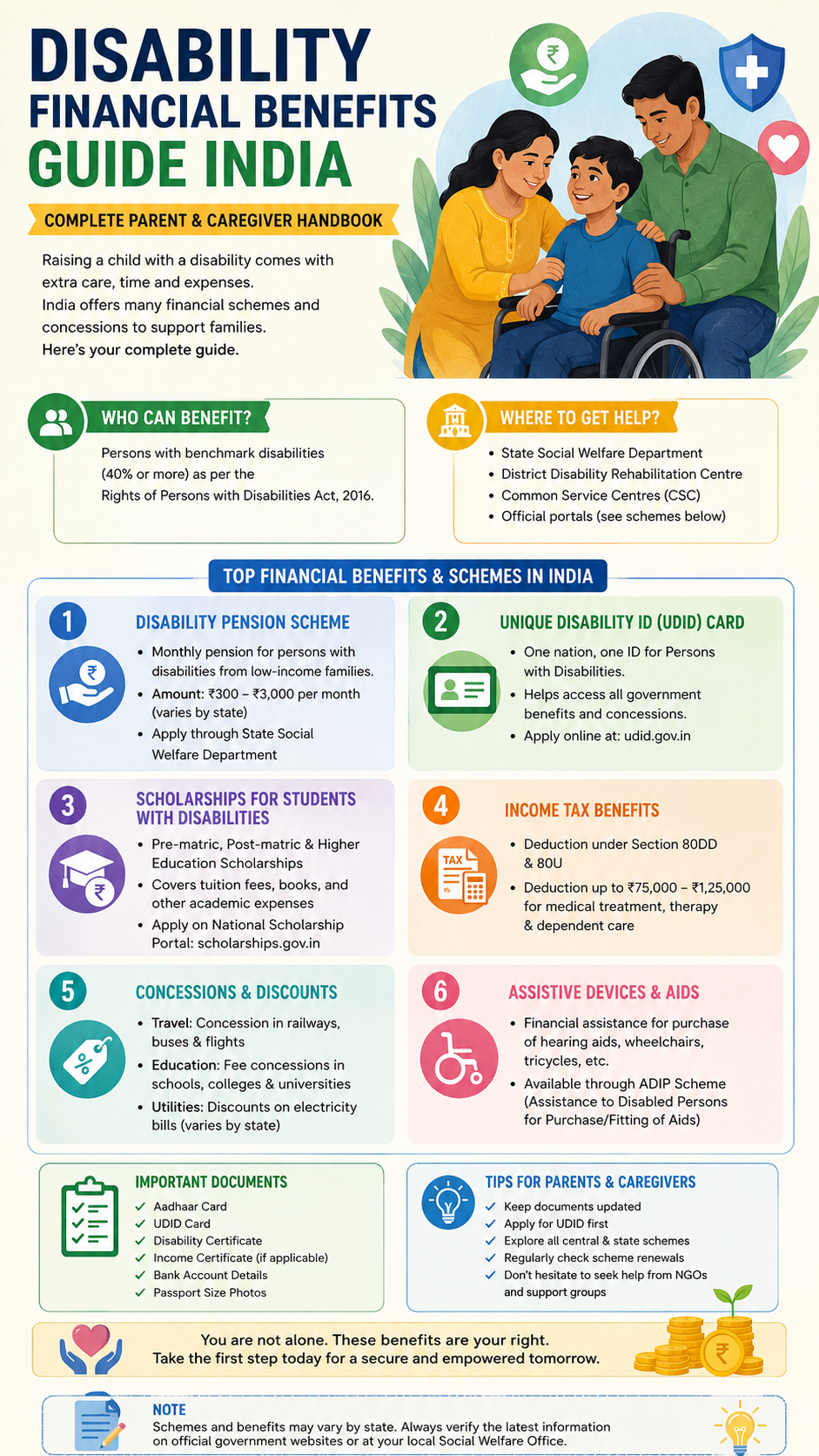
💰 Disability Financial Benefits Guide India: 2026 Complete Parent and Caregiver Handbook
This disability financial benefits guide India covers every major financial scheme, tax benefit, insurance policy, scholarship, and government grant available to families of children and adults with disabilities in India in 2026 — in one place, in plain language.
In short: if your child has a disability certificate, they are entitled to benefits potentially worth ₹3–5 lakh over their lifetime, and this guide tells you exactly how to claim every one.
💛 Let us start with what is yours.

- 🚨 Why Most Indian Families Miss Benefits Worth Lakhs
- 🎫 THE FOUNDATION: Getting Your Disability Certificate and UDID Card
- 💸 TAX BENEFITS: The Most Underused Financial Relief for Parents
- Section 80DD — For Parents Supporting a Disabled Dependent
- Section 80U — For the Person With Disability (or Adult Child)
- Annual Tax Saving Calculation
- 🏦 PENSION SCHEMES: Monthly Income Support
- 🏥 HEALTH INSURANCE: Niramaya and Swavlamban
- 🏥 AYUSHMAN BHARAT PM-JAY: ₹5 Lakh Annual Health Cover
- 🦽 THE ADIP SCHEME: Free Assistive Devices Worth ₹30,000–₹1 Lakh
- 🎓 EDUCATIONAL SCHOLARSHIPS: Annual Support for Students
- 🏦 NHFDC: Concessional Loans for Self-Employment and Education
- 🏫 DDRS: NGO-Delivered Therapy and Rehabilitation Support
- 🗺️ STATE GOVERNMENT DISABILITY PENSIONS
- 🚂 TRAVEL CONCESSIONS: Rail, Air, and Road
- 📊 THE COMPLETE BENEFITS MASTER TABLE
- 🔍 What You Must Not Miss About This Topic
- 1. 🔄 Niramaya and Swavlamban Can Be Used Together
- 2. 📊 The Tax Benefit Renumbering Under Income Tax Act 2025
- 3. 🎓 The Scholarship Portal Requires Annual Renewal — and Many Families Miss It
- 4. 💼 NHFDC Loans for Parents Are Rarely Mentioned
- 5. 🌐 The UDID Card Now Enables Digital Access to All Schemes
- 💙 A Parent’s Story: The ₹2.4 Lakh She Found in Plain Sight
- ❓ FAQs About the Disability Financial Benefits Guide India
- Q: What financial benefits are available for disabled children in India?
- Q: How do I claim Section 80DD tax deduction for a disabled child in India?
- Q: What is the Niramaya health insurance scheme and how much does it cost?
- Q: What free assistive devices does the ADIP scheme provide?
- Q: How do I apply for a disability pension in India?
- Q: What scholarships are available for students with disabilities in India?
- 🔗 Trusted Resources for Indian Families
- 💙 Final Thoughts: The Money Was Always Yours. Now Go Claim It.
🚨 Why Most Indian Families Miss Benefits Worth Lakhs
Over 42% of eligible persons with disabilities in India do not apply for government benefits simply because they are unaware of the schemes. As per the latest records, there are more than 2.68 crore disabled persons in India.
The gap between entitlement and access is not caused by a lack of government commitment. It is caused by a lack of information reaching the families who need it most. (Source: India Autism Center — Government Schemes for Disabled Persons, May 2026)
This disability financial benefits guide India exists specifically to close that gap — giving parents, caregivers, and self-advocates a complete, actionable reference for every financial entitlement available in 2026.
🎫 THE FOUNDATION: Getting Your Disability Certificate and UDID Card
Every benefit in this guide requires one thing first: a valid Disability Certificate and UDID (Unique Disability ID) Card. Without these, even the most deserving family cannot access any scheme.
Over 80 million Indians with disabilities are missing out on government benefits worth ₹3–5 lakh lifetime because they lack proper disability documentation. (Source: Abhyash Suchi — Disability Certificate & UDID Guide 2026)
How to Get the UDID Card Online
The entire process can now be initiated online at swavlambancard.gov.in:
- Register an account at swavlambancard.gov.in (30 minutes)
- Apply for disability certificate online — upload documents
- Portal assigns a medical assessment appointment at the nearest government hospital
- Attend assessment (45–60 minutes) with original documents
- Medical board prepares assessment report and approves certificate
- Download your UDID e-card immediately; physical card delivered by post
Documents needed: Proof of identity (Aadhaar), proof of address, diagnosis report from a qualified specialist, passport-size photographs
Once you have your UDID card, use it as your single national identity document to access all schemes below — no need to carry multiple state-specific certificates.
💸 TAX BENEFITS: The Most Underused Financial Relief for Parents
Tax benefits are available immediately, require no waitlist, and deliver significant annual savings — yet they are consistently the most underused element of this disability financial benefits guide India.
Section 80DD — For Parents Supporting a Disabled Dependent
Who claims it: You, the parent or legal guardian, supporting a child or dependent family member with a disability.
What the deduction provides:
| Disability Severity | Annual Deduction Available |
|---|---|
| 40% to 79% disability | ₹75,000 per year |
| 80% or above (severe) | ₹1,25,000 per year |
Note on the new Income Tax Act 2025: Under the Income Tax Act 2025 (effective from April 2026), Section 80DD is now re-numbered as Section 127. The provision operates identically — flat deduction amounts remain ₹75,000 and ₹1,25,000 respectively. (Source: Kotak Life — Income Tax Deductions 2026-27)
How to claim: File Form 10-IA with your income tax return. This form certifies the nature of the dependent’s disability and confirms the dependency relationship.
Section 80U — For the Person With Disability (or Adult Child)
Who claims it: The adult person with disability themselves — not the parent.
| Disability Level | Annual Deduction |
|---|---|
| 40%–79% disability | ₹75,000 |
| 80%+ (severe) | ₹1,25,000 |
(Re-numbered as Section 80U under Income Tax Act 2025 — same amounts and eligibility.)
Annual Tax Saving Calculation
For a parent in the 30% tax bracket claiming Section 80DD (40–79% disability child):
- Deduction: ₹75,000
- Tax saved: ₹75,000 × 30% = ₹22,500 per year
For severe disability:
- Deduction: ₹1,25,000
- Tax saved: ₹1,25,000 × 30% = ₹37,500 per year
Over 10 years, this alone represents ₹2.25–₹3.75 lakh in direct financial relief — money that remains in your family’s hands.

🏦 PENSION SCHEMES: Monthly Income Support
Indira Gandhi National Disability Pension Scheme (IGNDPS)
What it provides: ₹300 per month from the Central Government. Most states top this up significantly.
Example — Maharashtra State Topup: ₹300/month central + ₹1,200/month state = ₹1,500/month total (Source: Maharashtra SJSA — IGNDPS)
Eligibility:
- Age 18–79 years
- Below Poverty Line (BPL) household
- 80% or above disability (as assessed by medical board)
Apply through: Your local Panchayat, Municipal Corporation, or District Social Welfare Office. Also available via the NSAP portal — nsap.nic.in
Delhi Disability Financial Allowance
For families in Delhi, a Subsistence Allowance of ₹2,500/month is provided for persons with disability aged 0–60 years with a valid disability certificate. (Source: Commissioner for Persons with Disabilities, Delhi) This is one of the highest state-level disability allowances in India.
Note: Pension and allowance amounts vary significantly by state. Always check your state’s Social Justice and Empowerment department website for current state-level rates.
🏥 HEALTH INSURANCE: Niramaya and Swavlamban
This section of the disability financial benefits guide India is among the most financially impactful — especially for families managing chronic conditions and ongoing therapies.
Niramaya Health Insurance Scheme
For: Persons with autism, cerebral palsy, intellectual disability, or multiple disabilities (four conditions under the National Trust Act 1999).
What it covers: Up to ₹1 lakh per year on a reimbursement basis — covering:
- OPD and regular medical check-ups
- Hospitalisation and surgeries (including corrective surgeries for congenital disability)
- Ongoing therapies (physiotherapy, occupational therapy, speech therapy)
- Dental treatment and preventive dentistry
- AYUSH treatments
- No age limit — children, adults, and senior citizens all eligible
Premium: Just ₹250 per year for BPL/low-income families (income below ₹15,000/month) or ₹500 per year for higher income. (Source: Schemes in India — Niramaya 2026)
The 2026-27 policy year enrolment commenced on 1 February 2026, with e-cards available from 15 April 2026. Apply through Registered Organisations (ROs) authorised by the National Trust. Find your nearest RO at thenationaltrust.gov.in.
Value calculation: ₹1 lakh annual cover at ₹500 premium = 200:1 benefit-to-premium ratio — one of the most generous insurance schemes available anywhere in India for any population.
Swavlamban Health Insurance Scheme
For: Persons with ALL 21 disabilities under the RPWD Act 2016 — the broadest disability health insurance in India.
What it provides: Up to ₹2 lakh per year health coverage (recently enhanced from ₹1 lakh). Covers hospitalisation, surgeries, OPD, diagnostics, medications, prosthetic devices, and rehabilitation.
Premium structure:
| Annual Family Income | Annual Premium |
|---|---|
| Up to ₹3 lakh | FREE — ₹0 |
| ₹3–6 lakh | ₹500 per year |
| Above ₹6 lakh | ₹1,000 per year |
(Source: Schemes in India — Swavlamban 2026)
Apply through: DEPwD-authorised implementing agencies. Details at depwd.gov.in
🏥 AYUSHMAN BHARAT PM-JAY: ₹5 Lakh Annual Health Cover
The Pradhan Mantri Jan Arogya Yojana (PM-JAY) is India’s largest government health insurance scheme — and persons with disabilities are specifically covered.
What PM-JAY provides: ₹5 lakh per year health coverage for the entire family (not just the person with disability) covering hospitalisation, pre and post-hospitalisation, day care procedures, and more.
Eligibility: Disability certificate holders are prioritised. Income criteria apply — primarily for BPL and low-income families.
How to check eligibility and apply: Visit pmjay.gov.in or contact your nearest Common Service Centre (CSC).
Combined with Niramaya or Swavlamban: The schemes can operate alongside PM-JAY, covering different aspects of medical care — PM-JAY for hospitalisation and major procedures, Niramaya/Swavlamban for ongoing therapies and OPD care.
🦽 THE ADIP SCHEME: Free Assistive Devices Worth ₹30,000–₹1 Lakh
The Assistance to Disabled Persons for Purchase/Fitting of Aids and Appliances (ADIP) scheme is one of the most tangible and immediately impactful financial benefits available in this disability financial benefits guide India.
What ADIP provides free:
| Device | Benefit Value |
|---|---|
| Wheelchairs (manual and motorised) | ₹30,000–₹1,00,000 per device |
| Hearing aids | Significant market value — provided free |
| Prosthetic limbs | High-value — customised to individual |
| Crutches, walkers, tricycles | Mobility support |
| Braille kits | For visually impaired students |
| Communication devices (AAC) | For speech and language disabilities |
| Special learning aids | For intellectual disability and autism |
Additional features:
- One device per person per year
- Devices come with a 2-year warranty
- Free training on device use is included
- Implemented through ALIMCO (Artificial Limbs Manufacturing Corporation of India)
Eligibility: Indian citizen with at least 40% disability, within income limits, who has not received similar assistance recently.
Apply at: alimco.in or through your District Social Welfare Office or nearest ALIMCO camp.
For families of children with autism or intellectual disability: specifically relevant devices include communication aids, assistive technology for learning, and hearing aids if co-occurring hearing impairment exists.
🎓 EDUCATIONAL SCHOLARSHIPS: Annual Support for Students
For families in this disability financial benefits guide India with school and college-going children, educational scholarships provide meaningful annual support.
| Scholarship | Amount | Level | Where to Apply |
|---|---|---|---|
| National Scholarship for Disabled Students (Pre-Matric) | ₹3,000–₹5,000 per year | Class 1 to 10 | scholarships.gov.in |
| National Scholarship (Post-Matric) | ₹5,000–₹8,000 per year | Class 11 to graduation | scholarships.gov.in |
| Top Class Scholarship (PwD) | Higher amounts for premier institutions | IIT/IIM/NLU and other top institutions | DEPwD — depwd.gov.in |
| Samagra Shiksha Stipend (Girls with disability) | State-variable DBT stipend | Class I to XII | Through school CWSN registration |
| State-level scholarships | Varies significantly by state | All levels | State Social Justice Department |
(Source: Abhyash Suchi — Disability Certificate Benefits 2026)
Apply for central scholarships exclusively through the National Scholarships Portal at scholarships.gov.in — the single platform for all central government scholarship applications.
🏦 NHFDC: Concessional Loans for Self-Employment and Education
The National Handicapped Finance and Development Corporation (NHFDC) provides concessional loans to persons with disabilities for:
- Self-employment and micro-enterprise: ₹5–50 lakh at 4–8% interest (well below commercial rates)
- Education loans: For professional courses, technical education, and higher studies
Who can access this: Persons with benchmark disability (40%+) with a UDID card, channelled through state-level implementing agencies.
How to apply: Through your State Channelising Agency (SCA) — typically your state’s disability corporation or scheduled caste/OBC development corporation. Find details at nhfdc.nic.in.
This scheme is particularly relevant for older adolescents with disabilities pursuing higher education or for family members of disabled children seeking funds for therapy, equipment, or establishing home-based income.
🏫 DDRS: NGO-Delivered Therapy and Rehabilitation Support
The Deendayal Disabled Rehabilitation Scheme (DDRS) is the central government scheme that funds over 200 NGOs to run special schools, early intervention centres, vocational training, and home-based rehabilitation programmes — often at very low or no cost to families.
What DDRS-funded organisations provide:
- Special schools for visual, hearing, intellectual, and multiple disabilities
- Early intervention programmes for children 0–6 years
- Vocational training and employment preparation
- Home-based rehabilitation for non-ambulatory children
- Day care centres and respite care
How to find a DDRS-funded organisation near you: Contact your District Social Welfare Office or search DEPwD’s list of recognised organisations at depwd.gov.in.
🗺️ STATE GOVERNMENT DISABILITY PENSIONS
State-level disability pensions vary significantly — from ₹300/month in some states to over ₹2,500/month in others. Here is a snapshot of current state pension rates:
| State | Monthly Disability Pension (Approx.) | Notes |
|---|---|---|
| Delhi | ₹2,500/month | One of the highest in India |
| Maharashtra | ₹300 central + ₹1,200 state = ₹1,500 total | IGNDPS + state topup |
| Kerala | ₹1,500–₹2,000/month | Various disability pension schemes |
| Tamil Nadu | ₹1,500/month | State disability pension |
| Rajasthan | ₹750–₹1,500/month | Palanhaar and other schemes |
| Karnataka | ₹600–₹1,000/month | Sandhya Suraksha Yojane |
Apply through: Your nearest Gram Panchayat (rural) or Ward Office (urban), or your state’s Social Welfare Department portal.
🚂 TRAVEL CONCESSIONS: Rail, Air, and Road
Travel concessions are one of the most immediately usable benefits in this disability financial benefits guide India — and they apply every time you travel.
| Travel Mode | Concession | Details |
|---|---|---|
| Indian Railways | 25–75% discount | Varies by class and disability type. One escort also eligible for concession. Apply at booking counter with disability certificate. |
| Air travel (Air India) | 50% discount | On specific routes and classes for persons with disability |
| State road transport | 25–100% depending on state | Many states offer free or heavily subsidised bus travel |
| Metro (city-specific) | 50% discount or free | Delhi Metro, Chennai Metro, and others offer concessions |
For railway concessions: Apply directly at the booking counter or through the IRCTC portal with disability certificate details. A new UDID-linked concession system is being implemented to make this process seamless.
📊 THE COMPLETE BENEFITS MASTER TABLE
| Benefit | Amount / Value | Eligibility | How to Apply |
|---|---|---|---|
| Section 127 (formerly 80DD) tax deduction | ₹75,000 or ₹1,25,000/year | Parent of dependent with disability | Income tax return + Form 10-IA |
| IGNDPS pension | ₹300/month central + state topup | BPL, 80%+ disability, 18–79 years | District Social Welfare Office / NSAP portal |
| Delhi disability allowance | ₹2,500/month | Delhi residents, 0–60 years | Delhi DISCOMM |
| Niramaya health insurance | ₹1 lakh/year at ₹250–500 premium | Autism, CP, ID, MD (National Trust Act) | National Trust ROs |
| Swavlamban health insurance | ₹2 lakh/year at ₹0–1,000 premium | All 21 disabilities (RPWD Act) | DEPwD agencies |
| PM-JAY (Ayushman Bharat) | ₹5 lakh/year (family) | BPL and low-income with disability | pmjay.gov.in / CSC |
| ADIP assistive devices | ₹30,000–₹1 lakh per device | 40%+ disability, income criteria | alimco.in / District SW office |
| Pre-Matric scholarship | ₹3,000–₹5,000/year | School students with disability | scholarships.gov.in |
| Post-Matric scholarship | ₹5,000–₹8,000/year | College students with disability | scholarships.gov.in |
| NHFDC education loan | ₹5–50 lakh at 4–8% | 40%+ disability, education purpose | State Channelising Agency |
| Samagra Shiksha CWSN support | ₹3,500/year per child | All CWSN in government schools | School CWSN registration |
| Girls’ stipend (Samagra Shiksha) | DBT — state-variable | Girls with disability, Classes I–XII | School CWSN registration |
| Railway travel concession | 25–75% off ticket price | All disability certificate holders | IRCTC / booking counter |
| Government job reservation | 4% of vacancies | Benchmark disability, 40%+ | Job application — disability quota |
| Higher education reservation | 5% of seats | Benchmark disability, 40%+ | College admission form |
🔍 What You Must Not Miss About This Topic
1. 🔄 Niramaya and Swavlamban Can Be Used Together
Most guides describe Niramaya (for 4 National Trust Act disabilities) and Swavlamban (for all 21 RPWD Act disabilities) as alternatives. They are not — they are different schemes from different authorities, covering different costs, and can in many cases be used simultaneously.
A child with autism could access Niramaya for therapy costs and Swavlamban for hospitalisation, while also being covered under PM-JAY for major medical procedures. No guide clearly explains this stacking possibility.
2. 📊 The Tax Benefit Renumbering Under Income Tax Act 2025
The Income Tax Act 2025, effective from April 2026, renumbers Section 80DD as Section 127 and Section 80U as Section 80U (retained). Many parents are confused by this renumbering and unsure whether their disability tax benefits still apply. They do — the benefit amounts and eligibility criteria are unchanged. This guide clarifies this, which almost no other resource currently does.
3. 🎓 The Scholarship Portal Requires Annual Renewal — and Many Families Miss It
National scholarships from the scholarships.gov.in portal require annual renewal — they are not automatically continued. Many families receive a scholarship in Year 1 and miss it in Years 2 and 3 because no one told them renewal applications are required. Set a calendar reminder for August–September each year (when most scholarship cycles open) to reapply.
4. 💼 NHFDC Loans for Parents Are Rarely Mentioned
Most disability financial guides focus on benefits for the person with disability. The NHFDC concessional loan scheme is actually available for family members of persons with disabilities seeking to establish home-based income, manage the financial burden of care, or fund higher education. This is a significant resource for caregiving parents that almost no resource specifically flags.
5. 🌐 The UDID Card Now Enables Digital Access to All Schemes
The UDID card system has been progressively integrated with the central government’s Direct Benefit Transfer (DBT) platform — meaning benefits are increasingly sent directly to the linked bank account without requiring repeated document submission.
Families that have linked their UDID to their Aadhaar and bank account through swavlambancard.gov.in are positioned to receive future DBT-routed benefits automatically. This integration is rapidly expanding in 2026 and is rarely explained to families.
💙 A Parent’s Story: The ₹2.4 Lakh She Found in Plain Sight
Meenakshi had been managing alone for four years. Her son Kartik, 9, had autism and intellectual disability. She worked part-time. Her husband drove a cab. Together they managed therapy bills of nearly ₹8,000 a month.
She had a disability certificate. She had the UDID card. But she had no idea what those documents were supposed to unlock.
At a parents’ workshop run by a local disability NGO, she sat through a session on government schemes for the first time.
“I came home with six pages of notes,” she says. “I did not sleep that night. I just kept calculating.”
Here is what Meenakshi found that evening:
₹75,000/year: Section 80DD (now Section 127) tax deduction — her husband was in the 20% bracket. Annual tax saving: ₹15,000. Over four years she had missed: ₹60,000.
₹1 lakh/year at ₹500 premium: Niramaya health insurance — she enrolled the following week. Kartik’s monthly speech therapy sessions immediately became reimbursable.
₹3,500/year: Samagra Shiksha CWSN support — she requested Kartik’s registration at his school the same week.
₹5,000/year: Pre-Matric scholarship through scholarships.gov.in — applied in September.
₹30,000 device: ADIP scheme for a communication aid — Kartik had been using a borrowed device for two years. Within three months, ALIMCO provided one at no cost.
Total benefit value accessed in her first year of knowing her rights: approximately ₹2.4 lakh.
“The money was always there,” Meenakshi says. “We were just never told it was ours.”
❓ FAQs About the Disability Financial Benefits Guide India
Q: What financial benefits are available for disabled children in India?
Families of children with disabilities in India can access tax deductions under Section 127 (formerly 80DD) of ₹75,000–₹1,25,000 per year; Niramaya health insurance (₹1 lakh/year at ₹250–500 premium for autism, CP, ID, MD); Swavlamban health insurance (₹2 lakh/year for all 21 disabilities); free assistive devices under the ADIP scheme worth ₹30,000–₹1 lakh; educational scholarships from ₹3,000–₹8,000 per year; the IGNDPS disability pension; and state-level disability allowances ranging from ₹300–₹2,500 per month.
Q: How do I claim Section 80DD tax deduction for a disabled child in India?
File Form 10-IA with your income tax return. This certifies the nature of your dependent’s disability and confirms the dependency relationship. You can claim ₹75,000 per year if your child has 40–79% disability, or ₹1,25,000 per year for 80% or above disability. Under the Income Tax Act 2025 (effective April 2026), this deduction is renumbered as Section 127 — the amounts and eligibility are unchanged.
Q: What is the Niramaya health insurance scheme and how much does it cost?
Niramaya is a health insurance scheme from the National Trust for persons with autism, cerebral palsy, intellectual disability, or multiple disabilities. It provides ₹1 lakh per year on a reimbursement basis covering OPD, therapies, hospitalisation, corrective surgeries, and AYUSH treatments. The premium is just ₹250 per year for BPL/low-income families (income below ₹15,000/month) and ₹500 per year for others. Apply through Registered Organisations listed at thenationaltrust.gov.in.
Q: What free assistive devices does the ADIP scheme provide?
The ADIP scheme provides free assistive devices to eligible persons with disabilities, including wheelchairs (manual and motorised), hearing aids, prosthetic limbs, crutches, braille kits, communication devices, and special learning aids. Devices are worth ₹30,000–₹1 lakh and include a 2-year warranty and free usage training. Apply through ALIMCO at alimco.in or your District Social Welfare Office.
Q: How do I apply for a disability pension in India?
The Indira Gandhi National Disability Pension Scheme (IGNDPS) provides ₹300 per month from the central government for persons aged 18–79 with 80% or above disability from BPL households, with most states adding a topup ranging from ₹300 to ₹2,500. Apply through your Gram Panchayat or Ward Office, or online through the NSAP portal at nsap.nic.in.
Q: What scholarships are available for students with disabilities in India?
Central government scholarships include Pre-Matric scholarships of ₹3,000–₹5,000 per year for Classes 1–10, and Post-Matric scholarships of ₹5,000–₹8,000 per year for Classes 11 and above. A Top Class Scholarship is available for students entering premier institutions like IITs, NITs, and NLUs. All central scholarships are applied for through the National Scholarships Portal at scholarships.gov.in. Applications typically open between August and October each year and require annual renewal.
🔗 Trusted Resources for Indian Families
| Resource | What It Offers | Link |
|---|---|---|
| 🎫 UDID Card Application | Apply for Unique Disability ID card | swavlambancard.gov.in |
| 🏛️ DEPwD — All Central Schemes | Complete scheme list from the Ministry | depwd.gov.in |
| 🤝 National Trust — Niramaya Application | Niramaya health insurance + National Trust schemes | thenationaltrust.gov.in |
| 🎓 National Scholarships Portal | All disability scholarships — apply and renew | scholarships.gov.in |
| 🦽 ALIMCO — ADIP Scheme Devices | Free assistive devices application | alimco.in |
| 💊 PM-JAY Ayushman Bharat | ₹5 lakh health coverage — check eligibility | pmjay.gov.in |
| 🏦 NHFDC — Concessional Loans | Self-employment and education loans | nhfdc.nic.in |
| 💰 NSAP Pension Portal | Disability pension application | nsap.nic.in |
| 📣 CCPD — Grievance Redressal | Complaints if benefits are denied | ccpd.nic.in |
💙 Final Thoughts: The Money Was Always Yours. Now Go Claim It.
This disability financial benefits guide India was built on one uncomfortable truth: the benefits described here are not new. Most of them have existed for years. The families who are not accessing them are not failing to access them because they are undeserving — they are failing to access them because no one hands you a complete list and tells you plainly: this is yours.
Start with the UDID card. Then Section 127 (80DD) on your next income tax return. Then Niramaya or Swavlamban depending on your child’s disability category. Then ADIP for any device your child needs. Then the scholarship portal in September.
One benefit at a time. One application at a time. Every one of them matters.
Because the monthly therapy bill that keeps you up at night? Some of it was always supposed to be reimbursed. The tax you paid last year? Some of it was supposed to stay in your pocket. The device your child needs? It was supposed to be free.
Claim what is yours. 💛
📝 This article is for informational and educational purposes only. Scheme amounts, eligibility criteria, and application processes may change. Always verify current details with official government sources before applying. For amounts from state-level schemes, check your specific state’s Social Justice and Empowerment Department website.


