

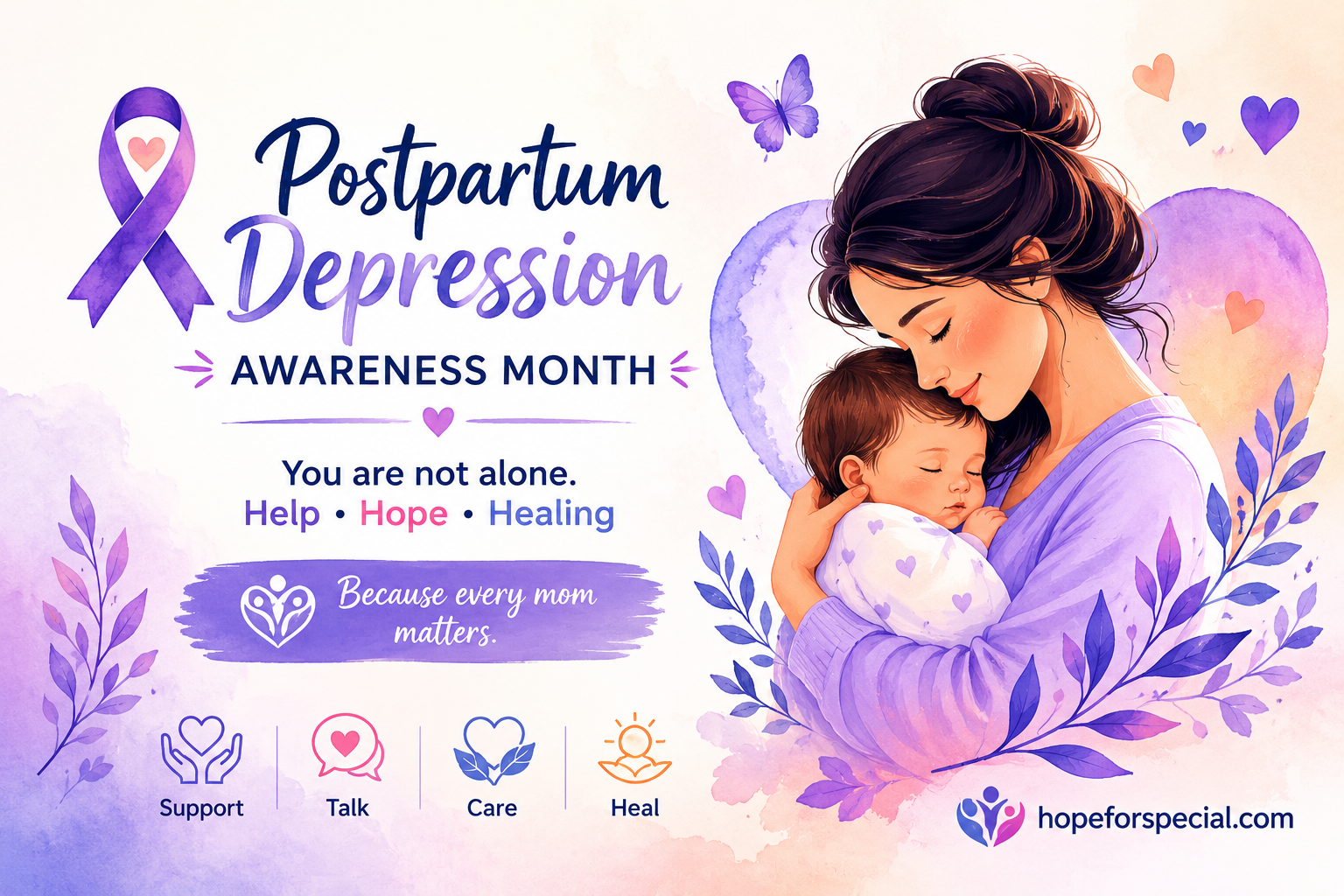
💜 Postpartum Depression Awareness Month 2026: The Silent Struggle Every New Parent Deserves to Understand
Postpartum depression awareness month exists because too many new mothers are suffering alone — and nobody is talking about it. So what exactly is it? Postpartum Depression Awareness Month is observed every May in the United States. It raises critical awareness about postpartum depression (PPD), reduces stigma, and connects struggling parents with life-changing support and care.
This month matters more than most people realize.
Because postpartum depression is not weakness. It is not a failure of motherhood. It is a medical condition — and it affects far more families than you might think. Including families raising children with special needs, where the emotional load is already extraordinarily heavy. 💜

- 📖 What Is Postpartum Depression Awareness Month?
- 📅 The History Behind Postpartum Depression Awareness Month
- 💔 A Mother’s Story: “I Thought Something Was Permanently Broken in Me”
- 📊 Postpartum Depression Statistics That Will Stop You in Your Tracks
- 🧩 Postpartum Depression and Special Needs Families: The Double Weight Nobody Talks About
- 🔍 Baby Blues vs. Postpartum Depression vs. Postpartum Psychosis: Know the Difference
- 🗓️ When Is Postpartum Depression Awareness Month 2026?
- ⚠️ Early Warning Signs of Postpartum Depression to Watch For
- 💜 The Postpartum Depression Nobody Talks About: Fathers and Partners
- ✅ How to Participate in Postpartum Depression Awareness Month 2026
- 🟢 For New and Expecting Parents:
- 🔵 For Families of Children with Special Needs:
- 🟡 For Healthcare Providers:
- 🔴 For Everyone:
- 💊 Treatment Options for Postpartum Depression: What Actually Works
- 🌍 Postpartum Depression Awareness Month Around the World
- 💡 The Hidden PPD Risk in Mothers Who Received a Prenatal Diagnosis
- 🤝 Trusted Resources for Postpartum Depression Awareness Month
- 🏛️ Organizations and Support Lines:
- 📞 Crisis Lines — Save These Now:
- 📱 Apps for Postpartum Mental Health:
- ❓ FAQs About Postpartum Depression Awareness Month
- 🔹 Q1: What month is Postpartum Depression Awareness Month?
- 🔹 Q2: What are the early signs of postpartum depression I should watch for?
- 🔹 Q3: How is postpartum depression different from baby blues?
- 🔹 Q4: Can fathers get postpartum depression?
- 🔹 Q5: How long does postpartum depression last without treatment?
- 🔹 Q6: Are mothers of special needs children at higher risk for postpartum depression?
- 🔹 Q7: What is the best treatment for postpartum depression in 2026?
- 🔹 Q8: Can postpartum depression affect my ability to breastfeed?
- 🔹 Q9: How can I support a friend or family member with postpartum depression during Awareness Month?
- 🔹 Q10: What is the color for Postpartum Depression Awareness Month?
- 🔹 Q11: Is postpartum depression more common after a difficult pregnancy or birth?
- 🔹 Q12: What should I do if I think I have postpartum depression right now?
- 🌈 Conclusion: Postpartum Depression Awareness Month Is About More Than One Month
📖 What Is Postpartum Depression Awareness Month?
Postpartum Depression Awareness Month is a national campaign observed every May — which also aligns with Mental Health Awareness Month — making it one of the most powerful mental health advocacy periods of the entire year.
It is led and championed by organizations like:
- 💜 Postpartum Support International (PSI)
- 🏛️ The American College of Obstetricians and Gynecologists (ACOG)
- 🧠 The National Institute of Mental Health (NIMH)
- 💚 Mental Health America (MHA)
The goals of Postpartum Depression Awareness Month are clear and urgent:
- 🗣️ Normalize conversations about maternal mental health
- 🔍 Help new parents identify the early signs of PPD
- 💪 Eliminate the shame that keeps millions of mothers silent
- 🤝 Connect families with trusted treatment and peer support
- 👨👩👧 Remind fathers, partners, and caregivers that PPD affects them too
🎙️ Voice Search Answer: “Postpartum Depression Awareness Month is observed every May in the United States. It is led by Postpartum Support International and other mental health organizations. Its goal is to reduce stigma, raise awareness, and connect new parents with the support they need.”
📅 The History Behind Postpartum Depression Awareness Month
Postpartum depression has existed as long as childbirth itself. But awareness — true public awareness — is surprisingly recent.
Here is a timeline of key milestones in the PPD awareness movement:
| 📆 Year | 🏆 Milestone |
|---|---|
| 1987 | Postpartum Support International (PSI) founded by Jane Honikman |
| 1994 | DSM-IV officially recognizes postpartum onset specifier for mood disorders |
| 2003 | New Jersey becomes the first U.S. state to mandate PPD screening |
| 2008 | Mental Health Parity Act helps improve coverage for PPD treatment |
| 2010 | PSI launches Maternal Mental Health Awareness Week in May |
| 2016 | U.S. Preventive Services Task Force recommends universal PPD screening |
| 2019 | FDA approves brexanolone — the first drug specifically for PPD |
| 2023 | FDA approves zuranolone — a first-ever oral PPD medication |
| 2026 | Postpartum Depression Awareness Month focuses on neurodivergent parents and special needs caregivers |
💡 Deep Insight: It took until 2019 for the FDA to approve the very first drug specifically designed for postpartum depression. For decades before that, mothers were treated with general antidepressants that were never studied specifically in the postpartum period. Awareness months like this one helped fuel that urgency.
💔 A Mother’s Story: “I Thought Something Was Permanently Broken in Me”
Meet Meera — a 32-year-old mother from Punjab, India, now living in the UK.
Meera had dreamed of motherhood her whole life. When her daughter Ananya was born — a beautiful baby with Down syndrome — Meera felt something she never expected.
Not joy. Not love at first sight. Just a hollow, terrifying numbness.
“I looked at my daughter and felt nothing,” Meera shared in a peer support forum hosted by Postpartum Support International. “Then I felt an overwhelming flood of shame for feeling nothing. I thought I was a monster. I thought I was broken forever.”
Her husband noticed she had stopped eating. She cried for hours without knowing why. She could not sleep — even when Ananya slept. She began thinking that her family would be better off without her.
Three months after Ananya’s birth, Meera’s midwife finally asked the right questions. She was diagnosed with severe postpartum depression with anxiety. She received therapy, medication, and peer support.
“The day I found out it had a name — that it was a real medical condition and not a flaw in my soul — I cried with relief,” Meera said. “That was the beginning of my healing.”
Ananya is now 6. She and Meera are inseparable. 💜
That is the power of Postpartum Depression Awareness Month. One diagnosis. One name. One chance to heal.
📊 Postpartum Depression Statistics That Will Stop You in Your Tracks
These numbers represent real mothers. Real fathers. Real children growing up with untreated parental mental illness.
| 📌 Statistic | 🔢 Figure | 🔗 Source |
|---|---|---|
| New mothers in the U.S. who experience PPD | 1 in 5 (approx. 600,000 annually) | CDC — cdc.gov |
| New fathers who experience paternal PPD | 1 in 10 | NIMH — nimh.nih.gov |
| PPD cases that go undiagnosed or untreated | Approx. 50% | Postpartum Support International — postpartum.net |
| Women with “baby blues” (resolves within 2 weeks) | 70–80% of new mothers | ACOG — acog.org |
| Risk increase for PPD in mothers of children with disabilities | 2–3 times higher than average | Autism Speaks — autismspeaks.org |
| PPD symptoms that can persist beyond 1 year untreated | Up to 25% of cases | NIMH — nimh.nih.gov |
| Women globally affected by perinatal mental health conditions | 1 in 5 | WHO — who.int |
| Mothers who feel too ashamed to discuss PPD with their doctor | Over 50% | Mental Health America — mhanational.org |
| Economic cost of untreated perinatal mental health conditions per birth (U.S.) | $32,000 | PSI — postpartum.net |
| Reduction in PPD symptoms with proper treatment | Up to 85–90% improvement | ACOG — acog.org |
⚠️ Sobering Reality: Postpartum depression is the most common complication of childbirth in the developed world. It is more common than gestational diabetes and preterm birth combined — yet it receives a fraction of the awareness and funding.
🧩 Postpartum Depression and Special Needs Families: The Double Weight Nobody Talks About
When a mother gives birth to a child who is then diagnosed with a developmental disability, chromosomal condition, or complex medical need — the emotional journey is completely different.
She is simultaneously grieving. Processing a new diagnosis. Navigating unfamiliar medical systems. Feeling isolated from other new parents who are celebrating milestones she may never see.
Research shows that mothers of children with autism, Down syndrome, cerebral palsy, and other disabilities experience postpartum and ongoing depression at rates 2 to 3 times higher than mothers of neurotypical children.
Furthermore, their PPD is more likely to go undetected — because the focus of medical appointments quickly shifts to the child’s needs rather than the mother’s wellbeing.
During Postpartum Depression Awareness Month, these mothers deserve to be seen specifically and clearly.
🌟 What Makes PPD Different in Special Needs Families:
- The grief of a missed or altered expectation of parenthood
- Isolation from mainstream parenting communities
- Exhaustion from intensive caregiving with little or no respite
- Financial stress from therapies, medical equipment, and specialist visits
- Hypervigilance — the constant mental load of monitoring a medically complex child
- Ambiguous loss — loving a child deeply while mourning the life you had imagined for them
💡 Clinical Insight: Psychiatrists increasingly recognize “chronic sorrow” as a distinct emotional experience in parents of children with disabilities — a recurring grief that is separate from but can trigger or deepen postpartum depression. Awareness and language around this condition are still developing.
🔍 Baby Blues vs. Postpartum Depression vs. Postpartum Psychosis: Know the Difference
This is one of the most searched questions during Postpartum Depression Awareness Month — and it is critically important to understand.
| Condition | When It Starts | How Long It Lasts | Key Symptoms | Action Needed |
|---|---|---|---|---|
| 😢 Baby Blues | 2–3 days after birth | Up to 2 weeks | Mood swings, crying, irritability, tiredness | Monitor; usually resolves on its own |
| 😔 Postpartum Depression (PPD) | Within first year after birth | Months to years if untreated | Persistent sadness, loss of interest, anxiety, difficulty bonding, intrusive thoughts | Seek medical help immediately |
| 😰 Postpartum Anxiety (PPA) | Within first year after birth | Months to years if untreated | Constant worry, racing heart, inability to relax, physical symptoms | Seek therapy and/or medication |
| 🚨 Postpartum Psychosis | Usually within 2 weeks of birth | Days to weeks (medical emergency) | Hallucinations, delusions, confusion, mania, severe disorientation | Emergency — call 911 or go to ER immediately |
| 🌀 Postpartum OCD | Within first year | Months if untreated | Intrusive unwanted thoughts, compulsive checking, intense fear of harming baby | Seek specialist immediately — this is treatable |
⚠️ Important: Having intrusive thoughts about harming your baby does NOT make you dangerous or a bad mother. Postpartum OCD is a well-recognized condition. The very fact that these thoughts horrify you shows you are a caring parent. Tell your doctor right away — it is highly treatable.
🗓️ When Is Postpartum Depression Awareness Month 2026?
Postpartum Depression Awareness Month 2026 is observed throughout the entire month of May 2026.
Key dates within the month:
- 📅 First Week of May: Maternal Mental Health Awareness Week (PSI’s flagship event)
- 📅 May 5: International Day of the Midwife — honor frontline PPD screeners
- 📅 May 9: Mothers Day 2026 — a powerful day to normalize PPD conversations
- 📅 May 10: PSI’s Climb Out of the Darkness fundraising event kicks off
- 📅 May 31: Month closes with community storytelling campaigns
⚠️ Early Warning Signs of Postpartum Depression to Watch For
Early identification changes outcomes dramatically. Here is what to look for — in yourself or someone you love.
🔴 Emotional Signs:
- Persistent sadness, emptiness, or hopelessness that does not lift
- Feeling like a bad mother or convinced you are failing your baby
- Inability to feel joy — even in moments that should feel wonderful
- Crying frequently without a clear reason
- Feeling disconnected from your baby (difficulty bonding)
- Intense irritability or anger that feels out of proportion
🟠 Physical Signs:
- Severe fatigue that goes beyond normal new-parent tiredness
- Changes in appetite — eating too little or too much
- Headaches, stomach aches, or muscle pain with no medical cause
- Inability to sleep even when the baby is sleeping
🟡 Behavioral Signs:
- Withdrawing from friends, family, and support networks
- Losing interest in activities you once found meaningful
- Difficulty concentrating, making decisions, or thinking clearly
- Neglecting your own basic self-care
🚨 Seek Immediate Help If You Experience:
- Thoughts of harming yourself or your baby
- Feeling like your baby or family would be better off without you
- Hearing or seeing things that others do not
- Feeling confused, disoriented, or experiencing racing thoughts that feel out of control
💜 The Postpartum Depression Nobody Talks About: Fathers and Partners
Here is what Postpartum Depression Awareness Month is slowly but powerfully bringing into the light:
Postpartum depression affects fathers and non-birthing partners too.
Approximately 1 in 10 new fathers experience paternal postpartum depression. Yet most awareness campaigns, most screening tools, and most conversations focus almost exclusively on mothers.
Paternal PPD looks slightly different. It often presents as:
- 😠 Increased irritability, anger, or aggression
- 🍺 Withdrawal and increased substance use
- 📵 Emotional detachment from partner and baby
- 😴 Excessive sleeping or severe fatigue
- 🏃 Escaping into work, hobbies, or screens to avoid home
💡 Why It Matters for Special Needs Families: When a couple is raising a child with a disability, paternal PPD is even more likely — and even more invisible. Both parents carry an extraordinary weight. Both deserve support. Postpartum Depression Awareness Month 2026 is the perfect time to start that conversation.
✅ How to Participate in Postpartum Depression Awareness Month 2026
Whether you are a parent, healthcare provider, educator, or ally — here is how to make May count:

🟢 For New and Expecting Parents:
- Take the free Edinburgh Postnatal Depression Scale (EPDS) screening at postpartum.net
- Call PSI’s helpline: 1-800-944-4773 (free, confidential)
- Join a free PSI online support group at postpartum.net/get-help/locations/online-support-meetings/
- Tell your OB or midwife honestly how you are really feeling
🔵 For Families of Children with Special Needs:
- Ask your child’s pediatric team to also screen you for PPD at appointments
- Seek a therapist who specializes in both perinatal mental health AND disability parenting
- Connect with organizations like Postpartum Support International and Autism Speaks
- Find local respite care to give yourself a mental health break
🟡 For Healthcare Providers:
- Screen all postpartum patients — not just those who appear visibly distressed
- Screen partners and fathers too, not just birthing parents
- Provide culturally sensitive PPD resources in multiple languages
- Follow up at 2 weeks, 6 weeks, and 6 months postpartum — not just at discharge
🔴 For Everyone:
- 💜 Wear purple — the official color of maternal mental health awareness
- 🤝 Check in on a new mother or father in your life — sincerely and specifically
- 💰 Donate to Postpartum Support International to fund free support programs
💊 Treatment Options for Postpartum Depression: What Actually Works
During Postpartum Depression Awareness Month, it is critical to emphasize this clearly:
Postpartum depression is highly treatable. Up to 85–90% of women see significant improvement with proper care.
Here are the evidence-based treatment options:
| 🏥 Treatment Type | ✅ What It Involves | ⏱️ Typical Timeline | 👍 Best For |
|---|---|---|---|
| Psychotherapy (CBT) | Talk therapy focused on thought patterns and behaviors | 8–16 weeks | Mild to moderate PPD |
| Interpersonal Therapy (IPT) | Focuses on relationships and life transitions | 8–12 weeks | PPD with relationship strain |
| Antidepressants (SSRIs) | Medication such as sertraline or paroxetine | 4–6 weeks to full effect | Moderate to severe PPD |
| Zuranolone (Zurzuvae) | FDA-approved oral PPD medication (2023) | 14-day course | Rapid relief for severe PPD |
| Brexanolone (Zulresso) | IV infusion — first FDA-approved PPD drug (2019) | 60-hour infusion | Severe or treatment-resistant PPD |
| Peer Support Groups | Connecting with other mothers who have experienced PPD | Ongoing | All severity levels |
| Lifestyle Interventions | Sleep support, exercise, nutrition, mindfulness | Ongoing | Mild PPD; used alongside other treatments |
💡 Expert Insight: The 2023 FDA approval of zuranolone (Zurzuvae) was a landmark moment. Unlike traditional antidepressants that take 4–6 weeks to work, zuranolone showed significant symptom reduction in just 3 days in clinical trials. For a suffering new mother, three days versus six weeks is an enormous difference.
🌍 Postpartum Depression Awareness Month Around the World
PPD does not recognize borders. And neither does Postpartum Depression Awareness Month.
Here is how awareness efforts vary globally:
| 🌍 Country / Region | 🗓️ Key Awareness Period | 🏛️ Leading Organization |
|---|---|---|
| 🇺🇸 United States | May (PPD Awareness Month) | PSI — postpartum.net |
| 🇬🇧 United Kingdom | May (Perinatal Mental Health Awareness Week) | PANDAS Foundation — pandasfoundation.org.uk |
| 🇦🇺 Australia | November (PANDA Awareness Week) | PANDA — panda.org.au |
| 🇨🇦 Canada | May (Mental Health Week aligned) | Pacific Post Partum Support Society — postpartum.org |
| 🇮🇳 India | Growing awareness; May and October | iCall — icallhelpline.org |
| 🌍 Global | Year-round | WHO Maternal Mental Health |
💡 The Hidden PPD Risk in Mothers Who Received a Prenatal Diagnosis
Mothers who received a prenatal diagnosis of a fetal abnormality or disability face a dramatically elevated and unique PPD risk — yet they are almost never screened specifically for it.
Consider this experience:
A mother discovers at 20 weeks that her baby has Down syndrome. She spends the rest of pregnancy processing grief, fear, and uncertainty. She researches tirelessly. She prepares. She loves her baby fiercely — and she also grieves.
Then the baby is born. Everyone expects her to now feel better. “The baby is here. The baby is beautiful. You should feel happy now.”
But the prenatal grief does not simply disappear. It transforms. Sometimes it deepens.
This mother needs a PPD screening that accounts for her specific journey — one that acknowledges grief, anticipatory loss, and the emotional complexity of disability parenting from the very beginning.
🛡️ What Should Happen (But Usually Doesn’t):
- Prenatal mental health screening when a fetal diagnosis is received
- Automatic PPD follow-up at 2 weeks, 6 weeks, 3 months, and 6 months for high-risk mothers
- Connection to disability-aware perinatal therapists before birth
- Peer support with other parents who received prenatal diagnoses
🤝 Trusted Resources for Postpartum Depression Awareness Month
🏛️ Organizations and Support Lines:
- 💜 Postpartum Support International: www.postpartum.net — Helpline: 1-800-944-4773
- 🧠 NIMH Postpartum Depression Info: www.nimh.nih.gov/health/publications/postpartum-depression-facts
- 🏥 ACOG PPD Resources: www.acog.org/womens-health/faqs/postpartum-depression
- 💚 Mental Health America: www.mhanational.org
- 🇬🇧 PANDAS Foundation (UK): www.pandasfoundation.org.uk
- 🇦🇺 PANDA (Australia): www.panda.org.au — Helpline: 1300 726 306
- 🧩 Autism Speaks (for special needs families): www.autismspeaks.org
📞 Crisis Lines — Save These Now:
- 988 Suicide & Crisis Lifeline (U.S.): Call or text 988
- PSI Helpline (U.S.): 1-800-944-4773
- Crisis Text Line: Text HOME to 741741
- Vandrevala Foundation (India): 1860-2662-345 (24/7)
- iCall India: 9152987821
📱 Apps for Postpartum Mental Health:
- Ovia Parenting — Tracks mood and flags PPD risk
- Maven Clinic — Virtual access to perinatal mental health specialists
- Calm or Headspace — Guided meditation for postpartum anxiety and sleep
❓ FAQs About Postpartum Depression Awareness Month
🔹 Q1: What month is Postpartum Depression Awareness Month?
A: Postpartum Depression Awareness Month is observed every May in the United States. May also aligns with Mental Health Awareness Month, making it one of the most important mental health advocacy periods of the year. Postpartum Support International leads key events throughout the entire month.
🔹 Q2: What are the early signs of postpartum depression I should watch for?
A: Early signs of postpartum depression include persistent sadness, inability to bond with your baby, feeling like a bad mother, crying without a clear reason, loss of appetite, extreme fatigue beyond normal tiredness, withdrawal from loved ones, and intrusive or frightening thoughts. If symptoms last longer than two weeks after birth, seek medical help right away.
🔹 Q3: How is postpartum depression different from baby blues?
A: Baby blues affect up to 80% of new mothers and typically resolve within 2 weeks of birth on their own. Postpartum depression is more severe, lasts longer — often for months or years if untreated — and significantly interferes with a mother’s ability to function and care for her baby. PPD requires professional medical treatment.
🔹 Q4: Can fathers get postpartum depression?
A: Yes. Research shows that approximately 1 in 10 new fathers experience paternal postpartum depression. It often presents differently in men — as irritability, anger, withdrawal, increased substance use, or emotional detachment rather than sadness. During Postpartum Depression Awareness Month, paternal PPD deserves equal attention and destigmatization.
🔹 Q5: How long does postpartum depression last without treatment?
A: Without treatment, postpartum depression can last many months — and in up to 25% of cases, symptoms persist beyond one year. Some women experience untreated PPD for several years. The good news is that with proper treatment, up to 85–90% of women experience significant recovery. Early help leads to faster healing.
🔹 Q6: Are mothers of special needs children at higher risk for postpartum depression?
A: Yes, significantly. Research shows that mothers of children with autism, Down syndrome, cerebral palsy, and other disabilities experience postpartum and ongoing depression at 2 to 3 times the rate of other mothers. This elevated risk is due to increased caregiving demands, social isolation, grief from diagnosis, and limited respite. These mothers need targeted screening and support.
🔹 Q7: What is the best treatment for postpartum depression in 2026?
A: The most effective treatments for postpartum depression include cognitive behavioral therapy (CBT), interpersonal therapy, SSRI antidepressants, the new FDA-approved oral medication zuranolone (Zurzuvae), peer support groups, and lifestyle interventions. Many women benefit from a combination of therapy and medication. Treatment should be personalized and guided by a qualified mental health professional.
🔹 Q8: Can postpartum depression affect my ability to breastfeed?
A: Yes. Postpartum depression can significantly affect breastfeeding. The stress hormones associated with PPD can reduce milk supply, and the emotional weight of PPD can make breastfeeding feel overwhelming. Importantly, several PPD medications — including sertraline — are considered compatible with breastfeeding. Always discuss medication options with your doctor if you are nursing.
🔹 Q9: How can I support a friend or family member with postpartum depression during Awareness Month?
A: The best ways to support someone with PPD are: ask direct, caring questions (“How are you really feeling?”), listen without judgment, offer specific practical help (cooking, childcare, errands), accompany them to a doctor’s appointment, and share resources from Postpartum Support International. Never minimize their experience or tell them to “just enjoy the baby.”
🔹 Q10: What is the color for Postpartum Depression Awareness Month?
A: Purple / Lavender is the recognized color for maternal mental health awareness and postpartum depression awareness. 💜 Wearing purple during May shows solidarity with mothers and families navigating postpartum depression.
🔹 Q11: Is postpartum depression more common after a difficult pregnancy or birth?
A: Yes. Risk factors for PPD include traumatic birth experiences, pregnancy complications, premature birth, NICU admissions, a previous history of depression or anxiety, lack of social support, relationship difficulties, financial stress, and — critically — receiving a diagnosis of a fetal or neonatal abnormality or disability during or after pregnancy.
🔹 Q12: What should I do if I think I have postpartum depression right now?
A: Contact your OB-GYN, midwife, or general practitioner today. You can also call PSI’s free helpline at 1-800-944-4773 or text HOME to 741741 (Crisis Text Line). If you are having thoughts of harming yourself or your baby, call 988 or go to your nearest emergency room immediately. You are not alone — and this is treatable.
🌈 Conclusion: Postpartum Depression Awareness Month Is About More Than One Month
Postpartum Depression Awareness Month is observed in May. But the need for awareness, compassion, and action exists every single day of the year.
Especially for the mother who is sitting alone at 3 AM, feeding her baby and feeling more lost than she has ever felt in her life.
Especially for the father who cannot explain why he feels nothing. Or the mother who just received her child’s disability diagnosis and is drowning in grief, love, and exhaustion all at once.
You are not broken. You are not failing. You are not alone. 💜
What you are experiencing has a name. It has treatment. And it has a community of millions who understand exactly how you feel — and who made it through to the other side.
Postpartum depression awareness month exists so that no parent ever has to search for those words alone in the dark.
Share this article. Start the conversation. Ask the question. Wear purple. 💜
Because awareness is not just a month. It is a lifeline.
⚕️ Medical Disclaimer: This article is written for informational and awareness purposes only. It does not constitute medical, psychiatric, or therapeutic advice. Always consult a qualified healthcare professional for personal mental health concerns, especially during the perinatal period.


