

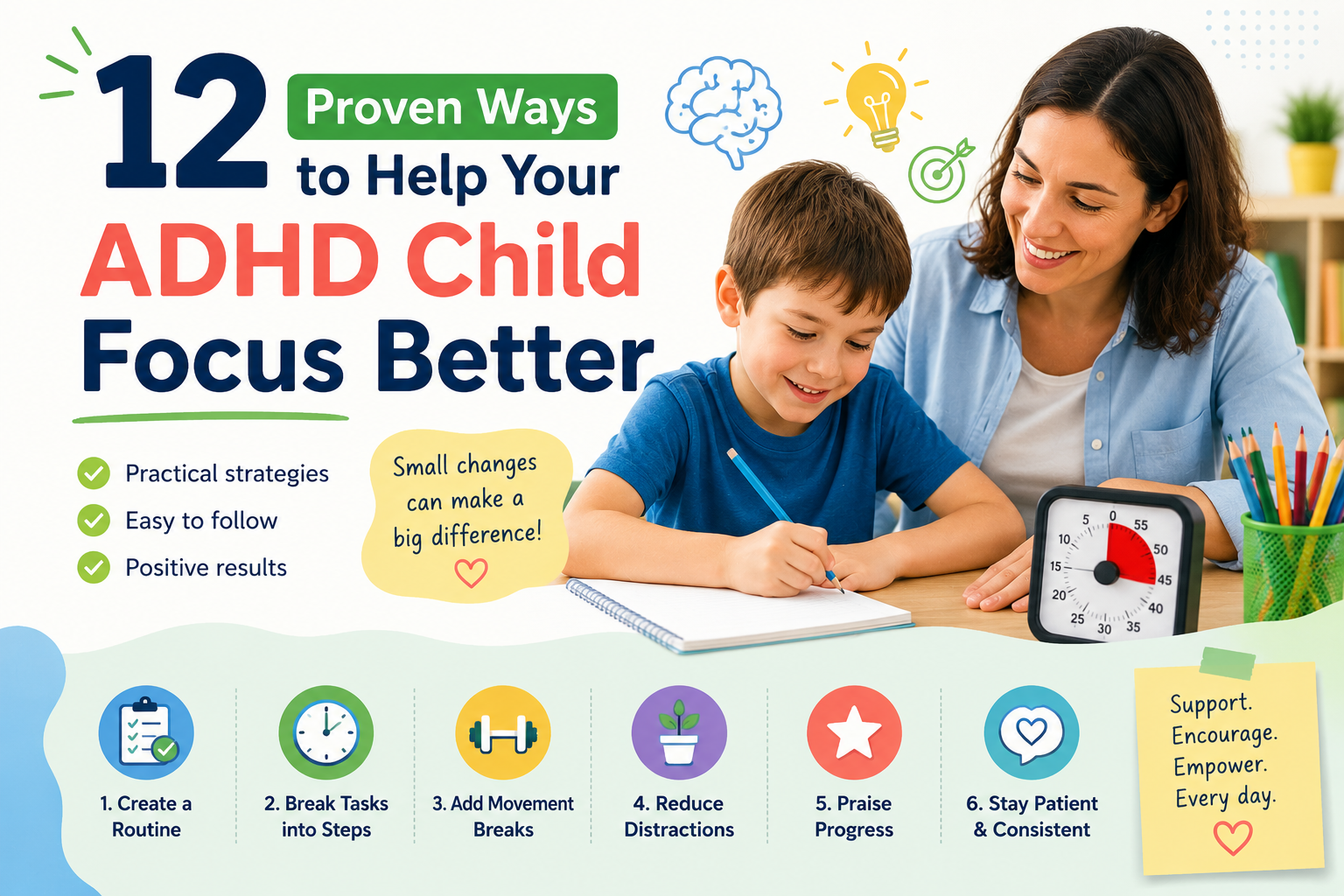
12 Proven Ways to Help ADHD Child Focus Better 🎯
How to help ADHD child focus starts with understanding that their brain isn’t ignoring you on purpose — it’s wired to prioritize novelty and struggle with executive function. The fix isn’t more discipline. It’s the right structure, movement, and environment. Here are 12 strategies backed by real research. 💙
If you’ve repeated the same instruction five times while your child stares blankly or bounces off to something else entirely, you already know this struggle intimately. This guide is built for exactly that moment. 🙌

- Why ADHD Makes Focus So Hard (It’s Not About Willpower) 🧠
- Real Research: What the Data Tells Us About ADHD and Focus 📊
- A Real Parent Story: The Homework Battle That Finally Ended 👩👦
- 12 Proven Ways to Help ADHD Child Focus Better 🌟
- 1. Break Tasks Into Short, Timed Chunks ⏱️
- 2. Build In Movement Breaks 🏃
- 3. Use Visual Schedules and Checklists 📋
- 4. Minimize Environmental Distractions 🔇
- 5. Give One Instruction at a Time 🗣️
- 6. Use Body Doubling 👯
- 7. Offer Immediate, Specific Feedback 🎉
- 8. Incorporate Their Interests Into Tasks 🎨
- 9. Create a Consistent Daily Routine 🗓️
- 10. Use Fidget Tools Strategically 🧸
- 11. Talk to a Doctor About Medication Options 💊
- 12. Protect Sleep and Nutrition Basics 🌙
- Focus Strategy Quick-Reference Table 📋
- What Most Focus Guides Get Wrong About ADHD Children ⚠️
- Voice Search Quick Answers 🎙️
- Frequently Asked Questions ❓
- 1. How do I help my ADHD child focus during homework without constant fighting?
- 2. What natural strategies help ADHD children focus better without medication?
- 3. Why does my ADHD child focus intensely on video games but not schoolwork?
- 4. At what age should I start focus-building strategies for a child with ADHD?
- 5. Can diet or sleep affect how well my ADHD child focuses?
- 6. Is medication necessary to help an ADHD child focus, or can behavioral strategies work alone?
- Final Thoughts: Working With Their Brain, Not Against It 💛
Why ADHD Makes Focus So Hard (It’s Not About Willpower) 🧠
ADHD affects roughly 5% to 7% of children worldwide, making it one of the most common neurodevelopmental conditions in childhood. But here’s what many parents don’t realize: ADHD isn’t a focus problem. It’s an executive function problem.
Executive function includes skills like working memory, impulse control, and task-switching — the mental “control tower” that helps a brain decide what to pay attention to and for how long. Research shows children with ADHD consistently show measurable differences in these exact skills compared to their peers.
This is why yelling “pay attention!” rarely works. You’re asking a brain to do something its control tower genuinely struggles to do, not something it’s choosing to ignore. Once you understand that, everything about how to help your ADHD child focus starts to shift. 💡
Real Research: What the Data Tells Us About ADHD and Focus 📊
| Statistic | What It Means for Parents | Source |
|---|---|---|
| ADHD affects roughly 5% to 7% of children and adolescents worldwide | Your child’s struggle is common and well-documented, not rare or unusual | PMC, Executive Function & Neurodevelopmental Disorders Study |
| Inhibit and Working Memory are the two executive function areas most closely tied to ADHD symptoms, explaining 38.5% of symptom variance | These two specific skills, not general “focus,” are the real target for support strategies | PMC, BRIEF-P Preschool ADHD Study |
| Stimulant medication alleviates symptoms in approximately 70% of children with ADHD | Medication can be a genuinely effective tool for many families, alongside behavioral strategies | ScienceDirect, Neural Correlates of Executive Function Study, 2025 |
| A single 20-minute session of moderate physical activity significantly improved executive function and attention performance in ADHD children | Movement breaks aren’t just a nice idea — they’re a research-backed focus tool | PMC, Acute Physical Activity and ADHD Study |
| 18–45% of children with ADHD also experience reading difficulties | Focus struggles at school may overlap with learning differences, requiring layered support | PMC, Reading Difficulties & ADHD Study, 2025 |
💡 Key insight: The two most research-backed focus tools — movement and working-memory support — are also the two most overlooked by traditional “just sit still” advice.
A Real Parent Story: The Homework Battle That Finally Ended 👩👦
Lisa, mother of a 9-year-old son with ADHD, remembers homework time as nightly chaos. “Twenty minutes of math would take two hours. He wasn’t being defiant. He’d start, wander off, come back, forget what problem he was even on.”
A school psychologist suggested something Lisa hadn’t considered: breaking homework into five-minute movement-interrupted blocks, using a simple kitchen timer. Five minutes of work, one minute of jumping jacks or stretching, repeat.
“It felt almost too simple to work,” Lisa admitted. But within two weeks, homework time dropped from two hours to under forty minutes, with far fewer meltdowns.
She also started using a visual checklist taped to his desk, so he could see progress instead of relying on memory alone.
Lisa’s advice to other parents: “Stop fighting his brain’s need for movement. Build it into the plan instead of punishing it out of him.” 🏃
12 Proven Ways to Help ADHD Child Focus Better 🌟

1. Break Tasks Into Short, Timed Chunks ⏱️
Long tasks overwhelm working memory. Use a visible timer for 5–15 minute focus blocks, followed by a short break. This matches how ADHD attention naturally cycles.
2. Build In Movement Breaks 🏃
Research confirms that even brief physical activity measurably boosts executive function and attention. Let your child stretch, jump, or walk between tasks instead of demanding stillness throughout.
3. Use Visual Schedules and Checklists 📋
Written or picture-based checklists reduce reliance on working memory, one of the two executive function areas most affected by ADHD.
4. Minimize Environmental Distractions 🔇
Reduce background noise, visual clutter, and unnecessary screens nearby during focus tasks. A simpler environment reduces competition for attention.
5. Give One Instruction at a Time 🗣️
Multi-step verbal instructions often overload ADHD working memory. Break instructions into single, clear steps instead of long strings of directions.
6. Use Body Doubling 👯
Having a parent or sibling quietly work nearby (even on something unrelated) can help many ADHD children stay on task through simple co-presence and gentle accountability.
7. Offer Immediate, Specific Feedback 🎉
ADHD brains often respond better to immediate rewards than delayed ones. Specific praise (“You finished that math row!”) works better than vague encouragement or distant rewards.
8. Incorporate Their Interests Into Tasks 🎨
Wherever possible, connect boring tasks to something your child cares about — using dinosaur-themed math problems, for example. Interest-driven engagement often outperforms willpower-based focus.
9. Create a Consistent Daily Routine 🗓️
Predictable daily structure reduces the number of decisions and transitions a child’s brain has to manage, freeing up mental energy for actual focus tasks.
10. Use Fidget Tools Strategically 🧸
For many ADHD children, subtle movement (fidget tools, standing desks, wobble cushions) actually supports focus rather than distracting from it.
11. Talk to a Doctor About Medication Options 💊
Research shows stimulant medication helps a significant majority of children with ADHD manage symptoms effectively. This is a personal, medical decision best made with a pediatrician or psychiatrist, not a last resort to feel guilty about.
12. Protect Sleep and Nutrition Basics 🌙
Poor sleep dramatically worsens attention and impulse control in all children, and especially in those with ADHD. Consistent sleep routines are an often-overlooked focus strategy.
Focus Strategy Quick-Reference Table 📋
| Strategy | Best For | Time Needed |
|---|---|---|
| Timed task chunks | Homework, chores | 5–15 minutes per block |
| Movement breaks | Between tasks, mid-lesson | 1–5 minutes |
| Visual checklists | Multi-step routines | Setup once, reuse daily |
| Body doubling | Solo tasks that feel isolating | Ongoing, as needed |
| Fidget tools | Sit-down tasks (reading, meetings) | Ongoing |
What Most Focus Guides Get Wrong About ADHD Children ⚠️
- They frame focus struggles as a discipline issue. Executive function research clearly shows this is a neurological difference, not a motivation problem — and treating it as defiance often makes things worse.
- They ignore movement as a real solution. Many guides suggest stillness strategies, when research actually shows brief physical activity is one of the most effective, evidence-backed focus tools available.
- They rarely mention working memory specifically. Most advice targets generic “attention,” when research points to working memory and inhibition as the two specific skills most worth targeting directly.
- They skip the medication conversation entirely, or treat it as failure. Research-backed data shows stimulant medication helps a majority of children significantly — it deserves a judgment-free place in this conversation.
Voice Search Quick Answers 🎙️
“How can I help my ADHD child focus on homework?”
Break homework into short, timed chunks with movement breaks in between, use visual checklists to reduce reliance on memory, and give one instruction at a time instead of multi-step directions.
“Does exercise really help ADHD children focus better?”
Yes. Research shows even a single 20-minute session of moderate physical activity measurably improves executive function and attention performance in children with ADHD.
“Is it normal for my ADHD child to lose focus every few minutes?”
Yes, ADHD directly affects executive function skills like sustained attention and working memory, making frequent focus shifts a common, expected part of the condition rather than deliberate behavior.
Frequently Asked Questions ❓
1. How do I help my ADHD child focus during homework without constant fighting?
Use short, timed work blocks with movement breaks between them, break instructions into single clear steps, and offer immediate specific praise for completed sections rather than waiting until the entire task is done.
2. What natural strategies help ADHD children focus better without medication?
Movement breaks, visual checklists, consistent routines, body doubling, and strategic fidget tools are all research-supported, non-medication strategies that support attention and working memory.
3. Why does my ADHD child focus intensely on video games but not schoolwork?
This is called hyperfocus, common in ADHD, where high-stimulation, high-interest activities naturally capture attention, while less stimulating tasks require far more executive function effort to sustain focus.
4. At what age should I start focus-building strategies for a child with ADHD?
Executive function strategies can begin as early as preschool age, using simplified visual schedules and short task chunks appropriate to the child’s developmental stage.
5. Can diet or sleep affect how well my ADHD child focuses?
Yes, poor sleep in particular significantly worsens attention and impulse control, making consistent sleep routines an important, often-overlooked part of any focus strategy.
6. Is medication necessary to help an ADHD child focus, or can behavioral strategies work alone?
Both approaches can help, and many families use a combination; research shows medication helps a majority of children significantly, while behavioral strategies like movement breaks and structured routines provide additional, complementary support.
Final Thoughts: Working With Their Brain, Not Against It 💛
Learning how to help your ADHD child focus isn’t about forcing stillness or demanding more willpower. It’s about understanding the specific executive function skills their brain finds hardest, and building strategies around that reality instead of fighting it.
Every short movement break, every visual checklist, every broken-down instruction is you meeting your child’s brain where it actually is; not where you wish it were.
That shift, more than any single strategy, is what changes everything. 🌟


