

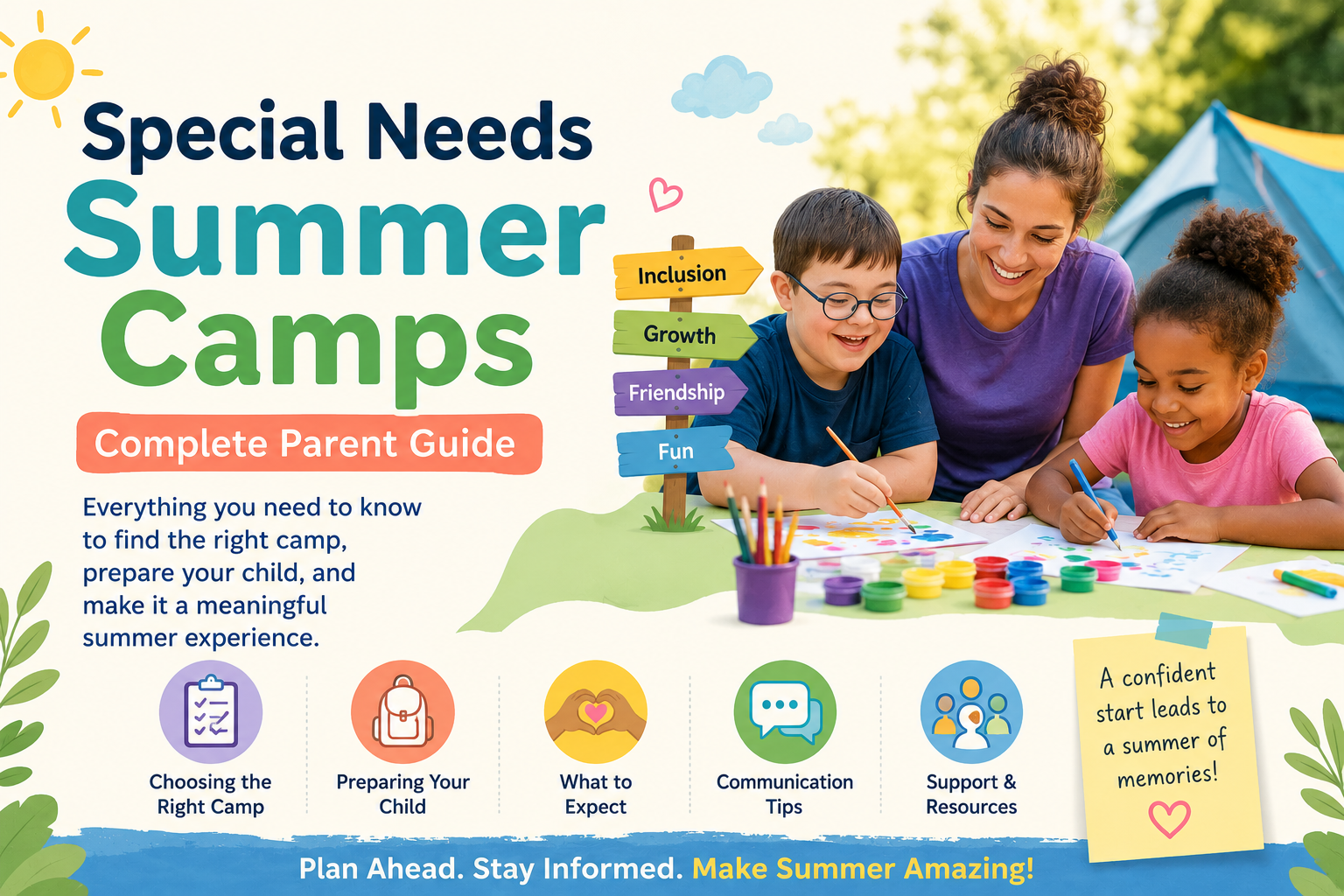
Special Needs Summer Camps: Complete Parent Guide 🏕️
Special needs summer camps are structured programs designed to give children with disabilities a safe, supportive space to build friendships, independence, and confidence over the summer break. The right camp match depends on your child’s specific needs, comfort level, and goals. Here’s how to find it. 💙
If the idea of sending your child to camp fills you with equal parts hope and anxiety, you’re feeling exactly what most special needs parents feel. This guide will help you turn that uncertainty into a confident decision. 🌟

- Why Special Needs Summer Camps Matter More Than You Think 🧠
- Real Research: What the Data Tells Us About Camp Benefits 📊
- Types of Special Needs Summer Camps: Which One Fits Your Child? 🗂️
- A Real Parent Story: “I Almost Didn’t Send Him” 👨👦
- How to Choose the Right Special Needs Summer Camp: Step-by-Step 🗺️
- 1. Define Your Goals First 🎯
- 2. Check Staff-to-Camper Ratios 👥
- 3. Ask About Staff Training 🎓
- 4. Visit Before Committing, If Possible 🚶
- 5. Ask About Sensory and Medical Accommodations 🧸
- 6. Talk to Other Parents 🗣️
- 7. Prepare Your Child in Advance 📋
- Questions Every Parent Should Ask Before Enrolling ❓
- What Most Camp Guides Miss About Special Needs Summer Camps ⚠️
- Voice Search Quick Answers 🎙️
- Frequently Asked Questions ❓
- 1. What is the difference between inclusive and disability-specific special needs summer camps?
- 2. How much do special needs summer camps typically cost?
- 3. What questions should I ask before enrolling my child in a special needs summer camp?
- 4. Can children with severe communication needs attend special needs summer camps?
- 5. How do I prepare my anxious special needs child for their first summer camp experience?
- 6. Are there special needs summer camps that include therapy services like speech or occupational therapy?
- Final Thoughts: Giving Your Child a Summer of Their Own 💛
Why Special Needs Summer Camps Matter More Than You Think 🧠
Summer break can feel like a loss of structure for many children with disabilities. Routines disappear. Therapy schedules shift. Social opportunities shrink. Special needs summer camps exist to fill that gap — not just with childcare, but with genuine developmental opportunity.
Unlike a typical camp, these programs are built around one core idea: your child doesn’t have to fit the environment. The environment fits your child. That single difference changes everything about how a child experiences the summer. 🎯
Real Research: What the Data Tells Us About Camp Benefits 📊
| Statistic | What It Means for Parents | Source |
|---|---|---|
| 73% of children with special needs show improved peer interactions in well-structured, inclusive camp programs | Camp isn’t just recreation — it’s measurable social skill-building | Carolina Behavior & Beyond, Research Summary, 2025 |
| 73% of families report improved functional outcomes when therapy services are built directly into camp programming | Camps that blend therapy with fun often outperform clinical-only settings | Carolina Behavior & Beyond, 2025 |
| Children with ADHD attending structured camp programs show documented gains in social competence and peer relationships | Structured summer programs can offer growth that school settings sometimes can’t replicate | VerySpecialCamps.com, Benefits of Camp Research Review, 2026 |
| Autism-focused camp research documents gains in social interaction and reduced isolation-related behaviors | Camp environments can help skills generalize beyond therapy rooms, into real peer settings | VerySpecialCamps.com, 2026 |
| Camps for children with disabilities and chronic illness support identity formation, peer belonging, and psychosocial wellbeing | Camp offers something therapy alone often can’t: genuine friendship and belonging | Child and Adolescent Social Work Journal, Springer, 2026 |
💡 Key insight: The research consistently points to one theme — structured, well-supported camp environments build real, lasting social and emotional skills, not just summer memories.
Types of Special Needs Summer Camps: Which One Fits Your Child? 🗂️
| Camp Type | Best For | What to Expect |
|---|---|---|
| Disability-Specific Camps | Children needing specialized, condition-focused support (autism, Down syndrome, cerebral palsy, etc.) | Staff trained specifically in your child’s condition, tailored activities |
| Inclusive Camps | Children who thrive with peer modeling and community integration | Mixed groups of typically developing and special needs children, often with 1:1 aide support |
| Therapeutic Camps | Children needing ongoing clinical support during camp | On-site speech, occupational, physical, or behavioral therapy woven into activities |
| Residential (Overnight) Camps | Older children building independence and ready for extended time away | Multi-day or multi-week stays, higher structure, strong safety protocols |
| Day Camps | Younger children or families not ready for overnight separation | Daily drop-off/pick-up, more flexibility, less separation anxiety |
A Real Parent Story: “I Almost Didn’t Send Him” 👨👦
Daniel, father of a 10-year-old son with autism and ADHD, admits he nearly canceled his son’s first week at a special needs summer camp the night before.
“I kept thinking, what if he has a meltdown and nobody knows how to handle it? What if he comes home more anxious, not less?” he recalled.
He almost pulled him out — until a phone call with the camp’s program coordinator changed his mind. She walked him through their specific de-escalation protocol, sensory break spaces, and 1:2 staff-to-camper ratio for his son’s group.
By day three, his son was texting (through his tablet AAC app) about a new friend he’d made during the camp’s water play station. By the end of the two-week session, he asked to go back the following summer.
“The biggest shift wasn’t in him,” Daniel said. “It was in me, realizing other people could genuinely understand and support my son too — not just me.” 💛
Daniel’s advice to other parents: “Call and ask hard questions before you commit. A good camp will welcome them, not brush past them.”
How to Choose the Right Special Needs Summer Camp: Step-by-Step 🗺️

1. Define Your Goals First 🎯
Before browsing options, ask: Is the priority social skills? Physical activity? Respite for the family? Continued therapy? Clarity here narrows your search significantly.
2. Check Staff-to-Camper Ratios 👥
Lower ratios (1:1 or 1:2) matter significantly for children with higher support needs. Always ask this directly — reputable camps share this information readily.
3. Ask About Staff Training 🎓
Confirm whether staff are trained specifically in your child’s condition, including behavioral de-escalation, medical protocols, and communication methods like AAC devices or sign language.
4. Visit Before Committing, If Possible 🚶
A short visit or trial day reveals more than any brochure. Watch how staff interact with campers who show signs of distress or sensory overwhelm.
5. Ask About Sensory and Medical Accommodations 🧸
Confirm availability of quiet spaces, sensory tools, medication administration protocols, and emergency procedures specific to your child’s needs.
6. Talk to Other Parents 🗣️
Ask the camp for references from families with similar needs to yours. Real parent feedback often reveals details brochures leave out.
7. Prepare Your Child in Advance 📋
Use visual schedules, social stories, or a practice drop-off to reduce first-day anxiety, especially for residential camps.
Questions Every Parent Should Ask Before Enrolling ❓
- What is your staff-to-camper ratio for children with [specific condition]?
- How is staff trained to handle meltdowns, seizures, or medical emergencies?
- Are quiet or sensory break spaces available on-site?
- Can you accommodate specific communication tools, like AAC devices?
- What does a typical day’s schedule look like?
- How do you handle medication administration?
- What is your policy on parent contact during residential stays?
- Can I speak with a parent of a current or former camper?
Print this list and bring it to every camp conversation — a confident, prepared camp staff will welcome every question. ✅
What Most Camp Guides Miss About Special Needs Summer Camps ⚠️
- They rarely mention parent anxiety as part of the process. Choosing camp isn’t just a logistics decision — it’s an emotional one, tied to trust and letting go, even briefly.
- They treat “inclusive” and “special needs-specific” as interchangeable. They’re not. Inclusive camps offer peer modeling; specialized camps offer condition-specific expertise. The right choice depends entirely on your child.
- They skip sibling considerations. If siblings attend a general camp while your child attends a specialized one, plan for how that difference is explained and normalized at home.
- They underestimate the value of a trial day. A short visit reveals staff competence and camp culture far better than any website or brochure ever could.
Voice Search Quick Answers 🎙️
“What are the best summer camps for kids with special needs?”
The best fit depends on your child’s specific needs, ranging from disability-specific camps with specialized staff training to inclusive camps that blend special needs and typically developing peers.
“How do I know if my special needs child is ready for overnight camp?”
Signs of readiness include comfort with separation, ability to communicate basic needs (verbally or through AAC), and prior success with shorter day programs or sleepovers.
“Are special needs summer camps covered by insurance or state programs?”
Coverage varies significantly by location and program type; some therapeutic camps qualify for insurance reimbursement or state respite care funding, so checking directly with the camp and your provider is recommended.
Frequently Asked Questions ❓
1. What is the difference between inclusive and disability-specific special needs summer camps?
Inclusive camps mix typically developing children with special needs campers, often with dedicated support aides, while disability-specific camps focus entirely on one or more conditions with specially trained staff throughout.
2. How much do special needs summer camps typically cost?
Costs vary widely based on camp type, duration, and location, with day camps generally costing less than residential programs; many camps offer scholarships or sliding-scale fees, so it’s worth asking directly.
3. What questions should I ask before enrolling my child in a special needs summer camp?
Key questions include staff-to-camper ratios, staff training specific to your child’s condition, availability of sensory break spaces, and emergency medical protocols.
4. Can children with severe communication needs attend special needs summer camps?
Yes, many camps accommodate AAC devices, sign language, and picture communication systems, though confirming specific communication support during enrollment is essential.
5. How do I prepare my anxious special needs child for their first summer camp experience?
Use visual schedules, social stories describing what to expect, and if possible, a practice visit or trial day before the full session begins.
6. Are there special needs summer camps that include therapy services like speech or occupational therapy?
Yes, therapeutic camps often integrate speech, occupational, and physical therapy directly into daily activities, offering combined recreational and clinical benefits.
Final Thoughts: Giving Your Child a Summer of Their Own 💛
Choosing among special needs summer camps isn’t just about filling a summer schedule. It’s about giving your child a space where their needs are understood, their differences are welcomed, and their growth is genuinely supported.
The research is clear: the right camp environment builds real social skills, real independence, and real friendships — the kind that often follow children long after summer ends.
Trust your instincts, ask the hard questions, and remember: every child deserves a summer filled with belonging, not just supervision. 🌟


