

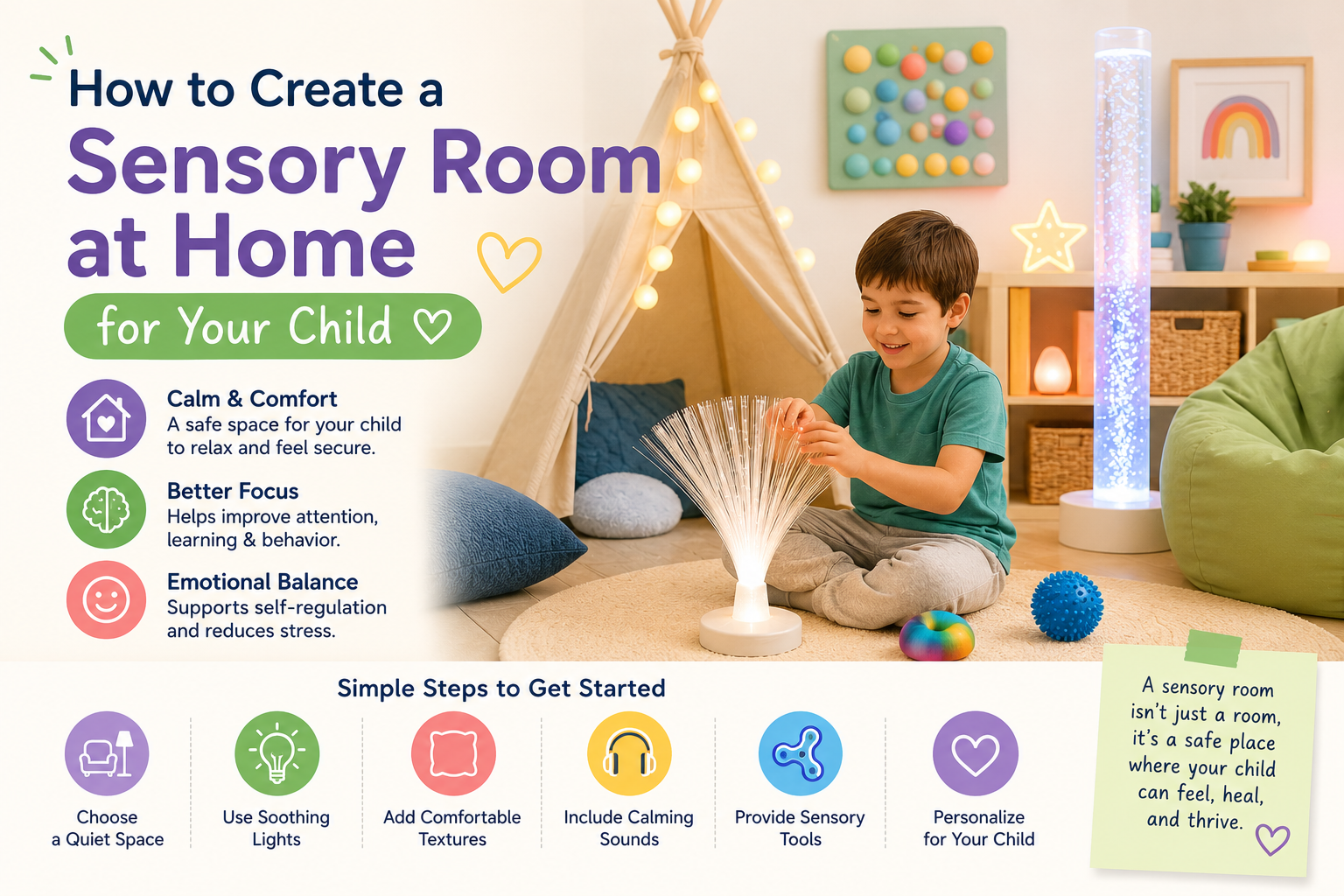
How to Create a Sensory Room at Home for Your Child 🌈
Sensory room ideas at home don’t require a big budget or a spare room — just one small corner with the right lighting, textures, and calming tools can help your child regulate their nervous system. Here’s exactly how to build one, step by step, using research-backed elements. 💙
If your child has ever collapsed onto the floor mid-meltdown while you scrambled to find something, anything, that might help, this guide gives you a real plan — one you can start building this weekend. 🛠️

- What Is a Sensory Room, and Does It Really Help? 🧠
- Real Research: What the Data Tells Us About Sensory Spaces 📊
- A Real Parent Story: The Closet That Became a Calm-Down Corner 👨👧
- How to Create a Sensory Room at Home: Step-by-Step 🛠️
- Step 1: Choose the Right Space 📍
- Step 2: Control the Lighting 💡
- Step 3: Add Deep-Pressure Tools 🫂
- Step 4: Include Tactile Elements 🧸
- Step 5: Manage Sound Carefully 🔊
- Step 6: Add a Physical Movement Option 🤸
- Step 7: Personalize With Your Child’s Preferences 🎨
- Sensory Room Elements by Sensory Need: Quick Reference 📋
- Budget-Friendly Sensory Room Ideas at Home 💰
- What Most Sensory Room Guides Miss ⚠️
- Voice Search Quick Answers 🎙️
- Frequently Asked Questions ❓
- 1. What are the best sensory room ideas at home for a small space or apartment?
- 2. How much does it cost to build a sensory room at home?
- 3. What sensory room equipment is best for children who seek movement input?
- 4. Can a sensory room help with autism meltdowns specifically?
- 5. How do I know what sensory elements my child actually needs?
- 6. Should a sensory room be used only during meltdowns, or regularly?
- Final Thoughts: A Small Space With Big Impact 💛
What Is a Sensory Room, and Does It Really Help? 🧠
A sensory room, also called a multisensory environment (MSE), is a dedicated space designed to either calm an overwhelmed nervous system or provide safe sensory input a child is seeking. Clinically, these spaces are often called Snoezelen rooms, a term combining Dutch words for “sniffing” and “dozing.”
Here’s the encouraging part: research on multisensory environments shows real, measurable benefits. A pilot study using multisensory environments with autistic preschoolers found significant improvements in tactile, taste, and smell behaviors, along with gross motor skills, after structured MSE-integrated intervention. A broader systematic review also found that multisensory environments helped reduce stereotypic behaviors and improve sustained attention in autistic children and adults.
In simple terms: a well-designed sensory room isn’t just a cute idea — it’s a legitimate, evidence-supported regulation tool. 🎯
Real Research: What the Data Tells Us About Sensory Spaces 📊
| Statistic | What It Means for Parents | Source |
|---|---|---|
| 5% to 16% of school-aged children show signs of sensory processing differences | Sensory support tools help a large number of children, not just those with an autism diagnosis | UC San Francisco Research, 2013 |
| A pilot study found significant improvement in tactile, taste, and smell behaviors, plus gross motor skills, after MSE-integrated intervention | Sensory room use can create measurable developmental gains, not just temporary calm | PMC, Multi-Sensory Environment Study, 2024 |
| A systematic review found multisensory environments reduced stereotypic behavior frequency in multiple studies | Structured sensory spaces may help reduce repetitive behaviors tied to overwhelm | PMC, Systematic Review of MSE and ASD, 2025 |
| MSE interventions showed positive effects on sustained attention and aggressive behaviors across multiple included studies | A calming sensory space may support both focus and emotional regulation | PubMed, Systematic Review, 2025 |
💡 Key insight: Even a small, home-built sensory space follows the same core principles researchers use in clinical multisensory rooms — controlled, adjustable sensory input.
A Real Parent Story: The Closet That Became a Calm-Down Corner 👨👧
Marcus, father of a 6-year-old daughter with sensory processing disorder, didn’t have a spare room to dedicate to a sensory space. What he had was an underused closet.
“I cleared it out, threw in a beanbag, hung fairy lights, and added a small speaker for white noise,” he said. “I honestly thought it was too small to matter.”
Within the first week, his daughter started asking to go to her “cozy spot” whenever she felt overwhelmed, instead of melting down in the middle of the living room. Marcus later added a soft weighted blanket and a basket of fidget tools.
“It cost me under $60 total,” he shared. “The transformation wasn’t in the size of the space. It was in giving her somewhere predictable to go when her body needed a reset.”
Marcus’s advice to other parents: “You don’t need a Pinterest-perfect room. You need one corner your child trusts.” 💛
How to Create a Sensory Room at Home: Step-by-Step 🛠️

Step 1: Choose the Right Space 📍
You don’t need a full room. A closet, corner of a bedroom, or even a curtained-off nook works well. Prioritize a quiet location, away from high-traffic areas of the home.
Step 2: Control the Lighting 💡
Bright, fluorescent lighting overstimulates many children. Use dimmable lamps, string lights, or a lava lamp for gentle, adjustable visual input.
Step 3: Add Deep-Pressure Tools 🫂
Weighted blankets, compression items, and body socks provide calming deep-pressure input, one of the most consistently helpful sensory tools for regulation.
Step 4: Include Tactile Elements 🧸
Textured cushions, sensory bins with rice or sand, and soft fabrics give hands something safe to explore, supporting the tactile behaviors research links to MSE benefits.
Step 5: Manage Sound Carefully 🔊
Offer noise-cancelling headphones for sound-sensitive moments, and consider white noise or calming instrumental music for children who find rhythmic sound soothing instead.
Step 6: Add a Physical Movement Option 🤸
A mini trampoline, swing, or crash pad supports proprioceptive input (body-position awareness), which many sensory-seeking children need regularly throughout the day.
Step 7: Personalize With Your Child’s Preferences 🎨
Every child’s sensory profile is different. Some seek stimulation; others need to escape it. Watch what calms your specific child and build the space around their real preferences, not a generic template.
Sensory Room Elements by Sensory Need: Quick Reference 📋
| Sensory Need | Helpful Additions | Why It Works |
|---|---|---|
| Visual sensitivity | Dimmable lights, blackout curtains, lava lamp | Reduces overstimulating brightness and flicker |
| Sound sensitivity | Noise-cancelling headphones, white noise machine | Blocks or softens overwhelming background noise |
| Tactile seeking | Textured cushions, sensory bins, fidget tools | Provides safe, exploratory touch input |
| Deep pressure needs | Weighted blanket, compression vest, bean bag | Calms the nervous system through firm pressure |
| Movement/proprioceptive needs | Mini trampoline, swing, crash pad | Supports body-awareness and energy release |
| Smell sensitivity | Unscented products, good ventilation | Avoids overwhelming or triggering scent exposure |
Budget-Friendly Sensory Room Ideas at Home 💰
You don’t need expensive clinical equipment to build an effective space. Try these low-cost swaps:
- Fairy lights instead of a commercial bubble tube
- A DIY sensory bin using rice, beans, or dried pasta instead of store-bought kits
- A homemade weighted lap pad using rice-filled fabric pouches
- A repurposed closet or curtained corner instead of a dedicated room
- A yoga mat and pillows instead of a specialized crash pad
- A thrifted bean bag chair for deep-pressure seating
Building sensory room ideas at home doesn’t require a large budget — it requires understanding what specifically calms or regulates your child. 🌟
What Most Sensory Room Guides Miss ⚠️
- They assume every child wants the same sensory input. Some children need calming, low-stimulation spaces. Others genuinely need active, movement-heavy sensory input to regulate. Know which type your child is before designing the space.
- They forget to involve the child in the process. Letting your child choose colors, textures, or a name for their space increases their sense of ownership and comfort using it.
- They skip maintenance and rotation. Sensory preferences change over time. Rotate tools every few months to keep the space effective, rather than assuming a one-time setup will work forever.
- They rarely mention using the space preventatively. A sensory room works best as a regular regulation tool, used before overwhelm peaks, not only as an emergency meltdown response.
Voice Search Quick Answers 🎙️
“How do I make a sensory room at home on a budget?”
Use a small space like a closet or corner, add dimmable lighting, textured cushions, a weighted blanket, and noise-cancelling headphones, choosing low-cost items like fairy lights and DIY sensory bins to keep costs down.
“What should be included in a sensory room for autism?”
Effective elements often include adjustable lighting, deep-pressure tools like weighted blankets, tactile items, noise control options, and movement equipment such as a small trampoline or swing.
“Do sensory rooms actually help calm meltdowns?”
Research shows multisensory environments can reduce stereotypic behaviors and improve sustained attention, making them a genuinely helpful, evidence-supported regulation tool for many children.
Frequently Asked Questions ❓
1. What are the best sensory room ideas at home for a small space or apartment?
A closet, curtained corner, or even a tent-covered nook can work well. Focus on portable elements like dimmable lights, a weighted lap pad, and a small basket of textured or fidget tools.
2. How much does it cost to build a sensory room at home?
Costs vary widely, but budget-friendly setups using DIY sensory bins, thrifted seating, and fairy lights can be built for under $100, while more elaborate setups with commercial equipment cost significantly more.
3. What sensory room equipment is best for children who seek movement input?
Mini trampolines, indoor swings, crash pads, and body socks support proprioceptive and vestibular input, which movement-seeking children often need regularly throughout the day.
4. Can a sensory room help with autism meltdowns specifically?
Research on multisensory environments shows reductions in stereotypic behaviors and improved sustained attention, suggesting sensory rooms can be a helpful preventative and calming tool for meltdown-prone children.
5. How do I know what sensory elements my child actually needs?
Observe your child’s natural preferences: do they seek out touch, movement, and stimulation, or do they avoid noise and bright light? Their existing patterns are the best guide for what to include.
6. Should a sensory room be used only during meltdowns, or regularly?
Regular, preventative use is often more effective than emergency-only use, helping children build a consistent relationship with the space as a regulation tool rather than only a crisis response.
Final Thoughts: A Small Space With Big Impact 💛
Building sensory room ideas at home isn’t about creating a picture-perfect space. It’s about giving your child a place where their nervous system can genuinely rest, reset, and feel understood.
Research backs what many parents already sense intuitively: the right sensory environment can measurably support attention, reduce overwhelming behaviors, and offer real calm. And that calm doesn’t require a big budget or a big room — just thoughtful attention to what your specific child needs.
Start small. One corner, one weighted blanket, one dimmable light. Your child’s calm-down space can grow from there. 🌟


