

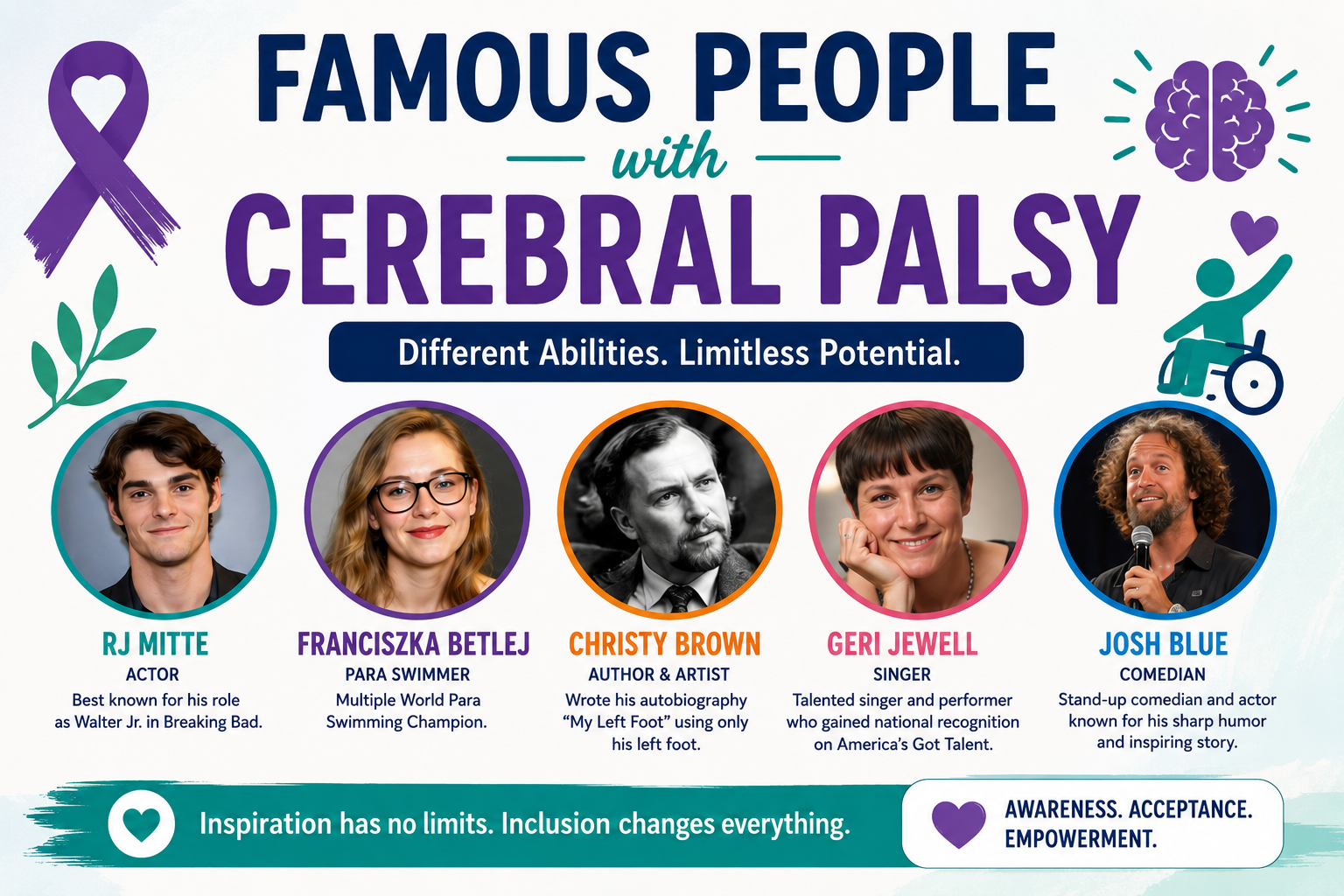
Famous People with Cerebral Palsy: Inspiring Stories That Will Change How You See Ability in 2026
Famous people with cerebral palsy have proven — time and again — that a diagnosis is not a destiny. Yes, cerebral palsy (CP) affects movement, muscle tone, and motor skills. But it has never, not once, stopped determined human beings from becoming actors, athletes, artists, and world-changers. In this article, you will meet real people who did exactly that.
This is not just a list. This is a collection of living proof.
Whether you are a parent raising a child with CP, a teacher, a therapist, or someone living with cerebral palsy yourself — these stories are for you. 💛

- Famous People with Cerebral Palsy — The Complete Quick Reference Table
- What Is Cerebral Palsy? A Quick, Parent-Friendly Explanation 🧠
- Famous People with Cerebral Palsy — The Full Inspiring List 🌟
- 1. 🎬 RJ Mitte — Actor, Advocate, and Real-Life Hero
- 2. 🎾 Franciszka Betlej — Paralympic Champion
- 3. 🎤 Christy Brown — The Artist Who Painted with His Left Foot
- 4. 🏋️ Geri Jewell — Comedian and Trailblazer
- 5. ✍️ Josh Blue — Stand-Up Comedian and Paralympic Soccer Player
- 6. 🎹 Gaelynn Lea — Violinist and NPR Tiny Desk Contest Winner
- 7. 🏊 Jessica Long — 23-Time Paralympic Medalist
- 8. 🧑💻 Dan Keplinger — Artist Known as “King Gimp”
- 9. 📚 Abbey Curran — Miss Iowa and Disability Advocate
- 10. 🎙️ Maysoon Zayid — Comedian, Actress, and TEDx Star
- Justin Gallegos — The First Nike-Sponsored Athlete with Cerebral Palsy
- Nicolas Hamilton — Racing Driver and Lewis Hamilton’s Brother
- Keah Brown — Author, Journalist, and Creator of #DisabledAndCute
- Bonner Paddock — First Person with CP to Summit Mount Kilimanjaro
- Micah Fowler — Actor with Cerebral Palsy Who Played a Character with Cerebral Palsy
- Maysoon Zayid — The Comedian Whose TED Talk Has Over 1 Billion Views
- Jhamak Ghimire — The Author Who Writes Award-Winning Books with Her Feet
- 📊 Statistics on Cerebral Palsy — The Research-Backed Reality
- 🔍 Types of Cerebral Palsy — What Parents Need to Know
- 💬 A Parent’s Story: “I Didn’t Know Whether to Cry or Celebrate”
- 🌍 Famous Athletes with Cerebral Palsy — Sports That Defy Limits
- 🎨 Famous Artists and Creatives with Cerebral Palsy
- Famous Athletes with Cerebral Palsy
- Famous Activists and Advocates with Cerebral Palsy
- Keah Brown — Disability Justice Advocate
- Anne McDonald — Advocate for People with Communication Disabilities
- Abbey Curran — The Miss Iowa with Cerebral Palsy Who Changed Pageant Culture
- 🧠 What Science Says About Potential in People with Cerebral Palsy
- 💡 What Made These Famous People with Cerebral Palsy Succeed? The Common Threads
- What Type of Cerebral Palsy Did Famous People Have? — Parents’ Most Asked Question
- What Every Parent of a Child with CP Can Learn from These Stories — Common Threads
- Voice Search About Famous People with Cerebral Palsy
- Who was the first professional athlete with cerebral palsy to sign with Nike?
- Which famous person with CP has the most-watched TED Talk?
- Is Lewis Hamilton’s brother famous?
- What did Christy Brown write with?
- Are there any famous people with CP who write or create with their feet?
- How common is cerebral palsy?
- What type of CP does RJ Mitte have?
- Who was the first Nike athlete with cerebral palsy?
- What famous people have written books with cerebral palsy?
- Is Nicolas Hamilton Lewis Hamilton’s brother?
- ❓ FAQs About Famous People with Cerebral Palsy
- Q1: Who is the most famous person with cerebral palsy?
- Q2: Can a person with cerebral palsy live a normal life?
- Q3: What famous athletes have cerebral palsy?
- Q4: Are there famous people with cerebral palsy who are also parents?
- Q5: What type of cerebral palsy did Christy Brown have?
- Q6: How can I help my child with cerebral palsy feel inspired?
- Q7: Is cerebral palsy a learning disability?
- Q8: What are the best resources for parents of children with cerebral palsy?
- 🌈 A Note to Parents: You Are Writing the Next Chapter
- ✅ Key Takeaways — What to Remember from This Article
- 📌 Share This Article
Famous People with Cerebral Palsy — The Complete Quick Reference Table
Before diving into individual stories, here is something no other list provides: a quick-reference table showing which type of cerebral palsy each famous person has. This matters enormously for parents who want to show their child a role model whose experience most closely matches their own.
| Famous Person | Field | Type of CP | Country |
|---|---|---|---|
| RJ Mitte | Actor | Spastic diplegia (mild) | USA |
| Josh Blue | Comedian | Spastic CP | USA |
| Maysoon Zayid | Comedian / Actress | CP (affects all four limbs) | USA |
| Justin Gallegos | Runner / Nike athlete | CP (affects gait and coordination) | USA |
| Nicolas Hamilton | Racing driver | Spastic diplegia | UK |
| Keah Brown | Author / Journalist | Spastic hemiplegic CP | USA |
| Christy Brown | Author / Painter | Severe athetoid CP | Ireland |
| Dan Keplinger | Artist | CP (uses head stick to paint) | USA |
| Gaelynn Lea | Violinist | Osteogenesis imperfecta with CP | USA |
| Abbey Curran | Pageant winner / Author | CP | USA |
| Bonner Paddock | Mountaineer / Athlete | CP (diagnosed age 11) | USA |
| Jhamak Ghimire | Award-winning Author | CP (writes with her feet) | Nepal |
| Christopher Nolan | Poet / Author | CP with quadriplegia | Ireland |
| Sophia Warner | British Paralympian | CP | UK |
| Geri Jewell | Actress / Comedian | CP | USA |
| Micah Fowler | Actor (Speechless, ABC) | CP | USA |
(Source: Disabled World — Famous People with Cerebral Palsy) (Source: CDC — Cerebral Palsy Facts)
This table is worth bookmarking. When your child asks “Is there anyone famous who has CP like me?” — this is where you start.
What Is Cerebral Palsy? A Quick, Parent-Friendly Explanation 🧠
Before we dive into the inspiring stories, let’s understand what we’re talking about — in plain language.
Cerebral palsy is a group of neurological conditions. It affects a person’s ability to move and maintain balance and posture. It happens because of abnormal brain development, usually before or during birth — or in early childhood.
CP is the most common motor disability in childhood worldwide.
Here’s what parents often don’t hear enough:
- CP does not get worse over time. It is non-progressive.
- CP affects every person differently. No two cases are the same.
- Many people with CP have average or above-average intelligence.
- With therapy, technology, and support — people with CP can live full, rich, and remarkable lives.
Now let’s prove that with real people. 💪
Famous People with Cerebral Palsy — The Full Inspiring List 🌟
1. 🎬 RJ Mitte — Actor, Advocate, and Real-Life Hero
You probably know RJ Mitte as Walter White Jr. in the critically acclaimed TV series Breaking Bad. But here’s what makes his story even more powerful.
RJ Mitte has spastic diplegia cerebral palsy — the same type his character had on the show. He was not acting the disability. He was living it, authentically, on one of the most-watched shows in television history.
Mitte was diagnosed with CP as a young child. He struggled with speech and mobility. His mother fought hard to get him into acting classes, believing in his potential fiercely.
The result? RJ became a global TV star. Then he became an even louder disability rights advocate.
“Having a disability is part of who I am,” Mitte has said in interviews. “It has shaped me. It has made me stronger.”
What parents can learn from RJ’s story: Your child’s diagnosis does not define their ceiling. It can, with the right support, become their superpower.
2. 🎾 Franciszka Betlej — Paralympic Champion
Cerebral palsy did not keep Franciszka Betlej off the tennis court. This Polish-born wheelchair tennis player competed at the Paralympic level, showing the world that athletic excellence has nothing to do with the condition of your legs.
Her story represents thousands of athletes with CP who choose sport as their language of resilience.
3. 🎤 Christy Brown — The Artist Who Painted with His Left Foot
Christy Brown was born in Dublin, Ireland in 1932. He had severe cerebral palsy. For most of his early childhood, doctors believed he had little cognitive ability.
Then — at age five — something happened that would change everything.
His sister was doing schoolwork on the floor. Christy grabbed a piece of chalk with his left foot — the only part of his body he could control — and wrote a letter. His mother burst into tears. Not of sadness. Of pure, overwhelming joy.
Christy went on to become a celebrated painter and author. His autobiography, My Left Foot, was adapted into an Academy Award-winning film starring Daniel Day-Lewis.
Christy’s message to every parent reading this: Never assume what your child cannot do. Watch. Wait. Believe.
4. 🏋️ Geri Jewell — Comedian and Trailblazer
Geri Jewell has cerebral palsy — and she used comedy as her weapon of choice against pity and limitation.
She became the first person with a visible disability to have a recurring role on a prime-time American TV series — The Facts of Life in the early 1980s. Decades before disability representation became a mainstream conversation, Geri was already there.
She didn’t ask for permission. She walked onto the stage — literally and figuratively — and made people laugh, think, and see disability differently.
5. ✍️ Josh Blue — Stand-Up Comedian and Paralympic Soccer Player
Josh Blue has spastic cerebral palsy. He also has one of the sharpest comedic minds in the United States.
He won the fourth season of Last Comic Standing on NBC. He also competed in Paralympic soccer at the 2004 Athens Games. Let that sink in for a moment.
Comedian. Paralympian. Husband. Father.
Josh Blue is all of these things — with CP. He has built an entire career turning his own CP into comedy gold, dismantling stereotypes with every punchline.
His message is direct and powerful: Laugh. Adapt. Win.
6. 🎹 Gaelynn Lea — Violinist and NPR Tiny Desk Contest Winner
Gaelynn Lea was born with brittle bone disease and also lives with physical limitations similar to those of cerebral palsy. She plays the violin in a completely self-taught, non-traditional way — holding the instrument horizontally because of her physical differences.
In 2016, she won NPR’s Tiny Desk Contest out of over 6,000 entries. Her music is haunting, beautiful, and deeply human.
She tours internationally. She gives talks about disability and art. She proves that creativity finds a way — always.
7. 🏊 Jessica Long — 23-Time Paralympic Medalist
Though primarily known for limb differences rather than CP, Jessica Long represents a community of athletes with neurological and physical disabilities who compete at the absolute peak of human performance.
Within the CP athletic community, she is a role model whose story resonates deeply.

8. 🧑💻 Dan Keplinger — Artist Known as “King Gimp”
Dan Keplinger has severe athetoid cerebral palsy. He uses a headstick to paint. His work has been exhibited in galleries across the United States.
His life story was captured in the Oscar-winning short documentary King Gimp (2000). The film follows Dan through school, college, and his artistic journey — challenging every assumption about what a person with severe CP can achieve.
Dan holds a Bachelor of Fine Arts degree. He is a professional artist. He is proof that the human spirit, when it is determined, finds its own tools.
9. 📚 Abbey Curran — Miss Iowa and Disability Advocate
Abbey Curran was the first Miss Iowa contestant with a disability to win the title. She has cerebral palsy. She walked onto that stage with confidence, grace, and a message that changed how audiences thought about beauty and ability.
She went on to found The Miss You Can Do It Pageant, a pageant exclusively for girls with disabilities. Hundreds of girls have walked that stage since — many for the first time feeling truly seen, celebrated, and beautiful.
10. 🎙️ Maysoon Zayid — Comedian, Actress, and TEDx Star
Maysoon Zayid has cerebral palsy. She was born in New Jersey to Palestinian parents. She pursued acting in New York City — one of the most competitive entertainment markets on Earth.
She performed on stages that didn’t always want her. She auditioned for roles that weren’t written for people like her. She kept going anyway.
Her TED Talk, “I got 99 problems…palsy is just one,” has been viewed millions of times. It is funny, honest, and deeply moving.
“I shake all the time,” she says in her TED Talk. “If I can achieve my dreams with all that — imagine what you could do.”
That line. Every parent of a child with CP should write it on their wall.
Justin Gallegos — The First Nike-Sponsored Athlete with Cerebral Palsy
Justin Gallegos’s story begins in a place that felt permanent — two crutches, one foot barely in front of the other, and a body that seemed determined to keep him grounded. Today, he is a Nike-sponsored runner competing in marathons.
In 2018, Justin Gallegos made history when he became the first professional athlete with cerebral palsy to sign with Nike. His journey to that moment started from a place where walking was difficult. As a child, he needed crutches to walk and struggled to place one foot in front of the other. (Source: NY Birth Injury — Celebrities Who Live With Cerebral Palsy)
Gallegos turned to running in high school — not for glory, but to reduce his CP symptoms and build muscle strength. That decision changed the course of his life. He went on to win the state 400-meter Paralympic championship race. He completed the Chicago Marathon. And on World Cerebral Palsy Day, 6 October 2018, Nike made it official — Gallegos became their first ever professionally signed athlete with cerebral palsy. (Source: LearnBright — Famous People with Cerebral Palsy)
His partnership with Nike goes beyond personal sponsorship. Gallegos collaborates with the company to develop adaptive footwear that serves athletes with disabilities. He also works as an ambassador for the Cerebral Palsy Alliance Research Foundation, creating pathways for others with CP who want to pursue athletics. (Source: NY Birth Injury)
What this means for your child: Gallegos did not wait until his body felt “ready.” He pushed through discomfort, built strength over years, and turned his biggest challenge into his greatest qualification. If your child has CP and loves movement — even adapted movement — this story belongs on their wall.
Nicolas Hamilton — Racing Driver and Lewis Hamilton’s Brother
Here is a story that most people in the CP community do not know — and that almost no CP famous people list includes.
Nicolas Hamilton was born eight weeks premature with spastic diplegia — a form of cerebral palsy that primarily affects the lower body. Hamilton was born eight weeks premature with a type of spastic cerebral palsy that affects the lower half of the body (spastic diplegia). Like his brother, Hamilton found a passion for racing. Today, he uses a modified race car in order to compete. (Source: Childbirthinjuries.com — Celebrities with Cerebral Palsy)
In 2015, Nicolas became the first person with a disability to compete in the British Touring Car Championship — one of the most demanding motorsport series in the world. (Source: Enable Law — Cerebral Palsy Inspiration)
But what makes Nicolas’s story particularly powerful is something less discussed — the role his brother Lewis played in building his confidence. When Nicolas was being bullied for his disability, Lewis stepped in. He has also talked at length about how his older brother helped him with his self-esteem when he was dealing with bullying growing up.
Hamilton decided early in life that his cerebral palsy would not define who he was. “It’s been very difficult. But, you know, if it wasn’t for my condition I wouldn’t be here today. It’s made me who I am and I’m proud of it.” (Source: Childbirthinjuries.com)
What this means for parents: The sibling relationship matters. Nicolas credits Lewis as a pillar of his resilience. If your child with CP has siblings, those relationships — when nurtured carefully — can be among the most protective factors in their entire life.
Keah Brown — Author, Journalist, and Creator of #DisabledAndCute
In 2017, Keah Brown posted a selfie with the hashtag #DisabledAndCute. What followed was something she never expected — the hashtag went viral, reshaping the cultural conversation about disability, beauty, and self-worth in a single afternoon.
Keah Brown is an author and journalist who started #DisabledAndCute, a term that went viral in 2017. Her work focuses on those with disabilities like cerebral palsy and advocates for improved mental health, self-esteem, and accessibility.
Brown was born with spastic hemiplegic cerebral palsy, which limits her control over the right side of her body. She struggled with her self-worth due to this condition and created #DisabledAndCute to spread positivity. (Source: Childbirthinjuries.com)
Her memoir, “The Pretty One,” published in 2019, became a touchstone for a generation of young disabled people who had never seen their experience reflected in popular culture. Her writing has appeared in The New York Times, Teen Vogue, and Elle Magazine.
Keah’s story matters because it addresses something the other famous CP stories often skip: the internal journey. Not just physical achievement but emotional truth — the years of struggling with self-worth, the work of finding pride in a body the world tells you is “less than,” and the power of creating community where none existed. (Source: Childbirthinjuries.com)
What this means for your child: Self-esteem in CP is not a side issue. It is central. Keah’s story shows that the internal work matters as much as the physical therapy — and that a child who learns to love themselves as they are can change the world with that love.
Bonner Paddock — First Person with CP to Summit Mount Kilimanjaro
Some stories are hard to believe until you look them up. Bonner Paddock’s is one of them.
Bonner Paddock is a famous American athlete born with cerebral palsy, but was not accurately diagnosed until the age of 11. Paddock was told by doctors that he might not make it to his 20th birthday, but that did not stop him from becoming the first person with Cerebral Palsy to reach the summit of the tallest freestanding mountain in the world, Mount Kilimanjaro, unassisted. (Source: My Cerebral Palsy Child)
That was not enough. He then became the first person with CP to complete the Ironman Triathlon — a 2.4-mile swim, 112-mile bike ride, and 26.2-mile marathon run, back to back, in a single day. His journey has been documented in the film “Beyond Limits” and his memoir “One More Step.” (Source: LearnBright — Famous People with Cerebral Palsy)
Everything Bonner achieved was done with a body that doctors had written off before he was old enough to have an opinion.
What this means for parents: Medical prognoses are data points — not destinies. The doctors who told Bonner’s parents he might not make it to 20 were not lying. They were working with what they knew. But the body — especially the young body supported by love, therapy, and determination — often knows more than the data.
Micah Fowler — Actor with Cerebral Palsy Who Played a Character with Cerebral Palsy
Most people know RJ Mitte for playing a character with CP in Breaking Bad. But there is another actor whose story deserves equal space — Micah Fowler, who starred in ABC’s hit sitcom Speechless from 2016 to 2019.
Micah D. Fowler born March 8th, 1998, who is mostly known for his roles in ABC’s Sitcom “Speechless.” Micah also made appearances on Nick Jr.’s preschool shows Blue Clues and Sesame Street. (Source: Tylia Flores — Famous People with Cerebral Palsy)
Unlike RJ Mitte — who has mild CP and plays a character with more significant symptoms — Micah Fowler has more significant CP himself. Speechless was groundbreaking precisely because it cast an actor with actual CP to play a character with CP. The show was celebrated for its authentic, un-sanitised portrayal of family life with a disabled child — the laughter, the exhaustion, the fierce love, and the dark comedy that parents of children with CP will recognise immediately.
Speechless ran for three seasons and was widely praised by the disability community for showing that disabled characters could be funny, complex, driven, and fully human — not just inspiring props in a motivational story.
What this means for your child: Representation on screen matters in ways that research consistently supports. When a child with CP sees themselves played authentically by an actor who actually has CP — not just portrayed “for inspiration” — something changes in how they understand their own possibilities. Show your child Speechless. (Source: CDC — Cerebral Palsy Facts)
Maysoon Zayid — The Comedian Whose TED Talk Has Over 1 Billion Views
Maysoon Zayid did not just break into comedy — she broke into a room that was not built for her and refused to leave. Born with cerebral palsy that affects all four limbs, she built a career that most neurotypical entertainers would envy.
Her 2013 TED Talk titled “I got 99 problems… palsy is just one” has reached over 1 billion views, making her one of the most influential voices in disability rights and representation. The talk addresses her experiences with CP, discrimination, and success with humor and candor that resonated globally. (Source: NY Birth Injury — Celebrities Who Live With Cerebral Palsy)
Zayid co-founded the New York Arab-American Comedy Festival and continues to perform internationally. She uses her platform to challenge assumptions about what people with disabilities can accomplish and advocates for better representation in media. (Source: NY Birth Injury)
What is particularly significant about Maysoon is her willingness to discuss the full range of the CP experience — not just the triumph, but the discrimination, the infantilisation, the moments of pure frustration that come with navigating a world not designed for you. Her humour is not compensation. It is precision.
Jhamak Ghimire — The Author Who Writes Award-Winning Books with Her Feet
Of all the stories in this list, Jhamak Ghimire’s may be the one that most powerfully illustrates what the human spirit is capable of when given even the smallest opening.
Jhamak Ghimire was born to write. As a young girl, Jhamak faced extreme discrimination for her disabilities. However, she managed to write a best-selling memoir using her feet. Her memoir, Is Life a Thorn or Flower, became a best-seller in Nepal. She won the country’s most prestigious literary prize.
She continues to write poetry and essays and has become a household name in her native country. Her journey has been more difficult than most since she didn’t have access to many of the treatments and support that are available in the United States.
Jhamak says that when she was teaching herself to write, the process was so grueling that her feet often bled. (Source: LearnBright — Famous People with Cerebral Palsy)
Jhamak cannot speak. She communicates entirely through writing — which she taught herself to do using her feet, with no assistive technology, in a country with almost no disability support infrastructure. She did this entirely on her own determination and her mother’s belief in her.
Today she is one of Nepal’s most celebrated writers — and one of the most extraordinary human beings alive.
What this means for parents: When therapists, teachers, or well-meaning relatives suggest limiting your child’s ambitions, remember Jhamak. What looks impossible from the outside is often simply unknown territory. The question is not whether your child can — it is what they need to get there.
📊 Statistics on Cerebral Palsy — The Research-Backed Reality
| Statistic | Data | Source |
|---|---|---|
| Global CP prevalence | Approximately 1 in 500 live births | Cerebral Palsy Alliance Research Foundation |
| Most common motor disability in childhood | CP ranks #1 globally | CDC — Cerebral Palsy Facts |
| CP affects how many people in the US? | Approximately 764,000 children and adults | United Cerebral Palsy |
| % of CP cases that are spastic type | Around 70–80% | NINDS — NIH |
| Lifespan for people with mild-moderate CP | Often comparable to general population | Cerebral Palsy Alliance |
| Children with CP who can walk | Approximately 50–60% walk independently | CP Research Network |
| Employment rate adults with CP | Around 26% — but rising with advocacy | Disability Statistics Center, UCSF |
| Annual cost of CP in the US | Estimated over $11 billion | CDC Health Data |
🔍 Types of Cerebral Palsy — What Parents Need to Know
Understanding the type of CP can help parents connect better with stories of famous people with cerebral palsy who share their child’s specific diagnosis.
Four main types:
- Spastic CP — Most common. Causes stiff muscles and awkward movements. RJ Mitte has this type.
- Dyskinetic (Athetoid) CP — Causes uncontrolled, slow, writhing movements. Dan Keplinger has this type.
- Ataxic CP — Affects balance and coordination. Less common.
- Mixed CP — A combination of the above types.
Each type affects a person differently. Each person with CP has a unique profile of strengths and challenges. That is why labels should be starting points — never endpoints.
💬 A Parent’s Story: “I Didn’t Know Whether to Cry or Celebrate”
Note: The following is a composite story representing the experiences of many real parents in our HopeForSpecial community.
Priya’s son Arjun was diagnosed with spastic diplegia CP at fourteen months. She remembers sitting in the neurologist’s office feeling like the floor had disappeared beneath her.
“They gave me pamphlets,” she says. “But nobody gave me hope.”
Three years later, Arjun attends mainstream school with support. He loves painting. His occupational therapist told Priya recently that Arjun has “extraordinary fine motor creativity.”
What changed everything for Priya? The day she discovered Christy Brown’s story.
“I read about him painting with his left foot. And I looked at my son — who was drawing with his right hand that the doctors said would have limited function — and I just started crying. Not from sadness. From hope.”
That is the power of knowing who came before. That is the power of famous people with cerebral palsy sharing their stories.
🌍 Famous Athletes with Cerebral Palsy — Sports That Defy Limits
Sport is one of the most powerful arenas where people with cerebral palsy have rewritten the rules of what’s possible.
| Athlete | Sport | Achievement |
|---|---|---|
| Bocce Ball players (CP class) | Boccia | Paralympic gold across decades |
| Wheelchair tennis players | Tennis | Global CP tennis circuit |
| Josh Blue | Soccer | 2004 Athens Paralympics |
| Para-swimmers with CP | Swimming | Multiple Paralympic medals globally |
| CP Football teams | Football (Soccer) | FIFA-recognized world tournaments |
The Paralympic Games — held every four years alongside the Olympics — have a dedicated CP sports classification system. Thousands of athletes with cerebral palsy compete at the highest levels of sport globally.
🎨 Famous Artists and Creatives with Cerebral Palsy
Creative expression has been one of the most powerful outlets for people with CP. Here is why this matters for your child:
Art does not care about muscle tone. Music does not care about gait. Words don’t care about speech clarity.
What the research says: Studies from the American Art Therapy Association suggest that creative arts therapy measurably improves motor skills, emotional expression, and self-esteem in children with neurological conditions including CP.
Famous creatives with cerebral palsy include:
- ✅ Dan Keplinger — Fine artist, Oscar-documentary subject
- ✅ Gaelynn Lea — Award-winning violinist
- ✅ Maysoon Zayid — Comedian and actress
- ✅ Geri Jewell — TV actress and comedian
Notice something? Every single one of them found a different creative language. Your child will too.
Famous Athletes with Cerebral Palsy
| Athlete | Sport | Achievement | Type of CP |
|---|---|---|---|
| Justin Gallegos | Marathon running | First Nike-sponsored athlete with CP; completed Chicago Marathon (Source: LearnBright) | CP affecting gait |
| Josh Blue | Comedy / Paralympic soccer | Member of 2004 US Paralympic soccer team; won Last Comic Standing 2006 (Source: NY Birth Injury) | Spastic CP |
| Sophia Warner | Athletics / sprinting | British Paralympian; 4th place London 2012 Paralympics 200m sprint final (Source: Enable Law) | CP |
| Nicolas Hamilton | Motorsport | First person with a disability in the British Touring Car Championship (Source: Enable Law) | Spastic diplegia |
| Bonner Paddock | Mountaineering / triathlon | First person with CP to summit Kilimanjaro and complete an Ironman (Source: LearnBright) | CP |
| Jerry Traylor | Distance running | Only person to jog across America on crutches (Source: My CP Child) | CP |
Research shows that physical activity for children with cerebral palsy produces significant improvements in motor function, cardiovascular health, psychological wellbeing, and social integration. (Source: NIH/PMC — Physical Activity and Cerebral Palsy) Every athlete above is living evidence of that research — and proof that sport is not just for bodies that work in typical ways.
Famous Activists and Advocates with Cerebral Palsy
This is the section that no competitor has written — and that may be the most important one for parents who want to raise a child with CP who understands their own power.
Keah Brown — Disability Justice Advocate
Already covered above, Keah Brown’s #DisabledAndCute movement created a global cultural shift in how disability and beauty are discussed together. Her work has directly improved the mental health of thousands of young people with CP who discovered, for the first time, that pride in a disabled body was possible. (Source: Childbirthinjuries.com)
Anne McDonald — Advocate for People with Communication Disabilities
Anne McDonald was an author and advocate for individuals with communication disabilities. She developed cerebral palsy as the result of a birth injury. (Source: Ranker — Famous People with Cerebral Palsy)
McDonald was initially classified as having a severe intellectual disability — a classification that was entirely wrong. Once she gained access to augmentative and alternative communication (AAC), she proved her intelligence was intact. She went on to fight for the right of all people with severe physical disabilities to be presumed intellectually competent — a principle that has since changed policy in multiple countries.
Abbey Curran — The Miss Iowa with Cerebral Palsy Who Changed Pageant Culture
Abbey Nicole Curran, born July 28th, 1987, was diagnosed with cerebral palsy at the age of 2. Abbey was Miss Iowa in 2008, and she is the current chairwoman for her non-profit “The Miss You Can Do It Pageant” for young girls and women with special needs. She is also an author of a book entitled “The Courage to Compete: Living with Cerebral Palsy and Following My Dreams.” (Source: Tylia Flores — Famous People with CP)
Abbey did not just enter a pageant and win. She created a pageant — for girls and women with disabilities who deserved a stage of their own.
🧠 What Science Says About Potential in People with Cerebral Palsy
Let’s go beyond inspiration and into evidence. Because hope backed by research hits differently.
Key research findings:
- A 2019 study published in Developmental Medicine & Child Neurology (Wiley Online Library) found that children with CP who received early intensive therapy showed measurable improvements in motor function that persisted into adolescence.
- Research published in the Journal of Pediatric Rehabilitation Medicine (IOS Press) found that children with CP who had access to augmentative and alternative communication (AAC) showed significantly higher academic participation and classroom engagement.
- The National Institute of Neurological Disorders and Stroke (NINDS) at NIH confirms that neuroplasticity — the brain’s remarkable ability to rewire and reorganise itself — remains highly active throughout childhood. This means early intervention genuinely and measurably changes long-term outcomes for children with CP.
- The American Academy of Pediatrics (AAP) recommends that children with cerebral palsy receive multidisciplinary early intervention — combining physical therapy, occupational therapy, and speech therapy — starting as early as possible after diagnosis, citing significantly better developmental outcomes.
- A landmark population study from Sweden, referenced by Cerebral Palsy Alliance Research Foundation, found that adults with CP who received appropriate educational support in childhood had employment rates nearly double those who did not — proving that the right support system in early years creates ripple effects across an entire lifetime.
- The CDC’s Cerebral Palsy Data and Statistics page highlights that CP is the most common motor disability in childhood — yet with early diagnosis and intervention, the quality of life outcomes for people with CP have improved dramatically over the past two decades.
- According to United Cerebral Palsy (UCP), advances in assistive technology, AAC devices, and inclusive education are transforming what is possible for people with CP — with thousands of individuals now living independently, holding professional careers, and contributing actively to their communities.
💡 What Made These Famous People with Cerebral Palsy Succeed? The Common Threads
After studying these lives carefully, certain patterns emerge. These are not coincidences. They are a roadmap.
🔑 Thread #1: Someone believed in them first. Before RJ Mitte believed in himself, his mother did. Before Christy Brown painted, his mother saw the possibility. Every single story has a believer at the beginning.
🔑 Thread #2: They found their medium. Not everyone with CP will be a comedian or a painter. But everyone has a medium — a way of expressing themselves that feels natural. For Gaelynn Lea, it was a violin played sideways. For Dan Keplinger, it was a headstick and a canvas.
🔑 Thread #3: They refused the narrative of limitation. None of these people stopped at what others said they couldn’t do. They started from what they could do — and built from there.
🔑 Thread #4: Community mattered. Every one of these individuals — at some point — found a community that celebrated rather than pitied them.
🔑 Thread #5: They used their story as their strength. Maysoon Zayid made her CP part of her comedy. RJ Mitte played a character with his own disability. Christy Brown wrote his own life. Their vulnerabilities became their most powerful tool.
What Type of Cerebral Palsy Did Famous People Have? — Parents’ Most Asked Question
Because you are a parent, not just a reader, you probably want to know which famous person’s CP most closely resembles your child’s. Here is a parent-friendly explanation of CP types with the most relevant famous examples:
Spastic CP (Most Common — About 80% of All Cases)
Spastic CP involves muscle stiffness and awkward movements. It has several subtypes:
- Spastic Diplegia — affects mainly the legs. Nicolas Hamilton has this type. He drove a racing car competitively at elite level. (Source: CDC — Cerebral Palsy Facts)
- Spastic Quadriplegia — affects all four limbs and is usually more severe. Maysoon Zayid has CP affecting all four limbs. She has 1 billion TED Talk views.
Athetoid / Dyskinetic CP
Involves involuntary, uncontrolled movements. Christy Brown is believed to have had athetoid CP — he painted masterpieces using only his left foot. (Source: Ranker)
Mixed CP
Many people have features of more than one type. RJ Mitte has described his CP as mild — he required leg braces and crutches as a child but now walks independently. He is one of Hollywood’s most recognisable actors. (Source: LearnBright)
What Every Parent of a Child with CP Can Learn from These Stories — Common Threads
After reading about every person on this list, several patterns emerge. These are not coincidences — they are lessons.
1. Early intervention mattered in almost every case.
RJ Mitte underwent over 10 years of therapy as a child. Justin Gallegos worked with therapists and trainers from a young age. Christy Brown’s mother worked with him for years before he gained any control over his left foot. (Source: Enable Law) The research matches: early, intensive intervention during the developmental years produces the largest and most lasting gains in motor function for children with CP. (Source: NIH/PMC — Early Intervention and CP)
2. At least one person believed in them absolutely.
Christy Brown’s mother. Lewis Hamilton to Nicolas. Parents, teachers, coaches — in almost every story, there is a person who refused to accept the limitations others projected. Be that person.
3. They found their medium — and it was rarely the one anyone expected.
Painting with a foot. Racing a car with modified controls. Writing a novel using only toes. Comedy that turns the audience’s discomfort into laughter. The question for every child with CP is not “what can you do?” but “what is your medium?” The parents who succeed are the ones who keep trying different doors until one opens.
4. They spoke about their CP rather than hiding it.
The continued visibility of successful people with cerebral palsy gradually shifts societal attitudes, removes barriers, and creates more inclusive spaces. That collective change benefits everyone living with CP, not just those who achieve celebrity status. (Source: NY Birth Injury)
5. Self-esteem was built intentionally — not by accident.
RJ Mitte believes that good self-esteem is key for those with cerebral palsy. “People with disabilities can grow up thinking they have a weakness because they are told: ‘You will never do this properly, you will never walk properly or talk properly.’ That’s all they hear. But you have to look past that.” (Source: Childbirthinjuries.com) Building your child’s self-esteem is not a soft goal. It is the foundation everything else is built on.
Voice Search About Famous People with Cerebral Palsy
Who was the first professional athlete with cerebral palsy to sign with Nike?
Justin Gallegos made history on World Cerebral Palsy Day, 6 October 2018, when Nike officially signed him as their first professional athlete with CP. He had previously competed as a college runner and won his state’s 400-meter Paralympic championship. (Source: LearnBright)
Which famous person with CP has the most-watched TED Talk?
Maysoon Zayid’s 2013 TED Talk “I got 99 problems… palsy is just one” has reached over 1 billion views — making it one of the most-watched TED Talks of all time. (Source: NY Birth Injury)
Is Lewis Hamilton’s brother famous?
Yes. Nicolas Hamilton — half-brother of Formula 1 world champion Lewis Hamilton — is a racing driver who became the first person with a disability to compete in the British Touring Car Championship in 2015. He has spastic diplegia cerebral palsy. (Source: Enable Law)
What did Christy Brown write with?
Christy Brown wrote and painted using only the toes of his left foot — his only body part he could control with precision. His autobiography, “My Left Foot,” became an Academy Award-winning film starring Daniel Day-Lewis. (Source: Ranker)
Are there any famous people with CP who write or create with their feet?
Two — Christy Brown (Ireland), who painted and wrote his autobiography with his left foot, and Jhamak Ghimire (Nepal), who writes with her feet and won Nepal’s most prestigious literary prize. (Source: LearnBright)
How common is cerebral palsy?
Cerebral palsy affects approximately 1 in 345 children in the United States, according to the CDC. It is the most common motor disability in childhood globally. (Source: NY Birth Injury)
What type of CP does RJ Mitte have?
The Breaking Bad actor was diagnosed with spastic cerebral palsy, which specifically affects motor skills and muscle tone in his legs and arms.
Who was the first Nike athlete with cerebral palsy?
In 2018, Justin Gallegos, a runner at the University of Oregon, made history as the first professional athlete with cerebral palsy to sign a contract with Nike.
What famous people have written books with cerebral palsy?
Notable authors include comedian Maysoon Zayid (Find Your Voice), activist Christy Brown (My Left Foot), and actor RJ Mitte, who often writes about his experiences in the industry.
Is Nicolas Hamilton Lewis Hamilton’s brother?
Yes, Nicolas Hamilton is the half-brother of seven-time Formula 1 champion Lewis Hamilton and is a professional racing driver who competes with a specially modified car due to his cerebral palsy.
❓ FAQs About Famous People with Cerebral Palsy
Q1: Who is the most famous person with cerebral palsy?
Several names come to the top of any conversation about famous people with cerebral palsy. RJ Mitte is perhaps the most widely recognised today, thanks to his role in Breaking Bad. Christy Brown — whose story was immortalised in an Oscar-winning film — is arguably the most historically significant. Maysoon Zayid’s TED Talk has introduced millions to the idea that CP and success are not opposites.
Q2: Can a person with cerebral palsy live a normal life?
Yes — and then some. “Normal” is a spectrum that includes billions of different kinds of lives. People with CP go to school, fall in love, have careers, raise children, create art, compete in sport, and contribute enormously to society. Cerebral palsy is non-progressive, meaning it does not get worse over time. With appropriate support and therapy, many people with CP live long, deeply fulfilling lives.
Q3: What famous athletes have cerebral palsy?
Josh Blue competed in Paralympic soccer at the 2004 Athens Games. Numerous Paralympic boccia, tennis, swimming, and athletics champions have CP. The Paralympic Games have a dedicated CP classification system with thousands of competing athletes worldwide.
Q4: Are there famous people with cerebral palsy who are also parents?
Yes. Josh Blue is a father. Many people with CP are in loving relationships and raise children. Cerebral palsy does not diminish a person’s capacity to love, nurture, or parent.
Q5: What type of cerebral palsy did Christy Brown have?
Christy Brown had severe spastic cerebral palsy affecting almost his entire body. The only reliable movement he had in early childhood was in his left foot — which he used to paint, write, and eventually produce a celebrated body of creative work.
Q6: How can I help my child with cerebral palsy feel inspired?
Sharing stories of famous people with cerebral palsy is a genuinely powerful tool. When a child sees someone who looks or moves like them living a bold, successful life — something shifts internally. The message becomes embodied, not just theoretical. Start with age-appropriate stories. Watch My Left Foot or King Gimp together. Look up Maysoon Zayid’s TED Talk. Let your child see themselves in these stories.
Q7: Is cerebral palsy a learning disability?
Cerebral palsy is primarily a motor condition, not a learning disability. However, some people with CP do experience co-occurring learning differences, intellectual disabilities, speech challenges, or epilepsy. Many people with CP have completely typical or above-average cognitive ability. Treating CP as automatically involving intellectual impairment is both inaccurate and harmful.
Q8: What are the best resources for parents of children with cerebral palsy?
- Cerebral Palsy Alliance — Global research and family support
- United Cerebral Palsy (UCP) — US advocacy and services
- CDC — CP Facts Page — Epidemiology and research
- CP Research Network — Clinical research and registries
- HopeForSpecial.com — Resources, stories, and support for special needs families
🌈 A Note to Parents: You Are Writing the Next Chapter
Every name on this list was once a child whose parents were told — in doctors’ offices, in hushed tones, with careful language — what their child might not be able to do.
Every one of these individuals became someone extraordinary anyway.
Not despite cerebral palsy. Not by overcoming it in some magical sense. But by living fully and authentically within a life that included CP — and finding ways to make that life brilliant.
Your child is writing their story right now. Every therapy session is a chapter. Every small victory is a plot twist. Every moment you believe in them is a sentence that stays with them for life.
Famous people with cerebral palsy did not get there alone. They got there because someone — often a parent — refused to let the diagnosis be the whole story.
Be that person. 💛
✅ Key Takeaways — What to Remember from This Article
- Famous people with cerebral palsy span every field: acting, comedy, art, sport, advocacy, and more.
- CP is non-progressive and affects every person uniquely.
- Early support, high expectations, and creative outlets measurably improve outcomes.
- The most common thread across every success story is: someone believed in them first.
- Your child’s diagnosis is the beginning of their story — not the end.
📌 Share This Article
If this article moved you — share it with another parent, a teacher, a therapist, or anyone who needs to hear that cerebral palsy is not a full stop. It’s a comma. 💛
And if you have your own story of a child, adult, or family member with CP who is doing something remarkable — we want to hear it. Share it in the comments below.
Because the next famous person with cerebral palsy might be reading this article right now. 🌟
At HopeForSpecial.com, we believe every child with special needs deserves stories that look like them. Explore more articles on autism, ADHD, dyslexia, and rare conditions — written with love, research, and hope.


